
Initiative on Asian Americans and Pacific Islanders Blog
Remembering Vincent Chin
Posted by on June 22, 2012 at 2:18 PM ESTThirty years ago this week, a 27 year-old Chinese-American named Vincent Chin was brutally murdered. Two assailants beat him with a baseball bat, matching their physical violence with a stream of racial epithets. He died four days later, shortly before what would have been his wedding day. Despite the heinous nature of the crime, the state court imposed lenient sentences, so the Civil Rights Division of the U.S. Department of Justice charged the assailants under the federal hate crimes law on the books at the time. One of the two was convicted, and although his conviction was overturned, the story of Vincent Chin serves as an important moment in the Asian American and Pacific Islander (AAPI) community and civil rights history.
Hate crimes enforcement is among the earliest of our responsibilities in the Civil Rights Division. Regrettably, hate crimes remain all too prevalent in communities across the country today. I have seen firsthand the devastating impact of hate crimes - and not only on victims and their families. Acts of bigotry can tear entire communities apart. Hate crimes are an unconscionable reminder that we have not yet achieved the ideal of equal justice for all.
Learn more about Civil RightsWhite House Hosts Briefing for Filipino American Leaders
Posted by on June 22, 2012 at 10:27 AM ESTOn Thursday, the White House Office of Public Engagement and the White House Initiative on Asian Americans and Pacific Islanders (AAPIs) welcomed Filipino American leaders from across the country for a White House briefing for the Filipino American community.
As a proud second-generation Filipino American, I was honored to join members of my community who heard from Obama Administration officials on issues of importance to Filipino Americans nationwide.

White House Executive Chef, Cris Comerford, makes a surprise visit to the White House Briefing for Filipino American leaders, June 21, 2012. (Photo by Jason Tengco)
White House Hosts First-Ever Briefing for Korean American Leaders
Posted by on June 14, 2012 at 5:10 PM ESTOn June 7, the White House Office of Public Engagement, in collaboration with the Council of Korean Americans (CKA), welcomed more than 175 Korean American leaders from across the nation for a briefing by Obama Administration officials on issues of importance to the Korean American community.
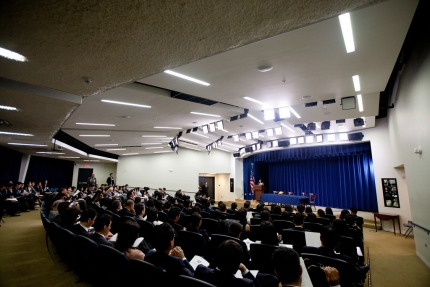
The White House Office of Public Engagement and the Council of Korean Americans host a briefing for Korean American leaders, June 7, 2012. (Photo courtesy of Taeck Jang Photography)
The briefing was kicked off by Chris Lu, Cabinet Secretary and Co-Chair of the White House Initiative on Asian Americans and Pacific Islanders (AAPIs), who welcomed the participants to the White House, and noted that it was important for the federal government to hear from Americans about how it can better serve them.
Learn more about Civil RightsHow the Department of Transportation is Helping AAPI Communities
Posted by on June 13, 2012 at 8:00 AM ESTA year ago, I wrote that the U.S. Department of Transportation (DOT) was in the midst of launching several important activities as part of its commitment to the White House Initiative on Asian Americans and Pacific Islanders. As I said then, transportation is vitally important to the growth and development of the AAPI community. And I’m happy to report that over the past 12 months, DOT has taken specific steps that will enable the community to fully and safely participate in the nation’s transportation system.
For example, the National Highway Traffic Safety Administration (NHTSA) has developed pedestrian safety resources for Chinese-, Filipino-, Vietnamese- and Korean-speaking families. These handy materials include tips for parents of elementary school children on how to prevent pedestrian accidents, along with a “Walkability Checklist” families can use to determine if their neighborhoods are pedestrian-friendly. These free resources are available for download on the NHTSA website. In addition, NHTSA is actively working to finalize and implement a dissemination plan to make sure these important safety messages reach the frontlines of the AAPI community.
Learn more about Civil RightsPartnering with the AAPI Community to Resolve Racial Conflict
Posted by on May 31, 2012 at 9:00 AM ESTThe Community Relations Service (CRS) is a component of the U.S. Department of Justice that is responsible for working with community-based organizations, state and local government officials, law enforcement, and civil rights groups to help them peacefully resolve conflicts resulting issues of race, color, and national origin. The agency also supports local efforts to prevent and respond to violent hate crimes committed on the basis of race, color, national origin, gender, gender identity, sexual orientation, religion, or disability.
In CRS’ forty-eight year history, we have mediated many emotionally charged conflicts affecting Asian American and Pacific Islander (AAPI) communities, and according to Ron Wakabayashi, a Regional Director with the agency, awareness of discrimination against Asian Americans has increased. Wakabayashi is responsible for CRS operations in Arizona, Nevada, California, Hawaii, and Guam, and was formerly the Executive Director of Japanese American Citizens League.
Saving Face Can’t Make You Safe – HIV and the AAPI Community
Posted by on May 31, 2012 at 8:00 AM EST“Saving face can’t make you safe. Talk about HIV—for me, for you, for everyone.” The slogan is reflective of how Asian Americans and Pacific Islanders need to embrace the growing concern of HIV in our communities. Judging by recent activities the efforts to educate the community about HIV is having an impact.
On May 19, Asian Americans and Pacific Islanders gathered at more than 20 community events for the 8th Annual National Asian & Pacific Islander HIV/AIDS Awareness Day. From Jacksonville, Florida to Upper Tumon, Guam to Philadelphia, Pennsylvania and Honolulu, Hawaii, AAPIs met to raise awareness about HIV and AIDS, encourage testing and and prevention efforts, and seek an end to the stigma about HIV in the community. The events featured free HIV testing and counseling, educational forums, video screenings and other activities.
- &lsaquo previous
- …
- 36
- 37
- 38
- 39
- 40
- 41
- 42
- 43
- 44
- …
- next &rsaquo

White House Blogs
- The White House Blog
- Middle Class Task Force
- Council of Economic Advisers
- Council on Environmental Quality
- Council on Women and Girls
- Office of Intergovernmental Affairs
- Office of Management and Budget
- Office of Public Engagement
- Office of Science & Tech Policy
- Office of Urban Affairs
- Open Government
- Faith and Neighborhood Partnerships
- Social Innovation and Civic Participation
- US Trade Representative
- Office National Drug Control Policy
categories
- AIDS Policy
- Alaska
- Blueprint for an America Built to Last
- Budget
- Civil Rights
- Defense
- Disabilities
- Economy
- Education
- Energy and Environment
- Equal Pay
- Ethics
- Faith Based
- Fiscal Responsibility
- Foreign Policy
- Grab Bag
- Health Care
- Homeland Security
- Immigration
- Innovation Fellows
- Inside the White House
- Middle Class Security
- Open Government
- Poverty
- Rural
- Seniors and Social Security
- Service
- Social Innovation
- State of the Union
- Taxes
- Technology
- Urban Policy
- Veterans
- Violence Prevention
- White House Internships
- Women
- Working Families
- Additional Issues