
Office of Science and Technology Policy Blog
Super Materials, Super Vision, and Space Robots: World Class Research in our Nation’s Defense Labs
Posted by on March 10, 2014 at 11:05 AM ESTToday, two premier Department of Defense (DOD) research labs, in collaboration with the Pentagon Channel, will debut a science-focused TV series called “Armed with Science,” shining a light on the importance of science and technology to national defense and the innovative work being done in DOD laboratories to help address the complex challenges facing the military. The pilot episode, airing on the Pentagon Channel today at 1:00pm and 5:00pm EST, will explore the cutting-edge research taking place at the Naval Research Laboratory and the Army Research Laboratory based in Washington, DC, and Adelphi, MD respectively.
The Nation’s defense laboratories are critical to DOD's diverse missions and to keeping our country on the leading edge of innovation. The White House Office of Science and Technology Policy (OSTP) works closely with DOD labs to develop policies and programs that can strengthen the Department’s in-house R&D capabilities and speed the development of new technologies. Adequately supporting the labs’ research budgets and infrastructure needs and helping to inspire, attract, and retain a world-class science, technology, engineering, and mathematics (STEM) workforce in this domain is essential protecting America’s national security and keeping our country on the leading edge of innovation.
At the Army Research Lab, for example, scientists are working to study and develop “super materials” that operate in extreme environments to protect soldiers against threats. These materials, which scientists and engineers are designing at the atomic scale, will help make up game-changing electronics, munitions, and armor for the military of the future.
And at the Naval Research Lab’s Space Robotics Laboratory, scientists are developing robotic technology that can help repair, reposition, or update satellites that are beyond human reach, some 20,000 miles more distant than the Hubble Space Telescope—many of which are critical for Navy and Marine Corps operations.
Learn more about TechnologyPresident Obama Greets Student Finalists of 2014 Intel Science Talent Search
Posted by on March 7, 2014 at 5:49 PM ESTPresident Obama today welcomed the 40 student finalists of the 2014 Intel Science Talent Search to the White House. These extraordinary high schoolers—representing 20 states—are in Washington, DC, to participate in the final competitive judging of their innovative research projects in computer science, microbiology, environmental science, engineering, and many other cutting-edge fields of science, technology, engineering, and math (STEM). In greeting these STEM all-stars, the President emphasized his Administration’s ongoing and unwavering commitment to get more students inspired and excelling in key STEM fields in order to cultivate the next generation of American innovators, discoverers, inventors, and makers.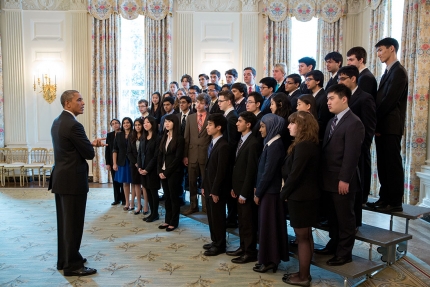
President Barack Obama talks with the 2014 Intel Science Talent Search finalists in the State Dining Room of the White House, March 7, 2014. (Official White House Photo by Chuck Kennedy)
Becky Fried is Senior Communications Advisor and Web Editor at OSTP
Learn more about EducationPresident Obama Welcomes top Science and Math Teachers to the White House
Posted by on March 6, 2014 at 1:29 PM ESTFor 101 of the Nation’s top science and math teachers, Monday was not your typical snow day. While DC-area students spent the day at home, the winners of the Presidential Awards for Excellence in Mathematics and Science Teaching (PAEMST) trekked through the slushy streets of Washington to spend time with President Obama at the White House.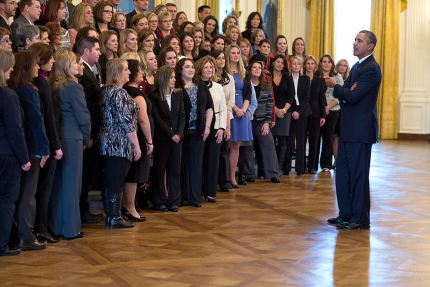
President Barack Obama meets with Presidential award for excellence in math and science teaching winners in the East Room of the White House, March 3, 2014. (Official White House Photo by Pete Souza)
These outstanding teachers came from far and wide to be recognized for their tireless work to equip America’s students with the skills they need to grow into the next generation of innovators and science, technology, engineering, and math (STEM) professionals.
This Presidential Award is the U.S. Government’s highest honor for K-12 math and science teachers. In December, President Obama announced this year’s 102 winners, who represent all 50 states, the District of Columbia, Puerto Rico, and the Department of Defense Education Activity. These phenomenal educators were selected from a pool of more than 950 applicants by a distinguished panel of leaders in STEM education at both the state and national level.
Before meeting with President Obama, the teachers kicked off a three-day visit to Washington, DC, with a conversation about the future of STEM education in America with experts from the Department of Education, and participated in several professional development workshops with leaders from the National Council of Teachers of Mathematics, the American Institute of Physics, the American Physical Society, and the National Oceanographic and Atmospheric Administration. Then, on Wednesday morning, the teachers received their award during a ceremony at the National Academies of Science.
Learn more about EducationJoin the Conversation on Big Data and Privacy
Posted by on March 6, 2014 at 11:25 AM ESTOn March 3, the White House Office of Science and Technology policy (OSTP) and Massachusetts Institute of Technology (MIT) co-hosted a thought-provoking conference about the state of the art in big-data analytics and privacy technologies. Counselor to the President John Podesta and U.S. Secretary of Commerce Penny Pritzker gave keynote addresses at the event. The conference attracted some of the top technologists working on leading-edge big data projects in a range of important areas, including healthcare, genomics, education, and transportation, as well as privacy-enhancing technologies. In case you missed it, you can find the MIT webcast here.
I am also pleased to announce the second in the series of public events that OSTP is co-hosting with academic institutions across the country. On March 17, OSTP, the Data & Society Research Institute, and New York University will host a conference to explore the social, cultural, and ethical implications of big data. You can find more information about this event on the Data & Society Research Institute website, here.
As John Podesta remarked in his keynote address at MIT, the discussion of big data should not be confined to Washington or to academia. This issue is of such great importance and involves an array of technologies already so pervasive that it demands a robust, public conversation about how we—as a Nation and as individuals—can realize the great benefits of big data while also protecting privacy and other values.
Toward that end, today, OSTP is releasing a Request for Information seeking public comment on the ways in which big data may impact privacy, the economy, and public policy. The full Request for Information can be found here. Comments are due by March 31, 2014, and can be sent to bigdata@ostp.gov. We hope you will join this important conversation.
Nicole Wong is U.S. Deputy Chief Technology Officer at the White House Office of Science & Technology Policy
Learn more about TechnologyPresidential Innovation Fellows Round 3: Serve. Create. Innovate.
Posted by on March 6, 2014 at 9:00 AM ESTToday, we are very excited to announce that applications are now being accepted for the third round of the Presidential Innovation Fellows program. This initiative pairs talented, diverse individuals from outside government with top Federal innovators to implement game-changing projects that make the Federal Government work better for the American people.
At its core, the Presidential Innovation Fellows Program is as strong as the incredible people that are willing to join this effort and serve their country. That’s why we want the best and brightest individuals—original thinkers, gifted designers, tech-savvy strategists, private-sector doers, inventors, entrepreneurs, and talented developers and engineers—to offer up their skills and expertise to create huge value for the American public.
Learn more aboutPreparing Now for Our Climate Future
Posted by on March 4, 2014 at 11:39 AM ESTOur climate is changing. We are not just seeing global increases in air and ocean temperatures, we are seeing changes across the United States: extended periods of unusual heat, a greater number of heavier downpours, more severe regional drought and wildfires in parts of the American West, permafrost thawing in Alaska, ocean acidification, and sea-level rise threatening coastal communities. At the same time, much of our Nation’s infrastructure has been designed for the climate that we have had, and not the changing climate we now are experiencing and can expect in the future.
President Obama believes we have a moral obligation to future generations to leave them a planet that is not polluted and damaged. That’s why, last year, he launched a comprehensive Climate Action Plan to reduce the carbon pollution that contributes to climate change, prepare for the impacts of a changing climate on American communities and businesses, and lead international efforts to address this global challenge.
Even as we act to reduce carbon pollution, we know some impacts of climate change are already unavoidable. The Federal Government has an obligation to support American communities by protecting critical infrastructure and natural resources, advancing science that informs planning and investments, establishing policies that promote resilience, and ensuring that Federal operations and facilities continue to protect and serve citizens in a changing climate. The President’s Climate Action Plan prioritizes this work and integrates consideration of climate impacts and risks into Federal programs so that we are making the best possible use of our taxpayer dollars.
In his Budget Request for Fiscal Year 2015 being transmitted to Congress today, President Obama is following through on those commitments and taking a wide range of steps to “up our game” in promoting preparedness for, and resilience against, the impacts of climate change. This includes robust support for State, local, and tribal preparedness efforts, analysis of vulnerabilities of critical infrastructure, creation of incentives to address those vulnerabilities, and development and dissemination of better information and planning tools.
Learn more about Energy and Environment
- &lsaquo previous
- …
- 38
- 39
- 40
- 41
- 42
- 43
- 44
- 45
- 46
- …
- next &rsaquo


White House Blogs
- The White House Blog
- Middle Class Task Force
- Council of Economic Advisers
- Council on Environmental Quality
- Council on Women and Girls
- Office of Intergovernmental Affairs
- Office of Management and Budget
- Office of Public Engagement
- Office of Science & Tech Policy
- Office of Urban Affairs
- Open Government
- Faith and Neighborhood Partnerships
- Social Innovation and Civic Participation
- US Trade Representative
- Office National Drug Control Policy
categories
- AIDS Policy
- Alaska
- Blueprint for an America Built to Last
- Budget
- Civil Rights
- Defense
- Disabilities
- Economy
- Education
- Energy and Environment
- Equal Pay
- Ethics
- Faith Based
- Fiscal Responsibility
- Foreign Policy
- Grab Bag
- Health Care
- Homeland Security
- Immigration
- Innovation Fellows
- Inside the White House
- Middle Class Security
- Open Government
- Poverty
- Rural
- Seniors and Social Security
- Service
- Social Innovation
- State of the Union
- Taxes
- Technology
- Urban Policy
- Veterans
- Violence Prevention
- White House Internships
- Women
- Working Families
- Additional Issues