
Office of Science and Technology Policy Blog
Big Data is a Big Deal
Posted by on March 29, 2012 at 8:23 AM EST[Editor's Note: Watch the live webcast today at 2pm ET of the Big Data Research and Development event at http://live.science360.gov/bigdata/]
Today, the Obama Administration is announcing the “Big Data Research and Development Initiative.” By improving our ability to extract knowledge and insights from large and complex collections of digital data, the initiative promises to help accelerate the pace of discovery in science and engineering, strengthen our national security, and transform teaching and learning.
To launch the initiative, six Federal departments and agencies will announce more than $200 million in new commitments that, together, promise to greatly improve the tools and techniques needed to access, organize, and glean discoveries from huge volumes of digital data. Learn more about ongoing Federal government programs that address the challenges of, and tap the opportunities afforded by, the big data revolution in our Big Data Fact Sheet.
Ensuring a Reliable Supply of Medical Radioisotopes
Posted by on March 27, 2012 at 4:02 PM EST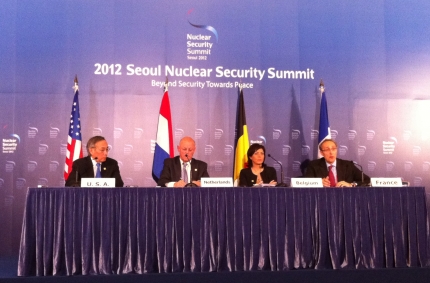
Seoul, South Korea: U.S. Secretary of Energy Steven Chu today joined Dr Bernard Bigot, head of French Alternative Energies and Atomic Energy Commission (CEA), Deputy Prime Minister of Belgium, Mrs. Joelle Milquet, and Minister of Foreign Affairs Dr. Uri Rosenthal from the Netherlands in announcing their common understanding to help minimize the use of highly enriched uranium (HEU) in the production of medical isotopes.
Every year 30 million people around the world undergo medical diagnostic procedures that use the radioactive isotope technetium-99 metastable (Tc-99m), which is the most commonly used medical radioisotope. The Tc-99m procedures include tests that can tell doctors how well the heart is functioning, whether cancer is present, and other critical medical information. Of the 30 million Tc-99m procedures conducted worldwide every year, over half are performed in the United States.
Tc-99m is derived from molybdenum-99 (Mo-99). Most of the world’s supply of Mo-99 is produced today in nuclear reactors where targets containing highly-enriched uranium (HEU) are irradiated and subsequently processed into pure Mo-99. But HEU is a very dangerous substance and is one of the materials slated to be secured under the President’s four-year lock-down agenda. These dangers were central to the work plan of the 2010 Nuclear Security Summit. Luckily, new technology is allowing Mo-99 to be produced without using HEU, andmost of the world is in the process of converting to non-HEU-based technology.
In Search of a Four-Wheel Dreamliner
Posted by on March 27, 2012 at 10:18 AM ESTLast week, in support of the President’s Materials Genome Initiative, the White House announced a new $14.2 million Department of Energy program to improve vehicle fuel efficiency by incorporating advanced materials to make cars lighter while maintaining safety and performance, a process known as “lightweighting”. Using lighter materials can dramatically reduce a vehicle’s fuel consumption. For example, a 30 percent reduction in weight can improve fuel economy by 18 - 24 percent. Investing in technologies to enhance fuel efficiency is a key part of the Obama Administration’s all-of-the-above energy strategy, which aims to reduce our dependence on foreign oil by keeping America on the leading edge of modern energy technologies.
Learn more about TechnologyU.S. Winter 2011-2012 is Fourth Warmest in Recorded History
Posted by on March 26, 2012 at 3:12 PM ESTNew data released last week by the National Oceanic and Atmospheric Administration (NOAA) showed that the 2011-2012 winter season was the fourth warmest ever recorded in the United States.
The data were published in NOAA’s National Climatic Data Center State of the Climate report, which provides regularly updated climate and weather information for regions across the United States.
The data show that this past winter was generally both warmer than average and drier than average for the lower 48 States. The average temperature across these states for December through February was 36.8 degrees F, nearly 4 degrees higher than the long-term average for U.S. winters from 1901 – 2000. Precipitation was down 12 percent on average, and when it came to snow, the United States experienced its third smallest winter snow-cover footprint—square miles of snow-cover, as measured by satellites—since recording began 46 years ago.
More than half of the United States experienced winters that ranked in their top 10 warmest winters ever recorded.
In addition to temperature and precipitation data, NOAA collects and publishes information on extreme weather events across the country. This information is communicated using NOAA’s U.S. Climate Extremes Index, an index that tracks the frequency of extreme climate indicators such as very high or low temperatures, droughts, and tropical cyclones across the United States during a given period. The Climate Extremes Index this winter ranked ninth highest among since recording began more than a century ago.
Although it’s clear that human-caused climate change has made unusually warm seasons and weather extremes more likely in many regions, it’s not possible to fully attribute any single warm period or weather event to human-caused climate change. But it’s important to recognize that such certainty of attribution is not necessary to justify taking action to minimize human contributions to climate change.
After all, it’s impossible to say with certainty that cigarette smoking was the cause of any individual smoker’s lung cancer, since a minority of cases do have other causes. But given the overwhelming evidence that tobacco use increases risks for many types of cancer—that, in fact, cigarette smoking is the No. 1 risk factor for lung cancer—it makes sense to support smoking cessation programs.
In the same way, no one can say why this past winter was as warm as it was. But scientists around the world have concluded overwhelmingly that modern climate change trends are primarily attributable to human activities. So doesn’t it make sense to kick some of our most egregious energy habits before the prognosis gets even more dire?
To read NOAA’s full State of the Climate Report, please visit: http://www.ncdc.noaa.gov/sotc/
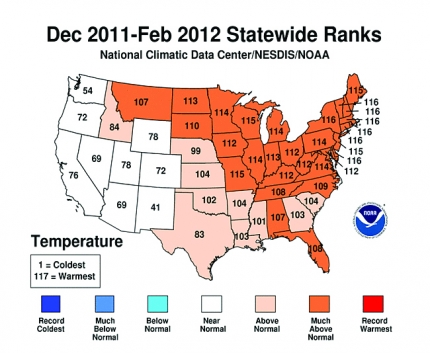
State-by-state information on winter 2011-2012 temperatures is represented above. Redder colors indicate states in which this winter was relatively warm compared to previous winters; white indicates states in which this winter was near-normal. No state had below-normal temperatures. Numbers indicate state-by-state rankings of winter 2011-2012 temperatures within the 117-year NOAA temperature dataset for each state; 117 would indicate the warmest winter on record; 1 would indicate the coldest winter on record. (Graphic courtesy NOAA)
Phil Duffy is a Senior Policy Analyst and Becky Fried is a Policy Analyst at OSTP
Learn more about Energy and EnvironmentBuilding a League of Innovative Schools
Posted by on March 19, 2012 at 11:42 AM ESTLeaders in innovative education are coming together today in Houston, TX, for the second meeting of the League of Innovative Schools.
The League, announced at a White House event in September, is an alliance of school districts committed to working with entrepreneurs and researchers to dramatically increase student achievement. The League was launched in partnership with Digital Promise, a new national center to advance breakthroughs in education with technology. Digital Promise is part of the Administration’s broader agenda to spur innovation in education and prepare our Nation’s students for the challenges of a 21st century economy.
Learn more about Education, TechnologyNavy Opens Cutting-Edge Lab for Robotics and Autonomous Systems
Posted by on March 16, 2012 at 8:33 AM EST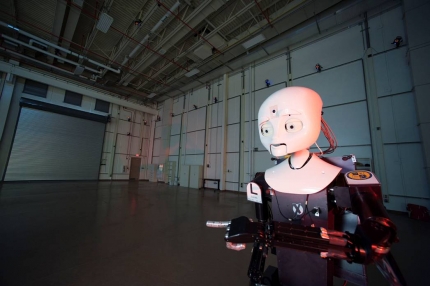
Lucas, a mobile, dextrous, and social (MDS) robot, is one of many robots working in the new LASR facility. In the Damage Control for the 21st Century research project, robots like Lucas are being used to develop future firefighting capabilities for Navy ships.
Today, at a ceremony with OSTP Director John P. Holdren, the Naval Research Laboratory opened the Laboratory for Autonomous Systems Research (LASR), a new facility located at the NRL’s main site in Washington, D.C. NRL has served the Navy and the Nation for almost 90 years, and is responsible for scientific and technological breakthroughs such as GPS, deep ocean searches, radar, and systems for the identification of “friend or foe.”
LASR will support cutting-edge research in robotics and autonomous systems of interest to the Navy, the Marine Corps, and the Department of Defense, such as unmanned underwater vehicles, autonomous firefighting robots, and sensor networks. The LASR will also advance the goals of the President’s National Robotics Initiative, a multi-agency effort to strengthen U.S. leadership in robotics and to enable human-robot teams to solve important challenges in defense, space, health, and manufacturing.
Learn more about Technology
- &lsaquo previous
- …
- 89
- 90
- 91
- 92
- 93
- 94
- 95
- 96
- 97
- …
- next &rsaquo


White House Blogs
- The White House Blog
- Middle Class Task Force
- Council of Economic Advisers
- Council on Environmental Quality
- Council on Women and Girls
- Office of Intergovernmental Affairs
- Office of Management and Budget
- Office of Public Engagement
- Office of Science & Tech Policy
- Office of Urban Affairs
- Open Government
- Faith and Neighborhood Partnerships
- Social Innovation and Civic Participation
- US Trade Representative
- Office National Drug Control Policy
categories
- AIDS Policy
- Alaska
- Blueprint for an America Built to Last
- Budget
- Civil Rights
- Defense
- Disabilities
- Economy
- Education
- Energy and Environment
- Equal Pay
- Ethics
- Faith Based
- Fiscal Responsibility
- Foreign Policy
- Grab Bag
- Health Care
- Homeland Security
- Immigration
- Innovation Fellows
- Inside the White House
- Middle Class Security
- Open Government
- Poverty
- Rural
- Seniors and Social Security
- Service
- Social Innovation
- State of the Union
- Taxes
- Technology
- Urban Policy
- Veterans
- Violence Prevention
- White House Internships
- Women
- Working Families
- Additional Issues