
U.S., China Extend Science and Technology Agreement
Today, in the ornate Secretary of War Room in the Eisenhower Executive Office Building next door to the White House, OSTP Director John P. Holdren and the Minister of Science and Technology for the People’s Republic of China, Wan Gang, took pens to paper and signed an historic extension to the U.S.-China Agreement on Cooperation in Science and Technology. The newly extended agreement will foster a continuation of decades of cooperative endeavors that have encompassed such domains as agricultural science, high-energy physics, clean energy, and biomedical research.
The symbolism of signing the accord for peaceful collaboration in a room once used to plan wars was apt, Dr. Holdren said, noting that the Science and Technology Agreement was the first bilateral accord signed by the two countries after relations were normalized in 1979. In that year, U.S. President Jimmy Carter sat down with Chinese Premier Deng Xiaoping and agreed that the realms of science and engineering provided a natural common ground upon which the two nations could build mutual trust and broader bilateral relations.
In the 32 years since that agreement was signed, an enormous amount of scientific and technological collaboration has been achieved—some of it accomplished by Dr. Holdren and Minister Wan, who as academics in the early 2000s worked together from their respective universities, Harvard and Tongji. In those days, Wan said at today’s ceremony, the two never imagined that years later they would be serving as science and technology advisors to the presidents of their two countries, and signing a formal agreement to extend decades of progress well into the 21st Century.
Some of the many shared achievements cultivated by the original Agreement can be seen here.
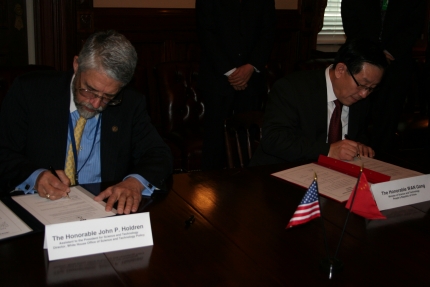
OSTP Director John P. Holdren and the Minister of Science and Technology for the People’s Republic of China Wan Gang sign an historic extension to the U.S.-China Agreement on Cooperation in Science and Technology on January 19, 2011.

OSTP Director John P. Holdren and the Minister of Science and Technology for the People’s Republic of China Wan Gang hold a photograph of U.S. President Jimmy Carter and Chinese Premier Deng Xiaoping signing the original U.S.-China Agreement on Cooperation in Science and Technology in 1979.

White House Blogs
- The White House Blog
- Middle Class Task Force
- Council of Economic Advisers
- Council on Environmental Quality
- Council on Women and Girls
- Office of Intergovernmental Affairs
- Office of Management and Budget
- Office of Public Engagement
- Office of Science & Tech Policy
- Office of Urban Affairs
- Open Government
- Faith and Neighborhood Partnerships
- Social Innovation and Civic Participation
- US Trade Representative
- Office National Drug Control Policy
categories
- AIDS Policy
- Alaska
- Blueprint for an America Built to Last
- Budget
- Civil Rights
- Defense
- Disabilities
- Economy
- Education
- Energy and Environment
- Equal Pay
- Ethics
- Faith Based
- Fiscal Responsibility
- Foreign Policy
- Grab Bag
- Health Care
- Homeland Security
- Immigration
- Innovation Fellows
- Inside the White House
- Middle Class Security
- Open Government
- Poverty
- Rural
- Seniors and Social Security
- Service
- Social Innovation
- State of the Union
- Taxes
- Technology
- Urban Policy
- Veterans
- Violence Prevention
- White House Internships
- Women
- Working Families
- Additional Issues