
Unleashing Rooftop Solar Energy through More Efficient Government
Ed. Note: Cross posted from the Energy Blog.
Across the country, the race is on to drive down the cost of solar energy. And a new challenge through the U.S. Department of Energy’s SunShot Initiative could help slash the costs even faster.
We are challenging cities and counties to compete nationwide to cut the red tape that can push up the price tags on solar energy projects.
One of the highest hurdles for would-be investors in residential and small commercial solar energy installations is navigating the differing and expensive administrative processes required to get their solar panels from the drawing board to the rooftop.
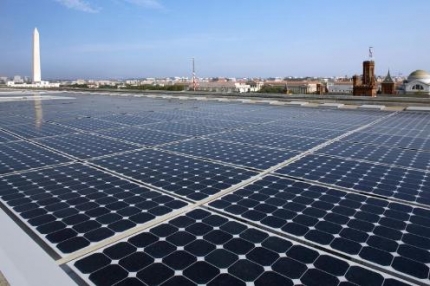
Solar panels on the roof of the Department of Energy Forrestal Building. Photo provided by the Department of Energy.
Up to 40 percent of the total cost of a solar energy system is the result of balance of system costs, which include the capital required to pay for siting, permitting, and installing a solar energy project and connecting it to the grid.
By challenging local governments to cut their upfront fees and paperwork and standardize their permitting processes, the Challenge will not only reduce the cost to homeowners and businesses of installing solar energy systems, but it will also save money and time for local governments already struggling with tight budgets.
Using the Administration’s “Race to the Top” model, the Rooftop Solar Challenge incentivizes local governments to find new ways to tackle old problems and use the best of those innovative solutions as models for other regions. To participate, cities and counties will build teams with other local governments in their state or region, as well as with other critical stakeholders such as their local utility and their state energy office, to develop a step-by-step plan for how they will meet the goals laid out in the Challenge.
The Rooftop Solar Challenge will encourage participating government teams to compete in four critical areas: standardizing permit processes, updating planning and zoning codes, improving standards for connecting to the grid and increasing access to financing. Each team must submit data, including information about their current permitting and grid interconnection processes to establish the baseline against which to measure the progress they make during the year of the Challenge.
The Rooftop Solar Challenge will make it easier for investors to capitalize on all of the benefits of solar energy technologies, support jobs for solar installers, create new opportunities for small solar companies across the country and help the U.S. remain a top competitor in this key renewable energy market.
The Rooftop Solar Challenge will be funded with $12.5 million as part of the SunShot Initiative, which aims to make solar energy cost-competitive with traditional forms of electricity by reducing the total installed cost of solar energy systems by 75 percent before decade’s end.
For more information and to follow the progress of the Initiative, visit the SunShot Initiative site.
Ramamoorthy Ramesh is the Director of the SunShot Initiative and Solar Energy Technologies Program

White House Blogs
- The White House Blog
- Middle Class Task Force
- Council of Economic Advisers
- Council on Environmental Quality
- Council on Women and Girls
- Office of Intergovernmental Affairs
- Office of Management and Budget
- Office of Public Engagement
- Office of Science & Tech Policy
- Office of Urban Affairs
- Open Government
- Faith and Neighborhood Partnerships
- Social Innovation and Civic Participation
- US Trade Representative
- Office National Drug Control Policy
categories
- AIDS Policy
- Alaska
- Blueprint for an America Built to Last
- Budget
- Civil Rights
- Defense
- Disabilities
- Economy
- Education
- Energy and Environment
- Equal Pay
- Ethics
- Faith Based
- Fiscal Responsibility
- Foreign Policy
- Grab Bag
- Health Care
- Homeland Security
- Immigration
- Innovation Fellows
- Inside the White House
- Middle Class Security
- Open Government
- Poverty
- Rural
- Seniors and Social Security
- Service
- Social Innovation
- State of the Union
- Taxes
- Technology
- Urban Policy
- Veterans
- Violence Prevention
- White House Internships
- Women
- Working Families
- Additional Issues