
Talking to Explorers Underwater
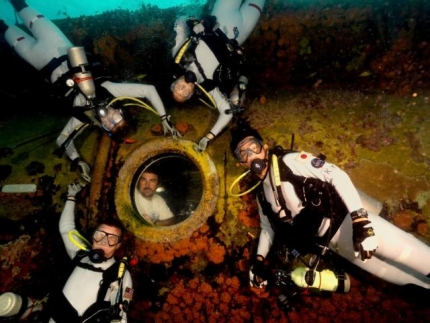
The international crew of four aquanauts has been working in its home in the National Oceanic and Atmospheric Administration's Aquarius Reef Base undersea research habitat off the coast of Key Largo, 63 feet below the surface of the Atlantic Ocean. [Photo courtesy of NASA]
Yesterday I placed a call to the explorers currently undertaking a 12-day mission beneath the waves of the Florida Keys to help us test and prove concepts for outer space missions. The 16th crew of NASA's Extreme Environment Mission Operations (NEEMO) is focusing their activities on helping us understand what a mission to an asteroid will be like.
The international crew of four aquanauts has been working in its home in the National Oceanic and Atmospheric Administration's Aquarius Reef Base undersea research habitat off the coast of Key Largo, 63 feet below the surface of the Atlantic Ocean. Aquarius provides a convincing simulation of space exploration, and NEEMO crew members experience some of the same tasks and challenges under water that they would in space.
This crew of NEEMO aquanauts has been investigating communication delays, restraint and translation techniques, and optimum crew size as they relate to a human mission to an asteroid. I was happy to speak to NEEMO 16 Commander Dottie Metcalf-Lindenburger of NASA, and European Space Agency astronaut Timothy Peake as they undertook the final "spacewalk" of the mission. The two are joined in Aquarius by Japan Aerospace Exploration Agency astronaut Kimiya Yui and Steven W. Squyres, Goldwin Smith Professor of Astronomy at Cornell University and chairman of the NASA Advisory Council. Steve was also a member of the shortened NEEMO 15 mission.
NASA's Orion spacecraft and the Space Launch System rocket, which currently are in development, will allow people to begin exploring beyond the boundaries of Earth's orbit. The first human mission to an asteroid is planned for 2025. Along with the multiple paths on which NASA is working to develop the capabilities to reach farther destinations, NEEMO is one more example of how the future of spaceflight is unfolding right now.
For more information about NEEMO, visit: http://www.nasa.gov/neemo
Charles Bolden is the Administrator of NASA

White House Blogs
- The White House Blog
- Middle Class Task Force
- Council of Economic Advisers
- Council on Environmental Quality
- Council on Women and Girls
- Office of Intergovernmental Affairs
- Office of Management and Budget
- Office of Public Engagement
- Office of Science & Tech Policy
- Office of Urban Affairs
- Open Government
- Faith and Neighborhood Partnerships
- Social Innovation and Civic Participation
- US Trade Representative
- Office National Drug Control Policy
categories
- AIDS Policy
- Alaska
- Blueprint for an America Built to Last
- Budget
- Civil Rights
- Defense
- Disabilities
- Economy
- Education
- Energy and Environment
- Equal Pay
- Ethics
- Faith Based
- Fiscal Responsibility
- Foreign Policy
- Grab Bag
- Health Care
- Homeland Security
- Immigration
- Innovation Fellows
- Inside the White House
- Middle Class Security
- Open Government
- Poverty
- Rural
- Seniors and Social Security
- Service
- Social Innovation
- State of the Union
- Taxes
- Technology
- Urban Policy
- Veterans
- Violence Prevention
- White House Internships
- Women
- Working Families
- Additional Issues