
$25M in Research Awards to Advance Administration’s Materials Genome Initiative
Last month, the National Science Foundation (NSF) and the Department of Energy (DOE) announced more than$25 million of funding for innovative materials-science research projects. The research awards are a significant milestone for the Administration’s Materials Genome Initiative (MGI)—a collaborative effort of public, private, and academic leaders to make the discovery, development, and deployment of cutting-edge materials faster and cheaper than ever before.
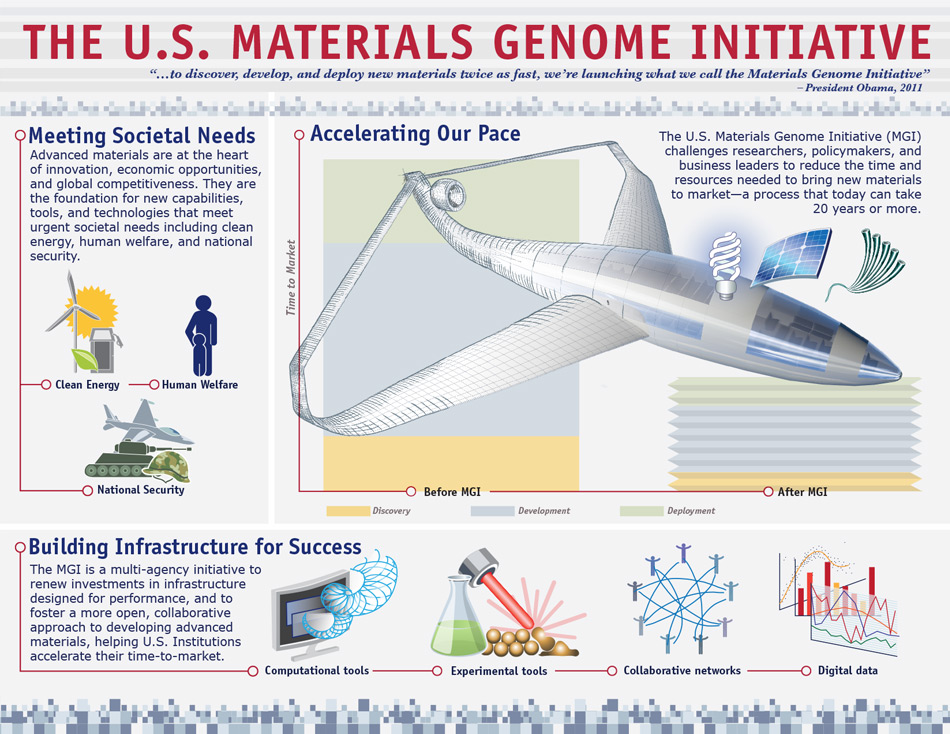
- A new software center led by Lawrence Berkeley National Laboratory and Massachusetts Institute of Technology that will use computer simulations to rapidly design novel functional electronic materials, such as photocatalysts, photovoltaics, and transparent conductors for a sustainable energy future. (DOE)
- A collaboration between University of Washington and General Motors to develop new composite materials that capture waste heat for conversion into usable electricity—a function that could help make next-generation automotive engines more energy efficient and require less fossil fuel. (NSF)
- A software center at University of Michigan that will develop a suite of software tools to predict the behavior of magnesium alloys and improve their properties for use in light-weight vehicles. (DOE)
- A new software center led by University of Minnesota that will develop computer algorithms for the design of porous materials used in carbon capture and sequestration technologies to remove carbon dioxide from power plant exhaust and reduce atmospheric pollution. (DOE)
- A collaboration between scientists from University of Pennsylvania and University of Delaware to use computer models to predict and assemble biomaterials that may enable higher-performing, lower-cost solar energy applications. (NSF)
- A project by researchers from University of Virginia and University of Alabama Tuscaloosa that will model, synthesize, and test “half-metal” materials to be incorporated into circuits for faster computer memory. (NSF)
- Support for a new collaborative research network between University of Illinois and Oak Ridge, Sandia, Argonne, and Lawrence Livermore National Laboratories to develop computer code to better predict the behavior and performance of materials such as catalysts and semiconductors. (DOE)
These grants come at the end of a busy year for MGI. Earlier in 2012, 170 stakeholders convened at the White House to discuss how the materials community could achieve the ambitious target of shrinking the time needed to discover, develop, and utilize new materials. In the six months since, we have seen over $60M in Federal grants for new infrastructure that will help advance this goal; participated in a NIST-led workshop that set the stage for new modes of materials data handling; and obtained pledges from more than 100 stakeholders in universities and industry to take the necessary measures in their own institutions to seed change in the materials community.
Stay tuned for information about how we will keep up this momentum going forward at: http://obamawhitehouse.archives.gov/mgi
Cyrus Wadia is Assistant Director for Clean Energy and Materials R&D at OSTP
Meredith Drosback is a TMS fellow at OSTP

White House Blogs
- The White House Blog
- Middle Class Task Force
- Council of Economic Advisers
- Council on Environmental Quality
- Council on Women and Girls
- Office of Intergovernmental Affairs
- Office of Management and Budget
- Office of Public Engagement
- Office of Science & Tech Policy
- Office of Urban Affairs
- Open Government
- Faith and Neighborhood Partnerships
- Social Innovation and Civic Participation
- US Trade Representative
- Office National Drug Control Policy
categories
- AIDS Policy
- Alaska
- Blueprint for an America Built to Last
- Budget
- Civil Rights
- Defense
- Disabilities
- Economy
- Education
- Energy and Environment
- Equal Pay
- Ethics
- Faith Based
- Fiscal Responsibility
- Foreign Policy
- Grab Bag
- Health Care
- Homeland Security
- Immigration
- Innovation Fellows
- Inside the White House
- Middle Class Security
- Open Government
- Poverty
- Rural
- Seniors and Social Security
- Service
- Social Innovation
- State of the Union
- Taxes
- Technology
- Urban Policy
- Veterans
- Violence Prevention
- White House Internships
- Women
- Working Families
- Additional Issues