
The White House Education Game Jam
More than 90% of America’s youth play video games. What if the power of these games to engage and entertain could be used to teach as well?
"I’m calling for investments in educational technology that will help create. . . educational software that’s as compelling as the best video game. I want you guys to be stuck on a video game that’s teaching you something other than just blowing something up."
- President Obama, 2011
In response to the President’s call to action to create compelling educational software, the White House recently hosted its first-ever education game jam, the culminating event of an education games week developed with the U.S. Department of Education. Over the weekend of September 6-7, 100 game developers plus 35 teachers, learning researchers, and students gathered together at Difference Engine, an education technology startup in Washington, D.C., to develop new, fun ways to learn.
The group, split into 23 teams and fueled by endless pizza and energy drinks, spent the next 48 hours brainstorming and building prototypes of new videogames to help teach the most difficult school subjects identified by K-12 students and teachers. For many of the developers in attendance, working on learning tools was a new experience, and the challenge of making complex topics in history, English, math, civics, and science easier to understand was a welcome opportunity for creativity and innovation.
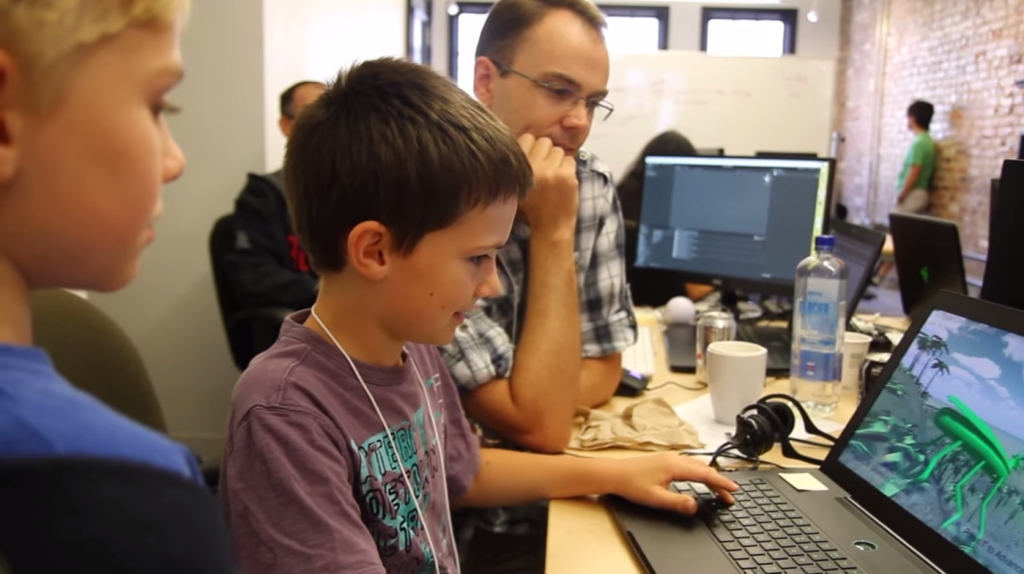
The Monday morning after the game jam, participants arrived at the White House to share their games with each other and with agency members of the Federal Games Working Group. For four hours, the participants demonstrated and discussed their education game prototypes, shared their experiences developing the games, and recommended ideas about how to work with teachers, learning researchers, and students to design even better educational games in the future.
Developers attending the event included a wide variety of artists and technologists from game companies such as Disney, Rovio, Sony, and Ubisoft, as well as from many independent game studios, education software developers, and universities. Videos of the game prototypes they produced can be found on the U.S. Department of Education’s Office of Ed Tech YouTube page, in this playlist.
Many of these new learning tools will have life beyond the game jam. Some of the game prototypes developed will be expanded into complete products, while others may be released as-is for classroom use. The game jam participants may have developed their games over just 48 hours, but the learning they facilitate will last a lifetime.
Mark DeLoura is Senior Advisor for Digital Media to the Director of Technology and Innovation.

White House Blogs
- The White House Blog
- Middle Class Task Force
- Council of Economic Advisers
- Council on Environmental Quality
- Council on Women and Girls
- Office of Intergovernmental Affairs
- Office of Management and Budget
- Office of Public Engagement
- Office of Science & Tech Policy
- Office of Urban Affairs
- Open Government
- Faith and Neighborhood Partnerships
- Social Innovation and Civic Participation
- US Trade Representative
- Office National Drug Control Policy
categories
- AIDS Policy
- Alaska
- Blueprint for an America Built to Last
- Budget
- Civil Rights
- Defense
- Disabilities
- Economy
- Education
- Energy and Environment
- Equal Pay
- Ethics
- Faith Based
- Fiscal Responsibility
- Foreign Policy
- Grab Bag
- Health Care
- Homeland Security
- Immigration
- Innovation Fellows
- Inside the White House
- Middle Class Security
- Open Government
- Poverty
- Rural
- Seniors and Social Security
- Service
- Social Innovation
- State of the Union
- Taxes
- Technology
- Urban Policy
- Veterans
- Violence Prevention
- White House Internships
- Women
- Working Families
- Additional Issues