
Making Makers in Cleveland
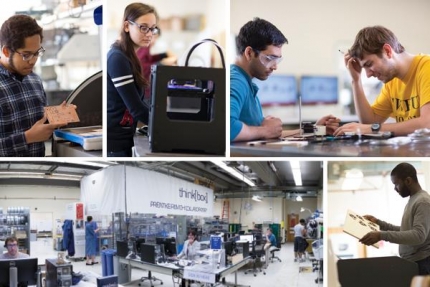
(Photo by Case Western Reserve University’s think[box])
Recently I spoke with Ian Charnas, who is the manager of Case Western Reserve University’s think[box]. Case Western is one of the universities that signed the letter, and think[box] is a makerspace and innovation center designed to provide students, staff, faculty and members of the public with the tools they need to create, build and invent.
What resources do students and other users of think[box] currently have access to?
In our current 4,500 sq. ft. space, users have access to 3D printers, laser cutters, 3D scanners, and the technology needed to print circuit boards. We also have the equipment necessary for professional quality photography, computerized embroidery and vinyl cutting as well as a full metal and wood shop. If you need to brainstorm or meet with others, there’s also plenty of space for collaboration.
Tink[box] is freely available not only for faculty and students, but members of the public as well. The students who manage and staff the space have the skills and knowledge to help individuals with a variety of projects and come from diverse majors and backgrounds. For example, more than half of our student workers are women.
I understand a larger version of think[box] is currently under construction. When will that be completed and what will be different about that facility?
Our goal with think[box] is to build one of the world’s largest university-based innovation centers. We’re currently renovating a seven-story, 50,000 sq. ft. facility and the grand opening for the first phase will be in August 2015. We’ll have expanded prototyping and fabrication areas, in addition to office space for projects that might become businesses. Entrepreneurs will be able to get help with writing business plans, filing patents, and identifying potential investors and customers. More than 75% of CWRU students are from outside the state of Ohio. Our hope is that our graduates will start and grow businesses in Ohio, and provide a “brain gain” for the region.
What are a few examples of projects that students have completed in the existing space?
Our students have developed a child-sized car for a 7-year-old girl with cerebral palsy, built robots for a NASA Robotic Mining Competition, and designed training simulators for nursing students. There are student startups focused on rockets for space exploration and the design for more efficient engines for commercial aircraft. Other students are developing rapid, inexpensive diagnostics for malaria, and a novel aerodynamic bicycle wheel.
What advice would you have for other campuses that are considering launching a similar initiative?
Make it open. Welcome students from every department and from every walk of life. Open this to your faculty, your staff, and to the public. In the spirit of sharing, our playbook page has a variety of resources with tips on how to get started. In addition, all of the tutorials and documentation we developed are freely available and designed to help other colleges and universities create their own makerspaces.
Tom Kalil is OSTP’s Deputy Director for Technology and Innovation.
White House Blogs
- The White House Blog
- Middle Class Task Force
- Council of Economic Advisers
- Council on Environmental Quality
- Council on Women and Girls
- Office of Intergovernmental Affairs
- Office of Management and Budget
- Office of Public Engagement
- Office of Science & Tech Policy
- Office of Urban Affairs
- Open Government
- Faith and Neighborhood Partnerships
- Social Innovation and Civic Participation
- US Trade Representative
- Office National Drug Control Policy
categories
- AIDS Policy
- Alaska
- Blueprint for an America Built to Last
- Budget
- Civil Rights
- Defense
- Disabilities
- Economy
- Education
- Energy and Environment
- Equal Pay
- Ethics
- Faith Based
- Fiscal Responsibility
- Foreign Policy
- Grab Bag
- Health Care
- Homeland Security
- Immigration
- Innovation Fellows
- Inside the White House
- Middle Class Security
- Open Government
- Poverty
- Rural
- Seniors and Social Security
- Service
- Social Innovation
- State of the Union
- Taxes
- Technology
- Urban Policy
- Veterans
- Violence Prevention
- White House Internships
- Women
- Working Families
- Additional Issues