Energy and Environment Latest News
President Obama Meets with Congressional Leaders on the BP Spill and the Months Ahead
Posted by on June 10, 2010 at 1:42 PM ESTThis morning the President hosted Congressional leaders from both parties to talk through the months ahead and make sure they are as productive as possible. As the President made clear in remarks afterwards, the top priorities have to be the BP oil spill and putting people back to work:
Obviously the top of our list was our continued response to the crisis in the Gulf and what’s happening with the oil spill. We gave them an update on all the measures that are being taken, the single largest national response in United States history to an environmental disaster. But we had a frank conversation about the fact that the laws that have been in place have not been adequate for a crisis of this magnitude. The Oil Pollution Act was passed at a time when people didn’t envision drilling four miles under the sea for oil.
And so it’s going to be important that, based on facts, based on experts, based on a thorough examination of what went wrong here and where things have gone right, but also where things have gone wrong, that we update the laws to make sure that the people in the Gulf, the fishermen, the hotel owners, families who are dependent for their livelihoods in the Gulf, that they are all made whole and that we are in a much better position to respond to any such crisis in the future.
So that was a prominent part of the discussion, and I was pleased to see bipartisan agreement that we have to deal with that in an aggressive, forward-leaning way.
Even as we deal with that crisis, we’ve still got an economy that’s on the mend, but there are a lot of people out there who are still out of work. There are a lot of families who are still struggling to pay the bills. And so a major part of our discussion was how could we continue to build on the progress that’s been made in the economy and, in particular, how can we make sure that that has an impact on job growth and the day-to-day improvements that people are seeing in their own lives.
The President talked about the urgency of passing extensions for unemployment insurance and other measures to help families stay above water while they’re looking for work, which will in turn make sure the recovery continues with some stability. He also expressed confidence that a strong package to help small businesses grow and hire is coming together.
Also on the agenda is finishing financial reform, a supplemental to fund our troops, and continued work on ways to reduce the deficit, an area the President was particularly hopeful of finding bipartisan solutions on.

President Barack Obama meets with bipartisan members of Congress, including, from left, House Majority Leader Steny Hoyer, D-Md., House Minority Leader John Boehner, R-Ohio, and Speaker Nancy Pelosi, D-Calif., in the Cabinet Room of the White House to discuss the upcoming work period, the economy and the BP Deepwater Horizon oil spill, June 10, 2010. (Official White House Photo by Pete Souza)
The President closed speaking passionately about the need for a new energy policy for the long term to begin now:
In that same category of thinking about the next generation, I want to close by just talking about my personal belief that we have to move on an energy agenda that is forward-looking, that creates jobs, that assures that we are leaders in solar and wind and biodiesel, but recognizes that we are going to be reliant on fossil fuels for many years to come, that we are going to still be using oil and we’re still going to be using other fossil fuels, but that we have to start planning now and putting the infrastructure in place now, putting the research and development in place now so that we end up being leaders in our energy future.
I’m actually going to have a group of CEOs this afternoon who’ve come in from a wide range of different industries -- people from Bill Gates of Microsoft to the former chairman of DuPont who have come up with a series of recommendations about how we need to move much more aggressively on the energy agenda.
And although obviously our immediate task is to deal with a crisis that is affecting millions of people down in the Gulf, we can’t keep our eye off the importance of having an energy policy that meets the needs of the next generation and ensures that the United States is the leader when it comes to energy policy. We are not yet that leader, and that’s what I want us to do.

President Barack Obama meets with, from left, House Majority Leader Steny Hoyer, D-Md., House Minority Leader John Boehner, R-Ohio, Speaker Nancy Pelosi, D-Calif., Senate Majority Leader Harry Reid, D-Nev., and Senate Minority Leader Senator Mitch McConnell, R-Ky., in the Cabinet Room of the White House to discuss the upcoming work period, the economy and the BP Deepwater Horizon oil spill. June 10, 2010. (Official White House Photo by Pete Souza)
Open for Questions: BP Oil Spill Tomorrow at 12:30 PM EDT
Posted by on June 10, 2010 at 11:13 AM ESTThe BP Deepwater Horizon oil spill in the Gulf of Mexico is a massive and potentially unprecedented environmental disaster – and its economic and ecological implications could be devastating. I know many of you have questions about how the government is responding to this crisis.
President Obama has asked me to spend some time answering your questions directly, so tomorrow at 12:30 PM EDT, I will be hosting a live chat. You can watch the chat live on WhiteHouse.gov/live, and you can submit your questions in advance via Facebook, Twitter or our webform.
From day one our focus has been capping the leak, containing and cleaning up the oil that has spilled, and restoring the lives and livelihoods of the people in the Gulf Coast region. You can track our response efforts and find additional information and resources on the on the ongoing government-wide response here.
Carol Browner is Assistant to the President for Energy and Climate Change.
Learn more about Deepwater BP Oil Spill, Energy and EnvironmentRating Home Energy Performance
Posted by on June 9, 2010 at 8:15 PM ESTHome energy retrofits are good investments that save families money, but consumers often do not have the straightforward information they need to decide whether to retrofit their homes and which investments make the most sense. However, exciting and important work is underway at the Department of Energy (DOE) to give consumers access to additional information about their home’s energy use and associated cost. This week, the Department issued a Request for Information from the public to help inform its work on developing a National Energy Rating Program for existing homes. This Rating Program will offer easy-to-understand and reliable information about the energy performance of an existing home that will help consumers to identify cost-effective energy efficiency improvements.
The Recovery Through Retrofit report to the Vice President in October, 2009 recommended the development of a consistent way of measuring a home’s energy performance and a clear method for conveying information to consumers. The report noted that providing clear, consistent information is critical to building the foundation for a self-sustaining home energy retrofit market that will save consumers money, reduce greenhouse gas emissions, and create high-quality, clean energy jobs.Since October, a team of Federal Agencies and Departments, led by DOE, has been working hard to refine methods for measuring energy performance and ways to communicate this information effectively to consumers. This Request for Information lays out the guiding principles that DOE will use to develop each part of the Rating Program. It outlines the pros and cons of different options for providing information to consumers and the initial strategy that DOE is considering.
If you would like to help figure out what type of National Energy Rating Program for existing homes is right for America, please submit comments to DOE by any of the following methods:
- Federal eRulemaking Portal: http://www.regulations.gov. Follow the instructions for submitting comments.
- E-mail: buildingratingRFI@EE.DOE.GOV. Include “RFI: National Energy Rating Program for Homes” in the subject line of the message.
- Mail: U.S. Department of Energy, Office of Energy Efficiency and Renewable Energy (EE-1), 1000 Independence Avenue, SW , Washington, DC 20585. Attn: National Energy Rating Program for Homes, Jessica Balsam
Comments must be received by no later than July 10, 2010.
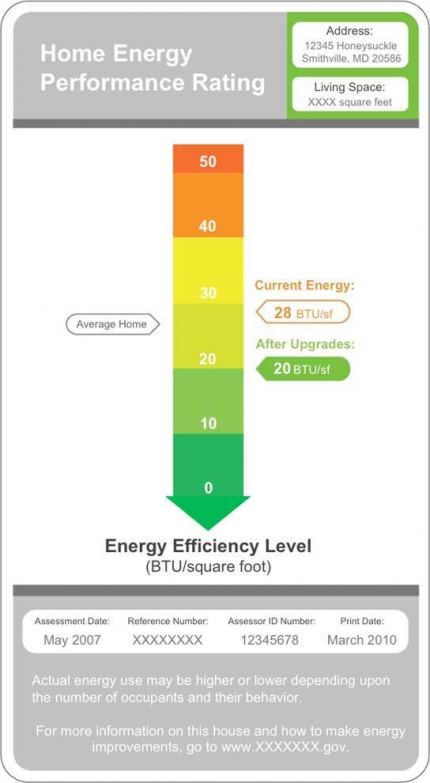
Proposed Home Energy Performance Rating label
Nancy Sutley is the Chair of the White House Council on Environmental Quality
Learn more about Energy and EnvironmentThe President Meets with His Cabinet on BP Spill: "This Will Be Contained"
Posted by on June 7, 2010 at 6:54 PM ESTThis morning the President met with Members of Cabinet to discuss the administration’s ongoing response to the BP Deepwater Horizon oil spill and receive a briefing from National Incident Commander Admiral Thad Allen. He spoke to the press afterwards and reiterated his commitment to protecting small business owners and workers in the Gulf Coast region:
Now, there are a number of other issues that were raised during this meeting that I just want to touch on. Number one, when I was down in the Gulf on Friday, meeting with fishermen and small business owners, what is clear is that the economic impact of this disaster is going to be substantial and it is going to be ongoing. And as I said on Friday -- and I want to repeat -- I do not want to see BP nickel-and-diming these businesses that are having a very tough time.
Now, we’ve got the SBA in there helping to provide bridge loans, and we’ve got the Department of Commerce helping businesses to prepare and document the damages that they’re experiencing. But what we also need is BP being quick and responsive to the needs of these local communities. We have individuals who have been assigned specifically to ride herd on BP, to make sure that that’s happening. We want the people who are in charge of BP’s claims process to be meeting with us on a regular basis. But we are going to insist that that money flows quickly, in a timely basis, so that you don’t have a shrimp processor or a fisherman who’s going out of business before BP finally makes up its mind as to whether or not it’s going to pay out.
And that’s going to be one of our top priorities, because we know that no matter how successful we are over the next few weeks in some of the containment efforts, the damages are still going to be there.
At the conclusion of his remarks, the President stated that that he is confident that the Gulf Coast ecosystems and people affected by the crisis will make a full recovery:
Let me just make one final point, and I think this was something that was emphasized by everybody here, and it’s something that I want to say to the American people. This will be contained. It may take some time, and it’s going to take a whole lot of effort. There is going to be damage done to the Gulf Coast and there is going to be economic damages that we’ve got to make sure BP is responsible for and compensates people for.
But the one thing I’m absolutely confident about is that as we have before, we will get through this crisis. And one of the things that I want to make sure we understand is that not only are we going to control the damages to the Gulf Coast, but we want to actually use this as an opportunity to reexamine and work with states and local communities to restore the coast in ways that actually enhance the livelihoods and the quality of life for people in that area.
It’s going to take some time. It’s not going to be easy. But this is a resilient ecosystem. These are resilient people down on the Gulf Coast. I had a chance to talk to them, and they’ve gone through all kinds of stuff over the last 50, 100 years. And they bounce back, and they’re going to bounce back this time. And they’re going to need help from the entire country. They’re going to need constant vigilant attention from this administration. That’s what they’re going to get.

President Barack Obama meets with members of his Cabinet to discuss the ongoing response to the BP Deepwater Horizon oil spill in the Gulf of Mexico, June 7, 2010, in the Cabinet Room of the White House. From left, Interior Secretary Ken Salazar, Assistant to the President for Energy and Climate Change Carol Browner, the President, National Incident Commander Admiral Thad Allen, Homeland Security Secretary Janet Napolitano and Energy Secretary Steven Chu. (Official White House Photo by Pete Souza)
Learn more about Deepwater BP Oil Spill, Energy and EnvironmentWeekly Address: Speaking from Louisiana on the Oil Spill
Posted by on June 5, 2010 at 5:00 AM ESTSpeaking from Grand Isle, Louisiana, the President discusses the hardships local residents and small business owners are facing as a result of the BP oil spill. He pledges to make sure those responsible do not shortchange them.
Learn more about Deepwater BP Oil Spill, Energy and EnvironmentOn the Ground in Louisiana
Posted by on June 4, 2010 at 6:34 PM ESTEd. Note: The live chat with Assistant to the President for Energy and Climate Change Carol Browner origninally scheduled for June 7 has been rescheduled for Friday at 12:30PM EDT, we hope you'll join us.
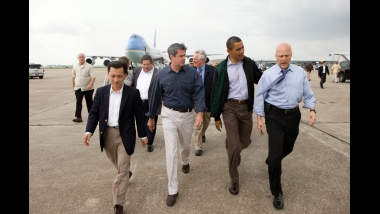
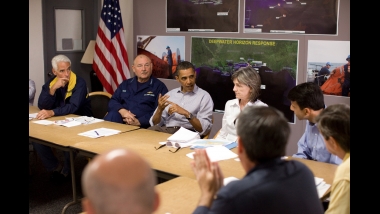
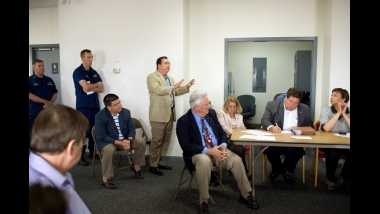
Today, President Obama travelled to Louisiana to meet with National Incident Commander Admiral Thad Allen, Governors of Louisiana, Alabama, and Florida, members of Congress and local officials to discuss efforts to stop the leak, contain and clean up the oil, and restore the Gulf Coast.
The President began his remarks with an update about the most recent attempts to cap the well:
I know that a lot of the press may be curious about what’s happening in terms of the attempts to cap the well. I don't want to go into the technical details here. I'd prefer Thad to give an update when he has had a chance to talk directly with command and control about what’s happening there. But it does appear that the cap, at least for now, is holding; that some hydrocarbons are being sent up to the surface; and that they are still ratcheting up the amount of oil and gas that's being extracted -- they’re doing it carefully so that they don't dislodge or disrupt the cap in some fashion.
We will know more over the next 24 to 48 hours. And it is way too early to be optimistic. But we're just going to keep on monitoring it, and Thad will give you a more thorough briefing when he knows more.
We spent a lot of time here just talking about the logistics of the response on the shore as oil begins to come in. And everybody here has particular concerns because we've got limited resources. We're trying to get more boom, for example, into the places that are needed. We deployed initially a lot of boom here in Louisiana. That meant that some in Alabama wasn’t where it was supposed to be. Governor Riley has been appropriately concerned -- that's a mild way of putting it -- about what’s being done with respect to Alabama plans. And what I told him was, is that Thad Allen will be meeting with him individually with respect to the Alabama plan and if he’s not satisfied with the answers that are given over the course of this weekend, then he’s going to call me and we're going to meet and sort this out.
Here in Louisiana, where the oil has hit most rapidly, there are still areas where, for example, the mayor, here, was talking to fishermen; they want to try to build up some barriers to estuaries and areas that are particularly vulnerable. Thad Allen is going to be following up with each of the parish presidents in terms of figuring out what’s going on.
playPresident Obama Makes His Third Visit to the Gulf Coast
President Barack Obama travels to Louisiana to further assess the latest efforts to counter the BP oil spill.
1 of 10The President also emphasized the importance of ensuring quick and fair processing of all financial damage claims by residents and businesses in the Gulf Coast region:
We also talked about claims. And this is an area where I think everybody has a lot of concern. My understanding is, is that BP has contracted for $50 million worth of TV advertising to manage their image during the course of this disaster. In addition, there are reports that BP will be paying $10.5 billion -- that's billion with a B -- in dividend payments this quarter.
Now, I don't have a problem with BP fulfilling its legal obligations. But I want BP to be very clear, they’ve got moral and legal obligations here in the Gulf for the damage that has been done. And what I don't want to hear is, when they’re spending that kind of money on their shareholders and spending that kind of money on TV advertising, that they’re nickel-and-diming fishermen or small businesses here in the Gulf who are having a hard time.
We’ve assigned federal folks to look over BP’s shoulder and to work with state and local officials to make sure that claims are being processed quickly, fairly, and that BP is not lawyering up, essentially, when it comes to these claims.
They say they want to make it right. That’s part of their advertising campaign. Well, we want them to make it right. And what that means is that if a fisherman got a $5,000 check, and the next time he goes in, because it’s a new month, suddenly BP is saying, well, we need some documentation and this may take six months to process, or 60 days to process -- or 30 days to process, for that matter -- that fisherman, with all his money tied up in that boat, just may not be able to hang on for another 30 days. He may lose his boat and his livelihood.
So the key point I’m making here is, this has been a disaster for this region and people are understandably frightened and concerned about what the next few months and the new few years may hold. I am absolutely confident about the resilience of this area long term, but if we can make sure that BP is doing the right thing on the front end, it’s going to make it an awful lot easier for us to fully recover on the back end. And by the way, it may end up being cheaper for BP.
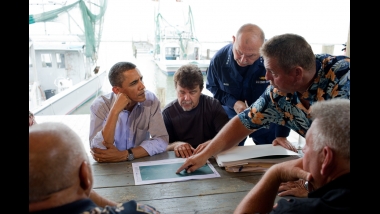
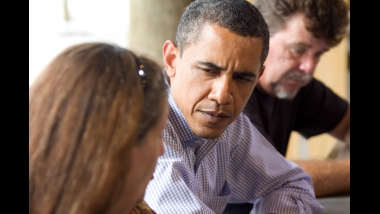
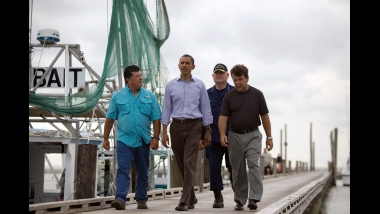
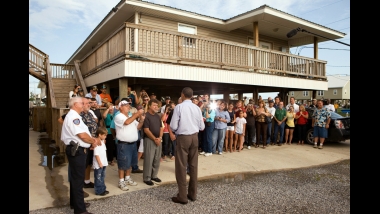
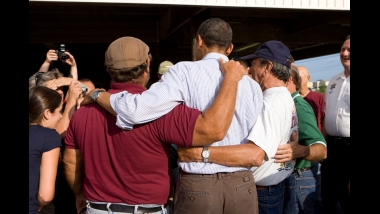
After his meeting with Admiral Allen and other state and local officials the President travelled by motorcade to Grande Isle, Louisiana to meet with families and small business owners affected by the oil spill.
Learn more about Deepwater BP Oil Spill, Energy and Environment


Related Videos
-
 May 09, 2014 8:21 AM
Inside the White House: Solar Panels
-
 September 01, 2016 8:25 PM
President Obama Delivers a Statement to the Press
White House Blogs
- The White House Blog
- Middle Class Task Force
- Council of Economic Advisers
- Council on Environmental Quality
- Council on Women and Girls
- Office of Intergovernmental Affairs
- Office of Management and Budget
- Office of Public Engagement
- Office of Science & Tech Policy
- Office of Urban Affairs
- Open Government
- Faith and Neighborhood Partnerships
- Social Innovation and Civic Participation
- US Trade Representative
- Office National Drug Control Policy