Energy and Environment Latest News
President Obama Delivers on American High-Speed Rail
Posted by on January 28, 2010 at 6:02 PM ESTCross-posted from the DOT's Fast Lane blog.
I have looked forward to this day for a long time.
It is a great honor--a great honor--to have President Obama and Vice President Biden in Tampa, Florida, to announce our American Recovery and Reinvestment Act High-Speed and Inter-city Passenger Rail grants.
The investments we announce today make rail a viable transportation alternative in many regions. With this historic $8 billion investment by President Obama, we are jump-starting American High-Speed rail.
The bulk of today's awards go to new, large-scale high-speed rail programs--projects such as Florida, with $1.25 billion to develop a high-speed rail corridor between Tampa and Orlando with trains running up to 168 miles per hour--and California, with $2.25 billion to connect Los Angeles to San Francisco and points in between with trains running up to 220 miles per hour.
In total, 31 states and the District of Columbia will receive awards. In addition to 13 corridor investments, we are also awarding several grants for improvement projects and planning. These efforts on existing routes and emerging corridors will lay the groundwork for future high-speed and intercity rail development.
I've said it before, and I believe it even more today: this is an absolute game-changer for American transportation.
We will make passenger rail more efficient, providing better service in travel markets across the country.
- High-speed rail travel offers competitive door-to-door trip times
- It reduces congestion on key routes between cities
- It reduces transportation emissions
- And, most of all, it creates the jobs of the future, the jobs America needs right now
Learn more about Economy, Energy and EnvironmentGSA: Year One
Posted by on January 28, 2010 at 3:00 PM ESTEd. Note: You can watch video of each Cabinet member describing what his or her department or agency has accomplished this year and what to expect in the year ahead at our The President's Cabinet Reporting to You page.
In his first year in office, President Obama crafted an ambitious agenda that called on all Federal agencies to change the way government works and provide an unprecedented amount of support to the American people. The U.S. General Services Administration (GSA) took this call to action as an opportunity to provide leadership in areas such as sustainable building design, online citizen engagement, and green IT alternatives.
As the business arm of the government, GSA is responsible for laying the foundation on which other Federal agencies can build. For example, just this week GSA’s Office of Citizen Services made available an online public dialog tool for government agencies to use in order to engage community members and meet President Obama’s Open Government Directive.
Moving forward, GSA will continue to support the Federal agenda with innovative business solutions, quality acquisition services, superior workplaces and effective government-wide policies.
Stephen Leeds is the Acting Administrator of the General Services Administration (GSA)
Learn more about Energy and Environment, Fiscal ResponsibilityPutting Washington at the Service of the Middle Class
Posted by on January 27, 2010 at 10:23 PM ESTEd. note: Also watch shorter video clips from the speech, broken down by topic.
In his State of the Union Address tonight, the President laid out an agenda attempting to attack one problem from every conceivable angle: the terrible squeeze felt by America’s middle class. Fundamentally, that means prying government away from special interests and dedicating it to measures that put Americans to work and lay the foundation for a stronger economy for our country – lowering health care and tuition costs, spurring creation of the next generation of clean energy jobs. It also means putting a cop on the beat on Wall Street, so major banks can no longer take advantage of families and taxpayers.
To do all that, though, we need to change the way Washington works. Already the President has taken unprecedented steps in this direction, from releasing the names of all visitors to the White House for the first time ever to clamping down on the revolving door between government and lobbying. But as much progress was made on this front in this first year, it was still only the first year, and the President will keep pushing forward, whether that’s shining sunlight on any contact between lobbyists and the White House, or pushing Congress to disclose all earmark requests in one place for Americans to see.
This was the vision that shaped the President's address, but this is not just a matter of rhetoric. The President made clear that there is tremendously busy agenda ahead for his second year – the policies and proposals below are just examples of the plans the President laid out in his address to put government to work for the middle class.
Here are a few initiatives you might have missed in the course of the speech:
- The President called on the Senate to pass a financial reform package. “A strong, healthy financial market makes it possible for businesses to access credit and create new jobs. It channels the savings of families into investments that raise incomes. But that can only happen if we guard against the same recklessness that nearly brought down our entire economy.” Essential reforms include measures to protect consumers and investors from financial abuse; close loopholes, raise standards, and create accountability for supervision of major financial firms; restrict the size and scope of financial institutions to reign in excesses and protect taxpayers and address the ‘too big to fail’ problem; and establish comprehensive supervision of financial markets.
- A vision for a clean energy economy. “…to create more of these clean energy jobs, we need more production, more efficiency, and more incentives.” We will build on the historic $80 billion investment made through the Recovery Act. The President’s vision includes investments in important technologies to diversity our energy sources and reduce our dependence on foreign oil, including: the renewal of our nation’s nuclear energy industry after a 30-year hiatus, cutting edge biofuel and clean coal technologies, and additional offshore oil and gas drilling. To fully transition to a clean energy economy and create millions of new American jobs, we must pass comprehensive energy and climate legislation to promote energy independence and address climate change.
- The President will continue his push to invest in the skills and education of our people. “This year, we have broken through the stalemate between left and right by launching a national competition to improve our schools. And the idea here is simple: instead of rewarding failure, we only reward success... In this country, the success of our children cannot depend more on where they live than on their potential.” The Obama Administration supports a new vision for increasing student achievement, delivering opportunity, and supporting excellence in America’s public schools. The President’s 2011 budget supports a new framework for the Elementary and Secondary Education Act that will foster innovation, reward excellence, and promote reform in our schools, as well as invests an additional $1.35 billion to continue the historic Race to the Top program to open it up to districts in order to spur innovation and additional progress. At the same time, the Administration is moving to consolidate ineffective policies and practices. The President’s Budget eliminates six programs and consolidates 38 others into 11 new programs that emphasize using competition to allocate funds, giving communities more choices around activities, and using rigorous evidence to fund what works.
- The President is committed to making college affordable for all Americans. “(I)n this economy, a high school diploma no longer guarantees a good job.” To increase college access and completion, the Administration will make student loans more affordable by limiting a borrower’s payments to 10 percent of his/her income and forgives remaining debt after 20 years – 10 years for public service works. We will also make permanent the American Opportunity Tax Credit. The President urges the Senate to pass the American Graduation Initiative, which invests more than $10 billion over the next decade in reforming our nation’s community colleges, promoting college completion, and moving toward the President’s goal of having the highest proportion of college graduates in the world by 2020. The President is also asking colleges and universities to do their share to make college affordable for all Americans cutting their own costs.
- The President is making investments to ensure that the middle class benefits from this economic recovery. “(T)he price of college tuition is just one of the burdens facing the middle class. That's why last year I asked Vice President Biden to chair a task force on middle-class families.” The President has outlined immediate steps to reduce the strain on family budgets and help middle class families manage their child and elder care responsibilities, save for retirement and pay for college. He will double the child tax credit this year, make it easier to save for retirement with automatic IRAs for workers without access to existing retirement plans, provide larger tax credits to match retirement savings for millions of additional workers, and provide new safeguards to protect retirement savings.
- Changing the way we do business. “To close that credibility gap we have to take action on both ends of Pennsylvania Avenue to end the outsized influence of lobbyists; to do our work openly; to give our people the government they deserve.” The President has called for additional new lobbyist reforms, including enhanced disclosure of lobbyist contacts, strict campaign contribution limits by lobbyists, and a single earmark database, so American taxpayers find out what earmarks are being requested, and where their money is going.
- Countering Citizens United. “I don't think American elections should be bankrolled by America's most powerful interests, or worse, by foreign entities.” Last week’s Supreme Court Citizen’s United decision opens the floodgates to special interests and foreign countries and companies bankrolling national campaigns. The President called for bipartisan support for legislation that will remedy the Supreme Court’s unprecedented and troubling decision.
- The President stands by military families. “Tonight, all of our men and women in uniform...have to know that they have our respect, our gratitude, our full support.” The President’s 2011 budget announces significant new investments, totaling more than $8 billion, and protections for our nation’s military families, including increased military pay and housing allowances, increased funding for family support programs, expanded availability of affordable, high-quality child care, the renovation or replacement of schools, and expanded and improved care for wounded, ill and injured service members.
- The President is establishing a National Equal Pay Enforcement Task Force. “We're going to crack down on violations of equal pay laws -– so that women get equal pay for an equal day's work.” To make sure we uphold our nation’s core commitment to equality of opportunity, the Obama Administration is implementing an Equal Pay initiative to improve compliance, public education, and enforcement of equal pay laws. The Task Force will ensure that the agencies with responsibility for equal pay enforcement are coordinating efforts and limiting potential gaps in enforcement. The Administration also continues to support the Paycheck Fairness Act, and is increasing funding for the agencies enforcing equal pay laws and other key civil rights statutes.
- Immigration reform. “And we should continue the work of fixing our broken immigration system - to secure our borders and enforce our laws, and ensure that everyone who plays by the rules can contribute to our economy and enrich our nation.” The President is pleased Congress is taking steps forward on immigration reform that includes effective border security measures with a path for legalization for those who are willing to pay taxes and abide by the law. He is committed to confronting this problem in practical, effective ways, using the current tools at our disposal while we work with Congress to enact comprehensive reform.
playState of the Union
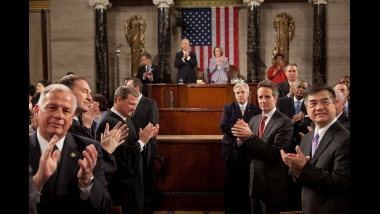
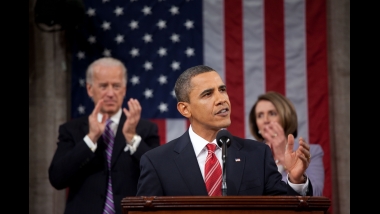
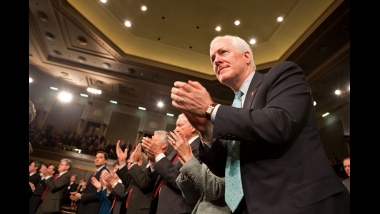
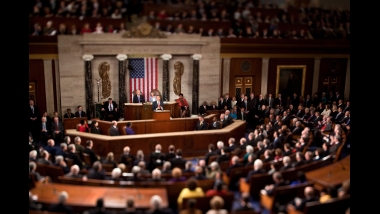
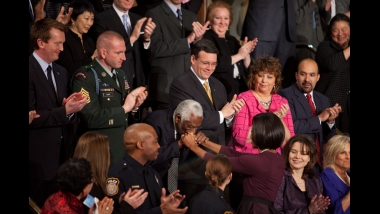
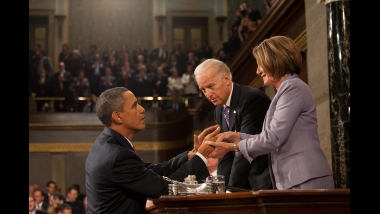
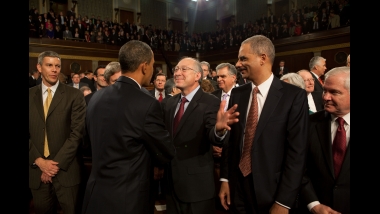
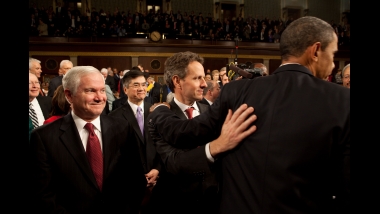
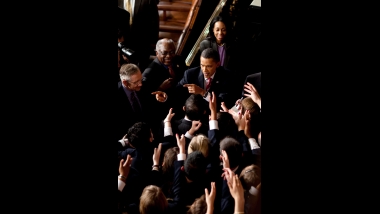
President Barack Obama delivers his first State of the Union address.
1 of 11And here are still more initiatives the President spoke to just tonight:
- The President will fight to recover the money American taxpayers spent to bailout the banks. “To recover the rest, I've proposed a fee on the biggest banks. Now, I know Wall Street isn't keen on this idea. But if these firms can afford to hand out big bonuses again, they can afford a modest fee to pay back the taxpayers who rescued them in their time of need.” The President has proposed the Financial Crisis Responsibility Fee, which will require the largest and most highly leveraged Wall Street firms to pay back taxpayers and provide a deterrent against excessive leverage for the largest firms. The conservative estimate for the cost of TARP in the budget is $117 billion, but the Treasury Department expects it to be much less and the fee will be in place for a minimum of ten years or however long it takes to recoup every last penny to the American taxpayer.
- The President recognizes that Small Businesses will be key to our nation’s economic recovery. “I'm proposing that we take $30 billion of the money Wall Street banks have repaid and use it to help community banks give small businesses the credit they need to stay afloat. I'm also proposing a new small business tax credit – one that will go to over one million small businesses who hire new workers or raise wages.” To get small businesses growing again, and growing our economy, the President has proposed a range of provisions that include tax incentives to spur investment; expanded access to capital and growth opportunities to create jobs; and increased support for entrepreneurship to foster innovation. He is proposing an employment tax credit for small businesses to encourage hiring, eliminating capital gains taxes on small business investments, extending enhanced small business expensing, and transferring $30 billion in resources from TARP to a new program to help community and smaller banks give small businesses the credit they need. The President and members of his Administration will announce additional details in the coming weeks.
- The President reiterates his support for continued investment in our nation’s infrastructure. “Tomorrow, I'll visit Tampa, Florida, where workers will soon break ground on a new high-speed railroad funded by the Recovery Act. There are projects like that all across this country that will create jobs and help move our nation's goods, services, and information.” Through the Recovery Act, we made the largest investment in our nation’s infrastructure since President Eisenhower called for the creation of our national highway system over half a century ago. In his speech, the President announced funding to make a down-payment on a new nationwide high-speed rail system being built in-part with ARRA dollars.
- Tax breaks to keep jobs at home. “(I)t’s time to finally slash the tax breaks for companies that ship our jobs overseas, and give those tax breaks to companies that create jobs right here in the United States of America.” The President has called for an end for tax breaks for companies that ship our jobs overseas to help fund tax cuts – like making the R & E credit permanent – that reward companies for investing and creating jobs in the United States.
- The President also called on the Senate to pass a jobs bill that he can sign. “The House has passed a jobs bill…. As the first order of business this year, I urge the Senate to do the same, and I know they will. People are out of work. They are hurting. They need our help. And I want a jobs bill on my desk without delay.” The bold and difficult steps the President took to stabilize the financial system have reduced the cost of TARP by more than $200 billion, providing additional resources for job creation and for deficit reduction. In December, the President outlined a package of targeted measures to help further stimulate private sector hiring, including measures to facilitate small business growth, green jobs and infrastructure. The House has passed strong legislation - it is time for the Senate to do the same.
- We must invest in American ingenuity and innovation. “We need to encourage American innovation.” The Obama Innovation Agenda will get us closer to the President’s long-term goal of increasing combined private and public R&D investment to three percent of GDP. The Obama 2011 budget will move us closer to restoring America to first in the world in college completion; and invest in the next generation of scientists so we will not lag behind countries like China in science and engineering graduates. More details will be announced in the coming weeks.
- We need to export more of our goods around the world. “We will double our exports over the next five years, an increase that will support two million jobs in America.” To meet this goal, we’re launching a National Export Initiative that will help farmers and small businesses increase their exports and expand their markets. Details will be announced in the coming weeks, but the NEI includes the creation of the President’s Export Promotion Cabinet and an enhancement of funding for key export promotion programs. We will work to shape a Doha trade agreement that opens markets and will continue to work with key allies like South Korea, Panama, and Colombia on trade agreements that provide real benefits to our workers. The President and members of his Administration will announce additional details in the coming week.
- The President remains committed to helping Americans stay in their homes and help their homes retain their value. “… we’re working to lift the value of a family’s single largest investment – their home.” Last year, we took steps allowing millions of Americans to take out new loans and save an average of $1,500 per family on mortgage payments. This year, we will step up programs that encourage re-financing so that homeowners can move into more affordable and sustainable mortgages. In addition to the changes proposed last week to ensure sound risk management, the FHA is continuing to evaluate its mortgage insurance underwriting standards and its measures to help distressed and underwater borrowers through other FHA initiatives going forward. In order to ensure American families receive the same consideration American corporations do, the Obama Administration remains supportive of efforts to allow bankruptcy proceedings to renegotiate all debts, including home mortgages.
- As Americans are getting their budgets in order, the President is getting the nation’s financial house in order. “Like any cash-strapped family, we will work within a budget to invest in what we need and sacrifice what we don’t.” The President has announced the three year, non-security discretionary spending freeze, and also called for a bipartisan Fiscal Commissionto identify policies to improve the fiscal situation in the medium term and to achieve fiscal sustainability over the long run. The President and members of his Administration will announce additional details in the coming weeks.
- The President’s focus on national security includes rooting out terrorists where they hide. “Since the day I took office, we have renewed our focus on the terrorists who threaten our nation.” In the last year, hundreds of Al Qaeda’s fighters and affiliates have been captured or killed – far more than in 2008.
- The President’s commitment to Non-Proliferation results. “Even as we prosecute two wars, we're also confronting perhaps the greatest danger to the American people - the threat of nuclear weapons.” The United States and Russia are completing negotiations on the farthest-reaching arms control treaty in nearly twenty years. He will also host a Nuclear Security Summit in April, which will bring forty-four nations together behind a clear goal: to secure all loose nuclear materials around the world in four years, so that they never fall into the hands of terrorists.
- The President is launching a bioterror and pandemic threat initiative. “We are launching a new initiative that will give us the capacity to respond faster and more effectively to bioterrorism or an infectious disease - a plan that will counter threats at home and strengthen public health abroad.” The President called to action key U.S. Government leaders to re-design our medical countermeasure enterprise to protect Americans from bioterror or infectious health threats. We will pursue a business model that leverages market forces and reduces risk to attract pharmaceutical and biotechnology industry collaboration with the U.S. Government.
- The President announced that he will work this year to repeal “Don’t Ask, Don’t Tell.” “I will work with Congress and the military to finally repeal the law that denies gay Americans the right to serve the country they love because of who they are.”
Mona Sutphen is Deputy Chief of Staff
The Cabinet Reporting to the President … and to You
Posted by on January 26, 2010 at 11:34 AM ESTWhen President Obama and his Cabinet took office a year ago, they faced an array of historic challenges: an economy in freefall; job losses averaging almost 700,000 a month; a middle class under assault; two wars and badly frayed global alliances; and a staggering $1.3 trillion budget deficit.
Faced with these unparalleled challenges, the President and his Cabinet went straight to work. The Administration took bold steps to: rescue the country from a potential second Great Depression; rebuild the economy for the long-term by creating good-paying jobs, improving education, reducing health care costs, and promoting energy independence; and restore America’s standing and leadership in the world.
Over the past year, the Administration has made real progress towards these goals. Today, I’m pleased to announce a new interactive online feature, "The President’s Cabinet Reporting to You." Through short videos, members of the President’s Cabinet describe their agencies’ accomplishments over the past year, as well as their plans for moving the country forward.
For example:
- Energy Secretary Chu highlights the thousands of green jobs that have been created through Recovery Act dollars;
- Health and Human Services Secretary Sebelius talks about the success in helping to prevent the spread of the H1N1 virus;
- Secretary of State Clinton describes her department’s efforts to restore our global partnerships; and
- Office of Management and Budget Director Peter Orszag discusses the President’s initiative to streamline government programs that work and eliminate those that don’t.
This Friday morning, President Obama will convene the fifth Cabinet Meeting of his Administration and continue his discussions with the Cabinet about their efforts to create more jobs, rebuild the middle class, and transform our economy for the 21st Century.
Chris Lu is Assistant to the President and Cabinet Secretary
Learn more about Defense, Economy, Education, Energy and Environment, Fiscal Responsibility, Foreign Policy, Health Care, Homeland Security, Rural, Seniors and Social Security, Taxes, Urban Policy, Veterans, WomenThe Winds of Recovery are Blowing Across the Nation
Posted by on January 26, 2010 at 11:15 AM ESTThe American Wind Energy Association (AWEA) released their 4th Quarter 2009 industry assessment, in which they credited the American Recovery and Reinvestment Act (ARRA) with almost solely turning a potential decline into historic growth in the U.S. wind industry. According to their press release:
Early last year, before [ARRA], the industry anticipated that in 2009 wind power development might drop by as much as 50% from 2008 levels, with equivalent job losses. The clear commitment by the President to create clean energy jobs and the swift implementation of ARRA incentives by the Administration in mid-summer reversed the situation. Recovery Act incentives spurred the growth of construction, operations and maintenance, and management jobs, helping the industry to save and create jobs in those sectors and shine as a bright spot in the economy.
ARRA included more than $80 billion in clean energy investments. Through these investments, American companies and American workers are involved in unprecedented growth in the generation of renewable energy, expanding manufacturing capacity for clean energy, advancing vehicle and fuel technologies, and building a bigger, better, smarter electric grid... all while saving and creating jobs here at home. Some of the direct benefits this report identifies include:
- The nation's fleet of wind plants grew by 39% last year alone.
- America's wind power fleet will avoid an estimated 62 million tons of greenhouse gases annually, equivalent to taking 10.5 million cars off the road.
This report is good news, and it is consistent with the clean energy jobs numbers recently released by the President's Council of Economic Advisors. Across the country, communities are beginning to establish the clean energy industries that will power the 21st century global economy. Just last week, President Obama got to see firsthand how clean energy investments are putting people to work during his visit to the Wind Turbine Manufacturing and Fab Lab facilities at Lorain County Community College (LCCC) in Elyria, Ohio. LCCC is offering the first associate's degree credit program in Ohio in the burgeoning field of wind turbine power generation. This program will train students to become installation and maintenance professionals in the wind energy sector. The new associate's degree program will cover an overview of alternative energy sources, with specialized training in electronics, electronic controls, mechanical systems and more.
During the visit, the President spoke on the undertapped potential for clean energy jobs:
That's why I'm calling on Congress to pass a jobs bill to put more Americans to work building off our Recovery Act; put more Americans back to work rebuilding roads and railways; provide tax breaks to small businesses for hiring people; offer families incentives to make their homes more energy-efficient, saving them money while creating jobs.
That's why we enacted initiatives that are beginning to give rise to a clean energy economy. That's part of what's going on in this community college. If we hadn't done anything with the Recovery Act, talk to the people who are building wind turbines and solar panels. They would have told you their industry was about to collapse because credit had completely frozen. And now you're seeing all across Ohio some of the -- this state has received more funds than just about anybody in order to build on that clean energy economy -- new cutting-edge wind turbines and batteries that are going to be going into energy-efficient cars.
Almost $25 million of our investment went to a plant right here in Elyria that's helping produce the car batteries of the future. That's what we're going to keep on doing for the rest of 2010 and 2011 and 2012, until we've got this country working again.
The AWEA assessment shows the solid progress made over the last year, but there is still more to be done to both ensure a long-term market signal for renewables and to ensure the U.S. is the global leader in clean energy technology. To achieve this goal, Congress must pass comprehensive energy and climate legislation to make renewable energy the profitable kind of energy and provide business with the certainty and predictability they need. The House of Representatives has already passed such legislation and the Senate is working to do the same. The President will continue to make passage of legislation a top priority given its benefits for our economy, our security and the environment.
Heather Zichal is Deputy Assistant to the President for Energy and Climate Change
Learn more about Economy, Energy and EnvironmentFrom the Heartland to the Frontlines: Improving Security and Creating Jobs
Posted by on January 22, 2010 at 12:22 PM ESTYesterday, Agriculture Secretary Tom Vilsack and Secretary of the Navy Ray Mabus signed a Memorandum of Understanding between their departments to encourage the development of advanced biofuels and other renewable energy systems. This agreement will simultaneously strengthen the economic recovery in rural America, creating new jobs and new industries that cannot be exported; enhance our national security by decreasing our dependence on foreign oil; and address the challenge of climate change.
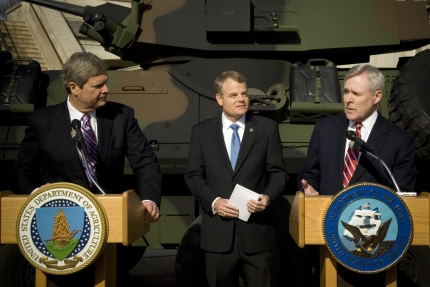
(left to right) Secretary of Agriculture Thomas Vilsack, U.S. Representative Mike McIntyre, and Secretary of the Navy the Honorable Ray Mabus address the media following a memorandum of understanding signing ceremony at the Pentagon. January 21, 2010. (by by U.S. Navy Mass Communication Specialist 2nd Class Kevin S. O'Brien)
The Obama Administration has been engaged in these efforts since May 2009, when President Obama established the Biofuels Interagency Working Group, an effort to help coordinate efforts across the federal government to advance biofuels research and commercialization. This agreement creates a strong partnership that promotes clean energy technologies and will help stimulate additional private investment and innovation to develop the next generation of biofuels. In fiscal year 2008, the Navy alone consumed nearly 1.2 billion gallons of petroleum, predominantly in fuel for ships and aircraft.
Read more about yesterday’s announcement.
To demonstrate the potential of this partnership, the Marine Corps had on display a prototype Light Armored Vehicle or LAV. The U.S. Army’s Tank and Automotive Command, has for the past 6 months conducted tests with biofuels in LAVs ranging in biofuel mixture level from 5%-30%. The Department of the Navy is committed to testing biofuels for use in its aircraft, surface ships and tactical vehicles like LAVs. The LAV-25A2 on display is mechanically the same as the LAV-25 operating in Afghanistan.
Tony Russell is Communication Advisor for the White House Office of Energy and Climate Change.
Related Videos
-
 May 09, 2014 8:21 AM
Inside the White House: Solar Panels
-
 September 01, 2016 8:25 PM
President Obama Delivers a Statement to the Press
White House Blogs
- The White House Blog
- Middle Class Task Force
- Council of Economic Advisers
- Council on Environmental Quality
- Council on Women and Girls
- Office of Intergovernmental Affairs
- Office of Management and Budget
- Office of Public Engagement
- Office of Science & Tech Policy
- Office of Urban Affairs
- Open Government
- Faith and Neighborhood Partnerships
- Social Innovation and Civic Participation
- US Trade Representative
- Office National Drug Control Policy