Energy and Environment Latest News
Green jobs and the Middle Class
Posted by on February 25, 2009 at 10:30 AM ESTUpdate: The AP has a preview of Friday’s event: The $787 billion economic stimulus bill Obama signed last week includes billions to help create such jobs as installing solar panels and building wind turbines, which also is part of his goal to nudge the country away from dependence on foreign oil and toward reliance on renewable forms of energy.
It is Obama's belief that such jobs will help raise living standards for middle-class families, who didn't fare well before the current economic downturn set in and are now feeling pinched along with millions of other people who have lost their jobs and homes, and watched retirement and college savings disappear."
…..
Jared Bernstein, the task force's executive director, said middle-class incomes have fallen by about $2,000 in real terms since the start of the decade and that violates a basic American tenet: that you'll get ahead if you work hard and your children will fare even better."Part of this election was about recognizing that a key part of any effective government's economic agenda had to be reconnecting the living standards of the middle class to that of the expanding economy once it starts expanding again," said Bernstein — Biden's chief economist and economic policy adviser.
As Vice President Joe Biden often says, let's roll up our sleeves.
Vice President Biden and the rest of the Middle Class Task Force get down to (official) business for the first time Friday, Feb. 27, at the University of Pennsylvania in Philadelphia.
On the agenda: jobs. Green jobs. Lots of 'em.
Half the cabinet will be there, along with top domestic policy aide Melody Barnes, top environmental policy aide Carol Browner, and Pennsylvania's Gov. Rendell, Sens. Specter and Casey, and Reps. Chaka Fattah and Robert Brady.
But what are green jobs? Where are they? And how do you get one?
Beyond the political heavy-hitters, a lot of clean energy leaders -- including prominent voices from the worlds of policy, non-profits, local government, labor, and business -- will be on hand to try to answer those questions, and these:
--How can we change Washington to make green jobs a political reality? (John Podesta, President and CEO, Center for American Progress)
--How can we ensure access to green jobs to everyone? (Van Jones, founding President, Green for All)
--How do we connect people who need jobs to companies that need people? (Fred Krupp, President, the Environmental Defense Fund)
--How can the federal government help bring green jobs to the middle class? (Carol Browner, Assistant to President Obama for Energy and Climate Change)
--What's the role of the labor movement in creating green jobs and training workers for them? (Leo Gerard, International President of the Steelworkers of America
--How do you create green jobs in a city? (Michael Nutter, Mayor of Philadelphia)
--How can public-private partnerships help train people for green jobs? (Cecilia Estolano, CEO of the Los Angeles Community Redevelopment Authority)
--What's the role for business? (Mark Edlen, President, Gerding-Edlen)We'll have much more from the MCTF's first meeting later in the week.
Learn more about Economy, Energy and EnvironmentStewards of America's natural wonders
Posted by on February 9, 2009 at 8:54 PM ESTMrs. Obama this afternoon visited the Department of the Interior, where she spoke about how important it is to protect our natural resources and move towards a clean, sustainable energy future."These [priorities] aren't only vital for the survival of our planet as we work to combat climate change, but also incredibly important to strengthen our economy and the well-being of our families," she said. "At a time when so many Americans are out of work, sound energy and environmental policies are going to help create thousands of jobs through the economic recovery and reinvestment plan that Barack is out there promoting today."She also announced that President Obama will soon appoint a new, high-level advisor to serve as a liaison between Native Americans and the federal government, "on issues such as sovereignty, health care, education -- all central to the well-being of Native American families and the prosperity of tribes all across this country."View photos from the First Lady's visit and read her full remarks below.
REMARKS BY THE FIRST LADY
AT THE U.S. DEPARTMENT OF THE INTERIOR
U.S. Department of the Interior
February 9, 2009MRS. OBAMA: Well, I have to say I am completely humbled and moved by all of you, by the Black Bear Tribal Group. We have to give them another round of applause -- (applause) -- for that inspiring performance, for the beautiful shawl. Thank you, Nedra, thank you so much for the prayers. It means so much to me. It means so much to my family. And I want to thank you for that beautiful sign there in the back. It's a small sign. (Applause.) It's hard to read, but -- (laughter).And I also want to acknowledge these wonderful workers, folks who have been in this department longer than I've been alive. (Laughter.) I mean, that is amazing. And they don't look it. There's no way, by looking on this stage, that you can tell that people have devoted their careers, lifetimes, more than lifetimes -- I know there's some people in this audience who haven't been born half the time that they've been working here, and they are amazing and true representatives of what government work is all about. And it's one of the reasons why I'm here -- to say thank you, not just to the folks on this stage, but to all of you.I want to thank Secretary Salazar, who has been a unique and wonderful friend. He is correct; he and his wife, Hope, were two of the first people we met when Barack joined the United States Senate. And they showed us a level of kindness that we will never forget, and we are proud for his contribution to this country. He brings the department a lifetime of experience protecting our natural resources, promoting clean energy, and standing up for rural communities. And we could not be more pleased -- could not be more pleased -- to have him as a part of this administration. You are lucky to have him as a leader. (Applause.)So this is the third agency that I visited since we've arrived, and each of the agencies that I've seen have had a different flavor. It's been such a great way for me to get to know our new community and to meet you, our new co-workers and our new neighbors.I know that this is an important time of reform and renewal here in this department. And as you begin the work -- the hard work -- of taking this department into a new era of excellence, I wanted to come by, again, to simply say thank you. Thank you for your service to this nation. It's a simple message, but it's one that we think is important to deliver.The issues that you're working on, as you know, affect us all. They affect you, they affect your children, your grandchildren, your friends, your neighbors. And as public servants and stewards of some of America's greatest assets, from our parks and forests to mountains and rivers, you're charged with the sacred task of ensuring that America's resources are used responsibly and protected for future generations.Some of the greatest adventures that we experience in life here in this nation –- like family vacations, and camping, and hiking, and fishing, if you're blessed to have access to those resources -- are possible because of the work that you do right here in this department.And Barack and I and the girls, as you may have read, just had a little retreat away. We visited Camp David for the first time, and got to experience the beautiful -- the beauty of those grounds, and it was just wonderful to get a bit of a break and to spend some quality time as a family in nature.You are also, in addition to helping make those experiences possible for our family, you are at the center of this administration's highest priorities: securing America's energy future -- Barack has talked about it time and time again; protecting its natural environment; and using the natural resources, again, as responsibly as we can.These aren't only vital for the survival of our planet as we work to combat climate change, but also incredibly important to strengthen our economy and the well-being of our families. At a time when so many Americans are out of work, sound energy and environmental policies are going to help create thousands of jobs through the economic recovery and reinvestment plan that Barack is out there promoting today.And for those of you focused on meeting the federal government's obligations to the Native Americans, understand that you have a wonderful partner in the White House right now. (Applause.)Barack has pledged to honor the unique government-to-government relationship between tribes and the federal government. And he'll soon appoint a policy advisor to his senior White House staff to work with tribes and across the government on these issues such as sovereignty, health care, education -- all central to the well-being of Native American families and the prosperity of tribes all across this country. So there is a lot of work to do -- a lot of work. And we have great leaders in Secretary Salazar and in President Obama. I love to say that. (Applause.)But what's important to remember that we will never forget -- never can forget is that great leaders are only as great as the people who hold them up. (Applause.) So that is why I'm here. (Laughter.) We're counting on you all. (Laughter and applause.) We're at the beginning of what will be a lot of work, a long journey, and we're going to need one another, not just here in Washington but we're going to need one another across this country.So before we start that hard work, Barack and I want to thank those of you who have been here long before you ever heard of Barack Obama, working tirelessly to keep this country sound. Thank you for the work that you've done. Thank you for the work that you're going to do today and in the future. We are all neighbors in this effort. And together we can get a lot of things done.So on behalf of my husband, my girls, thank you for the warm welcome that you've offered us to Washington. And let's get some good things done. Thank you so much. (Applause.)Learn more about Energy and EnvironmentIndiana (Update: pictures)
Posted by on February 9, 2009 at 3:51 PM ESTplayIndiana Town Hall on Economic Recovery, 2/9/09
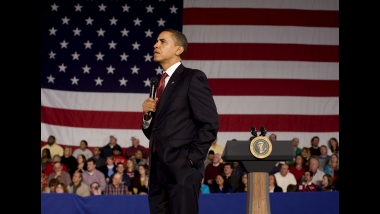
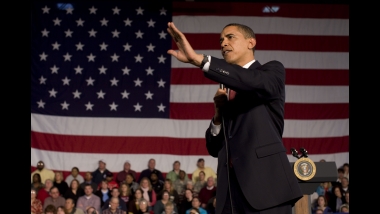
President Obama held a town hall in Elkhart, Indiana on February 9, 2009.
1 of 6While some in Washington have obsessed about "process stories" regarding the recovery package, for most of America the economy is not a spectator sport. That’s why the President went to discuss with working people exactly how the package will affect them and their communities in a town hall today in Elkhart, Indiana.
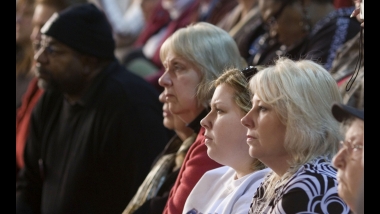
quot;You know, we tend to take the measure of the economic crisis we face in numbers and statistics. But when we say we’ve lost 3.6 million jobs since this recession began....We’re talking about folks who’ve lost their livelihood and don’t know what will take its place," President Obama said. "Parents who’ve lost their health care and lie awake nights praying the kids don’t get sick. Families who’ve lost the home that was their corner of the American dream. Young people who put that college acceptance letter back in the envelope because they just can’t afford it."The President was introduced by Ed Neufeldt, one of many Elkhart residents laid off recently from the area's RV plants. At 62 years old, he has two young children and 5 grown children, and he needs to work. But unemployment in the area has more than tripled from 4.7% at the end of 2007 to over 15% at the end of last year.Questions from the crowd of about 1,700 people ranged from the foreclosure crisis and green energy to the mechanism by which recovery funds will reach communities like Elkhart. Some highlights, then the full transcript below.Q: With respect to the stimulus bill, are there provisions in there that address green job issues, improvement of environmental issues, and those type of matters?A:Under this plan, we would double the production of alternative energy -- double it from where it is right now….there is money allocated in this plan to develop the new battery technologies that will allow not just cars but potentially RVs as well to move into the next generation of plug-in hybrids….We also have put in money that provide for the weatherization of millions of homes across the country....If we don't use this crisis as an opportunity to start retooling, then we will never catch up and be able to compete effectively against Japanese automakers, Korean automakers, and we will find ourselves continuing to slide.This should be an opportunity for us to retool.Q We are truly tired of the economics that we have been getting that has got us into the position that we're in. That theory has been a trickle down. We need to trickle up. So I would hope in your philosophy about trying to kick-start the economy that the money gets directly to the people who are -- have homes that are foreclosed, the people that have lost jobs....So I would hope...that the money gets directly into the hands of the people who are hurting.A:When it comes to tax cuts, you are exactly right that instead of providing tax cuts to the wealthiest Americans, what I've been pushing in this plan is to make sure that the tax cuts go to working families. That is not only good for those families, it's actually good for the economy, because when you give a tax break to working families who are struggling, they will spend it on buying a new coat for the kids, or making sure that they get that car repaired that they use to get to work.Q: What are you going to do about enticing companies to stay here in the United States once we have them?A: The single most important factor I think in whether companies are going to continue to locate here in Elkhart and around the country is, what are we doing about education. Because the quality of the work force is probably what most companies are going to pay the most attention to over time…. [W]hat we should be looking for is how do we encourage high-wage, high-value work. And there the key is going to be how well we are training our work force….And over the next few days, as we are having these conversations, we should talk about how we can make sure that we're investing in education, because that's what's going to keep companies investing right here in the United States over the long term.
REMARKS BY THE PRESIDENT AT TOWN HALL
Concord Community High School
Elkhart, Indiana
February 9, 2009THE PRESIDENT: Thank you. Thank you so much. Well, let's -- everybody can have a seat. Make yourselves comfortable -- we're going to be here a while. (Applause.)It is good to be back in Elkhart. (Applause.) And it's good to be back in Indiana. You know, the last event we had on the campaign was Indiana. And the first time that I'm traveling outside of the White House to talk about the economy is back in Indiana. (Applause.)And I want to start by thanking Ed for coming here today and sharing his family's story with all of us. Ed was terrific -- give him a big round of applause. (Applause.)There are a few other special guests that I just want to acknowledge very quickly. First of all, your own senator, my former colleague, a outstanding legislator and public servant, former governor here in Indiana -- give it up for Senator Evan Bayh. Where is he? Where's Evan? There he is. (Applause.)A guy you may be familiar with, your own member of Congress, Joe Donnelly. (Applause.) We brought a few other members of Congress here to get in on the fun: Representative Baron Hill. (Applause.) Representative Brad Ellsworth. (Applause.) Representative Fred Upton. (Applause.) Representative André Carson. (Applause.) Former Representative Tim Roemer. (Applause.) Former Representative Lee Hamilton. (Applause.) We've got Mayor Dick Moore of Elkhart. (Applause.) And we've got the new Secretary of Transportation, a former member of Congress from my own home state of Illinois, Ray LaHood. (Applause.)I don't know if you guys have been noticing, but we've had a little debate in Washington -- (laughter) -- over the last week or two about the economy. You know, we tend to take the measure of the economic crisis we face in numbers and statistics. But when we say that we've lost 3.6 million jobs since this recession began, nearly 600,000 in the past month alone; when we say that this area has lost jobs faster than anywhere else in the United States of America, with an unemployment rate of over 15 percent, when it was 4.7 percent just last year; when we talk about layoffs at companies like Monaco Coach, and Keystone RV, and Pilgrim International -- companies that have sustained this community for years -- we're not just talking numbers, we're talking about Ed. We're talking about people in the audience here today. People not just in Elkhart, but all across this country. We're talking about people who have lost their livelihood and don't know what will take its place.We're talking about parents who've lost their health care and lie away at night, praying their kids don't get sick. We're talking about families who've lost the home that was the corner -- their foundation for their American Dream. Young people who put that college acceptance letter back in the envelope because they just can't afford it. That's what those numbers and statistics mean. That is the true measure of this economic crisis.Those are the stories I heard when I came to Elkhart six months ago, and those are the stories that I carried with me to the White House. I have not forgotten them. And I promised you back then that if elected -- (applause) -- I'd do everything I could to help this community recover, and that's why I came back today, because I intend to keep my promise. (Applause.)I intend to keep my promise. But you know, the work is going to be hard. I don't want to lie to people -- that's why we're having a town hall meeting -- because the situation we face could not be more serious. We have inherited an economic crisis as deep and as dire as any since the Great Depression.Economists from across the spectrum have warned that if we don't act immediately, millions of more jobs will be lost. The national unemployment rates will approach double digits not just here in Elkhart, all across the country. More people will lose their homes and their health care. And our nation will sink into a crisis that at some point we may be unable to reverse.So we can't afford to wait. We can't wait and see and hope for the best. We can't posture and bicker and resort to the same failed ideas that got us into this mess in the first place. (Applause.) That was what this election was all about -- the American people rejected those ideas because they hadn't worked. (Applause.) You didn't send us to Washington because you were hoping for more of the same; you sent us there to change things -- (applause) -- the expectation that we would act quickly and boldly to carry out change. And that's exactly what I intend to do as President of the United States of America. (Applause.)That's why I put forth a recovery and reinvestment plan that is now before Congress. At its core is a very simple idea: to put Americans back to work doing the work America needs to be done. Ed -- Ed said it better than anybody could. He said, look, folks in Elkhart, they want to work. Nobody is looking for a handout. Everybody just wants to be able to get a job that supports a family. And we got the most productive workers on Earth. (Applause.) We've got the best workers right here in Elkhart -- (applause) -- who are willing to put hard time and do whatever it takes to make sure a company succeeds.But they've got to have a chance. The plan that we put forward will save or create 3 to 4 million jobs over the next two years. But not just any jobs -- jobs that meet the needs we've neglected for far too long, jobs that lay the groundwork for long-term economic growth; jobs fixing our schools; computerizing medical records to save costs and save lives; jobs repairing our roads and our bridges and our levees; jobs investing in renewable energy to help us move towards energy independence. (Applause.)The plan also calls for immediate tax relief for 95 percent of American workers, so that you who are being pinched, even if you still have a job, with rising costs while your wages and incomes are flat-lined, you'll actually have a little bit of extra money at the end of the month to buy the necessities for you and your children.Now, I know that some of you might be thinking, well, that all sounds good, but when are we going to see any of this here in Elkhart? What does all this mean to my family, to my community? And those are exactly the kinds of questions you should be asking your President and your government. And today, I want to provide some answers -- and I want to be as specific as I can.Number one, this plan will provide for extended unemployment insurance, health care and other assistance for workers -- (applause) -- other assistance for workers and families who have lost their jobs in this recession. So if you've lost your job, for example, under existing law you can get COBRA -- some of you have heard of COBRA -- but the only problem is it's so expensive, it doesn't do you any good. (Applause.) So what we've said is -- what we've said is we will help subsidize people so that they can keep -- at least keep their health insurance while they're out there looking for a new job. (Applause.)This plan will also -- and what this means is, from the perspective of unemployment insurance, you will have an additional $100 per month in unemployment benefits that will go to more than 450,000 Indiana workers, extended unemployment benefits for another 89,000 folks who've been laid off and can't find work, and job training assistance to help more than 51,000 people here get back on their feet. (Applause.)Now, that's not just our moral -- that's not just our moral responsibility to lend a helping hand to our fellow Americans at a time of emergency; it makes good economic sense. If you don't have money, you can't spend it. And if you don't spend it, our economy will continue to decline.Now, for that same reason, the plan includes badly needed tax relief for middle class workers and families. (Applause.) Folks all across the country are under siege. We need to give you more of the money you've earned so that you can spend it and pay your bills. Under our plan, families -- working families will get a thousand dollars, providing relief for nearly 2.5 million workers and their families here in Indiana. The plan also will provide a partially refundable $2,500 per student tax credit to help 76,000 Hoosier families send their kids to college. (Applause.) This will benefit your household budgets in the short run, and it will benefit America in the long run.But providing tax relief and college assistance, and helping folks who have lost their jobs, that's not enough. A real recovery plan helps create more jobs and put people back to work. And that's why between the investments our plan makes, and the tax relief for small business it provides, we'll create or save nearly 80,000 badly needed jobs for Indiana right here over the next couple of years.Now, you may have heard some of the critics of our plan say it would create mostly government jobs. That is not true. Ninety percent -- more than 90 percent of the jobs created under this recovery act will be in the private sector; more than 90 percent. (Applause.) But it's not just the jobs that will benefit Indiana and the rest of America. It's the work people will be doing -- rebuilding our roads, our bridges, our dams, our levees; roads like US 31 here in Indiana -- (applause) -- that Hoosiers can count on -- that connects small towns and rural communities to opportunities for economic growth. And I know that a new overpass downtown would make a big difference for businesses and families right here in Elkhart. (Applause.)We'll also put people to work rebuilding our schools. (Applause.) This school is a terrific school, but I know there's work to be done here. We should do it so that all our children can have the world-class classrooms -- the labs, the libraries -- that they need in order to compete in today's global economy. (Applause.)We should be investing in clean alternative sources of energy. (Applause.) We should be investing in the electric grid we need to transport this new energy from coast to coast. So if you build a windmill here in Indiana and it generates energy, that energy can get to Chicago and can get to St. Louis and can get to other places all across the country. (Applause.)We can help make Indiana an energy-producing state, not just an energy-consuming state. (Applause.) The plan calls for weatherizing homes across Indiana; installing state-of-the-art equipment that help you control your energy costs; building new, high-speed broadband lines; reaching schools and small businesses in rural Indiana so they can connect and compete with their counterparts in any city of any country in the world. (Applause.)Those -- those are the kinds of projects that we're looking at -- that put people to work, that allow us to train people for jobs that pay a living wage, and that end up being a gift that keeps on giving, because not only are we creating jobs now, but we're creating the infrastructure for the jobs of the future. (ApplauseNow, let me be clear, I'm not going to tell you that this bill is perfect. It's coming out of Washington, it's going through Congress -- (laughter) -- you know. Look, it's not perfect, but it is the right size, it is the right scope. Broadly speaking, it has the right priorities to create jobs that will jumpstart our economy and transform this economy for the 21st century. (Applause.)I can't tell you with a hundred percent certainty that every single item in this plan will work exactly as we hoped. But what I can tell you is, I can say with complete confidence that endless delay or paralysis in Washington in the face of this crisis will only bring deepening disaster. I can tell you that doing nothing is not an option. (Applause.)So we've had a good debate. Now is the time to act. That's why I'm calling on Congress to pass this bill immediately. Folks here in Elkhart and all across America need help right now. They can't afford to keep waiting for folks in Washington to get this done.Even with this plan, the road ahead won't be easy. This crisis has been a long time in the making. We're not going to turn it around overnight. Recovery will likely be measured in years, not weeks or months. But we also know that our economy will be stronger for generations to come if we commit ourselves to the work that needs to be done -- commit ourselves today to the work that needs to be done.And being here in Elkhart, I am more confident than ever that we will get where we need to be, because I know people are struggling, but I also know that folks here are good workers and good neighbors -- (applause) -- who step up, who help each other out, who make sacrifices when times are tough. (Applause.) I know that all folks here are asking for is a chance to work hard and to have that work translate into a decent life for you and your family. (Applause.) So I know you're going to be doing your part. I think it's about time that government did its part, too. (Applause.) That's what this recovery plan is all about. That's why I hope it passes as soon as possible, so we can start creating jobs and helping families, and turning our economy around. (Applause.)Thank you, Elkhart. Thank you. (Applause.)Thank you. All right. Thank you. All right, we're going to take questions. All right, I just want to make sure my mic is working here. Here's the deal on questions. First of all, we didn't screen anybody. So there's some people who like me in the audience, some people who don't. Some people agree with me, some people who don't. It doesn't matter. We want to take questions from everybody.Here's the only thing I've got to ask, though. I would ask that everybody raise their hand -- not right now. (Laughter.) People who had a question, raise their hand. We're going to try to call on people -- I'm going to try to go around the room. We may not get to every single question, so don't be mad at me. We've got a lot of people here. We've got about 35 minutes, 40 minutes, so I'm going to try to get as many questions as possible -- which means try to keep your question relatively succinct, and I will try to keep my answer relatively succinct. We've got young people in the audience who have microphones, so wait until the microphone gets to you. And if you could introduce yourself, that will be helpful. And the last thing I'm going to do is I'm going to go girl, boy, girl, boy, so that nobody gets mad at me. (Laughter and applause.)All, right. This young lady right here, she's number one, right here. (Applause.)Q Thank you. And, President Obama, we welcome you to Elkhart with our whole heart.THE PRESIDENT: Thank you.Q You are just -- we are so grateful that you've come here today.THE PRESIDENT: Thank you.Q My question to you is, sir, when you allocate the money for Elkhart, Indiana, will it come directly into Elkhart? Or where -- is it going to have to go around somewhere else?THE PRESIDENT: Well, first of all, what's your name?Q My name is Helen Castillo [phonetic].THE PRESIDENT: Okay, thank you, Helen. It's a good question. Look, we've got to get the bill passed. But we also have to make sure that the money is well spent, which means we're doing some things that are unprecedented to make sure that the money gets out quickly, but it gets out wisely.We're going to set up an independent board made up of Democrats and Republicans to review how the money is being spent, because we've got to make sure that it's not being wasted on somebody's special project that may not actually create help for people. So that's point number one.Point number two is we're actually going to set up something called recovery.gov. This is going to be a special website that we set up that gives you a report on where the money is going in your community, how it's being spent, how many jobs it's [sic] being created, so that all of you can be the eyes and ears. And if you see that a project is not working the way it's supposed to, you'll be able to get on that website and say, you know, I thought this was supposed to be going to school construction, but I haven't noticed any changes being made. And that will help us track how this money is being spent.Now, in terms of how it's -- how it's being utilized and who it's going to, it's probably going to depend on different aspects of the plan. Some of the plan will go to the state government because, for example -- well, let me give you an example. Unemployment insurance is run through the state, not run through a city, and so that part of the plan will be going through the state.There are going to be other projects having to do with transportation, for example, in which we may be working directly with local municipalities and communities as well as the state government to make sure that the project is well planned. And that's why we've got Secretary LaHood here, because he's going to be working with the local communities.The same is true on education funding. We may be working directly with the school superintendent, who I know is here, to figure out where are the schools that are in most need of help and where we can right away get some construction going and get some improvements going. So it'll probably depend on what stream of money we're talking about, but the key is we're going to have strong oversight and strong transparency to make sure that this money is well spent.And listen, I know that there are a lot of folks out there who have been saying, oh, this is pork and this is money that's going to be wasted and et cetera, et cetera. Understand: This bill does not have a single earmark in it -- which is unprecedented for a bill of this size -- does not have a single earmark in it. (Applause.)So we may debate -- we can debate, you know, whether you'd rather have this tax cut versus that tax cut, or this project versus that project. Be clear, though, that there aren't a -- there aren't individual pork projects that members of Congress are putting into this bill. Regardless of what the critics say, there are no earmarks in this bill. That's part of the change that we're bringing to Washington, is making sure that this money is well spent to actually create jobs right here in Elkhart.All right? Okay. (Applause.)Gentleman out there, all the way at the top. You, that's right. (Laughter.) But hold on a second. Let's get a mic to him.Q Thank you. I also want to just be very thrilled to be in the presence of you because we've been looking for a change. We are truly tired of the economics that we have been getting that has got us into the position that we're in. That theory has been a trickle down. We need to trickle up. (Applause.)So I would hope in your philosophy about trying to kick-start the economy that the money gets directly to the people who are -- have homes that are foreclosed, the people that have lost jobs. To try to give to a bank and give a low interest rate, and the person whose home has been foreclosed on don't have a job, don't help anybody. It's a sale that nobody can take advantage of because you ain't got no money. (Applause.)So I would hope and I pray that you would support the people who got you into the office -- we, the people, not the fat cat -- (laughter) -- we, the people -- to where that the money gets directly into the hands of the people who are hurting, to where that we don't have to worry about going to the state, going to the federal government, standing in line somewhere. Send that check to our mailbox. (Laughter and applause.) Amen, amen. So we can take it to the bank and pay that mortgage. Thank you. (Applause.)THE PRESIDENT: Let me -- can everybody hear me? Hold on a second. Testing, testing. How's that? All right.Well, let me respond in a couple of ways. Number one, when it comes to tax cuts, you are exactly right that instead of providing tax cuts to the wealthiest Americans, what I've been pushing in this plan is to make sure that the tax cuts goes to working families. That is not only good for those families, it's actually good for the economy, because when you give a tax break to working families who are struggling, they will spend it on buying a new coat for the kids, or making sure that they get that car repaired that they use to get to work.When you give it to the wealthier families, they just put it away somewhere, and so it doesn't circulate in the economy. So tax cuts targeted to working families are the most effective means of stimulus that we can provide to the economy.Now, you're making another point, though, that has to do with a separate part of what we're going to need to get this economy moving again, and that has to do with the financial system and the banking system. And I just want to be clear that the Recovery and Reinvestment Act that is before Congress right now is just one leg in the stool of recovery.The other thing that we've got to get done is we've got to get the banks stable and lending again. Part of what's happened in terms of the RV industry, for example -- I was talking to Congressman Donnelly about this -- is basically people who want to buy an RV can't get financing right now even if they've got good credit. So what we're going to be trying to do is to set up a whole new mechanism for helping people get consumer credit. We're going to help small businesses and medium-sized businesses get credit. And instead of just pumping that money directly into Wall Street, we're going to make sure that a lot of that money is going directly to consumers, and the money that does go into Wall Street is going to come with some strings attached. (Applause.)You cannot expect taxpayers to bail out banks that have made bad decisions when they are then using that money to give themselves huge bonuses. (Applause.)So one of the things that we said is, look, we understand that the banking system is fragile right now and even though those folks made bad decisions -- could bring down the entire economy, and it affects towns like Elkhart, so we're going to do something strengthen the banking system. But, you know, you are not going to be able to give out these big bonuses until you've paid taxpayers back. You can't get corporate jets -- (applause) -- you can't go take a trip to Las Vegas or go down to the Super Bowl on the taxpayers' dime. (Applause.) There's got to be some accountability and some responsibility, and that's something that I intend to impose as President of the United States. (Applause.)All right. Young lady right here -- right here in the striped sweater.Q Thank you. My question is, you have -- my name is Tara. You have come to our county and asked us to trust you, but those that you have appointed to your Cabinet are not trustworthy and can't handle their own budget and taxes.THE PRESIDENT: No, no, no, this is a legitimate -- this is a legitimate question.Q So I'm one of those that thinks you need to have a beer with Sean Hannity. So tell me why, from my side, we can understand --AUDIENCE: Boo!THE PRESIDENT: No, that's okay. That's okay. No, no, look, I think it was a perfectly legitimate question.First of all, I appoint -- I've appointed hundreds of people, all of whom are outstanding Americans who are doing a great job. There are a couple who had problems before they came into my administration in terms of -- in terms of their taxes. Look -- and I think this is a legitimate criticism that people have made, because you can't expect one set of folks to not pay their taxes when everybody else is paying theirs. So I think that's a legitimate concern. (Applause.)I will tell you that the individuals at issue here, I know them personally, and I think these were honest mistakes. And I made sure they were honest mistakes beforehand. And one of the things I discovered is if you're not going to appoint anybody whose ever made a mistake in your [sic] life, then you're not going to have anybody taking your job. So -- (applause) --But having said that, what I did acknowledge -- and I said it publicly on just about every TV station -- is something that you probably sometimes don't hear from politicians, which is: I made a mistake. (Applause.) And that, because I don't want to send the signal that they're two sets of rules.Now, understand, though, I think something that should also be mentioned is that we've set up an unprecedented set of ethics rules in my White House where we are not -- we are not -- everybody will acknowledge that we have set up the highest standard ever for lobbyists not working in the administration; people who work in my administration aren't going to be able to go out the revolving door and start working for some lobbying firm and lobbying the White House. Republicans and Democrats have acknowledged that there's a very high bar that we've set for ourselves. We have not been perfect, but we are changing the culture in Washington and it's going to take some time.Now, with respect to Sean Hannity, I didn't know that he had invited me for a beer. (Laughter.) But I will take that under advisement. (Laughter.) Generally, his opinion of me does not seem to be very high -- (laughter) -- but I'm always good for a beer, so -- (laughter and applause.)All right. Well, let me -- let me get this side of the room and then I'll come back. I want to make sure I'm not looking too biased on one side here. That gentlemen right up there in the corner there -- you, yes.Q Thank you, President Obama. It's -- like everybody has said, it's an honor to be here. I'm -- my name is Jason Ward [phonetic] and I'm a local attorney here in town, but I've seen a lot of the effects that the manufacturing industry has had here. And there's been a lot of discussion with respect to green jobs and environmental issues --THE PRESIDENT: Right.Q -- and this area has been one of the areas that's been mentioned about maybe retooling to take advantage of the green revolution. And I guess the question is, with respect to the stimulus bill, are there provisions in there that address green job issues, improvement of environmental issues, and those type of matters?THE PRESIDENT: Absolutely. It's a great question, and let me describe for you just some of the things that we have in there. Under this plan, we would double the production of alternative energy -- double it from where it is right now. So that's point number one. (Applause.)Point number two -- point number two, there is money allocated in this plan to develop the new battery technologies that will allow not just cars but potentially RVs as well to be -- to move into the next generation of plug-in hybrids that get much better gas mileage, that will wean ourselves off dependence on Middle Eastern oil, and will improve our environment and lessen the potential effects of greenhouse gases and climate change.We also have put in money that provide for the weatherization of millions of homes across the country. Now, this is an example of where you get a multiplier effect. If you allocate money to weatherize homes, the homeowner gets the benefit of lower energy bills. You right away put people back to work, many of whom in the construction industry and in the housing industry are out of work right now -- they are immediately put to work doing something. You can train young people as apprentices to start getting training at -- in home construction through weatherization. And you start reducing energy costs for the nation as a whole. So there are billions of dollars in this plan allocated for moving us towards a new energy future.Now, I'll be honest with you, some of the critics of the plan have said that's pork. I don't understand their criticism. Their basic argument is, well, that's -- you're trying to make policy instead of just doing short-term stimulus. Well, my whole attitude is, if we're going to spend billions of dollars that creates jobs anyway, then why wouldn't we want to create jobs in things like clean energy that create a better economic future for us over the long term? That's just -- that's common sense to me. That's common sense to me. (Applause.)And that is especially important for the Midwest, because if you think about it, the auto industry, RV industry, transportation industry is so important to us here in the Midwest. If we don't use this crisis as an opportunity to start retooling, then we will never catch up and be able to compete effectively against Japanese automakers, Korean automakers, and we will find ourselves continuing to slide. This should be an opportunity for us to retool.And so I am going to make this a big priority over the next few days as we're trying to reconcile the House and the Senate bill, getting folks in Congress to understand that this is one of the best possible investments that we can make.Let me give you another example of long-term investments that are in this plan. I've been criticized because I suggested that as part of this plan we should improve information technology in the health care system. Now, here's the reason that I want to do it. Not only will it immediately create jobs in the health care industry, as well as in information technologies -- people who are programmers, people who are information systems specialists -- but it will also put everybody's medical records in a computerized form that will reduce medical errors and cut down the cost of health care over the long term.One of our biggest problems is that health care costs keep on going up even when everything else is going down. You know that in your own lives. The average family premium has doubled over the last eight years, even though your wages and your incomes haven't doubled.If we keep on going down that path, health care is going to gobble up everything. So what I've said is, look, if we're going to be spending money anyway creating jobs, why not create jobs getting these medical records set up in a way that drives down health care costs over the long term. Some of my critics have said that's social policy, that's not stimulus. Look, doesn't it make sense, if we're going to spend this money, to solve some big problems that have been around for decades? (Applause.) That's what we're trying to do. That's what's in this package. And that's why I hope Congress supports it. (Applause.)All right. It's a young lady's turn. This young lady right here. Hold on one second. Let's get a mic to you so everybody can hear you. We got a mic?
Q I'm Jackie Whittaker [phonetic] from South Bend. And I work as a foreclosure intervention counselor. And there's a bill pending that indicates that they're trying to get the authority for judges to go in and then they'd change and help mortgages. Do you think that is something that will pass?THE PRESIDENT: Let me talk to you about the housing foreclosure issue, because this was raised by this gentleman as well. We have to give homeowners some help and some relief.You've got home foreclosures that have gone up astronomically during this recession, during this downturn. It is both a cause and effect of the downturn. If we don't do anything about stabilizing the housing market, it is going to be much more difficult for us to recover.So we are going to be unveiling a series of plans to help not only homeowners who are at the brink of foreclosure, but there are a lot of homeowners who are making their mortgage payments every day, but they've seen the value of their homes decline so badly that now their mortgage is more than the value of their home -- which means that even when interest rates are low, it's very hard to refinance your home to take advantage of those low rates because a bank will say, well, you actually owe more than the home is worth. So we're going to be doing a lot of work on this.Now, one potential provision that has been discussed that I'm supportive of, but is not in this package -- it will be on a separate package -- is the idea that right now, if you have a second home or a third home or a fourth or a fifth home -- (laughter) -- and you go bankrupt, then the judge can modify the terms of your mortgage on your second, third, fourth, fifth home. So if you're worth $100 billion, you bought all these houses, and suddenly you went bankrupt, you would still be able to protect your second, third, fourth, fifth home.But, if you are like most people, including me, and you got one house -- (applause) -- keep in mind, the house I'm in, in D.C., I'm just borrowing that, that's the people's house. So I'm just -- I'm a guest in Washington, in the people's house. My house is on the south side of Chicago, that I own. (Applause.) But if you just have one house, it turns out that under current law you can't modify that mortgage if you are in bankruptcy. And if you -- if you just can't make the payments, the judge is not authorized to modify that loan so that let's say, the banks have to take a little bit less, but you are still making some payments. Now that makes no sense. What that's doing is, it's forcing a lot of people into foreclosure who potentially would be better off, and the bank would be better off and the community would be better off, if they're at least making some payments, but they're not able to make all the payments necessary. (Applause.)So this is a piece of legislation -- so this is a piece of legislation that I strongly support. We're going to try to make that part of our housing package so that -- remember I said, this recovery package and reinvestment package is just one leg of the stool. We've got to deal with the credit crisis. We've got to deal with housing. There are a whole bunch of other steps that we're going to have to take, and this is one of them.All right. The gentleman right back here in the tie -- yes.Q Thank you, President Obama. I'm Bill Keith [phonetic] from SunRise Solar. I manufacture a solar-powered attic fan right here in Indiana. (Applause.) And believe me, a lot of people encouraged me to go to China years ago to manufacture my products so I could live a little higher on the hog, and I decided to keep my friends and neighbors employed and make it right here. (Applause.)THE PRESIDENT: That's right. Excellent.Q And I wanted you to know that we've got people in this row -- Eric, Laura, Terry, Denise, Jesse Carbonda [phonetic] up in the balcony, and Gary Freimiller [phonetic] -- and these are people who are running green companies right now that are employing American people on our soil and keeping jobs here.What we need is a little more friendly environment from the utility companies, so if I want to put a solar system on my house I can get more than nine cents on the dollar for the electric I feed back into it. (Applause.) Some legislation like that would be helpful. And what my stance has been is, if the federal government mandates that the utility companies have to produce at least so much renewable energy, then all of our rates are going to go up.So I've been trying to encourage my own state to be more proactive and adopt a renewable energy standard, renewable electric standard on their own. What do you see in the pipeline for companies like mine? Because it's hard -- I don't get any tax -- you know, those of you out there that think that the prior administration or someone gave us some kind of benefits for being a green company here -- there are none. I mean, there's no real incentive for us to do what we're doing, so we're doing it out of passion right now. So we appreciate all that you're saying about renewables.THE PRESIDENT: Good. Well, let me -- three things that we can do, just very specific and we can do them quickly, and then there's a fourth thing that we can do that will take a little bit more time.Number one is that we need to pass a renewable energy standard. (Applause.) And what that does is, just as for people who aren't sort of experts in the field, it's pretty simple. What it says is -- to the various utilities, it says, you need to get 15 percent or 20 percent of your energy from renewable sources. And once you set that benchmark, then what happens is, is that people who are producing renewable energy -- solar or wind or hydrothermal -- what they're able to do then is count on a pretty solid market that they're going to be able to sell their energy to. And that means investors, then, will say, you know what, this is actually a pretty good thing for us to invest in. And over time what that means is, is that more and more people invest in renewable energy, which means that technology gets better, the research and development improves, and you start growing that sector. So a renewable energy standard is very important. That's point number one.Point number two is we should be providing tax credits and loan guarantees to renewable energy. There are some in place currently that have -- are on the verge of lapsing, and we have to act much more forcefully in terms of making sure that those are in place. That's the second thing.The third thing that we should be doing is working with utilities all across America, including here in Indiana, to do what some utilities are already doing in California. And this is a really smart thing. What they do is, the utility is able to make money not just on how much energy it sells, but it's also able to make money on how much energy its customers save.So you can structure how they charge your electricity bill so that if you started installing a solar panel, that you would actually, as you point out, be able to sell some of that energy back when you're not using it. You get to put some money in your pocket, and the utilities are rewarded for encouraging you to do that. Right now they don't have enough incentive to do it because they're making money the more energy you use, whereas what we want to do is make -- give them incentives so that they are constantly telling you how you can save energy.The fourth thing -- and this is the thing that's going to take a little bit longer -- is we've got to improve basic science, research and development. When it comes to solar, when it comes to wind, the price has gone down, but generally speaking it's still a little more expensive than fossil fuels: coal, natural gas, and so forth. So we've got to improve the technology, and that's why I want to make sure that we're investing some money every year in the development of new energy technologies that will drive those costs down over the long term.The country that figures out how to make cheaper energy that's also clean, that country is going to win the economic competition of the future. (Applause.) And I want that to be the United States of America. That's one of my commitments as President of the United States. (Applause.)All right, this part of the room has been kind of neglected here. Let's get that young lady right there. Yes.Q Thank you, Mr. President. My name is Erin Mendoza [phonetic]. And I kind of had a question that went along with the gentleman over there. What are you going to do about enticing companies to stay here in the United States once we have them? A lot of local companies have gone overseas since I was born -- sorry. And the economy here in Elkhart was at a high, and it is going down because companies are enticed to leave. So like the gentleman said, they can live higher on the hog.THE PRESIDENT: Well, look, I believe that the United States has the most productive workers. We've got the best universities and colleges. We've got the most dynamic, risk-taking economy and innovative economy of any in the world. So we can compete against anybody.But we've got some problems both in terms of our failure to invest in what's going to keep us competitive; we under-invest when it comes to energy -- we just talked about. Our health care system is broken, and that's a huge cost -- a lot of employers who want to stay here find it very difficult to deal with the rising cost of health care for their employees. So fixing health care will actually make us more competitive.We've got a tax code that is too often skewed to encourage companies to move overseas. We still have laws on the books that give tax breaks to companies that are shipping jobs overseas. And I think it's important for us to give tax breaks to companies that are investing right here in Elkhart, and right here in the United States of America. (Applause.)Now, having said all that, the single most important factor I think in whether companies are going to continue to locate here in Elkhart and around the country is, what are we doing about education. (Applause.) Because the quality of the work force is probably what most companies are going to pay the most attention to over time. There are going to be some companies that just ship jobs overseas, because it's low -- it's low value-added work. And they don't need skilled labor. And if you don't need skilled labor to make certain things, then you're just going to find the cheapest place. And we're never going to be able to compete against a country like Bangladesh when it comes to low-wage work.But what we should be looking for is how do we encourage high-wage, high-value work. (Applause.) And there the key is going to be how well we are training our work force. That's why in this recovery and reinvestment package, we put billions of dollars not only to make sure that school districts who are getting hammered are able to keep their teachers, but also we have money in the package to make sure that we are retraining our teachers around math and science, so that they are able to provide our young people what they need to compete in this new global economy, (applause); we have money to make -- create new labs, so that we have got science labs and the latest Internet connections into our schools so that they are part of this modern economy; we have money to revamp our community colleges, which are a tremendous bridge for people who maybe need more training to get these new jobs of the future.Now, I'll be honest with you, the Senate version cut a lot of these education dollars. I would like to see some of it restored. (Applause.) And over the next few days, as we are having these conversations, we should talk about how we can make sure that we're investing in education, because that's what's going to keep companies investing right here in the United States over the long term. All right?Now, there's a young man right in front of you here who's -- yes, you. (Laughter.) In fact, I just received a note that this is the last question. Oh, don't be mad at me. (Laughter.) I would love to stay here for a long time, but I've got to go back to Washington and convince everybody to get moving on this package. (ApplauseQ What are you going to do to help our schools?THE PRESIDENT: And this is a good place to end, with our future here. What's your name?Q My name is James.THE PRESIDENT: James, how old are you?Q I'm nine years old.THE PRESIDENT: Okay, fantastic. What's your question?Q What are you going to do to help our schools?THE PRESIDENT: Well, you know, I just started talking about that. (Laughter.) So, James, as I said, I think that we've got to rebuild our schools to make sure that they're state of the art. We also have to make sure that we are training new teachers and retraining some of the existing teachers so that they've got the best possible skills.We also are going to have to reform how we do business in some of the schools. I think it's very important for us to have high standards. I think we've got to do a better job, though, of assessing performance in schools. No Child Left Behind needs to be reworked in a more effective way. (Applause.)But the last thing that we need in schools -- do in schools has nothing to do with money. It has everything to do with parents. (Applause.) Because we can put as much money as we want into schools -- if parents don't have an attitude that says, I'm going to make sure my child does my homework; that I'm meeting with the teacher to find out what's going on; if all of us aren't instilling a sense of excellence in our kids -- then they're not going to be able to compete. And that means young people like you, you're going to have to -- you're going to have to work a little harder. (Laughter and applause.)Yes. Thank you, James.All right, everybody. God bless you. God bless America. (Applause.)END 1:07 P.M. ESTLearn more about Economy, Energy and EnvironmentSerious about energy independence
Posted by on February 5, 2009 at 1:25 PM ESTHe said hello to members of the DOE and their new Secretary, Steven Chu.He announced new efficiency standards for common household appliances, an important shift in policy that will get us closer to energy independence.And then President Obama issued a stark rebuke to critics of the stimulus plan and urged its swift passage."Washington may not be ready to get serious about energy independence, but I am. And so are you. And so are the American people," President Obama said. "Inaction is not an option that is acceptable to me and it’s certainly not acceptable to the American people – not on energy, not on the economy, and not at this critical moment."He singled out critics who have been nit-picking the stimulus plan and misrepresenting some of its provisions:"Now, I read the other day that the critics of this plan ridiculed our notion that we should use part of the money to modernize the entire fleet of federal vehicles to take advantage of state of the art fuel-efficiency. They call it pork. You know the truth. It will not only save the government significant money over time, it will not only create jobs manufacturing those vehicles, it will set a standard for private industry to match. And so when you hear these attacks deriding something of such obvious importance as this, you have to ask yourself – is it any wonder we haven’t had a real energy policy in this country?"Read the President's full remarks below.
REMARKS OF PRESIDENT BARACK OBAMA
PROMOTING THE RECOVERY PLAN WITH SECRETARY CHU
Department of Energy
February 5, 2009Thank you, Secretary Chu, for bringing your experience and expertise to this new role. And thank you all so much for your service each and every day here at the Department. Your mission is so important and will only grow as we seek to transform the ways we produce and use energy for the sake of our environment, our security – and our economy.As we are meeting, in the halls of Congress just down the street from here, there’s a debate going on about the plan I’ve proposed, the American Recovery and Reinvestment Plan.This isn’t some abstract debate. Last week, we learned that many of America’s largest corporations are planning to layoff tens off tens of thousands of workers. Today we learned that last week, the number of new unemployment claims jumped to 626,000. And tomorrow, we’re expecting another dismal jobs report on top of the 2.6 million jobs we lost last year.Now, I believe that legislation of such magnitude deserves the scrutiny that’s it received over the last month. But these numbers that we’re seeing are sending an unmistakable message – and so are the American people. The time for talk is over. The time for action is now. Because we know that if we don’t act, a bad situation will become dramatically worse. Crisis could turn into catastrophe for families and businesses across our country.I refuse to let that happen. We can’t delay and we can’t go back to the same worn ideas that led us here in the first place. In the last few days, we’ve seen proposals arise from some in Congress that you may not have read, but would be very familiar to you. They’re rooted in the idea that tax cuts alone can solve our problems. That half-measures and tinkering are somehow enough. That we can afford to ignore our most fundamental economic challenges – the crushing cost of health care, the inadequate state of so many schools, and our dangerous dependence on foreign oil.Let me be perfectly clear: those ideas have been tested, and they have failed. They have taken us from surpluses to an annual deficit of over a trillion dollars, and they have brought our economy to a halt. And that’s precisely what the election we just had was all about. The American people have rendered their judgment. Now is the time to move forward, not back. Now is the time for action.Just as past generations of Americans have done in trying times, we can and must turn this moment of challenge into one of opportunity. The plan I’ve proposed has at its core a simple idea: let’s put Americans to work doing the work that America needs done.This plan will save or create over three million jobs – almost all of them in the private sector.This plan will put people to work rebuilding our crumbling roads and bridges; our dangerous deficient dams and levees.This plan will put people to work modernizing our health care system, not only saving us billions of dollars, but countless lives.This plan will put people to work renovating more than 10,000 schools, giving millions of children the chance to learn in 21st century classrooms, libraries, and labs – and to all the scientists in the room today, you know what that means for America’s future.This plan will provide sensible tax relief for the struggling middle-class, unemployment insurance and continued health care coverage for those who’ve lost their jobs, and it will help prevent our states and local communities from laying off firefighters, teachers, and police.Finally, this plan will begin to end the tyranny of oil in our time.After decades of dragging our feet, this plan will finally spark the creation of a clean energy industry that will create hundreds of thousands of jobs over the next few years, manufacturing wind turbines and solar cells for example, and millions more after that. These jobs and these investments will double our capacity to generate renewable energy over the next few years.We’ll fund a better, smarter electricity grid and train workers to build it – a grid that will help us ship wind and solar power from one end of this country to another. Think about it. The grid that powers the tools of modern life – computers, appliances, even blackberries - looks largely the same as it did half a century ago. Just these first steps toward modernizing the way we distribute electricity could reduce consumption by 2 to 4 percent.We’ll also lead a revolution in energy efficiency, modernizing more than 75 percent of federal buildings and improving the efficiency of more than 2 million American homes. This will not only create jobs, it will cut the federal energy bill by a third and save taxpayers $2 billion each year and save Americans billions of dollars more on their utility bills.In fact, as part of this effort, today I've signed a presidential memorandum requesting that the Department of Energy set new efficiency standards for common household appliances. This will save consumers money. This will spur innovation. And this will conserve tremendous amounts energy. We’ll save through these simple steps over the next thirty years the amount of energy produced over a two-year period by all the coal-fired power plants in America.And through investments in our mass transit systems to boost capacity, in our roads to reduce congestion, and in technologies that will accelerate the development of innovations like plug-in hybrid vehicles, we’ll be making a significant down payment on a cleaner and more independent energy future.Now, I read the other day that the critics of this plan ridiculed our notion that we should use part of the money to modernize the entire fleet of federal vehicles to take advantage of state of the art fuel-efficiency. They call it pork. You know the truth. It will not only save the government significant money over time, it will not only create jobs manufacturing those vehicles, it will set a standard for private industry to match. And so when you hear these attacks deriding something of such obvious importance as this, you have to ask yourself – is it any wonder we haven’t had a real energy policy in this country?For the last few years, I’ve talked about these issues with Americans from one end of this country to another. Washington may not be ready to get serious about energy independence, but I am. And so are you. And so are the American people.Inaction is not an option that is acceptable to me and it’s certainly not acceptable to the American people – not on energy, not on the economy, and not at this critical moment.So I call on the members of Congress – Democrats and Republicans – to rise to this moment. No plan is perfect, and there have been constructive changes made to this one over the last month. There may be more today. But the scale and scope of this plan is right. It’s what America needs right now, and we need to move forward today. I thank you all for being here, and I’m eager to work with Secretary Chu and all of you as we stand up to meet the challenges of this new century.Thank you very much.
*The version of the American Recovery and Reinvestment Plan that passed the House and is now under consideration in the Senate included the following language:"Energy efficient federal motor vehicle fleet procurement:"For capital expenditures and necessary expenses of the General Services Administration's Motor Vehicle Acquisition and Motor Vehicle Leasing programs for the acquisition of motor vehicles, including plug-in and alternative fuel vehicles, $600,000,000: Provided, That the amount set aside from this appropriation pursuant to section 1106 of this Act shall be 1 percent instead of the percentage specified in such section: Provided further, That none of these funds may be obligated until the Administrator of General Services submits to the Committees on Appropriations of the House of Representatives and the Senate, within 90 days after enactment of this Act, a plan for expenditure of the funds that details the current inventory of the Federal fleet owned by the General Services Administration, as well as other Federal agencies, and the strategy to expend these funds to replace a portion of the Federal fleet with the goal of substantially increasing energy efficiency over the current status, including increasing fuel efficiency and reducing emissions: Provided further, That the Administrator shall report to the Committees on the obligation of these funds on a quarterly basis beginning on June 30, 2009."Learn more about Energy and EnvironmentThe technology is there
Posted by on February 4, 2009 at 3:05 PM ESTYesterday, several members of the President's energy and environment team attended the Washington auto show. We asked Carol Browner, Assistant to the President for Energy and Climate Change, to jot down some notes with her impressions of the show.12:58 p.m.: Greeted by Auto Alliance CEO Dave McCurdy and his staff at the D.C. Auto Show. We headed upstairs to see the latest Chevy and Ford plug-in hybrid models.1:05 p.m.: First stop: Chevy Volt. Ed Welburn, the chief designer for GM, was there and ready to show us around. It was a great opportunity to have the people who craft these vehicles from start to finish on hand explaining their design features in person. I found the Volt to be very comfortable -- and surprisingly simple. You plug it in and you can get 40 miles on a single charge! Because nearly 80% of Americans commute 40 miles or less a day, this car could potentially provide 80% of Americans with a zero-emissions option for their commute.1:20 p.m.: We slowly made our way to the Ford exhibition, where we saw the new Ford Fusion. This is another example of a technology that will benefit from funding for battery investments in the American Recovery and Reinvestment Act -- the kind of forward thinking that we ought to be encouraging and supporting.1:30 p.m.: On our way to the Green Cars exhibit, Dave McCurdy stopped to emphasize the importance of green technologies and green jobs in the auto industry. This kind of innovation and shift in design is key to the renewed success of the American auto industry.1:35 p.m.: When we got to the Green Cars Floor, we were met by members of the media who were covering these groundbreaking new vehicles. Lou Rhodes, of Chrysler, showed me some new electric models. I was struck by the accessibility of these cars -- they are on the cutting edge of technology -- and so much of that technology is here today and affordable.1:58 p.m.: We wrapped up and headed back to the office.The technology is there. And the demand is there. And now, in the face of our dangerous dependence on foreign oil and a faltering economy, there is urgent need to support the industry and nurture this kind of development. That’s why passage of the American Recovery and Reinvestment Act is so crucial -- because it brings significant resources to develop new and emerging green car technologies as well as tax credits for consumers to purchase new advanced technology vehicles.Learn more about Innovations, Energy and Environment,Save the Date: First Meeting 2/27/2009
Posted by on January 30, 2009 at 10:05 AM ESTThe task force’s first focus will be green jobs as a pathway to a strong middle class.Green jobs are jobs that provide products and services which use renewable energy resources, reduce pollution, conserve energy and natural resources and reconstitute waste.So what do green jobs mean for the middle class?First, quite simply, it means more jobs. At a time when good jobs at good wages are harder and harder to come by, it is critical we find new and innovate ways to create more such jobs. Building a new power grid, manufacturing solar panels, weatherizing homes and office buildings, and renovating schools are just a few examples of ways to create new good quality jobs – green jobs – and strengthen the foundation of this country at the same time.Second, more green jobs mean more money in your pocketbook at the end of the month. If we create jobs that aim to reduce your energy costs – like your electric bill and your home heating bill – that means you have more disposable income for other things.Creating more green jobs has multiple benefits. It helps the economy as a whole; it helps our environment; and it will save you money.Stay tuned for more information on green jobs following the Middle Class Task Force’s first meeting on February 27, 2009 in Philadelphia, Pennsylvania.Learn more about Economy, Energy and Environment

Related Videos
-
 May 09, 2014 8:21 AM
Inside the White House: Solar Panels
-
 September 01, 2016 8:25 PM
President Obama Delivers a Statement to the Press
White House Blogs
- The White House Blog
- Middle Class Task Force
- Council of Economic Advisers
- Council on Environmental Quality
- Council on Women and Girls
- Office of Intergovernmental Affairs
- Office of Management and Budget
- Office of Public Engagement
- Office of Science & Tech Policy
- Office of Urban Affairs
- Open Government
- Faith and Neighborhood Partnerships
- Social Innovation and Civic Participation
- US Trade Representative
- Office National Drug Control Policy