Energy and Environment Latest News
A Banner Year for the U.S. Wind Industry
Posted by on August 14, 2012 at 1:39 PM EDTEd. note: This is cross-posted from energy.gov.
Today, the Energy Department and Lawrence Berkeley National Laboratory released a new report highlighting strong growth in America’s wind energy market in 2011 and underscoring the importance of continued policy support and clean energy tax credits to ensure that the U.S. remains a leading producer and manufacturer in this booming global industry.
As President Obama has made clear, we need an all-of-the-above approach to American energy and the U.S. wind industry is a critical part of this strategy. In fact, wind energy contributed 32 percent of all new U.S. electric capacity additions last year, representing $14 billion in new investment.
In the United States, domestic clean energy production and manufacturing competitiveness work hand-in-hand. The report finds total U.S. wind power capacity grew to 47,000 megawatts by the end of 2011 and has since grown to 50,000 megawatts, enough to power 12 million homes annually -- as many homes as in the entire state of California. And as wind energy capacity has grown, more and more wind turbines and components like towers, blades, gears, and generators are “Made in America.” Nearly 70 percent of all of the equipment installed at U.S. wind farms last year came from domestic manufacturers, doubling from 35 percent in 2005.
Learn more about Economy, Energy and EnvironmentHelping Communities Diversify Their Energy Sources
Posted by on August 3, 2012 at 9:40 AM EDTAcross rural America, biomass like wood pellets and wood chips is helping communities diversify their energy sources, create jobs, and save money on utility bills. At the Forest Service, we are working to support biomass projects that help us manage wildfire threats, and also serve as economic engines for rural communities. Last week, USDA Secretary Tom Vilsack announced grants of $4 million for renewable wood energy projects that will provide 20 small businesses, tribes and community groups with the technical engineering and design services they need to explore installing wood heat and electricity projects.
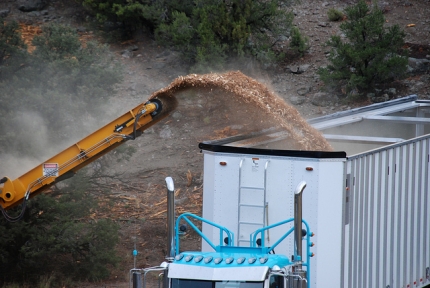
A truck is filled with wood chips as part of the process of turning wood into energy (Photo Credit: U.S. Department of Agriculture)
As a native of New Mexico, and a member of the Mescalero Apache Tribe, I was raised to appreciate the importance of natural resources and the responsibility we all have to care for our lands. This sense of stewardship has been further enhanced by my 27 years in the Bureau of Indian Affairs, as well as my prior experience as New Mexico State Forester, chair of the Council of Western State Foresters, and co-chair of the Western Forestry Leadership Coalition. I understand that improving the condition of our forests will improve economic opportunities for our tribal and rural communities.
The Forest Service is facing challenges associated with drought, wildfire, invasive species and unprecedented outbreaks of insects and disease. In 2012, the Forest Service estimated that between 65 and 82 million acres of national forests and grasslands are in urgent need of restoration -- more than four out of every 10 acres.
Building relationships and longstanding partnerships with tribes, states, private landowners and other stakeholders will help us address the issues facing the landscapes shared by us all – what we call an “all-lands, all-hands” approach. Working collaboratively with our partners, the Forest Service has announced a schedule to boost restoration and thinning programs by 20 percent each year in areas that face the greatest danger of a catastrophic fire. If we can use some of the woody biomass byproducts of these treatments for heat and electricity, we can leverage this restoration even further.
One of the grants we recently announced will go to Nulato, Alaska, to help the community design a wood-heating system to serve the local school and water plant. This will reduce dependence on costly fuel oil and create local jobs in delivering the wood through local businesses. In Tahola, Washington, the Quinault Indian Nation will design a thermal woody-biomass-fired energy system to serve their community facilities. In Superior, Montana, a wood pellet boiler has the potential to lower energy costs at the Mineral County Hospital’s new critical care center.
The grants build on President Obama’s strong record of supporting rural economies through the White House Rural Council. Established one year ago, the Rural Council has focused on maximizing the impact of federal investment to promote economic prosperity and improve the quality of life in rural communities. You can learn more about the Forest Service’s grant program and work to advance woody-biomass-to-energy projects here.
Arthur “Butch” Blazer is Deputy Under Secretary for Natural Resources and Environment at the U.S. Department of Agriculture
Learn more about Energy and EnvironmentA New Step Forward to Protect American Wind Energy Jobs
Posted by on August 2, 2012 at 7:30 PM EDTToday, in an overwhelmingly bipartisan vote, the Senate Finance Committee passed a one-year extension of the Production Tax Credit (PTC) for the domestic wind industry. For months, the President has been calling on Congress to extend the PTC – which is currently slated to expire at the end of 2012 – in order to save tens of thousands of jobs in the American wind industry, manufacturing industry, as well as the associated supply chain. We applaud the bipartisan leadership showcased today in the Finance Committee and urge the rest of Congress to follow the Committee’s lead as expeditiously as possible.
Renewing the PTC has been a top priority for the President because he views the American wind industry as an American success story. Over the past few years – thanks in part to the PTC – this industry has flourished. Today, we have enough wind capacity to power 10 million homes across the country. In 2011, which was a banner year for the industry, nearly one-third of all new power capacity in the United States came from wind.
Notably, as part of the package passed today in the Senate Finance Committee, an important provision was included that allows wind developers to use the Investment Tax Credit (ITC) instead of the Production Tax Credit, which is critical for offshore wind projects in particular.
In a parallel trend, the domestic content of wind turbines has increased dramatically in recent years. It used to be that we had to import most of the 8,000 component parts that go into a modern wind turbine. But today, with nearly 500 wind-related manufacturing facilities in 43 states, we’re producing more and more of those parts in America, which means job opportunities for tens of thousands of American workers in every corner of the country.
Learn more about Energy and EnvironmentBetter Building Federal Award Underway
Posted by on July 31, 2012 at 2:48 PM EDTThe nomination period for the 2013 Better Building Federal Award (BBFA) is now open. This contest builds on the Federal Government’s goal to reduce energy intensity – or energy consumed per square foot – by 30 percent by 2015 through encouraging, recognizing, and rewarding Federal agencies that achieve the greatest annual savings in energy intensity.
On December 2, 2011, the President announced the investment of nearly $4 billion in combined Federal and private sector energy upgrades to buildings. In this announcement, the President challenged the private and public sectors to make rapid investments in creating a more sustainable, energy-efficient workplace. As part of the Better Buildings Initiative, the White House Office of Science and Technology Policy and the Department of Energy challenged Federal agencies to nominate Federal facilities for the BBFA in a letter to Federal Building Managers.
Growing Our Economy Through the Great Outdoors
Posted by on July 31, 2012 at 8:55 AM EDTIt comes as no surprise that all living things require clean land, air and water. Does the U.S. economy require the same? A new report from the Outdoor Industry Association says, yes! According to the report, recreation in the United States supports 6.1 million jobs and drives $646 billion a year in direct consumer spending on recreational gear and travel. Even during these challenging economic times, the outdoor industry has been growing at a steady rate of 5 percent annually.
President Obama has proposed a $450 million investment in the Land and Water Conservation Fund (LWCF) for fiscal year 2013. The LWCF is a critical tool for protecting our forests, parks, rivers, open space and local sports fields. By using revenues from oil and gas drilling to invest in Federal, state and local conservation efforts, the LWCF has been used over the last 50 years to provide recreational opportunities in nearly every county in the Nation. Congress should follow the President’s lead by funding the LWCF, which will protect and enhance the local and state parks enjoyed by fly fishing enthusiasts around the country.
At the American Fly Fishing Trade Association, we understand the importance of protecting our public lands and fostering the economic contributions of outdoor enthusiasts. Manufacturers and retailers of fly-fishing products are not looking for a handout. What we envision is our Nation’s leaders working together to protect the public lands where citizens can use our products and ensure future generations have the same opportunities to recreate as we do today. We should all be able to agree that protecting the public’s access to the outdoors now and for future generations is not only common sense, but also the ideal job creator.
Ben Bulis is the President of the American Fly Fishing Trade Association
Learn more about Energy and EnvironmentA Long-Term Game Plan for Solar Energy Development on our Public Lands
Posted by on July 27, 2012 at 2:32 PM EDTSecretary Salazar’s Interior Department has made dramatic progress in siting utility-scale renewable energy projects on our public lands over the past three years. When President Obama came into office in January 2009, there were no solar projects permitted on our public lands -- despite the availability of world class solar resources in the tens of millions of acres of public lands in the sunny desert southwest.
What a difference three years can make. As of July 2012, our Department has permitted 31 major renewable energy projects with the capacity to generate nearly 7,000 megawatts and meet the power needs of about two million homes. A majority of that new renewable energy involves utility-scale solar projects. Indeed, workers are constructing – right now -- some of the world’s largest solar facilities in the deserts of California and Nevada.
Learn more about Energy and Environment


Related Videos
-
 May 09, 2014 9:21 AM
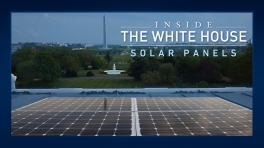
Inside the White House: Solar Panels
-
 September 01, 2016 9:25 PM
President Obama Delivers a Statement to the Press
White House Blogs
- The White House Blog
- Middle Class Task Force
- Council of Economic Advisers
- Council on Environmental Quality
- Council on Women and Girls
- Office of Intergovernmental Affairs
- Office of Management and Budget
- Office of Public Engagement
- Office of Science & Tech Policy
- Office of Urban Affairs
- Open Government
- Faith and Neighborhood Partnerships
- Social Innovation and Civic Participation
- US Trade Representative
- Office National Drug Control Policy