

Latest News
Expanding Opportunity in Indian Country
Posted by on March 20, 2014 at 10:09 AM EDT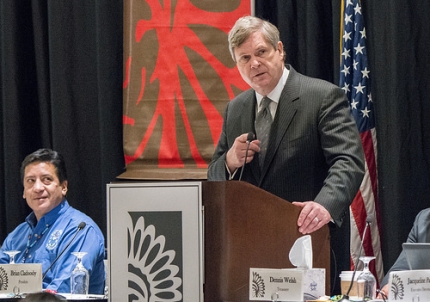
Secretary Vilsack speaks to National Congress of American Indians Tribal Nations Legislative Summit in Washington, DC. March 13, 2014. (by The U.S. Department of Agriculture)
Earlier today, Secretary Vilsack published an op-ed in Indian Country Today discussing USDA’s efforts to improve access to capital for Tribal citizens. You can read the original op-ed here.Last week, I spoke to several hundred tribal leaders at the National Congress of American Indians Tribal Nations Legislative Summit here in Washington, DC. The conversation was wide ranging, but boiled down to two key topics: what have we achieved, and how can USDA programs better support sustained economic growth in Indian Country?USDA and our partners in Indian Country have made significant improvements to critical infrastructure over the past five years. In the past year alone, USDA invested more than $625 million in Indian Country through our Rural Development programs. We have worked with Tribes to bring new and improved electric infrastructure to Tribal lands and financed Tribal community facilities, including schools, medical facilities and Tribal colleges and universities.Upgraded facilities improve the quality of life in Tribal communities and provide state-of-the-art healthcare, education and training, particularly for young people. Still, retaining talented young people in Tribal communities remains a challenge. This is not an issue exclusive to Indian Country—we face the same challenge of brain drain across rural America.From my perspective, Tribal-owned farming and ranching operations and small agribusinesses represent an enormous opportunity for Tribal Nations to create the kinds of jobs and opportunity that encourage young leaders and entrepreneurs to put down roots in Indian Country.Certainly, there is significant value in expanding access to healthy foods for Tribal citizens and teaching Tribal youth about traditional foods. At the same time, Tribal-owned businesses also expand economic development by infusing depressed areas with new in-flows of cash and encouraging those dollars to be spent locally.While many tribes have commercial farms and ranches, others are just now re-entering farming or ranching, as many did not have access to the land or capital required to operate until relatively recently. Access to capital and resources can make or break these operations, and, while not a situation unique to Indian Country, credit histories or a lack of records, including tax filings, can make accessing credit a barrier for individuals and small businesses.USDA is here to help. Our agency staffs understand the unique challenges that face farmers, ranchers and entrepreneurs in Indian Country and stand ready to help navigate the landscape of USDA tools and resources.One of the ways we do this is through the Obama Administration’s place-based initiatives, exemplified by the first tribal Promise Zone — the Choctaw Nation of Oklahoma — and USDA’s StrikeForce for Rural Growth and Opportunity, which works across the country and in 13 states with American Indian and Alaska Native communities. We partner with community organizations and technical assistance providers in these areas, like the Intertribal Agriculture Council, and provide extra help as they apply for grants, loans and other resources.Initiatives like the Promise Zones and StrikeForce are just examples of the ways USDA has focused on place-based investments in rural and tribal areas. For example, our microloan program, which is a new initiative managed by our Farm Service Agency, offers small loans of up to $35,000 under a simplified application process with no down payment required. The idea is that by shortening the application process, reducing loan paperwork, and expanding the types of experiences that qualify toward meeting the loan requirements, we can better reach and assist smaller and niche-type operations.It’s working: since the program began last year, we’ve extended $97 million dollars to more than 4,900 farmers and ranchers, including those in Indian Country. A $35,000 microloan helped one Native American rancher in New Mexico purchase 25 bred cows and begin working her own lease and grazing allotment on Navajo Nation, after being unable to obtain credit elsewhere. In Washington State, a $30,000 microloan helped a Native farmer purchase haying equipment. He wasn’t able to access commercial credit, but the USDA microloan enables him to continue farming while building a credit history for his future.These are just a few examples of the myriad ways USDA works with Tribes. Whether you are a Tribe interested in a wide variety of construction and business possibilities or a Tribal citizen interested in establishing or expanding your farm, ranch or small business, I encourage you to work with our Office of Tribal Relations to get a broad spectrum perspective on the resources available through USDA.I can say with confidence that we’ve worked hard over the past five years to change the culture of USDA and improve the way we work with Tribes to support their goals. The challenges in Indian Country and across rural America are not insurmountable. It will take time, but I know that with continued collaboration between Tribal communities, USDA and a wide range of public and private partners, we can achieve long-term economic prosperity in Indian Country.Tom Vilsack is the Secretary of the U.S. Department of AgricultureLearn more aboutDiscussing President Obama's My Brother's Keeper Initiative
Posted by on March 19, 2014 at 3:47 PM EDTEd. note: This is cross-posted from ED.gov
This Thursday, from March 20, 2014 from 12-1 p.m. ET the White House Initiative on Educational Excellence for African Americans will host its next installment of #AfAmEdChat. This edition will focus on President Obama’s new #MyBrothersKeeper initiative. “By increasing awareness of the President’s initiative My Brother’s Keeper we can each take concrete steps to reduce the barriers that race and poverty play in denying equality of opportunity” shares Deputy Secretary of Education, Jim Shelton.
The March 20th #AfAmEdChat is one of a series of strategies the White House Initiative on Educational Excellence for African Americans is using to bring people together around issues and ideas supporting the achievement of boys and men of color. Deputy Secretary Shelton notes “Social media is the fastest and easiest way to spark discussion and exchange ideas. Conversations about race and poverty are often difficult to have face to face and are often therefore avoided.” President Obama reminded us during the launch of My Brother’s Keeper, and Shelton adds “the unique challenges facing boys and men of color should never be swept under the rug.”
According to Deputy Secretary Shelton, “folks should tune into the My Brother’s Keeper #AfAmEdChat to stay in touch with the latest details and help move the conversation forward. We will be sharing information regarding our process and next steps as well as ways for you to be involved and updated in this critical work.”
In addition to White House Initiative on Educational Excellence for African Americans Executive Director David J. Johns and Policy Advisor Christopher Scott, confirmed guests include:
-
Mike Blake – Green For All – Director of Public Policy & External Affairs & Operation Hope – Senior Advisor – @MrMikeBlake
-
Mary Brown – Executive Director, Life Pieces to Masterpieces – @LP2MP
-
Christopher Chatmon – Executive Director, African American Male Achievement, Oakland Unified School District – @AAMAOUSD
-
Shawn Dove – Manager of Open Society Foundations Campaign for Black Male Achievement – @DoveSoars
-
Angela Glover–Blackwell – Founder and Chief Executive Officers, PolicyLink – @policylink
- Shaun Harper – Executive Director, Center for the Study of Race & Equity in Education at University of Pennsylvania – @DrShaunHarper
Additionally, to support the work of My Brothers Keeper, the Initiative is hosting a series of Summits on Educational Excellence for African Americans in cities across the Nation to directly engage young people, schools, communities, philanthropy and businesses interested in implementing successful strategies. To learn more and to register for a Summit near you visit www.ed.gov/AfAmEducation
Khalilah Harris is a fellow with the White House Initiative on Educational Excellence for African-Americans.
Learn more about-
Mike Blake – Green For All – Director of Public Policy & External Affairs & Operation Hope – Senior Advisor – @MrMikeBlake
Nominate a White House Champion of Change for Expanding Reentry Employment Opportunities
Posted by on March 19, 2014 at 9:01 AM EDTStable employment – like stable housing, family and community support, and access to substance abuse and mental health treatment – is critical to the rehabilitation, stability and successful reentry of individuals who have been incarcerated and are returning to our communities. Research shows that those who have been employed even for a year or less are far less likely to commit another crime. That is why the innovative work of local and state community leaders to help those with criminal records re-enter society with dignity and viable employment opportunities is so important. Their leadership is improving public safety and giving individuals who have paid their debt to society a real second chance to support their families and contribute to our economy.
For individuals who are returning to their communities and working hard to stay on the right track, limited access to employment can present insurmountable difficulties for them and their families, but the impact is even more far-reaching. For example, the potential effect on our economy and job growth is substantial. Individuals with criminal histories are thought to lower employment rates for men by 1.5 to 1.7 percentage points, resulting in a loss of output between $57 and $65 billion over the span of a year. The overall loss of productivity and purchasing power is a drag on our economy; so, if reentry fails, we all pay the price.
In light of this reality, and as part of its overarching efforts to restore the economy and get Americans back to work, the Administration is working to reduce barriers to employment for individuals with past criminal involvement, so that these individuals – once their debt is paid – can compete for appropriate work opportunities in order to support themselves and their families, pay their taxes, and contribute to the economy. For example, the Federal Interagency Reentry Council, chaired by Attorney General Eric Holder and comprised of 20 federal agencies, was launched in 2011 with one main goal – to make communities safer by facilitating successful reentry for the formerly incarcerated, including in the area of employment. The Department of Justice and the Department of Labor (DOL) have provided substantial funding under the Second Chance Act and Workforce Investment Act for workforce development and support services to the formerly incarcerated; and the Department of Education has implemented programming to support successful reentry from adult and juvenile correctional facilities into education, employment and community programs. And recently, the Equal Employment Opportunity Commission, DOL and the Office of Personnel Management have provided guidance to employers on how to navigate employment decisions involving job applicants with criminal histories. Taken together, these developments provide important supports for those who have served their time and seek to re-join their communities as contributing citizens.
Today, we are asking you to help us identify and honor extraordinary individuals who are enabling employment opportunities for formerly incarcerated individuals. These leaders will be invited to the White House to celebrate their accomplishments and showcase their actions to support stronger and safer communities. Please nominate a Champion of Change HERE by noon on Friday, April 4, 2014. Nominees may include individuals who are:
-
Providing job opportunities to individuals with a criminal record and/or creating and implementing model screening or hiring policies,
-
Personally demonstrating an exemplary record of employment or entrepreneurial success after incarceration and in turn providing employment opportunities and mentorship to the reentry population,
-
Creating effective education, training, mentoring and other transitional programs to help individuals with a criminal record improve employment outcomes,
-
Advocating for policy and legislative changes that lead to increased employment opportunities for individuals with a criminal record; and/or
- Leveraging technology to increase access to employment-related reentry services or education and skills-building for individuals with a criminal record.
Click on the link below to submit your nomination (be sure to choose Reentry Employment Opportunities in the “Theme of Service” field of the nomination form).
Nominate a Reentry Champion of Change Here
We are looking forward to hosting this event and to highlighting the great work communities across the country are doing to advance the health, safety and well-being of the American people.
Tonya Robinson is the Special Assistant to the President for Justice and Regulatory Policy for the White House Domestic Policy Council.
Learn more about-
Providing job opportunities to individuals with a criminal record and/or creating and implementing model screening or hiring policies,
President's budget promises big benefits for Tribal Lands
Posted by on March 19, 2014 at 8:46 AM EDTLast week, I had a chance to visit with the National Congress of American Indians to talk about President Obama's transportation budget proposal and what it means for our tribal lands. And the news was very good.We all know that transportation isn't just about how we get from one point to another – it's, what President Obama likes to call, a ladder of opportunity.This is especially true in Indian Country, where a rebuilt road or a new transit system can make the difference in a child getting to school, a father getting to work, or a tribal elder getting to the doctor.That's why the Department of Transportation has a long history of partnering with tribal communities to build the roads, bridges, and transit systems they need to succeed.First, we have the Tribal Transportation Program, which helps tribes improve safety and public roads access to and within their lands.Last year, as part of this program, we awarded $8.6 million in Tribal Transportation Safety Funds to 183 tribes. This is improving road safety on tribal lands, which have consistently ranked among the nation’s highest road fatality rates.The Tribal Transportation Program is already making a huge difference. And under President Obama’s budget proposal, it will be able to make an even bigger impact – with funding increasing from $450 million per year to $507 million in 2015.In addition to the work we’re doing on roads and bridges, we’re also committed to making sure tribal communities have access to transit services that connect to jobs, schools, and health care. That’s why we’re proud to support the Tribal Transit Program, which provides grants for tribes to build and operate public transit programs and services.Under MAP-21, funding for this program doubled to $30 million per year. In fact, today, the Federal Transit Administration announced the award of $5 million in competitive funds to 42 American Indian and Alaska Native tribes in 19 states for projects to improve transit service. The funds complement $25 million allocated by formula to eligible tribal recipients for FY 2014. The combined $30 million investment – double the amount available in prior years – supports efforts to enhance public transit service on rural tribal lands and better connect tribal members and other residents.And in the President’s budget, the program’s funding level would rise again –to $35 million in FY 2015.Indian Country has also benefitted substantially from our TIGER grant program - with tribal projects receiving nearly $80 million in funding since 2009.For example, the Navajo Division of Transportation received a $31 million TIGER grant to add two lanes to US-491 – boosting capacity and improving safety on a critical corridor that connects Navajo Nation to other parts of New Mexico and Colorado.And with DOT now taking applications for our sixth round of TIGER, which will award $600 million this year, I hope to see tribal projects well-represented once again.As you can see, we're already making a substantial difference in tribal communities – improving safety and ensuring access to the transportation services residents and businesses need to thrive in the 21st century.And thanks to President Obama's vision for transportation – and the bill we'll soon be submitting to Congress – we'll be able to do even more to boost economic opportunity for America's tribal nations.Victor Mendez is Acting Deputy U.S. Secretary of Transportation.Learn more aboutMaking Health Care Coverage More Accessible and Equitable for Same-Sex Couples
Posted by on March 14, 2014 at 1:58 PM EDTEd. note: This is cross-posted from the Department of Health and Human Services' health care blog. See the original post here.
Today, the Department of Health and Human Services took one more step toward making health care coverage more accessible and equitable for married same-sex couples.
Already, thanks to the Affordable Care Act, more than 4.2 million people have signed up for private health insurance plans through the Health Insurance Marketplace. Marketplace plans cover essential health benefits like emergency services, prescription drugs and mental health and substance use disorder services. And preventive services like flu shots, blood pressure screening and HIV screening are covered at no additional charge.
Moreover, all health plans sold in the Marketplace have to follow rules that make health care more accessible for everyone. You can’t be denied coverage for a pre-existing condition, like HIV/AIDS or cancer, and you can’t be charged more for being a woman.
Today, we are clarifying that, starting next year, if an insurance company offers coverage to opposite-sex spouses, it cannot choose to deny that coverage to same-sex spouses. In other words, insurance companies will not be permitted to discriminate against married same-sex couples when offering coverage. This will further enhance access to health care for all Americans, including those with same-sex spouses.
Learn more about Health CareWe're looking for a few good... Champions of Change
Posted by on March 14, 2014 at 12:26 PM EDTEd. note: This is cross-posted from the United States Department of Transportation.
The work we do at DOT cannot be done without our partners. Whether we're investing in safety, seeking innovation, or solving regional transportation challenges, success often depends on exceptional groups and individuals doing the heavy lifting and setting the bar high for the rest of us. That's why the Obama Administration has been recognizing Champions of Change in different fields, including transportation.
Like previous winner Beverly Scott--the MARTA CEO who actually painted red X's on Atlanta buses to show what transit service cuts would mean to commuters--one person with one idea can make a world of difference.
And just as that holds true with transit in Atlanta, it also holds true in the difficult challenge of connecting people to ladders of opportunity like good jobs, education, and important services.
But our country's continued economic growth depends on meeting that access challenge, so this May, DOT and the White House Office of Public Engagement will host a Champions of Change event focused onTransportation and Ladders of Opportunity.
Selected Champions will be individuals who have provided exemplary leadership to ensure that transportation facilities, services, and jobs help individuals and their communities connect to 21st century opportunities. A champion’s work may include transportation projects, services, or advocacy across any mode of transportation.
Examples include:
-
Providing leadership in planning, design, and development of innovative transportation solutions that result in connected communities
-
Advancing the use of equity based performance measures and planning initiatives at the state and/or community level
-
Developing and/or implementing transportation safety strategies or innovative transportation safety programs for communities for minority, older adults, limited English proficiency or other at-risk communities
-
Establishing transportation workforce training initiatives for disadvantaged workers, including at-risk youth, minority, low income, women, veterans, people with disabilities and others
-
Implementing innovative public engagement strategies that ensure full participation by all citizens across the community
-
Providing strategies for streamlining project delivery that provide efficiency and economic benefits for the community
-
Demonstrating best practices in environmental justice related to transportation projects
-
Advancing innovative strategies for utilizing disadvantaged businesses in transportation projects
-
Demonstrating leadership in efforts to enhance transportation services for people who may not have access to personal vehicles, including people with disabilities, older adults, and/or people with lower incomes
- Applying technologies that advance access to transportation for underrepresented communities
If you know of someone making a difference in one or more of these ways, help us share their achievement by nominating them as a White House Champion of Change today!
Nominations are due by Thursday March 27, 2014, and we've made it easy by offering you two ways to submit your nomination:
-
Download our Nomination Form, complete it, and email it tochampions@dot.gov; or
- Use our handy online Nomination Form.
However you share your nomination, please let us hear from you. It's a great way to recognize someone making a difference in their community. And it's a great way of inspiring other problem-solvers and innovators to continue pursuing their work.
In his blog post yesterday, Secretary Foxx talked about the important quality of “good, old-fashioned American inventiveness.” Today, we’re asking you to help us shine a light on that quality, wherever you find it.
-
Providing leadership in planning, design, and development of innovative transportation solutions that result in connected communities
Let’s Make Some Noise—It’s Purim!
Posted by on March 14, 2014 at 10:57 AM EDTTomorrow evening, Jews in America, Israel and around the globe will celebrate Purim, a holiday known for costumes, carnivals and noisemakers. Even rabbis and synagogue presidents dress up for a playful re-telling of the holiday story during Purim spoofs called spiels. With all the fun of the holiday, it’s also important to remember Purim’s more serious underlying themes of persecution and survival in the face of the planned genocide of ancient Persia’s Jews. Based on events over 2,000 years ago, these themes resonate throughout the centuries and in today’s world as well. By speaking up and speaking out, justice will triumph over evil.
NTIA Brings Broadband Opportunities to Alaska
Posted by on March 11, 2014 at 12:26 PM EDTEd. note: This blog is cross-posted from The U.S. Department of Commerce.
Last week, I traveled to Anchorage for the annual economic summit hosted by the Southwest Alaska Municipal Conference, a non-profit regional economic development organization. The Southwest Alaska Municipal Conference is working to improve the quality of life and drive responsible development across the Alaska Peninsula, the Aleutian Islands, Bristol Bay, the Kodiak Archipelago and the Pribilof Islands.
Last week’s summit had a packed agenda, covering everything from energy conservation to sustainable fishing practices. One big topic of conversation was broadband and the power of high-speed Internet to open up economic, educational and social opportunities in some of the poorest, most isolated communities in our nation.
It’s no wonder that the Alaska state nickname is “The Last Frontier.” The state is more than double the size of Texas, with more than 3 million lakes, 34,000 miles of shoreline, and 29,000 square miles of ice fields. But with fewer than 750,000 residents, Alaska includes some of the most remote, sparsely populated pockets of the U.S. Many Alaska Natives reside in tiny villages with just a few hundred people and lead subsistence lifestyles.
Broadband offers these communities a way to connect with the wider world and access everything from online classes to healthcare services to job opportunities. It also offers Alaska Natives a way to preserve their indigenous culture for future generations and share it with a global audience.
- &lsaquo previous
- …
- 40
- 41
- 42
- 43
- 44
- 45
- 46
- 47
- 48
- …
- next &rsaquo
Twitter