
Sharing Ideas that Work: How Technology can Improve Education

Digital Promise site visit to Olympus Academy in Canarsie, Brooklyn. (Photo by Digital Promise)
Below, Sara Shapiro, Digital Promise’s Director of the League of Innovative Schools, answers questions about this week’s meeting and next steps for Digital Promise.
What is Digital Promise and the League of Innovative Schools?
Digital Promise is a national, bipartisan, nonprofit center based in Washington, D.C. Chartered by Congress and launched in late 2011 by President Obama, Digital Promise is dedicated to advancing breakthrough educational technology through research, rapid evaluation, and knowledge sharing. The Digital Promise League of Innovative Schools is borne out of that last component—knowledge sharing. With 32 members representing 2.5 million students in 21 states nationwide, the League is a way for school districts to share ideas, results, and even resources as they tackle contemporary and future challenges in education. You can learn more about Digital Promise in our recently released annual report.
Why are you gathering this week in New York City?
The meeting of the League of Innovative Schools in New York City this week is co-hosted by the New York City Department of Education. New York City is the largest school district in the country, representing 1.1 million students. It is its own ecosystem of ideas, a place where great teaching methods or effective uses of capital can be lost within a classroom, school building, or department. New York City created the iZone to prevent that from happening. The iZone is a network of schools where instructional practices, school models, and technology can be piloted, tested, and evaluated.
For example, there are schools in the iZone where students learn asynchronously, based not on seat time, but on mastery of skills. The iZone is also running a prize competition for software developers creating apps that improve math achievement. When ideas work, they are scaled to benefit the most students possible. When they don’t, lessons are learned and adjustments are made.
New York Department of Education is focused on sharing ideas that work through the iZone. How is this similar to the League's national approach?
This “ideas economy” can be used on a number of levels—within a school district, within a network of districts like the League of Innovative Schools, or within an entire industry.
At our meeting this week, officials from Meridian, Idaho, a district of 36,000 students, will share how they redesigned five classrooms using different technology-integrated learning models, as part of a pilot being evaluated by researchers from Northwestern University. When Meridian shares the story of this pilot, leaders from Chicago Public Schools or Tucson’s Sunnyside Unified School District will be listening and looking for ways to apply the approach to their own classrooms. And, through the League, those same leaders will have immediate access to the results gathered at Northwestern University.
What’s next for Digital Promise and the League of Innovative Schools?
We’ve got lots of exciting work underway, so stay tuned. For example, we’re committed to using incentive prizes to address barriers facing member school districts and advance the understanding about when incentive prizes work best in education.
Also, to allow all League districts to rapidly prototype and scale up innovative online curricula, we created the Digital Online Content Evaluation Network (DOCENT), a cloud-based collection of established and emerging digital curricula that will make innovative new digital learning tools available to League members and that will leverage the buying power of all League members to be utilized in licensing these hosted tools.
Cristin Dorgelo is Assistant Director for Grand Challenges at OSTP
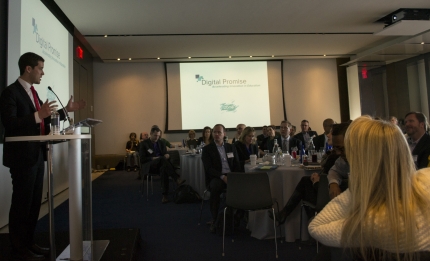
Opening remarks at the March 2013 Digital Promise meeting in New York City. (Photo by Digital Promise)

White House Blogs
- The White House Blog
- Middle Class Task Force
- Council of Economic Advisers
- Council on Environmental Quality
- Council on Women and Girls
- Office of Intergovernmental Affairs
- Office of Management and Budget
- Office of Public Engagement
- Office of Science & Tech Policy
- Office of Urban Affairs
- Open Government
- Faith and Neighborhood Partnerships
- Social Innovation and Civic Participation
- US Trade Representative
- Office National Drug Control Policy
categories
- AIDS Policy
- Alaska
- Blueprint for an America Built to Last
- Budget
- Civil Rights
- Defense
- Disabilities
- Economy
- Education
- Energy and Environment
- Equal Pay
- Ethics
- Faith Based
- Fiscal Responsibility
- Foreign Policy
- Grab Bag
- Health Care
- Homeland Security
- Immigration
- Innovation Fellows
- Inside the White House
- Middle Class Security
- Open Government
- Poverty
- Rural
- Seniors and Social Security
- Service
- Social Innovation
- State of the Union
- Taxes
- Technology
- Urban Policy
- Veterans
- Violence Prevention
- White House Internships
- Women
- Working Families
- Additional Issues