West Wing Week 12/2/11 or "Bo Meets Bo"

December 01, 2011 | 4:02 | Public Domain

This week, as the President urged Republicans to join a Democratic effort to prevent a thousand dollar tax increase on the typical American family, the White House got spruced up for the holidays. The President also hosted the EU Summit, the Dutch Prime Minister, and announced a new commitment to fighting AIDS in America and around the world. He also lit the National Christmas Tree. That's November 25th to December 1st, or "Bo Meets Bo."

Download mp4 (128MB)

Senate Vote Against the Payroll Tax Cut: "Unacceptable"

Just now, Republicans in the Senate rejected an extension of the payroll tax cut that is set to expire at the end of the month. In a statement, President Obama called that vote "unacceptable" -- and urged Congress to stop playing politics:

Tonight, Senate Republicans chose to raise taxes on nearly 160 million hardworking Americans because they refused to ask a few hundred thousand millionaires and billionaires to pay their fair share. They voted against a bill that would have not only extended the $1,000 tax cut for a typical family, but expanded that tax cut to put an extra $1,500 in their pockets next year, and given nearly six million small business owners new incentives to expand and hire. That is unacceptable. It makes absolutely no sense to raise taxes on the middle class at a time when so many are still trying to get back on their feet.

Now is not the time to put the economy and the security of the middle class at risk. Now is the time to rebuild an economy where hard work and responsibility pay off, and everybody has a chance to succeed. Now is the time to put country before party and work together on behalf of the American people. And I will continue to urge Congress to stop playing politics with the security of millions of American families and small business owners and get this done.

Related Topics: Economy, Taxes

The White House

Office of the Press Secretary

Statement by the President

Tonight, Senate Republicans chose to raise taxes on nearly 160 million hardworking Americans because they refused to ask a few hundred thousand millionaires and billionaires to pay their fair share.  They voted against a bill that would have not only extended the $1,000 tax cut for a typical family, but expanded that tax cut to put an extra $1,500 in their pockets next year, and given nearly six million small business owners new incentives to expand and hire.  That is unacceptable.  It makes absolutely no sense to raise taxes on the middle class at a time when so many are still trying to get back on their feet.

Now is not the time to put the economy and the security of the middle class at risk. Now is the time to rebuild an economy where hard work and responsibility pay off, and everybody has a chance to succeed.  Now is the time to put country before party and work together on behalf of the American people.  And I will continue to urge Congress to stop playing politics with the security of millions of American families and small business owners and get this done.

National Christmas Tree Lighting Ceremony

December 01, 2011 | 7:54 | Public Domain

President Obama speaks before the lighting of the National Christmas Tree on the Ellipse.

Download mp4 (76MB) | mp3 (7MB)

Read the Transcript

Remarks by the President at Lighting of the National Christmas Tree

5:31 P.M. EST

        THE PRESIDENT:  It’s nice having your own band.  Please have a seat, everyone.  Merry Christmas!  Merry Christmas!

        Thank you, Secretary Salazar, for that introduction and for your hard work to preserve and protect our land and our water and our wildlife.  I also want to thank Minister Rogers for the beautiful invocation, as well as Neil Mulholland and everyone at the National Park Foundation and the National Park Service who helped put this outstanding event together.  I’d like to thank Carson Daly and Big Time Rush, and all of tonight’s performers for joining us to kick off the holiday season here at the White House.

        For 89 years, Presidents and Americans have come together to light the National Christmas Tree.  And this year is a special one.  This year, we have a brand new tree.  The last one stood here for more than 30 years -- until we lost it in a storm earlier this year.  But we all know that this tradition is much larger than any single tree.  And tonight, once again, we gather here not simply to light some decorations, but to honor a story that lights the world.

        More than 2,000 years ago, a child was born to two faithful travelers who could find rest only in a stable, among the cattle and the sheep.  But this was not just any child.  Christ’s birth made the angels rejoice and attracted shepherds and kings from afar.  He was a manifestation of God’s love for us.  And He grew up to become a leader with a servant’s heart who taught us a message as simple as it is powerful:  that we should love God, and love our neighbor as ourselves.  

        That teaching has come to encircle the globe.  It has endured for generations.  And today, it lies at the heart of my Christian faith and that of millions of Americans.  No matter who we are, or where we come from, or how we worship, it’s a message that can unite all of us on this holiday season.  

        So long as the gifts and the parties are happening, it’s important for us to keep in mind the central message of this season, and keep Christ’s words not only in our thoughts, but also in our deeds.  In this season of hope, let’s help those who need it most –- the homeless, the hungry, the sick and shut in.  In this season of plenty, let’s reach out to those who struggle to find work or provide for their families.  In this season of generosity, let’s give thanks and honor to our troops and our veterans, and their families who've sacrificed so much for us.  And let’s welcome all those who are happily coming home.  (Applause.)  

        And this holiday season, let us reaffirm our commitment
        to each other, as family members, as neighbors, as Americans, regardless of our color or creed or faith.  Let us remember that we are one, and we are a family.

        So on behalf of Malia and Sasha and Michelle and our grandmother-in-chief, Marian -- (laughter) -- I wish you all the happiest holiday season, the merriest of Christmases.  God bless you all, and may God bless the United States of America.  (Applause.)

        And with that, I'm going to invite the entire Obama clan up here to light the Christmas tree.  I need some help, and there's a lot of technical aspects to this.  (Laughter.)  Come on, guys.  (Applause.)  All right.  

        Okay, we're going to start counting down here.  We've got the switch right here.

        MRS. OBAMA:  All right, come on.

        THE PRESIDENT:  Everybody ready?  And this is the new tree.  I know it's not quite as big as the old tree, but it's going to take time to grow.  But we're going to fill it up with some  spirit and start a new tradition right now.

        All right, everybody ready?  We're going to start counting down.  Five, four, three, two, one -- (applause.)  There you go.  That's a good-looking tree.  Thank you, everyone.

END 5:35 P.M. EST

Close Transcript

The White House

Office of the Press Secretary

Presidential Nomination and Withdrawal Sent to the Senate

NOMINATION SENT TO THE SENATE:

Marilyn B. Tavenner, of Virginia, to be Administrator of the Centers for Medicare and Medicaid Services, vice Donald M. Berwick, resigned.

WITHDRAWAL SENT TO THE SENATE:

Donald M. Berwick, of Massachusetts, to be Administrator of the Centers for Medicare and Medicaid Services, vice Mark B. McClellan, which was sent to the Senate on January 26, 2011.

The White House

Office of the Press Secretary

Remarks by the President at Lighting of the National Christmas Tree

The Ellipse

5:31 P.M. EST

        THE PRESIDENT:  It’s nice having your own band.  Please have a seat, everyone.  Merry Christmas!  Merry Christmas!

        Thank you, Secretary Salazar, for that introduction and for your hard work to preserve and protect our land and our water and our wildlife.  I also want to thank Minister Rogers for the beautiful invocation, as well as Neil Mulholland and everyone at the National Park Foundation and the National Park Service who helped put this outstanding event together.  I’d like to thank Carson Daly and Big Time Rush, and all of tonight’s performers for joining us to kick off the holiday season here at the White House.

        For 89 years, Presidents and Americans have come together to light the National Christmas Tree.  And this year is a special one.  This year, we have a brand new tree.  The last one stood here for more than 30 years -- until we lost it in a storm earlier this year.  But we all know that this tradition is much larger than any single tree.  And tonight, once again, we gather here not simply to light some decorations, but to honor a story that lights the world.

        More than 2,000 years ago, a child was born to two faithful travelers who could find rest only in a stable, among the cattle and the sheep.  But this was not just any child.  Christ’s birth made the angels rejoice and attracted shepherds and kings from afar.  He was a manifestation of God’s love for us.  And He grew up to become a leader with a servant’s heart who taught us a message as simple as it is powerful:  that we should love God, and love our neighbor as ourselves.  

        That teaching has come to encircle the globe.  It has endured for generations.  And today, it lies at the heart of my Christian faith and that of millions of Americans.  No matter who we are, or where we come from, or how we worship, it’s a message that can unite all of us on this holiday season.  

        So long as the gifts and the parties are happening, it’s important for us to keep in mind the central message of this season, and keep Christ’s words not only in our thoughts, but also in our deeds.  In this season of hope, let’s help those who need it most –- the homeless, the hungry, the sick and shut in.  In this season of plenty, let’s reach out to those who struggle to find work or provide for their families.  In this season of generosity, let’s give thanks and honor to our troops and our veterans, and their families who've sacrificed so much for us.  And let’s welcome all those who are happily coming home.  (Applause.)  

        And this holiday season, let us reaffirm our commitment
        to each other, as family members, as neighbors, as Americans, regardless of our color or creed or faith.  Let us remember that we are one, and we are a family.

        So on behalf of Malia and Sasha and Michelle and our grandmother-in-chief, Marian -- (laughter) -- I wish you all the happiest holiday season, the merriest of Christmases.  God bless you all, and may God bless the United States of America.  (Applause.)

        And with that, I'm going to invite the entire Obama clan up here to light the Christmas tree.  I need some help, and there's a lot of technical aspects to this.  (Laughter.)  Come on, guys.  (Applause.)  All right.  

        Okay, we're going to start counting down here.  We've got the switch right here.

        MRS. OBAMA:  All right, come on.

        THE PRESIDENT:  Everybody ready?  And this is the new tree.  I know it's not quite as big as the old tree, but it's going to take time to grow.  But we're going to fill it up with some  spirit and start a new tradition right now.

        All right, everybody ready?  We're going to start counting down.  Five, four, three, two, one -- (applause.)  There you go.  That's a good-looking tree.  Thank you, everyone.

END 5:35 P.M. EST

President Obama on World AIDS Day

December 01, 2011 | 13:47 | Public Domain

The President announced new commitments to fight AIDS in the US at the “The Beginning of the End” event sponsored by the ONE and (Red) campaigns.

Download mp4 (132MB) | mp3 (13MB)

Read the Transcript

Remarks by the President on World AIDS Day

George Washington University
Washington, D.C.

10:27 A.M. EST

THE PRESIDENT:  Well, thank you, Sanjay.  It is an honor to be with you today and to follow President Kikwete and President Bush.  To Bono and Alicia, to the ONE campaign, thank you for bringing us together.  Because of your work, all across Africa there are children who are no longer starving, mothers who are no longer dying of treatable diseases, fathers who are again providing for their families.  And because of all of you, so many people are now blessed with hope.

We’ve got members of Congress who have done so much for this cause who are here today, and we want to thank them.  Let me also thank President Bush for joining us from Tanzania and for his bold leadership on this issue.  I believe that history will record the President’s Emergency Plan for AIDS Relief as one of his greatest legacies.  And that program -- more ambitious than even the leading advocates thought was possible at the time -- has saved thousands and thousands and thousands of lives, and spurred international action, and laid the foundation for a comprehensive global plan that will impact the lives of millions.  And we are proud that we have the opportunity to carry that work forward.

Today is a remarkable day.  Today, we come together as a global community, across continents, across faiths and cultures, to renew our commitment to ending the AIDS pandemic once and for all.

Now, if you go back and you look at the themes of past World AIDS Days, if you read them one after another, you’ll see the story of how the human race has confronted one of the most devastating pandemics in our history.  You’ll see that in those early years -- when we started losing good men and women to a disease that no one truly understood -- it was about ringing the alarm, calling for global action, proving that this deadly disease was not isolated to one area or one group of people.

And that’s part of what makes today so remarkable, because back in those early years, few could have imagined this day -- that we would be looking ahead to “The Beginning of the End,” marking a World AIDS Day that has gone from that early beginning when people were still uncertain to now a theme, “Getting to Zero.”  Few could have imagined that we’d be talking about the real possibility of an AIDS-free generation.  But that’s what we’re talking about.  That’s why we’re here.  And we arrived here because of all of you and your unwavering belief that we can -- and we will -- beat this disease.

Because we invested in anti-retroviral treatment, people who would have died, some of whom are here today, are living full and vibrant lives.  Because we developed new tools, more and more mothers are giving birth to children free from this disease.  And because of a persistent focus on awareness, the global rate of new infections and deaths is declining.

So make no mistake, we are going to win this fight.  But the fight is not over -- not by a long shot.  The rate of new infections may be going down elsewhere, but it’s not going down here in America.  The infection rate here has been holding steady for over a decade.  There are communities in this country being devastated, still, by this disease. 

When new infections among young black gay men increase by nearly 50 percent in 3 years, we need to do more to show them that their lives matter.  When Latinos are dying sooner than other groups, and when black women feel forgotten, even though they account for most of the new cases among women, then we’ve got to do more.

So this fight is not over.  Not for the 1.2 million Americans who are living with HIV right now.  Not for the Americans who are infected every day.  This fight is not over for them, it’s not over for their families, and as a consequence, it can’t be over for anybody in this room -- and it certainly isn’t over for your President.

Since I took office, we’ve had a robust national dialogue on HIV/AIDS.  Members of my administration have fanned out across the country to meet people living with HIV; to meet researchers, faith leaders, medical providers and private sector partners.  We’ve spoken to over 4,000 people.  And out of all those conversations, we drafted a new plan to combat this disease.  Last year, we released that plan -- a first-ever national HIV/AIDS strategy.

We went back to basics:  prevention, treatment and focusing our efforts where the need is greatest.  And we laid out a vision where every American, regardless of age, gender, race, ethnicity, sexual orientation, gender identity or socioeconomic status, can get access to life-extending care.

And I want to be clear about something else:  Since taking office, we’ve increased overall funding to combat HIV/AIDS to record levels.  With bipartisan support, we reauthorized the Ryan White Care Act.  And as I signed that bill, I was so proud to also announce that my administration was ending the ban that prohibited people with HIV from entering America.  (Applause.)  Because of that step, next year, for the first time in two decades, we will host the international AIDS conference.  (Applause.)

So we’ve done a lot over the past three years, but we can do so much more.  Today, I’m announcing some new commitments.  We’re committing an additional $15 million for the Ryan White Program that supports care provided by HIV medical clinics across the country.  We want to keep those doors open so they can keep saving lives.  We’re committing an additional $35 million for state AIDS-drug assistance programs. 

The federal government can’t do this alone, so I’m also calling on state governments, and pharmaceutical companies, and private foundations to do their part to help Americans get access to all the life-saving treatments.

This is a global fight, and it’s one that America must continue to lead.  Looking back at the history of HIV/AIDS, you’ll see that no other country has done more than this country, and that’s testament to our leadership as a country.  But we can’t be complacent. 

I think this is an area where we can also look back and take pride that both Republicans and Democrats in Congress have consistently come together to fund this fight -- not just here, but around the world.  And that’s a testament to the values that we share as Americans; a commitment that extends across party lines, that’s demonstrated by the fact that President Bush, President Clinton and I are joining you all today.

Since I took office, we’ve increased support for the Global Fund to Fight AIDS, Tuberculosis and Malaria.  We’ve launched a Global Health Initiative that has improved access to health care, helping bring down the cost of vaccines, and over the next five years, will help save the lives of 4 million more children.  And all along, we kept focusing on expanding our impact.

Today, I’m proud to announce that as of September, the United States now supports anti-retroviral treatment for nearly 4 million people worldwide.  (Applause.)  Four million people.  And in just the past year, we’ve provided 600,000 HIV-positive mothers with access to drugs so that 200,000 babies could be born HIV-free.  (Applause.)  And nearly 13 million people have received care and treatment, including more than 4 million children.  So we’ve got some stuff to be proud of.

But we’ve got to do more.  We’re achieving these results not by acting alone, but by partnering with developing countries like Tanzania, and with leaders like President Kikwete.

Now, as we go forward, we’ve got to keep refining our strategy so that we’re saving as many lives as possible.  We need to listen when the scientific community focuses on prevention.  That’s why, as a matter of policy, we’re now investing in what works -- from medical procedures to promoting healthy behavior. 

And that’s why we’re setting a goal of providing anti-retroviral drugs to more than 1.5 million HIV-positive pregnant women over the next two years so that they have the chance to give birth to HIV-free babies.

We’re not going to stop there. We know that treatment is also prevention.  And today, we’re setting a new target of helping 6 million people get treatment by the end of 2013.  (Applause.)  That’s 2 million more people than our original goal.

And on this World AIDS Day, here’s my message to everybody who is out there:

To the global community -- we ask you to join us.  Countries that have committed to the Global Fund need to give the money that they promised.  (Applause.)  Countries that haven’t made a pledge, they need to do so.  (Applause.)  That includes countries that in the past might have been recipients, but now are in a position to step up as major donors.  China and other major economies are in a position now to transition in a way that can help more people.  

To Congress -- keep working together and keep the commitments you’ve made intact.  At a time when so much in Washington divides us, the fight against this disease has united us across parties and across presidents.  And it shows that we can do big things when Republicans and Democrats put their common humanity before politics.  So we need to carry that spirit forward.

And to all Americans -- we’ve got to keep fighting.  Fight for every person who needs our help today, but also fight for every person who didn’t live to see this moment; for the Rock Hudsons and the Arthur Ashes, and every person who woke us up to the reality of HIV/AIDS.  We’ve got to fight for Ryan White and his mother Jeanne, and the Ray brothers, and every person who forced us to confront our destructive prejudices and our misguided fears.  Fight for Magic Johnson and Mary Fisher, and every man, woman and child, who, when told they were going to die from this disease, they said, “No, we’re not.  We’re going to live.”

Keep fighting for all of them because we can end this pandemic.  We can beat this disease.  We can win this fight.  We just have to keep at it, steady, persistent -- today, tomorrow, every day until we get to zero.  And as long as I have the honor of being your President, that’s what this administration is going to keep doing.  That’s my pledge.  That’s my commitment to all of you.  And that’s got to be our promise to each other -- because we’ve come so far and we’ve saved so many lives, we might as well finish the fight.

Thank you for all you’ve done.  God bless you.  God bless America.  Thank you.  (Applause.)

END
10:41 A.M. EST

Close Transcript

The White House

Office of the Press Secretary

President Obama Announces More Key Administration Posts

WASHINGTON, DC – Today, President Barack Obama announced his intent to nominate the following individuals to key Administration posts:

  • Jonathan D. Farrar - Ambassador to the Republic of Panama, Department of State
  • Joseph E. Macmanus - United States Representative to the Vienna Office of the United Nations, with the rank of Ambassador and United States Representative to the International Atomic Energy Agency, with the rank of Ambassador
  • Ambassador Phyllis M. Powers  - Ambassador to the Republic of Nicaragua, Department of State
  • Ambassador William E. Todd  - Ambassador to the Kingdom of Cambodia, Department of State

The President also announced his intent to appoint the following individual to a key administration post:

  • Philip G. Freelon - Member, Commission of Fine Arts

President Obama said, “I am grateful that these impressive individuals have chosen to dedicate their talents to serving the American people at this important time for our country.  I look forward to working with them in the months and years ahead.”

President Obama announced his intent to nominate the following individuals to key Administration posts:

Jonathan D. Farrar, Nominee for Ambassador to the Republic of Panama, Department of State
Jonathan D. Farrar is a career member of the Senior Foreign Service.  From 2008 to 2011, he was Chief of Mission of the U.S. Interests Section in Havana, Cuba.  From 2005 to 2008, Mr. Farrar served as the Principal Deputy Assistant Secretary in the Bureau of Democracy, Human Rights and Labor.  Previous assignments in Washington have included:  Deputy Assistant Secretary in the Bureau of International Narcotics and Law Enforcement Affairs; Executive Assistant in the Office of the Under Secretary for Democracy and Global Affairs; Deputy Director in the Office of Andean Affairs for the Bureau of Western Hemisphere Affairs; Desk Officer for Argentina in the Bureau of Western Hemisphere Affairs, and Financial Economist in the Bureau of Western Hemisphere Affairs.  Overseas assignments have included Political/Economic Officer and Deputy Chief of Mission at the U.S. Embassy in Uruguay; Economic/Commercial Officer at the U.S. Embassy of Paraguay; and Economic/Commercial Officer at the U.S. Embassy of Belize.  Mr. Farrar is a graduate of California State Polytechnic University Pomona and the Industrial College of the Armed Forces.

Joseph E. Macmanus, Nominee for United States Representative to the Vienna Office of the United Nations, with the rank of Ambassador and United States Representative to the International Atomic Energy Agency, with the rank of Ambassador
Joseph E. Macmanus is a career member of the Senior Foreign Service and currently serves as the Principal Deputy Assistant Secretary of State for Legislative Affairs.  Previously, he served as the Executive Assistant to Secretary of State Hillary Rodham Clinton and Secretary of State Condoleezza Rice.  From 2005 to 2008, Mr. Macmanus was Deputy Assistant Secretary for Legislative Affairs.  Previous Department of State assignments in Washington include: Office Director for Global Affairs and Office Director for Regional Affairs in the Bureau of Legislative Affairs.  Mr. Macmanus began his Foreign Service career in 1986 at the United States Information Agency, where he served as Executive Assistant to the Director and Deputy Director, and as the Russia Desk Officer.  Overseas posts have included: Counselor for Public Affairs in Brussels, Belgium; Public Affairs Officer in Krakow, Poland, Press Attaché/ Information Officer in San Salvador, El Salvador; and Junior Officer in Mexico.  Mr. Macmanus holds a B.A. from the University of Notre Dame and an M.L.S. from State University at Buffalo.

Ambassador Phyllis M. Powers, Nominee for Ambassador to the Republic of Nicaragua, Department of State
Ambassador Phyllis M. Powers, a career member of the Senior Foreign Service with the rank of Minister-Counselor, has served as U.S. Ambassador to Panama since September 2010.  From 2007 to 2009, she served at the U.S. Embassy in Baghdad as Director of the Office of Provincial Affairs.  From 2005 to 2007, she was Deputy Chief of Mission at the U.S. Embassy in Peru.  From 2001 to 2005, Ambassador Powers served consecutively as the Director of the Narcotics Affairs Section responsible for the Counter-Narcotics program and as Management Counselor at the U.S. Embassy in Colombia.  Other overseas assignments have included service in Jordan, Russia, and Poland.  Previous assignments in Washington include Senior Post Management Officer for the Bureau of Near East Asian and South Asian Affairs and Deputy Director of the Office of Travel Support in the Bureau of Administration.  Ambassador Powers holds a B.S. from Pennsylvania State University.

Ambassador William E. Todd, Nominee for Ambassador to the Kingdom of Cambodia, Department of State
Ambassador William E. Todd, a career member of the Senior Executive Service, most recently served as the Coordinating Director of Development and Economic Affairs at the U.S. Embassy in Kabul from June 2010 to June 2011.  Previously, from 2008 to 2010, Ambassador Todd was the U.S. Ambassador to Brunei Darussalam.  Prior to serving as Ambassador to Brunei, Ambassador Todd was the Acting Inspector General of the Department of State in 2008 and Deputy Inspector General from 2006 to 2008.  From 2002 to 2006, Ambassador Todd served in the Bureau of International Narcotics and Law Enforcement Affairs at the Department of State.  Ambassador Todd has held several other senior positions within the U.S. Government, including Executive Director of the Bureau of Resource Management at the Department of State; Director of the Office of Security and Management in the Office of the Secretary at the Department of Transportation; and Director of Planning and Resource Management for the U.S. and Foreign Commercial Service at the Department of Commerce.  Ambassador Todd holds a B.S. from Longwood College.

President Obama announced his intent to appoint the following individual to a key Administration post:

Philip G. Freelon, Appointee for Member, Commission of Fine Arts
Philip G. Freelon is the founder and President of The Freelon Group and Professor of Practice at the MIT School of Architecture and Planning.  Mr. Freelon is a Peer Professional for the GSA’s Design Excellence Program and has served on numerous design award juries, including the National American Institute of Architects (AIA) Institute Honor Awards jury and the National Endowment for the Arts Design Stewardship Panel.  He is a Fellow of the American Institute of Architects, a LEED Accredited Professional and the 2009 recipient of the AIA Thomas Jefferson Award for Public Architecture.  Mr. Freelon earned his Bachelor of Environmental Design degree in Architecture from North Carolina State University and his Master of Architecture degree from MIT.

Getting to Zero on World AIDS Day

Read the Transcript  |  Download Video: mp4 (132MB) | mp3 (13MB)

Watch President Obama's full remarks here.

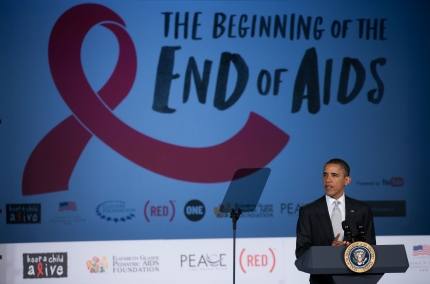
President Obama today marked World AIDS Day, speaking at an event called "The Beginning of the End of AIDS" where he outlined the progress that has been made in the global fight against the pandemic:

Because we invested in anti-retroviral treatment, people who would have died, some of whom are here today, are living full and vibrant lives. Because we developed new tools, more and more mothers are giving birth to children free from this disease. And because of a persistent focus on awareness, the global rate of new infections and deaths is declining. So make no mistake, we are going to win this fight. 

AIDS has claimed 30 million lives over the past three decades, and while the rate of new infections is going down in many countries, the President acknowledged that it is not declining in America:

The infection rate here has been holding steady for over a decade. There are communities in this country being devastated, still, by this disease. 

When new infections among young black gay men increase by nearly 50 percent in 3 years, we need to do more to show them that their lives matter. When Latinos are dying sooner than other groups, and when black women feel forgotten, even though they account for most of the new cases among women, then we’ve got to do more.

So this fight is not over. Not for the 1.2 million Americans who are living with HIV right now. Not for the Americans who are infected every day. This fight is not over for them, it’s not over for their families, and as a consequence, it can’t be over for anybody in this room -- and it certainly isn’t over for your President.

20111201 POTUS World AIDS Day

President Barack Obama delivers remarks on World Aid's Day event at George Washington University in Washington, Dec. 1, 2011. (Official White House Photo by Lawrence Jackson)

The President announced that he is directing $50 million in increased funding for domestic HIV/AIDS treatment and care -- an additional $15 million for the Ryan White program for HIV medical clinics across the country. and an additional $35 million for state AIDS Drug Assistance Programs. He also pledged that America will continue to be a leader in the global fight against the pandemic: 

Now, as we go forward, we’ve got to keep refining our strategy so that we’re saving as many lives as possible. We need to listen when the scientific community focuses on prevention. That’s why, as a matter of policy, we’re now investing in what works -- from medical procedures to promoting healthy behavior.  

And that’s why we’re setting a goal of providing anti-retroviral drugs to more than 1.5 million HIV-positive pregnant women over the next two years so that they have the chance to give birth to HIV-free babies. 

We’re not going to stop there. We know that treatment is also prevention. And today, we’re setting a new target of helping 6 million people get treatment by the end of 2013. That’s 2 million more people than our original goal.

Today’s event was sponsored by the ONE and (Red) campaigns and also featured remarks from Presidents George W. Bush and Bill Clinton, via satellite. 

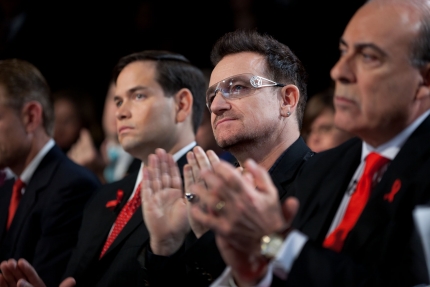
20111201 Bono

Musician Bono, center, listens as President Barack Obama delivers remarks at a World AIDS Day event at George Washington University in Washington, D.C., Dec. 1, 2011. (Official White House Photo by Pete Souza)

The White House

Office of the Press Secretary

Remarks by the President on World AIDS Day

George Washington University
Washington, D.C.

10:27 A.M. EST

THE PRESIDENT:  Well, thank you, Sanjay.  It is an honor to be with you today and to follow President Kikwete and President Bush.  To Bono and Alicia, to the ONE campaign, thank you for bringing us together.  Because of your work, all across Africa there are children who are no longer starving, mothers who are no longer dying of treatable diseases, fathers who are again providing for their families.  And because of all of you, so many people are now blessed with hope.

We’ve got members of Congress who have done so much for this cause who are here today, and we want to thank them.  Let me also thank President Bush for joining us from Tanzania and for his bold leadership on this issue.  I believe that history will record the President’s Emergency Plan for AIDS Relief as one of his greatest legacies.  And that program -- more ambitious than even the leading advocates thought was possible at the time -- has saved thousands and thousands and thousands of lives, and spurred international action, and laid the foundation for a comprehensive global plan that will impact the lives of millions.  And we are proud that we have the opportunity to carry that work forward.

Today is a remarkable day.  Today, we come together as a global community, across continents, across faiths and cultures, to renew our commitment to ending the AIDS pandemic once and for all.

Now, if you go back and you look at the themes of past World AIDS Days, if you read them one after another, you’ll see the story of how the human race has confronted one of the most devastating pandemics in our history.  You’ll see that in those early years -- when we started losing good men and women to a disease that no one truly understood -- it was about ringing the alarm, calling for global action, proving that this deadly disease was not isolated to one area or one group of people.

And that’s part of what makes today so remarkable, because back in those early years, few could have imagined this day -- that we would be looking ahead to “The Beginning of the End,” marking a World AIDS Day that has gone from that early beginning when people were still uncertain to now a theme, “Getting to Zero.”  Few could have imagined that we’d be talking about the real possibility of an AIDS-free generation.  But that’s what we’re talking about.  That’s why we’re here.  And we arrived here because of all of you and your unwavering belief that we can -- and we will -- beat this disease.

Because we invested in anti-retroviral treatment, people who would have died, some of whom are here today, are living full and vibrant lives.  Because we developed new tools, more and more mothers are giving birth to children free from this disease.  And because of a persistent focus on awareness, the global rate of new infections and deaths is declining.

So make no mistake, we are going to win this fight.  But the fight is not over -- not by a long shot.  The rate of new infections may be going down elsewhere, but it’s not going down here in America.  The infection rate here has been holding steady for over a decade.  There are communities in this country being devastated, still, by this disease. 

When new infections among young black gay men increase by nearly 50 percent in 3 years, we need to do more to show them that their lives matter.  When Latinos are dying sooner than other groups, and when black women feel forgotten, even though they account for most of the new cases among women, then we’ve got to do more.

So this fight is not over.  Not for the 1.2 million Americans who are living with HIV right now.  Not for the Americans who are infected every day.  This fight is not over for them, it’s not over for their families, and as a consequence, it can’t be over for anybody in this room -- and it certainly isn’t over for your President.

Since I took office, we’ve had a robust national dialogue on HIV/AIDS.  Members of my administration have fanned out across the country to meet people living with HIV; to meet researchers, faith leaders, medical providers and private sector partners.  We’ve spoken to over 4,000 people.  And out of all those conversations, we drafted a new plan to combat this disease.  Last year, we released that plan -- a first-ever national HIV/AIDS strategy.

We went back to basics:  prevention, treatment and focusing our efforts where the need is greatest.  And we laid out a vision where every American, regardless of age, gender, race, ethnicity, sexual orientation, gender identity or socioeconomic status, can get access to life-extending care.

And I want to be clear about something else:  Since taking office, we’ve increased overall funding to combat HIV/AIDS to record levels.  With bipartisan support, we reauthorized the Ryan White Care Act.  And as I signed that bill, I was so proud to also announce that my administration was ending the ban that prohibited people with HIV from entering America.  (Applause.)  Because of that step, next year, for the first time in two decades, we will host the international AIDS conference.  (Applause.)

So we’ve done a lot over the past three years, but we can do so much more.  Today, I’m announcing some new commitments.  We’re committing an additional $15 million for the Ryan White Program that supports care provided by HIV medical clinics across the country.  We want to keep those doors open so they can keep saving lives.  We’re committing an additional $35 million for state AIDS-drug assistance programs. 

The federal government can’t do this alone, so I’m also calling on state governments, and pharmaceutical companies, and private foundations to do their part to help Americans get access to all the life-saving treatments.

This is a global fight, and it’s one that America must continue to lead.  Looking back at the history of HIV/AIDS, you’ll see that no other country has done more than this country, and that’s testament to our leadership as a country.  But we can’t be complacent. 

I think this is an area where we can also look back and take pride that both Republicans and Democrats in Congress have consistently come together to fund this fight -- not just here, but around the world.  And that’s a testament to the values that we share as Americans; a commitment that extends across party lines, that’s demonstrated by the fact that President Bush, President Clinton and I are joining you all today.

Since I took office, we’ve increased support for the Global Fund to Fight AIDS, Tuberculosis and Malaria.  We’ve launched a Global Health Initiative that has improved access to health care, helping bring down the cost of vaccines, and over the next five years, will help save the lives of 4 million more children.  And all along, we kept focusing on expanding our impact.

Today, I’m proud to announce that as of September, the United States now supports anti-retroviral treatment for nearly 4 million people worldwide.  (Applause.)  Four million people.  And in just the past year, we’ve provided 600,000 HIV-positive mothers with access to drugs so that 200,000 babies could be born HIV-free.  (Applause.)  And nearly 13 million people have received care and treatment, including more than 4 million children.  So we’ve got some stuff to be proud of.

But we’ve got to do more.  We’re achieving these results not by acting alone, but by partnering with developing countries like Tanzania, and with leaders like President Kikwete.

Now, as we go forward, we’ve got to keep refining our strategy so that we’re saving as many lives as possible.  We need to listen when the scientific community focuses on prevention.  That’s why, as a matter of policy, we’re now investing in what works -- from medical procedures to promoting healthy behavior. 

And that’s why we’re setting a goal of providing anti-retroviral drugs to more than 1.5 million HIV-positive pregnant women over the next two years so that they have the chance to give birth to HIV-free babies.

We’re not going to stop there. We know that treatment is also prevention.  And today, we’re setting a new target of helping 6 million people get treatment by the end of 2013.  (Applause.)  That’s 2 million more people than our original goal.

And on this World AIDS Day, here’s my message to everybody who is out there:

To the global community -- we ask you to join us.  Countries that have committed to the Global Fund need to give the money that they promised.  (Applause.)  Countries that haven’t made a pledge, they need to do so.  (Applause.)  That includes countries that in the past might have been recipients, but now are in a position to step up as major donors.  China and other major economies are in a position now to transition in a way that can help more people.  

To Congress -- keep working together and keep the commitments you’ve made intact.  At a time when so much in Washington divides us, the fight against this disease has united us across parties and across presidents.  And it shows that we can do big things when Republicans and Democrats put their common humanity before politics.  So we need to carry that spirit forward.

And to all Americans -- we’ve got to keep fighting.  Fight for every person who needs our help today, but also fight for every person who didn’t live to see this moment; for the Rock Hudsons and the Arthur Ashes, and every person who woke us up to the reality of HIV/AIDS.  We’ve got to fight for Ryan White and his mother Jeanne, and the Ray brothers, and every person who forced us to confront our destructive prejudices and our misguided fears.  Fight for Magic Johnson and Mary Fisher, and every man, woman and child, who, when told they were going to die from this disease, they said, “No, we’re not.  We’re going to live.”

Keep fighting for all of them because we can end this pandemic.  We can beat this disease.  We can win this fight.  We just have to keep at it, steady, persistent -- today, tomorrow, every day until we get to zero.  And as long as I have the honor of being your President, that’s what this administration is going to keep doing.  That’s my pledge.  That’s my commitment to all of you.  And that’s got to be our promise to each other -- because we’ve come so far and we’ve saved so many lives, we might as well finish the fight.

Thank you for all you’ve done.  God bless you.  God bless America.  Thank you.  (Applause.)

END
10:41 A.M. EST