The White House

Office of the Press Secretary

Readout of President Obama’s Video Conference with British Prime Minister David Cameron, French President Francois Hollande, German Chancellor Angela Merkel, Italian Prime Minister Matteo Renzi, and European Council President Donald Tusk

President Obama today spoke about Ukraine with his counterparts from France, Germany, Italy, and the United Kingdom as well as European Council President Tusk.  They reaffirmed their support for a peaceful resolution of the conflict in eastern Ukraine as expressed in the Implementation Plan agreed to on February 12 and the Minsk agreements signed in September 2014.  They condemned the attack on Debaltseve by Russia and the separatists it backs that immediately followed and violated the February 12 Minsk Implementation Plan.  The leaders called on all parties to cease all military action, cooperate with the OSCE so that its monitors can verify a full pull back of heavy weapons, and complete the exchange of all prisoners.  They emphasized their support for the OSCE and the need for its monitors to have full and unfettered access to the entire area of conflict, and they discussed ways to strengthen OSCE monitoring activities.  The leaders expressed their hope for the successful and complete implementation of the Minsk agreements and agreed that the easing of current sanctions would be linked to the full implementation of these agreements.  They also affirmed their determination to act quickly and in unison to impose significant additional costs, if serious violations of the Minsk agreements occur or if Russian-backed separatists seek to gain new territory.  The leaders welcomed the Ukrainian parliament’s passage of an ambitious package of reforms and reiterated their commitment to work alongside international partners to provide Ukraine with the financial assistance it needs to stabilize its economy.  They also discussed the continuing violence in Libya and the terrorist threat from ISIL and agreed on the need to consult further on ways to address this threat and support a political resolution of the conflict in Libya.

A photograph of President Obama speaking with the leaders can be found HERE.

Making Sure That We "Let Girls Learn"

Watch on YouTube

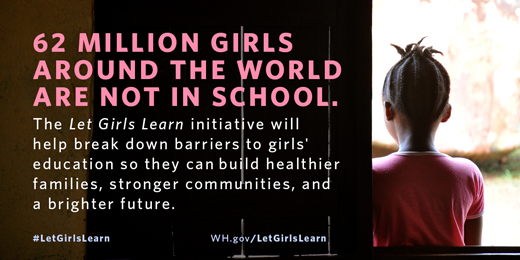
This afternoon, President Obama and First Lady Michelle Obama announced that the White House is ramping up its efforts to Let Girls Learn with a new initiative focused on supporting girls’ education around the world.

The Obama administration has partnered with the Peace Corps to take on the challenge of keeping girls in school.  Even in 2015, more than 62 million girls across the globe are not receiving an education, and even more are fighting to stay there. In many countries around the world, a girl risks dangerous walks to school, pressure to give up her education, and a lack of support for the resources she needs in her schooling.

Related Topics: Human Rights, Education, Women, Georgia

The White House

Office of the Press Secretary

President Obama Announces More Key Administration Posts

WASHINGTON, DC – Today, President Barack Obama announced his intent to nominate the following individuals to key Administration posts:

  • John Conger – Principal Deputy Under Secretary of Defense (Comptroller), Department of Defense
  • Gregory T. Delawie – Ambassador to the Republic of Kosovo, Department of State
  • Peter Levine – Deputy Chief Management Officer, Department of Defense
  • Vanessa Allen Sutherland – Chairperson and Member, Chemical Safety and Hazard Investigation Board

President Obama also announced his intent to appoint the following individual to a key Administration post:

  • Robert Teranishi – Member, Board of Directors of the National Board for Education Sciences

President Obama said, “I am confident that these experienced and hardworking individuals will help us tackle the important challenges facing America, and I am grateful for their service.  I look forward to working with them.”

President Obama announced his intent to nominate the following individuals to key Administration posts:

John Conger, Nominee for Principal Deputy Under Secretary of Defense (Comptroller), Department of Defense

John Conger is currently the Assistant Deputy Under Secretary for Installations and Environment at the Department of Defense, a position he has held since 2009.  Mr. Conger has concurrently performed the duties of Assistant Secretary of Defense for Energy, Installations and Environment since December 2014, and served as Acting Deputy Under Secretary of Defense for Installations and Environment from 2012 to 2014.  Prior to this, Mr. Conger worked in the Office of Rep. Chet Edwards as his Legislative Director from 2001 to 2009, and concurrently as his Associate Appropriations Committee Staff from 2007 to 2009.  From 2000 to 2001 he was a Professional Staff Member on the House International Relations Committee.  Mr. Conger served as a Legislative Assistant for Rep. Sam Gejdenson from 1999 to 2000, and as a Legislative Assistant for Rep. Jane Harman from 1997 to 1999.  Mr. Conger worked at Adroit Systems as a Legislative Affairs Analyst from 1995 to 1997 and as an Airborne Reconnaissance Systems Analyst from 1993 to 1995.  He was a Research Assistant at the MIT Space Power and Propulsion Laboratory from 1991 to 1993.  Mr. Conger received a B.S. and M.S. from the Massachusetts Institute of Technology, and an M.A. from The George Washington University.

Gregory T. Delawie, Nominee for Ambassador to the Republic of Kosovo, Department of State

Gregory T. Delawie, a career member of the Foreign Service, Class of Minister-Counselor, currently serves as Deputy Assistant Secretary in the Bureau of Arms Control, Verification and Compliance in the Department of State, a position he has held since 2012.  Previously, Mr. Delawie served as Deputy Chief of Mission at the U.S. Embassy in Berlin, Germany from 2009 to 2012, Deputy Assistant Secretary in the Bureau of Political-Military Affairs from 2008 to 2009, Office Director in the Bilateral Trade Affairs Office of the Bureau of Economic and Business Affairs from 2007 to 2008, and Deputy Chief of Mission at the U.S. Embassy in Zagreb, Croatia from 2004 to 2007.  Mr. Delawie was Office Director in the Policy Coordination Office of the Bureau of Human Resources from 2001 to 2003, Mid-Level Career Development Officer in the Bureau of Human Resources from 2000 to 2001, Economic Counselor at the U.S. Embassy in Rome, Italy from 1996 to 2000, and Deputy Division Chief of the Developed Country Trade Division in the Bilateral Trade Affairs Office of the Bureau of Economic and Business Affairs from 1994 to 1996.  He also served at U.S. missions in Ankara, Turkey and Frankfurt, Germany, and in the Regional Political-Economic Affairs Office of the Bureau of European and Canadian Affairs, the State Department Operations Center, and the Aviation Policy Office of the Bureau of Economic and Business Affairs.  Mr. Delawie received a A.B. from Harvard College.

Peter Levine, Nominee for Deputy Chief Management Officer, Department of Defense

Peter Levine most recently served as Staff Director of the Senate Armed Services Committee, a position he held from 2013 to January 2015.  From 1996 to 2012 he served as General Counsel and Minority Counsel of the Senate Armed Services Committee.  Mr. Levine was Counsel for Senator Carl Levin from 1995 to 1996, and Counsel on the Senate Committee on Governmental Affairs Subcommittee on Oversight of Government Management from 1987 to 1994.  From 1983 to 1987 he was an Associate at Crowell and Moring.  Mr. Levine received an A.B. from Harvard College and a J.D. from Harvard Law School.

Vanessa Allen Sutherland, Nominee for Chairperson and Member, Chemical Safety and Hazard Investigation Board

Vanessa Allen Sutherland serves as the Chief Counsel for the Pipeline and Hazardous Materials Safety Administration at the Department of Transportation, a position she has held since 2011.  Prior to this, she served as Senior Counsel to Altria Client Services from 2008 to 2011.  From 2004 to 2008, Ms. Sutherland served as Counsel to Philip Morris USA.  From 1998 to 2004, she held multiple roles at Digex, Inc., MCI (WORLDCOM) Subsidiary, including Vice President, Deputy General Counsel, Senior Corporate Counsel, and Corporate Counsel.  From 1997 to 1998, Ms. Sutherland was a Legal Associate at MCI Telecommunications Corporation.  In 1996, Ms. Sutherland was a Law Clerk at the Federal Deposit Insurance Corporation and from 1994 to 1995, she was a Law Clerk at Fulbright & Jaworski, LLP.  Ms. Sutherland received a B.A. from Drew University and a J.D. and M.B.A. from American University.

President Obama announced his intent to appoint the following individual to a key Administration post:

Dr. Robert Teranishi, Appointee for Member, Board of Directors of the National Board for Education Sciences

Dr. Robert Teranishi is a Professor of Social Science and Comparative Education, the Morgan and Helen Chu Endowed Chair in Asian American Studies, and Co-Director of the Institute for Immigration, Globalization, and Education at the University of California, Los Angeles positions he has held since 2013.  Since 2004, he has concurrently served as a Senior Faculty Fellow at the Steinhardt Institute for Higher Education Policy at New York University (NYU).  From 2002 to 2014, he was an Assistant Professor and then an Associate Professor of Higher Education in the Steinhardt School of Culture, Education, and Human Development at NYU.  From 2011 to 2013, Dr. Teranishi served as a Member of the Equity and Excellence Commission at the Department of Education.  From 2010 to 2012, he was a strategic planning and restructuring consultant for the Educational Opportunity and Scholarship division of the Ford Foundation.  Dr. Teranishi was a senior research associate at NYU’s Alliance for International Higher Education Policy Studies from 2002 to 2005 and from 2001 to 2002, he was the National Institute of Mental Health Postdoctoral Fellow at the University of Pennsylvania’s W.E.B. DuBois Collective Research Institute.  Dr. Teranishi received a B.A. from the University of California, Santa Cruz and an M.A. and Ph.D. from the University of California, Los Angeles. 

The White House

Office of the Press Secretary

Remarks by the President and the First Lady at Launch of the "Let Girls Learn" Initiative

East Room

3:02 P.M. EST

THE PRESIDENT:  Thank you so much.  Everybody have a seat.  (Applause.)  Everybody have a seat.  Thank you, Charlene, for that terrific introduction, for everything that you’ve done to help those young girls in Liberia, and all the young women I hope that are inspired here in the United States by seeing your example.  We couldn't be prouder -- except for your mom.  She’s prouder.  (Laughter.)  Mom is here.  And we know that you're just getting started, so you're going to do amazing things in the future. 

I want to thank the members of Congress who are here today  -- including Congresswoman Kay Granger, who’s a leading advocate for “development done right.”  Where is Kay?  She was here just a second ago.  She had to run back to vote on Homeland Security.  So we really wanted to get her there on time.  (Laughter.) 

I also want to mention Congresswoman Nita Lowey, who is also in the midst of this Department of Homeland Security vote, but has championed the cause of global education for over 20 years.  We are looking forward to working with all of you on this initiative in the months ahead. 

Now, my job is pretty easy.  I am here to introduce her.  (Laughter.)  An extraordinary woman -- (laughter) -- a passionate advocate for girls in the United States, around the globe -- and in the Obama household.  (Laughter.)  Michelle Obama.  (Applause.)  Yay! 

And in just a minute, she’s going to announce a piece of this new initiative -- which is sure to make Charlene and her fellow Peace Corps volunteers excited to get back to work.  But before I turn it over to Michelle, I figure you need a man’s perspective.  (Laughter.)  So I want to talk a little bit about why we all need to care about letting girls learn.

Now, I wish I could just say, because they’ve got the same potential as boys.  It's pretty straightforward and we could just stop there.  This really should not be complicated.  Wherever they live, whoever they are, every girl on this planet has value. Every girl on this planet deserves to be treated with dignity and equality.  And that includes the chance to develop her mind and her talents, and to live a life of her own choosing, to chart her own destiny.  That may be obvious to us, but we know it’s not obvious to everyone.  Sixty-two million girls around the world who should be in school are not.  That’s not by accident.  It’s the direct result of barriers, large and small, that stand in the way of girls who want to learn. 

In some cases, their families can’t afford the school fees. In some cases, the only local school doesn’t have a girls’ restroom.  Maybe the risk of being hurt or kidnapped or killed by men who will do anything to stop girls from learning is just too great.  Maybe girls aren’t in school because they’re expected to get married and become mothers while they’re still teens -- or even earlier.  Even today, in too many parts of the world, girls are valued more for their bodies than for their minds.  That’s not just antiquated.  It’s not just a bad strategy for any country that’s serious about growing their economy or promoting stability.  It is just plain wrong.  And we have to do more to stop it.

And I’m proud to say that the United States already does a great deal to support girls’ education around the world.  But what we do we tend to do quietly.  It doesn’t get a lot of publicity.  And what we determined -- what she determined --

MRS. OBAMA:  What we all determined.

THE PRESIDENT:  What we all determined is that we've got to take this work to the next level, and tie all our different programs together in a single, coordinated strategy.  And that’s what this initiative is about. 

Our diplomats and development experts are hard at work.  We’re making it clear to any country that’s our partner or wants to be our partner that they need to get serious about increasing the number of girls in school.  We are looking for every opportunity to put our partnerships with NGOs and businesses and foundations to work every day on behalf of girls everywhere. 

So this will be, yes, a focus of the First Lady’s, but it's also going to be a focus of the President of the United States.  And we expect results, because this matters to all of us.  (Applause.) 

And just to be clear, I come to this issue as a concerned citizen, but also as the leader of the world’s largest economy, and the Commander-in-Chief of the world’s most powerful military. And I’m convinced that a world in which girls are educated is a safer, more stable, more prosperous place.  (Applause.)

The evidence is compelling.  We know that when girls are educated, they’re more likely to delay marriage.  Their future children, as a consequence, are more likely to be healthy and better nourished.  Their future wages increase, which, in turn, strengthens the security of their family.  And national growth gets a boost, as well. 

From a political standpoint, and a security standpoint, places where women and girls are treated as full and equal citizens tend to be more stable, tend to be more democratic.  So this is not just a humanitarian issue.  This is an economic issue and it is a security issue.  And that’s why it has to be a foreign policy priority. 

Now, I will confess, I also come to this as the father of two fabulous, extraordinary, awesome young women.  (Laughter.)  They’ve got a lot to offer to the world.  And what we know is, is that everywhere there are girls just like Malia and Sasha.  They’re funny and they’re caring and they’re inquisitive and they’re strong, and their heads are buzzing with ideas.  And they’re constantly changing their minds about what they’re going to do when they grow up because there are just so many things they could be doing and want to do and want to explore.  

What an extraordinary privilege it is to be the father of those two girls -- to watch them learn and grow, and become strong and capable women.  And I want to make sure that no girl out there is denied her chance to be a strong, capable woman with the resources that she needs to succeed -- that no girl is prevented from making her unique contributions to the world.  Every child is precious.  Every girl is precious.  Every girl deserves an education.

And that’s the message that we want to deliver here today and we're going to sustain over the next two years and beyond -- let girls learn.

Now, to say more about why and how we’re going to do this -- (laughter) -- let me step aside for a very strong and capable woman -- the First Lady of the United States, Michelle Obama.  (Applause.) 

MRS. OBAMA:  Thank you all so much.  (Applause.)  Thank you, guys.  Thank you.  We are excited.  This is good stuff.  And I want to thank Barack Obama -- (laughter and applause) -- for that wonderful introduction.  He doesn’t always get to introduce me a lot, so I like to watch him say good things about me.  (Laughter.)  It's a really nice thing.  But as you can hear from his passion, I'm just so grateful that he is such a champion for our girls -- all our girls -- not just for Malia and Sasha, but for every girl.  And he does it every day as President, and he does it even better as a father.  And I am proud of him.

I also want to recognize Ambassador Rice; and Representatives Granger and Lowey, who had to leave; Valerie Jarrett for her tremendous leadership on this issue.  I want to also thank Charlene for her great work -- just an inspiring young person doing terrific things.  Just an example of why this initiative is so important -- all the outstanding work she’s doing to give girls worldwide the education they deserve.

And I want to thank all of you for the work that you all are doing.  For years, you all have been working at the grassroots -- one family, one community, one girl at a time.  And you’ve been driven all along by a fundamental belief about how change really happens -- a belief that Barack and I share -- that true change doesn’t happen from the top down, it happens from the bottom up

And as I’ve traveled the world over the past six years, I’ve seen time and again how our young people -- particularly our girls -- are so often pushed to the very bottom of their societies.  Everywhere I go, I meet these girls, and they are so fiercely intelligent, and hungry to make something of themselves. These girls are our change-makers -- our future doctors and teachers and entrepreneurs.  They’re our dreamers and our visionaries who could change the world as we know it. 

Just take the example of Malala Yousafzai.  All it takes is 30 seconds in a room with this young woman to realize what a blessing she is to our world.  And Malala would be the first to tell you that she is not unique, that there are millions of girls around the world just like her.  These girls know they have the spark of something extraordinary inside of them, but too often, that spark is snuffed out by circumstances of their birth or the norms of their communities.

And that’s where this issue becomes personal for me, and for Barack, because I see myself in these girls.  I see our daughters in these girls.  And like all of you, I just can’t walk away from them.  Like you, I can’t just sit back and accept the barriers that keep them from realizing their promise.  So I know that I want to use my time and my platform as First Lady and beyond to make a real impact on this issue.  I want to lift up the extraordinary work all of you have been doing long before I came to this issue, and I want to bring new resources and new partners to this effort.

And in recent years, I’ve worked with my staff and we've consulted with so many of you to ask how I can be most helpful -- and folks from CARE and Brookings, the Global Partnership for Education, the National Peace Corps Association, and so many others -- you guys have stepped up.  And time and again, you have told me that whatever these obstacles these girls face -- whether it’s school fees, or violence, or cultural beliefs that girls simply aren’t worthy of an education -- you’ve said that these problems will not be fixed from on high, that these are community challenges that call for community solutions.

And that made a lot of sense to me and it made a lot of sense to my husband, because that’s the kind of work we did long before we came to the White House, back when Barack was a community organizer and I was running a little non-profit AmeriCorps program in Chicago. 

So with the help of many of you in this room, and in collaboration with the Peace Corps, I am thrilled to announce that as part of Let Girls Learn, we’re going to be launching a new community-focused girls’ education initiative across the globe.  This effort will draw on the talent and energy of the nearly 7,000 Peace Corps volunteers serving in more than 60 countries.

Through this effort, Peace Corps will be supporting hundreds of new community projects to help girls go to school and stay in school –-- everything from after-school mentoring to girls’ leadership camps, to entrepreneurial projects like Bosh Bosh that Charlene talked about, and many more. 

And I want to emphasize that these programs will be community-generated and community-led.  They’ll be based on solutions devised by local leaders, families and, yes, even the girls themselves.  And you can learn more about these projects and how to support these efforts at LetGirlsLearn.PeaceCorps.gov.

As part of this effort, the Peace Corps is also going to be eventually training all of its volunteers about gender and girls’ education.  So even volunteers who are focusing on other issues like health care or agriculture can also help support girls’ education on the ground.

In other words, Peace Corps will soon be bringing new expertise and leadership on girls’ education into every single community they serve.  So while the focus of this effort will be local, because of this work, the scope will be global and the impact will truly be generational.

Now, if you think about what the Peace Corps means to so many, just think about the many leaders in developing countries  -- businesswomen, politicians, activists -- who can trace their journey back to a Peace Corps volunteer who inspired them and invested in them.  And think about the kind of daughters these leaders are now raising.  Think about all the other women and girls these leaders are inspiring today.  That’s the kind of impact that this initiative can have.

And I am so excited to kick this effort off with a trip later this month to Japan and Cambodia.  I’ll be starting with a visit with Mrs. Akie Abe, the wife of Japan’s Prime Minister, who also shares our passion for girls’ education and is eager to partner with us in this work.  I’ll also be meeting with our Ambassador to Japan, Caroline Kennedy, who just happens to be the daughter of the President who started the Peace Corps.  And in Cambodia, I’ll be meeting with Peace Corps volunteers and visiting a school where community-driven solutions are changing girls’ lives. 

But while the focus of this work is international, I just want to be clear that for me, Let Girls Learn isn’t just about improving girls’ education abroad.  It’s also about reminding our young people of the hunger they should be feeling for their own education here at home. 

You see, through Let Girls Learn, I hope that more of our girls -- and our boys -- here in the U.S. will learn about the sacrifices girls worldwide are making to get their education -- how they’re pushing forward in the face of poverty and violence, death threats and so many other horrors.  I want our young people to be awed by these girls.  But more importantly, I want them to be inspired and motivated by these girls.

I want our kids to realize that while their own school may be far from perfect -- and believe you me, this guy here is working hard to fix that -- they still have an obligation to show up every day to that classroom and learn as much as they can.  I want our kids to understand the transformative power of education.  That’s something that Barack and I understand from our own experiences -- that's our life story, how a good education can lift you from the most humble circumstances into a life you never could have imagined. 

And finally, I want our kids in this country to be citizens of the world.  I want them to connect with, and learn from, kids in every corner of the globe.

That’s why, when I travel abroad, I use all kinds of social media and technology to reach back here to young people at home. And I'm going to be doing so again during my trip to Asia, working with PBS, and Girl Rising, and Girl Scouts and -- yay!  (Laughter.)   So many others great partners --  because I want our young people to learn about the world and dream of being Peace Corps volunteers, and diplomats, and international business leaders, and more.  I want all our young people here in the U.S. and around the globe to dream big dreams, as my husband always says -- dream big dreams for themselves.  I want them to have big, ambitious futures.

And I know that’s possible, no matter what obstacles they face, because I’ve seen it again and again in the most unlikely places.  The Martin Luther King Girls Secondary School, which I visited last year in Senegal, is a wonderful example.  The school is concrete-floored classrooms, rooms containing little more than desks and a few faded posters -- but, oh, those girls, man, they were fierce; ambitious; confident.  They had serious dreams for their future. 

One of the girls wrote a poem about those dreams.  And she said it was about a world free from pollution and global warming, a world where violence and wars would be replaced by mutual acceptance and tolerance and love.  The poem ended with this line:  She said, “I have a dream that one day, the Martin Luther King Girls School of Dakar, my school, will be as prestigious as Harvard and Princeton Universities.”  (Laughter.) 

So we owe these girls, and girls like them across the globe, an education worthy of those dreams.  So I am so proud to join this movement.  I'm honored to learn more from all of you.  I am inspired by you.  And I’m excited to roll up my sleeves and work hard with you over the next few years and beyond.  So let’s get to work.

Thank you all.  (Applause.) 

END
3:23 P.M. EST

The White House

Office of the Press Secretary

Message -- Continuation of the National Emergency with Respect to Zimbabwe

TO THE CONGRESS OF THE UNITED STATES:

Section 202(d) of the National Emergencies Act (50 U.S.C. 1622(d)) provides for the automatic termination of a national emergency unless, within 90 days prior to the anniversary date of its declaration, the President publishes in the Federal Register and transmits to the Congress a notice stating that the emergency is to continue in effect beyond the anniversary date.  In accordance with this provision, I have sent to the Federal Register for publication the enclosed notice stating that the national emergency declared in Executive Order 13288 of March 6, 2003, with respect to the actions and policies of certain members of the Government of Zimbabwe and other persons to undermine Zimbabwe's democratic processes or institutions is to continue in effect beyond March 6, 2015.

The threat constituted by the actions and policies of certain members of the Government of Zimbabwe and other persons to undermine Zimbabwe's democratic processes or institutions has not been resolved.  These actions and policies continue to pose an unusual and extraordinary threat to the foreign policy of the United States.  For these reasons, I have determined that it is necessary to continue this national emergency and to maintain in force the sanctions to respond to this threat.

 BARACK OBAMA

The White House

Office of the Press Secretary

Notice -- Continuation of the National Emergency with Respect to Zimbabwe

NOTICE

- - - - - - -

CONTINUATION OF THE NATIONAL EMERGENCY WITH RESPECT TO ZIMBABWE

On March 6, 2003, by Executive Order 13288, the President declared a national emergency and blocked the property of certain persons, pursuant to the International Emergency Economic Powers Act (50 U.S.C. 1701-1706), to deal with the unusual and extraordinary threat to the foreign policy of the United States constituted by the actions and policies of certain members of the Government of Zimbabwe and other persons to undermine Zimbabwe's democratic processes or institutions.  These actions and policies had contributed to the deliberate breakdown in the rule of law in Zimbabwe, to politically motivated violence and intimidation in that country, and to political and economic instability in the southern African region.

On November 22, 2005, the President issued Executive Order 13391 to take additional steps with respect to the national emergency declared in Executive Order 13288 by ordering the blocking of the property of certain persons who undermine democratic processes or institutions in Zimbabwe.

On July 25, 2008, the President issued Executive Order 13469, which expanded the scope of the national emergency declared in Executive Order 13288 and authorized the blocking of the property of certain persons determined to have engaged in actions or policies to undermine democratic processes or institutions in Zimbabwe, to commit acts of violence and other human rights abuses against political opponents, and to engage in public corruption.

The actions and policies of these persons continue to pose an unusual and extraordinary threat to the foreign policy of the United States.  For this reason, the national emergency declared on March 6, 2003, and the measures adopted on that date, on November 22, 2005, and on July 25, 2008, to deal with that emergency, must continue in effect beyond March 6, 2015.  Therefore, in accordance with section 202(d) of the National Emergencies Act (50 U.S.C. 1622(d)), I am continuing for 1 year the national emergency declared in Executive Order 13288.

This notice shall be published in the Federal Register and transmitted to the Congress.

BARACK OBAMA

The White House

Office of the Press Secretary

Notice -- Continuation of the National Emergency with Respect to Ukraine

NOTICE
 
- - - - - - -
 
CONTINUATION OF THE NATIONAL EMERGENCY WITH RESPECT TO UKRAINE

On March 6, 2014, by Executive Order 13660, I declared a national emergency pursuant to the International Emergency Economic Powers Act (50 U.S.C. 1701-1706) to deal with the unusual and extraordinary threat to the national security and foreign policy of the United States constituted by the actions and policies of persons that undermine democratic processes and institutions in Ukraine; threaten its peace, security, stability, sovereignty, and territorial integrity; and contribute to the misappropriation of its assets.

On March 16, 2014, I issued Executive Order 13661, which expanded the scope of the national emergency declared in Executive Order 13660, and found that the actions and policies of the Government of the Russian Federation with respect to Ukraine undermine democratic processes and institutions in Ukraine; threaten its peace, security, stability, sovereignty, and territorial integrity; and contribute to the misappropriation of its assets.
 
On March 20, 2014, I issued Executive Order 13662, which further expanded the scope of the national emergency declared in Executive Order 13660, as expanded in scope in Executive Order 13661, and found that the actions and policies of the Government of the Russian Federation, including its purported annexation of Crimea and its use of force in Ukraine, continue to undermine democratic processes and institutions in Ukraine; threaten its peace, security, stability, sovereignty, and territorial integrity; and contribute to the misappropriation of its assets.

On December 19, 2014, I issued Executive Order 13685, to take additional steps to address the Russian occupation of the Crimea region of Ukraine.
 
The actions and policies addressed in these Executive Orders continue to pose an unusual and extraordinary threat to the national security and foreign policy of the United States. For this reason, the national emergency declared on March 6, 2014, and the measures adopted on that date, on March 16, 2014, on March 20, 2014, and December 19, 2014, to deal with that emergency, must continue in effect beyond March 6, 2015.  Therefore, in accordance with section 202(d) of the National Emergencies Act (50 U.S.C. 1622(d)), I am continuing for 1 year the national emergency declared in Executive Order 13660.
 
This notice shall be published in the Federal Register and transmitted to the Congress.

BARACK OBAMA

The White House

Office of the Press Secretary

Message -- Continuation of the National Emergency with Respect to Ukraine

TO THE CONGRESS OF THE UNITED STATES:

Section 202(d) of the National Emergencies Act (50 U.S.C. 1622(d)) provides for the automatic termination of a national emergency unless, within 90 days prior to the anniversary date of its declaration, the President publishes in the Federal Register and transmits to the Congress a notice stating that the emergency is to continue in effect beyond the anniversary date.  In accordance with this provision, I have sent to the Federal Register for publication the enclosed notice stating that the national emergency declared in Executive Order 13660 of March 6, 2014, is to continue in effect beyond March 6, 2015.

The actions and policies of persons that undermine democratic processes and institutions in Ukraine; threaten its peace, security, stability, sovereignty, and territorial integrity; and contribute to the misappropriation of its assets, as well as the actions and policies of the Government of the Russian Federation, including its purported annexation of Crimea and its use of force in Ukraine, continue to pose an unusual and extraordinary threat to the national security and foreign policy of the United States.  Therefore, I have determined that it is necessary to continue the national emergency declared in Executive Order 13660 with respect to Ukraine.

BARACK OBAMA

The White House

Office of the Press Secretary

Remarks by the President Before Meeting with Secretary of Defense Carter

Oval Office

1:40 P.M. EST

THE PRESIDENT:  Well, this is going to be the first opportunity that I have to get an extensive debriefing from Secretary Carter, who took a trip last week to Afghanistan and other parts of the region.  He’ll be giving me some impressions about how we’re planning our drawdown and transition in Afghanistan, and talk about some other regional issues.
 
One issue that we will be discussing is Iran.  And obviously that’s been a topic of great interest today, so let me just make a couple comments on that.  I did not have a chance to watch Prime Minister Netanyahu’s speech -- I was on a video conference with our European partners with respect to Ukraine.  I did have a chance to take a look at the transcript and as far as I can tell, there was nothing new.
 
The Prime Minister appropriately pointed out that the bond between the United States of America is unbreakable, and on that point I thoroughly agree.  He also pointed out that Iran has been a dangerous regime and continues to engage in activities that are contrary to the interests of the United States, to Israel, and to the region.  And on that, we agree.  He also pointed out the fact that Iran has repeatedly threatened Israel and engaged in the most venomous of anti-Semitic statements.  And no one can dispute that.
 
But on the core issue, which is how do we prevent Iran from obtaining a nuclear weapon, which would make it far more dangerous and would give it scope for even greater action in the region, the Prime Minister didn’t offer any viable alternatives.  So let’s be clear about what exactly the central concern should be, both for the United States and for Israel. 
 
I’ve said since before I became President that one of my primary goals in foreign policy would be preventing Iran from getting nuclear weapons.  And with the help of Congress and our international partners, we constructed an extraordinarily effective sanctions regime that pressured Iran to come to the table to negotiate in a serious fashion.  They have now been negotiating over the last year, and during that period, Iran has, in fact, frozen its program, rolled back some of its most dangerous highly enriched uranium, and subjected itself to the kinds of verifications and inspections that we had not previously seen.  Keep in mind that when we shaped that interim deal, Prime Minister Netanyahu made almost the precise same speech about how dangerous that deal was going to be.  And yet, over a year later, even Israeli intelligence officers and, in some cases, members of the Israeli government, have to acknowledge that, in fact, it has kept Iran from further pursuing its nuclear program.
 
Now, the deal that we are trying to negotiate that is not yet completed would cut off the different pathways for Iran to advance its nuclear capabilities.  It would roll back some elements of its program.  It would ensure that it did not have what we call a breakout capacity that was shorter than a year’s time.  And it would subject Iran to the most vigorous inspections and verifications regimes that have ever been put in place.
 
And the alternative that the Prime Minister offers is no deal, in which case Iran will immediately begin once again pursuing its nuclear program, accelerate its nuclear program, without us having any insight into what they’re doing, and without constraint.  And his essential argument is that if we just double down on sanctions, Iran won’t want to do that.
 
Well, we have evidence from the past decade that sanctions alone are not sufficient to prevent Iran from pursuing its nuclear ambitions.  And if it, in fact, does not have some sense that sanctions will be removed, it will not have an interest in avoiding the path that it’s currently on.
 
So the bottom line is this:  We don’t yet have a deal.  It may be that Iran cannot say yes to a good deal.  I have repeatedly said that I would rather have no deal than a bad deal. But if we’re successful in negotiating, then, in fact, this will be the best deal possible to prevent Iran from obtaining a nuclear weapon.  Nothing else comes close.  Sanctions won’t do it.  Even military action would not be as successful as the deal that we have put forward. 
 
And I think it is very important not to be distracted by the nature of the Iranian regime’s ambitions when it comes to territory or terrorism -- all issues which we share a concern with Israel about and are working consistently with Israel on.  Because we know that if, in fact, they obtain a nuclear weapon, all those problems would be worse.
 
So we’re staying focused on the central issue here:  How do we prevent Iran from getting a nuclear weapon.  The path that we’ve proposed, if successful, by far is the best way to do that.  That’s demonstrable.  And Prime Minister Netanyahu has not offered any kind of viable alternative that would achieve the same verifiable mechanism to prevent Iran from getting a nuclear weapon.
 
So I would urge the members of Congress who were there to continue to express their strong support for Israel’s security, to continue to express their strong interest in providing the assistance Israel needs to repel attacks.  I think it's important for members of Congress, on a bipartisan basis, to be unified in pushing back against terrorism in the region and the destabilizing efforts that Iran may have engaged in with our partners.  Those are all things in which this administration and Israel agree.
 
But when it comes to this nuclear deal, let’s wait until there’s actually a deal on the table that Iran has agreed to, at which point everybody can evaluate it; we don’t have to speculate.  And what I can guarantee is that if it's a deal I’ve signed off on, I will be able to prove that it is the best way for us to prevent Iran from getting a nuclear weapon.
 
And for us to pass up on that potential opportunity would be a great mistake.  It's not one that I intend to make, and I will take that case to every member of Congress once we actually have a deal. 
 
I’ll take one question from Julie.  Go ahead.
 
Q    Now that you’ve had a chance to read the Prime Minister’s remarks at least, do you feel like the speech he gave was appropriate, considering his upcoming elections and the upcoming deadline?  And you also talked to other foreign leaders today -- the call on Ukraine.  Did Iran come up at all, and are you expecting any signs of support from them vis-à-vis your position versus the Prime Minister?
 
THE PRESIDENT:  No.  All the folks on the call today share my position that we should see if we can get this deal done.  It was not a topic of conversation. 
 
With respect to the decision of the Speaker to offer up the House Chamber two weeks before Mr. Netanyahu’s election to make this case, I think that question should be directed to Mr. Boehner.
 
As I said, it is very important for us not to politicize the relationship between Israel and the United States.  It's very important for all of us Americans to realize that we have a system of government in which foreign policy runs through the executive branch and the President, not through other channels. 
 
And I think it's important for us to stay focused on the problem at hand.  And the specific problem that is being debated right now is not whether we trust the Iranian regime or not -- we don’t trust them.  It's not whether Iran engages in destabilizing activities -- everybody agrees with that.  The central question is, how can we stop them from getting a nuclear weapon. 
 
And what we know is that if we’re able to get a deal, not only do we cut off all the various pathways for Iran getting a nuclear weapon, but we also know that we’ll have a verification mechanism and an inspection mechanism where if they cheat and if they engage in a covert program we are far more likely to see it in time to do something about it. 
 
What I also know is if we don’t have a deal, as Prime Minster Netanyahu suggested -- if, in fact, he’s right that they’re not trustworthy, they intend to pursue a covert program, and they cheat, we’ll be far less aware of it until it is potentially too late. 
 
What I also know is, is that he made the same argument before this current interim deal, and even officials in his own government had to acknowledge that Iran has, in fact, maintained their end of the bargain.
 
So what I'm focused on right now is solving this problem.  I’m not focused on the politics of it, I'm not focused on the theater of it.  And my strong suggestion would be that members of Congress, as they evaluate it, stay similarly focused.
 
All right.  Thank you, guys.
 
END   
1:51 P.M. EST

Celebrating Black History Month at The White House

March 02, 2015 | 3:27 | Public Domain

To celebrate Black History Month, the White House honored the courage and contributions of African Americans who came before us, and highlighted ways that the Obama administration has been working to empower communities across America.

Download mp4 (112MB)