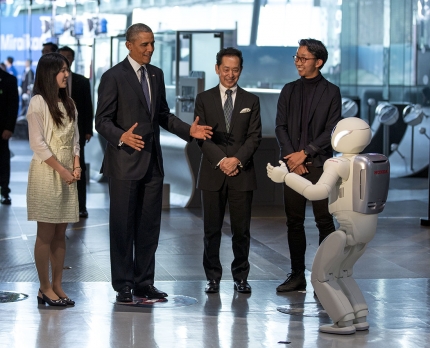
Joint Press Conference with President Obama and Prime Minister Abe of Japan
Akasaka Palace
Tokyo, Japan
12:40 P.M. JST
PRIME MINISTER ABE: (As interpreted.) On behalf of the Japanese people, I would like to express my heartfelt welcome to President Barack Obama, who is in Japan as our state guest. Barack and I met at the White House for the first time last year in February. We talked about all the different themes that one could think of. We had talks without reserve and we confirmed that we had the same awareness with regard to issues and that we share common objectives.
The Japan-U.S. alliance has been revived very strongly. And the nature of our talks this time was such that we were able to demonstrate this both inside and outside of the country. Barack said this before -- to create a large economic zone in the Asia Pacific would bring about major benefits to Japan, the United States, and to the Asian nations.
The TPP was indeed a very farsighted plan. As a result of serious exchanges between Barack and myself, Japan was able to make the transition to the next stage, which was to participate in the TPP talks. It’s been one year since then and Japan along with the United States is in a role to lead in a major way the TPP talks. To make the talks between the two leaders a milestone and so as to resolve pending issues between our two countries, Minister Amari and U.S. Trade Representative Ambassador Froman decided that they would energetically and earnestly continue the talks.
President Obama and I instructed the ministers to continue these talks so as to bring to a conclusion the remaining issues and so as to bring about a major conclusion of the TPP talks as a whole. Today and tomorrow, the talks will continue. So the joint statement released will see the result of this and we will formulate a joint statement after this.
Between Japan and the United States, we share values such as freedom, democracy, human rights and rule of law. We have shared these basic values and strategic interests. We are global partners. So we have this partnership and this strong alliance between our two countries. It’s the cornerstone of peace and prosperity in the Asia Pacific region.
Japan espouses the principle of proactive contribution to peace. And the United States is moving forward with its policy of pivoting to the Asia Pacific. These are contributing to peace and stability in the region. And we mutually appreciated and welcomed each other’s policies. Having done so between Barack and myself, we were able to confirm that the Japan-U.S. alliance would play a leading role in ensuring peace and prosperity of the Asia Pacific. This is what I wanted to communicate to you.
With regard to security, including the review of the Japan-U.S. Defense Cooperation guidelines, wide-ranging security and defensive cooperation would be promoted. We agreed on this point. With regard to the realignment of U.S. forces in Japan, including the transfer of U.S. Marines in Okinawa to Guam and relocation of the Futenma Air Station, we would make steady progress on this front. And we reaffirmed the resolve on both sides to make this transpire.
Okinawa Governor Nakaima has requested termination of the operation of the Futenma Air Station in five years or less. With regard to this and other requests by the Governor, I explained this to President Barack and requested further cooperation from the United States to alleviate the impact on Okinawa.
With regard to various issues which the international society is facing, we had a heart-to-heart talk between Barack and myself. On the situation in Ukraine, changing the status quo against the backdrop of coercion and intimidation would not be condoned. We confirmed this point once again, and the importance to providing support to Ukraine and to cooperate between Japan and the G7 is something that we agreed on.
With regard to China, based on the rule of law, a free and open Asia Pacific region will be developed and we would try to engage China in this region. And we agreed to cooperate toward this end. With regard to moves to try to change the status quo through coercion and intimidation, we agreed that we would clearly oppose such news. Going forward with regard to policies vis-à-vis China, we agreed to maintain close cooperation between Japan and the United States. This was confirmed.
On the DPRK, we confirmed that close cooperation between the U.S., Japan and ROK would continue to be important. And this time Barack made the time to meet with the Yokotas and Mr. Iizuka. At our talks, I requested understanding, and continued understanding and cooperation toward the resolution of the abduction issue and the President expressed his support.
This month I met three times with Ambassador Kennedy. I had this honor. We discussed space, linear and cultural exchanges, and so this is a manifestation of the best of the cooperative relationship which exists between our two countries. In the talks between the leaders, I put forth once again the proposal to introduce Maglev technology in the United States. We had an exchange of views with regard to energy cooperation, and inclusive of a society where women can shine, and global issues. We agreed that we would cooperate on these issues.
Ambassador Kennedy is a symbol of the friendship which exists between our two countries and the bonds which exist. I’d like to cooperate even more closely with the Ambassador to further deepen cooperative relations between our two countries.
Going forward, what supports the alliance are the youth in both of our countries. To further enhance exchanges between youth I have told Barack of our plans to send 6,000 Japanese students to the United States this fiscal year. The Japan-U.S. alliance is more robust than ever before.
Barack, you talked about the sushi you had last night and you said it was the best you had in your life. We had heart-to-heart talks for an hour and a half. We talked about issues between our two countries and challenges of the world. We confirmed the bonds and the roles of our two countries and we talked about further potential of the relationship between our two countries. It was a very enriching and satisfactory time. And the sushi I had yesterday, for me, too, was the best I had in my life so far, and it is without a doubt that this is the case.
So, between Barack and I, we want to make U.S.-Japan relations more favorable than ever before. And that is all for me. Thank you.
PRESIDENT OBAMA: Konnichiwa. I want to thank Prime Minister Abe for your kind words and your warm welcome, as well as the outstanding sushi and sake yesterday. It is wonderful to be back in Japan. This is my third visit as President. I’m deeply honored to be making the first state visit by a U.S. President in nearly two decades. I’m grateful to Their Majesties, the Emperor and Empress, for their gracious welcome this morning. And I've once again been touched by the kindness and hospitality of the Japanese people -- your omotenashi.
I’ve said many times the United States is and always will be a Pacific nation. America’s security and prosperity is inseparable from the future of this region, and that’s why I’ve made it a priority to renew American leadership in the Asia Pacific. And the cornerstone of our strategy -- and the foundation of the region’s security and economic progress -- is our historic treaty alliances, including with Japan.
Prime Minister Abe, I want to thank you for your exceptional commitment to our alliance, which in recent years has grown even stronger. Under your leadership, Japan is also looking to make even greater contributions to peace and security around the world, which the United States very much welcomes.
And last night we had an excellent discussion on a whole range of issues. We agreed to continue deepening our security cooperation. We continue to make progress towards realigning our forces in the region, including Okinawa, which will lessen the impact of our bases on local communities. As we modernize our defense posture in the region, our forces in Japan will include our most advanced military capabilities.
We stand together in calling for disputes in the region, including maritime issues, to be resolved peacefully through dialogue. We share a commitment to fundamental principles such as freedom of navigation and respect for international law. And let me reiterate that our treaty commitment to Japan’s security is absolute, and Article 5 covers all territories under Japan’s administration, including the Senkaku Islands.
Our two nations are united along with the Republic of Korea in our determination to bring about the peaceful denuclearization of the Korean Peninsula and in our firm response to North Korea’s provocations. And we stand with Japan as it seeks to resolve the tragedy of North Korea’s abductions of Japanese citizens.
Beyond Northeast Asia, Japan and the United States are working together to enhance our economic and diplomatic and security coordination with our ASEAN partners in Southeast Asia. We’re deepening our cooperation as global partners, from the relief we delivered together after the typhoon in the Philippines last year to our unified response to Russia’s military intervention in Ukraine.
We made important progress in the Trans-Pacific Partnership, TPP, which will support good jobs and growth in the United States as well as economic reform and revitalization here in Japan. We’re closer to agreement on issues like automobiles and agriculture. I’ve been very clear and honest that American manufacturers and farmers need to have meaningful access to markets that are included under TPP, including here in Japan. That’s what will make it a good deal for America -- for our workers and our consumers, and our families. That’s my bottom line, and I can’t accept anything less.
At the same time, Prime Minister Abe is committed to renewing Japan’s economy, and TPP is a vital part of that. As I’ve told Shinzo, Japan has the opportunity -- in part through TPP -- to play a key leadership role in the Asia Pacific region for this century. So now is the time for bold steps that are needed to reach a comprehensive agreement, and I continue to believe we can get this done.
I would add that our countries are more prosperous when we tap the talents of all of our citizens. So I want to commend the Prime Minister for his commitment to bringing more women into the work force. And because our economic security also depends on energy security, we’re going to keep working together on clean and efficient alternatives to fossil fuels both at home and abroad that can power the global economy while combating climate change.
Finally, I’m pleased that we continue to deepen the extraordinary ties between our people, especially our young people, like the Japanese students that I’ll be meeting later today. And I’m proud to announce that we’re launching a new program that will help even more Japanese students come to the United States to improve their English-language skills and gain valuable experience working in American businesses and organizations. And that’s part of our effort to double student exchanges by 2020 -- bonds among our young people that can bring us closer together for decades to come.
So, Prime Minister Abe, thank you for your friendship, your partnership, and the progress that we’ve made together. I want to thank you and the people of Japan for being such extraordinary allies. Standing together, I have no doubt about what our nations can achieve. So as you say here, ganbarou. Thank you.
Q I’d like to raise a question with regard to security. First, my question is addressed to Prime Minister Abe. President Obama, with regard to the defense of the Senkaku Islands, he had clearly stated his security stance based on the security treaty. And what kind of discussion did you have on the exercise of collective security rights?
To President Obama, the following question: Based on the security treaty, the obligation to defend the Senkaku Islands, this is the first time that you referred to this issue. Why did you mention this? Could you talk about the import of your statement?
PRIME MINISTER ABE: (As interpreted.) Through the talks with President Obama, as President Obama mentioned at the outset in his speech, between our two countries we have the security treaty and under the security treaty, all of the abilities and capabilities to perform the commitment is provided. And this includes all territories under the administration of Japan, inclusive of the Senkaku Islands. And any unilateral action to undermine Japan’s administration of the Senkaku Islands will be opposed by the United States. We agreed on this point.
On the exercise of the right of collective defense, presently in Japan the legal basis for security is being discussed and with regard to the stability of Japan and regional safety and stability, and to function the alliance effectively, and to contribute to the stability of the region we are making these studies. This is what I have explained to President Obama. Concerning such studies and examinations being made in Japan, this was welcomed and this would be supported. That was the position expressed by President Obama.
PRESIDENT OBAMA: Our position is not new. Secretary Hagel, our Defense Secretary, when he visited here, Secretary of State John Kerry when he visited here, both indicated what has been our consistent position throughout. We don’t take a position on final sovereignty determinations with respect to Senkakus, but historically they have been administered by Japan and we do not believe that they should be subject to change unilaterally. And what is a consistent part of the alliance is that the treaty covers all territories administered by Japan. So this is not a new position, this is a consistent one.
In our discussions, I emphasized with Prime Minister Abe the importance of resolving this issue peacefully -- not escalating the situation, keeping the rhetoric low, not taking provocative actions, and trying to determine how both Japan and China can work cooperatively together. And I want to make that larger point. We have strong relations with China. They are a critical country not just to the region, but to the world.
Obviously, with a huge population, a growing economy, we want to continue to encourage the peaceful rise of China. I think there’s enormous opportunities for trade, development, working on common issues like climate change with China. But what we’ve also emphasized -- and I will continue to emphasize throughout this trip -- is that all of us have responsibilities to help maintain basic rules of the road and an international order so that large countries, small countries, all have to abide by what is considered just and fair, and that we are resolving disputes in peaceful fashion.
And this is a message that I’ve delivered directly to the Chinese and it’s one that I think is entirely consistent with China being successful. I think the alternative is a situation in which large countries, like the United States or China or Russia or other countries, feel as if whenever they think it’s expedient they can take actions that disadvantage smaller countries, and that’s not the kind of world that is going to be stable and prosperous and secure over the long term.
So we are invested in an international order, and that applies to a whole range of issues, including maritime issues. My hope is, is that China will continue to engage with us and other countries in the region where we do not take a position on the particular sovereignty of this piece of land or this rock but we do take a position in making sure that all countries are following basic international procedures in resolving these disputes. And if that happens, then I think not only will China be successful, but I think there’s a great potential for Chinese and Japanese cooperation, Chinese and Vietnamese cooperation, cooperation with the Philippines and China -- all of which will benefit the peoples of the region.
MR. CARNEY: The next question comes from Jim Acosta of CNN.
Q Thank you, Mr. President. Arigato, Mr. Prime Minister. Mr. President, in regards to the Senkaku Islands, I just want to make sure that this is absolutely clear. Are you saying that the U.S. would consider using military force were China to have some sort of military incursion in those islands to protect those islands? And how does that not draw another red line that you would have to enforce -- of putting U.S. credibility, your credibility on the line once again, as it was in the case with Syria and Russia? And on another key security issue, you mentioned North Korea in your meeting with the Prime Minister. Are you issuing a warning to North Korea that there should not be another nuclear test?
And to Prime Minister Abe, do you have confidence in President Obama’s assurances about your security when the U.S. and the West were unable to stop Russia’s advances in Ukraine? Thank you.
PRESIDENT OBAMA: Well, Jim, let me unpack that question because there’s a whole bunch of assumptions in there, some of which I don’t agree with.
First of all, the treaty between the United States and Japan preceded my birth, so obviously, this isn’t a “red line” that I’m drawing; it is the standard interpretation over multiple administrations of the terms of the alliance, which is that territories under the administration of Japan are covered under the treaty. There’s no shift in position. There’s no “red line” that’s been drawn. We’re simply applying the treaty.
At the same time, as I’ve said directly to the Prime Minister that it would be a profound mistake to continue to see escalation around this issue rather than dialogue and confidence-building measures between Japan and China. And we’re going to do everything we can to encourage that diplomatically.
With respect to the other issues that you raise, our position, Jim, the United States’ position is that countries should abide by international law; that those laws, those rules, those norms are violated when you gas children, or when you invade the territory of another country. Now, the implication of the question I think is, is that each and every time a country violates one of those norms the United States should go to war, or stand prepared to engage militarily, and if it doesn’t then somehow we’re not serious about those norms. Well, that’s not the case.
Right now, we have 87 percent of serious chemical weapons have already been removed from Syria. There’s about 13 percent left. That’s as a consequence of U.S. leadership. And the fact that we didn’t have to fire a missile to get that accomplished is not a failure to uphold those international norms, it’s a success. It’s not a complete success until we have the last 13 percent out.
With respect to Russia and Ukraine, we’ve been very clear about the fact that there’s not going to be a military solution to the problem in Ukraine, but we have already applied sanctions that have had an impact on the Russian economy and we have continued to hold out the prospect, the possibility to resolve this issue diplomatically. There was some possibility that Russia could take the wiser course after the meetings in Geneva. So far, at least, we have seen them not abide by the spirit or the letter of the agreement in Geneva. And instead, we continue to see militias and armed men taking over buildings, harassing folks who are disagreeing with them, and destabilizing the region, and we haven’t seen Russia step up and discourage that.
On the other side, you’ve seen the government in Kyiv take very concrete steps, in introducing an amnesty law and offering a whole range of reforms with respect to the constitution, that are consistent with what was discussed in Geneva. And my expectation is, is that if, once again, Russia fails to abide by both the spirit and the letter of what was discussed in Geneva, that there will be further consequences and we will ramp up further sanctions.
That doesn’t mean that the problem is going to be solved right away. These are difficult issues. But what we try to do is to make sure that we are very clear about what we stand for, what we believe in, and we are willing to take actions on behalf of those values, those norms, and those ideals.
Q And on North Korea?
PRESIDENT OBAMA: And the question was?
Q Is there a warning to North Korea to not conduct another nuclear test?
PRESIDENT OBAMA: North Korea has engaged in provocative actions for the last several decades. It’s been an irresponsible actor on the international stage for the last several decades. So our message on North Korea has been consistent throughout. They are the most isolated country in the world. They are subject to more international sanctions and international condemnation than any country in the world. As a consequence, their people suffer as much as any peoples in the world.
And what we’ve said is if you are, in fact, serious about North Korea being a normal nation, then you’ve got to start changing your behavior. And that starts with the basic principle of denuclearizing the Korean Peninsula.
Now, am I optimistic that there’s going to be a major strategic shift in North Korea’s attitudes any time soon? Probably not. But what I am confident about is, is that working with Japan, working with the Republic of Korea, and working with China and other interested parties in the region, that we can continue to apply more and more pressure on North Korea so that at some juncture they end up taking a different course.
In the meantime, they’re dangerous, and we have to make sure that we are guarding against any provocations getting out of hand. This is one of the reasons why the alliance is so important and collective self-defense is so important. But we are not surprised when they engage in irresponsible behavior. That’s been their pattern for the last couple of decades. And what we have to do is to continue to try to contain and mitigate the potential damage that this behavior has and continue to put pressure on them so that we can see a shift.
And China’s participation in pushing the DPRK in a different direction is critically important as well. They have not only an opportunity but I think a security interest and a broader interest in a peaceful resolution to what has been a generation-long conflict and is the most destabilizing, dangerous situation in all of the Asia Pacific region.
PRIME MINISTER ABE: (As interpreted.) First of all, I would like to state the following: The Japan-U.S. alliance is unwavering and it’s indispensable to maintain the Asia Pacific region peaceful and stable. The Japan-U.S. alliance and the relationship and the strengthening thereof is very beneficial. And to strengthen our bilateral relationship, you have tremendous enthusiasm. I believe in that. And your enthusiasm and the United States’ is what we place our confidence in. And in the talks between us today that confidence became even stronger. This is something that I wished to mention to you.
And the alliance between our two countries in order to strengthen this -- or if we strengthen this, this is not applying pressure to other countries or intimidating other countries. This is for the peace and stability of the region and to strengthen this and to make this region a law-abiding region. Changes of the status quo based on intimidation and coercion will not be condoned. We want to make this a peaceful region which values laws, and in doing this strengthening of our bilateral alliance is extremely important. On this point, I fully trust President Obama.
The reporter has mentioned the situation in Ukraine. In The Hague the G7 meeting took place, and President Obama exerted strong leadership and the G7 was united in its approach toward Russia. Annexation of Crimea in violation of the international laws would not be condoned -- that was the message which was generated to Russia. We would continue to communicate information -- message under the leadership of President Obama to Russia.
And with regard to the DPRK, unless they change the present policies there is no future for the public in the DPRK. We need to make the DPRK understand this and pressure must be applied with cooperation between the international society to achieve this. And China holds the key to this. Japan, the United States, and ROK must exercise its influence over China.
With regard to the Asia Pacific region as well as international society, there are various challenges and the alliance must continue to be robust so that we can cooperate to resolve issues in Asia and in the world.
Q On the TPP, I’d like to ask the question to the two leaders. First to Prime Minister Abe, regarding TPP -- negotiations and consultations are to continue, you have said. What are the remaining issues? And to what extent have you made progress at the Diet? With regard to the five sensitive items they resolve that in this stage the elimination of tariffs would not be accepted. Do you believe under such circumstances an agreement can be reached?
The next question to President Obama. Japan, with regard to rice and wheat and beef and pork, is very careful about reducing tariffs. What is your view on this for agreement between Japan and the United States? Agriculture, produce tariffs -- what is the ideal resolution to this issue in your view, please?
PRIME MINISTER ABE: (As interpreted.) On the TPP, this is to create a major economic zone in the growth area of Asia -- basic human rights, rule of law, and democracy with countries that share these values. We will be creating new rules and it is for this purpose. It is the 21st-century type of economic zone which we wish to create. For the region as a whole, it’s strategically very important, and we see eye-to-eye on this point between President Obama and myself.
The remaining issues must be overcome very quickly and resolved so that TPP as a whole can be concluded. We should cooperate and exert further leadership. And that is the task that President Obama and I have, I believe. And from a broad perspective, along with President Obama, we want to make decisions and judgments. On the part of our country, there is this resolution adopted by the Diet. We will take the proper heed of this so that we will choose the path in the best interest of the country. But we also hope to conclude the talks in a favorable way. We want to try to achieve conclusion of the talks as a whole.
PRESIDENT OBAMA: I will leave the details of the negotiations to the negotiators. I think it’s fair to say that there are certain sectors of the Japanese economy -- agricultural sectors, the auto sector -- in which market access has been restricted historically, certainly compared to the market access that Japan has had to U.S. consumers. And those are all issues that people are all familiar with, and at some point have to be resolved. I believe that point is now.
Prime Minister Abe, I think courageously, has recognized that although Japan continues to be one of the most powerful economies in the world, that over the last two decades its pace of growth and innovation had stalled and that if, in fact, Japan wanted to push forward in this new century then reforms were going to have to take place. And he has initiated a number of those reforms.
TPP is consistent with those reforms. And as Prime Minister Abe said, there’s strategic importance to this because what’s happening now is we’re shaping the economic environment for the fastest-growing region in the world, not just for this year or next year, but potentially for this decade and the next decade. And what rules apply -- whether we are operating in a fair and transparent way, whether intellectual property is respected, whether markets are freely accessible, whether, in fact, countries are able to increase trade and as a consequence, increase jobs and prosperity for their people -- a lot of that is going to depend on choices and decisions that we make right now. TPP is an opportunity for us to make that happen.
Now, there are always political sensitivities in any kind of trade discussions. Prime Minister Abe has got to deal with his politics; I’ve got to deal with mine. And I think that Congress has passed, for example, recently a free trade agreement with the Republic of Korea and other countries around the world, and it’s been based on notions of reciprocity and notions that if we tear down some of these existing barriers that both countries can do better, both countries can grow.
This is even more challenging because we have more countries involved. But my basis for doing this is because, ultimately, I think it’s good for America to have a Asia Pacific region where our companies can innovate, can compete, can sell our goods and services freely, where our intellectual property is protected. And I think that’s going to create more jobs in the United States. It’s going to create greater prosperity in the United States. But it’s a win-win situation, because I think the same is going to be true for Japan, the same is going to be true for Malaysia, the same is going to be true for Vietnam, the same is going to be true for the other countries that are in this discussion.
But that means that short term, all of us have to move out of our comfort zones and not just expect that we’re going to get access to somebody else’s market without providing access to our own. And it means that we have to sometimes push our constituencies beyond their current comfort levels because ultimately it’s going to deliver a greater good for all people.
MR. CARNEY: Julie Pace of the Associated Press has the final question.
Q I wanted to go back to the situation in Ukraine. You said that Russia is so far not abiding by the Geneva agreement, but you appeared to indicate that you have not made a decision yet on levying further sanctions. So, first, can you just clarify whether you have or have not made that decision? And if you have not, what gives you confidence that holding off on further sanctions might change Russia’s calculus? And couldn’t they just be using the Geneva agreement as a stalling tactic as they weigh military options or try to influence the May Ukraine elections?
And, Prime Minister Abe, there are historical disputes in Asia that are a powerful source of tension and instability in this region. What responsibility do you and other leaders in Asia have to avoid inflammatory language or actions, including further visits to the Yasukuni Shrine that could further exacerbate these tensions? Thank you.
PRESIDENT OBAMA: Well, Julie, we have been consistently preparing for the possibility that, in fact, Geneva didn’t deliver on its promise. I think you’ll remember I was asked the day that the discussions had concluded what my hopes were and I said, well, I’m not overly optimistic about the ability to deliver. And so what that means is that we have been preparing for the prospect that we’re going to have to engage in further sanctions. Those are teed up.
It requires some technical work and it also requires coordination with other countries. So the fact that I haven’t announced them yet doesn’t mean that they haven’t been prepared and teed up. At the point where they are ready to go, I guarantee you AP is going to be the first to know.
Q I’ll hold you to that. (Laughter.)
PRESIDENT OBAMA: But I think it’s important to emphasize that throughout this process, our goal has been to change Mr. Putin’s calculus; that our preference is to resolve this issue diplomatically; that sanctions hurt Russia more than anybody else but they’re disruptive to the global economy and they’re unnecessary if, in fact, Russia would recognize that the government in Kyiv is prepared to have serious negotiations that preserve the rights of all Ukrainians, including Russian speakers, and is prepared to decentralize in ways that, originally, Mr. Putin said were of utmost importance to him.
So far, at least, they have not chosen the wise path. And over the medium and long term, this is going to hurt Russia as much as it hurts Ukraine. Already you’ve seen a whole lot of money, a whole lot of foreign investors leaving Russia because they don’t see this as a reliable place to invest. And Russia needs to reform its economy and needs to diversify its economy because the rest of the world is moving further and further off the fossil fuels that are the primary way that Russia is able to bankroll itself. And the decisions right now that are being made in Ukraine will not help that process; it will hinder it.
Now, I understand that additional sanctions may not change Mr. Putin’s calculus -- that’s possible. How well they change his calculus in part depends on not just us applying sanctions but also the cooperation of other countries. And that’s why there’s got to be a lot of diplomatic spadework done at each phase of this process.
And in discussions that I’ve had with Prime Minister Abe, in discussions that I had with my European counterparts, my consistent point has been there’s some things the United States can do alone, but ultimately it’s going to have to be a joint effort, a collective effort. And so while we’ve done our homework and we have things teed up, it’s also important for us to make sure that we’re in consultation with all these countries each and every time that we apply additional sanctions.
Q Can I clarify?
PRESIDENT OBAMA: Sure.
Q Are you saying that you have made a decision to apply further sanctions but you just have to wait for a technical process to play out? Or are you saying you have not made the decision yet to levy those sanctions?
PRESIDENT OBAMA: What I’m saying is, is that we have prepared for the possibility of applying additional sanctions, that there are a whole bunch of technical issues behind that; that there’s always the possibility that Russia, tomorrow or the next day, reverses course and takes a different approach -- which, by the way, would simply involve them stating clearly that they actually believe in what they said in Geneva, that they actually call on those who are holding buildings in the south and eastern Ukraine to get out of those buildings, that they are encouraged by the willingness of the Kyiv government to follow through on amnesty, that they allow OSCE monitors in and that they support an election process where Ukrainians are able to make their own decisions. So it wouldn’t require a radical shift. It would require the kinds of steps that on paper, at least they already agreed to as recently as last week.
Do I think they’re going to do that? So far, the evidence doesn’t make me hopeful. And I think it’s fair to say that, as we’ve said earlier this week, this is a matter of days and not weeks. Assuming that they do not follow through, we will follow through on what we said, which is that there will be additional consequences on the Russians.
PRIME MINISTER ABE: (As interpreted.) First of all, my basic recognition of history is such that politicians have to have a sense of humility when it comes to history. Japan, 70 years ago in the war -- when the war ended, to many persons especially persons in Asia, we had inflicted tremendous damage and pain. And we have reflected on this, and we started our work after the war. For 70 years, as a peace-loving nation we have steadily shed the past, and that is Japan and that is the Japanese public.
Ever since we were poor we tried to contribute to Asia. We made our maximum efforts, even when we were poor. And many nations in Asia have evaluated highly Japan’s work. In the Abe government, there is no change in stance compared to previous governments. Last year’s end, I visited Yasukuni, and to those that have fought for the country and that have been wounded, that have passed away, I have prayed and prayed for the souls of such persons. That was the purpose of my visit to the shrine.
And many leaders of the world share this common attitude, I believe. And at the same time, in Yasukuni Shrine there is a remembrance memorial called Chinreisha, and I visited this memorial. This has not been reported much, but in this memorial, those who have passed away as a result of the war, not only Japanese, but those from all over the world honored there. So I have visited this memorial so that never again people would suffer in wars. I renewed my resolve to create such a society and such a world and I have renewed my pledge not to engage in war. And I have released a statement to that effect.
With regard to my basic thinking, I will continue to explain and make efforts so that people will understand. I should like to accumulate such efforts. After the war, in order to create a democratic and free nation, we have made tremendous efforts and we have respected human rights and we have valued the rule of law not only in Japan, but in the world. We want to increase regions of this kind.
And so, we would like to accumulate efforts toward this end -- a peaceful and a prosperous world. In order to build such a world, we would like to contribute. And by so doing, I hope that many countries of the world would understand.
END
1:29 P.M. JST