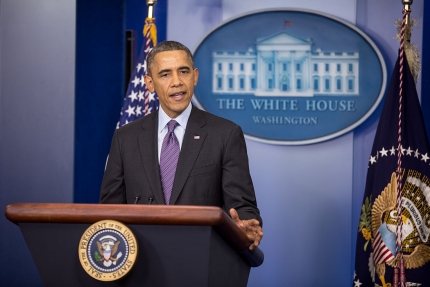
Daily Briefing by the Press Secretary, 12/5/2013
James S. Brady Press Briefing Room
1:46 P.M. EST
MR. CARNEY: Hello, friends. Good afternoon. Thanks for being here. Before I take your questions I have a couple of toppers. The first -- which goes with this graphic -- today, as part of our daily effort to highlight the benefits of the health care law, we are focusing on the Affordable Care Act’s protections for consumers with preexisting conditions, which can include conditions as common as asthma, diabetes, high blood pressure, heart disease or cancer.
Because of the Affordable Care Act, for the first time insurance companies will be prohibited from denying health coverage for the up to 129 million Americans living with preexisting conditions. Insurance companies will also no longer be able to charge higher premiums based on a consumer’s health status or history. In fact, in Virginia, where I grew up, almost 3.5 million adults and children have preexisting conditions, and now those people and their families will have the peace of mind of knowing that they cannot be denied coverage or charged higher premiums due to their health.
Unfortunately, this is also the same number of people who would lose these vital new protections if opponents of reform had their way and repealed the law. Just yesterday we saw a particularly egregious example of Republicans who to this day say they want to repeal the law or are trying to sabotage or undermine it and the protections provided by the Affordable Care Act. A Republican insurance commissioner in Georgia compared having a preexisting condition to being an irresponsible driver who illegally chooses not to get insurance and then causes an accident. “It’s your fault,” he said. It’s your fault. So it’s your fault if you have asthma or cancer, or some other preexisting condition. That kind of language is obviously wrong.
Almost half of Americans under age 65 say that they or a family member has a preexisting medical condition. That means almost half of you have a preexisting medical condition. And I want to take a moment to draw your attention to one example close to home, here in our White House family. Deputy Cabinet Secretary Michael Robertson, a remarkable 36-year-old who has worked for the President since his days in the Senate, came forward today to tell his story of being diagnosed 16 months ago with stage 4 cancer. Michael details his brave fight in an incredibly moving essay available now on whitehouse.gov, which I encourage you to read.
Next topper, on a different subject: In the latest step under his Climate Action Plan, President Obama today signed a memorandum directing the federal government to more than double the percentage of electricity that comes from renewable sources, to 20 percent by the year 2020. Today’s announcement builds on an executive order the President signed in 2009, directing the federal government to become a leader in clean energy and energy efficiency. As a result, the federal government has been able to reduce energy use and pollution in its operations and to save taxpayer dollars.
The presidential memorandum issued today caps off a week of announcements under the President’s Climate Action Plan. On Tuesday, the administration expanded its Better Buildings Challenge and released a new fuel economy guide that provides consumers reliable, user-friendly information that can help them choose the right fuel-efficient vehicle for their family and business and to save them money at the pump. And yesterday, the Department of Agriculture launched a new energy efficiency loan program, working with rural electric cooperatives to help businesses and consumers cut their energy bills by making energy efficiency and renewable energy improvements.
Thank you for your patience. I will now take your questions. Nedra.
Q Thanks, Jay. I want to ask you about a couple of developments on the Hill. Speaker Boehner said today that he would support a one-month extension of the farm bill. Would the President sign such an extension?
MR. CARNEY: As you know, the President has mentioned and made clear that there is an opportunity for bipartisan cooperation on a comprehensive farm bill and he hopes and expects that that can be achieved before the end of the year. So I’m not going to speculate about what would happen if Congress were to fail to achieve that. The President hopes that work will continue on that and that a bipartisan compromise is reached. We support the Senate bill, as you know, and hopefully there will be some resolution to that.
Q Will the President support cuts to food stamps that are greater than the $4 billion over 10 years that are in that Senate bill?
MR. CARNEY: I think our position is clear: We support the Senate bill. And I think that on the broader issue of food stamps, you heard the President talk about it yesterday. It is unconscionable what the House of Representatives did by separating it out, and the cuts that they envision would be enormously harmful to families across the country.
So the President has been clear on this. He talked about it again yesterday. And we believe there should be, as there has in the past, bipartisan support for a broad farm bill that includes the very important nutrition assistance and food programs that are provided under SNAP.
Q And also, what is the White House position on the Murray-Ryan budget deal that’s emerging?
MR. CARNEY: Well, what I can tell you is that there are ongoing negotiations, as has been reported, but we don’t have any comment on suggestions of a deal. We’ll wait and see what emerges from those negotiations. We are actively engaged with the Congress on this, but this is something that, as the President has said, can be and should be worked out in a bipartisan way between the Senate and the House.
So there’s no reason that we should go down the path the Republicans chose to take us down in October, and the President hopes that Republican leaders who have said that won’t happen again, that they won’t shut the government down because of their ideological opposition to health care reform or for any other reason, will hold true, and that they’ll instead negotiate a responsible compromise that makes sure that we invest in areas of the economy where we need to invest, that we make the right choices about how we deal with our longer-term fiscal issues, and that we approach all of our budget issues in a balanced way.
Let me go to Peter.
Q Quick question if I can. Right now, we know across the country in a hundred cities there are protests taking place where fast-food workers are calling for a minimum wage hike to $15. The President has in the past endorsed plans up to $10 and change. What is the President’s opinion of the $15 request being made?
MR. CARNEY: Well, I can tell you that, as the President said in his State of the Union address and as we have said clearly about the Senate bill, the Senate proposal for $10.10, which we support, that the minimum wage needs to be raised. In real terms, it is at a true low. I don’t have the specific comparative year, but it is very low comparatively over the past several decades.
And this is something that there is ample proof, as the President discussed yesterday, that would not have negative impacts on job creation or economic growth; in fact, would have positive impact on economic growth. And when you look at what the President spoke about yesterday and the fundamental idea that if you work hard you ought to be able to get a living wage, raising the minimum wage is an essential part of that.
Another thing I note -- because I saw some stories today about discussions among House Republicans about how better to I guess comport themselves in dealing with women candidates or issues of women -- and I would simply say that the problem that Republicans have had with women isn’t about language, it’s about policies. One way that they could support women today is to vote to raise the minimum wage, because women disproportionately benefit from increases in the minimum wage.
One thing they could do to support women in America is to stop trying to repeal the Affordable Care Act, and instead work with lawmakers who want to make it work as effectively as possible, because the Affordable Care Act prohibits insurance companies from charging women double for the same insurance policies that men receive. And there are a long list of policies that the President supports and obviously Democrats support that I think are concrete examples of concern for women.
Q But in terms of the $15-an-hour number that’s being thrown around today, there’s no position?
MR. CARNEY: We support the Senate bill. I don’t have a position on these protests beyond the fact that the President quite explicitly and passionately supports the need to pass an increase in the minimum wage.
Q You spoke about some Republicans on the Hill, but congressional progressives -- the Congressional Progressive Caucus, Democrats, have written a letter to the President urging that he circumvent Congress and sign an executive order to raise the minimum wage for workers employed through federal government contracts with private companies.
MR. CARNEY: I haven’t seen that, Peter. I would simply say that for those who watched or heard or read the President’s speech yesterday, you know how strongly he supports raising the minimum wage. This has always been done legislatively, and it has been done with support from Republicans and not just Democrats in the past.
The fact of the matter is, as the President cited yesterday, there are a lot of studies that show that there is no significant or measurable impact -- negative impact when you raise the minimum wage, and there are enormous positive benefits when you raise the minimum wage. And he credited those states that have taken action on their own, and he is calling on Congress to take action, because the benefits would be significant to hardworking Americans across the country.
Let me move around. Christi.
Q Jay, on that, can you imagine a scenario in which that Senate bill could pick up enough Republican support to pass, and how much energy is the President willing to put into making that happen?
MR. CARNEY: I would simply point to what the President did yesterday in his speech -- a speech that was, more broadly, about what he considers a fundamental challenge of our time, which is -- in domestic policy, which is the need to address growing inequality and diminishing opportunity. And raising the minimum wage is part of an approach that he believes we have to take as a nation to address this fundamental challenge.
So you will, as he said -- you will see from him, as he said, a focus on these issues every day for the remainder of his presidency. And I would note to those who might suggest that he was making a pivot yesterday that the themes he spoke about yesterday are entirely consistent with what you heard him talk about in the State of the Union, what he said in Osawatomie, and what he ran on in 2007 and 2008. It is the fundamental issue that motivates him when it comes to the future economic growth and prosperity of this country and of the middle class.
Q Does he think the most effective thing that he can be doing toward that -- on that cause is speaking about it publicly and making that case publicly? Or is he also tasking a legislative team with making it a priority?
MR. CARNEY: Both.
Alexis, then Jim.
Q Jay, in the past couple of days, the President has taken on --
MR. CARNEY: Go ahead. I'm just jumping ahead. But go ahead, Alexis. Sorry.
Q The past couple of days, the President has directly taken on Senator McConnell, as the Minority Leader of the Senate, and had some harsh rhetoric directed toward him. I was going to ask you, is the President feeling free to do that, to call him out directly, because he feels that his agenda and his need to work with Senator McConnell is over?
MR. CARNEY: Not at all. I think what you heard the President say is that he -- that yesterday was -- I think he took note of the fact that Kentucky is a state where we've seen a significant number of people sign up, based on what Kentucky is reporting, for the Affordable Care Act under the state exchange, and that instead of calling on Congress to repeal or for Washington to repeal the Affordable Care Act, he ought to listen to his own constituents who are demonstrating, by their actions, that they want and need affordable, quality health insurance.
And I think the singular fact of this debate over the last many years has been that, unfortunately, the Republican position has been not to offer alternatives, not to acknowledge that there are problems that need to be fixed, but to simply call for repeal. And what repeal means is a return to a world where women can be charged up to double for the same insurance policy that men receive; where insurance companies can deny you coverage because you have a preexisting condition; they can set annual or lifetime limits on your benefits; they can give you policies that carve out and exempt coverage on specific conditions that just happen to be the ones from which you suffer or that in the small print deny you coverage for hospital visits and the like.
So this is the fundamental debate and what is I think, for those of us who have been here a little longer, kind of frustrating or disappointing about it is there was a time not long ago -- including in Massachusetts when Mitt Romney was governor -- where Republicans actually had very specific and good ideas about how to reform the health care system that were certainly middle-of-the-road or even conservative. During the debates about health care reform in the first term of the Clinton administration, Republicans like Senator Chafee from Rhode Island and others were putting forward their own health care reform plans that, ironically, today look a lot like the one that the President signed into law three years ago.
Q So by singling out Senator McConnell as being, in his view, wrong on the Affordable Care Act --
MR. CARNEY: I think that Senator McConnell has spoken out about this a lot recently. He's also the leader of Republicans in the Senate. So I don't think he's -- I don't think we or he or anyone is suggesting that -- unfortunately, that he's alone in taking the position he takes among Republicans.
Q But I want to ask, is the President also trying to speak to Kentucky voters to suggest that he is supportive of Ms. Grimes as the opponent --
MR. CARNEY: Oh, I see, this is about electoral politics. I didn't get what your question was coming -- that it's about the election. No, this is about policy. This is about policy and the fact that Senator McConnell is the Republican leader.
And to your question about whether the President wants to or can continue to work with Republicans who oppose him on specific policy ideas, of course he answers, yes -- because that's been the case for a long time, including when Senator McConnell said it was the principal objective of Republicans to ensure that the President did not win a second term, and yet they managed to work together to get a few things done.
Jeff.
Q On China, the United States has urged China not to implement its air defense zone in the East China Sea. Would you like to see the zone implemented in a way that will minimize the chance of conflict, or would you like to see it rescinded altogether?
MR. CARNEY: We, the United States, do not recognize it and we do not accept it. And it will not change how the U.S. conducts military operations in the region. It does not have any practical effect on U.S. government operations.
To underscore, China's announcement was a provocative unilateral action that raises tensions in one of the world's most geopolitically sensitive areas, including territory administered by another state. It clearly increases the risk of a dangerous miscalculation or accident that could escalate quickly and dangerously.
Vice President Biden, who was just in China, was candid and direct with President Xi yesterday on these points: One, the zone should not be implemented -- I think that answers your question -- two, more broadly, China should refrain from taking similar actions elsewhere in the region, and three, China should work with other countries, including Japan and South Korea, to establish confidence-building measures, including emergency communications channels, to address the dangers its recent announcement has created, and to immediately lower tensions.
If I could go on, our message to China is that this type of provocative behavior is not consistent with the actions of a major power that upholds international norms and promotes peace and stability.
So I think -- I appreciate the opportunity to be very clear about our position.
Q Do you think you've been clear up until now?
MR. CARNEY: Yes, I do. I think that there was -- because of the reissuance of longstanding guidance to commercial airlines, there was some misunderstanding -- or just misunderstanding of what our position is. Our position is very clear.
Q Is that guidance to the airlines changing?
MR. CARNEY: The FAA? No, the FAA -- I think I addressed this yesterday and the day before -- our policy with regards to U.S. government operations has not changed. I think that has been demonstrated by action, by the fact that I have and others have made clear it is unacceptable and that we do not recognize it.
Q And on a budget question, would the President sign a bill that does not extend unemployment insurance past December 31st?
MR. CARNEY: What I can't do is negotiate budget compromises from here. The President strongly supports the extension of unemployment insurance benefits. I think it's worth noting that when President George W. Bush signed into law an extension of unemployment insurance, he did so because the unemployment rate was something like 5.6 percent and when longtime -- the average person who was unemployed was unemployed for 17 weeks. Now, even though the unemployment rate has come down significantly from its high because of the Great Recession, it is still much too high at 7.3 percent -- considerably higher than when it was the right thing to do for President Bush to sign into law an extension of unemployment insurance and the average person is unemployed for something like 36 weeks.
So if it was right then, it is certainly right now to do. And as the President discussed and others have discussed and experts have noted, the benefits of extending unemployment insurance are significant for the economy as well as obviously for those families that depend on the benefits.
Q Does the White House have any proposal on how to pay for that?
MR. CARNEY: We are working with Congress. I would note that for the last several years, we have successfully -- or Congress has successfully found a way to extend unemployment insurance in a way that the President can sign and that was paid for. So I would simply say that this is and should be very doable, and we hope that Congress will take action appropriately.
Jim.
Q Jay, getting back to the President's speech on the economy yesterday, he said the combined trends of increased inequality and decreasing mobility pose a fundamental threat to the American Dream. Hasn't that happened on his watch?
MR. CARNEY: No. In fact --
Q Isn't he responsible for that?
MR. CARNEY: Jim, as I think you know, since he ran on this issue in 2007, the answer is, of course, that these are long-term trends. He talked about it in great detail. And I appreciate everyone's concentration and patience through what was a substantive economic speech, but he talked about data that I think that -- the hinge point, if you will, was 1979, when he talked about what had happened since 1979. So this is a -- these are trends that have been long in the making, and they have to do --
Q These trends stabilized when he became President. Obviously, the Great Recession had a major impact on all of this.
MR. CARNEY: When he took office, our economy was in free fall, and we were shedding jobs at the rate of 800,000 per month, and our economy was shrinking at the fastest rate since the Great Depression. All that aside, I guess is your question -- and since the President’s policies have been implemented, the economy has been growing consistently for a long time now and been producing jobs consistently.
But the President didn’t run for office simply to get us back to where we were, on the verge of the Great Recession. He ran for office, as he talked about as early as 2007, because there was this problem and there is this problem with growing inequality and reduced upward mobility. And that has been his focus since he ran for this office, and it’s why he made clear that it remains his focus, his principal priority as President, and will be throughout his term.
Q A big part of his speech yesterday was about income inequality. I mean, he said this is one of the driving motivations for the remainder of his presidency. But that disparity has been exacerbated as he’s been in office.
MR. CARNEY: No, to the contrary. I'm sure you were here, you saw that for the first time in decades, because of the President, we reduced unfairness in the tax code and addressed the imbalance through the deal at the end of last year or January 1st of this year.
Q Economists saying Wall Street is feeling the benefits of this recovery, as it stands right now -- that people on the streets right now protesting because they want a higher minimum wage.
MR. CARNEY: Which the President supports.
Q They’re saying they’re not feeling it.
MR. CARNEY: Jim, I really urge you to look at the President’s speech, look at the data. The fact is the President has long supported policies and continues to support policies and has taken action on policies that go right at this issue. That work is not done. And there’s no question that when he took office that job, for all of us in Washington and for everyone who is concerned about this issue, was made enormously more difficult by the worst economy that we've seen in our lifetimes, the result of, in part, some truly poor policy decisions that had been made in the previous administration.
So this is the principal focus when it comes to domestic policy of his presidency. It has been since he took office, and what the President made clear yesterday is that it will continue to be while he remains in office.
Q And those enrollment numbers that came out yesterday, 29,000 people enrolled, roughly -- numbers need to be scrubbed -- in the first couple of days of this month. Republicans up on Capitol -- I'm sure you're aware -- were saying yesterday that that is not fast enough to make up for all of these millions of people who are getting cancellation letters. Is this White House concerned that you may not be able to get all of those folks enrolled?
MR. CARNEY: What I can tell you is that there has been, because of the steady progress that's been made on improving the website, a significant improvement in the functionality of the website and, therefore, a significant increase in the number of visitors to the website and the number of people who have been enrolling. When we have scrubbed hard data it will be released, but we're confident that those numbers are increasing.
And that's what we're focused on, is delivering the product. Republican are spending a lot of time rooting for failure, and when there’s improvement here they say, “yes, but what about this?” What we're doing is addressing this and this and making sure that the obvious and demonstrated desire by millions of Americans to get this product, get the security that comes from being able to enroll in and receive quality, affordable health insurance is achieved and that we do it.
And we made that work a lot harder on us because of the problems with the website and other issues. But we're focused on fixing the problems, not repealing the law so that things can go back to where they were; not on denying people the benefits that they’ve already received under the Affordable Care Act. That so far has been the Republican message. We're focused on making the fixes necessary.
And I know it’s hard, probably, for Republicans to take that the website is improving -- it takes away some talking points, forces them to look at other issues, as opposed to maybe trying to actually improve people’s lives through finding a way for them to get the kind of quality, affordable health insurance they deserve.
Q And really quickly, on the American killed in Libya, has the President been briefed on this?
MR. CARNEY: The President was briefed on it during his morning briefing. And all I can say right now is I can confirm that a U.S. citizen was shot and killed in Benghazi, Libya. We offer our condolences to the victim’s family. The State Department is in contact with the family and is providing consular assistance. We are following events closely, and at this point no individual or group has claimed responsibility. We look to the Libyan government to thoroughly investigate this killing.
Out of respect for the privacy of the family, we have no further comment at this time.
Michael, and then Ann.
Q Does the President have any reaction to the theft and then eventual recovery of radioactive material in Mexico, apparently in some very lightly secured because it got taken out by people who may not have known what it was? And does he have any sense, or do you guys have any sense that the sort of transportation of such material in this country needs to be reviewed to see whether it’s secure enough as well?
MR. CARNEY: Well, these are separate issues, but let me just address the situation in Mexico with the stolen vehicle. Our national security team monitored that situation involving the stolen vehicle and medical equipment very closely yesterday. Throughout the day we were in tough -- close touch with Mexican officials. We also took appropriate precautionary steps along our shared border with Mexico, and we are pleased that the vehicle and equipment were recovered and that the situation was resolved.
The President was briefed by Assistant to the President Lisa Monaco yesterday morning and was provided updates throughout the day. I'd refer you to Mexican authorities on their investigation, but at this point, we do not have any reason to believe that the stolen vehicle ever posed a threat to the United States. Again, what’s most important is that the vehicle and equipment were recovered and the situation was resolved.
On broader issues about transportation safety, I don't have -- I would refer you to the relevant agencies on that. I don't have anything on that as it relates to the Mexican incident.
Ann.
Q When will the President deliver his State of the Union address? And will it be -- was yesterday kind of a rough draft of the kind of approach he'll take, including his call for government engagement to make the economy move forward?
MR. CARNEY: I don't have a date for you on the State of the Union address. That's something that obviously a President is invited to do, as I recall, and we'll have an announcement --
Q So it will be next month?
MR. CARNEY: Next month? It will be early next year. I don't have a date for you, Ann. But it is safe to say that the themes that the President spoke about yesterday will be reflected in the State of the Union as they were in his last State of the Union address, and as they have been often throughout his presidency and candidacy for President, because they are so elemental to why he believes -- why he ran for President and why he believes we need to take the action that we should take on economic policy moving forward.
So I don’t have any more of a preview for the State of the Union address. As he joked yesterday, yesterday was not a State of the Union address. It was not as full of new or specific policy proposals that State of the Union addresses often are. But it certainly -- those issues will absolutely be central to a major address he might give sometime early next year.
Q Thirty-million Americans are in the path of this extreme cold storm system moving across the country. Does the President have any worries that there are enough resources at either the Weather Service or at the Federal Emergency Management Agency? Has the President gotten request from governors for any help in what's proven to be a deadly storm?
MR. CARNEY: I don’t have anything on that regarding the President. I know that -- I'm sure that FEMA is the agency best suited to answer those questions about federal resources positioned for potential emergencies, weather-related emergencies. That is the work that they do, and do extremely well. So I don’t have any updates from the White House on that, but I know that these are the kinds of things that the administration as a whole, with FEMA taking a lead, monitor very closely.
Mara, then Major.
Q Just to follow up on Jim's question -- the President said yesterday these trends have been going on for a very long time and they're certainly going to be around when he leaves office. Probably the middle class won't be any better off than before he took office. My question is --
MR. CARNEY: Well, we're not willing to concede that. (Laughter.)
Q All right. Well he listed -- he gave a long list yesterday --
MR. CARNEY: I'm disappointed that you are.
Q He listed the initiatives that he's mentioned before that he thinks could make a difference --
MR. CARNEY: By the way, let's just stipulate that you're wrong. (Laughter.)
Q Okay.
MR. CARNEY: The middle class, in January of 2009, was faced with the prospect and predictions of 25 to 30 percent unemployment in America, the likes of which we have not seen since the 1930s. The middle class was at the heart of a storm that was causing this economy to shed 800,000 a month. The middle class saw their home values, their savings, everything that had sustained them diminish dramatically during that terrible recession.
So I think it is not too bold a thing to say that while there is much work to be done, that we as a nation, including the middle class, are better off today than we were then, as we were being dragged into the worst recession, dragged towards 10 percent unemployment and all of the terrible impacts that that had on the middle class and every other American family -- but that we have a lot more work to do, and that if we continue to make the steady progress that we've made, and if we take the necessary measures to invest in our economy so it grows even faster and creates even more and better-paying jobs, that we will be better off and the middle class will be better off in three years, in five years, in 10 years. And that’s what the President was talking about.
Q But in terms of the things he listed that he wants to do, like universal pre-K, and investing in education and infrastructure, raising the minimum wage, what realistically does he think are his chances of getting any of them passed between now and the end of his term?
MR. CARNEY: I think he thinks his chances are very good, because in the end, when it comes to raising the minimum wage, this is something that Republicans and Democrats have supported in the past -- not always -- but have in the past. And there is just so much ample evidence that it's the right thing to do for our economy. And you've seen it in states across the country, and you've seen it from some Republicans across the country, an interest in doing this and an interest -- and a recognition that it is sound economic policy.
Universal pre-K -- this is something that shouldn’t be political or partisan, providing that start to your education for children across the country. As the President said yesterday, there’s no better predictor of income and future economic security than education. So, look, there are a lot of Republicans out there -- governors, former governors, others -- who recognize that and understand that education and investment in education is key to our future economic growth. So there’s no reason to accept that these are not things that can’t be done.
And that’s true also of investments in our infrastructure and other areas that have traditionally enjoyed bipartisan support precisely because they are the kinds of investments that create jobs in the near term and build a foundation for future economic growth and job creation.
So the President is convinced that we need to act on these, that Congress can and should work with him to act on these, and that where Congress won’t, he will where he can.
Major.
Q Jay, you mentioned that you hope the Libyan government investigates the killing of Ronald Smith. As is not a secret to this White House, the Libyan government has, charitably, a tenuous level of interaction in Benghazi. It is largely a lawless place in Libya with militias running rampant. Is it too dangerous a place for Americans to be?
MR. CARNEY: There is a longstanding travel warning.
Q I know, but does this amplify that?
MR. CARNEY: So as a government, we have -- the State Department has issued a travel warning that’s been in place for some time about warning Americans about the dangers of traveling in Libya. So for greater detail on how those assessments are made and why, I would refer you to the State Department.
We do expect the Libyan government to investigate this. At this point, we don’t have very much information to share about who is responsible or how it happened or why. But we certainly do expect the Libyans to investigate.
Q There was an announcement yesterday where the administration said along with several key players in the insurance industry they would be working together to try to technologically resolve the continuing and persistent problems with the 834 and backend data transmission and for those who believe they’ve enrolled in the Affordable Care Act. Can you describe the nature of that relationship? What are the insurance companies going to be doing that they were not doing before? And doesn’t this illustrate that there will be -- the frontend of the website is demonstrably better; the backend, the most -- or equally important part of it, is still substandard?
MR. CARNEY: What I would say, Major, as I think I said not yesterday because I didn’t brief, but the day before, is that -- two things: one, CMS has stood up teams of experts that are working directly and closely with issuers on this specific matter of the 834 forms and the backend issues that have arisen. There is no question that since the launch of healthcare.gov on October 1st there have been a number of different types of problems with 834 forms, as there were problems with other aspects of the site. And we believe that many of these were the result of the initial technical problems with the site and have been fixed with our improvements and upgrades over the past several weeks.
Our priority is understanding the results that issuers are getting because of the fixes put in place, and fixing any remaining bugs that are causing problems, and working to make sure that every 834 form past and present is accurate. Because what’s most important is working to ensure that those who want insurance starting in January can enroll and begin their coverage. So CMS, as I think I said the other day, will be reaching out directly to consumers by email and by phone who have already selected a plan to let them know to be in touch with their plan and to pay their first premium.
So there’s a lot of effort going into ensuring that whatever issues there were and whatever bugs remain with 834 forms are resolved in time for insurance to kick in on January 1st. As I think I hinted the other day, the universe -- when you talk about the early problems with the backend, there were so many problems with the website that unfortunately -- but we’ve acknowledged this -- not that many people were able to enroll in October. And so the universe of the people who in their enrollment had issues with their 834 forms or the backend is not all that large -- which is actually an inadvertent or unexpected positive out of a very negative situation in October.
So what we know is that the fixes that have been put in place over the past several weeks, including some major fixes over last weekend, have had brought about a significant improvement across the board on the site, including with the 834 forms. We are working with issuers regularly to look at the results of those fixes, and also to address the remaining bugs that exist.
Q I’d like to address -- because the language you just used was very general, just as it was in the early stages of the website’s problems. You’ve now become more specific about error rates, time improvements on the frontend of the website. CMS in these daily calls is still very opaque; asked directly what is the magnitude of the problem, what are the error rates you’re seeing in the 834s -- no information whatsoever.
MR. CARNEY: I think they’re working with issuers on the specific problems and data, but I think you have to --
Q Do you have a handle on the magnitude of this problem?
MR. CARNEY: You have to understand, it’s not like -- the answer I think broadly is, yes, and we know without a doubt that the problems that existed on the backend have been diminished greatly, no question, with the fixes that have been put in.
Q Then why not have the same transparency about tabulating that as you have with some of these other issues?
MR. CARNEY: Well, again, first of all, I would refer you to CMS because they have --
Q No, I have -- and they provide nothing.
MR. CARNEY: Well, I dispute that.
Q To this direct question, about numbers and magnitude of the problem and error rates and things like that, they're like, we'll get to that eventually.
MR. CARNEY: I understand. Well, they're working very hard on this, so I wouldn't suggest they're being lackadaisical.
Q It’s not as if it’s an immaterial issue. It's a hugely important issue.
MR. CARNEY: It is, and fixing it is a hugely important issue. When you talk about finding out specific percentages, it's not -- these are bugs that affect individual aspects. So to collect data on it is not necessarily as simple as what's the error rate for this broad array of or series of small problems that may have affected 834 forms.
What we know is that there were significant problems with the whole website, including the backend, and that over the course of the time that the teams were in place to make improvements to the site through software fixes and hardware upgrades that those problems have abated, although have not been completely eliminated.
And I think, Major, as those who have noted, we've been pretty candid about the self-inflicted problems that have been created and we're candid about the fact that even though we hit our goal for November 30th and the site is functioning as we hoped it would that there are still problems and we need to address those.
Q But to challenge the transparency is to work on behalf of people who may assume that they have enrolled, and they have fallen into a category that insurers are now commonly referring to as “ghost enrollees,” people who believe that they enrolled but they're not.
MR. CARNEY: And, Major, what I can tell you is we know every person who has enrolled or believe he or she is enrolled -- we, the CMS and others -- and every one of them is being contacted and making sure that their enrollment is accurate and that they will, if they sought to enroll and have insurance on January 1st, they will have it.
Q Hand over the data.
MR. CARNEY: Ed.
Q A different subject. The Boston Globe has some news today saying that the White House has changed its story about the President's relationship with his uncle who lives in the Boston area. You know he was under threat of deportation this week.
MR. CARNEY: His father's half-brother.
Q His father's half-brother?
MR. CARNEY: Yes.
Q Okay.
MR. CARNEY: -- his uncle, but, yes.
Q His uncle, correct. The White House said in 2011, I believe, that there was no record of them ever meeting. And now the Boston Globe is being told by the White House -- and I assume you can elaborate here -- that in fact they not only met, but they lived together briefly when the President was in law school. So how could you make that kind of mistake?
MR. CARNEY: Well, what I can tell you, Ed -- and thank you for the question -- is that back when this arose, folks looked at the record, including the President's book, and there was no evidence that they had met and that was what was conveyed. Nobody spoke to the President.
When Omar Obama said the other day -- and there were reports that he had said the other day that President Obama, back when he was a law school student, had stayed with him in Cambridge, I thought it was the right thing to do to go ask him. Nobody had asked him in the past, and the President said that he, in fact, had met Omar Obama when he moved to Cambridge for law school, and that he stayed with him for a brief period of time until his -- the President's apartment -- was ready. After that, they saw each other once every few months while the President was in Cambridge. And then after law school, they gradually fell out of touch.
The President has not seen Omar Obama in 20 years, and has not spoken with him in roughly 10 years. And as I said the other day, obviously this was an issue -- his legal issue was one that was handled appropriately by --
Q So you can say there was no interference at the White House?
MR. CARNEY: Absolutely not.
Q Health care. Senator Harry Reid gave an interview back in Las Vegas to one of the stations back there, and he defended the President previously saying, "If you like your plan, you can keep it," because he was saying, as you've alluded to before, that policies change, et cetera. And Harry Reid said, "I’d still go back and say what I said earlier. What the President said was true. If you want to keep the insurance you have, you can keep it." Do you agree with Senator Reid? Is that still true, that if you have a plan that you like, the insurance you like, you can keep it?
MR. CARNEY: Ed, I think the President has addressed this in detail, not just in answering questions, but also in making a policy change to address the problem that has arisen because of cancellations. So I think he acknowledged that this created problems that need to be addressed. And so he has --
Q But that's just for a year, right, what the President came here and said -- he was fixing it for a year?
MR. CARNEY: He extended -- the policy that I think the rule change allowed -- that there was nothing in the Affordable Care Act that would prevent them now from extending those policies beyond where they could have been extended in the past.
I mean, look, the fact of the matter is, Ed, in the end, when it comes to the challenges that have arisen within the rollout, I think we've been pretty honest about acknowledging where we need to make fixes, we need to make improvements. And the President is willing every day to hear from lawmakers who want to fix the Affordable Care Act, fix Obamacare, rather than repeal it, rather than go back to the status quo ante, where insurers could kick you off your policy or refuse to cover you if you had a preexisting condition. And that remains his position to this day.
Q But I realize the White House believes this is an old story, but then you have the Senate Majority Leader, a Democrat, who supports the President, supports the Affordable Care Act, saying what the President said all along was true. Do you agree what the President said was true?
MR. CARNEY: Look, I haven't seen Senator Reid's comments. I think the President has spoken about this at length and repeatedly, and has taken action on this. So I really don't have anything to add to that, Ed.
Q Okay, the last one on that. Related to Senator Reid -- we didn't have a briefing yesterday, so we didn't get a chance to ask you what developed in the last 24, 48 hours -- Senator Reid has now exempted not all, but some of his staffers from entering into the D.C. exchange. Isn't that hypocritical for somebody that supportive of the Affordable Care Act?
MR. CARNEY: Ed, I would direct you to Senator Reid's office. I haven't --
Q But why shouldn't they sign up like everyone else?
MR. CARNEY: I haven't seen that, so I would direct you to the Senator's office.
Steve.
Q Back to China. When Jeff asked you if China should rescind the zone, you said it should not be implemented. Does that mean that the U.S. would accept a solution in which while China may not rescind the zone officially it would not enforce it?
MR. CARNEY: I think you're looking for nuance and semantics that aren't really there. The fact is countries have ADIZs. The United States has them. But it is not wise to unilaterally declare one in an uncoordinated fashion in one of the most highly sensitive areas in the world, which includes territories administered by other countries, and then make statements interpreted by many as threatening and out of line with international aviation practice and freedom of navigation norms.
That’s why China's recent actions have been so dangerous and provocative. That’s why we reject it, we don’t accept it, and we call on China not to implement it. I think if you don’t implement it, that effectively -- I think that’s pretty clear about what our policy is. We do not recognize it, and we have made no changes that have had any practical effect on U.S. government operations in the region. So I think we've been pretty clear about this.
Margaret.
Q Thanks. I don’t think the White House has announced it yet, but Brookings did, that the President is going to be among those participating in the Saban Center Forum on Saturday. It's a forum about the Middle East. Can you talk to us about how prominently Iran will factor in his remarks, and whether we should expect --
MR. CARNEY: He's not giving remarks. I think he's having a conversation. So the conversation will --
Q Is he prepping for it?
MR. CARNEY: I don’t think he needs to prep. He's pretty engaged in the issue.
Q Can you talk about -- although I think Netanyahu is speaking on a different day and maybe by webcast, of course, Secretary of State Kerry speaking with Netanyahu ahead of this, but do you expect that the President and Bibi will have a chance to talk again before that forum event?
MR. CARNEY: I don’t know of any prearranged conversations. As you know, Prime Minister Netanyahu and the President speak frequently, meet frequently. There is no leader in the world with whom the President has had more meetings or conversations than he has had with Prime Minister Netanyahu. I think it's been reported -- and it sounded accurate to me -- that they recently had a very long phone conversation focused largely on Iran.
So it's entirely possible, but I don’t know when they're speaking next. They communicate regularly. Our governments communicate daily, intensely on a whole range of issues, and that includes on Iran and many other issues. And I believe Secretary of State Kerry is in the region, as well. So that relationship is extremely close, and it is one in which there is cooperation on numerous levels and information shared that is of great importance to the fulfillment of our commitment to Israel's security. And we work very closely with Israel on these issues and apprise Israel of what we're doing. And that’s what we've been doing.
Q Can I ask you, since we last checked in on this a couple of days ago, where do you see the action on the Hill moving with regard to the triggering sanctions? Do you think that’s -- I know you don’t like it, but do you think it's a foregone conclusion at this point, or do you think you can still stop that from happening before the end of the year?
MR. CARNEY: We're working very aggressively on this issue because we, as I've said in the past and so many others have as well, we strongly believe that it is not the right time for Congress to pass new sanctions. Congress has been an extremely helpful and effective partner with the administration and with our international allies on this matter. And working with Congress, the United States has helped build the most comprehensive sanctions regime in history with I think great success.
It is precisely because of the effectiveness of that sanctions regime that we have the opportunity now to explore whether or not Tehran is serious about resolving this issue diplomatically. And if they are not, then we will have to move on to other means of ensuring that Iran cannot obtain and does not obtain a nuclear weapon.
But if we can reach an understanding with Iran on strict constraints, then we can contemplate an arrangement that includes a -- let me just back up. This is a step-by-step process. The preliminary agreement as it's implemented requires Iran to keep its commitments to halt progress on its program and to roll back key aspects of it. The purpose of that is to essentially put time on the clock, because the alternative to the preliminary agreement is to allow Iran, even as we -- I mean, the purpose of the preliminary agreement is to put time on the clock so that progress is not made on its nuclear program while we pursue a comprehensive agreement.
The alternative is to -- and sanctions could undermine, obviously, the preliminary agreement. The alternative is then to continue to pursue a permanent resolution without a preliminary agreement while Iran has no constraints on its capacity to make more progress on its program. So the result would be, six months down the road, Iran would be further along in its progress. The preliminary agreement would prevent that.
Q Did the U.S. really not tell the Iranians during the last round of negotiations, look, we’re not supportive, but this is the reality and in Congress there’s a great likelihood you’re going to get some sort of trigger --
MR. CARNEY: No. We’ve been extremely vocal about our position on sanctions and the need for Congress to act when the time is ripe for new sanctions, if that time arises, because that’s when new sanctions could be more effective if Iran fails to comply with its commitments in the agreement.
Mark, and then April.
Q Jay, is it assumed here that the American shot and killed in Benghazi was targeted because he is an American or was an American?
MR. CARNEY: We just don’t have information on this right now, so what I can say about it is what I said at the top.
Q And on his speech yesterday, President Obama said that he wants to encourage savings by the American people. Can you elaborate on that? Does he mean bank savings when he referred to that yesterday in his speech?
MR. CARNEY: Well, you picked a little piece out of that speech to ask me about.
Q It caught my ear because he rarely mentions it.
MR. CARNEY: I think, as a general matter -- and I don’t want to venture too far here because I’m not steeped in the policy -- but there has been an issue over the years to increase -- for Americans to increase their savings rate and to reduce their debt. But I think the broader issue here is to grow the economy, create jobs, provide and act on policies that allow that to happen, including raising the minimum wage, including providing pre-K for all, including making the investments in the economy that will help create jobs here in the United States that pay well and help the middle class grow and be more secure.
So I can take that question and get you more information about the specific prescription that that referred to, but I think it’s part of a broader push for policies that go at the issue of growing inequality and go at the issue of diminished upward mobility.
Q If you could get more, I’d appreciate it.
MR. CARNEY: Sure. Yes.
Q Me?
MR. CARNEY: Oh, sorry, April. And then -- yes.
Q So, Jay, on yesterday’s speech, could you tell me what the President has in mind when it comes to teeth and to helping bridge the inequities in the economy?
Q I think he spoke in detail about that yesterday, and I think he’s made clear that this nation has always and this economy has always grown best when it grows from the middle out, and been strongest when the middle class is expanding and becoming more secure, and that we need to address this trend that we were talking about earlier that has been in the making now for many, many years, and because the idea of who we are as a country is built in part on the notion that anybody, no matter the circumstances in which he or she is born, has the opportunity to succeed. And I think it’s pretty startling for those of us who have deep faith in that ideal to hear that the United States now has lower mobility than countries in Europe, which was certainly not the case in the past.
So it is a profound problem, and it is one that the President believes, as you heard him say yesterday, we need to address through a series of policies that go right at these fundamental economic challenges.
Q Do you have a timeline of when these policies will be rolled out? Because you have --
MR. CARNEY: Well, as the President mentioned yesterday and acknowledged in the middle of his speech, he’s put out a lot of ideas that address these already. And as we were talking with Ann earlier about the State of the Union, he will obviously give a State of the Union address and there will be other matters that he discusses there and other policies. But we already know what we can do in many cases to address these challenges, including raising the minimum wage, including providing pre-K for every child in America, and all the other things that the President talked about in the speech yesterday.
Q The reason why I ask that -- you have critics of the speech, people -- there are praises and there are critics. Mary Frances Berry, the former head of the U.S. Commission on Civil Rights, said you did not give -- he didn’t have teeth, he did not come up with specifics. And this is going to be a three-year timeline that you’re going to be rolling things out and people want to know when and what? What will be done --
MR. CARNEY: Well, I didn’t see that particular comment. I think the President made clear that he wasn’t rolling out -- he wasn’t giving a specific-laden policy speech. He was giving a speech about the broader challenge and ways that we need to address it.
There are specific policies that he has already put on the table -- as we’ve been talking about, raising the minimum wage and others -- that Congress could act on in the very near term. But the President committed to a couple of things yesterday. One is fighting for those -- just because we haven’t gotten them done yet doesn’t mean we should abandon the effort to get them done, because in so many cases these are the kinds of things that have enjoyed bipartisan support in the past and where there is ample nonpartisan, nonpolitical analysis that demonstrates that the measures that he’s proposing are good for the economy and good for the middle class.
Second, he called on Congress and opponents of his policies to engage in the debate. Don’t just be against something; be for something. If you in Congress have better ideas or believe that your ideas are better for addressing the growing inequality in America, or addressing the diminished upward mobility in America, let’s hear them and let’s debate the policy specifics about whether or not they actually address the problem. That would be very healthy instead of simply opposing everything.
And finally, he said that where Congress won’t act and he can, he will. But it is very important for Congress to engage in this issue because there really is no more important issue for our economy and our people than the problem the President identified yesterday.
Q Thanks, Jay.
MR. CARNEY: I’ll do the last one.
Q Thank you, Jay. Two questions. First one, on the new regulations concerning the NSA surveillance program today, collection of 9 billion location data, is the White House worried that, again, tensions will be exacerbated with European leaders, Latin American leaders on these topics as we’ve seen earlier?
MR. CARNEY: Well, I’m not in a position to discuss the details of particular tools and methods of intelligence collection, although yesterday, ODNI stated for the record that no element of the intelligence community is intentionally collecting bulk cell phone location information about cell phones in the United States. When conducting its overseas foreign intelligence mission, however, if NSA incidentally acquires information to, from or about a U.S. person, such information must be handled in accordance with approved minimization procedures to safeguard that information.
When it comes to issues -- and this is not specific to stories yesterday, but just in general -- issues that have arisen because of these disclosures and revelations that have caused tension in our relationship with important allies, we have, as I’ve said in the past, addressed those matters directly through diplomatic channels and we’ll continue to do that.
Q One question in the spirit of what you said earlier about the climate action plan. Are we getting closer to a decision on the Keystone XL pipeline?
MR. CARNEY: I have no update on that and I would refer you to the State Department, where they are -- they house the process.
Laura, I saw you back there with your hand up for a long time. You’re the last question.
Q Thanks. France is going to launch a military operation in the Central African Republic. That is what President Hollande said. What's the White House reaction? And will you support the French action, again, in Africa?
MR. CARNEY: I can tell you that in recent weeks government-affiliated armed groups and independent self-defense militias in the Central African Republic have committed shocking and horrific atrocities against innocent civilians that demand a swift response by the international community. Today's passage of U.N. Security Council Resolution 2127 is an important step in preventing further atrocities or an escalation of the violence.
It provides African Union-led peacekeepers and French forces a Chapter 7 mandate to protect civilians, restore, and ensure humanitarian access. It also calls for contingency planning to move forward now should the Council determine conditions are appropriate for the deployment of a U.N. peacekeeping operation in the future.
In support of these efforts, the United States is providing $40 million in assistance to the African Union security mission. And we continue to evaluate what more we can do to help stabilize the situation and support a political transition. We join the international community in condemning the violence that has taken place and demanding accountability for the perpetrators, and in calling on all parties to work toward a restoration of democracy.
Thank you all very much. Have a great afternoon.
END
2:54 P.M. EST