The White House

Office of the Press Secretary

Remarks by the President at a Campaign Event -- Bowling Green, OH

Bowling Green State University
Bowling Green, Ohio

1:25 P.M. EDT
 
THE PRESIDENT:  Hello, Falcons!  (Applause.)  Thank you so much.  Thank you.  (Applause.)  Now, let me begin by asking everybody to give Seth a big round of applause for that great introduction.  (Applause.)  I was backstage and I had trouble hearing -- did he explain what was going on with his arm?  So Seth was playing, I think -- ultimate Frisbee, that’s what it was.  (Laughter.)  He was playing ultimate Frisbee.  He went up -- he was going to make this amazing touchdown, and he had the Frisbee and somebody cut him under his legs, cut out from under him.  It is clear replacement refs were in the game.  (Laughter and applause.)  He broke his wrist.  He was supposed to get it set yesterday but he didn’t want to miss this.  (Applause.)  So when he came up here, his wrist was not yet set, and he’s going to have to go to the hospital afterwards to get his wrist set.
 
Now, I just want to make the point that if Seth can come up here with a broken wrist, then there is not a student here who cannot get registered and make sure they go to vote.  (Applause.)  No excuses.  No excuses.  You got to play through injuries, Falcons.  (Laughter.) 
 
AUDIENCE MEMBER:  I love you!
 
THE PRESIDENT:  I love you back.  I’m glad to be here.  (Applause.) 
 
Now, it’s great to be here with your next Congresswoman, Angela Zimmann.  (Applause.)  I’m thrilled to be with all of you.  And unless you live under a rock, or your cable is bust, you may have noticed that there’s an election going on here in Ohio.  By the way, those of you guys who have seats, feel free to sit down.  I’m going to be talking for a while here.  (Laughter.)  And those of you who don’t, make sure to bend your knees, because sometimes people faint, fall out -- not because I’m so exciting, but just because you’ve been standing a long time.  (Laughter.)
 
So there’s an election going on here in Ohio, and in case you’re wondering what kind of impact that’s having, I was talking to my campaign manager; he was meeting with this couple who had this adorable four-year-old son named Sammy.  And they were very proud that Sammy knew what was going on, and there was a picture of me up on the wall, and the parents said, “Who’s that, Sammy?”  And Sammy said, “That’s Barack Obama.”  And then the parents asked, “And what does Barack Obama do?”  And Sammy thinks for a second and he says, “He approves this message.”  (Laughter and applause.)  True story.  True story.
 
That’s what I do.  I approve this message.  (Laughter.)  And, Ohio, that’s because, starting on October 2nd, which is just six days from now, you get to start voting.  You get to have your say.  (Applause.)  You can register to vote all the way up until October 9th, but if you’re already registered you can start voting in six days.  And this is important, because you’ve got a big choice to make.  And it’s not just a choice between two parties or two candidates.  It is a choice between two fundamentally different paths for America, two fundamentally different choices for our future. 
 
My opponent and his running mate are big believers in top-down economics.  They basically think that if we just spend another $5 trillion on tax cuts that favor the very wealthiest, then --
 
AUDIENCE:  Booo --
 
THE PRESIDENT:  Don’t boo, vote.  Vote.  (Applause.)  Vote.  Vote.  (Applause.) 
 
But their theory is, these tax cuts for the folks at the top, then prosperity and jobs will rain down on everybody else.  The deficit will magically go away, and we will live happily ever after.
 
There’s only one problem.  We just tried this during the last decade, during the previous presidency.  It didn’t work.  Top-down economics never works.  The country doesn’t succeed when only the rich get richer.  We succeed when the middle class gets bigger -- (applause) -- when more people have a chance to get ahead, more people have a chance to live up to their God-given potential.
 
Look, I don’t believe we can get very far with leaders who write off half the nation as a bunch of victims who never take responsibility for their own lives.  (Applause.)  And I’ve got to tell you, as I travel around Ohio and as I look out on this crowd, I don’t see a lot of victims.  I see hardworking Ohioans.  That’s what I see.  (Applause.)  We’ve got students who are trying to work their way through college.  (Applause.)  We've got single moms who are putting in overtime to raise their kids. 
 
By the way, your outstanding president of this institution, Bowling Green -- charming woman, really smart -- (applause) -- and there she is right there.  We were talking because we both were raised by single moms, and she was telling the story about how her mom worked at a resort in West Virginia, but she was doing the hard work and ended up raising one college president and one federal judge. 
 
That’s what we believe about the economy -- when you give folks a chance.  I see in this audience senior citizens who have been saving for retirement their entire lives; veterans who served this country so bravely.  (Applause.)  Soldiers who are today defending our freedom.  (Applause.)
 
Look, so let’s just get something straight in case anybody is confused.  We don’t believe that anybody is entitled to success in this country.  We don’t believe government should be helping people who refuse to help themselves.  But we do believe in something called opportunity.  (Applause.)  We do believe that hard work should pay off.  We do believe in an America where everybody gets a fair shot, and everybody is doing their fair share, and everybody is playing by the same set of rules.  (Applause.)  We do believe in an America where no matter who you are, or what you look like, or what you’re your last name is, or who you love, you can make it if you try.  (Applause.)
 
That’s the country I believe in.  That’s what I’ve been fighting for, for four years.  And that’s why I’m running for a second term as President of the United States.  (Applause.)
 
AUDIENCE:  Four more years!  Four more years! 
 
THE PRESIDENT:  Now, I’ve got to say this.  This country has gone through a very tough time, and we’ve still got a lot of folks who are hurting out there.  And I’m not somebody who is coming here offering some easy, quick solutions.  The truth is it’s going to take more than a few years to solve the challenges that were building up over decades -- jobs being shipped overseas; paychecks flat, even as costs of everything from college to health care were going up. 
 
AUDIENCE MEMBER:  -- in Ohio.
 
THE PRESIDENT:  That, too.  (Applause.) 
 
But here is what I want everybody to be confident about:  Our problems can be solved.  Our challenges can be met.  We’ve still got the best workers in the world.  We’ve got the best businesses in the world.  We’ve got the best scientists in the world and researchers.  We definitely have the best colleges and universities in the world.  (Applause.) 
 
So especially for the young people out here, I want you to understand, there is not a country on Earth that wouldn’t gladly trade places with the United States of America.  (Applause.) 
 
But we’ve got work to do.  We’ve got work to do.  And the path I’m offering may be harder, but it leads to a better place.  And I’m putting forward a practical, five-point plan to create jobs and to grow the middle class, and rebuild this economy on a stronger foundation. 
 
So just in case you guys missed the convention and -- (laughter) -- I know you didn’t miss Michelle.  (Applause.)  Let me reprise what this plan consists of.
 
First, I want to export more products and outsource fewer jobs.  (Applause.)  When my opponent said we should just “let Detroit go bankrupt” --
 
AUDIENCE:  Booo --
 
THE PRESIDENT:  Don’t boo.
 
AUDIENCE:  Vote!
 
THE PRESIDENT:  Vote.
 
That would have meant walking away from an industry that supports one in eight Ohio jobs.  It supports businesses in 82 of 88 Ohio counties.  So when he said that, I said, no, I’m going to bet on America; I’m betting on American workers.  I’m betting on American industry.  (Applause.)  And today, the American auto industry has come roaring back with nearly 250,000 new jobs.  (Applause.)  
 
And now you’ve got a choice.  We can give more tax breaks to companies that are shipping jobs overseas, or we can start rewarding companies that open new plants and train new workers, and create new jobs right here in the United States.  (Applause.) 
 
Now, I understand my opponent has been spending some time here in Ohio lately, and he’s been talking tough on China.  Have you been hearing this? 
 
AUDIENCE:  Yeah!
 
THE PRESIDENT:  He’s been talking tough on China.  He says he’s going to take the fight to them; he’s going to go after these cheaters.  And I’ve got to admit, that message is the better -- is better than what he’s actually done about this thing.  (Laughter.)  It sounds better than talking about all the years he spent profiting from companies that sent our jobs to China. 
 
So when you hear this newfound outrage, when you see these ads he’s running promising to get tough on China, it feels a lot like that fox saying, “You know, we need more secure chicken coops.”  (Laughter.)  I mean, it’s just not credible.
 
Now, Ohio, I’ll tell you what I’ve done, because I’m not just talking the talk.  I have woken up every single day doing everything I can to give American workers a fair shot in this global economy.  (Applause.)  So we’ve brought more trade cases against China in one term than the previous administration did in two -- and, by the way, we’ve been winning those cases.  We’ve stood up for autoworkers against unfair trade practices.  When Governor Romney said stopping an unfair surge in Chinese tires would be bad for America, bad for our workers -- we politely declined his advice.  We went after China on that, and we got over 1,000 American workers back to work producing American tires.  (Applause.)
 
So when you want -- if you want to know who is going to actually fight for workers and fight for American jobs when it comes to trade, you can look at the records.  You can look at who said what before election time.  And right now, I am asking you to choose a better path than the one that my opponent is offering -- one that helps big factories and small businesses double their exports; that sells more goods stamped with “Made in America” to the rest of the world.  We can create one million new manufacturing jobs in the next four years with the right policies.  That’s what I’m fighting for.  That’s why I’m running for a second term as President.  (Applause.)  That’s what’s going to be important to Ohio. 
 
Second part of the plan -- I want us to control more of our own energy.  After 30 years of inaction, we raised fuel standards so that by the middle of the next decade, your cars and trucks will go twice as far on a gallon of gas.  (Applause.)  We’ve doubled the amount of renewable clean energy we generate from sources like wind and solar.  (Applause.)  There are thousands of Americans -- including here in Ohio -- who have jobs today building wind turbines and long-lasting batteries.  Today, America is less dependent on foreign oil than any time in nearly 20 years.  (Applause.)  
 
So now you’ve got a choice between a plan that builds on this progress, or a plan that reverses it like my opponent is suggesting.  And this is a clear plan, because -- a clear difference, because I will not let oil companies write this country’s energies plan.  (Applause.)  And I want to stop oil companies collecting another $4 billion in corporate welfare from our taxpayers.  (Applause.) 
 
We have a better plan.  Let’s take that money we’re giving to companies that are already hugely profitable -- every time you go to the pump, they’re making money; they don't need a tax break.  Let’s use that money and invest in wind and solar and clean coal technology.  (Applause.)  Let’s help farmers and scientists harness new biofuels to power our cars and our trucks.  Let’s put construction workers to work retrofitting homes and factories so they waste less energy.  Let’s develop 100-year supply of natural gas that’s right beneath our feet.  And if we do all these things, we can cut our oil imports even more -- cut them in half by 2020, and support hundreds of thousands of new jobs in the process.  That’s why I’m running.  That’s what’s going to be good for Ohio.  (Applause.)  
 
Number three -- I want to give more Americans the chance to get the skills that they need to compete. 
 
AUDIENCE MEMBER:  Apprenticeships!
 
THE PRESIDENT:  That's a good idea.  Education -- it was my gateway to opportunity.  That's the only reason I’m standing here.  (Applause.)  It was Michelle’s path to opportunity.  It’s the path more than ever to a middle-class life.  Today, millions of students are paying less for college because we took on a system that was wasting billions of dollars using banks and lenders and middlemen on the student loan process.  We said let’s give that money directly to students.  And as a consequence, millions of students are getting more grants, and we kept interest rates on student loans low.  All right?  That's what we fought for.  That’s what we fought for.  We already got that done.  (Applause.)
 
So now you’ve got a choice, because my opponent, he would gut education to pay for more tax breaks for the wealthy.  That's one choice.  That's door number one.  Door number two -- we can decide that the United States of America should never have a child’s dreams deferred just because she’s in an overcrowded classroom or a crumbling school or has outdated textbooks.  No family should have to set aside an acceptance letter to a college like Bowling Green because they don’t have the money.  (Applause.)
 
No company should have to look for workers in China because they can’t find workers with the right skills here in the United States.  That's not the future that we want.  (Applause.) 
 
So, Ohio, I need your help because I want to recruit 100,000 new math and science teachers, and I want to improve early childhood education.  (Applause.)  I want to give 2 million more workers the chance to learn skills that they need at community colleges that will directly lead to a job.  (Applause.)
 
And I want to work with college presidents to keep tuition costs down.  We can cut in half the growth of tuition if we’re focused on this.  (Applause.)  We can meet this goal.  You can choose that future.  That's why I’m running, because I want to make sure that the folks coming behind me have the same opportunities I had.  That's what America is about.  (Applause.)
 
Number four -- I want to reduce the deficit without sticking it to the middle class.  (Applause.)  Now, I’ve already worked with Republicans in Congress to cut a trillion dollars in spending, and I’m willing to do more.  I put forward a very specific plan -- $4 trillion in deficit reduction.  I want to simplify the tax code so that it’s fair.  But I also want to ask the wealthiest households to pay a higher rate on incomes over $250,000 -- (applause) -- the same rate we had when Bill Clinton was President, and our economy created nearly 23 million new jobs, we had the biggest surplus in history and, by the way, a whole lot of millionaires did really well, too -- because that’s how you grow an economy.  I want to keep taxes low for middle-class families and working families.  But if we’re going to close the deficit, we’ve got to ask folks like me to do a little bit more. 
 
And understand what happens.  When you get a tax break, what do you do?  You spend it, because you’ve got -- times are already tough.  So maybe you trade in finally that 10-year-old car, or maybe you a buy a computer for your kid who’s about to go off to college.  And that mean business now has more customers, and they make more profits, which means they hire more workers, and the whole economy does better.  That’s how you grow an economy -- from the middle out, not from the top down.  (Applause.)
 
And that’s also how we’ll reduce our deficit.  Now, in fairness, my opponent has a plan, too.  The problem is it’s missing what President Clinton called arithmetic.  (Laughter.)
 
So just understand my opponent and his allies in Congress tell us somehow we can lower the deficit by spending trillions more on new tax breaks for the wealthy.  No matter how many times they promise to “reboot” their campaign, no matter how many times they start saying they’re going to explain the specifics of this thing -- they can’t, they won’t.  They can’t say how they’d pay for $5 trillion in tax cuts without raising taxes on middle-class families.  They can’t explain how they’re going to pay for $2 trillion in new military spending that our military has said won’t make us safer.  They can't explain it because the math doesn’t add up. 
 
Now, my opponent may think it’s fair that somebody who makes $20 million a year, like he does, pays a lower rate than a teacher or an autoworker who makes $50,000 a year.  But I disagree.  I don’t think that’s fair.  I don’t think it helps grow our economy.  (Applause.)  I refuse to ask middle-class families to give up their deductions for owning a home or looking after their kids just to pay for another millionaire’s tax cut.  We’re not going to do that.  We’re not going to do that.  (Applause.) 
 
I’m not going to ask the students here to pay more for college, or kick some kids off of Head Start, or eliminate health insurance for millions of Americans who are poor, or elderly, or disabled -- just to give myself a tax cut.  We can't afford it.  (Applause.)  
 
And I want you guys to know, I will never turn Medicare into a voucher.  (Applause.)  No American should ever have to spend their golden years at the mercy of insurance companies.  They should retire with dignity and the respect that they've earned.  We'll reform and strengthen Medicare for the long haul, but we’ll do it by reducing the actual cost of care -- not by dumping those costs onto seniors.  And we're going to keep the promise of Social Security.  We'll strengthen it, but we're not going to turn it over to Wall Street.  (Applause.)  We're not going to do that. 
 
Now, obviously, Governor Romney and I have a lot of differences when it comes to domestic policy, but our prosperity here at home is linked to what happens abroad.  Four years ago, I promised to end the war in Iraq.  We did.  (Applause.)  I said we would responsibly wind down the war in Afghanistan, and we are.  You've got a new tower that's rising over the New York skyline, and meanwhile, al Qaeda is on the path to defeat and Osama bin Laden is dead.  (Applause.)  We made that commitment.  (Applause.)
 
But as we saw just a few days ago, we still face some serious threats in the world.  And that’s why, as long as I’m Commander-in-Chief, we're going to maintain the strongest military the world has ever known.  (Applause.)  And when our troops come home and they take off their uniform, we're going to serve them as well as they’ve served us, because nobody who fights for America should have to fight for a job when they come home.  I believe that.  (Applause.)   
 
My opponent has got a different view.  He said the way we ended the war in Iraq was “tragic.”  He still hasn't explained what his policy in Afghanistan will be.  But I have, and I will.  And one more thing, I will use the money we’re no longer spending on war to pay down our debt and to put more people back to work rebuilding roads and bridges and schools and runways -- (applause) -- because after a decade of war, it's time to do some nation-building right here in Ohio, right here at home.  (Applause.)
 
So this is the choice that you face; it's what this election comes down to.  And over the next 41 days, you will be seeing more money than has ever been spent, and a whole bunch of it on the other side from folks who are writing $10 million checks to these super PACs.  And they'll tell you that bigger tax cuts and fewer regulations are the only way to go.  Their basic argument is since government can’t do everything, it should do almost nothing.  Their basic theory is you're on your own.  If you can’t afford health insurance, hope you don’t get sick.  (Laughter.)  If a company is releasing toxic pollution that your kids are breathing, well, that’s the price of progress.  If you can’t afford to start a business or go to college, just borrow more money from your parents.  (Laughter.)  
 
Let me tell you something -- that’s not who we are.  That’s not what this country is about.  We don’t think government can solve all our problems.  But we don’t think it's the source of all our problems, either -- (applause) -- just like we don't think that folks who are having a tough time are our problem, or welfare recipients are our problem, or corporations are our problem, or unions are our problem, or immigrants or gays, or all the other groups that we’re told to blame for our troubles.   
 
Because here in America, we believe we’re in this thing together.  We believe that all of us have responsibilities.  (Applause.)  We believe we've got responsibilities to look after ourselves and work hard and show individual initiative.  But we also believe we have responsibilities to each other and to this country and to future generations, to make sure that America continues to be the place where there's more opportunity and possibility than any other nation on Earth.  That's what we believe.  That's what we're fighting for.  (Applause.)  
 
We understand that America is not about what can be done for us.  It’s about what can be done by us, together, as one nation and as one people.  (Applause.)  And that's what I've always said.  That's why I ran for this office, because I have faith in you.   
 
Four years ago, I told you this wasn't about me.  It was about you, the American people.  You were the change.  You are the reason a mother in Cleveland right now doesn’t have to worry about her son being denied medical coverage because of some preexisting condition.  You made that happen.  (Applause.)
 
You’re the reason a factory worker who lost his job in Toledo or Lordstown is back on the line building some of the best cars in the world.  You did that.  (Applause.)
 
You’re the reason a student in Akron or Columbus or Bowling Green has some help paying for a college education.  (Applause.)  You're the reason a veteran can go to school on the new GI Bill. 
 
You’re the reason a young immigrant who grew up here and went to school here and pledged allegiance to the flag is not in danger of being deported from the only country she’s ever known.  (Applause.) 
 
You're the reason some outstanding soldier won’t be kicked out of our military because of who they are or who they love.  (Applause.)  You're the reason why thousands of families have finally been able to welcome home their loved ones who served us so bravely, to say, “Welcome home.” 
 
And the interesting thing is my opponent maybe doesn't understand this concept about how change happens, because I made this point down in Florida.  I said one of the things we learned is we can’t change Washington just from the inside.  You got to change it from the outside.  You change it with the help of ordinary Americans who are willing to make their voices heard.   
 
And my opponent got really excited.  He heard me say this.  He changed his speech.  (Laughter.)  He said, I'm going to get the job done from the inside.  That's what he said -- I'm going to get the job done from the inside.  And I'm thinking to myself, well, what kind of inside job is he talking about?  (Laughter and applause.) 
 
Is he talking about the inside job to rubber-stamp the agenda of this Republican Congress?  Because if he is, we don’t want it.  If he’s talking about the inside job of letting oil companies write the energy policies, and insurance companies writing health care policies, and outsourcers rewriting our tax code -- we don’t need that.  If he's talking about the inside job where politicians in Washington are controlling the health care choices that women are perfectly capable of making for themselves, we'll take a pass.  (Applause.)  We don’t need an inside job.  We want to change Washington. 
 
I've always said change is hard; it takes more than one term or even one President.  And the way our democracy works, we're never going to get everything that each of us individually want.  But if we're working together, you can make things happen.  Now, you can't make it happen if you write off half the nation before you take office.  (Applause.) 
 
It’s interesting, in 2008, 47 percent of the country did not vote for me.  They voted for John McCain.  But on election night, in Grant Park in Chicago, I said to all those Americans who didn't vote for me, I said, I may not have won your vote, but I hear your voices, and I need your help.  And I will be your President, too.  That's what I said.  (Applause.)
 
So I don't know how many votes I’ll get in Ohio this time, but no matter who you are, no matter what party you belong to --and I want everybody who’s listening on television to understand -- I will be fighting for you because I’m not fighting to create Democratic jobs or Republican jobs.  I’m fighting to create American jobs.  (Applause.)
 
I’m not fighting to improve blue state schools or red state schools, I’m fighting to improve schools in the United States of America.  (Applause.)
 
The values of hard work and personal responsibility, those values that we believe in don't just belong to workers or businesses, or the rich or the poor, the 53 percent or the 47 percent, the 1 percent or the 99 percent.  Those are American values.  They belong to all of us.
 
So I want you guys to understand we are not as divided as our politics suggests.  I still believe, no matter how many times I'm called naïve about this, I still believe that we have more in common than divides us.  (Applause.)  I still believe in that.  I still believe in one nation and one people. 
 
I still believe in you.  And I'm asking you to keep believing in me.  (Applause.)  And if you do, I need you to register to vote.  (Applause.)  I need you to start voting six days from now on October 2nd.  And if you’re with me and if you work with me, we'll win Wood County again.  We'll win Ohio again.  (Applause.)  We'll finish what we started.  We'll remind the world why the United States of America is the greatest nation on Earth. 
 
God bless you, everybody.  God bless America.  (Applause.)

END
2:00 P.M. EDT

The White House

Office of the Press Secretary

Press Gaggle by Press Secretary Jay Carney Aboard Air Force One en route Ohio, 09/26/12

Aboard Air Force One
En Route Ohio

11:33 A.M. EDT

MR. CARNEY:  Welcome aboard Air Force One, past travelers as well as new, as we make our way to the great state of Ohio.  I know that we don't have a lot of time, so I'll not make any announcements at the top.  Jen, do you have anything at the top?

MS. PSAKI:  Very briefly.  I know I sent this to all of you last night, but just to reiterate, the President will talk about his record of holding China accountable at his events in Ohio today, so that American workers can compete globally, while Mitt Romney continues to profit from companies that ship jobs overseas.

Just to give you a couple of examples, and I'm happy to send these to you guys.  When Mitt Romney was in charge of his firm, his firm invested millions in Global-Tech, a company that the Boston Globe wrote about today.  I'm happy to also send you that story if you don't already have it -- because before the company invested, Global-Tech was actually advertising and pushing to investors that they were a low-wage, low-tax firm that would not be taxed in the U.S.

Until recently, he also owned stock in a Chinese online video company.  He owned partnership interest in GOME, a Chinese electronics company being sued for piracy.  We know from his tax returns just a week ago that he also invested in an oil company. So clearly his rhetoric that he's using out there on the campaign trail doesn’t match his financial record.

Q    Is the President going to name those companies by name?

MS. PSAKI:  I would not expect that, no.  But I'm happy to provide those details to you if you need them.

Q    Jay, in his interview on the Today Show this morning, the Libyan President said that the attacks on the consulate had nothing to do with the video that sparked all the protests as elsewhere.  He also repeated his claim that they were preplanned, given their sophistication, so given that's in direct contradiction to what the administration says, who's right?

MR. CARNEY:  Well, I can tell you that President Magarief made very heartfelt public statements before his meeting with Secretary Clinton in New York about the brave four Americans who were killed and the firm commitment of Libya to not allow a violent minority to hijack Libya's hopes and dreams. 

Over the course of the past two weeks, this administration has provided as much information as it has been able to.  We made clear that our initial assessment and interim reports were based on information that was available at the time.  Several administration officials, including the NCTC director, have spoken on the record about the information we have.  We have also been clear that there's an ongoing FBI investigation and that we must allow that investigation to take its course.  The Accountability Review Board established by Secretary of State Clinton is also doing a full investigation. 

I can point you again to the statements by the NCTC director about his assessment as the chief counterterrorism official about the information that we had available at the time about how the attack occurred and who was responsible.  And it continues to be the case that we provided information based on what we know -- not based on speculation, but based on what we know -- acknowledging that we are continuing an investigation that will undoubtedly uncover more facts, and as more facts and more details emerge we will, when appropriate, provide them to you.

Q    The fact that he was pretty equivocal statement today that the video --

MR. CARNEY:  The U.S. intelligence upon which we make our assessments has provided very clear public assessments of the information that they have available, that they had initially, that they had available when the NCTC director talked to Congress and spoke publicly.  And that's what -- we make our judgments based on the information that we gather.

Q    One more question on that.  But how often is the President in contact with President Magarief?  I mean, are they talking every day?  Are they sharing this information?  Is there anything that he might be aware of that the President would not be?

MR. CARNEY:  We have significant cooperation with the new Libyan government, but I don't think intelligence sharing occurs at the President-to-President level, necessarily.  President Obama did speak last week with the Libyan leader, the same night that he spoke with President Morsi of Egypt.  But I don't believe they’ve had a conversation since.

Q    Is now an opportunity to perhaps announce any meetings on Friday with Netanyahu?

MR. CARNEY:  I have no scheduling announcements to make.  As you know, the President had a productive and lengthy phone call with the Prime Minister recently, and Secretary of State Hillary Clinton will be meeting with Prime Minister Netanyahu later this week in New York.

Q    Governor Romney says that the President isn’t tough enough on China, which is the focus today.  Specifically, the Governor says that he would label China a currency manipulator on day one.  Why has the President been reluctant to take that step? And is that something he’s considering for a second term?

MR. CARNEY:  I’ll say two things.  One, this President’s record when it comes to ensuring a level playing field for America’s workers and businesses is very clear and very strong.  This administration, because of the President’s views and guidance, has brought double the rate of WTO actions against China as its predecessor brought.  And every one of those actions thus far has been met with success.  The President also initiated the Section 421, I believe it’s called, action on Chinese tire imports that protected American workers, and which Governor Romney opposed and said was harmful to competition.  The President could not disagree more strongly.

When it comes to the Chinese currency, this President, the Secretary of Treasury, and every high-level administration official who meets with their Chinese counterparts always presses the Chinese on this matter.  We've seen some improvement in the currency situation, but not enough.  And it's something that we press the Chinese on all the time.  And I personally have seen that discussed and heard that discussed in the President's meeting with President Hu.

Q    Jen, the Romney campaign accuses your campaign of spiking the ball at the 30-yard line, which I believe is a football metaphor.  (Laughter.)  How do you respond to that?

Q    An American football metaphor?  (Laughter.) 

MS. PSAKI:  Should I speak in metaphor completely?  Look, I think we've seen the public polls that have been out there, just as the Romney team has.  We don't get too whipped up when we're up, or too whipped up when we're down.  And we're running this race in every single swing state like we're five points down.  If we need to pass out horse blinders to all of our staff, we will do that.

But this is a campaign where we have a playbook -- I'm going to go back to football now.  Every day we wake up, whether you're a field staffer in Ohio or you're a press person in New Hampshire, and you open the playbook and say how do I get to November 6th?  How do we get to 270?

So we know they're running their campaign; we're running ours.  I will say that as time progresses, the field is looking like it's narrowing for them.  And so, in that sense, we'd rather be us than them, because we want a field -- or a path, I should say, where you can drive a Mack truck through it, not one where you can drive a little scooter through it.

But we know, those of us who've been -- and this is the last thing I'll say -- that those of us who've been to this rodeo before have been through these close campaigns before -- I'm just using a lot of sports metaphors to make you laugh -- know that there are ups and downs in campaigns.  We know there could be many downs for us, too, between now and November 6th.  And that's why we're focused on our own race, but still would rather be us than them.

MR. CARNEY:  So I think the real question is what would the replacement refs do if somebody spiked their ball on the 30-yard line.

Q    Well done.  When do you pull the guards and have even a bigger hole?  (Laughter.)  Did the President listen to Ahmadinejad's speech this morning at the United Nations?

MR. CARNEY:  No, he didn't.  He had meetings this morning.

Q    Did the President look out of his aircraft and see Air Iran parked at Andrews?

MR. CARNEY:  I don't believe he did.  I would refer questions about that to the State Department.  This is in keeping with past precedent.  The United Nations obviously decides who is invited, which foreign leaders are invited.  The State Department and Secret Service deal with security and protocol.

Q    Do we know how he got from Andrews up to the U.N.?  Did he fly?

MR. CARNEY:  I would refer you to the State Department

Q    Acela?

MR. CARNEY:  I'd refer you to State.

Q    Given the protests -- there's some protests in both Spain and Greece.  Has the President been in contact with any eurozone leaders about that crisis recently, or today?

MR. CARNEY:  I don't have any foreign leader contacts or conversations with the President to read out to you.  It is certainly the case that the Treasury Department, Secretary Geithner and others -- Lael Brainard -- are constantly engaging with their counterparts.  But I would refer you to Treasury for anything specific about that.

Q    It looks like we're landing.

Q    Just a quick one.  Governor Romney today said that if the President were reelected, the national debt may hit $20 trillion.  I'd love to get some response from you.

MS. PSAKI:  President Obama is the only one who has a comprehensive, balanced approach to bringing the deficit down.  When your approach is, like Governor Romney's is, to -- your first offering is a $5 trillion tax cut for millionaires and billionaires, it’s hard to take your plans for deficit reduction seriously.  So we know he’s going to have opportunities to present more details -- he could do it any day of the week -- and we’ll look forward to hearing those.

MR. CARNEY:  And I can just say as a matter of policy -- since we now seem to be heading back up into the sky -- (laughter) -- that it is, as outside tax analysts and budget analysts have made clear, independent budget analysts have made clear -- it’s simply not plausible to say you can cut taxes by $5 trillion, add a couple of a trillion in defense spending that the Joint Chiefs largely doesn’t want or believe we need for our security, and then claim that you’re going to be fiscally responsible. 

The choices are clear, as the Tax Policy Center and others made obvious in their assessments, if you’re going to have a revenue-neutral $5 trillion tax cut, the middle class is going to get hammered.  The alternative is to blow a gigantic hole in the deficit.  So some further explanation is required.

Q    Can I make a preemptive request -- as soon as I put in the pool report that we had to ascend after we descended, that's all anybody is going to want to know -- that you find out for us?

MR. CARNEY:  Yes, sure.

MS. PSAKI:  One just last note to leave you with -- I’m going to ask and answer this question.  Why are we going to Ohio? We’re going because next Tuesday is Game Day in Ohio.  It’s when early vote starts.  October 9th is when the voter registration deadline is.  It’s called Golden Week.  It’s a huge priority for us.  That’s why we’re going to two college campuses today.  So just so you have that.

Q    Can I ask one more -- are criticizing the President for not classifying what happened in Benghazi as a terrorist attack, going as far as you did or the NCTC director.  Can you respond to that and explain why that is?

MR. CARNEY:  The President spoke eloquently I believe about the attack that took the lives of four Americans at the United Nations General Assembly, and I think made very clear that it is wholly unacceptable to respond to a video, no matter how offensive, with violence, and it is wholly unacceptable, regardless of the reason, to attack embassies or diplomatic facilities and to kill diplomatic personnel. 

The President -- our position is, as reflected by the NCTC director, that it was a terrorist attack.  It is, I think by definition, a terrorist attack when there is a prolonged assault on an embassy with weapons.

The broader questions here about who participated, what led to the attack on the facility in Benghazi -- all those questions are under investigation at two levels, by the FBI and by the Accountability Review Board established by Secretary Clinton to look at issues of security in Benghazi and security at other diplomatic facilities. 

So, let’s be clear, it was a terrorist attack and it was an inexcusable attack.

Q    Could you get back to us if this up and down on the landing isn't weather-related?  Would you come back again?

MR. CARNEY:  I'll let you know either way.

Q    Is there any reason why the President did not -- he was asked point-blank in The View interview, is this a terrorist attack, yes or no?  Is there any reason why he didn’t say yes?

MR. CARNEY:  No, there’s -- I mean, he answered the question that he was asked, and there's no reason that he chose the words he did beyond trying to provide a full explanation of his views and his assessment that we need to await further information that the investigation will uncover.  But it is certainly the case that it is our view as an administration, the President’s view, that it was a terrorist attack. 

Q    Thanks.

END
11:48 A.M. EDT

The White House

Office of the Press Secretary

President Obama Signs Washington Disaster Declaration

The President today declared a major disaster exists in the State of Washington and ordered Federal aid to supplement state and local recovery efforts in the area affected by a severe storm, straight-line winds, and flooding on July 20, 2012.
 
Federal funding is available to state and eligible local governments and certain private nonprofit organizations on a cost-sharing basis for emergency work and the repair or replacement of facilities damaged by the severe storm, straight-line winds, and flooding in Ferry and Okanogan Counties and the Confederated Tribes of the Colville Reservation.
 
Federal funding is also available on a cost-sharing basis for hazard mitigation measures for all counties and Tribes within the state.
 
W. Craig Fugate, Administrator, Federal Emergency Management Agency (FEMA), Department of Homeland Security, named Kenneth K. Suiso as the Federal Coordinating Officer for federal recovery operations in the affected area.
 
FEMA said additional designations may be made at a later date if requested by the state and warranted by the results of further damage assessments.

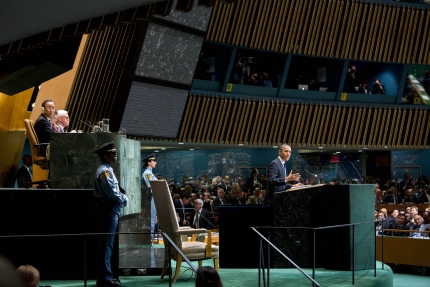
President Obama Speaks to the United Nations General Assembly

September 25, 2012 | 30:20 | Public Domain

In remarks to the UN General Assembly, President Obama discusses a vision of leadership that protects our people and promotes our values around the world, and makes a powerful case for the world to come together to reject extremism and advance our common interests.

Download mp4 (2437MB) | mp3 (29MB)

Read the Transcript

Remarks by the President to the Clinton Global Initiative

Sheraton New York Hotel and Towers
New York, New York

12:34 P.M. EDT

THE PRESIDENT:  Thank you very much.  (Applause.)  Thank you.  Appreciate it.  Please, please, everybody have a seat. 

Well, good afternoon, everybody.  And, President Clinton, thank you for your very kind introduction.  Although I have to admit, I really did like the speech a few weeks ago a little bit better.  (Laughter.)  Afterwards, somebody tweeted that somebody needs to make him "Secretary of Explaining Things."  (Laughter.) Although they didn’t use the word, "things."  (Laughter.) 

President Clinton, you are a tireless, passionate advocate on behalf of what's best in our country.  You have helped to improve and save the lives of millions of people around the world.  I am grateful for your friendship and your extraordinary leadership.  And I think I speak for the entire country when we say that you continue to be a great treasure for all of us.  (Applause.)

As always, I also have to thank President Clinton for being so understanding with the record-breaking number of countries visited by our Secretary of State.  (Laughter and applause.)  As we’ve seen again in recent days, Hillary Clinton is a leader of grace and grit -- and I believe she will go down as one of the finest Secretaries of State in American history.  So we are grateful to her.  (Applause.) 

To the dedicated CGI staff and every organization that's made commitments and touched the lives of hundreds of millions of people, thank you for being an example of what we need more of in the world, especially in Washington -- working together to actually solve problems. 

And that’s why I’m here.  As Bill mentioned, I’ve come to CGI every year that I’ve been President, and I’ve talked with you about how we need to sustain the economic recovery, how we need to create more jobs.  I’ve talked about the importance of development -- from global health to our fight against HIV/AIDS to the growth that lifts nations to prosperity.  We've talked about development and how it has to include women and girls -- because by every benchmark, nations that educate their women and girls end up being more successful.  (Applause.)

And today, I want to discuss an issue that relates to each of these challenges.  It ought to concern every person, because it is a debasement of our common humanity.  It ought to concern every community, because it tears at our social fabric.  It ought to concern every business, because it distorts markets.  It ought to concern every nation, because it endangers public health and fuels violence and organized crime.  I’m talking about the injustice, the outrage, of human trafficking, which must be called by its true name -- modern slavery.  (Applause.)  

Now, I do not use that word, "slavery" lightly.  It evokes obviously one of the most painful chapters in our nation’s history.  But around the world, there’s no denying the awful reality.  When a man, desperate for work, finds himself in a factory or on a fishing boat or in a field, working, toiling, for little or no pay, and beaten if he tries to escape -- that is slavery.  When a woman is locked in a sweatshop, or trapped in a home as a domestic servant, alone and abused and incapable of leaving -- that’s slavery.

When a little boy is kidnapped, turned into a child soldier, forced to kill or be killed -- that’s slavery.  When a little girl is sold by her impoverished family -- girls my daughters’ age -- runs away from home, or is lured by the false promises of a better life, and then imprisoned in a brothel and tortured if she resists -- that’s slavery.  It is barbaric, and it is evil, and it has no place in a civilized world.  (Applause.)

Now, as a nation, we’ve long rejected such cruelty.  Just a few days ago, we marked the 150th anniversary of a document that I have hanging in the Oval Office -- the Emancipation Proclamation.  With the advance of Union forces, it brought a new day -- that "all persons held as slaves" would thenceforth be forever free.  We wrote that promise into our Constitution.  We spent decades struggling to make it real.  We joined with other nations, in the Universal Declaration of Human Rights, so that "slavery and the slave trade shall be prohibited in all their forms."

A global movement was sparked, with the Trafficking Victims Protection Act -- signed by President Clinton and carried on by President Bush. 

And here at CGI, you’ve made impressive commitments in this fight.  We are especially honored to be joined today by advocates who dedicate their lives -- and, at times, risk their lives -- to liberate victims and help them recover.  This includes men and women of faith, who, like the great abolitionists before them, are truly doing the Lord’s work -- evangelicals, the Catholic Church, International Justice Mission and World Relief, even individual congregations, like Passion City Church in Atlanta, and so many young people of faith who've decided that their conscience compels them to act in the face of injustice.  Groups like these are answering the Bible’s call -- to "seek justice" and "rescue the oppressed."  Some of them join us today, and we are grateful for your leadership.

Now, as President, I’ve made it clear that the United States will continue to be a leader in this global movement.  We’ve got a comprehensive strategy.  We’re shining a spotlight on the dark corners where it persists.  Under Hillary’s leadership, we’re doing more than ever -- with our annual trafficking report, with new outreach and partnerships -- to give countries incentives to meet their responsibilities and calling them out when they don’t.

I recently renewed sanctions on some of the worst abusers, including North Korea and Eritrea.  We’re partnering with groups that help women and children escape from the grip of their abusers.  We’re helping other countries step up their own efforts.  And we’re seeing results.  More nations have passed and more are enforcing modern anti-trafficking laws. 

Last week I was proud to welcome to the Oval Office not only a great champion of democracy but a fierce advocate against the use of forced labor and child soldiers -- Aung San Suu Kyi.  (Applause.)  And as part of our engagement, we’ll encourage Burma to keep taking steps to reform -- because nations must speak with one voice:  Our people and our children are not for sale.

But for all the progress that we’ve made, the bitter truth is that trafficking also goes on right here, in the United States.  It’s the migrant worker unable to pay off the debt to his trafficker.  The man, lured here with the promise of a job, his documents then taken, and forced to work endless hours in a kitchen.  The teenage girl, beaten, forced to walk the streets.  This should not be happening in the United States of America.

As President, I directed my administration to step up our efforts -- and we have.  For the first time, at Hillary’s direction, our annual trafficking report now includes the United States, because we can’t ask other nations to do what we are not doing ourselves.  (Applause.)  We’ve expanded our interagency task force to include more federal partners, including the FBI.  The intelligence community is devoting more resources to identifying trafficking networks.  We’ve strengthened protections so that foreign-born workers know their rights.

And most of all, we’re going after the traffickers.  New anti-trafficking teams are dismantling their networks.  Last year, we charged a record number of these predators with human trafficking.  We’re putting them where they belong -- behind bars.  (Applause.) 

But with more than 20 million victims of human trafficking around the world -- think about that, more than 20 million -- they’ve got a lot more to do.  And that’s why, earlier this year, I directed my administration to increase our efforts.  And today, I can announce a series of additional steps that we’re going to take.

First, we’re going to do more to spot it and stop it.  We’ll prepare a new assessment of human trafficking in the United States so we better understand the scope and scale of the problem.  We’ll strengthen training, so investigators and law enforcement are even better equipped to take action -- and treat victims as victims, not as criminals.  (Applause.)  We’re going to work with Amtrak, and bus and truck inspectors, so that they’re on the lookout.  We’ll help teachers and educators spot the signs as well, and better serve those who are vulnerable, especially our young people.

Second, we’re turning the tables on the traffickers.  Just as they are now using technology and the Internet to exploit their victims, we’re going to harness technology to stop them.  We’re encouraging tech companies and advocates and law enforcement -- and we’re also challenging college students -- to develop tools that our young people can use to stay safe online and on their smart phones.

Third, we’ll do even more to help victims recover and rebuild their lives.  We’ll develop a new action plan to improve coordination across the federal government.  We’re increasing access to services to help survivors become self-sufficient.  We’re working to simplify visa procedures for "T" visas so that innocent victims from other countries can stay here as they help us prosecute their traffickers.

This coming year, my Office of Faith-based and Neighborhood Partnerships will make the fight against human trafficking a focus of its work.  (Applause.)  They’re doing great work.  And I’m also proud to announce a new partnership with Humanity United, which is a leader in anti-trafficking -- a multi-million dollar challenge to local communities to find new ways to care for trafficking victims.  And I want to thank Johns Hopkins University, which will be focusing on how to best care for child victims.  (Applause.)

Now, finally, as one of the largest purchasers of goods and services in the world, the United States government will lead by example.  We’ve already taken steps to make sure our contractors do not engage in forced labor.  And today we’re going to go  further.  I’ve signed a new executive order that raises the bar. It’s specific about the prohibitions.  It does more to protect workers.  It ensures stronger compliance.   In short, we’re making clear that American tax dollars must never, ever be used to support the trafficking of human beings.  We will have zero tolerance.  We mean what we say.  We will enforce it.  (Applause.)

Of course, no government, no nation, can meet this challenge alone.  Everybody has a responsibility.  Every nation can take action.  Modern anti-trafficking laws must be passed and enforced and justice systems must be strengthened.  Victims must be cared for.  So here in the United States, Congress should renew the Trafficking Victims Protection Act.  Whether you are a conservative or a liberal, Democrat or Republican, this is a no-brainer.  This is something we should all agree on.  We need to get that done.

And more broadly, as nations, let’s recommit to addressing the underlying forces that push so many into bondage in the first place.  With development and economic growth that creates legitimate jobs, there’s less likelihood of indentured servitude around the globe.  A sense of justice that says no child should ever be exploited, that has to be burned into the cultures of every country.  A commitment to equality -- as in the Equal Futures Partnership that we launched with other nations yesterday so societies empower our sisters and our daughters just as much as our brothers and sons.  (Applause.)

And every business can take action.  All the business leaders who are here and our global economy companies have a responsibility to make sure that their supply chains, stretching into the far corners of the globe, are free of forced labor.  (Applause.)  The good news is more and more responsible companies are holding themselves to higher standards.  And today, I want to salute the new commitments that are being made.  That includes the new Global Business Coalition Against Trafficking -- companies that are sending a message:  Human trafficking is not a business model, it is a crime, and we are going to stop it.  We’re proud of them.  (Applause.)

Every faith community can take action as well, by educating their congregations, by joining in coalitions that are bound by a love of God and a concern for the oppressed.  And like that Good Samaritan on the road to Jericho, we can’t just pass by, indifferent.  We’ve got to be moved by compassion.  We’ve got to bind up the wounds.  Let’s come together around a simple truth -- that we are our brother’s keepers and we are our sister’s keepers. 

And finally, every citizen can take action:  by learning more; by going to the website that we helped create -- SlaveryFootprint.org; by speaking up and insisting that the clothes we wear, the food we eat, the products we buy are made free of forced labor; by standing up against the degradation and abuse of women. 

That’s how real change happens -- from the bottom up.  And if you doubt that, ask Marie Godet Niyonyota, from the Congo.  Think about Marie’s story.  She was kidnapped by rebels, turned into a slave.  She was abused -- physically and sexually.  They got her pregnant five times.  In one awful battle, her children were killed -- all five of them.  Miraculously, she survived and escaped.  And with care and support, she began to heal.  And she learned to read and write and sew, and today Marie is back home, working toward a new future.

Or ask Ima Matul.  She grew up in Indonesia, and at 17 was given the opportunity to work as a nanny here in the United States.  But when she arrived, it turned out to be a nightmare.  Cooking, cleaning -- 18-hour days, seven days a week.  One beating was so bad it sent her to the emergency room.  And finally, she escaped.  And with the help from a group that cared, today Ima has a stable job.  She’s an advocate -- she’s even testified before Congress.

Or ask Sheila White, who grew up in the Bronx.  Fleeing an abusive home, she fell in with a guy who said he’d protect her.  Instead, he sold her -- just 15 years old -- 15 -- to men who raped her and beat her, and burned her with irons.  And finally, after years -- with the help of a non-profit led by other survivors -- she found the courage to break free and get the services she needed.  Sheila earned her GED.  Today she is a powerful, fierce advocate who helped to pass a new anti-trafficking law right here in New York.  (Applause.)

These women endured unspeakable horror.  But in their unbreakable will, in their courage, in their resilience, they remind us that this cycle can be broken; victims can become not only survivors, they can become leaders and advocates, and bring about change. 

And I just met Ima and Sheila and several of their fellow advocates, and I have to tell you they are an incredible inspiration.  They are here -- they’ve chosen to tell their stories.  I want them to stand and be recognized because they are inspiring all of us.  Please -- Sheila, Ima.  (Applause.)  

To Ima and Sheila, and each of you -- in the darkest hours of your lives, you may have felt utterly alone, and it seemed like nobody cared.  And the important thing for us to understand is there are millions around the world who are feeling that same way at this very moment.

Right now, there is a man on a boat, casting the net with his bleeding hands, knowing he deserves a better life, a life of dignity, but doesn’t know if anybody is paying attention.  Right now, there’s a woman, hunched over a sewing machine, glancing beyond the bars on the window, knowing if just given the chance, she might some day sell her own wares, but she doesn’t think anybody is paying attention.  Right now, there’s a young boy, in a brick factory, covered in dust, hauling his heavy load under a blazing sun, thinking if he could just go to school, he might know a different future, but he doesn’t think anybody is paying attention.  Right now, there is a girl, somewhere trapped in a brothel, crying herself to sleep again, and maybe daring to imagine that some day, just maybe, she might be treated not like a piece of property, but as a human being.

And so our message today, to them, is -- to the millions around the world -- we see you.  We hear you.  We insist on your dignity.  And we share your belief that if just given the chance, you will forge a life equal to your talents and worthy of your dreams.  (Applause.)  

Our fight against human trafficking is one of the great human rights causes of our time, and the United States will continue to lead it -- in partnership with you.  The change we seek will not come easy, but we can draw strength from the movements of the past.  For we know that every life saved -- in the words of that great Proclamation -- is "an act of justice," worthy of "the considerate judgment of mankind, and the gracious favor of Almighty God." 

That’s what we believe.  That’s what we're fighting for.  And I'm so proud to be in partnership with CGI to make this happen.

Thank you very much, everybody.  God bless you.  God bless America.  (Applause.)

END               
12:57 P.M. EDT

Close Transcript

The White House

Office of the Press Secretary

Press Gaggle by Press Secretary Jay Carney and Deputy National Security Advisor Ben Rhodes, 9/25/12

Aboard Air Force One
En Route Andrews Air Force Base

2:10 P.M. EDT

MR. CARNEY:  Good afternoon, ladies and gentlemen.  Thanks for joining us aboard Air Force One as we make our way back from New York to Washington.  I have with me Ben Rhodes, Deputy National Security Advisor to the President for Strategic Communications, who can, I’m sure, answer some of your questions about the President’s speeches today and the vision he laid out broadly at the United Nations and then on a specific subject at the CGI.

I have no announcements, but I do have to say that there is a pressing matter that kind of transcends all else for most Americans, and that is the --

Q    -- the question?  Come on.  You’re not even waiting for the question, Carney.  (Laughter.) 

MR. CARNEY:  But I am -- just having watched it -- last night I watched it.  This morning I watched it, and it was really astounding.  And by “it,” I mean the end of the Packers-Seahawks game.  It’s very distressing for every American football fan to see all the focus at the beginning of the season on the officiating rather than on players in the games.

Q    I’m sorry, was that “American, football fan” or “American football fan?”  Was the American modifying the football, or is it American football fans?

MR. CARNEY:  I’m not even sure what you’re asking, Hans, but I appreciate the question.

Q    Does the President have a position on this?

MR. CARNEY:  As an avid sports fan and an avid football fan, he does.  As a matter of fact, last week in an interview with a Cleveland radio station, he brought it up on his own, saying that as a sports fan he thought it was time that we got back to the regular refs.  This morning, I talked to him about the end of the Packers-Seahawks game and he said that what happened in that game is a perfect example of why both sides need to come together to resolve their differences so that the regular refs can get back on the field and we can start focusing on a game that so many of us love, rather than debating whether or not a game was won or lost because of a bad call.

Q    So the President clearly thinks it was an interception?

MR. CARNEY:  Yes, he thinks that there was a real problem with the call.

Q    And the pass interference before the interception?

MR. CARNEY:  I didn’t get into the details, but I think everybody who saw that play saw a number of problems with it.

And with that, I turn it over to my esteemed colleague, Ben Rhodes.

MR. RHODES:  Well, I may be the only American who didn’t see the game last night, but I just saw the replay and I was very distressed by it as an American football fan, so I associate myself with those remarks.

Just a couple of things and then I’ll take your questions.  A number of people had asked about the gap in time after the President left the U.N.  As he does every year, he did courtesy-call meetings with both the Secretary General of the United Nations, Ban Ki-moon, and the current President of the U.N. General Assembly, Vuk Jeremić.  And then, John Brennan was meeting with President Hadi of Yemen.  President Obama stopped by that meeting to say hello to President Hadi of Yemen and to thank him for the steps he’s taken to secure our embassy and our diplomats in that country.

Beyond that, you all saw the President’s speeches.  I guess the only thing I’d say by way of opening on the U.N. speech is that the President felt it was very important to address directly what has been going in the Middle East and North Africa.  I think you heard him give a very strong message that violence is completely unacceptable as a response to any type of speech; that leaders have an obligation to stand up to violence and extremism; that even as we very much condemn the message of the video that has helped spark protests around the world, we also need to get at the deeper forces that helped fuel this type of unacceptable activity around the world, and that includes a politics that in some instances has preyed upon division and opened the door to extremism. 

And I think what you heard from the President is a very strong message to the world that that type of politics needs to be left behind if we're going to deal with the challenges we face.  That includes complete and successful transitions to democracy in the Arab world, and you heard the President speak about why it was so important for those transitions to succeed, but also how hard choices needed to be made along the road of transitioning to democracy so that we don't see incidents like we've seen in the last two weeks.  And then you also heard the President apply that to other events and issues in the region. 

So in Syria, clearly we need to reject a dictator who murders his people, and move forward towards a future that is inclusive for all Syrians.  With respect to Iran, clearly that is a country that has been outside of the boundaries of international law for many years now.  The President focused in particular on the nuclear program, and again, he reiterated that containment cannot be the policy of the United States, nor can it be accepted by the international community, and underscored that the United States will do what we must to prevent Iran from getting a nuclear weapon.

So in general, I think it was a chance for the President to step back and lift up his view of the world as it stands today and to project a vision of American leadership that deals with the challenges we face and supports our values around the world.

And with that, I'll take your questions.

Q    Ben, the President not only condemned extremism and violence and called on leaders to do the same, but he also called on them to respect free speech, no matter how reprehensible.  What gives him confidence that that message will go over in the countries that often have cultures that have a very different take?

MR. RHODES:  I think there were a couple of things the President wanted to do there.  First of all, he wanted to give the clearest affirmation that he could of why free speech is so important to the United States.  Because, you're right, different countries don’t ensure the same legal protections we have of free speech, or the same traditions of free speech.  But people need to understand that that’s a core American value, and it’s been essential to the progress of our democracy throughout our history.

Secondly, though, he was making a point that in the age of the world we live in today, no matter what prohibitions you might even try to make on free speech, you're going to have offensive images and material that can get around the world with the click of a button.  So people need to be able to deal with those types of challenges without resorting to violence, without resorting to this pattern of outrage that we've seen in recent years when you've had things taken as a cause to stir up not just protests but rather to stir up, in some instances, violence.

And I think the President's point, therefore, to these leaders was very much that it's not enough to simply respond to that type of -- to something that offends you by protecting an embassy; we have to put an end to people stirring up division and stirring up crowds in ways that, frankly, are not just harmful to the United States but ultimately are going to be deeply harmful to these countries.  Because for them to have successful transitions to democracy, they have to demonstrate that they can provide for the protection of diplomatic facilities, they can be a place for deeper trade and investment.

So he was responding to both our commitment to free speech, but also how do nations respond to speech in the world that we live in.

Q    In either of the courtesy calls, did Syria or Iran come up?

MR. RHODES:  I haven't gotten a detailed readout out.  I would expect that Syria -- he intended to discuss Syria and Iran with the Secretary General given how much of that has been at the United Nations. 

Q    Okay.  And then are you going to take this opportunity to announce any meetings with Prime Minister Benjamin Netanyahu on Friday?

MR. RHODES:  I have no scheduling updates for you on that.  Prime Minister Netanyahu is scheduled to meet with Secretary Clinton on Friday.

Q    During the reception last night, can you talk about were there any pull-asides or handshakes with people that you can tell us about?

MR. RHODES:  Nothing of particular note.  Generally, what happens at the reception is there is a photo line where the President is able to greet foreign leaders, take a picture with them, exchange a few words.  So I know he did that, but I don't have any particular readouts.

Q    Was Thein Sein down there?

MR. CARNEY:  No, I think he got here --

MR. RHODES:  Today, yes.

Q    Hey, Jay, Senator Barrasso had a TV interview last night; accused the administration of stonewalling and engaging in a cover-up regarding the murder of Ambassador Stevens.  Can you address anything on that?

MR. CARNEY:  I’m sure the Senator is aware that there is an active investigation into what happened in Benghazi.  The President has addressed it.  The Secretary of State has addressed it.  Our Ambassador to the United Nations has addressed it.  Ben Rhodes and I have addressed it.  That investigation needs to take place, and I think you heard the President again say with great clarity at the General Assembly today that he is determined to make sure that those who killed our personnel in Benghazi are brought to justice.

Q    So the administration was not aware of any of the findings we’ve seen in the journal that there was some security issues?

MR. CARNEY:  I think you’re putting words into my mouth, and that wasn’t even in your question.  I said that there’s an active investigation into this.  The fact of the matter is you saw the head of the NCTC testify before Congress on what we knew at the time that he testified and what we didn't know after that point.  That's the whole reason why you have investigations -- to find a full set of facts about how the attack happened and who was responsible.

MR. RHODES:  I’ll just add one thing.  In addition to the investigation by the FBI, the State Department has announced their own review of the security at the facility with an eye to understanding what happened.  But also, the President’s direction to us has always been that we need to be doing everything that we can to make sure that we’re taking appropriate security precautions around the world.  So this is something that we’re constantly reviewing and working on.

And frankly, I think it underscores just how seriously the President takes the incident in Benghazi that he focused his speech today at the United Nations General Assembly on what the entire world needs to take away from that event, and that includes protecting our diplomatic facilities and meeting their responsibility to provide that security, but it also means addressing some of the underlying causes that have fanned the flames of this type of violence for far too long. 

So this is something that we’re very focused on, and we have every interest in understanding exactly what happened precisely so we can make sure that we are doing everything we can going forward to protect our diplomats.

Q    Thanks, guys.

MR. CARNEY:  Thanks, a lot.

END
2:21 P.M. EDT

The White House

Office of the Press Secretary

Remarks by the President to the Clinton Global Initiative

Sheraton New York Hotel and Towers
New York, New York

12:34 P.M. EDT

THE PRESIDENT:  Thank you very much.  (Applause.)  Thank you.  Appreciate it.  Please, please, everybody have a seat. 

Well, good afternoon, everybody.  And, President Clinton, thank you for your very kind introduction.  Although I have to admit, I really did like the speech a few weeks ago a little bit better.  (Laughter.)  Afterwards, somebody tweeted that somebody needs to make him "Secretary of Explaining Things."  (Laughter.) Although they didn’t use the word, "things."  (Laughter.) 

President Clinton, you are a tireless, passionate advocate on behalf of what's best in our country.  You have helped to improve and save the lives of millions of people around the world.  I am grateful for your friendship and your extraordinary leadership.  And I think I speak for the entire country when we say that you continue to be a great treasure for all of us.  (Applause.)

As always, I also have to thank President Clinton for being so understanding with the record-breaking number of countries visited by our Secretary of State.  (Laughter and applause.)  As we’ve seen again in recent days, Hillary Clinton is a leader of grace and grit -- and I believe she will go down as one of the finest Secretaries of State in American history.  So we are grateful to her.  (Applause.) 

To the dedicated CGI staff and every organization that's made commitments and touched the lives of hundreds of millions of people, thank you for being an example of what we need more of in the world, especially in Washington -- working together to actually solve problems. 

And that’s why I’m here.  As Bill mentioned, I’ve come to CGI every year that I’ve been President, and I’ve talked with you about how we need to sustain the economic recovery, how we need to create more jobs.  I’ve talked about the importance of development -- from global health to our fight against HIV/AIDS to the growth that lifts nations to prosperity.  We've talked about development and how it has to include women and girls -- because by every benchmark, nations that educate their women and girls end up being more successful.  (Applause.)

And today, I want to discuss an issue that relates to each of these challenges.  It ought to concern every person, because it is a debasement of our common humanity.  It ought to concern every community, because it tears at our social fabric.  It ought to concern every business, because it distorts markets.  It ought to concern every nation, because it endangers public health and fuels violence and organized crime.  I’m talking about the injustice, the outrage, of human trafficking, which must be called by its true name -- modern slavery.  (Applause.)  

Now, I do not use that word, "slavery" lightly.  It evokes obviously one of the most painful chapters in our nation’s history.  But around the world, there’s no denying the awful reality.  When a man, desperate for work, finds himself in a factory or on a fishing boat or in a field, working, toiling, for little or no pay, and beaten if he tries to escape -- that is slavery.  When a woman is locked in a sweatshop, or trapped in a home as a domestic servant, alone and abused and incapable of leaving -- that’s slavery.

When a little boy is kidnapped, turned into a child soldier, forced to kill or be killed -- that’s slavery.  When a little girl is sold by her impoverished family -- girls my daughters’ age -- runs away from home, or is lured by the false promises of a better life, and then imprisoned in a brothel and tortured if she resists -- that’s slavery.  It is barbaric, and it is evil, and it has no place in a civilized world.  (Applause.)

Now, as a nation, we’ve long rejected such cruelty.  Just a few days ago, we marked the 150th anniversary of a document that I have hanging in the Oval Office -- the Emancipation Proclamation.  With the advance of Union forces, it brought a new day -- that "all persons held as slaves" would thenceforth be forever free.  We wrote that promise into our Constitution.  We spent decades struggling to make it real.  We joined with other nations, in the Universal Declaration of Human Rights, so that "slavery and the slave trade shall be prohibited in all their forms."

A global movement was sparked, with the Trafficking Victims Protection Act -- signed by President Clinton and carried on by President Bush. 

And here at CGI, you’ve made impressive commitments in this fight.  We are especially honored to be joined today by advocates who dedicate their lives -- and, at times, risk their lives -- to liberate victims and help them recover.  This includes men and women of faith, who, like the great abolitionists before them, are truly doing the Lord’s work -- evangelicals, the Catholic Church, International Justice Mission and World Relief, even individual congregations, like Passion City Church in Atlanta, and so many young people of faith who've decided that their conscience compels them to act in the face of injustice.  Groups like these are answering the Bible’s call -- to "seek justice" and "rescue the oppressed."  Some of them join us today, and we are grateful for your leadership.

Now, as President, I’ve made it clear that the United States will continue to be a leader in this global movement.  We’ve got a comprehensive strategy.  We’re shining a spotlight on the dark corners where it persists.  Under Hillary’s leadership, we’re doing more than ever -- with our annual trafficking report, with new outreach and partnerships -- to give countries incentives to meet their responsibilities and calling them out when they don’t.

I recently renewed sanctions on some of the worst abusers, including North Korea and Eritrea.  We’re partnering with groups that help women and children escape from the grip of their abusers.  We’re helping other countries step up their own efforts.  And we’re seeing results.  More nations have passed and more are enforcing modern anti-trafficking laws. 

Last week I was proud to welcome to the Oval Office not only a great champion of democracy but a fierce advocate against the use of forced labor and child soldiers -- Aung San Suu Kyi.  (Applause.)  And as part of our engagement, we’ll encourage Burma to keep taking steps to reform -- because nations must speak with one voice:  Our people and our children are not for sale.

But for all the progress that we’ve made, the bitter truth is that trafficking also goes on right here, in the United States.  It’s the migrant worker unable to pay off the debt to his trafficker.  The man, lured here with the promise of a job, his documents then taken, and forced to work endless hours in a kitchen.  The teenage girl, beaten, forced to walk the streets.  This should not be happening in the United States of America.

As President, I directed my administration to step up our efforts -- and we have.  For the first time, at Hillary’s direction, our annual trafficking report now includes the United States, because we can’t ask other nations to do what we are not doing ourselves.  (Applause.)  We’ve expanded our interagency task force to include more federal partners, including the FBI.  The intelligence community is devoting more resources to identifying trafficking networks.  We’ve strengthened protections so that foreign-born workers know their rights.

And most of all, we’re going after the traffickers.  New anti-trafficking teams are dismantling their networks.  Last year, we charged a record number of these predators with human trafficking.  We’re putting them where they belong -- behind bars.  (Applause.) 

But with more than 20 million victims of human trafficking around the world -- think about that, more than 20 million -- they’ve got a lot more to do.  And that’s why, earlier this year, I directed my administration to increase our efforts.  And today, I can announce a series of additional steps that we’re going to take.

First, we’re going to do more to spot it and stop it.  We’ll prepare a new assessment of human trafficking in the United States so we better understand the scope and scale of the problem.  We’ll strengthen training, so investigators and law enforcement are even better equipped to take action -- and treat victims as victims, not as criminals.  (Applause.)  We’re going to work with Amtrak, and bus and truck inspectors, so that they’re on the lookout.  We’ll help teachers and educators spot the signs as well, and better serve those who are vulnerable, especially our young people.

Second, we’re turning the tables on the traffickers.  Just as they are now using technology and the Internet to exploit their victims, we’re going to harness technology to stop them.  We’re encouraging tech companies and advocates and law enforcement -- and we’re also challenging college students -- to develop tools that our young people can use to stay safe online and on their smart phones.

Third, we’ll do even more to help victims recover and rebuild their lives.  We’ll develop a new action plan to improve coordination across the federal government.  We’re increasing access to services to help survivors become self-sufficient.  We’re working to simplify visa procedures for "T" visas so that innocent victims from other countries can stay here as they help us prosecute their traffickers.

This coming year, my Office of Faith-based and Neighborhood Partnerships will make the fight against human trafficking a focus of its work.  (Applause.)  They’re doing great work.  And I’m also proud to announce a new partnership with Humanity United, which is a leader in anti-trafficking -- a multi-million dollar challenge to local communities to find new ways to care for trafficking victims.  And I want to thank Johns Hopkins University, which will be focusing on how to best care for child victims.  (Applause.)

Now, finally, as one of the largest purchasers of goods and services in the world, the United States government will lead by example.  We’ve already taken steps to make sure our contractors do not engage in forced labor.  And today we’re going to go  further.  I’ve signed a new executive order that raises the bar. It’s specific about the prohibitions.  It does more to protect workers.  It ensures stronger compliance.   In short, we’re making clear that American tax dollars must never, ever be used to support the trafficking of human beings.  We will have zero tolerance.  We mean what we say.  We will enforce it.  (Applause.)

Of course, no government, no nation, can meet this challenge alone.  Everybody has a responsibility.  Every nation can take action.  Modern anti-trafficking laws must be passed and enforced and justice systems must be strengthened.  Victims must be cared for.  So here in the United States, Congress should renew the Trafficking Victims Protection Act.  Whether you are a conservative or a liberal, Democrat or Republican, this is a no-brainer.  This is something we should all agree on.  We need to get that done.

And more broadly, as nations, let’s recommit to addressing the underlying forces that push so many into bondage in the first place.  With development and economic growth that creates legitimate jobs, there’s less likelihood of indentured servitude around the globe.  A sense of justice that says no child should ever be exploited, that has to be burned into the cultures of every country.  A commitment to equality -- as in the Equal Futures Partnership that we launched with other nations yesterday so societies empower our sisters and our daughters just as much as our brothers and sons.  (Applause.)

And every business can take action.  All the business leaders who are here and our global economy companies have a responsibility to make sure that their supply chains, stretching into the far corners of the globe, are free of forced labor.  (Applause.)  The good news is more and more responsible companies are holding themselves to higher standards.  And today, I want to salute the new commitments that are being made.  That includes the new Global Business Coalition Against Trafficking -- companies that are sending a message:  Human trafficking is not a business model, it is a crime, and we are going to stop it.  We’re proud of them.  (Applause.)

Every faith community can take action as well, by educating their congregations, by joining in coalitions that are bound by a love of God and a concern for the oppressed.  And like that Good Samaritan on the road to Jericho, we can’t just pass by, indifferent.  We’ve got to be moved by compassion.  We’ve got to bind up the wounds.  Let’s come together around a simple truth -- that we are our brother’s keepers and we are our sister’s keepers. 

And finally, every citizen can take action:  by learning more; by going to the website that we helped create -- SlaveryFootprint.org; by speaking up and insisting that the clothes we wear, the food we eat, the products we buy are made free of forced labor; by standing up against the degradation and abuse of women. 

That’s how real change happens -- from the bottom up.  And if you doubt that, ask Marie Godet Niyonyota, from the Congo.  Think about Marie’s story.  She was kidnapped by rebels, turned into a slave.  She was abused -- physically and sexually.  They got her pregnant five times.  In one awful battle, her children were killed -- all five of them.  Miraculously, she survived and escaped.  And with care and support, she began to heal.  And she learned to read and write and sew, and today Marie is back home, working toward a new future.

Or ask Ima Matul.  She grew up in Indonesia, and at 17 was given the opportunity to work as a nanny here in the United States.  But when she arrived, it turned out to be a nightmare.  Cooking, cleaning -- 18-hour days, seven days a week.  One beating was so bad it sent her to the emergency room.  And finally, she escaped.  And with the help from a group that cared, today Ima has a stable job.  She’s an advocate -- she’s even testified before Congress.

Or ask Sheila White, who grew up in the Bronx.  Fleeing an abusive home, she fell in with a guy who said he’d protect her.  Instead, he sold her -- just 15 years old -- 15 -- to men who raped her and beat her, and burned her with irons.  And finally, after years -- with the help of a non-profit led by other survivors -- she found the courage to break free and get the services she needed.  Sheila earned her GED.  Today she is a powerful, fierce advocate who helped to pass a new anti-trafficking law right here in New York.  (Applause.)

These women endured unspeakable horror.  But in their unbreakable will, in their courage, in their resilience, they remind us that this cycle can be broken; victims can become not only survivors, they can become leaders and advocates, and bring about change. 

And I just met Ima and Sheila and several of their fellow advocates, and I have to tell you they are an incredible inspiration.  They are here -- they’ve chosen to tell their stories.  I want them to stand and be recognized because they are inspiring all of us.  Please -- Sheila, Ima.  (Applause.)  

To Ima and Sheila, and each of you -- in the darkest hours of your lives, you may have felt utterly alone, and it seemed like nobody cared.  And the important thing for us to understand is there are millions around the world who are feeling that same way at this very moment.

Right now, there is a man on a boat, casting the net with his bleeding hands, knowing he deserves a better life, a life of dignity, but doesn’t know if anybody is paying attention.  Right now, there’s a woman, hunched over a sewing machine, glancing beyond the bars on the window, knowing if just given the chance, she might some day sell her own wares, but she doesn’t think anybody is paying attention.  Right now, there’s a young boy, in a brick factory, covered in dust, hauling his heavy load under a blazing sun, thinking if he could just go to school, he might know a different future, but he doesn’t think anybody is paying attention.  Right now, there is a girl, somewhere trapped in a brothel, crying herself to sleep again, and maybe daring to imagine that some day, just maybe, she might be treated not like a piece of property, but as a human being.

And so our message today, to them, is -- to the millions around the world -- we see you.  We hear you.  We insist on your dignity.  And we share your belief that if just given the chance, you will forge a life equal to your talents and worthy of your dreams.  (Applause.)  

Our fight against human trafficking is one of the great human rights causes of our time, and the United States will continue to lead it -- in partnership with you.  The change we seek will not come easy, but we can draw strength from the movements of the past.  For we know that every life saved -- in the words of that great Proclamation -- is "an act of justice," worthy of "the considerate judgment of mankind, and the gracious favor of Almighty God." 

That’s what we believe.  That’s what we're fighting for.  And I'm so proud to be in partnership with CGI to make this happen.

Thank you very much, everybody.  God bless you.  God bless America.  (Applause.)

END               
12:57 P.M. EDT

President Obama Addresses the United Nations

President Barack Obama addresses the United Nations General Assembly (September 25, 2012)

President Barack Obama addresses the United Nations General Assembly (UNGA) at the United Nations in New York, N.Y., Sept. 25, 2012. Sitting on the dais are: U.N. Secretary General Ban Ki-Moon, UNGA President Vuk Jeremić and Jean-Jacques Graisse, Acting Head for General Assembly and Conference Management. (Official White House Photo by Chuck Kennedy)

Speaking to the United Nations General Assembly, President Obama remembered Ambassador Chris Stevens and delivered a defense of both free speech and the spirit of tolerance.

The President described Stevens -- who was slain earlier this month in an attack on the U.S. compound in Benghazi, Libya -- as a man who "embodied the best of America."

"Like his fellow Foreign Service officers, he built bridges across oceans and cultures, and was deeply invested in the international cooperation that the United Nations represents," the President said. "He acted with humility, but he also stood up for a set of principles -- a belief that individuals should be free to determine their own destiny, and live with liberty, dignity, justice, and opportunity."

President Obama Speaks at the Clinton Global Initiative Annual Meeting

September 25, 2012 | 22:31 | Public Domain

In remarks at the Clinton Global Initiative Annual Meeting, President Obama calls human trafficking a debasement of our common humanity that tears at the social fabric of our communities, distorts markets, endangers public health, and fuels violence and organized crime.

Download mp4 (831MB) | mp3 (22MB)

Read the Transcript

Remarks by the President to the Clinton Global Initiative

Sheraton New York Hotel and Towers
New York, New York

12:34 P.M. EDT

THE PRESIDENT:  Thank you very much.  (Applause.)  Thank you.  Appreciate it.  Please, please, everybody have a seat. 

Well, good afternoon, everybody.  And, President Clinton, thank you for your very kind introduction.  Although I have to admit, I really did like the speech a few weeks ago a little bit better.  (Laughter.)  Afterwards, somebody tweeted that somebody needs to make him "Secretary of Explaining Things."  (Laughter.) Although they didn’t use the word, "things."  (Laughter.) 

President Clinton, you are a tireless, passionate advocate on behalf of what's best in our country.  You have helped to improve and save the lives of millions of people around the world.  I am grateful for your friendship and your extraordinary leadership.  And I think I speak for the entire country when we say that you continue to be a great treasure for all of us.  (Applause.)

As always, I also have to thank President Clinton for being so understanding with the record-breaking number of countries visited by our Secretary of State.  (Laughter and applause.)  As we’ve seen again in recent days, Hillary Clinton is a leader of grace and grit -- and I believe she will go down as one of the finest Secretaries of State in American history.  So we are grateful to her.  (Applause.) 

To the dedicated CGI staff and every organization that's made commitments and touched the lives of hundreds of millions of people, thank you for being an example of what we need more of in the world, especially in Washington -- working together to actually solve problems. 

And that’s why I’m here.  As Bill mentioned, I’ve come to CGI every year that I’ve been President, and I’ve talked with you about how we need to sustain the economic recovery, how we need to create more jobs.  I’ve talked about the importance of development -- from global health to our fight against HIV/AIDS to the growth that lifts nations to prosperity.  We've talked about development and how it has to include women and girls -- because by every benchmark, nations that educate their women and girls end up being more successful.  (Applause.)

And today, I want to discuss an issue that relates to each of these challenges.  It ought to concern every person, because it is a debasement of our common humanity.  It ought to concern every community, because it tears at our social fabric.  It ought to concern every business, because it distorts markets.  It ought to concern every nation, because it endangers public health and fuels violence and organized crime.  I’m talking about the injustice, the outrage, of human trafficking, which must be called by its true name -- modern slavery.  (Applause.)  

Now, I do not use that word, "slavery" lightly.  It evokes obviously one of the most painful chapters in our nation’s history.  But around the world, there’s no denying the awful reality.  When a man, desperate for work, finds himself in a factory or on a fishing boat or in a field, working, toiling, for little or no pay, and beaten if he tries to escape -- that is slavery.  When a woman is locked in a sweatshop, or trapped in a home as a domestic servant, alone and abused and incapable of leaving -- that’s slavery.

When a little boy is kidnapped, turned into a child soldier, forced to kill or be killed -- that’s slavery.  When a little girl is sold by her impoverished family -- girls my daughters’ age -- runs away from home, or is lured by the false promises of a better life, and then imprisoned in a brothel and tortured if she resists -- that’s slavery.  It is barbaric, and it is evil, and it has no place in a civilized world.  (Applause.)

Now, as a nation, we’ve long rejected such cruelty.  Just a few days ago, we marked the 150th anniversary of a document that I have hanging in the Oval Office -- the Emancipation Proclamation.  With the advance of Union forces, it brought a new day -- that "all persons held as slaves" would thenceforth be forever free.  We wrote that promise into our Constitution.  We spent decades struggling to make it real.  We joined with other nations, in the Universal Declaration of Human Rights, so that "slavery and the slave trade shall be prohibited in all their forms."

A global movement was sparked, with the Trafficking Victims Protection Act -- signed by President Clinton and carried on by President Bush. 

And here at CGI, you’ve made impressive commitments in this fight.  We are especially honored to be joined today by advocates who dedicate their lives -- and, at times, risk their lives -- to liberate victims and help them recover.  This includes men and women of faith, who, like the great abolitionists before them, are truly doing the Lord’s work -- evangelicals, the Catholic Church, International Justice Mission and World Relief, even individual congregations, like Passion City Church in Atlanta, and so many young people of faith who've decided that their conscience compels them to act in the face of injustice.  Groups like these are answering the Bible’s call -- to "seek justice" and "rescue the oppressed."  Some of them join us today, and we are grateful for your leadership.

Now, as President, I’ve made it clear that the United States will continue to be a leader in this global movement.  We’ve got a comprehensive strategy.  We’re shining a spotlight on the dark corners where it persists.  Under Hillary’s leadership, we’re doing more than ever -- with our annual trafficking report, with new outreach and partnerships -- to give countries incentives to meet their responsibilities and calling them out when they don’t.

I recently renewed sanctions on some of the worst abusers, including North Korea and Eritrea.  We’re partnering with groups that help women and children escape from the grip of their abusers.  We’re helping other countries step up their own efforts.  And we’re seeing results.  More nations have passed and more are enforcing modern anti-trafficking laws. 

Last week I was proud to welcome to the Oval Office not only a great champion of democracy but a fierce advocate against the use of forced labor and child soldiers -- Aung San Suu Kyi.  (Applause.)  And as part of our engagement, we’ll encourage Burma to keep taking steps to reform -- because nations must speak with one voice:  Our people and our children are not for sale.

But for all the progress that we’ve made, the bitter truth is that trafficking also goes on right here, in the United States.  It’s the migrant worker unable to pay off the debt to his trafficker.  The man, lured here with the promise of a job, his documents then taken, and forced to work endless hours in a kitchen.  The teenage girl, beaten, forced to walk the streets.  This should not be happening in the United States of America.

As President, I directed my administration to step up our efforts -- and we have.  For the first time, at Hillary’s direction, our annual trafficking report now includes the United States, because we can’t ask other nations to do what we are not doing ourselves.  (Applause.)  We’ve expanded our interagency task force to include more federal partners, including the FBI.  The intelligence community is devoting more resources to identifying trafficking networks.  We’ve strengthened protections so that foreign-born workers know their rights.

And most of all, we’re going after the traffickers.  New anti-trafficking teams are dismantling their networks.  Last year, we charged a record number of these predators with human trafficking.  We’re putting them where they belong -- behind bars.  (Applause.) 

But with more than 20 million victims of human trafficking around the world -- think about that, more than 20 million -- they’ve got a lot more to do.  And that’s why, earlier this year, I directed my administration to increase our efforts.  And today, I can announce a series of additional steps that we’re going to take.

First, we’re going to do more to spot it and stop it.  We’ll prepare a new assessment of human trafficking in the United States so we better understand the scope and scale of the problem.  We’ll strengthen training, so investigators and law enforcement are even better equipped to take action -- and treat victims as victims, not as criminals.  (Applause.)  We’re going to work with Amtrak, and bus and truck inspectors, so that they’re on the lookout.  We’ll help teachers and educators spot the signs as well, and better serve those who are vulnerable, especially our young people.

Second, we’re turning the tables on the traffickers.  Just as they are now using technology and the Internet to exploit their victims, we’re going to harness technology to stop them.  We’re encouraging tech companies and advocates and law enforcement -- and we’re also challenging college students -- to develop tools that our young people can use to stay safe online and on their smart phones.

Third, we’ll do even more to help victims recover and rebuild their lives.  We’ll develop a new action plan to improve coordination across the federal government.  We’re increasing access to services to help survivors become self-sufficient.  We’re working to simplify visa procedures for "T" visas so that innocent victims from other countries can stay here as they help us prosecute their traffickers.

This coming year, my Office of Faith-based and Neighborhood Partnerships will make the fight against human trafficking a focus of its work.  (Applause.)  They’re doing great work.  And I’m also proud to announce a new partnership with Humanity United, which is a leader in anti-trafficking -- a multi-million dollar challenge to local communities to find new ways to care for trafficking victims.  And I want to thank Johns Hopkins University, which will be focusing on how to best care for child victims.  (Applause.)

Now, finally, as one of the largest purchasers of goods and services in the world, the United States government will lead by example.  We’ve already taken steps to make sure our contractors do not engage in forced labor.  And today we’re going to go  further.  I’ve signed a new executive order that raises the bar. It’s specific about the prohibitions.  It does more to protect workers.  It ensures stronger compliance.   In short, we’re making clear that American tax dollars must never, ever be used to support the trafficking of human beings.  We will have zero tolerance.  We mean what we say.  We will enforce it.  (Applause.)

Of course, no government, no nation, can meet this challenge alone.  Everybody has a responsibility.  Every nation can take action.  Modern anti-trafficking laws must be passed and enforced and justice systems must be strengthened.  Victims must be cared for.  So here in the United States, Congress should renew the Trafficking Victims Protection Act.  Whether you are a conservative or a liberal, Democrat or Republican, this is a no-brainer.  This is something we should all agree on.  We need to get that done.

And more broadly, as nations, let’s recommit to addressing the underlying forces that push so many into bondage in the first place.  With development and economic growth that creates legitimate jobs, there’s less likelihood of indentured servitude around the globe.  A sense of justice that says no child should ever be exploited, that has to be burned into the cultures of every country.  A commitment to equality -- as in the Equal Futures Partnership that we launched with other nations yesterday so societies empower our sisters and our daughters just as much as our brothers and sons.  (Applause.)

And every business can take action.  All the business leaders who are here and our global economy companies have a responsibility to make sure that their supply chains, stretching into the far corners of the globe, are free of forced labor.  (Applause.)  The good news is more and more responsible companies are holding themselves to higher standards.  And today, I want to salute the new commitments that are being made.  That includes the new Global Business Coalition Against Trafficking -- companies that are sending a message:  Human trafficking is not a business model, it is a crime, and we are going to stop it.  We’re proud of them.  (Applause.)

Every faith community can take action as well, by educating their congregations, by joining in coalitions that are bound by a love of God and a concern for the oppressed.  And like that Good Samaritan on the road to Jericho, we can’t just pass by, indifferent.  We’ve got to be moved by compassion.  We’ve got to bind up the wounds.  Let’s come together around a simple truth -- that we are our brother’s keepers and we are our sister’s keepers. 

And finally, every citizen can take action:  by learning more; by going to the website that we helped create -- SlaveryFootprint.org; by speaking up and insisting that the clothes we wear, the food we eat, the products we buy are made free of forced labor; by standing up against the degradation and abuse of women. 

That’s how real change happens -- from the bottom up.  And if you doubt that, ask Marie Godet Niyonyota, from the Congo.  Think about Marie’s story.  She was kidnapped by rebels, turned into a slave.  She was abused -- physically and sexually.  They got her pregnant five times.  In one awful battle, her children were killed -- all five of them.  Miraculously, she survived and escaped.  And with care and support, she began to heal.  And she learned to read and write and sew, and today Marie is back home, working toward a new future.

Or ask Ima Matul.  She grew up in Indonesia, and at 17 was given the opportunity to work as a nanny here in the United States.  But when she arrived, it turned out to be a nightmare.  Cooking, cleaning -- 18-hour days, seven days a week.  One beating was so bad it sent her to the emergency room.  And finally, she escaped.  And with the help from a group that cared, today Ima has a stable job.  She’s an advocate -- she’s even testified before Congress.

Or ask Sheila White, who grew up in the Bronx.  Fleeing an abusive home, she fell in with a guy who said he’d protect her.  Instead, he sold her -- just 15 years old -- 15 -- to men who raped her and beat her, and burned her with irons.  And finally, after years -- with the help of a non-profit led by other survivors -- she found the courage to break free and get the services she needed.  Sheila earned her GED.  Today she is a powerful, fierce advocate who helped to pass a new anti-trafficking law right here in New York.  (Applause.)

These women endured unspeakable horror.  But in their unbreakable will, in their courage, in their resilience, they remind us that this cycle can be broken; victims can become not only survivors, they can become leaders and advocates, and bring about change. 

And I just met Ima and Sheila and several of their fellow advocates, and I have to tell you they are an incredible inspiration.  They are here -- they’ve chosen to tell their stories.  I want them to stand and be recognized because they are inspiring all of us.  Please -- Sheila, Ima.  (Applause.)  

To Ima and Sheila, and each of you -- in the darkest hours of your lives, you may have felt utterly alone, and it seemed like nobody cared.  And the important thing for us to understand is there are millions around the world who are feeling that same way at this very moment.

Right now, there is a man on a boat, casting the net with his bleeding hands, knowing he deserves a better life, a life of dignity, but doesn’t know if anybody is paying attention.  Right now, there’s a woman, hunched over a sewing machine, glancing beyond the bars on the window, knowing if just given the chance, she might some day sell her own wares, but she doesn’t think anybody is paying attention.  Right now, there’s a young boy, in a brick factory, covered in dust, hauling his heavy load under a blazing sun, thinking if he could just go to school, he might know a different future, but he doesn’t think anybody is paying attention.  Right now, there is a girl, somewhere trapped in a brothel, crying herself to sleep again, and maybe daring to imagine that some day, just maybe, she might be treated not like a piece of property, but as a human being.

And so our message today, to them, is -- to the millions around the world -- we see you.  We hear you.  We insist on your dignity.  And we share your belief that if just given the chance, you will forge a life equal to your talents and worthy of your dreams.  (Applause.)  

Our fight against human trafficking is one of the great human rights causes of our time, and the United States will continue to lead it -- in partnership with you.  The change we seek will not come easy, but we can draw strength from the movements of the past.  For we know that every life saved -- in the words of that great Proclamation -- is "an act of justice," worthy of "the considerate judgment of mankind, and the gracious favor of Almighty God." 

That’s what we believe.  That’s what we're fighting for.  And I'm so proud to be in partnership with CGI to make this happen.

Thank you very much, everybody.  God bless you.  God bless America.  (Applause.)

END               
12:57 P.M. EDT

Close Transcript

The White House

Office of the Press Secretary

Remarks by the President to the UN General Assembly

United Nations Headquarters
New York, New York 

10:22 A.M. EDT

THE PRESIDENT:  Mr. President, Mr. Secretary General, fellow delegates, ladies and gentleman:  I would like to begin today by telling you about an American named Chris Stevens.

Chris was born in a town called Grass Valley, California, the son of a lawyer and a musician.  As a young man, Chris joined the Peace Corps, and taught English in Morocco.  And he came to love and respect the people of North Africa and the Middle East. He would carry that commitment throughout his life.  As a diplomat, he worked from Egypt to Syria, from Saudi Arabia to Libya.  He was known for walking the streets of the cities where he worked -- tasting the local food, meeting as many people as he could, speaking Arabic, listening with a broad smile. 

Chris went to Benghazi in the early days of the Libyan revolution, arriving on a cargo ship.  As America’s representative, he helped the Libyan people as they coped with violent conflict, cared for the wounded, and crafted a vision for the future in which the rights of all Libyans would be respected. And after the revolution, he supported the birth of a new democracy, as Libyans held elections, and built new institutions, and began to move forward after decades of dictatorship.

Chris Stevens loved his work.  He took pride in the country he served, and he saw dignity in the people that he met.  And two weeks ago, he traveled to Benghazi to review plans to establish a new cultural center and modernize a hospital.  That’s when America’s compound came under attack.  Along with three of his colleagues, Chris was killed in the city that he helped to save. He was 52 years old. 

I tell you this story because Chris Stevens embodied the best of America.  Like his fellow Foreign Service officers, he built bridges across oceans and cultures, and was deeply invested in the international cooperation that the United Nations represents.  He acted with humility, but he also stood up for a set of principles -- a belief that individuals should be free to determine their own destiny, and live with liberty, dignity, justice, and opportunity. 

The attacks on the civilians in Benghazi were attacks on America.  We are grateful for the assistance we received from the Libyan government and from the Libyan people.  There should be no doubt that we will be relentless in tracking down the killers and bringing them to justice.  And I also appreciate that in recent days, the leaders of other countries in the region -- including Egypt, Tunisia and Yemen -- have taken steps to secure our diplomatic facilities, and called for calm.  And so have religious authorities around the globe.

But understand, the attacks of the last two weeks are not simply an assault on America.  They are also an assault on the very ideals upon which the United Nations was founded -- the notion that people can resolve their differences peacefully; that diplomacy can take the place of war; that in an interdependent world, all of us have a stake in working towards greater opportunity and security for our citizens.

If we are serious about upholding these ideals, it will not be enough to put more guards in front of an embassy, or to put out statements of regret and wait for the outrage to pass.  If we are serious about these ideals, we must speak honestly about the deeper causes of the crisis -- because we face a choice between the forces that would drive us apart and the hopes that we hold in common.

Today, we must reaffirm that our future will be determined by people like Chris Stevens -- and not by his killers.  Today, we must declare that this violence and intolerance has no place among our United Nations.

It has been less than two years since a vendor in Tunisia set himself on fire to protest the oppressive corruption in his country, and sparked what became known as the Arab Spring.  And since then, the world has been captivated by the transformation that’s taken place, and the United States has supported the forces of change.

We were inspired by the Tunisian protests that toppled a dictator, because we recognized our own beliefs in the aspiration of men and women who took to the streets.

We insisted on change in Egypt, because our support for democracy ultimately put us on the side of the people. 

We supported a transition of leadership in Yemen, because the interests of the people were no longer being served by a corrupt status quo.

We intervened in Libya alongside a broad coalition, and with the mandate of the United Nations Security Council, because we had the ability to stop the slaughter of innocents, and because we believed that the aspirations of the people were more powerful than a tyrant.

And as we meet here, we again declare that the regime of Bashar al-Assad must come to an end so that the suffering of the Syrian people can stop and a new dawn can begin.

We have taken these positions because we believe that freedom and self-determination are not unique to one culture.  These are not simply American values or Western values -- they are universal values.  And even as there will be huge challenges to come with a transition to democracy, I am convinced that ultimately government of the people, by the people, and for the people is more likely to bring about the stability, prosperity, and individual opportunity that serve as a basis for peace in our world.

So let us remember that this is a season of progress.  For the first time in decades, Tunisians, Egyptians and Libyans voted for new leaders in elections that were credible, competitive, and fair.  This democratic spirit has not been restricted to the Arab world.  Over the past year, we’ve seen peaceful transitions of power in Malawi and Senegal, and a new President in Somalia.  In Burma, a President has freed political prisoners and opened a closed society, a courageous dissident has been elected to parliament, and people look forward to further reform.  Around the globe, people are making their voices heard, insisting on their innate dignity, and the right to determine their future.

And yet the turmoil of recent weeks reminds us that the path to democracy does not end with the casting of a ballot.  Nelson Mandela once said:  "To be free is not merely to cast off one’s chains, but to live in a way that respects and enhances the freedom of others."  (Applause.) 

True democracy demands that citizens cannot be thrown in jail because of what they believe, and that businesses can be opened without paying a bribe.  It depends on the freedom of citizens to speak their minds and assemble without fear, and on the rule of law and due process that guarantees the rights of all people.

In other words, true democracy -- real freedom -- is hard work.  Those in power have to resist the temptation to crack down on dissidents.  In hard economic times, countries must be tempted -- may be tempted to rally the people around perceived enemies, at home and abroad, rather than focusing on the painstaking work of reform.

Moreover, there will always be those that reject human progress -- dictators who cling to power, corrupt interests that depend on the status quo, and extremists who fan the flames of hate and division.  From Northern Ireland to South Asia, from Africa to the Americas, from the Balkans to the Pacific Rim, we’ve witnessed convulsions that can accompany transitions to a new political order. 

At time, the conflicts arise along the fault lines of race or tribe.  And often they arise from the difficulties of reconciling tradition and faith with the diversity and interdependence of the modern world.  In every country, there are those who find different religious beliefs threatening; in every culture, those who love freedom for themselves must ask themselves how much they’re willing to tolerate freedom for others.

That is what we saw play out in the last two weeks, as a crude and disgusting video sparked outrage throughout the Muslim world.  Now, I have made it clear that the United States government had nothing to do with this video, and I believe its message must be rejected by all who respect our common humanity.
It is an insult not only to Muslims, but to America as well -- for as the city outside these walls makes clear, we are a country that has welcomed people of every race and every faith.  We are home to Muslims who worship across our country.  We not only respect the freedom of religion, we have laws that protect individuals from being harmed because of how they look or what they believe.  We understand why people take offense to this video because millions of our citizens are among them.

I know there are some who ask why we don’t just ban such a video.  And the answer is enshrined in our laws:  Our Constitution protects the right to practice free speech. 

Here in the United States, countless publications provoke offense.  Like me, the majority of Americans are Christian, and yet we do not ban blasphemy against our most sacred beliefs.  As President of our country and Commander-in-Chief of our military, I accept that people are going to call me awful things every day -- (laughter) -- and I will always defend their right to do so.  (Applause.) 

Americans have fought and died around the globe to protect the right of all people to express their views, even views that we profoundly disagree with.  We do not do so because we support hateful speech, but because our founders understood that without such protections, the capacity of each individual to express their own views and practice their own faith may be threatened.  We do so because in a diverse society, efforts to restrict speech can quickly become a tool to silence critics and oppress minorities. 

We do so because given the power of faith in our lives, and the passion that religious differences can inflame, the strongest weapon against hateful speech is not repression; it is more speech -- the voices of tolerance that rally against bigotry and blasphemy, and lift up the values of understanding and mutual respect.

Now, I know that not all countries in this body share this particular understanding of the protection of free speech.  We recognize that.  But in 2012, at a time when anyone with a cell phone can spread offensive views around the world with the click of a button, the notion that we can control the flow of information is obsolete.  The question, then, is how do we respond? 

And on this we must agree:  There is no speech that justifies mindless violence.  (Applause.)  There are no words that excuse the killing of innocents.  There's no video that justifies an attack on an embassy.  There's no slander that provides an excuse for people to burn a restaurant in Lebanon, or destroy a school in Tunis, or cause death and destruction in Pakistan. 

In this modern world with modern technologies, for us to respond in that way to hateful speech empowers any individual who engages in such speech to create chaos around the world.  We empower the worst of us if that’s how we respond. 

More broadly, the events of the last two weeks also speak to the need for all of us to honestly address the tensions between the West and the Arab world that is moving towards democracy. 

Now, let me be clear:  Just as we cannot solve every problem in the world, the United States has not and will not seek to dictate the outcome of democratic transitions abroad.  We do not expect other nations to agree with us on every issue, nor do we assume that the violence of the past weeks or the hateful speech by some individuals represent the views of the overwhelming majority of Muslims, any more than the views of the people who produced this video represents those of Americans.  However, I do believe that it is the obligation of all leaders in all countries to speak out forcefully against violence and extremism.  (Applause.) 

It is time to marginalize those who -- even when not directly resorting to violence -- use hatred of America, or the West, or Israel, as the central organizing principle of politics. For that only gives cover, and sometimes makes an excuse, for those who do resort to violence.

That brand of politics -- one that pits East against West, and South against North, Muslims against Christians and Hindu and Jews -- can’t deliver on the promise of freedom.  To the youth, it offers only false hope.  Burning an American flag does nothing to provide a child an education.  Smashing apart a restaurant does not fill an empty stomach.  Attacking an embassy won’t create a single job.  That brand of politics only makes it harder to achieve what we must do together:  educating our children, and creating the opportunities that they deserve; protecting human rights, and extending democracy’s promise.

Understand America will never retreat from the world.  We will bring justice to those who harm our citizens and our friends, and we will stand with our allies.  We are willing to partner with countries around the world to deepen ties of trade and investment, and science and technology, energy and development -- all efforts that can spark economic growth for all our people and stabilize democratic change. 

But such efforts depend on a spirit of mutual interest and mutual respect.  No government or company, no school or NGO will be confident working in a country where its people are endangered.  For partnerships to be effective our citizens must be secure and our efforts must be welcomed.

A politics based only on anger -- one based on dividing the world between "us" and "them" -- not only sets back international cooperation, it ultimately undermines those who tolerate it.  All of us have an interest in standing up to these forces. 

Let us remember that Muslims have suffered the most at the hands of extremism.  On the same day our civilians were killed in Benghazi, a Turkish police officer was murdered in Istanbul only days before his wedding; more than 10 Yemenis were killed in a car bomb in Sana’a; several Afghan children were mourned by their parents just days after they were killed by a suicide bomber in Kabul.

The impulse towards intolerance and violence may initially be focused on the West, but over time it cannot be contained.  The same impulses toward extremism are used to justify war between Sunni and Shia, between tribes and clans.  It leads not to strength and prosperity but to chaos.  In less than two years, we have seen largely peaceful protests bring more change to Muslim-majority countries than a decade of violence.  And extremists understand this.  Because they have nothing to offer to improve the lives of people, violence is their only way to stay relevant.  They don’t build; they only destroy.

It is time to leave the call of violence and the politics of division behind.  On so many issues, we face a choice between the promise of the future, or the prisons of the past.  And we cannot afford to get it wrong.  We must seize this moment.  And America stands ready to work with all who are willing to embrace a better future.

The future must not belong to those who target Coptic Christians in Egypt -- it must be claimed by those in Tahrir Square who chanted, "Muslims, Christians, we are one."  The future must not belong to those who bully women -- it must be shaped by girls who go to school, and those who stand for a world where our daughters can live their dreams just like our sons.  (Applause.) 

The future must not belong to those corrupt few who steal a country’s resources -- it must be won by the students and entrepreneurs, the workers and business owners who seek a broader prosperity for all people.  Those are the women and men that America stands with; theirs is the vision we will support. 
 
The future must not belong to those who slander the prophet of Islam.  But to be credible, those who condemn that slander must also condemn the hate we see in the images of Jesus Christ that are desecrated, or churches that are destroyed, or the Holocaust that is denied.  (Applause.)

Let us condemn incitement against Sufi Muslims and Shiite pilgrims.  It’s time to heed the words of Gandhi:  "Intolerance is itself a form of violence and an obstacle to the growth of a true democratic spirit."  (Applause.)  Together, we must work towards a world where we are strengthened by our differences, and not defined by them.  That is what America embodies, that’s the vision we will support.

Among Israelis and Palestinians, the future must not belong to those who turn their backs on a prospect of peace.  Let us leave behind those who thrive on conflict, those who reject the right of Israel to exist.  The road is hard, but the destination is clear -- a secure, Jewish state of Israel and an independent, prosperous Palestine.  (Applause.)  Understanding that such a peace must come through a just agreement between the parties, America will walk alongside all who are prepared to make that journey.

In Syria, the future must not belong to a dictator who massacres his people.  If there is a cause that cries out for protest in the world today, peaceful protest, it is a regime that tortures children and shoots rockets at apartment buildings.  And we must remain engaged to assure that what began with citizens demanding their rights does not end in a cycle of sectarian violence. 

Together, we must stand with those Syrians who believe in a different vision -- a Syria that is united and inclusive, where children don’t need to fear their own government, and all Syrians have a say in how they are governed -- Sunnis and Alawites, Kurds and Christians.  That’s what America stands for.  That is the outcome that we will work for -- with sanctions and consequences for those who persecute, and assistance and support for those who work for this common good.  Because we believe that the Syrians who embrace this vision will have the strength and the legitimacy to lead.

In Iran, we see where the path of a violent and unaccountable ideology leads.  The Iranian people have a remarkable and ancient history, and many Iranians wish to enjoy peace and prosperity alongside their neighbors.  But just as it restricts the rights of its own people, the Iranian government continues to prop up a dictator in Damascus and supports terrorist groups abroad.  Time and again, it has failed to take the opportunity to demonstrate that its nuclear program is peaceful, and to meet its obligations to the United Nations.

So let me be clear.  America wants to resolve this issue through diplomacy, and we believe that there is still time and space to do so.  But that time is not unlimited.  We respect the right of nations to access peaceful nuclear power, but one of the purposes of the United Nations is to see that we harness that power for peace.  And make no mistake, a nuclear-armed Iran is not a challenge that can be contained.  It would threaten the elimination of Israel, the security of Gulf nations, and the stability of the global economy.  It risks triggering a nuclear-arms race in the region, and the unraveling of the non-proliferation treaty.  That’s why a coalition of countries is holding the Iranian government accountable.  And that’s why the United States will do what we must to prevent Iran from obtaining a nuclear weapon.

We know from painful experience that the path to security and prosperity does not lie outside the boundaries of international law and respect for human rights.  That’s why this institution was established from the rubble of conflict.  That is why liberty triumphed over tyranny in the Cold War.  And that is the lesson of the last two decades as well. 

History shows that peace and progress come to those who make the right choices.  Nations in every part of the world have traveled this difficult path.  Europe, the bloodiest battlefield of the 20th century, is united, free and at peace.  From Brazil to South Africa, from Turkey to South Korea, from India to Indonesia, people of different races, religions, and traditions have lifted millions out of poverty, while respecting the rights of their citizens and meeting their responsibilities as nations.

And it is because of the progress that I’ve witnessed in my own lifetime, the progress that I’ve witnessed after nearly four years as President, that I remain ever hopeful about the world that we live in.  The war in Iraq is over.  American troops have come home.  We’ve begun a transition in Afghanistan, and America and our allies will end our war on schedule in 2014.  Al Qaeda has been weakened, and Osama bin Laden is no more.  Nations have come together to lock down nuclear materials, and America and Russia are reducing our arsenals.  We have seen hard choices made -- from Naypyidaw to Cairo to Abidjan -- to put more power in the hands of citizens.

At a time of economic challenge, the world has come together to broaden prosperity.  Through the G20, we have partnered with emerging countries to keep the world on the path of recovery.  America has pursued a development agenda that fuels growth and breaks dependency, and worked with African leaders to help them feed their nations.  New partnerships have been forged to combat corruption and promote government that is open and transparent, and new commitments have been made through the Equal Futures Partnership to ensure that women and girls can fully participate in politics and pursue opportunity.  And later today, I will discuss our efforts to combat the scourge of human trafficking.

All these things give me hope.  But what gives me the most hope is not the actions of us, not the actions of leaders -- it is the people that I’ve seen.  The American troops who have risked their lives and sacrificed their limbs for strangers half a world away; the students in Jakarta or Seoul who are eager to use their knowledge to benefit mankind; the faces in a square in Prague or a parliament in Ghana who see democracy giving voice to their aspirations; the young people in the favelas of Rio and the schools of Mumbai whose eyes shine with promise.  These men, women, and children of every race and every faith remind me that for every angry mob that gets shown on television, there are billions around the world who share similar hopes and dreams.  They tell us that there is a common heartbeat to humanity.

So much attention in our world turns to what divides us.  That’s what we see on the news.  That's what consumes our political debates.  But when you strip it all away, people everywhere long for the freedom to determine their destiny; the dignity that comes with work; the comfort that comes with faith; and the justice that exists when governments serve their people  -- and not the other way around.

The United States of America will always stand up for these aspirations, for our own people and for people all across the world.  That was our founding purpose.  That is what our history shows.  That is what Chris Stevens worked for throughout his life.

And I promise you this:  Long after the killers are brought to justice, Chris Stevens’s legacy will live on in the lives that he touched -- in the tens of thousands who marched against violence through the streets of Benghazi; in the Libyans who changed their Facebook photo to one of Chris; in the signs that read, simply, "Chris Stevens was a friend to all Libyans."

They should give us hope.  They should remind us that so long as we work for it, justice will be done, that history is on our side, and that a rising tide of liberty will never be reversed.

Thank you very much.  (Applause.)

END          
10:16 A.M. EDT

The White House

Office of the Press Secretary

Fact Sheet: Executive Order Strengthening Protections Against Trafficking in Persons in Federal Contracts

More than 20 million men, women, and children worldwide are victims of human trafficking.  Companies around the world are taking steps to eliminate the potential for trafficked labor in their operations and supply chains, and President Obama is committed to protecting vulnerable individuals as government contractors and subcontractors perform vital services and manufacture goods procured by the United States.  As the largest single purchaser of goods and services in the world, the U.S. Government has a responsibility to combat human trafficking at home and abroad, and to ensure American tax dollars do not contribute to this affront to human dignity. 

Building on the Obama Administration’s existing efforts to end human trafficking, today the President signed an Executive Order to strengthen protections against trafficking in persons in federal contracting.  The importance of taking action to end human trafficking in government contracting is a matter of significant bipartisan agreement, and the Executive Order issued today incorporates approaches supported by business leaders, researchers, and members of Congress for how to effectively achieve that shared goal. 

The new Executive Order strengthens the efficacy of the U.S. Government’s zero-tolerance policy on trafficking in persons by directing the Federal Acquisition Regulatory (FAR) Council, working with the appropriate agencies, to amend federal contracting regulations to:

• Prohibit contractors and subcontractors from engaging in specific trafficking-related activities.  The Executive Order expressly prohibits federal contractors, subcontractors, and their employees from engaging in certain trafficking-related practices, such as misleading or fraudulent recruitment practices; charging employees recruitment fees; and destroying or confiscating an employee’s identity documents, such as a passport or a driver’s license.

• Apply new, tailored compliance measures for larger contracts performed abroad.  The Executive Order requires that for work exceeding $500,000 that is performed abroad, federal contractors and subcontractors must maintain compliance plans appropriate for the nature and scope of the activities performed.  Such plans must include: an employee awareness program, a process for employees to report trafficking violations without fear of retaliation, and recruitment and housing plans.  Each of these contractors and subcontractors must also certify that neither it nor any of its contractors has engaged in trafficking-related activities. 

The Executive Order also:

• Establishes a process to identify industries and sectors that have a history of human trafficking, to enhance compliance on domestic contracts.  Once identified, contracting agencies will adopt appropriate safeguards, guidance, and compliance assistance to prevent trafficking in industries or sectors where there is a history or current evidence of trafficking.

 Augments training and heightens agencies’ ability to detect and address trafficking violations.  The Executive Order stipulates that the Administrator for Federal Procurement Policy will provide guidance to agencies on how to improve monitoring of and compliance with actions to prevent trafficking and will implement improved training for the federal acquisition workforce on policies and procedures for combatting trafficking.