The White House

Office of the Press Secretary

Remarks by the President at Screening of "Cesar Chavez: An American Hero"

South Court Auditorium

2:38 P.M. EDT
 
THE PRESIDENT:  Welcome to the White House.  We are here to celebrate the life of an American hero.  Cesar Chavez was a man who devoted this brief time that we have on Earth to making sure that this country lived up to some of its lofty ideals, the words of our founding, the idea that all of us are created equal -- a man who organized others to widen the circle of opportunity not just for the people he knew, but for future generations. 
 
And some of those future generations are here today.  Cesar’s son, Paul, is here.  (Applause.)  There he is.  I was looking for him.  Some of his children -- some of his grandchildren and great-grandchildren are here.  I did not have the honor of knowing Mr. Chavez, but I’d imagine that he’d be pretty proud to know that his granddaughter works in the White House.  (Applause.)  And not only does she know how to deliver an outstanding introduction -- (laughter) -- but she also does just an extraordinary job carrying on his work organizing people, but now all across the country, to engage on issues that are of importance to all Americans.  And Julie just does an extraordinary job.  We’re so proud of her.  So, thank you, Julie, for the great introduction.  (Applause.) 
 
A couple of other acknowledgements -- I want to acknowledge an outstanding Democratic leader in the House of Representatives, Nancy Pelosi.  (Applause.)  The great Dolores Huerta, our dear friend who co-founded the United Farm Workers along with Cesar.  (Applause.)  Rosario told me she was playing Dolores, and I thought I can see that -- there’s the same fire.  I did have to say Rosario is a little taller.  Just a little bit.  (Laughter.) 
I want to thank the UFW’s current president, Arturo Rodriguez, a great friend of ours.  Thank you. (Applause.)  And I want to thank Diego Luna and the entire cast of “Cesar Chavez.”  (Applause.)  I told him I loved “Y Tu Mamá, También.”  But we can’t screen that at the White House.  (Laughter.)  It’s a great movie, but this is a little more family-friendly here.  (Laughter.)   

This movie, this film tells the story of a man guided by an enormous faith -- faith in a righteous cause and a loving God, and the dignity of every human being.  And it reminds us how throughout our history that faith has been tested, and that it falls to ordinary Americans, ordinary people, to fight and restore that faith. 
 
Cesar himself said that he spent his first 20 years working as an organizer without a single major victory.  But he never gave up.  He kept on going, and the world is a better place because he did.  And that’s one of the great lessons of his life. You don’t give up the fight no matter how long it takes.  No matter how long the odds, you keep going, fueled by a simple creed -- sí, se puede. 
 
Sometimes people ask me -- in fact, while we were backstage, somebody said, oh, you look pretty good.  You look better than I expected.  (Laughter.)  The implication being that there might be reason for me not to look good.  (Laughter.)  But part of what sustains me and part of what I’ve said in the past -- and some of you who have been in meetings with me when we’ve experienced setbacks or frustrations on particular issues -- I’ve tried to remind people change is hard.  It doesn’t happen easily.  It doesn’t happen smoothly or painlessly.  It happens because you put your shoulder behind the wheel and you keep on pushing.  And then, sometimes it’s going to roll back a little bit on you.  And then, you got to dig in and you’ve got to push some more. 
 
And Cesar Chavez understood that.  You have to push and you create this space.  And sometimes you won’t even see all the victories that are achieved, but you’ve invested that time and that effort, and you’ve inspired others.  And, eventually, things change, and you pass the baton and future generations then continue this process.
 
So we’ve got a lot of causes that are worth fighting for.  We’ve got to keep fighting to make sure that every American has access to quality, affordable health care.  We were very persistent about getting that website fixed.  It’s fixed now.  (Laughter and applause.)  And we’ve got more than 5 million people signed up.  But we’ve got two more weeks to sign them up. (Applause.)  So cuidadodesalud.gov -- (laughter) -- get on the website, spread the word.
 
We’ve got to keep fighting to make sure that our economy rewards the hard work of every American with a fair and living wage and equal pay for equal work.  We’ve got to keep working to fix our broken immigration system.  This is an example of where this is hard, but we’ve made progress and we are going to get this done.  This is going to happen.  It’s not a matter of if, just a matter of when.  And I want it to happen now, so we are going to keep on pushing.  (Applause.) 
 
Mr. Chavez once said, “When you have people together who believe in something very strongly -- whether it’s religion or politics or unions -- things happen.”  And today, we’ve got labor leaders and CEOs and faith leaders and law enforcement, and they’ve come together and they’ve said it’s time to fix this broken immigration system.  We’ve got Democrats and Republicans who have now passed in the Senate a comprehensive bill.  And if we stay united, things will happen, things will get done. 
 
None of us can claim to know exactly what Cesar would have said about this fight, or any other.  But I do think he would want us to remember that the debates we have are less about policy than they are about people.  They’re about the lives of men and women, the young and not so young, who want nothing more than the chance to work hard, support their families, provide a future for their kids and their grandkids, earn their place in our American story.  That’s what this is all about.  They’re about our highest hopes and aspirations for this country that we love -- and the country that we leave for future generations.
 
As this film reminds us, that was the cause of Cesar Chavez’s life, and I hope this afternoon it’s going to inspire all of us in the causes that we have to fight as well. 
 
I cannot stay for the screening.  I’ve been promised by our director that I’m -- or producer or somebody is going to get me the CD.
 
AUDIENCE MEMBER:  DVD.
 
THE PRESIDENT:  Whatever.  (Laughter.)  I’m a little technologically challenged.  (Laughter.)  The DVD.  (Laughter.)  The point is I’m going to watch it this weekend.  (Applause.)  Michelle and the girls are on their way to China.  It’s very lonely at home, so nothing better than to see an inspiring film. And I’m really looking forward to seeing a chronicled life of one of my heroes and one of the people who inspired me to get into the work that I’ve gotten into.  So thank you for sharing it with us.  (Applause.)  God bless.  (Applause.) 
 
END  
2:47 P.M. EDT

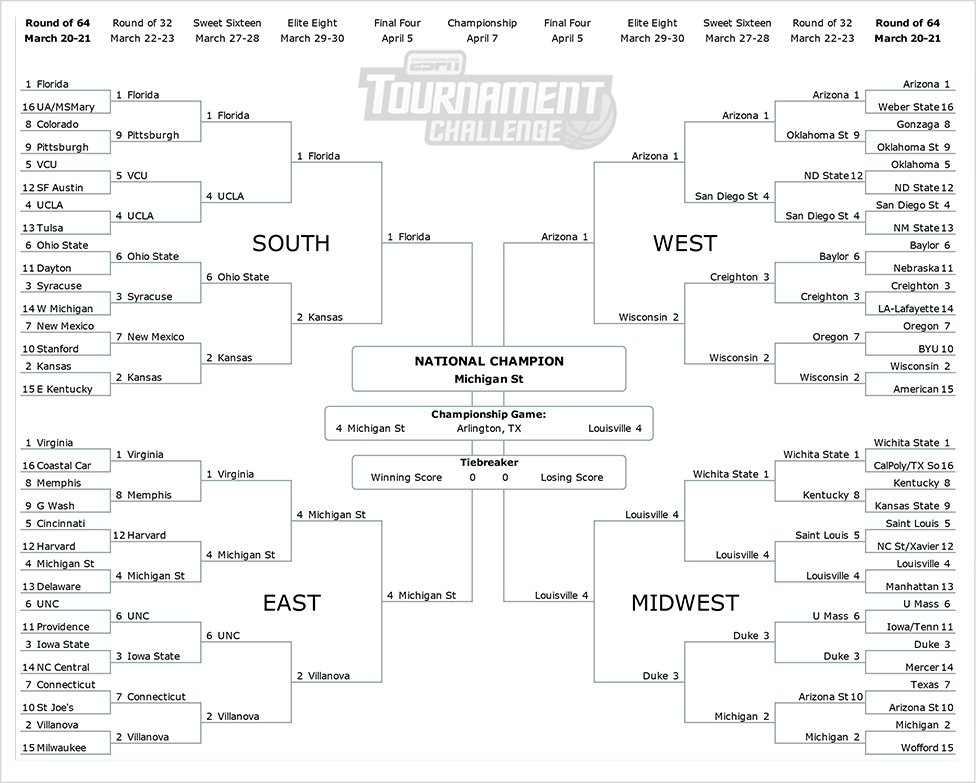
President Obama's Bracket for the 2014 NCAA Men's Basketball Tournament

President Barack Obama fills out his 2014 NCAA Division I Men's Basketball Tournament bracket during an ESPN interview with Andy Katz in the Map Room of the White House, March 18, 2014.

President Barack Obama fills out his 2014 NCAA Division I Men's Basketball Tournament bracket during an ESPN interview with Andy Katz in the Map Room of the White House, March 18, 2014. (Official White House Photo by Pete Souza)

Happy March Madness everyone!

Yesterday, for the sixth straight year, President Obama sat down to fill out his brackets for the NCAA men's and women's basketball tournaments -- and talked a little "Barack-etology" with ESPN's Andy Katz.

The President has Louisville, Michigan State, Florida, and Arizona headed to the Final Four.

Get excited Michigan State fans: The President picked the Spartans to beat the Louisville Cardinals in the National Championship game on April 7.

Share President Obama's Bracket on Twitter

The White House

Office of the Press Secretary

Statement by the Press Secretary on the Visit of Prime Minister Jomaa of Tunisia

President Obama will host Prime Minister Mehdi Jomaa of Tunisia at the White House on Friday, April 4.  During the meeting, the President looks forward to discussing the commitment Tunisia’s leaders have made to advancing Tunisia’s democracy and how the United States can further support Tunisia’s historic transition.  The leaders will discuss a broad range of bilateral and regional issues of mutual interest, including U.S. economic, political, and security assistance to support the Prime Minister’s reform agenda and Tunisia’s stability.  Prime Minister Jomaa’s visit is a demonstration of the strong bonds of friendship between the American and Tunisian people, and America’s enduring commitment to Tunisia’s democratic transition.

The White House

Office of the Press Secretary

Statement by NSC Spokesperson Caitlin Hayden on U.S. Admittance as an Extractive Industries Transparency Initiative Candidate Country

We are pleased that today the International Board of the Extractive Industries Transparency Initiative (EITI) accepted the U.S. Candidacy Application at their Board Meeting in Oslo, Norway. 

Two years ago, at the launch of the Open Government Partnership, President Obama announced the U.S. commitment to implement EITI, an international standard aimed at increasing transparency and accountability in the payments that companies make and the revenues governments receive for their natural resources such as oil, gas, and mining.

The United States is first G-8 country to achieve candidate status and become an EITI implementing country, joining a group of 41 countries around the world that are working actively to improve the management of their oil, gas, and mining sectors. 

As an EITI Candidate Country, the United States, through the Department of the Interior, will continue its work toward increasing revenue transparency and accountability in relevant industry sectors, ensuring that American taxpayers receive every dollar due for the extraction of the nation’s natural resources, and making the U.S. government more open and more accountable to the American people.

The White House

Office of the Press Secretary

FACT SHEET: The President’s Climate Data Initiative: Empowering America’s Communities to Prepare for the Effects of Climate Change

“Climate change is a fact.  And when our children’s children look us in the eye and ask if we did all we could to leave them a safer, more stable world, with new sources of energy, I want us to be able to say yes, we did.”– President Barack Obama, State of the Union Address, January 28, 2014

Last June, President Obama launched a Climate Action Plan to cut carbon pollution, prepare communities for the impacts of climate change, and lead international efforts to address this global challenge. The plan recognizes that even as we act to curb the carbon pollution that is driving climate change, we must also prepare our citizens and communities for the climate impacts that are already underway across the country.

Delivering on a commitment in the President’s Climate Action Plan, the Obama Administration is today launching the Climate Data Initiative—a broad effort to leverage the Federal Government’s extensive, freely-available climate-relevant data resources to stimulate innovation and private-sector entrepreneurship in support of national climate-change preparedness.

President Obama is committed to ensuring that communities across America have access to the information and tools they need to protect themselves from harm today and potential damage in the future. This means connecting regional and city planners, resource managers, farmers, hospitals, and businesses with data-driven tools to help them better understand, manage, and prepare for the real-world impacts associated with climate change. Maps of future sea-level rise, for instance, can help builders decide where to break ground out of harm’s way, while other online tools can help water utility operators identify potential threats to the local water supply.

Insights gathered from data can help communities and businesses better understand and manage the risks associated with climate change. However, taking data about climate that is collected by satellites and scientific equipment and turning it into easy-to-use information and tools takes analysis, innovation, and cutting-edge technology expertise.

Through the Climate Data Initiative, the Obama Administration is today issuing a call to America’s top private-sector innovators to leverage open government data resources and other datasets to build tools that will make America’s communities more resilient to climate change and to forge cross-sector partnerships to make those tools as useful as possible.  In response to this call to action, today’s launch includes a number of commitments by Federal agencies and private-sector partners:

Administration Commitments:

The Climate Data Initiative builds on two significant Administration commitments: (1) to strengthen America’s resilience to climate change, and (2) to make government-held data more accessible to the public, entrepreneurs, researchers, and others as fuel for innovation and economic growth. New steps by the Administration include:

  • Launch of climate.data.gov. With leadership from the National Oceanic and Atmospheric Administration (NOAA) and National Aeronautics and Space Administration (NASA), the Administration is launching climate.data.gov—a new climate-focused section of Data.gov, the Federal Government’s open data platform, hosted by the General Services Administration, that will make Federal data about our climate more open, accessible, and useful to citizens, researchers, entrepreneurs, and innovators. Climate.data.gov will initially focus on coastal flooding and sea level rise in its beta phase, and already includes more than 100 curated, high-quality datasets, web services, and tools that can be leveraged by innovators to help communities prepare for the future. Over time, these data and resources will expand to provide information on other climate-relevant threats, such as to human health, energy infrastructure, and our food supply. 

  • Launch of NASA and NOAA Innovation Challenge on Coastal Vulnerability and Preparedness.  Today, NOAA and NASA are launching an innovation challenge to encourage entrepreneurs, technologists, and developers to create and deploy data-driven visualizations and simulations that help people understand their exposure to coastal-inundation hazards and other vulnerabilities. This “Coastal Flooding Challenge” will culminate in a two-day event on April 12-13, 2014, as part of broader activities around the International Space Apps Challenge—a global mass collaboration inviting teams of problem-solvers to leverage publicly available data to design innovative solutions for global challenges. 

  • Release of New Infrastructure and Geographic Map Data Relevant to Climate-Preparedness. To help communities and citizens plan for the risks of coastal flooding and other climate-change-related impacts, the U.S. Geological Survey, U.S. Department of Homeland Security, U.S. Department of Defense, and National Geospatial-Intelligence Agency are releasing today a collection of datasets containing mapping information about hundreds of thousands of the Nation’s infrastructure units and geographical features, including bridges, roads, railroad tunnels, canals, and river gauges. Providing wider access to these data to mission partners and the general public can advance preparedness for climate change impacts and other disasters. These data, which have been reviewed by DHS, DoD, USGS, and NGA and deemed non-sensitive, are being made available via user-friendly mapping services on Geoplatform.gov and Climate.data.gov

  • NOAA Request for Information on Increasing Access to Environmental Data: To increase access to and use of its vast library of environmental data, NOAA has issued a request for information (RFI) seeking comment from industry, non-profits, research laboratories, universities, and private-sector partners to help make NOAA's vast data holdings available in a rapid, scalable manner to the public. Of the 20 terabytes of data NOAA gathers each day only a small percentage is easily accessible to the public. Through the RFI, American companies will be able to provide potential solutions for NOAA to turn this untapped information into usable products or services. Respondents have until March 24, 2014, to submit a written statement of interest, including a proposed way forward.  

  • Support for Climate Data & Tools in the President’s Budget. Recognizing the critical importance of data and information to meet the challenge of climate change, the President’s proposed FY15 Budget includes support for State, local, and tribal preparedness efforts, analysis of vulnerabilities of critical infrastructure, and development and dissemination of better information and planning tools, including the Climate Resilience Toolkit and Climate Data Initiative. The Budget also includes a new $1 billion Climate Resilience Fund, within a fully paid for $56 billion Opportunity, Growth, and Security Initiative, that expands on existing climate-change preparedness programs to ensure we are doing everything we can to support the safety and security of our communities and resources. The Fund will help us better understand and prepare for climate change by investing in research and unlocking data and information, including new sea-level rise analyses. 

  • Expanding Stakeholder Outreach & Engagement. The White House, NASA, NOAA, and other Federal agencies will convene innovators, community leaders, scientists, communicators, and citizens to identify needs for data and data-driven tools, spur innovative collaborations and partnerships, and get feedback on how to best make data, information tools, and other resources on climate change available and useful to people, businesses, and communities. This process began today with two collaborative stakeholder workshops during which climate and technology experts will brainstorm innovative new climate resilience tools and ways to provide increased data-access to wide audiences. These workshops will precede the public launch. 

Private Sector Commitments

  • Esri: Providing Communities with Map-Based Planning Tools and Collaboration Platforms. Esri is unveiling a new two-part initiative to help communities more effectively build climate-resilience. First, Esri will develop and publish a series of free and open "maps and apps" developed in partnership with 12 cities that help address the most urgent climate-relevant needs shared among thousands of users of Esri’s ArcGIS platform—such as preparing for droughts, heat waves, or flooding. Second, Esri is announcing today a climate-focused geo-collaboration portal—an online destination to discover, contribute, and share resources critical to confronting the impacts of climate change. Additionally, Esri recently announced, during one of the largest gatherings of GIS developers and in response to the President’s call to action, a Climate Resilience App Challenge to inspire more than 2,500 developers to focus their creative attention on creating mapping and analytical tools that help communities see, understand, and prepare for climate risks. Prizes will be awarded and the resulting apps will be openly shared in July.  

  • Intel Corporation: Fostering Regional Partnerships and Hosting Hackathons to Boost the Development of Climate Resilience Tools. Intel Corporation, as part of its Code for Good program, is announcing its sponsorship of three regional partnerships including “hackathon” events focused on climate resilience in the Chesapeake Bay, New Orleans, and San Jose. In each location, Intel will join with local partners to convene teams of engineering and computer science students, and other interested local citizens, and challenge them to develop new software applications and tools to make good use of available data sets related to climate -change resilience. Each hackathon will have a focus area tailored to priorities of its host community, with an emphasis on driving a sense of local ownership of the tools that emerge from the event. These tools will be broadly communicated and made available for use in other localities. 

  • Google: Providing Vast Cloud Computing Resources to Spur Creation of High-Resolution Drought and Flood Mapping, Apps, and Tools for Climate Risk Resilience Google is today announcing it will donate significant cloud computing and storage resources to support the creation of global, high-resolution maps, tools, and data products that will be made freely available to the public to help manage the risks of extreme heat, drought, sea-level rise and flooding. Google is committing to provide one petabyte (1,000 terabytes) of cloud storage to house satellite observations, digital elevation data, and climate and weather model datasets drawn from government open data and contributed by scientists as well as 50 million hours of high performance cloud computing on the Google Earth Engine geospatial analysis platform. To leverage these resources, Google is announcing today new partnerships with the Desert Research Institute, the University of Idaho, and the University of Nebraska to (1) provide drought mapping and monitoring for the entire continental United States in near real-time and (2) model water consumption from vegetation across the entire planet. To better manage climate-related flooding, Google is also challenging the innovation community to leverage these vast cloud computing resources by collaborating in the development of an open and freely available global terrain model at unprecedented resolution - one petabyte of storage could support better than 1 meter resolution which will help the public and planners worldwide better anticipate and map the risks of coastal floods and other disasters. Google is also committing to support analysis and visualization of these scientific data to make information about impacts such as sea-level rise, storm surges, extreme heat, and drought easily accessible to the public. 

  • CartoDB: Announcing New Grants Program to Support Creation of Data-Driven Tools. CartoDB will launch a grants program to support foundations and nonprofits in creating data-driven tools or efforts with respect to helping communities, companies, or citizens with resilience and preparedness for climate change impacts such as flooding, drought, and heat waves.  The company will solicit grant applications and offer between $50 and $3500 for successful applications to be used on CartoDB infrastructure to help make climate resilience apps or projects possible. The money is to be spent in a year, but funded projects are free to reapply in the future.   

  • Climate Central: Releasing New Web Tools to Assess Local-Scale Sea Level Rise. Climate Central will release a free web tool providing local projections, maps, and assessments of exposure to sea level rise and coastal flooding tabulated for every coastal zip code, municipality, county, and state in the U.S., along with planning, legislative and other geographic districts. Exposure assessments will cover more than 100 demographic, economic, infrastructure and environmental variables using data drawn mainly from federal sources, including NOAA, USGS, FEMA, DOT, DOE, DOI, EPA, FCC and the Census. Climate Central has already developed its Surging Seas Risk Finder tool for Florida, New Jersey, and New York, which is geared toward city, state, and Federal planners, and commits to completing the balance of coastal states this year. Climate Central will conduct at least 100 more informational webinars and briefings with officials, planners and other stakeholders across the country in 2014. 

  • Microsoft Research: Providing Climate Scientists with New Tools and Computing Resources. Microsoft Research is announcing a new program to provide climate change scientists and decision-makers free access to cloud computing resources to conduct research and analysis of climate data. Microsoft Research will grant 12 months of free cloud computing resources to 40 awardees selected from project proposals submitted by June 15, 2014. Each award provides up to 180,000 hours of free cloud computing time and 20 Terabytes of cloud storage. Microsoft is also announcing a new, free climate data resource, FetchClimate, for retrieving past and present observations and for future climate-prediction information. FetchClimate will continue to be available as a free intelligent environmental information-retrieval service and will now be adaptable as a cloud-based system that can be re-implemented and adapted to the specific needs of new projects.  

  • Circle of Blue and Qlik: Developing New Tools and Visualizations to Better Understand Climate Impacts. Circle of Blue, a nonprofit news and science organization, has partnered with Qlik, a data-analytics company, to develop a series of tools to improve understanding of water, food, and energy in a changing climate. Today the two organizations will launch an interactive visual dashboard that analyzes and integrates data into displays of current and past levels of water reservoirs in California, and which can be scaled to compare hyper-local data and research with national and global trends. Current data, particularly water-related, is often compartmentalized and not available in comparative, visual formats. This new interactive display application, will help the public, water managers, and researchers, and others to build more resilient communities and ecosystems by helping the nation better understand, monitor, compare and manage its water supplies in this era of climate change. 

  • 100 Resilient Cities, an effort Launched by the Rockefeller Foundation: Supplying Data on Local Demand and Market Opportunities for Resilience Tools. 100 Resilient Cities (100RC) is working to build urban resilience in 100 member cities around the world and develop the practice of resilience. As cities work to build resilience, they will demand new resilience-building tools from the marketplace. 100RC will provide to the Climate Data Initiative’s stakeholder engagement community with information from their 100 member cities on which types of resilience tools are most needed and could be most useful to inform efforts and direct investment in areas of greatest need, and pool demand for these tools as a signal to innovators of the market opportunity. 

  • Code for Philly: Using City Buses to Help Monitor Local Climate Change-Related Pollution. Code for Philly, Code for America’s Philadelphia Brigade, is announcing the development of a new mobile sensor network they aim to run on city buses to gather temperature and pollution data across the city, allowing researchers to track the effects of climate change on and its pollutants in areas across an entire city. This data will be combined with OpenTreeMaps, a platform for crowdsourced tree inventory and urban forestry analysis, to determine the value of trees in combating climate change. The data will also be openly available so developers can incorporate and convey information on local pollution and heat levels in real time to citizens. 

  • The World Bank: Launching New Initiative for Global Use of Open Data for Climate and Disaster Resilience. The World Bank is launching today a new Field Guide that serves as a model for how communities around the globe can best leverage open data for resilience to disasters and climate change impacts. As part of the World Bank’s Open Data for Resilience Initiative (OpenDRI), the Field Guide builds on work active across more than 20 countries to map millions of buildings and urban infrastructure; open more than 1,000 geospatial datasets to the public; and spur the development of innovative applications based on those data. The OpenDRI Field Guide will be presented at stakeholder workshops and events across the globe. Additionally, to establish a versatile framework for free access to risk data, the World Bank will share the Field Guide and other resources with at least 24 partner countries by 2016. 

  • Antioch University New England: Creating New Academic Center for Climate Preparedness and Resilience. Antioch University New England (AUNE) is announcing the creation of a new Center for Climate Preparedness and Community Resilience, to be launched later this year. The Center will expand on a decade of AUNE’s climate adaptation research and modeling efforts, community engagement/technical assistance, and professional science sustainable development and climate change education. The launch of the new Center will include a convening in May, 2014, in partnership with the U.S. Environmental Protection Agency, of municipal, county and regional leaders on the frontlines of climate change adaptation, from the upper Chesapeake Bay watershed to Maine, to leverage the data-driven expertise of a wide range of organizations and individuals. 

  • MIT Climate CoLab: Crowdsourcing Solutions to Global Climate Change Preparedness. The Massachusetts Institute for Technology (MIT) Center for Collective Intelligence runs the Climate CoLab, an online platform to crowdsource solutions for what to do about global climate change. Over 10,000 people from around the world have registered as members and have submitted more than 400 proposals in contests ranging from how to generate electricity with fewer harmful emissions, to how to increase public understanding about climate change. The MIT Climate CoLab recently launched two global crowdsourcing contests, in line with the White House Climate Data Initiative, to generate solutions to climate change preparedness and resilience: (1) What can be done to adapt to the impacts of climate change? and (2) How can crowdsourcing provide more efficient disaster risk management?  To help the public understand the potential impacts of climate change, MIT Climate CoLab’s platform also includes computer simulation models to predict phenomena such as temperature change and sea level rise.  

  • EcoHack: Launching New Hackahton Climate Data Track. EcoHack, an annual hackathon focused on tackling real scientific and environmental challenges through code, visualization, and hardware hacking, will launch and promote a new dedicated track to support climate data and application hacks. The event will take place this year on May 9 – 10th in New York City, San Francisco, and São Paulo, Brazil. At each of the three locations, organizers will work to identify one or more high-impact climate-relevant products or outcomes resulting from the hackathons—with the goal of creating a finished visualization, app, or website to help expand the reach and impact of these tools.

  • Alliance for Water Efficiency: Over the next three years, Alliance for Water Efficiency will provide assistance to communities across the country to help them achieve water use reductions or expand water conservation programs, through webinars, workshops, and new tools. This includes AWE’s Water Conservation Tracking Tool, which enables utilities to evaluate the water savings, costs, and benefits of a variety of conservation programs, and track savings over time. AWE is also announcing it will build over the next three years an Outdoor Water Savings Research Program to produce actionable data on the potential and actual water savings from outdoor conservation measures. AWE will work with at least ten communities to customize and distribute its online Household Water Calculator, which empowers citizens to make better decisions about their water use through data, allowing consumers to calculate their own water use and compare it to a neighboring and water-efficient home, and then receive a personalized efficiency plan to help them use water more wisely.

The White House

Office of the Press Secretary

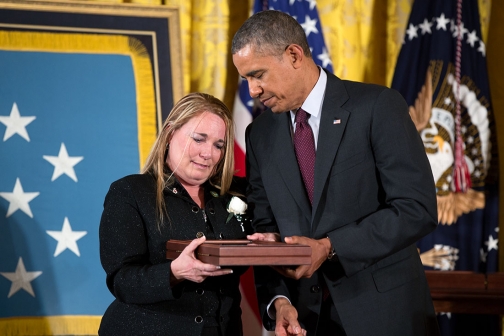
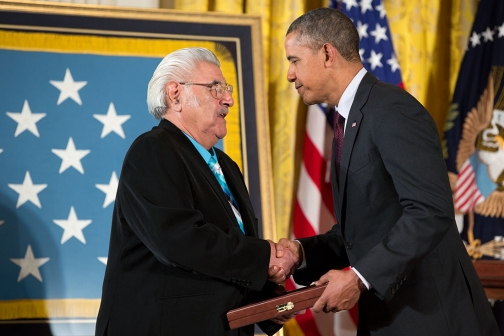
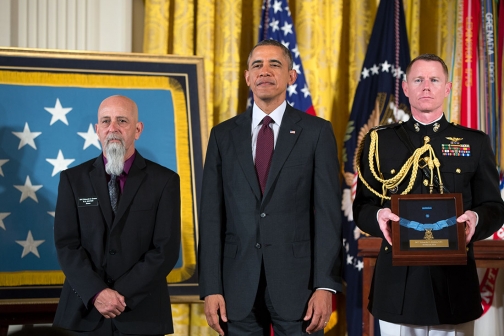
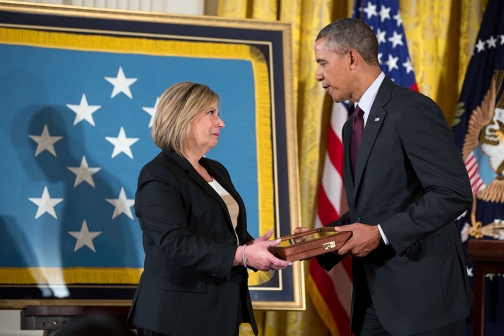
Remarks by the President at Presentation Ceremony for the Medal of Honor

East Room

3:33 P.M. EDT

THE PRESIDENT:  Good afternoon, everybody.  Please be seated.  Well, welcome to the White House. 

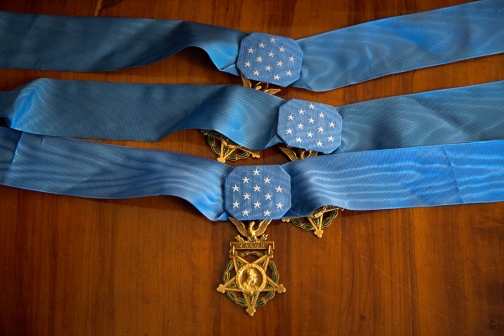
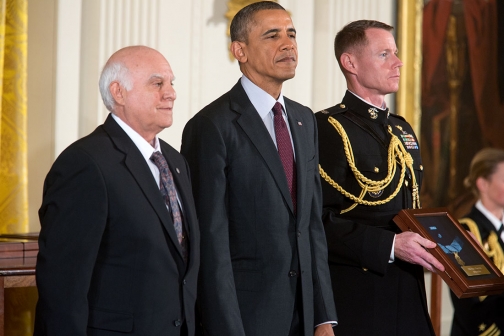
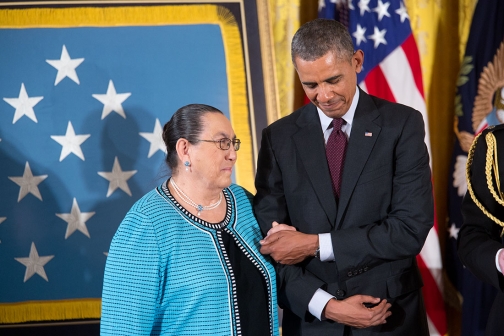
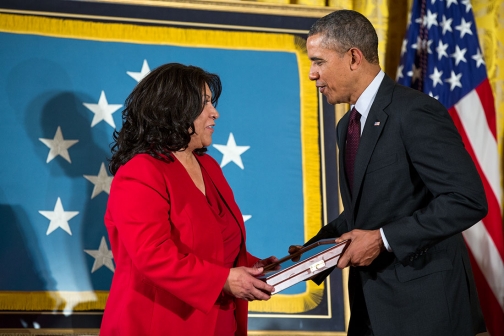
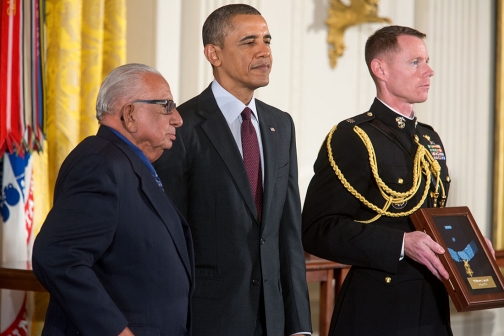
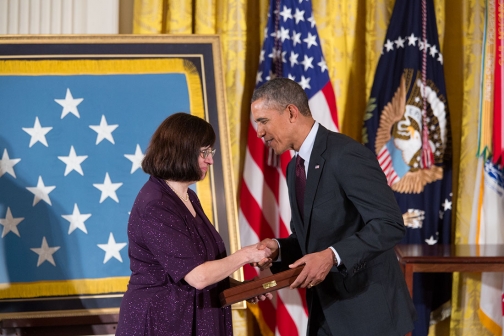
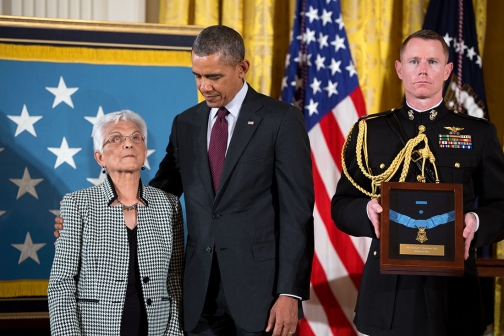
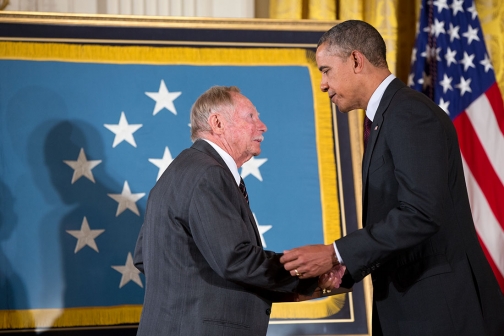
The presentation of our nation’s highest military decoration -- the Medal of Honor -- is always a special occasion.  But today, it is truly historic.  This is the single largest group of servicemembers to be awarded the Medal of Honor since the Second World War.  And with several of these soldiers recognized for their valor during that war, this ceremony is 70 years in the making.  As one family member has said, this is long overdue.

Many of these families -- and I had a chance to meet all of them who are present here today -- they’ve known these stories of heroism for decades.  Still, they were pretty surprised when we called them to break the news about the Medal of Honor.  Some of them thought it was a prank.  (Laughter.)  Some of them thought it was a scam.  A few of them thought it might be some trick to get their credit card number.  (Laughter.)  When I called Melvin Morris -- who we’ll recognize in a moment for his actions in Vietnam -- his first reaction was, “Oh, my God, what have I done?”  (Laughter.)  When I told him it was all good -- the Medal of Honor -- I could hear through the phone, he almost passed out.  (Laughter.)  

You see, for their gallantry under fire each of these soldiers was long ago recognized with the Army’s second-highest award -- the Distinguished Service Cross.  But ask their fellow veterans, ask their families, and they’ll tell you that their extraordinary deeds merited the highest recognition.  And today, we have the chance to set the record straight.

This ceremony reminds us of one of the enduring qualities that makes America great -- that makes us exceptional.  No nation is perfect, but here in America we confront our imperfections and face a sometimes painful past -- including the truth that some of these soldiers fought, and died, for a country that did not always see them as equal.  So with each generation we keep on striving to live up to our ideals of freedom and equality, and to recognize the dignity and patriotism of every person, no matter who they are, what they look like, or how they pray. 

And that’s why, more than a decade ago, Congress mandated a review to make sure that the heroism of our veterans wasn’t overlooked because of prejudice or discrimination.  Our military reviewed thousands of war records.  They teamed up with veterans groups and museums to get this right.  It was painstaking work, made even harder because sometimes our servicemembers felt as if they needed to change their last names to fit in.  That tells a story about our past.  But, ultimately, after years of review, these two dozen soldiers -- among them Hispanic, African American and Jewish veterans -- were identified as having earned the Medal of Honor.  This is the length to which America will go to make sure everyone who serves under our proud flag receives the thanks that they deserve.         

So this is going to be a long ceremony.  We’re going to read all 24 citations, because every one is a story of bravery that deserves to be told.  But first, I want to take just a few minutes to describe the Americans behind these actions, the men these families know -- the brilliant lives behind the smiling faces in those old photographs, and how they reflected all the beauty and diversity of the country that they served.

They were Americans by birth and Americans by choice -- immigrants, including one who was not yet even a citizen.  They grew up in big city neighborhoods like Brooklyn, rural communities like Hooper, Nebraska, small towns in Puerto Rico.  They loved to fish and play baseball.  They were sons who made their parents proud, and brothers who their siblings looked up to.  They were so young -- many in their early 20s.  And when their country went to war, they answered the call.  They put on the uniform, and hugged their families goodbye -- some of them hugged the wives and children that they’d never see again.

They fought in the rocky hills of Italy, the blood-stained beaches of France, in the freezing mountains of Korea, the humid jungles of Vietnam.  Their courage almost defies imagination.  When you read the records of these individuals, it's unimaginable, the valor that they displayed.  Running into bullets.  Charging machine gun nests and climbing aboard tanks and taking them out.  Covering their comrades so they could make it to safety.  Holding back enemies, wave after wave, even when the combat was hand-to-hand.  Manning their posts -- some to their very last breaths -- so that their comrades might live. 

Of the 24 American soldiers we honor today, 10 never came home.  One of them -- Corporal Joe Baldonado, from the Korean War -- is still missing, reminding us that, as a nation, we have a scared obligation to keep working to give the families of our missing servicemembers from all wars a full accounting of their loved ones.

Through their grief, the families of our fallen summoned the strength to carry on:  wives whose hearts ached for their husbands; sons and daughters who grew up without their dad; nieces and nephews and grandchildren.  These families join us here today.  And they know, more than most, that because others laid down their lives for us, we’ve been able to live our lives in freedom, pursue our dreams.  So there’s a legacy here born of sacrifice. 

That includes a soldier’s nephew -- a kid from New York, who grew up to become one of the great rock stars of all time and who honors his uncle here today.  It includes soldiers who came home and took different paths -- some continued to serve in uniform, some beginning new careers, some getting married and raising their kids, serving their communities, taking care of their fellow vets. 

These veterans lived out their lives in the country that they helped to defend, and doing what they loved --like William Leonard, who at age 71 passed away in his backyard, sitting in his chair, listening to his beloved Yankees play on the radio.

And that’s where this story might have ended.  But Mitchel Libman -- a friend of one of these soldiers and an Army vet himself -- set out on a mission.  He and his wife Marilyn spent years writing letters and working with Congress and our military to get this done.  And so we thank all those who worked so hard for so long to bring us to this moment, especially Marilyn and Mitchel -- now 83 years old -- who I’d ask to stand so that we can all say thank you.  (Applause.)     

Finally, of these 24 soldiers, three remain with us and have joined us here today -- men who remind us that sometimes the heroes we seek are right in front of us, literally living right next door.

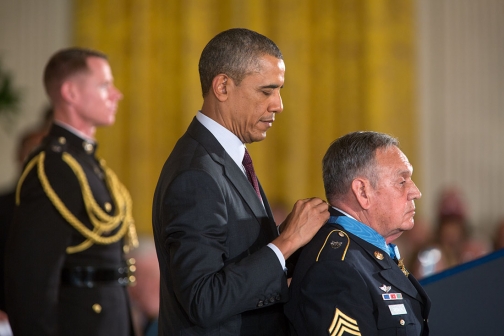
Most days, you can find Jose Rodela in his San Antonio home -- a 76-year-old retiree who enjoys watching baseball on TV, and working on his 1975 Chevy pickup, and mowing the grass for his neighbors.  Jose is such a humble guy that he did not even mention the ceremony to his neighbors -- who I think would be pretty shocked to turn on the news tonight -- (laughter) -- and see that the guy who cuts their lawn is getting the Medal of Honor.  (Laughter.)  Today, we remember how 32--year-old Sergeant First Class Rodela fought through his wounds in Vietnam and rallied his men during 18 hours of constant combat.

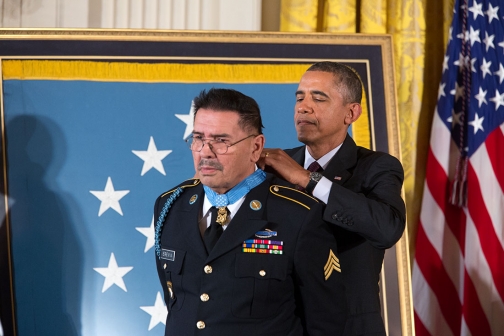
Most days, you can find Melvin Morris at home in Port St. John, Florida -- 72 years old, a retired salesman and a great-grandfather.  You’ll find him working on his boat, going fishing, reading the Bible, spending time with his beautiful wife Mary -- married 53 years this month.  You're going to have to give me some tips.  (Laughter.)  We're not that far along yet.  Today, we remember how 27-year-old Staff Sergeant Morris  -- one of our nation’s very first Green Berets -- one of our very first Green Berets -- think about that.  I mean, that's legendary -- how Staff Sergeant Morris recovered a fallen comrade in Vietnam, took out several enemy bunkers, and kept going even after he was shot three times.

And on most days, you can find Santiago Erevia at home in San Antonio -- he’s a 68-year-old retired postal worker.  He’s fixing up his house, typically, tending to the garden, going on walks with his wife, or doing some push-ups to stay in shape.  (Laughter.)  Today, we remember how 23-year-old Specialist Four Erevia, under a hail of bullets in Vietnam, gave first aid to his wounded comrades and single-handedly destroyed four enemy bunkers. 

These are extraordinary Americans.  They are exemplary soldiers.  And so I want to begin by welcoming Santiago Erevia to the stage for the reading of the citation.

MILITARY AIDE:  Specialist Four Santiago J. Erevia.  United States Army.  Specialist Four Santiago J. Erevia distinguished himself by acts of gallantry and intrepidity above and beyond the call of duty while serving as a radio telephone operator in Company C, 1st Battalion (Airmobile), 501st Infantry, 101st Airborne Division (Airmobile) during search and clear mission near Tam Ky, Republic of Vietnam on May 21, 1969.  After breaching an insurgent perimeter, Specialist Four Erevia was designated by his platoon leader to render first aid to several casualties, and the rest of the platoon moved forward.   As he was doing so, he came under intense hostile fire from four bunkers to his left front.  Although he could have taken cover with the rest of the element, he chose a retaliatory course of action.  With heavy enemy fire directed at him, he moved in full view of the hostile gunners as he proceeded to crawl from one wounded man to another, gathering ammunition.  Armed with two M-16 rifles and several hand grenades, he charged toward the enemy positions behind the suppressive fire of the two rifles.  Under very intense fire, he continued to advance on the insurgents until he was near the first bunker.  Disregarding the enemy fire, he pulled the pin from a hand grenade and advanced on the bunker, leveling suppressive fire until he could drop the grenade into the bunker, mortally wounding the insurgent and destroying the fortification.  Without hesitation, he employed identical tactics as he proceeded to eliminate the next two enemy positions.  With the destruction of the third bunker, Specialist Four Erevia had exhausted his supply of hand grenades.  Still under intense fire from the fourth position, he courageously charged forward behind the fire emitted by his M-16 rifles.  Arriving at the very edge of the bunker, he silenced the occupant within the fortification at point blank range.  Through his heroic actions the lives of the wounded were saved and the members of the Company Command Post were relieved from a very precarious situation.  His exemplary performance in the face of overwhelming danger was an inspiration to his entire company and contributed immeasurably to the success of the mission.  Specialist Four Erevia’s conspicuous gallantry, extraordinary heroism, and intrepidity at the risk of his own life, above and beyond the call of duty, were in keeping with the highest traditions of military service and reflect great credit upon himself, his unit, and the United States Army.

(The medal is presented.)  (Applause.) 

MILITARY AIDE:  Sergeant First Class Melvin Morris.  United States Army.  Staff Sergeant Melvin Morris distinguished himself by acts of gallantry and intrepidity above and beyond the call of duty while serving as Commander of a Strike Force drawn from Company D, 5th Special Forces Group (Airborne), 1st Special Forces, during combat operations against an armed enemy in the vicinity of Chi Lang, Republic of Vietnam on September 17, 1969. On that afternoon, Staff Sergeant Morris’s affiliated companies encountered an extensive enemy mine field and were subsequently engaged by a hostile force.  Staff Sergeant Morris learned by radio that a fellow team commander had been killed near an enemy bunker and he immediately reorganized his men into an effective assault posture before advancing forward and splitting off with two men to recover the team commander’s body.  Observing the maneuver, the hostile force concentrated its fire on Staff Sergeant Morris’s three-man element and successfully wounded both men accompanying him.  After assisting the two wounded men back to his forces’ lines, Staff Sergeant Morris charged forward into withering enemy fire with only his men’s suppressive fire as cover.  While enemy machine gun emplacements continuously directed strafing fusillades against him, Staff Sergeant Morris destroyed the positions with hand grenades and continued his assault, ultimately eliminating four bunkers.  Upon reaching the bunker nearest the fallen team commander, Staff Sergeant Morris repulsed the enemy, retrieved his comrade and began the arduous trek back to friendly lines.  He was wounded three times as he struggled forward, but ultimately succeeded in returning his fallen comrade to a friendly position.  Staff Sergeant Morris’s extraordinary heroism and selflessness above and beyond the call of duty are in keeping with the highest traditions of military service and reflect great credit upon himself, his unit, and the United States Army.   

(The medal is presented.)  (Applause.)

MILITARY AIDE:  Master Sergeant First Class Jose Rodela.  United States Army.   Sergeant First Class Jose Rodela distinguished himself by acts of gallantry and intrepidity above and beyond the call of duty while serving as the company commander, Detachment B-36, Company A, 5th Special Forces Group (Airborne), 1st Special Forces during combat operations against an armed enemy in Phuoc Long Province, Republic of Vietnam on September 1, 1969.  That afternoon, Sergeant First Class Rodela’s battalion came under an intense barrage of mortar, rocket, and machine gun fire.  Ignoring the withering enemy fire, Sergeant First Class Rodela immediately began placing his men into defensive positions to prevent the enemy from overrunning the entire battalion.  Repeatedly exposing himself to enemy fire, Sergeant First Class Rodela moved from position to position, providing suppressing fire and assisting wounded, and was himself wounded in the back and head by a B-40 rocket while recovering a wounded comrade.  Alone, Sergeant First Class Rodela assaulted and knocked out the B-40 rocket position before successfully returning to the battalion’s perimeter.  Sergeant First Class Rodela’s extraordinary heroism and selflessness above and beyond the call of duty are in keeping with the highest traditions of military service and reflect great credit upon himself, his unit and the United States Army.

(The medal is presented.)  (Applause.)    

THE PRESIDENT:  Before Jose returns to his seat, I just want to ask Santiago and Melvin to return to the stage, please. This is a remarkable moment.  And as they come up, I’ll like to recall -- as they take their positions I'd like to recall the words of a poet:

“Tho’ much is taken, much abides; and tho’

We are not now that strength which in old days
Moved earth and heaven; that which we are, we are;
One equal temper of heroic hearts,
Made weak by time and fate, but strong in will
To strive, to seek, to find, and not to yield.” 

Santiago Erevia, Melvin Morris, Jose Rodela -- in the thick of the fight, all those years ago, for your comrades and your country, you refused to yield.  And on behalf of a grateful nation, we all want to thank you for inspiring us -- then and now -- with your strength, your will, and your heroic hearts.

Please give them a big round of applause.  (Applause.)

Gentlemen, thank you.  Please take your seats.  We'll proceed with the rest of the ceremony.

MILITARY AIDE:  Lenora Alvarado accepting on behalf of her father, Specialist Four Leonard L. Alvarado. 

Specialist Four Leonard L. Alvarado distinguished himself by acts of gallantry and intrepidity above and beyond the call of duty while serving as a Rifleman with Company D, 2d Battalion, 12th Cavalry, 1st Cavalry Division (Airmobile) during combat operations against an armed enemy in Phuoc Long Province, Republic of Vietnam on August 12, 1969.  On that day, as Specialist Four Alvarado and a small reaction force moved through dense jungle en route to a beleaguered friendly platoon, Specialist Four Alvarado detected enemy movement and opened fire.  Despite his quick reaction, Specialist Four Alvarado and his comrades were soon pinned down by the hostile force that blocked the path to the trapped platoon.  Specialist Four Alvarado quickly moved forward through the hostile machinegun fire in order to engage the enemy troops.  Suddenly, an enemy grenade exploded nearby, wounding and momentarily stunning him. Retaliating immediately, he killed the grenadier just as another enemy barrage wounded him again.  Specialist Four Alvarado crawled forward through the fusillade to pull several comrades back within the hastily-formed perimeter.  Realizing his element needed to break away from the hostile force, Specialist Four Alvarado began maneuvering forward alone.  Though repeatedly thrown to the ground by exploding satchel charges, he continued advancing and firing, silencing several emplacements, including one enemy machinegun position.  From his dangerous forward position, he persistently laid suppressive fire on the hostile forces, and after the enemy troops had broken contact, his comrades discovered that he had succumbed to his wounds.  Specialist Four Alvarado’s extraordinary heroism and selflessness at the cost of his own life, above and beyond the call of duty, are in keeping with the highest traditions of military service and reflect great credit upon himself, his unit and the United States Army.

(The medal is presented.)  (Applause.)

MILITARY AIDE:  Richard Conde accepting on behalf of his father, Sergeant First Class Felix M. Conde-Falcon.

Staff Sergeant Felix M. Conde-Falcon distinguished himself by acts of gallantry and intrepidity above and beyond the call of duty while serving as an acting Platoon Leader in Company D, 1st Battalion, 505th Infantry Regiment, 3d Brigade, 82d Airborne Division during combat operations against an armed enemy in Ap Tan Hoa, Republic of Vietnam on April 4, 1969.  While entering a heavily wooded section on the route of advance, Staff Sergeant Conde-Falcon and his company encountered an extensive enemy bunker complex, later identified as a battalion command post.  Following tactical artillery and air strikes on the heavily-secured enemy position, Staff Sergeant Conde-Falcon’s platoon was selected to assault and clear the bunker fortifications.  Moving out ahead of his platoon, Staff Sergeant Conde-Falcon charged the first bunker, heaving grenades as he went.  As the hostile fire increased, he crawled to the blind side of an entrenchment position, jumped to the roof, and tossed a grenade into the bunker aperture.  Without hesitating, he proceeded to two additional bunkers, both of which he destroyed in the same manner as the first.  Rejoining his platoon, Staff Sergeant Conde-Falcon advanced about one hundred meters through the trees before coming under intense hostile fire.  Selecting three men to accompany him, he maneuvered toward the enemy’s flank position.  Carrying a machinegun, he single-handedly assaulted the nearest fortification, killing the enemy inside before running out of ammunition.  After returning to the three men with his empty weapon and taking up an M-16 rifle, he concentrated on the next bunker.  Within ten meters of his goal, Staff Sergeant Conde-Falcon was shot by an unseen assailant and soon died of his wounds.  Staff Sergeant Conde-Falcon’s extraordinary heroism and selflessness at the cost of his own life, above and beyond the call of duty, are in keeping with the highest traditions of military service and reflect great credit upon himself, his unit and the United States Army.

(The medal is presented.)  (Applause.)

MILITARY AIDE: Shyrell Jean Copas accepting on behalf of her father, Specialist Four Ardie R. Copas.

Specialist Four Ardie R. Copas distinguished himself by acts of gallantry and intrepidity above and beyond the call of duty while serving as a Machinegunner in Company C, 1st Battalion (Mechanized), 5th Infantry Regiment, 25th Infantry Division during combat operations against an armed enemy near Ph Romeas Hek, Cambodia on May 12, 1970.  That morning, Specialist Four Copas’s company was suddenly attacked by a large hostile force firing recoilless rifles, rocket-propelled grenades, and automatic weapons.  As Specialist Four Copas began returning fire, his armored car was struck by an enemy recoilless round, knocking him to the ground and injuring four American Soldiers beside the vehicle.  Ignoring his own wounds, Specialist Four Copas quickly remounted the burning vehicle and commenced firing his machinegun at the belligerents.  Braving the hostile fire directed at him and the possible detonation of the mortar rounds inside the track, Specialist Four Copas maintained a heavy volume of suppressive fire on the foe while the wounded Americans were safely evacuated.  Undaunted, Specialist Four Copas continued to place devastating volleys of fire upon the adversary until he was mortally wounded when another enemy round hit his vehicle.  Specialist Four Copas’s daring action resulted in the safe evacuation of his comrades.  Specialist Four Copas’s extraordinary heroism and selflessness at the cost of his own life, above and beyond the call of duty, are in keeping with the highest traditions of military service and reflect great credit upon himself, his unit and the United States Army.

(The medal is presented.)  (Applause.)

MILITARY AIDE:  Tina Duran-Ruvalcaba accepting on behalf of her father, Specialist Four Jesus S. Duran.

Specialist Four Jesus S. Duran distinguished himself by acts of gallantry and intrepidity above and beyond the call of duty while serving as an acting M-60 machinegunner in Company E, 2d Battalion, 5th Cavalry, 1st Cavalry Division (Airmobile) during combat operations against an armed enemy in the Republic of Vietnam on April 10, 1969.  That afternoon, the reconnaissance platoon was moving into an elaborate enemy bunker complex when the lead elements began taking concentrated ambush fire from every side.  The command post was in imminent danger of being overrun.  With an M-60 machinegun blazing from his hip, Specialist Four Duran rushed forward and assumed a defensive position near the command post.  As hostile forces stormed forward, Specialist Four Duran stood tall in a cloud of dust raised by the impacting rounds and bursting grenades directed towards him and thwarted the enemy with devastating streams of machinegun fire.  Learning that two seriously wounded troopers lay helplessly pinned down under harassing fire, Specialist Four Duran assaulted the suppressive enemy positions, firing deadly bursts on the run.  Mounting a log, he fired directly into the enemy’s foxholes, eliminating four and cutting down several others as they fled.  Specialist Four Duran then continued to pour effective fire on the disorganized and fleeing enemy.  Specialist Four Duran’s extraordinary heroism and selflessness above and beyond the call of duty are in keeping with the highest traditions of military service and reflect great credit upon himself, his unit and the United States Army.

(The medal is presented.)  (Applause.)

MILITARY AIDE:  Command Sergeant Major Michael Grinston accepting on behalf of Sergeant Candelario Garcia.

Sergeant Candelario Garcia distinguished himself by acts of gallantry and intrepidity above and beyond the call of duty while serving as an acting Team Leader for Company B, 1st Battalion, 2d Infantry, 1st Brigade,1st Infantry Division during combat operations against an armed enemy in Lai Khe, Republic of Vietnam on December 8, 1968.  On that day, while conducting reconnaissance, Sergeant Garcia and his platoon discovered communication wire and other signs of an enemy base camp leading into a densely vegetated area.  As the men advanced, they came under intense fire.  Several men were hit and trapped in the open.  Ignoring a hail of hostile bullets, Sergeant Garcia crawled to within ten meters of a machinegun bunker, leaped to his feet and ran directly at the fortification, firing his rifle as he charged.  Sergeant Garcia jammed two hand grenades into the gun port and then placed the muzzle of his weapon inside, killing all four occupants.  Continuing to expose himself to intense enemy fire, Sergeant Garcia raced fifteen meters to another bunker and killed its three defenders with hand grenades and rifle fire.  After again braving the enemies’ barrage in order to rescue two casualties, he joined his company in an assault which overran the remaining enemy positions.  Sergeant Garcia’s extraordinary heroism and selflessness above and beyond the call of duty are in keeping with the highest traditions of military service and reflect great credit upon himself, his unit and the United States Army.

(The medal is presented.)  (Applause.)

MILITARY AIDE:  Charles Baldonado accepting on behalf of his brother, Corporal Joe R. Baldonado 

Corporal Joe R. Baldonado distinguished himself by acts of gallantry and intrepidity above and beyond the call of duty while serving as an acting machinegunner in 3d Squad, 2d Platoon, Company B, 187th Airborne Infantry Regiment during combat operations against an armed enemy in Kangdong, Korea on November 25, 1950.  On that morning, the enemy launched a strong attack in an effort to seize the hill occupied by Corporal Baldonado and his company.  The platoon had expended most of its ammunition in repelling the enemy attack and the platoon leader decided to commit his 3d Squad, with its supply of ammunition, in the defensive action.  Since there was no time to dig in because of the proximity of the enemy, who had advanced to within twenty-five yards of the platoon position, Corporal Baldonado emplaced his weapon in an exposed position and delivered a withering stream of fire on the advancing enemy, causing them to fall back in disorder.  The enemy then concentrated all their fire on Corporal Baldonado’s gun and attempted to knock it out by rushing the position in small groups and hurling hand grenades.  Several times, grenades exploded extremely close to Corporal Baldonado but failed to interrupt his continuous firing.  The hostile troops made repeated attempts to storm his position and were driven back each time with appalling casualties.  The enemy finally withdrew after making a final assault on Corporal Baldonado’s position during which a grenade landed near his gun, killing him instantly.  Corporal Baldonado’s extraordinary heroism and selflessness at the cost of his own life, above and beyond the call of duty, are in keeping with the highest traditions of military service and reflect great credit upon himself, his unit and the United States Army.

(The medal is presented.)  (Applause.)

MILITARY AIDE:  Tyronne Espinoza accepting on behalf of his father, Corporal Victor H. Espinoza.

Corporal Victor H. Espinoza distinguished himself by acts of gallantry and intrepidity above and beyond the call of duty while serving as an Acting Rifleman in Company A, 23d Infantry Regiment, 2d Infantry Division during combat operations against an armed enemy in Chorwon, Korea on August 1, 1952.  On that day, Corporal Espinoza and his unit were responsible for securing and holding a vital enemy hill.  As the friendly unit neared its objective, it was subjected to a devastating volume of enemy fire, slowing its progress.  Corporal Espinoza, unhesitatingly and being fully aware of the hazards involved, left his place of comparative safety and made a deliberate one man assault on the enemy with his rifle and grenades, destroying a machinegun and killing its crew.  Corporal Espinoza continued across the fire-swept terrain to an exposed vantage point where he attacked an enemy mortar position and two bunkers with grenades and rifle fire, knocking out the enemy mortar position and destroying both bunkers and killing their occupants.  Upon reaching the crest, and after running out of rifle ammunition, he called for more grenades.  A comrade who was behind him threw some Chinese grenades to him.  Immediately upon catching them, he pulled the pins and hurled them into the occupied trenches, killing and wounding more of the enemy with their own weapons.  Continuing on through a tunnel, Corporal Espinoza made a daring charge, inflicting at least seven more casualties upon the enemy who were fast retreating into the tunnel.  Corporal Espinoza was quickly in pursuit, but the hostile fire from the opening prevented him from overtaking the retreating enemy.  As a result, Corporal Espinoza destroyed the tunnel with TNT, called for more grenades from his company, and hurled them at the enemy troops until they were out of reach.  Corporal Espinoza’s incredible display of valor secured the vital strong point and took a heavy toll on the enemy, resulting in at least fourteen dead and eleven wounded.  Corporal Espinoza’s extraordinary heroism and selflessness above and beyond the call of duty are in keeping with the highest traditions of military service and reflect great credit upon himself, his unit and the United States Army.

(The medal is presented.)  (Applause.)

MILITARY AIDE:  Pete Corrall accepting on behalf of his uncle, Sergeant Eduardo C. Gomez.

Sergeant Eduardo C. Gomez distinguished himself by acts of gallantry and intrepidity above and beyond the call of duty while serving with Company I, 8th Cavalry Regiment, 1st Cavalry Division during combat operations against an armed enemy in Tabu-dong, Korea on September 3, 1950.  That afternoon, while conducting combat patrol, Sergeant Gomez’ company was ruthlessly attacked by a hostile force which moved within seventy-five yards of the command post before it was immobilized by rocket fire.  However, an enemy tank and multiple enemy machineguns continued to rake the company perimeter with devastating fire.  Realizing the tank posed a serious threat to the entire perimeter, Sergeant Gomez voluntarily crawled thirty yards across an open rice field vulnerable to enemy observation and fire, boarded the tank, pried open one of the hatches on the turret and dropped an activated grenade into the hull, killing the crew.  Wounded in the left side while returning to his position, Sergeant Gomez refused evacuation.  Observing that the tripod of a .30 caliber machinegun was rendered inoperable by enemy fire, he cradled the weapon in his arms, returned to the forward defensive positions, and swept the assaulting force with withering fire.  Although his weapon overheated and burned his hands and his painful wound still bled, Sergeant Gomez maintained his stand and, upon orders to withdraw in the face of overwhelming enemy superiority, remained to provide protective fire.  Sergeant Gomez continued to pour accurate fire into the enemy ranks, exacting a heavy toll in casualties and retarding their advance.  Sergeant Gomez would not consent to leave his post for medical attention until the company established new defensive positions.  Sergeant Gomez’s extraordinary heroism and selflessness above and beyond the call of duty are in keeping with the highest traditions of military service and reflect great credit upon himself, his unit and the United States Army.

(The medal is presented.)  (Applause.)

MILITARY AIDE: Laurie Wegner accepting on behalf of her uncle, Private First Class Leonard M. Kravitz.    

Private First Class Leonard M. Kravitz distinguished himself by acts of gallantry and intrepidity above and beyond the call of duty while serving as an assistant machinegunner with Company M, 5th Infantry Regiment, 24th Infantry Division during combat operations against an armed enemy in Yangpyong, Korea on March 6 and 7, 1951.  After friendly elements had repulsed two probing attacks, the enemy launched a fanatical banzai charge with heavy supporting fire and, despite staggering losses, pressed the assault with ruthless determination.  When the machinegunner was wounded in the initial phase of the action, Private First Class Kravitz immediately seized the weapon and poured devastating fire into the ranks of the onrushing assailants.  The enemy effected and exploited a breach on the left flank, rendering the friendly positions untenable.  Upon order to withdraw, Private First Class Kravitz voluntarily remained to provide protective fire for the retiring elements.  Detecting enemy troops moving toward friendly positions, Private First Class Kravitz swept the hostile soldiers with deadly, accurate fire, killing the entire group.  His destructive retaliation caused the enemy to concentrate vicious fire on his position and enabled the friendly elements to withdraw.  Later, after friendly troops had returned, Private First Class Kravitz was found dead behind the gun he had so heroically manned, surrounded by numerous enemy dead.  Private First Class Kravitz’s extraordinary heroism and selflessness at the cost of his own life, above and beyond the call of duty, are in keeping with the highest traditions of military service and reflect great credit upon himself, his unit and the United States Army.

(The medal is presented.)  (Applause.)

MILITARY AIDE:  Iris Negron accepting on behalf of her father, Sergeant Juan E. Negron.    

Sergeant Juan E. Negron distinguished himself by acts of gallantry and intrepidity above and beyond the call of duty while serving as a member of Company L, 65th Infantry Regiment, 3d Infantry Division during combat operations against an armed enemy in Kalma-Eri, Korea on April 28, 1951.  That afternoon, Sergeant Negron took up the most vulnerable position on his company’s exposed right flank after an enemy force had overrun a section of the line.  When notified that elements of his company were withdrawing, Sergeant Negron refused to leave his exposed position, instead delivering withering fire at hostile troops who had broken through a road block.  When the hostile troops approached his position, Sergeant Negron accurately hurled hand grenades at short range, halting their attack.  Sergeant Negron held the position throughout the night while friendly forces organized and launched a counterattack.  The next morning, after the enemy had been repulsed, friendly forces relieved Sergeant Negron and found the bodies of fifteen enemy soldiers surrounding his position.  Sergeant Negron’s extraordinary heroism and selflessness above and beyond the call of duty are in keeping with the highest traditions of military service and reflect great credit upon himself, his unit and the United States Army.

(The medal is presented.)  (Applause.)

MILITARY AIDE:  Michael David Pena accepting on behalf of his father, Master Sergeant Mike C. Pena.

Master Sergeant Mike C. Pena distinguished himself by acts of gallantry and intrepidity above and beyond the call of duty while serving as a member of Company F, 5th Cavalry Regiment, 1st Cavalry Division during combat operations against an armed enemy in Waegwan, Korea, on September 4, 1950.  That evening, under cover of darkness and a dreary mist, an enemy battalion moved to within a few yards of Master Sergeant Pena’s platoon.  Recognizing the enemy’s approach, Master Sergeant Pena and his men opened fire, but the enemy’s sudden emergence and accurate, point blank fire forced the friendly troops to withdraw.  Master Sergeant Pena rapidly reorganized his men and led them in a counterattack which succeeded in regaining the positions they had just lost.  He and his men quickly established a defensive perimeter and laid down devastating fire, but enemy troops continued to hurl themselves at the defenses in overwhelming numbers.  Realizing that their scarce supply of ammunition would soon make their positions untenable, Master Sergeant Pena ordered his men to fall back and manned a machinegun to cover their withdrawal.  He singlehandedly held back the enemy until the early hours of the following morning when his position was overrun and he was killed.  Master Sergeant Pena’s extraordinary heroism and selflessness at the cost of his own life, above and beyond the call of duty, are in keeping with the highest traditions of military service and reflect great credit upon himself, his unit and the United States Army.

(The medal is presented.)  (Applause.)

MILITARY AIDE:  Sergeant Ashley Randall accepting on behalf of her grandfather, Private Demensio Rivera.    

Private Demensio Rivera distinguished himself by acts of gallantry and intrepidity above and beyond the call of duty while serving as an automatic rifleman with 2d Platoon, Company G, 7th Infantry Regiment, 3d Infantry Division during combat operations against an armed enemy in Changyong-ni, Korea on May 23, 1951.  Early that morning, a large hostile force emerged from a dense fog and viciously attacked Private Rivera and his comrades.  Private Rivera immediately responded by firing with deadly accuracy until his weapon jammed.  Without hesitating, he threw his rifle down and began to engage the enemy with his pistol and grenades.  At one point, Private Rivera fearlessly crawled from his emplacement to engage an infiltrating enemy soldier in fierce hand-to-hand combat.  With only the sound of footsteps and obscure shadows to guide his aim, Private Rivera held his position against tremendous odds, inflicting numerous casualties on the enemy until he found himself without ammunition of any kind except one grenade.  Displaying a peerless fighting spirit and an utterly selfless devotion to duty, Private Rivera pulled the pin from his last grenade and calmly waited for the enemy to reach his position.  As enemy troops leaped inside his bunker, Private Rivera activated the grenade with the full knowledge that it meant his almost certain death.  When the debris from the explosion had cleared, friendly forces recovered a severely wounded Private Rivera and discovered the bodies of four dead or dying enemy soldiers surrounding him.  Private Rivera’s extraordinary heroism and selflessness above and beyond the call of duty are in keeping with the highest traditions of military service and reflect great credit upon himself, his unit and the United States Army.

(The medal is presented.)  (Applause.)

MILITARY AIDE:  Joe Rodriguez accepting on behalf of his uncle, Private Miguel A. Vera.    

Private Miguel A. Vera distinguished himself by acts of gallantry and intrepidity above and beyond the call of duty while serving as an automatic rifleman with Company F, 38th Infantry Regiment, 2d Infantry Division in Chorwon, Korea, on September 21, 1952.  That morning, despite suffering from wounds inflicted in a previous battle, Private Vera voluntarily left the aid station to join his comrades in an attack against well-fortified enemy positions on a hill of great importance.  When the assaulting elements had moved within twenty yards of the enemy positions, they were suddenly trapped by a heavy volume of mortar, artillery and small-arms fire.  The company prepared to make a limited withdrawal, but Private Vera volunteered to remain behind to provide covering fire.  As his companions moved to safety, Private Vera remained steadfast in his position, directing accurate fire against the hostile positions despite the intense volume of fire which the enemy was concentrating upon him.  Later in the morning, when the friendly force returned, they discovered Private Vera in the same position, facing the enemy.  Private Vera’s noble intrepidity and self-sacrifice saved many of his comrades’ lives.  Private Vera’s extraordinary heroism and selflessness at the cost of his own life, above and beyond the call of duty, are in keeping with the highest traditions of the military service and reflect great credit upon himself, his unit and the United States Army.

(The medal is presented.)  (Applause.)

MILITARY AIDE:  Nancy Weinstein accepting on behalf of her husband, Sergeant Jack Weinstein.      

Sergeant Jack Weinstein distinguished himself by acts of gallantry and intrepidity above and beyond the call of duty while leading 1st Platoon, Company G, 21st Infantry Regiment, 24th Infantry Division in Kumsong, Korea on October 19, 1951.  That afternoon, thirty enemy troops counterattacked Sergeant Weinstein’s platoon.  Most of the platoon’s members had been wounded in the previous action and withdrew under the heavy fire. Sergeant Weinstein, however, remained in his position and continued to fight off the onrushing enemy, killing at least six with his M-1 rifle before running out of ammunition.  Although under extremely heavy enemy fire, Sergeant Weinstein refused to withdraw and continued fighting by throwing enemy hand grenades found lying near his position.  He again halted the enemy’s progress and inflicted numerous casualties.  Alone and unaided, he held the ground which his platoon had fought tenaciously to take and held out against overwhelming odds until another platoon was able to relieve him and drive back the enemy.  Sergeant Weinstein’s leg had been broken by an enemy grenade and old wounds suffered in previous battles had reopened, but he refused to withdraw and successfully bought time for his wounded comrades to reach friendly lines.  Sergeant Weinstein’s extraordinary heroism and selflessness above and beyond the call of duty are in keeping with the highest traditions of the military service and reflect great credit upon himself, his unit and the United States Army.

(The medal is presented.)  (Applause.)

MILITARY AIDE:  Dominga Perez accepting on behalf of her father, Private Pedro Cano.    

Private Pedro Cano distinguished himself by acts of gallantry and intrepidity above and beyond the call of duty while serving with Company C, 8th Infantry Regiment, 4th Infantry Division during combat operations against an armed enemy in Schevenhutte, Germany on December 2 and 3, 1944.  On the afternoon of the 2nd, American infantrymen launched an attack against German emplacements but were repulsed by enemy machinegun fire.  Armed with a rocket launcher, Private Cano crawled through a densely mined area under heavy enemy fire and successfully reached a point within ten yards of the nearest emplacement.  He quickly fired a rocket into the position, killing the two gunners and five supporting riflemen.   Without hesitating, he fired into a second position, killing two more gunners, and proceeded to assault the position with hand grenades, killing several others and dispersing the rest.  Then, when an adjacent company encountered heavy fire, Private Cano crossed his company front, crept to within fifteen yards of the nearest enemy emplacement and killed the two machinegunners with a rocket.  With another round he killed two more gunners and destroyed a second gun.  On the following day, his company renewed the attack and again encountered heavy machinegun fire.  Private Cano, armed with his rocket launcher, again moved across fire-swept terrain and destroyed three enemy machineguns in succession, killing the six gunners.  Private Cano’s extraordinary heroism and selflessness above and beyond the call of duty are in keeping with the highest traditions of military service and reflect great credit upon himself, his unit and the United States Army.

(The medal is presented.)  (Applause.)

MILITARY AIDE:  Miriam Adams accepting on behalf of her uncle, Private Joe Gandara.

Private Joe Gandara distinguished himself by acts of gallantry and intrepidity above and beyond the call of duty while serving with Company D, 2d Battalion, 507th Parachute Infantry Regiment, 17th Airborne Division during combat operations against an armed enemy in Amfreville, France on June 9, 1944.  On that day, Private Gandara’s detachment came under devastating enemy fire from a strong German force, pinning the men to the ground for a period of four hours.  Private Gandara voluntarily advanced alone toward the enemy position.  Firing his machinegun from his hip as he moved forward, he destroyed three hostile machineguns before he was fatally wounded.  Private Gandara’s extraordinary heroism and selflessness at the cost of his own life, above and beyond the call of duty, are in keeping with the highest traditions of military service and reflect great credit upon himself, his unit and the United States Army.

(The medal is presented.)  (Applause.)

MILITARY AIDE:  Alfonzo Lara accepting on behalf of his brother, Private First Class Salvador J. Lara.       

Private First Class Salvador J. Lara distinguished himself by acts of gallantry and intrepidity above and beyond the call of duty while serving as the Squad Leader of a rifle squad with 2d Platoon, Company L, 180th Infantry, 45th Infantry Division during combat operations against an armed enemy in Aprilia, Italy on May 27 and 28, 1944.  On the afternoon of the 27th, Private First Class Lara aggressively led his rifle squad in neutralizing multiple enemy strongpoints and in inflicting large numbers of casualties on the enemy.  Having taken his initial objective, Private First Class Lara noticed that the unit to his right was meeting stiff resistance from a large, well-entrenched enemy force in a deep ditch.  Private First Class Lara quickly gathered three men and attacked a wide section of the enemy position, killing four, forcing fifteen others to surrender and causing two enemy mortar crews to abandon their weapons.  His fearless and efficient performance enabled both his own unit and the unit to his right to continue to their objective.  The next morning, as his company resumed the attack, Private First Class Lara sustained a severe leg wound, but did not stop to receive first aid.  His company suffered heavy casualties as a result of withering machinegun fire coming from an enemy strongpoint on the right flank.  After requesting permission to destroy the enemy machineguns armed only with a Browning Automatic Rifle, Private First Class Lara crawled alone toward the nearest machinegun.  Despite his painful wound and the extreme danger of the task, he rose and fearlessly charged the nest, killing the crew members.  Another machinegun opened fire on him, but he quickly neutralized this weapon with accurate fire from his Browning, killing three more of the enemy.  His aggressive attack forced two other machinegun crews to flee their weapons.  After rejoining his company, Private First Class Lara continued his exemplary performance until he captured his objective.  Private First Class Lara’s extraordinary heroism and selflessness above and beyond the call of duty are in keeping with the highest traditions of military service and reflect great credit upon himself, his unit and the United States Army.

(The medal is presented.)  (Applause.)

MILITARY AIDE:  Patricia Kennedy accepting on behalf of her father, Private First Class William F. Leonard. 

Private First Class William F. Leonard distinguished himself by acts of gallantry and intrepidity above and beyond the call of duty while serving as a Squad Leader in Company C, 30th Infantry Regiment, 3d Infantry Division during combat operations against an armed enemy near St. Die, France on November 7, 1944.  Private First Class Leonard’s platoon was reduced to eight men as a result of blistering artillery, mortar, machinegun, and rifle fire.  Private First Class Leonard led the survivors in an assault over a hill covered by trees and shrubs which the enemy continuously swept with automatic weapons fire.  Ignoring bullets which pierced his pack, Private First Class Leonard killed two snipers at ranges of fifty and seventy-five yards and engaged and destroyed a machinegun nest with grenades, killing its two-man crew.  Though momentarily stunned by an exploding bazooka shell, Private First Class Leonard relentlessly advanced, ultimately knocking out a second machinegun nest and capturing the roadblock objective.  Private First Class Leonard’s extraordinary heroism and selflessness above and beyond the call of duty are in keeping with the highest traditions of military service and reflect great credit upon himself, his unit and the United States Army.

(The medal is presented.)  (Applause.)

MILITARY AIDE:  Alice Mendoza accepting on behalf of her husband, Staff Sergeant Manuel V. Mendoza.   

Staff Sergeant Manuel V. Mendoza distinguished himself by acts of gallantry and intrepidity above and beyond the call of duty while serving as a Platoon Sergeant with Company B, 350th Infantry, 88th Infantry Division during combat operations against an armed enemy on Mt. Battaglia, Italy on October 4, 1944.  That afternoon, the enemy launched a violent counterattack preceded by a heavy mortar barrage.  Staff Sergeant Mendoza, already wounded in the arm and leg, grabbed a Thompson sub-machinegun and ran to the crest of the hill where he saw approximately 200 enemy troops charging up the slopes employing flame-throwers, machine pistols, rifles, and hand grenades.  Staff Sergeant Mendoza immediately began to engage the enemy, firing five clips and killing ten enemy soldiers.  After exhausting his ammunition, he picked up a carbine and emptied its magazine at the enemy.  By this time, an enemy soldier with a flame-thrower had almost reached the crest, but was quickly eliminated as Staff Sergeant Mendoza drew his pistol and fired.  Seeing that the enemy force continued to advance, Staff Sergeant Mendoza jumped into a machinegun emplacement that had just been abandoned and opened fire.  Unable to engage the entire enemy force from his location, he picked up the machinegun and moved forward, firing from his hip and spraying a withering hail of bullets into the oncoming enemy, causing them to break into confusion.  He then set the machinegun on the ground and continued to fire until the gun jammed.  Without hesitating, Staff Sergeant Mendoza began throwing hand grenades at the enemy, causing them to flee.  After the enemy had withdrawn, he advanced down the forward slope of the hill, retrieved numerous enemy weapons scattered about the area, captured a wounded enemy soldier, and returned to consolidate friendly positions with all available men.  Staff Sergeant Mendoza’s gallant stand resulted in thirty German soldiers killed and the successful defense of the hill.  Staff Sergeant Mendoza’s extraordinary heroism and selflessness above and beyond the call of duty are in keeping with the highest traditions of military service and reflect great credit upon himself, his unit and the United States Army.

(The medal is presented.)  (Applause.)

MILITARY AIDE:  Robert Nietzel accepting on behalf of his first cousin, Sergeant Alfred B. Nietzel. 

Sergeant Alfred B. Nietzel distinguished himself by acts of gallantry and intrepidity above and beyond the call of duty while serving as a section leader for Company H, 16th Infantry Regiment, 1st Infantry Division during combat operations against an armed enemy in Heistern, Germany on November 18, 1944.  That afternoon, Sergeant Nietzel fought tenaciously to repel a vicious enemy attack against his unit.  Sergeant Nietzel employed accurate, intense fire from his machinegun and successfully slowed the hostile advance.  However, the overwhelming enemy force continued to press forward.  Realizing he desperately needed reinforcements, Sergeant Nietzel ordered the three remaining members of his squad to return to the company command post and secure aid.  He immediately turned his attention to covering their movement with his fire.  After expending all his machinegun ammunition, Sergeant Nietzel began firing his rifle into the attacking ranks until he was killed by the explosion of an enemy grenade.  Sergeant Nietzel’s extraordinary heroism and selflessness at the cost of his own life, above and beyond the call of duty, are in keeping with the highest traditions of military service and reflect great credit upon himself, his unit and the United States Army.

(The medal is presented.)  (Applause.)

MILITARY AIDE:  Dr. Terry Schwab accepting on behalf of his father, First Lieutenant Donald K. Schwab. 

First Lieutenant Donald K. Schwab distinguished himself by acts of gallantry and intrepidity above and beyond the call of duty while serving as the Commander of Company E, 15th Infantry Regiment, 3d Infantry Division, during combat operations against an armed enemy near Lure, France on September 17, 1944.  That afternoon, as First Lieutenant Schwab led his company across four hundred yards of exposed ground, an intense, grazing burst of machinegun and machine-pistol fire sprung forth without warning from a fringe of woods directly in front of the American force.  First Lieutenant Schwab quickly extricated his men from the attempted ambush and led them back to a defiladed position.  Soon after, he was ordered to overwhelm the enemy line.  He rapidly organized his men into a skirmish line and, with indomitable courage, again led them forward into the lethal enemy fire.  When halted a second time, First Lieutenant Schwab moved from man to man to supervise collection of the wounded and organize his company’s withdrawal.  From defilade, he rallied his decimated force for a third charge on the hostile strong point and successfully worked his way to within fifty yards of the Germans before ordering his men to hit the dirt.  While automatic weapons fire blazed around him, he rushed forward alone, firing his carbine at the German foxholes, aiming for the vital enemy machine-pistol nest which had sparked the German resistance and caused heavy casualties among his men.  Silhouetted through the mist and rain by enemy flares, he charged to the German emplacement, ripped the half-cover off the hostile firing pit, struck the German gunner on the head with his carbine butt and dragged the German back through a hail of fire to friendly lines. First Lieutenant Schwab’s action so disorganized hostile infantry resistance that the enemy forces withdrew, abandoning their formidable defensive line.  First Lieutenant Schwab’s extraordinary heroism and selflessness above and beyond the call of duty are in keeping with the highest traditions of military service and reflect great credit upon himself, his unit and the United States Army.

(The medal is presented.)  (Applause.)

THE PRESIDENT:  Ladies and gentlemen, it is very rare where we have the opportunity to reflect on the extraordinary courage and patriotism of such a remarkable collection of men.  We are so grateful to them.  We are so grateful to their families.  It makes us proud and it makes us inspired.  And so, before we conclude the program, I would ask all those who have witnessed this extraordinary day to please rise and give these latest recipients of the Medal of Honor your warmest applause.  (Applause.)

Chaplain, would you give us the benediction?

(A prayer is offered.)

Thank you so much, everybody.  This concludes our program. But please have an opportunity to enjoy the White House.  We are so grateful that all of you had a chance to come.  God bless you.  God bless America.  (Applause.)

END
4:54 P.M. EDT

The White House

Office of the Press Secretary

Press Briefing by Press Secretary Jay Carney, 3/18/2014

James S. Brady Press Briefing Room

12:12 P.M. EDT

MR. CARNEY:  Good early afternoon, ladies and gentlemen.  Thank you for being here.  Before I take your questions, I’d like to mention something.

As many of you are well aware, with over 5 million people now signed up for private health insurance plans through the marketplaces, and 13 days left to enroll this week, we are doing a March Madness enrollment push to reach our fellow college basketball fans, especially young adults, before the March 31st deadline.

Yesterday, we released our “16 Sweetest Reasons to Get Covered” bracket, and a video by the UNC and UCONN coaches.  Today, we’re lucky to have NCAA and NBA champion Shane Battier joining us to release a new analysis by HHS that looks at the economic costs and the incidence of common sports injuries like sprains and fractures.  The report finds that almost 2 million people every year suffer sports-related injuries and receive treatments in emergency departments.  And if you don’t have insurance, these types of injuries can really set you back financially.  For example, treatment for a sprained ankle could cost over $2,000.  Treatment for a broken arm could run you as much as nearly $7,700.  This data also finds that the rate of these types of injuries is especially high among folks under 25.

So this is yet another reminder of the importance of getting covered, whether you’re an athlete, a fan, or, like so many of you here, both. 

With that, I will take your questions.

Q    (Laughter.)  Take that as a compliment.

MR. CARNEY:  That’s exactly right. 

Q    Jay, on Ukraine -- Putin annexed Crimea today.  What is the definition of success if this is being labeled a test of President Obama’s leadership, as Tom Donilon mentioned over the weekend?  What is failure?  What is success?  Before, you were trying to stop something from happening; it seems that now you have to undo something.  That’s a much tougher task.  And what’s the goal for the meeting of the G7 in The Hague next week? 

MR. CARNEY:  Let me say a few things.  We condemn Russia’s moves to formally annex the Crimean region of Ukraine.  Such action is a threat to international peace and security, and it is against international law.  We would not recognize this attempted annexation.

As we have said, there are costs for such action.  Along with our partners in Europe and Japan, the United States imposed sanctions yesterday, including an executive order that gives us an expansive tool to sanction Russian government officials, entities operating in the arms sector in Russia, and individuals who act on behalf of or provide material support to senior officials of the Russian government.  You have seen some designations already, and there are more to come.

We also continue to be focused on how we can best support Ukraine.  We urge Congress to pass legislation as soon as possible that will enable us to provide Ukraine the resources it needs.  We also support the IMF’s ongoing work to negotiate a package with the Ukrainians. 

In addition, as you know, Vice President Biden was in Poland today, and he will be in Lithuania tomorrow.  To our NATO allies, our message is clear:  We have a solemn commitment to our collective defense, and we will uphold this commitment.

Lastly, I would note that today, President Obama invited his counterparts from Canada, France, Germany, Italy, Japan, the United Kingdom and the EU to a meeting of G7 leaders next week on the margins of the Nuclear Security Summit in The Hague.  In answer to your question, the meeting will focus on the situation in Ukraine and further steps that the G7 may take to respond to developments and to support Ukraine.  As you know, the U.S. and the other members of the G7 have already suspended our preparations for the G8 Summit in Sochi.

The actions that Russia has taken, in clear violation of international law, in clear disregard for Ukraine’s constitution, Ukraine’s territorial integrity and Ukraine’s sovereignty, have not been and will not be recognized by the international community.  Those actions have incurred costs already.  They have done damage to Russia’s economy, to its currency, and to its standing in the world.  Further actions, further provocations will lead to higher costs.

The goal of our policy is to make clear that in the 21st century, in the year 2014, these kinds of actions are not tolerated by the international community; that they are responded to, they bring about consequences.  And the leaders of Russia will have to make their own calculations about the costs that they are incurring for their country and for Russia’s future and Russia’s standing in the world. 

In the meantime, the President is focused on working to build and sustain the consensus that exists in opposition to these actions, and to ensure that we collectively, both here in the United States and in Europe and Asia, are working to support Ukraine and to make it clear that these kinds of actions will not be accepted by the international community.

Q    So the goal of the policy is for the Russians to disavow any steps that they have taken for the Crimean Peninsula to become -- to be part of Ukraine?  Or is it more to just get the Russians to stop threatening the Eastern Ukrainian region?

MR. CARNEY:  The answer is both, in the sense that what Russia has done -- the referendum held under circumstances that are unacceptable under international law and in violation of Ukraine’s constitution, the military actions taken by Russia, the actions taken by the Crimean parliament and the Russian Duma are not and will not be recognized by the international community.  Further provocations will result in increased costs to Russia and others who engage in activities that violate a sovereign state’s territorial integrity.

Q    So you’ve gone after visas, asset forfeitures.  None of that has changed Putin’s mind.  Why not deploy the full arsenal of your economic power against them initially, instead of doing it piecemeal, which doesn’t seem to be doing anything with the Russians?

MR. CARNEY:  Jim, what I would say is that the motivations and the calculations of the leaders in Russia are for them to describe.  What we have done is made clear that these actions will never be recognized by the international community.  They’re illegal, and they violate a sovereign state’s territorial integrity. 

We will make clear that we support the Ukrainian government and the Ukrainian people.  And we will make sure that there are costs to Russia for the actions that Russia has taken.  And the assessments as to what costs Russia’s leaders are willing to pay on behalf of their nation and at the expense of the Russian people are ones that they will have to make.  But they are real.

And Russia is taking action that reverses some of the work that that nation had done to establish itself as a responsible leader on the international stage.  It isolates Russia.  It undermines faith in Russia’s commitment to rule of law, and therefore undermines the incentive that global investors might have in investing in Russia.  That effect has a negative impact on Russia’s economy and on the Russian people.  And those costs are real.

What we can do is make sure that the costs are imposed, that the international community speaks with one voice in opposition to these steps, and that we together take action to ensure that the costs are imposed as we take action to ensure that Ukraine is supported with assistance by the United States and our allies and partners and the IMF, and as we take steps to make it clear, as Vice President Biden has done in Poland and will do in Lithuania, that we consider our commitment to our NATO allies a solemn commitment that, of course, will be upheld. 

Q    And on another subject -- The Washington Post is now reporting that the NSA has the ability to not only collect metadata about phone calls made and numbers, but that the calls themselves are recorded and can be played back.  These are calls from foreign countries.  Can you comment on that?

MR. CARNEY:  I can’t.  I haven’t seen the report, and I don’t have a response to it except to say that we don’t, as a general rule, comment on every specific allegation or report.  We made clear what activity the NSA and our intelligence community engages in, and the fact that they are bound by our laws and the oversight of three branches of government.  We also note, as I did the other day, the steps that the President announced in January to significantly reform our activity in order to provide the American people even greater assurance about these programs. But I don’t have anything specific on that report.

Q    Jay, would the U.S. back the expulsion of Russia from the G8?  Do you expect this to come up at the meeting next week? 

MR. CARNEY:  We and the other G7 nations have already now announced that preparations for the planned G8 Summit in Sochi have been halted.  I don’t have a preview of all the topics that will be discussed in the G7 meeting in The Hague, on the fringes of the National Security Summit -- sorry, the Nuclear Security Summit.  But certainly Ukraine and Russia’s behavior will be the number-one focus of that conversation. 

It is hard to imagine a meeting of this group taking place in Russia under the current circumstances.

Q    And Vladimir Putin said today that he’s not interested in Ukraine beyond Crimea.  Has he given the President such assurances, and do you believe him?

MR. CARNEY:  The President, as you know, spoke with President Putin the other day, one of several conversations, lengthy conversations the two leaders have had.  We provided a readout; I don’t have any more specificity on that conversation.

What we are monitoring is activity, of course, in Eastern Ukraine and near Eastern Ukraine, and we are making clear that further provocations will be met with further costs to Russia.  We are making clear our support for the Ukrainian government.  We are working with Congress to ensure that bilateral assistance is provided and that the IMF has all the tools it needs to provide even greater assistance to Ukraine.  And we’re in conversations with the Ukrainian government and others about other modes of assistance that we can provide. 

I’m not going to judge the truthfulness of the statements.  We’re going to look and see and evaluate the actions that are taken.

Let me go up and back.  Steve.

Q    The Russian stock market is soaring the last couple days.  Is this a sign that the sanctions that we’ve taken are ineffective if they’re not really paying a cost?  In reality, it’s up about 8, 9 percent in the last couple days, their main stock exchange.

MR. CARNEY:  I think it’s down for the year and I think the ruble has lost value.  And I think that the long-term effect of actions taken by the Russian government, in clear violation of the United Nations charter, in clear violation of its treaty commitments that are destabilizing and illegal, will have an impact on their economy all by themselves.  They will also incur costs because of the sanctions that we and the EU have imposed, and there will be more actions taken under the authorities that exist with the two executive orders that the President has signed.  So I wouldn’t, if I were you, invest in Russian equities right now -- unless you’re going short.

Q    How important is it for Congress to act, given this last few days?  And is the administration considering additional steps that you would like to see Congress take when they return in the light of the fact that the annexation is now going forward?

MR. CARNEY:  Additional steps that Congress can take or should take?  What Congress needs to do, as soon as it is able, is pass the assistance package that has been moving through the Senate.  And we strongly encourage both houses to pass legislation that not only provides the bilateral assistance but ensures that the IMF has all the tools necessary to provide the maximum amount of assistance to Ukraine -- because our bilateral assistance, everyone agrees, is meant to complement, not replace, the IMF’s assistance.  And if we all care, as we say we do, about making sure that the Ukrainian government in this difficult moment has all the assistance it needs to stabilize its economy, Congress needs to make sure that those IMF quota reforms are passed, as well as the bilateral assistance.

What other steps Congress can take, I’m sure we will be in discussion with congressional leaders about that matter.  We are in regular consultation with the Ukrainian government, with our allies in Europe and others about what the Ukrainian government’s needs are and how we can assist them.  Right now, our focus is and continues to be on de-escalation and on doing what we can to help Ukraine stabilize their economy in this difficult moment.

Jim.

Q    After that performance in Moscow today, does the President believe that Putin would actually give Crimea back?

MR. CARNEY:  We’re not judging motives or intentions or predicting future actions, Jim.  I think President Putin spoke for himself today, and everyone can evaluate what he said. 

What is unquestionably true is that the actions that have occurred in Crimea, the decisions made by the Russian government are all in violation of international law and the Ukrainian constitution. 

We have said all along, and so has the Ukrainian government, that there are legal means by which the residents of Crimea could take steps to change their status within Ukraine or change their relationship with Ukraine or Russia, for that matter.  But there’s a legal code in place and a constitution in place for those kinds of discussions to take place and decisions to be made.

Q    But it appears that Putin is not adhering to that legal code.

MR. CARNEY:  No question.

Q    So how do you deal with a person like that?  How do you deal with the Russians if they’re not abiding by the same legal code?

MR. CARNEY:  We are imposing costs to Russia through sanctions and other measures.  The international community is doing the same, and there are other costs incurred by Russia because of these actions that have an effect on Russia’s ability to grow and prosper in the future.  So what the motives of the Russian leadership are, I have to point you to statements by Russian leaders.

Q    And is there a sense of urgency that the West needs to step it up quickly in order to have Putin and Russia reverse course?  Is there a sense of urgency?

MR. CARNEY:  This is certainly a serious situation and we have taken steps accordingly, and we will continue to do so as I indicated earlier.  There are more designations to come when it comes to specific sanctions under the authorities created by the executive orders.  And I noted that the executive order the President signed yesterday is an expansive tool that allows for sanctions to be imposed on Russian government officials -- that has happened -- but also on entities operating in the arms sector in Russia and on individuals who act on behalf of or provide material support to Russian government officials even though they themselves do not hold office in the government. 

And I think that we discussed that yesterday -- there are individuals who fall into that category who have both a great deal of influence in Russia and on the Russian government and who also have substantial assets that can and would be affected by these kinds of sanctions.

Q    And you’ve heard the critics in the last couple of days say that because the President showed weakness to Russia, that that invited this move from Putin to take Crimea.  What is your best argument that that is not the case?

MR. CARNEY:  Here’s what I would say in response to those criticisms, which always lack an alternative approach or proposal.  The idea that bombing another country -- in this case, Syria -- would have somehow been the right policy in order to send a message to the leader of Russia so that he didn’t take action against Ukraine is preposterous in many ways.  It is also provably wrong, as others have said. The fact that President George W. Bush invaded Iraq and had two ongoing wars in the Middle East didn’t seem to affect Russia’s calculations when it came to its actions in Georgia.  So there’s a problem with the logic. 

I would generally say that when assessments are made and judgments made about the course of action the United States is taking with regard to Ukraine, most of what we here called for, we are doing and we will continue to do, including stepping up our assistance to Ukraine, including ratcheting up the costs to Russia for their actions.  If there are other concrete ideas that lawmakers or others have, they ought to express them; and certainly if they’re good ideas, we may take them up.

Chuck.  I never get to my right here.

Q    What made today so special about suspending diplomatic relations with Syria?

MR. CARNEY:  I’m not sure it’s about -- what’s special about today --

Q    I guess, why didn’t it happen sooner?

MR. CARNEY:  Following the announcement that the Syrian embassy suspended its provision of consular services, and in consideration of the atrocities the Assad regime has committed against the Syrian people, we have determined it is unacceptable for individuals appointed by that regime to conduct diplomatic or consular operations here in the United States.  Consequently, the United States notified the Syrian government today that it must immediately suspend operations of its embassy in Washington, D.C. and its honorary consulates in Troy, Michigan and Houston, Texas. Syrian diplomats at the embassy and Syrian honorary consulates are no longer permitted to perform diplomatic or consular functions, and those who are not U.S. citizens or lawful permanent residents must depart the United States.

Q    I guess what I’m trying to figure out is why didn’t this happen nine months ago when I think the Assad regime --

MR. CARNEY:  As I said, following the announcement that the Syrian embassy suspended its provision of consular services and in consideration of the atrocities perpetrated by the Assad regime, this step was taken.  I think the suspension of consular services was the nearer-term precipitating event.

Q    That’s more of the tipping point.  Ambassador McFaul said today -- said this morning in response to Putin’s speech that there should be more -- that the President should be enacting more sanctions today, that our new response should take place today.

MR. CARNEY:  Well, I think I said that --

Q    And Vice President Biden seemed to hint that more is coming.

MR. CARNEY:  Well, more is coming.

Q    When?

MR. CARNEY:  I don’t have timing for you.  But work is being done to make further designations.  And obviously when --

Q    It will continue to be on the individual?

MR. CARNEY:  I’m not going to itemize what’s under consideration or what the decisions will be.  The authorities under the two executive orders are broad and give us the tools we need to take appropriate action as we see fit, given the decisions by the Russian government.

Q    And can you give us more on the Merkel phone call?

MR. CARNEY:  The President spoke with Chancellor Merkel not that along ago, today, about Ukraine, about the collaboration that the two leaders have engaged in with our shared allies and others to ensure that the actions in Ukraine, in Crimea, the transgressions by the Russian government are not viewed as legitimate by the international community.  And that effort is clear to see, and it was evidenced by the 13 to 1 vote --

Q    She agreed with that?

MR. CARNEY:  I’m not going to speak for Chancellor Merkel, but I would point you to her public statements, which have been quite clear and strong on this matter, and on the need for further steps to be taken in response to Russia’s actions.

Q    And I want to get a response to Mitt Romney’s op-ed today that seemed to suggest that the President takes too -- that he’s left with bad options because he takes too long to make decisions in certain situations, whether it’s Syria or Russia, on foreign policy.  I just didn’t know if you had a response to --

MR. CARNEY:  I don’t have a response.

Q    There’s nothing you want -- anything to say in response to his --

MR. CARNEY:  I’ll resist. 

All the way in the back.

Q    Thanks, Jay.  Two questions on the missing flight.  First, Malaysia is criticized of lacking cooperation with the FBI.  Is the White House frustrated with that?

MR. CARNEY:  You’ll have to repeat.  You said, Malaysia is criticizing?

Q    Of lacking cooperation with the FBI.

Q    Criticized for.

Q    For -- yes.

MR. CARNEY:  What I can tell you is that the Malaysian government has the lead in this investigation.  U.S. officials are in Kuala Lumpur, as you know, working closely with the Malaysian government on the investigation. 

This is a difficult and unusual situation, and we are working hard, in close collaboration with the Malaysian government and other partners, to investigate a number of possible scenarios for what happened to the flight.  Our hearts of course go out to the families of the passengers.  They are in a truly agonizing situation.

We remain fully committed to assisting the Malaysians and working with our other international partners on this investigation, on this effort.  And we are providing assistance through the NTSB, through the FAA and through the FBI.  So I haven’t seen the report that you’re mentioning.  I can assure you that we are in a close, collaborative relationship as regards this investigation.

Q    And also, there are some new reports saying that the missing flight could have landed in the U.S. military base, Diego Garcia, in the central of Indian Ocean.  Do you rule in that or rule out that?

MR. CARNEY:  I’ll rule that one out.  

Bill.

Q    You mentioned earlier that there will be costs.  Again, you said that yesterday, you said it today.  But a lot of people who have looked at the sanctions that were imposed yesterday have found them to be minimal, and in some cases risible.  Mr. Rogozin said that they were written by a prankster.  And, in fact, a lot of the people who were sanctioned don’t have any assets in the U.S.  So --

MR. CARNEY:  Or say they don’t.

Q    Or say they don’t.  So how do these bite?  I mean, what --

MR. CARNEY:  Bill, what I can tell you is that the actions taken against 11 individuals were part of a process that will continue because of continued unwillingness by Russia to resolve this in a way that’s consistent with international law.  And the costs have been real and they will increase.  I’m not going to get into a guessing game about what the decision-making process is among President Putin and his advisors about steps moving forward or the acceptability of the rising costs that are being imposed on Russia for Russia’s actions.

What I can tell you is those costs are real and they will increase.

Q    What are those costs?  I mean, we don’t have any indication from you what you think the costs are.

MR. CARNEY:  No, that’s -- because somebody pops off for a television camera doesn’t mean that the costs aren’t real; that blocking of assets -- access to assets, blocking of an individual’s ability to travel are not real consequences.  And as outlined in the two executive orders that the President signed, there are authorities in those orders to expand considerably the sanctions imposed in response to Russia’s refusal to reverse course in this matter.  And so the costs will increase. 

And as we just discussed with regard to one of the provisions, one of the descriptions of those who could be sanctioned under yesterday’s executive order, they include individuals who are influential with, close to, and provide material support to leading government officials but are not members of the government.  I think anyone who understands how the Russian system of governance works and who has influence in that system understands the kind of person that we’re talking about here, and the fact that they have substantial assets not just in Russia but abroad.

Q    Exactly to that point:  People have pointed out that the people who were sanctioned yesterday are not the top-level oligarchs of Russia.  They are people who have some influence --

MR. CARNEY:  I don’t disagree with that, but I’m not sure what your point is.  We took steps yesterday identifying 11 people.  Further steps will be taken, as I’ve made clear today, in response to Russia’s continued refusal to avail itself of the means to resolve this diplomatically in a dialogue with the Ukrainian government, with the participation of international interlocutors, through the presence of U.N. and OSCE monitors in Ukraine; through a process that is established under Ukrainian law and the constitution that would allow for the legal discussion of decisions, like changing the status of a region within the sovereign state of Ukraine.  These are all options available to Russia, available to those in Crimea who have taken this step.  Russia has not availed itself of those options, thus there will be further costs imposed not just by the United States but by others.

Q    You don’t really expect the Russians to walk back what they did this morning, do you?

MR. CARNEY:  I’m not going to psychoanalyze motivations or behavior, and I’m not going to predict actions.  What I can say is that we have been very clear that there are costs to this behavior; those costs have been imposed and are increasing as the behavior continues.

Q    But they just don’t look very severe.

MR. CARNEY:  Bill, I get your point.  It’s yours to have.  I can tell you what we’re doing and what our policy is.

Ed.

Q    Jay, can I ask you about health care?  You started out by saying 5 million people have enrolled.  Is that the correct word, “enrolled,” since we still don’t know how many people have actually paid their premiums?  Is it 5 million signed up?  Will we get the information on who has actually enrolled and paid their premiums?

MR. CARNEY:  CMS is working to provide more detailed data on who has already paid their premiums, what percentage of the population of enrollees that includes.  We can point you to major insurers who have placed that figure at 80 percent, give or take, depending on the insurer.  But we don’t have specific data that is in a reliable enough form to provide.  I think it’s consistent with how these things tend to work. 

And what is ironic to me, I think it was -- in some ways it seems like yesterday and in some ways it seems like five years ago instead of five months ago -- but I doubt, based on the questions I got in the room at the time, that anybody would have done anything but laugh if I had said there would be 5 million enrollees by March 18th.

Q    The last time Secretary Sebelius did a call with CMS officials a couple weeks ago with enrollment figures, they did say -- as you say -- they’re working on the data; they hope to have that data soon about who’s paid.  Do you anticipate it would be by the end of March?

MR. CARNEY:   I would refer you to CMS.  I understand what’s happening here, which is the battle to discredit the process has been lost on the grounds of -- in the arena of nobody is going to enroll, healthcare.gov is a disaster, the whole thing is going to collapse of its own weight.  Well, that didn’t happen, and I apologize to those who were hoping it would.  

But, you know, what we are doing is systematically implementing a law that provides enormous benefits to millions of Americans who are making clear that they want us to do that by the demand they’re showing.  Every time there’s an issue that needs to be resolved, we are going about the business of resolving it.  Every time there’s data that we are able to provide in a responsible way, we provide it.  And that’s going to be the case here.

What I can tell you is a lot of people have signed up; a lot more will sign up.  They’re signing up because they want the benefits provided by the options available to them, and I am confident that no matter what the number is on April 1st, there will be those who find it insufficient.

Q    Last one.  One reason people have to go to the exchanges to get covered is if they’re looking for a new job.  And so I wonder if you think you’re going to be looking for health care and going to the exchanges any time soon.  (Laughter.)

MR. CARNEY:  I would say a couple of things about reports on personnel moves at the White House, which is the level of accuracy is inversely proportional to the quality of the sources.

Q    So can we get your take on it then?  So we can get the most accurate version, let’s get it from you.

MR. CARNEY:  I have a great job that I love.

Yes, sir.

Q    Thank you, Jay.  Vice President Biden with Polish President Komorowski this morning.  President Komorowski said he was not surprised of Russia’s move in Ukraine because the Russian budget defense had grown 400 percent in the last eight years, and he criticized NATO members who have scaled back their defense spending.  Does the White House agree or believe that NATO members, considering the Ukrainian crisis, should reconsider their military spending?

MR. CARNEY:  Well, I didn’t see those particular comments, but I can certainly understand the concern and suspicion on behalf of Polish officials with regards to what Russia has been doing in Ukraine.  I think that if you look at overall military spending by this country, say, from 10 years ago, you’d see dramatic increases, even as we now rationalize our military spending after having ended one war and being in the process of ending another.

What I would also say is that if you look at the President’s submitted budget, it contains within it both a topline for defense spending and an additional $25 billion through the security and investment fund that we certainly hope Congress will support, because we believe that is an appropriate additional amount of spending that we should see in our defense budget.

Q    And how about the NATO members?

MR. CARNEY:  I’ll wait until we talk to NATO, or hear what the institution itself has to say.  I don’t have at my fingertips figures on defense spending by NATO members.

April.

Q    Jay, on two subjects; one on health care.  You’re over 5 million enrolled.  What is the anticipation of this White House for March 31st?  What are your numbers for March 31st?  What are you expecting?

MR. CARNEY:  Now, you know I’m not going to do that, April.

Q    No, I don’t know.

MR. CARNEY:  All I can tell you is that we have a lot of people who have signed up and there are going to be more.  Our goal has always been to get a substantial number and for it to be demographically and geographically allocated in a way that allows the marketplaces to function effectively.  We believe very strongly that we’ll achieve those goals.

There’s been some talk over the months about what target figures there are, and CBO has made estimates and revised estimates, and I can point you to the CBO for the CBO’s figures. What I can tell you is, since the very, very rocky start that this enrollment period endured, we have seen substantial interest rewarded with an ability consummated to enroll in insurance coverage through the marketplaces.  That’s a good thing. 

The purpose of the law was to make sure that Americans across the country had options available to them for quality, affordable health insurance.  And that is being realized.  We have a lot of work to do.  We’re 13 days out.  A lot of people can and will still enroll, and we are doing a multifaceted campaign to reach as many people as we can so that they know what their options are and they know that March 31st is the deadline and they need to enroll by then or they won’t be able to until next year.

Q    So was it out of the realm of possibility that 7 million could be met?  Especially as this weekend the President told those workers at QSSI that he’s anticipating large numbers to come in on the site and through the other sites that are linked to the federal government to register. 

MR. CARNEY:  I think we’ve all learned through hard experience not to predict success but to do the hard work necessary to create success when it comes to this effort.  And there are a lot of people working extremely hard to ensure that the website is functioning, that all the various issues that need to be resolved as we smooth out the transition here are being resolved effectively for the American people.  And that work is going to continue right up until the deadline, and it will continue beyond that in the various efforts that need to continue to work.

So what we feel positive about is that since the wretched start to healthcare.gov, we have seen a system that has functioned effectively for the millions of Americans who want it to work for them.  And it was on us to fix the problems, and some very talented people worked hard to make that happen. 

We’ve got 13 days left, and I want everybody -- and I know the audience isn’t huge -- but anybody who is out there watching should be aware that March 31st is the deadline and they need to make sure they have the information they want and need so that they can enroll by March 31st.

Q    And last topic.  What would it take to see a G8 again versus a G7?  I mean, what would it take for Russia to come back into the fold?

MR. CARNEY:  I wouldn’t put it in terms of that institution and the meetings and the summits it holds.  I would simply say that the suspension of preparations for that G8 Summit are the result -- that that suspension is the result of the actions that Russia has taken.  So the positive that would come out of Russia reversing course might include restoring preparations for the G8 in general, but I think the positives are far greater than that as a general matter.

Jared.  Go ahead, Jared, and then Jon.

Q    You described the costs to Russia as real and significant, and they’ve been effective.  Can you at this point point to any hesitation or any reversal of course that Russia has made due to the sanctions and the other costs that the United States has put into place?

MR. CARNEY:  Jared, I want to congratulate you on the penetrating question.  I think it’s very clear that Russia continues to pursue a course that is in direct violation of international law, that directly contradicts its obligations under international treaties and understandings and memoranda that it has with Ukraine and other nations.  And that’s why we’re taking the actions we’re taking, and that’s why the costs will increase until Russia changes course.

Q    But at this point you can count no successes?

MR. CARNEY:  You’ve seen what’s happened today.  I’m not sure your point, except that as long as Russia -- I mean, you’re reinforcing the point.  Yes, if Russia refuses to change course, it will incur more costs imposed by us, imposed by our friends and allies around the world, and imposed in general by the global economy.

Jon.

Q    I just want a couple clarifications.  You said the United States will never recognize this annexation that Russia has done today.  Does that mean that the sanctions that have been put in place are going to remain in place until Russia reverses what it has done?

MR. CARNEY:  Sanctions will increase.  Designations will be forthcoming.  So it’s hard for me to put a pin on what the ongoing consequences of that kind of action would be.  What I can say without question is that this action, the results of the referendum, and the attempt to annex a region of Ukraine illegally will never be recognized by the United States or the international community.

Q    And should we then assume -- and I think you strongly implied it, so I’ll just ask directly -- the G8 Summit in Sochi will not happen unless Russia reverses course?

MR. CARNEY:  All I can say right now, Jon, is that preparations for that summit have been suspended.  Summits don’t occur without preparations; those preparations don’t look likely to be resumed any time soon.  But I don’t have an announcement to make about that at this time. 

We are focused on, as we have been throughout this situation, providing support to Ukraine, rallying the international community in opposition to these actions, and conveying very clearly to the Russians what we believe are very sensible options for them to take when it comes to ensuring that their interests in Ukraine are protected and recognized. 

Q    On the seven Russians that were sanctioned, assets freezed -- can you tell us, do any of them have assets in the United States? 

MR. CARNEY:  That’s not information I have.  I would refer you to the Department of Treasury for those kinds of questions.  What I can tell you is those named in the seven -- there were four others under the other designation -- the seven you mention are very well known and prominent members of the Russian government or the Duma, and they fall under the category of Russian government officials that was spelled out in the executive order.  That executive order contains within it expansive authorities for the designation of other individuals and entities.  And what I can tell you is that you should expect further action to be taken as Russia continues down this path.

Q    And just a political question.  Earlier today, the Chairman of the Republican Party predicted a Republican “tsunami” this fall.  I’m just wondering if political forecasters here at the White House see signs of a Republican “tsunami” on the horizon?

MR. CARNEY:  It’s an interesting choice of words.  But I think that the President is focused on and Democrats are focused on a message that supports the policy priorities that we have, which consist of steps we can take to expand opportunity and reward hard work and responsibility in this country.  And that policy approach is supported by a substantial percentage of Americans across the country.  And that’s the way we approach this election cycle, because elections in the end are about who makes the decisions going forward in Congress, in this case when it comes to policy.

And we’re always engaged in a debate about what the proper policies are when it comes to how do we grow our economy, how do we expand opportunity, how do we reward hard work.  What to me doesn’t seem like a particularly substantive argument is that we’re against everything they’re for and we’ll get back to you about what we’re for.  It certainly does leave the opening for those who might make the counter argument that, therefore, the policies that helped precipitate the worst recession since the Great Depression, that’s not a great place to be.

Q    Do you agree with your predecessor, Robert Gibbs, on the likelihood of the Republicans taking over the Senate?  I mean, it’s not -- the Republicans --

MR. CARNEY:  I didn’t see him say that was likely.  I don’t think it’s likely at all.  I think the Senate is going to be retained by Democrats for the reasons I just described. 

Q    Jay, you said of the G7 side meeting next week that they would discuss modes of assistance to Ukraine.  A Senate delegation that went over there late last week or whatever, Senator John McCain at the very least has come back and said that the United States and NATO should consider sending some kind of defensive military hardware -- anti-aircraft, anti-tank hardware, whatever.  Is that one of the modes of assistance that will be considered at that meeting next week?

MR. CARNEY:  Well, we have said -- and I’ll repeat -- that we are reviewing requests by the Ukrainian government, and we are -- and we’ll continue to do that.  Our focus, however, remains on supporting economic and diplomatic measures aimed at de-escalating the situation in Ukraine.  But we’re reviewing a variety of requests and running a process that evaluates what forms of assistance we and our partners can provide aimed at a focus that still hopes to see this situation de-escalate rather than escalate. 

Q    Have they requested significant amounts of military?

MR. CARNEY:  I would refer you to the Ukrainian government.

Alexis, then Roger.

Q    Jay, one quick question to follow up.  Because a lot of the relationships, international relationships with Russia are under some scrutiny or reevaluation, do you happen to know whether the World Trade Organization is something that Russia might lose its membership in?  It worked so hard to get into the WTO.  Is that at risk?

MR. CARNEY:  I haven’t heard that specific conversation.  I think that, in general, Russia’s credibility and stature internationally is affected by these actions.  The system that is in place through organizations with broad international membership that affect trade and politics, if you will, through the United Nations and other organizations depend on a fealty to the rule of law, a shared commitment to resolve differences through legal means. 

And what we have seen of late by the actions taken by the Russians in Crimea is an undermining of and a violation of those principles that undergird that structure that supports all of these international institutions.  So it certainly affects their standing within the world community.  I don’t know at this point how to answer questions about status or membership within any specific organization. 

Roger, last question. 

Q    Thank you.  The Vice President in Poland this morning talked about diversifying the region’s energy supply.  Can you talk a little bit more about what the Vice President has in mind and what possibly the U.S. role will be?

MR. CARNEY:  I think that there has been a lot of focus, for good reason, on the secure energy needs of Europe in general and which nations depend on which other nations for their energy supplies.  What we have said is that we’re taking immediate steps to assist Ukraine, including in the area of energy security, energy efficiency and energy sector reform.  In addition, we understand that there has been no interruption of oil and natural gas exports from Russia to Ukraine and Europe.  European gas inventories, as I think I pointed out the other day, are well above normal levels at this time due to a milder than usual winter in Europe and could replace a loss of Russian exports for several months if necessary.

It’s also important when you look at the question of energy security and Ukraine, that any disruption to Russia’s energy shipment to Ukraine and Europe is a lose-lose situation for everyone, with Russia being the biggest loser.  They depend heavily on Europe and Ukraine as critical export markets for its natural gas, and they earn something like $50 billion per year from those sales.  You remember that a lot of the supplies to Europe run through Ukraine.  So we’re evaluating steps that Ukraine can take when it comes to energy security to energy efficiency and energy sector reform, and mindful of all the things that I just mentioned.

Q    This would be on the agenda for The Hague next week, you think?

MR. CARNEY:   I don’t want to get more specific than I was earlier.  Ukraine is the subject, will be the principal subject of that conversation.  I obviously leave it up to the leaders to decide the particulars.  Thank you all very much. 

END
1:03 P.M. EDT

President Obama Awards the Medal of Honor to 24 Army Veterans

  • 01 MoH

    President Obama awarded 24 Medals of Honor during a ceremony in the East Room of the White House, March 18, 2014. (WH Photo by Chuck Kennedy)

    1 of 28
  • 02 MoH

    President Obama presents the Medal of Honor to Specialist Four Santiago J. Erevia during the Medal of Honor ceremony. (WH Photo by Amanda Lucidon)

    2 of 28
  • 03 MoH

    President Obama presents the Medal of Honor to Staff Sergeant Melvin Morris during the Medal of Honor ceremony. (WH Photo by Amanda Lucidon)

    3 of 28
  • 04 MoH

    President Obama presents the Medal of Honor to Staff Sergeant Melvin Morris during the Medal of Honor ceremony. (WH Photo by Chuck Kennedy)

    4 of 28
  • 054 MoH

    President Obama presents the Medal of Honor to Sergeant First Class Jose Rodela during the Medal of Honor ceremony. (WH Photo by Lawrence Jackson)

    5 of 28
  • 06 MoH

    President Obama recognizes honorees Staff Sgt. Melvin Morris, Sgt. 1st Class Jose Rodela, and Spec. 4 Santiago J. Erevia. (WH Photo by Pete Souza)

    6 of 28
  • 07 MoH

    President Obama presents the posthumous Medal of Honor for Spec. 4 Alvarado. The award is accepted by his daughter. (WH Photo by Pete Souza)

    7 of 28
  • 08 MoH

    President Obama presents the posthumous Medal of Honor for Pvt. Cano. The award is accepted by his daughter. (WH Photo by Amanda Lucidon)

    8 of 28
  • 09 MoH

    President Obama presents the posthumous Medal of Honor for Pfc. Lara. The award is accepted by his brother. (WH Photo by Chuck Kennedy)

    9 of 28
  • 10 MoH

    President Obama presents the posthumous Medal of Honor for Master Sergeant Negron. The award is accepted by his daughter. (WH Photo by Amanda Lucidon)

    10 of 28
  • 11 MoH

    President Obama presents the posthumous Medal of Honor for First Lieutenant Schwab. The award is accepted by his son. (WH Photo by Pete Souza)

    11 of 28
  • 12 MoH

    President Obama presents the posthumous Medal of Honor for Sgt. Nietzel. The award is accepted by his cousin. (WH Photo by Pete Souza)

    12 of 28
  • 13 MoH

    President Obama presents the posthumous Medal of Honor for Pfc. Leonard. The award is accepted by his daughter. (WH Photo by Amanda Lucidon)

    13 of 28
  • 14 MoH

    President Obama presents the posthumous Medal of Honor for Staff Sgt. Mendoza. The award is accepted by his wife. (WH Photo by Pete Souza)

    14 of 28
  • 15 MoH

    President Obama presents the posthumous Medal of Honor for Sgt. Weinstein. The award is accepted by his wife. (WH Photo by Amanda Lucidon)

    15 of 28
  • 16 MoH

    President Obama presents the posthumous Medal of Honor for Pvt. Vera. The award is accepted by his nephew. (WH Photo by Pete Souza)

    16 of 28
  • 17 MoH

    President Obama presents the posthumous Medal of Honor for Sgt. Garcia. The award is accepted by CSM Michael Grinston. (WH Photo by Chuck Kennedy)

    17 of 28
  • 18 MoH

    President Obama presents the posthumous Medal of Honor for Cpl. Baldonado. The award is accepted by his brother. (WH Photo by Pete Souza)

    18 of 28
  • 19 MoH

    President Obama presents the posthumous Medal of Honor for Spec. 4 Duran. The award is accepted by his daughter. (WH Photo by Chuck Kennedy)

    19 of 28
  • 20 MoH

    President Obama presents the posthumous Medal of Honor for Spec. 4 Copas. The award is accepted by his daughter. (WH Photo by Pete Souza)

    20 of 28
  • 21 MoH

    President Obama presents the posthumous Medal of Honor for Pvt. Gandara. The award is accepted by his niece. (WH Photo by Amanda Lucidon)

    21 of 28
  • 22 MoH

    President Obama presents the posthumous Medal of Honor for Staff Sgt. Conde-Falcon. The award is accepted by his son. (WH Photo by Pete Souza)

    22 of 28
  • 23 MoH

    President Obama presents the posthumous Medal of Honor for Cpl. Espinoza. The award is accepted by his son. (WH Photo by Pete Souza)

    23 of 28
  • 24 MoH

    President Obama presents the posthumous Medal of Honor for Sgt. Gomez. The award is accepted by his nephew. (WH Photo by Pete Souza)

    24 of 28
  • 25 MoH

    President Obama presents the posthumous Medal of Honor for Pvt. Rivera. The award is accepted by his granddaughter. (WH Photo by Pete Souza)

    25 of 28
  • 26 MoH

    President Obama presents the posthumous Medal of Honor for Master Sergeant Pena. The award is accepted by his son. (WH Photo by Chuck Kennedy)

    26 of 28
  • 27 MoH

    President Obama presents the posthumous Medal of Honor for Pfc. Kravitz. The award is accepted by his niece. (WH Photo by Pete Souza)

    27 of 28
  • 28 MoH

    Tina Duran-Ruvalcaba and Lenora Alvarado embrace. Each accepted the Medal of Honor awarded posthumously to their fathers. (WH Photo by Pete Souza)

    28 of 28


This afternoon, President Obama awarded the Medal of Honor to 24 Army veterans in recognition of their valor during major combat operations in World War II, the Korean War, and the Vietnam War.

Each veteran honored today had already received the Distinguished Service Cross – the nation's second-highest military award – but 19 of them were previously overlooked for the Medal of Honor due to their racial or ethnic backgrounds. Today's ceremony follows a 12-year Pentagon review, ordered by Congress, of past discrimination in the military.

"No nation is perfect," the President said at today's ceremony. "But here in America, we confront our imperfections and face a sometimes painful past, including the truth that some of these soldiers fought and died for a country that did not always see them as equal."

At the ceremony, the President awarded the Medal of Honor to three living veterans, and 21 other veterans received the honor posthumously. Read more details on today's recipients here.

Related Topics: Veterans

The White House

Office of the Press Secretary

Readout of the President’s Call with Chancellor Merkel of Germany

President Obama spoke this morning with Chancellor Merkel regarding Russia’s violation of Ukrainian sovereignty and territorial integrity.  The leaders condemned Russia’s moves to formally annex Crimea, which is a violation of international law, and noted there would be costs.  They agreed it was vital to send international monitors from the Organization for Security Cooperation in Europe and the United Nations to southern and eastern Ukraine immediately.  Both leaders agreed to continue to underscore to Russian President Putin that there remains a clear path for resolving this crisis diplomatically, in a way that addresses the interests of both Russia and the people of Ukraine.  Finally, the leaders discussed ways to support Ukraine as it works to stabilize its economy and prepare for elections in May.  They noted the importance of bilateral as well as multilateral support for Ukraine, including through the International Monetary Fund and the European Union. The two leaders agreed to continue to coordinate closely on the situation in Ukraine in the days to come, including at the G-7 meeting in the Hague.

President Obama Awards the Medal of Honor

March 18, 2014 | 01:17:00 | Public Domain

President Obama awards 24 Army veterans the Medal of Honor for conspicuous gallantry. These veterans are receiving the Medal of Honor in recognition of their valor during major combat operations in World War II, the Korean War and the Vietnam War.

Download mp4 (2908MB) | mp3 (74MB)