The White House

Office of the Press Secretary

Letter from the President Regarding the Administration's Comprehensive Interagency Strategy for Public Diplomacy and Strategic Communication

Attached is text of a letter from the President to the Chairmen and Ranking Members of the House and Senate Committees on Armed Services and Appropriations and the Chairmen and Ranking Members of the House Committee on Foreign Affairs and the Senate Committee on Foreign Relations regarding the Administration's comprehensive interagency strategy for public diplomacy and strategic communication.

The White House

Office of the Press Secretary

Remarks by the President on Energy

Prince George's Community College
Largo, Maryland

11:05 A.M. EDT

THE PRESIDENT:  Thank you.  (Applause.)  Thank you so much.  Thank you.  Well, I am so -- what a wonderful reception.  (Applause.)  That is so nice.  Thank you.  You’re all just cheering because I know Michelle.  (Laughter.)  Well, it is wonderful to be here.  Folks who have a seat, feel free to take a seat. 

I want to thank Roy for that introduction.  He talks pretty smooth, right?  (Laughter and applause.)  It’s great to be back in Maryland.  It’s great to be here at Prince George’s Community College.  (Applause.) 

AUDIENCE MEMBER:  We love you!

THE PRESIDENT:  I love you back.  (Applause.)  Now, but before I start, I want to thank your other president, Dr. Charlene Dukes.  (Applause.)  Your Governor, Martin O’Malley, is in the house.  (Applause.)  Lieutenant Governor Brown is here.  (Applause.)  We’ve got one of the finest members of the United States Senate that you could hope to have in Ben Cardin.  (Applause.)  Congresswoman Donna Edwards is here.  (Applause.) And County Executive Rushern Baker is here.  (Applause.)  And I want to thank all of you for coming out here today.  (Applause.)

Now, I just finished learning about some of the work that you’re doing here at this community college to make sure that homes are using less energy, and helping folks save money on their heating and their air-conditioning bills.  And I was very impressed.  I’m even more impressed because I know this program is giving a lot of people a chance to make a decent living -- everyone from veterans to folks with disabilities to folks who’ve just been down on their luck but want to work.  So I want you to know how proud I am of this program, of this institution, of all of you.  (Applause.)

The skills that you gain here at this community college will be the surest path to success in this economy.  Because if there’s one thing that we’re thinking about a lot these days, is, first of all, how do we make sure that American workers have the skills and education they need to be able to succeed in this competitive global economy?  And community colleges all across the country and all across Maryland are doing an outstanding job providing young people that first opportunity after high school but also helping older workers retrain for the jobs of the future because the economy is constantly adapting.  (Applause.)

So community colleges are big.  Community colleges are critical to our long-term success.  What’s also critical to our long-term success is the question of energy:  How do we use less energy?  How do we produce more energy right here in the United States of America?

And I know this is an especially important topic for everybody right now because you guys have to fill up at the gas station. 

AUDIENCE:  Yeah!

THE PRESIDENT:  And it’s rough.  Gas prices and the world oil markets right now are putting a lot of pressure on families right now.  And one of the things that is important to remember is for a lot of folks, just doing what you have to do to get your kids to school, to get to the job, to do grocery shopping
-- you don’t have an option.  You’ve got to be able to fill up that gas tank.  And when prices spike on the world market, it’s like a tax, it’s like somebody is going into your pocket.

We passed the payroll tax at the beginning of this year to make sure that everybody had an extra $40 in their paycheck, on average -- (applause) -- in part because we anticipated that gas prices might be going up like they did last year, given tight world oil supplies.

But that doesn’t make it easier for a lot of families out there that are just struggling to get by.  This is tough.  Now, the question is, how do we meet this challenge?  Because right now we’re starting to see a lot of politicians talking a lot but not doing much.  (Applause.)  And we’ve seen this movie before.  (Applause.)  Gas prices went up around this time last year.  Gas prices shot up in the spring and summer of 2008 -- I remember, I was running for President at the time.  This has been going on for years now. 

And every time prices start to go up -- especially in an election year -- politicians dust off their 3-point plans for $2.00 gas.  (Laughter.)  I guess this year they decided, we're going to make it $2.50.  (Laughter.)  I don't know where -- why not $2.40?  (Laughter.)  Why not $2.10?  (Laughter.)  But they tell the same story.  They head down to the gas station; they make sure a few cameras are following them -- (laughter) -- and then they start acting like we've got a magic wand and we will give you cheap gas forever if you just elect us.  (Laughter.)  Every time.  Been the same script for 30 years.  It's like a bad rerun.  (Laughter.) 

Now, here’s the thing -- because we've seen it all before, we know better.  You know better.  There is no such thing as a quick fix when it comes to high gas prices.  There’s no silver bullet.  Anybody who tells you otherwise isn’t really looking for a solution -- they’re trying to ride the political wave of the moment. 

Usually, the most common thing, when you actually ask them -- all right, how is it that you're going to get back to $2.00 a gallon gas, how are you going to do it, specifically, what is your plan -- then typically what you'll hear from them is, well, if we just drilled more for oil then gas prices would immediately come down and all our problems would go away.  That's usually the response.  

Now, Maryland, there are two problems with that answer.  First of all, we are drilling.  Under my administration, America is producing more oil today than at any time in the last eight years.  (Applause.)  Any time.  That's a fact.  That's a fact.  We’ve quadrupled the number of operating oil rigs to a record high.  I want everybody to listen to that -- we have more oil rigs operating now than ever.  That's a fact.  We’ve approved dozens of new pipelines to move oil across the country.  We announced our support for a new one in Oklahoma that will help get more oil down to refineries on the Gulf Coast. 

Over the last three years, my administration has opened millions of acres of land in 23 different states for oil and gas exploration.  (Applause.)  Offshore, I’ve directed my administration to open up more than 75 percent of our potential oil resources.  That includes an area in the Gulf of Mexico we opened up a few months ago that could produce more than 400 million barrels of oil. 

So do not tell me that we’re not drilling.  (Applause.)  We’re drilling all over this country.  (Applause.)  I guess there are a few spots where we’re not drilling.  We’re not drilling in the National Mall.  (Laughter.)  We’re not drilling at your house.  (Laughter.)  I guess we could try to have, like, 200 oil rigs in the middle of the Chesapeake Bay.

AUDIENCE:  No!

THE PRESIDENT:  Well, that’s the question.  We are drilling at a record pace but we’re doing so in a way that protects the health and safety and the natural resources of the American people.  (Applause.)

So that’s point number one.  If you start hearing this “drill, baby, drill; drill, drill, drill” -- if you start hearing that again, just remember you’ve got the facts -- we’re doing that.  Tell me something new.  (Applause.)  That’s problem number one. 

Here’s the second problem with what some of these politicians are talking about.  There’s a problem with a strategy that only relies on drilling and that is, America uses more than 20 percent of the world’s oil.  If we drilled every square inch of this country -- so we went to your house and we went to the National Mall and we put up those rigs everywhere -- we’d still have only 2 percent of the world’s known oil reserves.  Let’s say we miss something -- maybe it’s 3 percent instead of 2.  We’re using 20; we have 2. 

Now, you don’t need to be getting an excellent education at Prince George’s Community College to know that we’ve got a math problem here.  (Laughter and applause.)  I help out Sasha occasionally with her math homework and I know that if you’ve got 2 and you’ve got 20, there’s a gap.  (Laughter.)  There’s a gap, right?

AUDIENCE:  Yes!

THE PRESIDENT:  Do we have anybody who’s good at math here?  Am I right?  (Applause.)  Okay. 

So if we don’t develop other sources of energy, if we don’t develop the technology to use less energy to make our economy more energy-efficient, then we will always be dependent on foreign countries for our energy needs.  (Applause.) 

And that means every time there’s instability in the Middle East, which is the main thing that’s driving oil prices up right now -- it’s the same thing that was driving oil prices up last year -- every time that happens, every time that there’s unrest, any time that there’s concern about a conflict, suddenly, oil futures shoot up, you’re going to feel it at the pump.  It will happen every single time. 

We will not fully be in control of our energy future if our strategy is only to drill for the 2 percent but we still have to buy the 20 percent.  And there’s another wrinkle to this -- other countries use oil, too.  We’re not the only ones.  So you’ve got rapidly-growing nations like China and India, and they’re all starting to buy cars.  They’re getting wealthier.  They want cars, too.  And that means the price of gas will rise. 

Just to give you an example -- in 2010, China alone added 10 million new cars.  That’s just in one year.  And there are about a billion Chinese.  So they’ve got a lot more people who are going to want cars in the future, which means they are going to want to get some of that oil and that will drive prices up.  So we can’t just drill our way out of the problem.  We are drilling, but it’s not going to solve our problem.

That’s not the future I want for the United States of America.  We can’t allow ourselves to be held hostage to events on the other side of the globe.  That’s not who we are.  (Applause.)  America controls its own destiny.  We’re not dependent on somebody else.  (Applause.)

So we can’t have an energy strategy for the last century that traps us in the past.  We need an energy strategy for the future -- an all-of-the-above strategy for the 21st century that develops every source of American-made energy.  Yes, develop as much oil and gas as we can, but also develop wind power and solar power and biofuels.  (Applause.)  Make our buildings more fuel-efficient.  Make our homes more fuel-efficient.  Make our cars and trucks more fuel-efficient so they get more miles for the gallon.  (Applause.)  That’s where I want to take this country.  (Applause.)

And here's -- the best part of it is thousands of Americans have jobs right now because we’ve doubled the use of clean energy in this country since I came into office.  And I want to keep on making those investments.  (Applause.)  I don’t want to see wind turbines and solar panels and high-tech batteries made in other countries by other workers.  I want to make them here.  (Applause.)  I want to make them here in Maryland.  I want to make them here in the United States of America, with American workers.  That's what I want.  (Applause.)  

So when I came into office, we said, all right, how are we going to start moving America in that direction?  It's not a thing you get done in one year, but how do we start moving in that direction?  So after 30 years of not doing anything, we raised fuel economy standards on cars and trucks so that by the middle of the next decade, our cars will average nearly 55 miles per gallon -- that's double what we get today -- 55 miles per gallon.  (Applause.)  Fifty-five miles a gallon. 

So the young people here who were driving those beaters that -- (laughter) -- getting 5 miles per gallon -- (laughter) -- we're going to get you to 55.  And that will save the average family more than $8,000 over the life of a car -- $8,000.  (Applause.)  That will help pay some bills.  That means you’ll be able to fill up every two weeks instead of every week.  (Applause.)  And those are the cars we need to keep building here in the United States.

AUDIENCE MEMBER:  Yes, we can!

THE PRESIDENT:  Yes, we can do that.  (Applause.)  

All right, so now, to fuel these cars and trucks, obviously if they're using less gas, that's great.  That saves us; we're using less oil.  But we also want to invest in clean advanced biofuels that can replace some of the oil that we're currently using.  That's important.  (Applause.) 

Already, we’re using these biofuels to power everything from city buses to UPS trucks to Navy ships.  I want to see more of these fuels in American cars -- homegrown fuels -- because that means we're buying less oil from foreign countries and we're creating jobs here in the United States -- (applause) -- including big parts of rural America, big parts of rural Maryland, where the economy oftentimes is struggling and you have a real opportunity to create entire new industries and put people to work.  And it's happening all across the country. 

So all of these steps have put us on a path of greater energy independence.  Here's a statistic I want everybody to remember next time you're talking to somebody who doesn’t know what they're talking about.  (Laughter.)  Since I took office, America’s dependence on foreign oil has gone down every single year.  (Applause.)  In 2010, our oil dependence, the amount that we're bringing in, the percentage we're bringing in, was under 50 percent for the first time in 13 years.  (Applause.)  We've got to do better than that, and we can do better than that. 

AUDIENCE MEMBER:  Yes, we can!

THE PRESIDENT:  Yes, we can.  (Applause.)  But in order to do better than that, we've got to tell the folks who are stuck in the past that our future depends on this all-of-the-above energy strategy.  That’s our job.  That it can't just be -- it can't just be drilling for more oil.  We're drilling for more oil, but that can't be all the solution; that's just part of the solution. 

Now, here's the sad thing.  Lately, we’ve heard a lot of professional politicians, a lot of the folks who are running for a certain office -- (laughter) -- who shall go unnamed -- (laughter) -- they've been talking down new sources of energy.  They dismiss wind power.  They dismiss solar power.  They make jokes about biofuels.  They were against raising fuel standards. I guess they like gas-guzzlers.  They think that's good for our future.  We’re trying to move towards the future; they want to be stuck in the past.

We’ve heard this kind of thinking before.  Let me tell you something.  If some of these folks were around when Columbus set sail -- (laughter) -- they must have been founding members of the Flat Earth Society.  (Laughter.)  They would not have believed that the world was round.  (Applause.)  We've heard these folks in the past.  They probably would have agreed with one of the pioneers of the radio who said, "Television won’t last.  It’s a flash in the pan."  (Laughter.)  One of Henry Ford’s advisors was quoted as saying, "The horse is here to stay but the automobile is only a fad."  (Laughter.)   

There have always been folks like that.  There always have been folks who are the naysayers and don't believe in the future, and don't believe in trying to do things differently.  One of my predecessors, Rutherford B. Hayes, reportedly said about the telephone, "It’s a great invention, but who would ever want to use one?"  (Laughter.)  That's why he's not on Mt. Rushmore -- (laughter and applause) -- because he’s looking backwards.  He’s not looking forwards.  (Applause.)  He’s explaining why we can't do something, instead of why we can do something. 

The point is, there will always be cynics and naysayers who just want to keep on doing things the same way that we’ve always done them.  They want to double down on the same ideas that got us into some of the mess that we’ve been in.  But that's not who we are as Americans.  See, America has always succeeded because we refuse to stand still.  We put faith in the future.  We are inventors.  We are builders.  We are makers of things.  We are Thomas Edison.  We are the Wright Brothers.  We are Bill Gates.  We are Steve Jobs.  That’s who we are.  (Applause.) 

That’s who we need to be right now.  That's who we need to be right now.  I don't understand when I hear folks who are in elected office, or aspiring to elected office, who ignore the facts and seem to just want to get a cute bumper sticker line, instead of actually trying to solve our problems.  (Applause.)

What I just said about energy, by the way, is not disputed by any energy expert.  Everybody agrees with this.  So why is it that somebody who wants to help lead the country would be ignoring the facts?  (Applause.)

If you want an example of what I’m talking about, consider an important issue that's before Congress right now.

I think somebody may have fainted.  All right.  Remember next time if you’re going to stand for a long time, you got to eat.  (Laughter.)  I’m -- no, no, it’s true.  You got to get something to eat.  You got to get some juice.  I’m just saying.  It’s true.  They’ll be okay, just make sure to give them space. 

The question -- there’s a question before Congress I want everybody to know about.  The question is whether or not we should keep giving $4 billion in taxpayer subsidies to the oil industry.

AUDIENCE:  No!

THE PRESIDENT:  The oil industry has been subsidized by you, the taxpayer, for about a hundred years -- 100 years.  One hundred years, a century.  So some of the same folks who are complaining about biofuels getting subsidies, or wind or solar energy getting subsidies, or electric cars and advanced batteries getting subsidies to help get them off the ground, these same folks -- when you say, why are we still giving subsidies to the oil industry –- “well, no, we need those.”

Oil companies are making more money right now than they’ve ever made.  On top of the money they’re getting from you at the gas station every time you fill up, they want some of your tax dollars as well. 

That doesn't make any sense.  Does it make sense?

AUDIENCE:  No!

THE PRESIDENT:  It’s inexcusable.  It is time for this oil industry giveaway to end.  (Applause.)  So in the next few weeks, I expect Congress to vote on ending these subsidies.  And when they do, they’ll put every single member of Congress on record.  I guess you can stand up for the oil companies who really don't need much help, or they can stand up for the American people, because we can take that $4 billion -- we could be investing it in clean energy in a good energy future, in fuel efficiency.  (Applause.)  We could actually be trying to solve a vital problem.

  They can bet -- they can place their bets on the energy of the past, or they can place their bets on America’s future -- on American workers, American ingenuity, American technology, American science, American-made energy, American efficiency, American productivity.  (Applause.)  We can bet on America and our own capacity to solve this problem.  (Applause.)  That’s the choice we face.  That’s what’s at stake right now. 

Maryland, we know what direction we have to go in.

AUDIENCE:  Yes!

THE PRESIDENT:  And every American out there, as frustrated as they are about gas prices right now, when you actually ask people, they’ll tell you, yes, we’ve got to find new sources of energy.  We got to find new ways of doing things.  People understand that.  We just got to get Washington to understand it.  We got to get politicians to understand it. 

We’ve got to invest in a serious, sustained, all-of-the-above energy strategy that develops every resource available for the 21st century.  We’ve got to choose between the past and the future.  And that's a choice we shouldn’t be afraid to make because we’ve always bet on the future, and we’re good at it.  America is good at the future.  We are good at being ahead of the curve.  We’re good at being on the cutting edge.  (Applause.)

Ending these subsidies won’t bring down gas prices tomorrow.  Even if we drilled every inch of America, that won’t bring gas prices down tomorrow.  But if we’re tired of watching gas prices spike every single year, and being caught in this position, where what happens in the Middle East ends up taking money out of your pocket, if we want to stabilize energy prices for the long term and the medium term, if we want America to grow, we’re going to have look past what we’ve been doing and put ourselves on the path to a real, sustainable energy future. 

That’s the future you deserve.  So I need all of you to make your voices heard.  (Applause.)  Get on the phone, write an email, send a letter, let your member of Congress know where you stand.  Tell them to do the right thing.  Tell them we can win this fight.  Tell them we’re going to combine our creativity and our optimism, our brainpower, our manpower, our womanpower.  Tell them:  Yes, we can.  (Applause.)

Tell them we are going to build an economy that lasts.  Tell them we’re going to make this the American century just like the last century. 

Thank you, Prince George’s County.  (Applause.)  Thank you, Prince George’s Community College.  Thank you, Maryland.  (Applause.)  Let’s get to work.  God bless you.  God bless America.

END
11:37 A.M. EDT

Toasting the Alliance between America and Britain

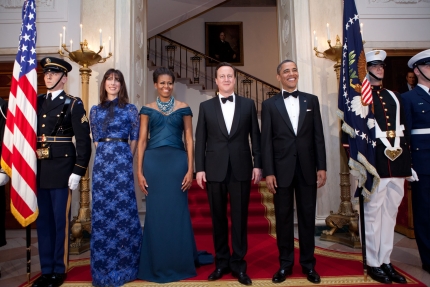
President Obama, the First Lady, Prime Minister Cameron, and Samantha Cameron pose for an official State Dinner photo (March 14, 2012)

President Barack Obama and First Lady Michelle Obama pose with Prime Minister David Cameron of the United Kingdom and Mrs. Samantha Cameron for an official State Dinner photo in the Grand Foyer of the White House, March 14, 2012. (Official White House Photo by Sonya N. Hebert)

Technically, Prime Minister Cameron's trip to the United States is an official visit -- not a state visit. State visits are reserved for the head of state, and in the case of the United Kingdom, that means the Queen. But last night, the Prime Minister and his wife Samantha Cameron were honored with a State Dinner all the same.

They were joined by dignitaries from both countries -- including Warren and Susan Buffet, Sir Jony Ive (the Apple designer), Hugh Bonnerville (the Earl of Grantham in Downton Abbey), and George Clooney.

Before raising his glass for a toast, President Obama spoke again on the nature of the values our two countries share:

In war and in peace, in times of plenty and times of hardship, we stand tall and proud and strong, together. And as free peoples committed to the dignity of all human beings, we will never apologize for our way of life, nor waver in its defense.

It’s why David’s grandfather fought alongside us Yanks after D-Day; why my grandfather marched across Europe in Patton’s army. It’s why tonight, at dusty bases in Afghanistan, both American and British soldiers are getting ready to go on patrol, like generations before them, shoulder to shoulder. It’s why our diplomats and development workers are side by side, standing with the activists who dare to demand their rights, save a child from drought or famine.

Read the full set of remarks from both leaders here. Or check out a slideshow of images throughout the visit below.

President Obama Speaks on American Energy

March 15, 2012 | 31:58 | Public Domain

President Obama speaks about an all-of-the-above strategy for the 21st century that develops every source of American-made energy – not just oil and gas, but wind power and solar power and biofuels – while building more fuel-efficient cars and trucks that get more miles to the gallon and investing in other technologies that help us use less energy altogether.

Download mp4 (1126MB) | mp3 (73MB)

The White House

Office of the Press Secretary

Obama Administration Establishes White House Council on Strong Cities, Strong Communities

WASHINGTON, DC – Today, President Obama signed an Executive Order that will establish the White House Council on Strong Cities, Strong Communities (SC2). The Council will build on the SC2 pilot initiative launched June 2011 aimed at creating new partnerships between federal agencies and localities to spark economic development in communities that have faced significant long-term challenges in developing and implementing their economic strategies. Attached is the Executive Order signed by the President today on SC2.

Based at the Department of Housing and Urban Development, the interagency Council will include 19 federal agencies and will coordinate the implementation of SC2 and build a foundation for expanding the program to cities across the country. Currently, dozens of federal agency staff work closely with six cities – Chester, PA; Cleveland/Youngstown, OH; Detroit, MI; Fresno, CA; Memphis, TN; and New Orleans, LA.

“Strong Cities, Strong Communities is a remarkable initiative, one that takes innovation, a determination to cut-through the red-tape and ensure taxpayer dollars are used wisely. The early successes of SC2 is clearly worth setting a foundation to sustain this model of partnership,” said Cecilia Munoz, Director of the Domestic Policy Council. “The Strong Cities Council will support bottom-up solutions that break down silos within federal and local governments, and will urge the private and nonprofit sectors to come up with innovate strategies to solve challenging issues.”

The Council will recommend policies to the President for building local expertise in strengthening local economies and changing Federal policies and programs to address issues to strengthen local capacity and spur economic growth.

In addition, to mark the six-month anniversary that SC2’s teams have been on the ground in the pilot cities, stakeholders – from mayors to philanthropic leaders to federal agency staff--gathered at the White House to discuss the pilot’s progress.

“The Strong Cities, Strong Communities initiative is making a real impact as Fresno moves forward on our economic development and community revitalization vision” said  Fresno Mayor Ashley Swearengin. “The SC2 team has been a terrific partner in contributing to the development of ‘ground-up’ solutions tailored to our needs, refining lasting partnerships with key local and regional stakeholders, and working to remove roadblocks accompanying federal programs that directly affect our city.”

"With the amount of federal investment hitting the streets of our city, Strong Cities, Strong Communities provides the type of interagency cooperation, coordination and expertise that is vital to making the most of existing resources,” said New Orleans Mayor Mitch Landrieu. “President Obama's commitment to New Orleans has been a critical part of our recovery, and SC2 is helping to revitalize our economy and improve the quality of life for our residents."      

SC2 pilot cities were selected on the basis of economic need, strong local leadership and collaboration, potential for economic growth, geographic diversity, and the ability to test the SC2 model across a range of environments.  Federal assessment teams spent time on the ground working directly with mayors and other local officials to determine needs, opportunities and gather input for the pilot initiative.

The White House

Office of the Press Secretary

Executive Order -- Establishing a White House Council on Strong Cities, Strong Communities

EXECUTIVE ORDER

ESTABLISHING A WHITE HOUSE COUNCIL ON STRONG CITIES, STRONG COMMUNITIES

By the authority vested in me as President by the Constitution and the laws of the United States of America, and in order to forge a partnership with local communities to provide them with comprehensive technical assistance to use and compete for Federal resources more effectively and efficiently, which will enable them to develop and implement economic strategies to become more competitive, sustainable, and inclusive, it is hereby ordered as follows:

Section 1Policy.  Cities, towns, and regions across our Nation continue to face difficult economic challenges.  Enhancing current Federal assistance is helping to lift communities out of distress.  To allow the Federal Government to better partner with these local communities to build local capacity to address economic issues, and to support comprehensive planning and regional collaboration, my Administration established the Strong Cities, Strong Communities (SC2) pilot initiative.  By partnering with cities and regions to augment their vision for stability and economic growth, the SC2 was designed to help communities strengthen their capacity to create jobs and more competitive business climates, and implement locally driven community and regional planning approaches that lead to sustained economic growth, as well as ensure that Federal assistance is more efficiently provided and used.

This order improves the way the Federal Government engages with and supports local communities by better aligning resources and coordinating efforts across executive departments and agencies (agencies) so that communities across the country have access to comprehensive, localized technical assistance and planning resources to develop and implement their economic vision and strategies.

Sec. 2White House Council on Strong Cities, Strong Communities.  There is established a White House Council on Strong Cities, Strong Communities (Council) within the Department of Housing and Urban Development, to be chaired by the Secretary of Housing and Urban Development and the Assistant to the President for Domestic Policy (Co-Chairs).

(a)  Membership.  In addition to the Co-Chairs, the Council shall consist of the following members:

(i)      the Secretary of the Treasury;

(ii)     the Secretary of Defense;

(iii)    the Attorney General;

(iv)     the Secretary of the Interior;

(v)      the Secretary of Agriculture;

(vi)     the Secretary of Commerce;

(vii)    the Secretary of Labor;

(viii)   the Secretary of Health and Human Services;

(ix)     the Secretary of Transportation;

(x)      the Secretary of Energy;

(xi)     the Secretary of Education;

(xii)    the Secretary of Veterans Affairs;

(xiii)   the Secretary of Homeland Security;

(xiv)    the Chair of the Council of Economic Advisers;

(xv)     the Administrator of the Environmental Protection Agency;

(xvi)    the Director of the Office of Management and Budget;

(xvii)   the Administrator of General Services;

(xviii)  the Administrator of the Small Business Administration;

(xix)    the Chief Executive Officer of the Corporation for National and Community Service;

(xx)     the Chairperson of the National Endowment for the Arts;

(xxi)    the Senior Advisor and Assistant to the President for Intergovernmental Affairs and Public Engagement;

(xxii)   the Assistant to the President and Cabinet Secretary;

(xxiii)  the Assistant to the President for Economic Policy;

(xxiv)   the Chair of the Council on Environmental Quality;

(xxv)    the Director of the Office of Science and Technology Policy; and

(xxvi)   the heads of such other agencies and offices as the President may, from time to time, designate.
 

A member of the Council may designate, to perform the Council functions of the member, a senior level official who is a part of the member's agency or office, and who is a full time officer or employee of the Federal Government.

(b)  Administration.  The Co Chairs shall convene regular meetings of the Council, determine its agenda, and direct its work.  The Secretary of Housing and Urban Development shall appoint an Executive Director of the Council to coordinate the Council's activities.  At the direction of the Co Chairs, the Council may establish subgroups consisting exclusively of Council members or their designees, as appropriate.  Agencies may detail staff to the Council to support its coordination and implementation efforts.

Sec. 3Mission and Function of the Council.  The Council shall, to the extent permitted by law, work across agencies and offices to:

(a)  coordinate the development and implementation of the various components of the SC2, as determined by the Co Chairs;

(b)  coordinate agency efforts to ensure communities have access to comprehensive, localized technical assistance and planning resources to develop and execute their economic vision and strategies (including, where appropriate, efforts of existing committees or task forces related to providing technical assistance to local governments and improving their capacity to address economic issues);

(c)  ensure that members of the Council incorporate SC2 implementation efforts into their agency annual performance plans and those efforts' outcomes into their annual performance results;

(d)  provide recommendations to the President, through the Co Chairs on:

(i)    policies for building local expertise in strengthening local economies;

(ii)   changes to Federal policies and programs to address issues of special importance to cities and local governments that pertain to local capacity and economic growth;

(iii)  implementing best practices from the SC2 initiative Government-wide to better support cities and local governments; and

(iv)   opportunities to increase the flexible utilization of existing Federal program resources across agencies to enable more performance and outcome-based funding;

(e)  encourage the development of technical assistance, planning, and financing tools and implementation strategies that can be coordinated or aligned across agencies to assist communities in building local capacity to address economic issues, engaging in comprehensive planning, and advancing regional collaboration; and

(f)  facilitate the exchange of ideas and strategies to help communities address economic challenges and create sustained economic opportunity.

Sec. 4Outreach.  Consistent with the objectives set forth in this order, the Council, in accordance with applicable law, shall conduct outreach to representatives of nonprofit organizations, businesses, labor organizations, State and local government agencies, school districts, elected officials, faith and other community based organizations, philanthropies, other institutions of local importance, and other interested persons with relevant expertise in the expansion and improvement of efforts to build local capacity to address economic issues in cities and communities.  The Council will convene an annual meeting of interested parties    including mayors and city employees    to share key findings and progress, offer best practices, and promote strategies that have worked in communities participating in the initiative.

Sec. 5Reports.  Within 1 year of the date of this order, and annually thereafter, the Executive Director shall provide a report to the Co Chairs on the work of the Council and its achievements during the year, including demonstrable changes in the capacity of local communities to implement their economic development goals and efforts to achieve more efficient and effective use of Federal resources.

Sec. 6General Provisions.  (a)  The heads of agencies shall assist and provide information to the Council, consistent with applicable law, as may be necessary to implement this order.  Each agency shall bear its own expense for participating in the Council.

(b)  Nothing in this order shall be construed to impair or otherwise affect:

(i)   the authority granted by law to an executive department, agency, or the head thereof; or

(ii)  the functions of the Director of the Office of Management and Budget relating to budgetary, administrative, or legislative proposals.

(c)  This order shall be implemented consistent with applicable law and subject to the availability of appropriations.

(d)  This order is not intended to, and does not, create any right or benefit, substantive or procedural, enforceable at law or in equity by any party against the United States, its departments, agencies, or entities, its officers, employees, or agents, or any other person.

BARACK OBAMA

THE WHITE HOUSE,
         March 15, 2012.

The White House

Office of the Press Secretary

Statement by the President on the Meeting of the Interagency Task Force to Monitor and Combat Trafficking in Persons

Nearly one hundred and fifty years ago, in issuing the Emancipation Proclamation, President Abraham Lincoln reaffirmed the commitment of the United States to the enduring cause of freedom.  Then as now, we remain steadfast in our resolve to see that all men, women, and children have the opportunity to realize this greatest of gifts.  Yet millions around the world—including here in the United States—toil under the boot of modern slavery.  Mothers and fathers are forced to work in fields and factories against their will or in service to debts that can never be repaid.  Sons and daughters are sold for sex, abducted as child soldiers, or coerced into involuntary labor.  In dark corners of our world, and hidden in plain sight in our own communities, human beings are exploited for financial gain and subjected to unspeakable cruelty.  

Slavery remains the affront to human dignity and stain on our collective conscience that it has always been.   That is why members of my cabinet and senior advisors gathered at the White House today, at a meeting chaired by Secretary of State Hillary Clinton, to lay out their plans for meeting this challenge. The United States is committed to eradicating trafficking in persons, and we will draw on tools ranging from law enforcement and victim service provision, to public awareness building and diplomatic pressure.  Because we know that government efforts are not enough, we are also increasing our partnerships with a broad coalition of local communities, faith-based and non-governmental organizations, schools, and businesses.

To bring all these elements together, and to be sure we are maximizing our efforts, today I am directing my cabinet to find ways to strengthen our current work, and to expand on partnerships with civil society and the private sector, so that we can bring more resources to bear in fighting this horrific injustice.  In the coming weeks the White House will build on this gathering on behalf of human dignity.  I am confident that we will one day end the scourge of modern slavery, because I believe in those committed to this issue: young people, people of faith and station, Americans who refuse to accept this injustice and will not rest until it is vanquished. Today, I reaffirm that the United States stands with them, and that together we will realize the promise of the Emancipation Proclamation and our country’s ideal of freedom.

State Dinner for Prime Minister Cameron

March 14, 2012 | 17:18 | Public Domain

President Obama exchanges toasts with Prime Minister Cameron during a state dinner on the South Lawn.

Download mp4 (610MB) | mp3 (40MB)

The White House

Office of the Press Secretary

Remarks by President Obama and Prime Minister Cameron of the United Kingdom in an Exchange of Toasts at State Dinner

South Grounds Tent

9:01 P.M. EDT

PRESIDENT OBAMA:  Good evening, everyone.  Please have a seat.  Welcome to the White House.  I was just telling the Prime Minister that, so far, the evening has been successful because I have not stepped on Michelle's train.  (Laughter.)  My main goal this evening.  Michelle and I could not be more honored that you could join us as we host our great friends -- the Prime Minister of the United Kingdom, David Cameron, and his remarkable wife, Samantha.  You can give them a round of applause -- why not?  (Applause.)

As I said this morning, this visit also gives us an opportunity to return the gracious hospitality that Her Majesty Queen Elizabeth, as well as David and Samantha and all the British people showed us during our visit to London last year.  And I know Michelle looks forward to returning.  Because, as she announced yesterday, she will be leading the U.S. delegation to the opening ceremonies of the Summer Olympics in London.  (Applause.)  I am jealous.  (Laughter.)

Now, I’m so grateful for all the time that David and I have had together.  But as we’ve learned, you can never tell how things will get reported as a consequence of our interactions.  When we met two years ago, we exchanged beers from our hometowns.  One news story said:  “David Cameron and Barack Obama cemented their special relationship -- by hitting the bottle.”  (Laughter.)

When we had a barbeque at Downing Street for some of our servicemembers, David and I rolled up our sleeves, threw away the aprons, decided to flip the burgers ourselves.  One reporter called it a “brave and foolish move.”  (Laughter.)  Another expressed amazement at our “surprising competence.”  (Laughter.)  Michelle and Samantha often remark the same way.  (Laughter.)

And finally, when David and I got beat pretty badly in table tennis by some local London kids, one newspaper asked the head coach of the British Olympic women’s team to critique our performance.  Obama, the coach said, “talked a lot.”  (Laughter.)  David “overhits the ball.”  (Laughter.)  Both of them -- I’m quoting here --“looked a little confused.”  (Laughter.)

But in moments like that, and in all of our interactions -- including today -- I’ve learned something about David.  In good times and in bad, he’s just the kind of partner that you want at your side.  I trust him.  He says what he does, and he does what he says.  And I’ve seen his character.  And I’ve seen his commitment to human dignity, during Libya.  I’ve seen his resolve, his determination to get the job done, whether it’s righting our economies or succeeding in Afghanistan.

And I will say something else, David.  All of us have seen how you, as a parent, along with Samantha, have shown a measure of strength that few of us will ever know.  Tonight, I thank you for bringing that same strength and solidarity to our partnership -- even if you do overhit the ball.  (Laughter.)

We are by no means the first President and Prime Minister to celebrate the deep and abiding bonds between our people.  There has been no shortage of words uttered about our special relationship.  And I was humbled to offer my own last year when I had the opportunity to address Parliament in Westminster Hall.

So, rather than words, I’d like to leave you tonight with two simple images.  They’re from different times and places, decades apart.  But they’re moments, I think, that reveal the spirit of our alliance and the character of our countries. 

The first is from the Blitz, when, month after month, the British people braved the onslaught from the sky.  And one of those most enduring images from those days is of the London skyline, covered in smoke, with one thing shining through -- the dome of St. Paul’s Cathedral, tall and proud and strong.  The other image we know from our own lives -- from that awful September day, that unforgettable picture of the Manhattan skyline, covered in smoke and dust, with one thing shining through -- our Statue of Liberty, tall and proud and strong.

In those two moments I think you see all you need to know about who we are and what brings us together tonight.  In war and in peace, in times of plenty and times of hardship, we stand tall and proud and strong, together.  And as free peoples committed to the dignity of all human beings, we will never apologize for our way of life, nor waver in its defense. 

It’s why David’s grandfather fought alongside us Yanks after D-Day; why my grandfather marched across Europe in Patton’s army.  It’s why tonight, at dusty bases in Afghanistan, both American and British soldiers are getting ready to go on patrol, like generations before them, shoulder to shoulder.  It’s why our diplomats and development workers are side by side, standing with the activists who dare to demand their rights, save a child from drought or famine. 

It’s why leaders of our two countries can embrace the same shared heritage and the promise of our alliance -- even if we come from different political traditions; even if the Prime Minister is younger than nearly 200 years of his predecessors; even if the President looks a little different than his predecessors.  And David, it’s why, tonight, our young children -- and children across our countries -- can sleep well, knowing that we’re doing everything in our power to build a future that is worthy of their dreams.

So, in closing, let me just say that I intended to make history tonight.  I thought that I could be the first American President to make it through an entire visit of our British friends without quoting Winston Churchill.  (Laughter.)  But then I saw this great quote and I thought, “Come on, this is Churchill!”  (Laughter.)  So I couldn’t resist.

It was December 1941, and the attack on Pearl Harbor had finally thrust America into war, alongside our British friends.  And these were the words Sir Winston spoke to his new American partners:  “I will say that he must indeed have a blind soul who cannot see that some great purpose and design is being worked out here below, of which we have the honor to be the faithful servants.”

And so I'd like to propose a toast:  To Her Majesty the Queen, on her Diamond Jubilee; to our dear friends, David and Samantha; and to the great purpose and design of our alliance.  May we remain, now and always, its faithful servants.  Cheers, everyone.

(A toast is offered.)

David.  (Applause.)

PRIME MINISTER CAMERON:  President Obama, First Lady, ladies and gentlemen:  It is a tremendous honor to be here this evening. And I want to thank you for putting on such a great dinner, and for making our visit so special over the last two days.  And thank you also for those strong and beautiful words that you've just spoken.

Now, Michelle, I'm sure that, like Sam, you often wonder what happens when your husband goes for a night out with the guys.  (Laughter.)  So maybe I should come clean about last night.  (Laughter.)  We went to basketball and we had a real man-to-man chat.  Barack tried to confuse me by talking about bracketology -- (laughter) -- but I got my own back by running him gently through the rules of cricket.  (Laughter.)

The truth is we have to have a guys' night out because so often we find we are completely overshadowed by our beautiful wives.  (Applause.) 

As I rolled into bed last night, I said, "Samantha, do you want to hear about what I got up to on this great guys' night out?"  And she -- she's not too impressed by these things.  She said, "Well, everything you did was on television.  You were surrounded by the presidential bodyguard, so presumably you didn’t get up to anything."  (Laughter.) 

Now, both Barack and I have said a lot today about the importance of the relationship between our two countries and our peoples.  Like my predecessors, I'm proud of our essential relationship and of Britain's strong national bond with the United States of America.  I feel it in my bones. 

Now, there is, of course a great history of close relationships between U.S. Presidents and British Prime Ministers.  Importantly, these have been regardless of the political parties they happen to represent.  Her Majesty the Queen is a great authority on the matter.  She has seen -- and she likes to tell me this -- no fewer than 12 British Prime Ministers and 11 American Presidents during her time on the throne.  But I'm sure everyone here would want to pay tribute to her incredible service and selfless duty in this, her special Diamond Jubilee year.  (Applause.) 

Now, Her Majesty's first Prime Minister was, of course, Winston Churchill, a regular guest here at the White House.  I'm not going to quote from Churchill, I'm going to quote about Churchill -- because it seems his visits were not always the easiest experience for his American hosts.

As Roosevelt's secretary wrote after one visit:  "Churchill is a trying guest.  He drinks like a fish.  He smokes like a chimney.  He has irregular routines, works nights, sleeps days, and turns the clocks upside down."  And for those of you who wonder why the British Prime Minister now stays at Blair House rather than the White House -- (laughter) -- I simply observe this.  We all know the story of Winston Churchill famously found naked in his bath by President Roosevelt.  This happened while he stayed at the White House in December 1941, and the federal government bought Blair House in 1942.  (Laughter.)

Now, for every genuine presidential-prime ministerial friendship, there have been some -- I think we could call them --total disconnects.  Edward Heath and Richard Nixon took personal awkwardness with each other to new and excruciating levels.  (Laughter.)  And yet, despite this, Richard Nixon arranged for someone to pay for the swimming pool at the Prime Minister's country residence of Chequers.  Incidentally, this swimming pool now has a serious and possibly terminal leak.  (Laughter.)

So I hope you won't find it amiss as I say here in the White House, for the first time in 40 years, these words:  It is time to call in the plumbers.  (Laughter.)

Now, turning to Obama-Cameron.  As fellow parents, Barack and Michelle have both been personally very kind to Sam and me.  And as fellow leaders, we've struck up, I believe, a really good partnership.  It is frank and honest.  We talk through issues very rationally.  We don't need to remind each other of the basic threats that we face; we know them.  But there are three things about Barack that really stand out for me:  strength, moral authority, and wisdom.

Strength, because Barack has been strong when required to defend his national interests.  Under President Obama's leadership, America got bin Laden.  (Applause.)  And together with British and coalition forces, America has fundamentally weakened al Qaeda.  The President says what he will do and he sticks to it.

I'll never forget that phone call on Libya, when he told me exactly what role America would play in Libya, and he delivered his side of the bargain to the letter.  We delivered our side of the bargain, too.  And let us all agree that the world is better off without bin Laden, but the world is better off without Qaddafi, too.  (Applause.) 

Moral authority, because Barack understands that the means matter every bit as much as the ends.  Yes, America must do the right thing, but to provide moral leadership, America must do it in the right way, too.  The first President I studied at school was Theodore Roosevelt.  He talked of speaking softly and carrying a big stick.  That is Barack's approach.  And in following it, he has pressed the reset button on the moral authority of the entire free world.

Wisdom, because Barack has not rushed into picking fights, but is steward of America's resources of hard and soft power.  He's taken time to make considered decisions, drawing down troops from Iraq and surging in Afghanistan.  He's found a new voice for America with the Arab people.  And at home, he's recognized that in America, as in Britain, the future depends on making the best of every citizen.  Both our nations have historically been held back by inequality.  But now there's a determined effort in both our countries -- most notably through education reform -- to ensure that opportunity is truly available for all. 

Half a century ago, the amazing courage of Rosa Parks, the visionary leadership of Martin Luther King, and the inspirational actions of the civil rights movement led politicians to write equality into the law and make real the promise of America for all her citizens.  But in the fight for justice and the struggle for freedom, there is no end, because there is so much more to do to ensure that every human being can fulfill their potential. 

That is why our generation faces a new civil rights struggle, to seek the prize of the future that is open to every child as never before. 

Barack has made this one of the goals of his presidency, the goal he's pursuing with enormous courage.  And it is fitting that a man whose own personal journey defines the promise and potential of this unique nation should be working to fulfill the hopes of his country in this way.

Barack, it is an honor to call you an ally, a partner, and a friend.  You don't get to choose the circumstances you have to deal with as a President or a Prime Minister.  And you don't get to choose the leaders that you have to work with.  But all I can say is that it is a pleasure to work with someone with moral strength, with clear reason, and with fundamental decency in this task of renewing our great national alliance for today and for the generations to follow.

And with that, I propose a toast:  To the President, to the First Lady, and to the people of the United States of America.  Cheers.

(A toast is offered.)  (Applause.)

END
9:19 P.M. EDT

The White House

Office of the Press Secretary

Readout of the President's Call with President Lee of Korea

The President spoke by phone this afternoon with Korean President Lee Myung-bak of Korea to welcome the entry into force of the U.S.-Korea Free Trade Agreement (KORUS) at midnight on March 15 in both countries.  The President noted that the agreement will begin boosting exports and creating jobs and growth immediately. The President thanked President Lee for Korea’s close cooperation in getting the agreement implemented, and noted this is a strong example of the accomplishments achieved in the U.S.-Korea partnership.  The two countries have made great strides in modernizing our alliance to promote security in the region and in promoting economic growth and trade in the Asia-Pacific.  The President also said he is looking forward to his upcoming March 25-27 trip to Korea and anticipates a successful Nuclear Security Summit.