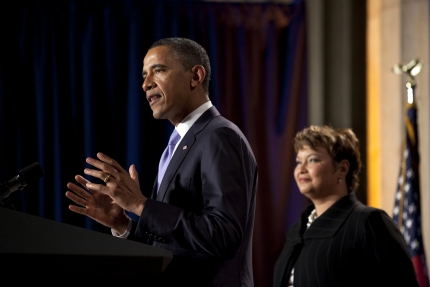
President Obama Visits the EPA

Read the Transcript  |  Download Video: mp4 (113MB) | mp3 (11MB)

President Obama earlier today stopped by the Environmental Protection Agency for his first ever visit. He made the trip to express his appreciation for the vital work done by the staff.

In a meeting with the staff, he said:

I want to say thank you to each and every one of you, because the EPA touches on the lives of every single American every single day. You help make sure that the air we breathe, the water we drink, the foods we eat are safe. You protect the environment not just for our children but their children. And you keep us moving towards energy independence.

And it is a vital mission. Over the past three years, because of your hard work, we’ve made historic progress on all these fronts.

The President pledged to stand by the EPA in its work:

Our environment is safer because of you. Our country is stronger because of you.  Our future is brighter because of you. And I want you to know that you’ve got a President who is grateful for your work and will stand with you every inch of the way as you carry out your mission to make sure that we’ve got a cleaner world.

President Barack Obama thanks the EPA staff

President Barack Obama delivers remarks to employees of the Environmental Protection Agency at the Andrew W. Mellon Auditorium, Washington, D.C., Jan. 10, 2012. EPA Administrator Lisa Jackson stands at right. (Official White House Photo by Pete Souza)

Read the full remarks here.

Related Topics: Energy and Environment

President Obama Speaks to Environmental Protection Agency Staff

January 10, 2012 | 11:49 | Public Domain

President Obama thanks the staff of the Environmental Protection Agency for the work they do, which touches on the lives of every American, from the food we eat, to the water we drink, to the air we breathe.

Download mp4 (113MB) | mp3 (11MB)

Read the Transcript

Remarks by the President to EPA staff

Andrew W. Mellon Auditorium
Washington, D.C.

2:51 P.M. EST

THE PRESIDENT:  Thank you!  Thank you, EPA!  (Applause.)  Thank you, everybody.  Thank you so much.  It is wonderful to see you.  It is great to see you.  Thank you, thank you. 

Now, everybody can have a seat.  I know Lisa is making you guys all stand up.  (Laughter.)  But you can all relax.

It is wonderful to be here with all of you.  Thank you so much for all the great work you do.  I want to first acknowledge your outstanding Administrator, Lisa Jackson.  (Applause.)  She has done an extraordinary job leading this agency.  But here’s what I want all of you to know:  Not only is she good on policy, not only is she tough and able to present the EPA’s mission so effectively to the public, but she also has your back.  (Applause.)  She is an advocate on behalf of all the people who work so hard here at the EPA.  And so you should know that your boss loves you, even if she doesn’t always show it, I don’t know.  (Laughter.)

The main reason I’m here is simple:  I just want to say thank you.  I want to say thank you to each and every one of you, because the EPA touches on the lives of every single American every single day.  You help make sure that the air we breathe, the water we drink, the foods we eat are safe.  You protect the environment not just for our children but their children.  And you keep us moving towards energy independence. 

And it is a vital mission.  Over the past three years, because of your hard work, we’ve made historic progress on all these fronts.  Just a few weeks ago, thanks to the hard work of so many of you, Lisa and I was able to announce new common-sense standards to better protect the air we breathe from mercury and other harmful air pollution.  And that was a big deal.  (Applause.)  And part of the reason it was a big deal was because, for over 20 years, special interest groups had successfully delayed implementing these standards when it came to our nation’s power plants.  And what we said was:  “Enough.”  It’s time to get this done.  

And because we acted, we’re going to prevent thousands of premature deaths, thousands of heart attacks and cases of childhood asthma.

There are families that are going to be directly impacted in a positive way because of the work that you do.  Because you kept fighting -- and some of you have been fighting this fight for a long time, long before I was here and long before Lisa was here.  And so your tenacity and stick-to-itness is making a difference. 

Because of you, across the board, we’re cutting down on acid rain and air pollution.  We’re making our drinking water cleaner and safer.  We’re creating healthier communities.  But that’s not all.  Safeguarding our environment is also about strengthening our economy.  I do not buy the notion that we have to make a choice between having clean air and clean water and growing this economy in a robust way.  I think that is a false debate.  (Applause.)

Think about it:  We established new fuel economy standards, a historic accomplishment that is going to slash oil consumption by about 12 billion barrels, dramatically reduces pollution that contributes to climate change, and saves consumers thousands of dollars at the pump, which they can then go spend on something else.

As part of the Recovery Act, you cleaned up contaminated sites across the country, which helped to rid neighborhoods of environmental blight while putting Americans back to work.

We don’t have to choose between dirty air and dirty water or a growing economy.  We can make sure that we are doing right by our environment and, in fact, putting people back to work all across America.  That’s part of our mission.

When we put in place new common-sense rules to reduce air pollution, we create new jobs building and installing all sorts of pollution-control technology.  When we put in place new emissions standards for our vehicles, we make sure that the cars of tomorrow are going to be built right here in the United States of America, that we’re going to win that race.

When we clean up our nation’s waterways, we generate more tourists for our local communities.  So what’s good for the environment can also be good for our economy. 

Now, that doesn’t mean that there aren’t going to be some tensions.  That doesn’t mean that there aren’t going to be legitimate debates that take place.  That doesn’t mean that it’s not important for every single one of us to think about how can we make sure that we are achieving our goals in the smartest way possible, in the most efficient ways possible, in the least bureaucratic ways possible, in the clearest ways possible.  That’s also part of our mission.

There’s not a federal agency that can’t get better and be smarter in accomplishing our mission, and we have an obligation every single day to think about how can we do our business a little bit better.  How can we make sure the taxpayers are getting every dime’s worth that they’re paying in order to achieve these important common goals that we have? 

But I believe we can do it, and you’ve shown me that we can do it over these last three years.  So I could not be prouder of the work that you all do every single day as federal employees.  I know the hours can be long.  I know that sometimes spending time getting these policies right means less time at home than you’d like, and you’re missing birthday parties, or you’re missing a soccer game, and the spouse is not happy with you.  I know a little bit about that sometimes.  (Laughter.)  I know these jobs are demanding.

But I also know what compelled you to enter public service in the first place -- and that’s the idea that you could make a difference; that you could leave behind a planet that is a little cleaner, a little safer than the one we inherited.

And I have to tell you that part of why I get excited when I see some of the work that you’re doing is because our next generation is so much more attuned to these issues than I was when I was growing up.  I can tell you when I sit down and I talk to my kids, probably the area where they have the most sophisticated understanding of policy is when it comes to the environment.  They understand that the decisions we make now are going to have an impact on their lives for many years to come.  And their instincts are right.  So your mission is vital. 

And just think of what this agency has been able to do over the last four decades.  There’s so many things we now take for granted.  When I hear folks grumbling about environmental policy, you almost want to do a Back to the Future -- (laughter) -- kind of reminder of folks of what happens when we didn’t have a strong EPA.  The year before President Nixon created the EPA, the Cuyahoga River was so dirty from industrial pollution and oil slicks that it literally caught on fire.  In my hometown, the Chicago River -- you probably could not find anything alive in there -- (laughter) -- four decades ago.  Now it’s thriving -- to the benefit of the city.  Today, because of your work, 92 percent of Americans have access to clean water that meets our national health standards.

Before the EPA was created, our cars were spewing harmful lead pollution into the air, with all sorts of impacts, especially on children.  Today, because of your work, air pollution is down by more than half, and lead pollution is down more than 90 percent from a generation ago.

So all of you, and all of those who served before you, have made a difference.  Our environment is safer because of you.  Our country is stronger because of you.  Our future is brighter because of you.  And I want you to know that you’ve got a President who is grateful for your work and will stand with you every inch of the way as you carry out your mission to make sure that we’ve got a cleaner world.  (Applause.)

So, thank you.  God bless you.  God bless the United States of America.  Thank you.  (Applause.)

END 
3:02 P.M. EST

Close Transcript

The White House

Office of the Press Secretary

Readout of the President's Meeting with Saudi Foreign Minister Prince Saud Al-Faisal

President Obama met with Saudi Arabia’s Minister of Foreign Affairs, Prince Saud Al-Faisal today in the Oval Office.  The President and Prince Saud affirmed the strong partnership between the United States and Saudi Arabia and discussed recent developments on key regional issues of mutual interest.  The President asked Prince Saud to convey his best wishes to King Abdullah bin Abd Al-Aziz Al Saud.
 

The White House

Office of the Press Secretary

Remarks by the President to EPA staff

Andrew W. Mellon Auditorium
Washington, D.C.

2:51 P.M. EST

THE PRESIDENT:  Thank you!  Thank you, EPA!  (Applause.)  Thank you, everybody.  Thank you so much.  It is wonderful to see you.  It is great to see you.  Thank you, thank you. 

Now, everybody can have a seat.  I know Lisa is making you guys all stand up.  (Laughter.)  But you can all relax.

It is wonderful to be here with all of you.  Thank you so much for all the great work you do.  I want to first acknowledge your outstanding Administrator, Lisa Jackson.  (Applause.)  She has done an extraordinary job leading this agency.  But here’s what I want all of you to know:  Not only is she good on policy, not only is she tough and able to present the EPA’s mission so effectively to the public, but she also has your back.  (Applause.)  She is an advocate on behalf of all the people who work so hard here at the EPA.  And so you should know that your boss loves you, even if she doesn’t always show it, I don’t know.  (Laughter.)

The main reason I’m here is simple:  I just want to say thank you.  I want to say thank you to each and every one of you, because the EPA touches on the lives of every single American every single day.  You help make sure that the air we breathe, the water we drink, the foods we eat are safe.  You protect the environment not just for our children but their children.  And you keep us moving towards energy independence. 

And it is a vital mission.  Over the past three years, because of your hard work, we’ve made historic progress on all these fronts.  Just a few weeks ago, thanks to the hard work of so many of you, Lisa and I was able to announce new common-sense standards to better protect the air we breathe from mercury and other harmful air pollution.  And that was a big deal.  (Applause.)  And part of the reason it was a big deal was because, for over 20 years, special interest groups had successfully delayed implementing these standards when it came to our nation’s power plants.  And what we said was:  “Enough.”  It’s time to get this done.  

And because we acted, we’re going to prevent thousands of premature deaths, thousands of heart attacks and cases of childhood asthma.

There are families that are going to be directly impacted in a positive way because of the work that you do.  Because you kept fighting -- and some of you have been fighting this fight for a long time, long before I was here and long before Lisa was here.  And so your tenacity and stick-to-itness is making a difference. 

Because of you, across the board, we’re cutting down on acid rain and air pollution.  We’re making our drinking water cleaner and safer.  We’re creating healthier communities.  But that’s not all.  Safeguarding our environment is also about strengthening our economy.  I do not buy the notion that we have to make a choice between having clean air and clean water and growing this economy in a robust way.  I think that is a false debate.  (Applause.)

Think about it:  We established new fuel economy standards, a historic accomplishment that is going to slash oil consumption by about 12 billion barrels, dramatically reduces pollution that contributes to climate change, and saves consumers thousands of dollars at the pump, which they can then go spend on something else.

As part of the Recovery Act, you cleaned up contaminated sites across the country, which helped to rid neighborhoods of environmental blight while putting Americans back to work.

We don’t have to choose between dirty air and dirty water or a growing economy.  We can make sure that we are doing right by our environment and, in fact, putting people back to work all across America.  That’s part of our mission.

When we put in place new common-sense rules to reduce air pollution, we create new jobs building and installing all sorts of pollution-control technology.  When we put in place new emissions standards for our vehicles, we make sure that the cars of tomorrow are going to be built right here in the United States of America, that we’re going to win that race.

When we clean up our nation’s waterways, we generate more tourists for our local communities.  So what’s good for the environment can also be good for our economy. 

Now, that doesn’t mean that there aren’t going to be some tensions.  That doesn’t mean that there aren’t going to be legitimate debates that take place.  That doesn’t mean that it’s not important for every single one of us to think about how can we make sure that we are achieving our goals in the smartest way possible, in the most efficient ways possible, in the least bureaucratic ways possible, in the clearest ways possible.  That’s also part of our mission.

There’s not a federal agency that can’t get better and be smarter in accomplishing our mission, and we have an obligation every single day to think about how can we do our business a little bit better.  How can we make sure the taxpayers are getting every dime’s worth that they’re paying in order to achieve these important common goals that we have? 

But I believe we can do it, and you’ve shown me that we can do it over these last three years.  So I could not be prouder of the work that you all do every single day as federal employees.  I know the hours can be long.  I know that sometimes spending time getting these policies right means less time at home than you’d like, and you’re missing birthday parties, or you’re missing a soccer game, and the spouse is not happy with you.  I know a little bit about that sometimes.  (Laughter.)  I know these jobs are demanding.

But I also know what compelled you to enter public service in the first place -- and that’s the idea that you could make a difference; that you could leave behind a planet that is a little cleaner, a little safer than the one we inherited.

And I have to tell you that part of why I get excited when I see some of the work that you’re doing is because our next generation is so much more attuned to these issues than I was when I was growing up.  I can tell you when I sit down and I talk to my kids, probably the area where they have the most sophisticated understanding of policy is when it comes to the environment.  They understand that the decisions we make now are going to have an impact on their lives for many years to come.  And their instincts are right.  So your mission is vital. 

And just think of what this agency has been able to do over the last four decades.  There’s so many things we now take for granted.  When I hear folks grumbling about environmental policy, you almost want to do a Back to the Future -- (laughter) -- kind of reminder of folks of what happens when we didn’t have a strong EPA.  The year before President Nixon created the EPA, the Cuyahoga River was so dirty from industrial pollution and oil slicks that it literally caught on fire.  In my hometown, the Chicago River -- you probably could not find anything alive in there -- (laughter) -- four decades ago.  Now it’s thriving -- to the benefit of the city.  Today, because of your work, 92 percent of Americans have access to clean water that meets our national health standards.

Before the EPA was created, our cars were spewing harmful lead pollution into the air, with all sorts of impacts, especially on children.  Today, because of your work, air pollution is down by more than half, and lead pollution is down more than 90 percent from a generation ago.

So all of you, and all of those who served before you, have made a difference.  Our environment is safer because of you.  Our country is stronger because of you.  Our future is brighter because of you.  And I want you to know that you’ve got a President who is grateful for your work and will stand with you every inch of the way as you carry out your mission to make sure that we’ve got a cleaner world.  (Applause.)

So, thank you.  God bless you.  God bless the United States of America.  Thank you.  (Applause.)

END 
3:02 P.M. EST

The White House

Office of the Press Secretary

Press Briefing by Press Secretary Jay Carney, 1/10/12

James S. Brady Press Briefing Room

12:28 P.M. EST

MR. CARNEY:  I apologize for that -- scheduling is a complicated business, and a lot of moving parts here in the West Wing of the White House.

Q    Tell us about them.

Q    Any personnel --

MR. CARNEY:  I will, I’ll be telling --

Q    What do you got?

MR. CARNEY:  Well, it’s -- let me begin, if I may.  I wanted to mention this yesterday and forgot, and I just wanted to offer my condolences to Tony Blankley’s family.  I knew him reasonably well -- we spent a lot of time in green rooms together -- a very decent gentleman and smart man who served both the Reagan administration and then Speaker Newt Gingrich well.  And we will miss him -- I will, personally.

I would also like to say a few things about the united -- the American automobile industry.  Yesterday the North American International Auto Show kicked off in Detroit, Michigan, with companies unveiling their new vehicles and folks eager to get their first peak. 

Transportation Secretary Ray LaHood was on hand for the opening events, and Commerce Secretary John Bryson, Energy Secretary Steven Chu, EPA Administrator Lisa Jackson, and the Labor Department’s Director of the Office of Recovery for Auto Communities and Workers Jay Williams are all taking part in auto show activities this week.

And the auto show is a reminder to me -- and I’m sure to you -- of the fact that in the face of stiff opposition, the President made a tough choice to help provide the auto industry with the temporary support it needed to rebuild their companies and get moving again.

This was a difficult decision, and it came with significant risk.  But the President was not willing to walk away from those workers, and to allow the great American automobile industry disappear.

Today, that industry is coming back, creating jobs and moving cars off the line.  Last month the automotive industry added nearly -- rather 11,000 positions, bringing the total number of jobs added in the fourth quarter of 2011 to 36,000.  The industry added 100,000 jobs over the course of 2011.  In December, we saw auto sales climb for the seventh consecutive month, and the Big Three -- Ford, GM and Chrysler -- all saw sale increases for December and the year as a whole.  Since Chrysler and GM emerged from bankruptcy in June of 2009, the auto industry has added back more than 170,000 jobs -- the best period of job growth for that industry in more than a decade.

I would also note that, as many of you know, that one of the positive signs we’ve seen of late, among other positive signs for the economy, is the growth in manufacturing.  And while the automotive industry makes up 5 percent of manufacturing in this country, it is responsible for 25 percent of that rebound in manufacturing.

So another reminder of why it was so important to make the decision the President made to rescue the American automobile industry a few years ago.

With that, I will go to The Associated Press.  Jim.

Q    Thank you, Jay.  I wanted to go back to yesterday’s surprise personnel announcement.  Mr. Daley had earlier indicated he would stay through January of next year, and he was supposed to build relations with Republicans, build relations with the business community.  What prompted his sudden decision to leave?  And did he get to accomplish that?  You don’t seem to have the strong relations that maybe he intended to build as he came in?


MR. CARNEY:  First of all, Jim, I appreciate the question, and I think this is a case where it’s important and accurate to take at face value what Bill said, Bill Daley said in his letter of resignation to the President, and what the President said yesterday in announcing this transition.

2011 has been -- was an extraordinary year in a rather extraordinary three years of this President’s first term.  Even before he had officially taken the job, the day after he was announced, if I recall correctly, he was here in the White House doing some paperwork associated with taking over as Chief of Staff when the news came that there had been a shooting in Tucson, Arizona.  He found himself in the Situation Room with the President as that terrible news unfolded. 

And from that day on, Bill Daley proceeded to help the President navigate an extremely event-filled and difficult year for Washington and for the country -- a year that included the Arab Spring, events in Egypt and Libya and the rest of the Middle East; the tsunami and -- earthquake and tsunami in Japan; a near-government shutdown; a extraordinarily impressive and important mission to remove Osama bin Laden from the face of the Earth; the very tough negotiations with Congress over the debt ceiling increase and deficit reduction that resulted, despite not achieving the grand bargain that the President and Bill Daley sought so aggressively -- nevertheless, locked in $2.2 trillion in deficit reduction.

In the fall, he helped oversee the President’s American Jobs Act proposal, which, by the end of the year, resulted in several provisions passing, including, most importantly, the extension of the payroll tax cut and unemployment insurance. 

These jobs are difficult.  People talk about how a year in the White House, and the West Wing in particular, you can measure it in dog years.  This one was particularly jam-packed.  And as the President said in his announcement in the State Dining Room, but also to us in a staff meeting, in a senior staff meeting, he is extremely grateful for Bill’s leadership and for his friendship. 

Q    What does it mean about the White House’s outreach to the business community, though, and to Republicans?  He seemed to be your best opportunity to do that.  What does it mean going forward?

MR. CARNEY:  Well, going forward with Jack Lew at the helm, we have someone who for decades has had excellent relations with both Democrats and Republicans, is broadly respected throughout Washington for his service in the House of Representatives for the former -- for then Speaker of the House Tip O’Neill, for his service in the Clinton administration, as well as his service here at the State Department and as Director of OMB.  I think if you ask any member of Congress -- Republican or Democrat -- who has dealt with Jack Lew, they will testify to the fact that he is a total straight shooter and knows how to work with members on both sides of the aisle.

And he also, to the point about business, has a lot of respect in the business community, so there is continuity in that respect.  And the President, as I’ve said and he has said, is absolutely committed to working with Congress this year to get more accomplished for the American people.  And we remain optimistic that opportunities will present themselves to do just that.  There are ones that -- there are things that have to get done, like the extension of the payroll tax cut and extension of unemployment insurance for the full calendar year.  There are other things that really should get done if members of Congress are listening to their constituents.  Putting construction workers back to work rebuilding our infrastructure is a key component of the American Jobs Act that could really help our economy, help folks who are out of work now go back to work rebuilding our bridges and highways and schools and other things, and working on projects that help our economy grow well beyond the duration of the project they’re working on.

So Jack Lew will be intimately involved in that process.  I think it is -- while it was, as the President said, a surprise that Bill decided that this was the right time for him to go back to Chicago, a town he loves dearly, as does the President -- if I could digress, I don’t think there’s another family like the Daleys more closely associated with a great American city, so the connection there is extremely strong.

And while this was a surprise for the President, the fact is it is because he has somebody like Jack Lew who can step right in and fulfill the Chief of Staff’s role that we will not miss a beat here in the West Wing.

Q    You mentioned continuity.  How quickly do you want to -- does the President want to get a new budget director?  And how do you get over a confirmation hump given the toxic environment with Congress?

MR. CARNEY:  Well, I don’t have any announcements to make on Jack’s replacement at OMB.  He will be staying there to finish the 2013 budget.  In addition to Jack, there is a very talented team, senior team there at the OMB that will function as effectively as they have under his leadership after he’s gone.  And once the President makes a decision about leadership at OMB, we’ll have an announcement for you.

Q    But does he want to have somebody in shortly after the month --

MR. CARNEY:  Again, I don’t have any --

Q    -- before the payroll tax cut extension?

MR. CARNEY:  I don’t want to go any further than I have.  I don’t want to get ahead of any announcement the President might make. 

Let me move around.  Mike.

Q    Thank you.  There was a GAO report that came out the other day.  And one of the conclusions that it found was that in the press releases the Treasury has put out regarding the TARP, it tended to highlight areas --

MR. CARNEY:  Regarding to what, sorry?

Q    In regarding press releases put out by the Treasury regarding TARP --

MR. CARNEY:  TARP, okay.

Q    -- that they tended to highlight those areas where TARP was making a profit, if you will, bringing money into the government but not the areas where the TARP was losing money for the government.  Do you have any response to that?

MR. CARNEY:  I’m not aware of the report, Mike.  I think we’ve been very straightforward about how much TARP has cost, what the projected cost was versus what the actual cost has been and where money has been paid back.  And that’s true also of the automobile industry.  I’m not aware of any discrepancies with regard to that, but I’m not familiar with the report.

Yes, Matt.

Q    Back on Jack Lew, does the President have a short list or is he -- do you have a time frame in which he will come up with a short list for a successor for Jack Lew?

MR. CARNEY:  I have no announcements on that and no estimation of the length of the list for you.  I’m sure there’s a list.

Q    Will the President consider a recess appointment, using a recess appointment in light of the likely Republican opposition?

MR. CARNEY:  I’m not going to speculate on that.

Q    And one last -- the reports that the President plans to create a government task force to monitor China for trade and other business violations and that he plans to announce this around the time of the State of The Union address -- can you confirm that?

MR. CARNEY:  I don’t have any announcements today on any new administration task forces or efforts on that issue.  What I can tell you is that we will continue to work to take the steps necessary to level the playing field for American workers and businesses.  You’ve heard the President speak about this repeatedly, and he did so on his trip to the Asia Pacific region not that long ago, where he made it clear that he will continue to stand up for American workers and businesses.

As you know, Secretary Geithner is in Beijing today, and that is part of our constant discussions with China as well as our friends and partners in the region about the importance of the Asia Pacific region and the importance of our economic relations with that region.

Yes, sir.

Q    The Iranians apparently have confirmed to the Swiss, who are our protecting power, that they’ve sentenced the American captive to death.  Has the administration heard anything, have you responded and how, to the Iranians through the Swiss?  What’s new?

MR. CARNEY:  Well, I don’t have anything new for you in terms of communications through the Swiss from us.  But we -- our position is what it was yesterday, which is that the charges, the allegations against Mr. Hekmati are false.  This is not the first time, though we could only hope it would be the last, that the Iranians have falsely accused people of being spies.  We urge his immediate release, and are working towards that end and hope that it happens soon.

Q    Now that you know he’s been officially sentenced to death, what’s the response?

MR. CARNEY:  Well, that is the response.  It’s absolutely -- the allegations are false, the sentence is absurd and wrong, and we urge his release.

Ken.

Q    Jay, next week King Abdullah comes to the White House, and it won’t be his first visit.  They’ll be talking about the efforts to jumpstart the Middle East peace process, we presume.  Again, not the first time they’ve talked about that.  Will there be any new approaches this time?  What will they try this time that they’ve not tried before?

MR. CARNEY:  Well, as you know, the President has already thanked King Abdullah for hosting the resumption of talks.  They will obviously discuss that issue.  They will discuss the King’s efforts at reform in Jordan.  And they will discuss the host of issues affecting the region.  So it won’t be limited simply to the Middle East peace process, although that will certainly be part of it.

I don’t have anything new to report about our approach to that very difficult issue.  Our commitment to doing everything we can, working with our partners, to urge both sides to come together and negotiate a peace remains very strong.  And we will continue to work with Jordan and other nations toward that end.

Q    Are you satisfied with the King’s commitment to working to try to get things solved in a more peaceful way in Syria?

MR. CARNEY:  Well, you know our position on Syria.  We’ve been working with a variety of and a long list of nations, friends, partners and allies around the region and the globe to put pressure on the Syrians, to put pressure on President Assad, whose legitimacy has long since been lost because of the wretched violence he’s perpetrated upon his own people, and our position on that certainly hasn’t changed. 

Yes, Brianna, and then Christi.

Q    Jay, Democratic Senator Robert Menendez is blocking the President’s nomination of Judith Shwartz to the Third Circuit Court of Appeals, and some suspect it’s because her long-time partner is the head of that corruption unit that investigated him.  Is the President concerned there’s any sort of revenge going on here?

MR. CARNEY:  You know, Brianna, I honestly don’t -- I don’t have anything on that.  We obviously want to see all of the President’s nominees considered in a timely manner, and we would like this nominee also to be considered in a timely manner.  But I don’t have anything specific on this particular nomination or those stories.

Q    But isn’t it strange it’s a Democrat that’s getting in the way this time? 

MR. CARNEY:  Well, again, I don’t have any particular comment on this.  Whatever obstacles are presented by members of the Senate to nominees, we are always disheartened by those.  The President has put forward very qualified nominees, including the woman you’re referring to right now, and they ought to be considered on the merits.

Q    Has the Senator -- he said he has substantive concerns.  Has he voiced those to the White House?

MR. CARNEY:  Not that I’m aware of, but I haven’t had a lot of in-depth discussions about that here.

Yes.

Q    There is planning to pay in Indian rupees under a new financial mechanism with Iran, and Pakistan is going ahead with building the Pakistan-Iran pipeline.  So is the White House worried about these leaks in enforcing the sanctions on Iran?

MR. CARNEY:  Well, we are working with our partners and allies around the country to enforce the sanctions and to take a multilateral approach, an approach that we hope will maximize the impact of the sanctions without creating any unintended consequences, any negative impacts on the oil markets or on our allies.  And we are engaged in that effort right now.

Christi.

Q    Jay, can you say what Bill Daley’s role with the campaign will be and when it will begin?

MR. CARNEY:  I don’t have a specific announcement on that.  I know that he will be -- I mean, I would expect the campaign would have that.  But I’m sure he will be very involved.  He was involved last time.  And I’m sure it will be a suitably high-profile role. 

He is very committed to this President and to his reelection, to the policies that the President has put into place last year with Bill’s help and to ensuring that all the work that has been done to pull this country out of the worst recession since the Great Depression, to put it on a path towards growth and job creation and greater security for the middle class continues.  And I know that Bill will be very involved in the reelection campaign.

Q    Is he traveling with the President tomorrow to Chicago?  Do you know?

MR. CARNEY:  I don’t know for sure, although I wouldn’t be surprised if he were. 

Yes.

Q    Jay, I wanted to ask on Jack Lew and Bill Daley, when Bill Daley was named a year ago, the President made a point of saying, as a business guy, as you were talking with Jim about, he had created jobs.  He was the CEO of several companies.  Why, then -- since you also told Jim that Jack Lew has good ties to the business community -- why didn’t the President mention yesterday Jack Lew’s private sector experience being a hedge fund executive at Citigroup?

MR. CARNEY:  I don’t know that there’s an answer to why.  Jack’s resume is quite long.  It is most notable for the fact that he was budget director twice and in his first stint is, as the President mentioned, the only budget director in history to oversee three years of surpluses, surpluses that were quickly squandered in the years that the next administration was in power, and that his tenure here both at the State Department and here in the White House as director of OMB for the second time has been stellar.  But it is also true that he has private sector experience as a manager at a private firm.  And I think that is part of a very broad resume. 

Q    When he was a manager at that private firm, The Huffington Post, which is not usually very critical of the administration, said that he ran Citigroup’s alternative investments division, which made billions of dollars by “betting that U.S. homeowners would not be able to make their mortgage payments.”  How does that --

MR. CARNEY:  Well, Jack was a management executive.  He was not an investment advisor at Citigroup. 

Q    He was the chief operating officer, I believe, was the title of the alternative investment --

MR. CARNEY:  But again, he was not an investment advisor.  He didn’t make investment advice.

Q    But how does that, running a business like that or helping to run a business like that, how does that square with what the President has been talking about with Richard Cordray and the administration is going to be really tough on the big banks when the White House -- new White House Chief of Staff is somebody who used to be at one of those big banks?

MR. CARNEY:  Ed, I would suggest to you that you’re tilling very fallow ground here, but I appreciate the effort.  We believe very strongly in the fact that the American financial industry needs to be successful and robust.  It’s an important part of the American economy.  It also needs to follow the same rules as Wall Street -- I mean as Main Street.  Wall Street needs to go by the same rules as Main Street.

That’s why the President pushed so hard to pass and sign into law Wall Street reform.  That’s why he pushed so hard, since you raised it, to get Richard Cordray nominated -- I mean to get Richard Cordray confirmed.  And when Senate Republicans despite his obvious qualifications refused to allow an up or down vote on Richard Cordray, the President felt he had no other alternative but to make a recess appointment -- one of the relatively few recess appointments he has made as President compared to his predecessors -- because this country needs, the middle class here in this country, folks who engage with non-bank financial institutions like payday lenders and non-bank mortgage brokers and things, they need somebody here in town watching out for them, looking out for their interests.  So the President is absolutely committed to the mission that CFPB has and to the mission that Richard Cordray specifically has.

Yes.

Q    Thanks, Jay.  How will Jack Lew and Pete Rouse split up their duties?

MR. CARNEY:  I think we will wait until Jack takes over as Chief of Staff, which will not be before the end of the month.  He has some loose ends to tie up as OMB Director, and he will obviously make some decisions about how his office is structured going forward.  But Pete is an invaluable senior advisor to the President.  His role under Bill Daley was highly effective in terms of helping the operations of the West Wing run smoothly, and I am very confident that Pete will continue to be one of the most valuable players here in the West Wing.

Q    Has -- and I know that the transition is still taking place -- but has it been determined who the point person for Congress will be at this point?

MR. CARNEY:  I’m sorry, for what? 

Q    For Congress.  Who will be the lead person?  Who will we see sort of leading when we revisit the payroll tax cut debate, for example?  Who will take the lead on that?

MR. CARNEY:  Well, I mean, we have a variety of folks who engage in that, but we do have -- our head of Legislative Affairs is Rob Nabors, who -- speaking of most valuable players -- might be my top vote getter.  So he will, as he has, take the lead in that effort.

Q    But I mean, Jack Lew as the Chief of Staff will obviously have a large role as well?

MR. CARNEY:  Well, no question.  No question.  And it’s important to remember, in terms of Jack’s legacy at OMB, is that he was intimately involved in that process last fall and in December to bringing that agreement finally to fruition with Congress that allowed for the extension of the payroll tax cut to make sure that 160 million Americans didn’t see a tax hike as a New Year’s Day present.  And he will be intimately involved in the effort to ensure that Congress does the right thing without drama and extends it for the full year.

Q    One political insider described the timing of this as switching places in a canoe in rough waters.  How does the administration see the timing of this, given that you are headed into a tough reelection year?

MR. CARNEY:  Well, I would disagree with that description because of what I think I told Jim, which is that Bill’s leadership has been exceptional through a very challenging year.  Jack has been there.  He has I think it’s important to remember been a participant in the 7:30 a.m. meeting, as you know, the meeting of the most senior staff in the Chief of Staff’s office every morning.  Jack has been there every morning.

He will, I think, as much as anyone possibly could, slide pretty effortlessly and seamlessly into that role.  He’s widely respected here inside the West Wing and the broader White House, just as he is up on Capitol Hill.

And for those of you who know him, he is just about as decent and smart an individual as you will ever encounter here in Washington. 

Yes, Cecilia.

Q    The Supreme Court today is hearing arguments on indecency in broadcasting.  As you know, this administration supports those stricter standards.  But would you at all agree with critics who say you can log onto the Internet at any time during the day, you can turn on cable television at any time and see and hear these images that are being questioned right now?  And in any way would you concede with these critics who say there’s no need for the government to take stricter controls over broadcasting in this day?

MR. CARNEY:  I confess that I have not looked into this issue, so I don’t want to venture an opinion except to say that as a parent you always have to weigh concerns about exposing kids to things as a parent you’d otherwise -- you’d rather not have them exposed to.

But I’ll have to take your question in terms of the broader issue because I wasn’t aware of it.

Yes.

Q    Jay, I know you addressed this yesterday, the insourcing forum, but can you tell us more about I guess what the President wants to learn out of that?  Is this -- I know it seems like an idea session, but is he trying to come up with ways -- is this the groundwork for in the future possibly ideas to spur more insourcing or foreign --

MR. CARNEY:  Absolutely.  He wants to hear from the executives who will be part of this forum, participating in it, and who are examples of major American companies that have brought jobs back to the United States, why they did that, what were the incentives to doing that.  And he’s very interested in ideas that go to just your question, which is what can we do to further develop this trend, which has American companies that are international and global companies, that do have factories and installations abroad and employ a lot of people abroad, what kind of incentives can be created to bring those jobs back to the United States that keep companies highly competitive, keep them making the best products in the world -- with American labor when that’s possible and when that makes sense.

So, absolutely, this will be a two-way session where ideas are exchanged, as well as the fact of insourcing and reinvesting in America is noted and celebrated.

Q    Is he going to bring or I guess announce any ideas related to that, or just kind of talk to them, talk to the --

MR. CARNEY:  I’ll let him make whatever announcements he might want to make tomorrow.  But I think it will be an important event, and it goes to what I’ve been talking about and he’s been talking about for a long time now, which is that he is committed to doing whatever he can, working with the private sector, using his executive authority, working with Congress, to further grow the economy, to get the economy creating more jobs as we dig ourselves out of this terrible recession.

And this is an important aspect of this.  I noted at the top the decision he made about the automobile industry, to rescue it, and why that has paid dividends and why it was the right thing to do.  And there are a variety of decisions and levers that a President can pull -- decisions he can make and levers he can pull to help that cause.  And this President is committed to exercising all his options with regard to growing the economy and creating jobs.

Alexis.

Q    The President recently went to CFPB and was a booster for the employees there.  He’s doing the same thing at EPA this afternoon, something similar, celebrating the employees there.  Is he going to continue to do that around the executive branch?  It seems like he’s sort of rediscovered that he has these career people who are keeping the government operating.

MR. CARNEY:  Well, I think he’s keenly aware of the high level of -- the high quality of people working out in the agencies, doing exemplary work for the American people.  And I don’t want to preview or predict other visits he might make, but he is noting important work that people are doing.  And his visit today, I’m sure, is about that and -- EPA played an integral role in the automobile efficiency standards -– fuel efficiency standards that were announced by the President as he was surrounded by close to a dozen automobile executives, automobile company executives.  EPA was integral on that.  EPA was -- obviously played a lead role in the mercury standards that were released after more than a decade, maybe two decades of work on that.  Mercury, as you know, is a very dangerous neurotoxin and those standards are very important to the health and welfare of American children and American citizens across the country.  So he will thank them for their hard work and thank them for the work to come. 

Q    Is he at all -- just to follow up, is he at all concerned that some of his decisions seem to -- recently seem to have gone against EPA’s direction?  And does he feel like he’s trying to maybe boost the morale about his support for their work?

MR. CARNEY:  Look, I think you were more on target in the first part of your question about taking note of the often unheralded work that really talented Americans do at some of these agencies and the work they do on behalf of the American people.  And then with regard to the EPA, which is often under siege but is responsible for ensuring that the air we breathe, that our children breathe when they run out on the soccer field is clean and that the water they drink is clean and not harmful, do really important work.

And this is an agency that was created under President Nixon -- people forget -- and has been responsible for ensuring the health and safety, in many cases, of millions of Americans.  So I think he’ll note that. 

Roger Runningen.

Q    Thank you.  You mentioned Mr. Geithner being in China a few minutes ago.  One of the things that he’s doing is asking China to reduce imports of oil from Iran.  Are there some indications that China might do that?  Or what arguments is the administration making to convince them?

MR. CARNEY:  I would just refer you to the answer I gave about sanctions on Iran generally and our efforts multilaterally to work with our friends and allies around the globe in that effort to ensure that they are implemented in a way that has maximum effect, maximum designed effect, and the fewest number of unintended consequences.  So we’ll be having that discussion with leaders of numerous countries, allies and partners around the world as regard that effort with Iran.

Q    But you don’t have any indications that they might proceed to --

MR. CARNEY:  I don’t want to get ahead of either Secretary Geithner’s conversations or other conversations we may or may not be having with the Chinese.  The Secretary’s portfolio in his dealings with China is certainly broader than that.

Q    A real quick question.  The debt ceiling increase, does that need to go to the Hill this week?

MR. CARNEY:  I don’t have a specific announcement for you.  I’m confident it will be executed in a matter of days, not weeks. 

Mark, did you have something?

Q    That was it. 

MR. CARNEY:  Mr. Landler, did you have something?

Q    I do.  Speaking of Mr. Geithner, when the Treasury Secretary indicated to the President that he wanted to go home to New York, the President leaned on him exceptionally hard to stay on the job.  I’m wondering why that case is different than the case of the Chief of Staff.  I understand he asked him to sleep on it, but that’s a very different order of pressure than he brought to bear on the Treasury Secretary.  Why is it easier to let this happen than it was to let that happen?

MR. CARNEY:  Well, look, I think you’re talking about -- I’ll simply address the Daley decision -- Daley without the “I.”   I mean, Bill, for those of you who know him, I think made up his mind, believed it was the right time.  And yes, the President did ask him to reconsider, to sleep on it, to think about it, and they would talk again the next day.  But Bill had made his decision, and the President respected that.  And he understood, in particular perhaps because of their shared love of Chicago and as their mutual hometown, and understanding Bill’s connection to it, why he would want to return to Chicago.

And let’s point out here that Bill will continue to be a very important part of the team in the broader effort here in terms of the President’s reelection and will be available to give advice to the President, and I’m sure, as the President noted, he will be calling Bill for advice going forward.  But I think that Bill was very clear about what his decision was.

Q    It would have been the President’s clear preference for him to stay through this year?

MR. CARNEY:  I think we’ve established that the President was surprised and -- but completely understood Bill’s decision and was gratified by the fact that both he and Bill had the same thought, which is that Jack Lew would be an excellent successor to Bill as Chief of Staff, and gratified by the fact that Jack Lew was, if you will, standing by and ready to be able to take on those responsibilities and to do so seamlessly.

Q    Just one last question on this.  Did the President make sort of a persuasive, impassioned case to Mr. Daley?  This is why -- “We’ve got so much left to do together, please think about staying on.  I know you may not love it, but” -- anything like that?

MR. CARNEY:  I don’t have a further readout of that private conversation or conversations because there was -- there were more than -- there was more than one.  I think we’ve unveiled the tick-tock with a fair amount of detail, but I don’t have any more for you.

Ann, yes.

Q    Is the President concerned that any other senior members of the administration might choose to leave during this year?  Has he done what some of his predecessors have done, asking senior staff, senior Cabinet-level people to stick with it for an election year to bring continuity to the -- keep continuity for the administration?

MR. CARNEY:  I don’t think the President is concerned about staff turnover.  He knows that everybody here is committed to this enterprise, to helping the American people -- helping him help the American people; helping him do what he can do as President to grow the economy and create jobs and keep Americans safe both here and abroad. 

Transitions are an inherent part of -- as you know, Ann, you’ve covered several White Houses.  You know that transitions are a part of it.  These are demanding jobs.  I mean, think about what flows through the corridors and offices here.  Every -- decisions of enormous global impact are made every day, and the pressure is significant.  The privilege is profound.  But these are not jobs that people occupy for long periods of time.  That’s always been the case, and especially in this White House where the Chiefs of Staff in all cases have been and will be empowered and have significant portfolios and responsibilities.  These are tough jobs, and the President appreciates Bill’s service just as he greatly appreciated Rahm Emanuel’s service.

Q    Isn’t that exactly the point, that because of the sensitivity and the import of these jobs, if the top person in a presidential campaign leaves, it’s interpreted as a problem with the campaign or a disruption?  Is that not applicable to the White House?

MR. CARNEY:  I don’t think it is, Ann, because of the kind of team that this President has assembled that allows for this transition, which I accept is a big one -- it’s the Chief of Staff -- but allows for it to be as smooth as it will be because of the exceptional qualifications and temperament that Jack Lew brings to this job.

So I don’t -- I think this will be exceptionally smooth and seamless.  And I think that’s because of the way that Bill has effectively been Chief of Staff, and the way that the President has dictated to his senior staffers how they ought to conduct their business, and because of the kinds of men and women the President has surrounded himself with.

I just ended a sentence with a preposition.  (Laughter.) 

Q    That’s all right, we’ll forgive you if I could ask one two-part question.  (Laughter.) 

MR. CARNEY:  NPR.  (Laughter.) 

Q    Speaking of vacancies, what can you tell us about the Domestic Policy Council?

MR. CARNEY:  I can tell that the President has asked -- and she has accepted -- Cecilia Muñoz to be the next White House Director of Domestic Policy.  Cecilia, as you know, has served as the Deputy Assistant to the President and Director of Intergovernmental Affairs, where she has overseen the Obama administration’s relationships with state and local governments.

As IGA director, under Valerie Jarrett, Ms. Muñoz leads a partnership between federal, state, local and tribal governments that Governing Magazine described as “more prominent and responsive than it ever was” -- citing praise from local and state elected officials from across the political spectrum.

Cecilia has enormous experience and brings a great deal of policy knowledge and intellect to this position, and the President is greatly appreciative of the fact that she’s willing to take on this important job.

Anybody else? 

Q    Just a follow-up.

MR. CARNEY:  You again?  Go ahead.

Q    Three in one day.  Do you think this will help I guess outreach to the Hispanic community, considering her prior role?

MR. CARNEY:  I think Cecilia is the best person for the job.  And she has done great work at IGA.  She’s -- for those of you who know her and know how -- what an effective advocate she is for the President’s policies and how knowledgeable she is about the whole set of domestic policy issues that any White House confronts and that this President has been dealing with for the past three years.

Yes.

Q    Thank you.

MR. CARNEY:  No, no, no, I’m sorry.  Hold on.

Q    Oh, I see.

MR. CARNEY:  I want to keep it clean, Lester, so I’m going here.

Q    You want to keep it clean?  Oh, my. 

Q    Following the latest action by Iran, and now Syria’s Assad saying -- coming out against I guess pressure against his regime -- has the White House has conversations with their allies about increasing the pressure that they’re putting on the two governments, and maybe being --

MR. CARNEY:  I’m sorry, on Iran and --

Q    On Iran and Syria both.  And maybe stepping it up and being a little more aggressive in the pressure that they’re putting?

MR. CARNEY:  Well, the answer is absolutely we have been working quite aggressively with the international community, with our partners and allies around the world, to put pressure on Syria and put pressure -- and isolate Iran.  And in both cases -- and obviously with regards to Iran, this is an ongoing effort.  We have effectively isolated Iran to a degree that has never before been the case.  And the impact of the sanctions and the efforts that we’ve implemented is profound as every report out there has recognized.  And we will continue to work with our allies to do that, to get Iran to behave, to live up to its international obligations.

And in the case of Syria, to pressure President Assad to cease the violence against his own people, and to step aside so that the Syrian people can have the democratic transition that they demand and deserve.

Q    Do these talks include military action?

MR. CARNEY:  I have said with regards broadly to these questions that the President, of course, takes no option off the table, but that we are focused in both cases on diplomatic, economic and other non-military actions that we can take to bring about the results that we and many, many countries around the world -- our international partners and allies -- are demanding.

Q    My last question is, a lot of people in the region are wondering what more it can take from these regimes to do to I guess see a military or strong response from the U.S. and its allies.

MR. CARNEY:  I think that -- again, we take no option off the table.  It is not -- well, I would just say that.  We take no option off the table.  We are pursuing at this point diplomatic, economic and other means to bring about the results that we and so many other nations are demanding with regards to Iranian and Syrian behavior.

Sorry, behind Chris.  Tell me --

Q    Nadia.

MR. CARNEY:  Nadia, of course.

Q    Jay, can you confirm that President Saleh of Yemen is no longer requesting to come to the U.S., and when was the last time that you’ve been in touch with him?

MR. CARNEY:  I don’t think I have an update on that.  Let me see.  As of -- let me just double-check and see if it’s changed.  I just don’t have an update on his application status for you.  To my understanding it hasn’t changed.  But if it has, I can -- I’ll take that for you.

Q    Can you please?

MR. CARNEY:  Sure.

Q    Because there is news that he is going to Saudi Arabia now instead of coming to the U.S.

MR. CARNEY:  I’ll check on that.  But that -- what his decisions might be about where he might be going may not necessarily be related to his application status for a visa here.

Chris.

Q    Just one?  Just one?

MR. CARNEY:  Chris.

Q    Yes.  Yesterday Rick Santorum said that he and the President have the same view on same-sex marriage.  What’s the President’s response to candidates using his position on marriage equality to say that?

MR. CARNEY:  I think, Chris, you know very well what the President’s views are on LGBT issues and civil rights, and the President is very proud of this administration’s record on those issues.

Q    That’s not the question.  The question is about marriage.

MR. CARNEY:  The question is -- but I have no updates for you on the President’s position on same-sex marriage.  I think that you know and others here know and understand that his position broadly on LGBT issues is quite significantly different from that particular candidate’s views.

Q    Thanks, Jay.

MR. CARNEY:  Neal, last one.

Q    Thanks, Jay.  I have just two quick questions.  First one, Mitt Romney told supporters at an event that he knows what it’s like to worry about getting pink-slipped, and the comment is getting a lot of attention.  I’m wondering if the President had any reaction to that, and if he’s ever had to worry about -- had that sort of anxiety himself?  Do you know of a time when that happened?

MR. CARNEY:  I would point you to his memoir.  I’m not -- I haven’t had that discussion with him, and I have not discussed those remarks with the President.

Q    And to follow on Chris’s question.  Over the weekend, Sarah Palin tweeted out something similar, but the language that she used was very specific.  She said, “The President position on the definition of marriage is the same as Santorum’s, Gingrich’s and Romney’s.”

MR. CARNEY:  Again, I would just point you to the answer I just gave.

Q    Would that be a true statement?

MR. CARNEY:  I will just point you to what the President has said and his record --

Q    But the President -- he said before that he believed that marriage was between one man and one woman, years ago.  And now he says his position is evolving.  Would it be fair to say that that definition no longer exclusively --

MR. CARNEY:  Again, I don’t have anything -- I don’t have anything new to give you on this.  I appreciate the question, but the President has spoken to it.  I’m sure he’ll be asked again about it.  But as of now, I have no --nothing new for you on it.

Thank you all very much.

END
1:15 P.M. EST

The White House

Office of the Press Secretary

Presidential Memorandum -- Certification Concerning U.S. Participation in the United Nations Mission in South Sudan Consistent with Section 2005 of the American Servicemembers' Protection Act

MEMORANDUM FOR THE SECRETARY OF STATE

SUBJECT: Certification Concerning U.S. Participation in the United Nations Mission in South Sudan Consistent with Section 2005 of the American Servicemembers' Protection Act

By the authority vested in me as President by the Constitution and the laws of the United States of America, and consistent with section 2005 of the American Servicemembers' Protection Act of 2002 (Public Law 107-206; 22 U.S.C. 7421 et seq.), concerning the participation of members of the Armed Forces of the United States in certain United Nations peacekeeping and peace enforcement operations, I hereby certify that members of the U.S. Armed Forces participating in the United Nations Mission in South Sudan are without risk of criminal prosecution or other assertion of jurisdiction by the International Criminal Court (ICC) because the Republic of South Sudan is not a party to the ICC and has not invoked the jurisdiction of the ICC pursuant to Article 12 of the Rome Statute.

You are authorized and directed to publish this determination in the Federal Register.

BARACK OBAMA

The White House

Office of the Press Secretary

President Obama Announces New White House Director of Domestic Policy Council Cecilia Muñoz

Washington, DC – Today, January 10th, the White House announced that current Director of Intergovernmental Affairs Cecilia Muñoz will now serve as the Director of the Domestic Policy Council.  Ms. Munoz will coordinate the policy-making process and supervise the execution of domestic policy in the White House.

“Over the past three years, Cecilia has been a trusted advisor who has demonstrated sound judgment day in and day out,” said President Obama. “Cecilia has done an extraordinary job working on behalf of middle class families, and I’m confident she’ll bring the same unwavering dedication to her new position.”

Cecilia Muñoz currently serves as Deputy Assistant to the President and Director of Intergovernmental Affairs where she oversees the Obama Administration’s relationships with state and local governments. As Director of Intergovernmental Affairs under Valerie Jarrett, Ms. Muñoz leads a partnership between federal, state, local, and tribal governments that Governing magazine described as “more prominent and responsive than it ever was,” citing praise from local and state elected officials from across the political spectrum.  Under Muñoz’s leadership, this partnership has brought the voices of local elected officials and the people they represent into the White House in the development and execution of policies to address local challenges in the economy, health care, disaster relief, and transportation infrastructure among others.

Ms. Muñoz also leads the Administration’s efforts to fix the broken immigration system so that it meets America’s 21st century economic and security needs. In addition, she serves as Co-Chair of the President’s Task Force on Puerto Rico’s Status, which has worked to not only continue to address the question of the island’s political status, but also partnered with local officials to address immediate concerns over jobs and the economy, health care, education, the environment, energy, and infrastructure.

Prior to joining the Obama Administration, Muñoz served as Senior Vice President for the Office of Research, Advocacy, and Legislation at the National Council of La Raza (NCLR), the nation’s largest Latino civil rights organization.  She supervised NCLR’s policy staff covering a variety of issues of importance to Latinos, including civil rights, employment, poverty, farmworker issues, education, health, housing, and immigration.  Her particular area of expertise is immigration policy, which she covered at NCLR for twenty years. 

Ms. Muñoz is the former Chair of the Board of Center for Community Change, and served on the U.S. Programs Board of the Open Society Institute and the Board of Directors of the Atlantic Philanthropies and the National Immigration Forum.  In June 2000, she was awarded a MacArthur Foundation fellowship in recognition of her work on immigration and civil rights.

Ms. Muñoz is the daughter of immigrants from Bolivia and was born in Detroit, Michigan.  She received her undergraduate degree from the University of Michigan in Ann Arbor and her master’s degree from the University of California at Berkeley.  In 2007, she served as the Towsley Foundation Policymaker in Residence at the Gerald R. Ford School of Public Policy at the University of Michigan.  

The White House

Office of the Press Secretary

Statement by the Press Secretary on the Visit of King Abdullah II of Jordan

President Obama will host King Abdullah II of Jordan at the White House on Tuesday, January 17.  The President looks forward to discussing a broad range of bilateral and regional economic and security issues during their Oval Office meeting, including King Abdullah’s leadership in advancing our shared goal of a negotiated peace between Israel and the Palestinians.  The President also welcomes the opportunity to underscore the strong bonds of friendship between the United States and Jordan, and to demonstrate support for the political reforms that King Abdullah II is leading to produce a government that is more transparent, inclusive, and responsive to the aspirations of the Jordanian people.

The White House

Office of the Press Secretary

Remarks by the President at Campaign Event

Capital Hilton
Washington, D.C.


 8:16 P.M. EST

THE PRESIDENT:  Hello, hello, hello!  (Applause.)  Thank you.  Thank you.  (Applause.)  Happy New Year, everybody.  It looks like Gaspard got you all fired up.  (Applause.) 

A few acknowledgements that I want to make.  First of all, the OFA Virginia state director, Lise Clavel is here.  And we just want to thank our directors in the state because they do such hard work every day.  Give them a big round of applause.  The chair of our event this evening, Spencer Overton, thank you. (Applause.)  One of my favorite singers, but more importantly, one of Michelle's favorite singers -- Sara Bareilles, thank you for doing -- (applause) -- and her band.  We are grateful to them.

And I am grateful to you. 

AUDIENCE MEMBER:  We love you!

THE PRESIDENT:  I love you back.  (Applause.)  I do. 

But I'm here, not just to say I love you -- (laughter) -- I'm here because I need your help.  (Applause.)  And more importantly, I’m here because the country needs your help.  There were a lot of reasons that many of you got involved in our campaign, worked your hearts out back in 2008.  And it wasn’t because you thought it was going to be easy.  It wasn’t because you thought it was a sure thing.  You decided to support a candidate named Barack Hussein Obama.  (Applause.)  You didn’t need a poll to know that that might be an uphill struggle.  (Laughter.)  

But what evolved during the course of that campaign -- I think people more and more became aware of the fact that the campaign wasn’t about me.  It was about us.  It was about our shared vision of America.  It was about a vision of America that wasn’t narrow, it wasn’t cramped, it wasn’t an idea that in America everybody goes out and fends for themselves and plays by their own rules and an America that's built on "what's in it for me."  It was a vision of a big, bold, ambitious, compassionate, just America where everybody who works hard has a chance to get ahead -- not just those at the very top, but everybody.  And it was a vision that said we're greater together than we are on our own.  It was a vision that says everybody deserves a fair shot and everybody needs to do their fair share and everybody has to play by the same set of rules, and that when that happens, we all advance together.

That’s the vision we shared.  That’s the change we believed in.  You helped me believe in that change.  It wasn’t just me; it was you.  And we knew it wasn’t going to be easy.  We knew the change we wanted wasn’t going to come quickly.

I was just talking to a group -- they were reminiscing about the 2008 campaign.  I said you guys are engaging in some selective memory here.  (Laughter.)  First of all, 2008 wasn’t easy at all.  There were all kinds of setbacks and all kinds of miscues and there were times where I screwed up.  But just over three years later, because of what you did in 2008, because you had faith, because you had confidence in the possibilities of this country, we’ve begun to see what change looks like. 
Think about it.  Think about what’s happened over the last three years. 

Change is the first bill I signed into law -- a bill that says an equal day’s work should mean an equal day’s pay, because our daughters should have the same opportunities as our sons.  (Applause.)  

Change is the decision we made to rescue an auto industry that was on the brink of collapse -- (applause) -- even when some politicians said we should let them all go bankrupt.  And one million jobs were saved, and the local businesses are picking up again, and now we’ve got the Big Three making money and rehiring workers, and fuel-efficient cars are rolling off the assembly line stamped with three proud words:  Made in America.  That’s what change is.  (Applause.)

Change is the decision we made to stop waiting for Congress to do something about our oil addiction and go ahead and finally raise fuel efficiency standards on cars.  And now, by the next decade we are going to be driving cars that get 55 miles to a gallon.  And that is going to help our environment.  That will help our economy.  That’s going to help consumers.  That’s because of you.  That’s what change is.   

Change is the fight we won to stop handing $60 billion of subsidies to banks to manage the student loan program and go ahead and give it directly to students, and as a consequence millions of young people have greater access to college than ever before.  (Applause.)

Change is the health care reform that we passed after a century of trying that will ensure that in America nobody goes bankrupt because they get sick.  Already, 2.5 million young people have health insurance today because that law let them stay on their parent's plan.  (Applause.)  Seniors are already seeing discounts on their prescription drugs, preventive care available to everybody, folks with preexisting conditions in a position to finally get insurance instead of being left out in the cold.  That’s what change is -- because of you.  That’s what we were fighting for.  (Applause.)  Millions of Americans who can no longer be denied or dropped by their insurance companies when they need it most.  That’s what change is.

Change is the fact that for the first time in our history, you don’t have to hide who you love in order to serve the country you love -- (applause) -- because "don't ask, don't tell" is history.  It is over.  (Applause.)   

And change is keeping one of the first promises I made in 2008 -- ending the war in Iraq and bringing our troops home.  (Applause.)  The war is over and our troops are home.  And instead, we refocused our efforts on the terrorists who actually attacked us on 9/11.  And thanks to our brave men and women in uniform, al Qaeda is weaker than it’s ever been, and Osama bin Laden will never again walk the face of this Earth.  That’s what change is.  (Applause.)

And now, a lot of these changes weren’t easy.  A lot of these changes weren’t easy and some of them were risky.  They all came in the face of tough opposition, powerful lobbyists, special interests spending millions to keep things the way they were.  And it’s no secret I haven't always taken the politically popular course, certainly not with the crowd in Washington.  But this progress has been possible nevertheless because of you, because you guys didn't stop believing.  You stood up.  You made your voices heard.  You were out there knocking on doors.  You made phone calls.  You kept up the fight for change long after the election was over. 

And that should make you proud, but it should also make you hopeful.  It shouldn’t make you satisfied.  It shouldn’t make us complacent.  We have so much more work to do.  And everything we fought for during the last election is at stake in this election. The very core of what this country stands for is on the line -- the basic promise that no matter what you look like, no matter where you come from, this is a place where you could make it if you try.  The notion that we're all in this together, that we look out for one another -- that's at stake in this election.  Don't take my word for it.  Watch some of these debates that have been going on up in New Hampshire.        

The crisis that struck in the months before I took office put more Americans out of work than any time since the Great Depression.  But it was the culmination of a decade where the middle class had been losing ground.  More good jobs and manufacturing left our shores.  More of our prosperity was built on risky financial deals and homes that we couldn’t afford.  And we racked up greater debt, and incomes fell and wages flat-lined. And the cost of everything from college to groceries went through the roof. 

Now, these problems didn’t happen overnight.  And the truth is they're not going to be solved overnight.  It is going to take us a few more years to meet all the challenges that have been decades in the making.  And the American people understand that. What the American people don’t understand are leaders who refuse to take action.  They're sick and tired of watching people who are supposed to represent them put party ahead of country and the next election ahead of the next generation.  That's what they don't understand.  That's what they don't understand.  (Applause.) 

You know, President Kennedy used to say after he took office what surprised him most about Washington was that things were just as bad as he had been saying they were.  (Laughter.)  And I understand what he meant.  (Laughter.)  When you’ve got the top Republican in the Senate saying his party’s number-one priority is not to create jobs, not to fix the economy, but to beat me -- that gives you a sense of the mentality here.  Things aren't on the level.  That’s how you end up with Republicans in Congress voting against all kinds of proposals that they supported in the past.  Tax cuts for workers and small businesses, rebuilding roads and bridges, putting cops and teachers back to work used to be bipartisan ideas.   

Now, I’ve said I will continue to look for every opportunity during the course of this year to work with Congress to move this country forward and create jobs. 

AUDIENCE MEMBER:  We can't wait!

THE PRESIDENT:  But we can’t wait.  (Laughter and applause.) When Congress -- whenever this Congress refuses to act in a way that hurts our economy and puts our people at risk, I’ve got an obligation as President to do what we can without them.  (Applause.)  I’ve got an obligation to work on behalf of you and the American people.  (Applause.)  I’m not going to let members of Congress put party ideology ahead of the people that they were elected to serve -- not when there's this much at stake. 

This is a make-or-break moment for this country, for the middle class in this country and folks who want to get into the middle class.  So, for example, that’s why last week I appointed Richard Cordray as America’s consumer watchdog.  (Applause.)  Now, this is a man whose sole job is to look out for the best interests of American consumers -- to protect families from the kinds of unfair or deceptive, abusive financial practices that helped to bring the economy to its knees.  That shouldn’t be controversial.  Why would somebody be against that?  (Laughter.) 
And yet, for almost half a year, Republicans in the Senate blocked his appointment.  They wouldn’t even vote on it, not because they said he wasn’t qualified, because they couldn’t say that.  Former attorney general -- you had Democrats and Republicans across the country, including his home state of Ohio, saying he was qualified.  They just wanted to weaken Wall Street reforms.  They thought, well, this might be too tough on these financial firms.

Now, does anybody here think that the reason we got into this financial mess was because we had too much oversight? 

AUDIENCE:  No!

THE PRESIDENT:  Too much accountability? 

AUDIENCE:  No!

THE PRESIDENT:  We shouldn’t be weakening these rules, we should be strengthening these rules.  (Applause.)  When it comes to American workers and American families, we should be looking to protect them more, not less.  And that’s what we’ve been doing, and that’s what we’re going to keep on doing.  (Applause.)

That’s also why I fought so hard last month to make sure that Congress didn’t go home without preventing a tax increase on 160 million working Americans.  (Applause.)  And I’m glad -- I’m glad Republicans finally came around and agreed to extend the payroll tax cut for working families into this year.  But they’ve got to now extend it for the entire year.  A lot of Republicans they’ve sworn an oath:  I will never raise taxes on anybody as long as I live.  (Laughter.)  Well, don’t make an exception for ordinary folks.  It can’t just apply to the wealthiest.  Now is the time to prove you’ll fight at least as hard for middle-class folks and folks trying to get into the middle class as you do for the wealthiest Americans. 

So we’ve got a clear choice this year.  People are hurting out there.  They’re going through a tough time.  Everybody understands that the economy is not where it needs to be.  It’s growing -- we’ve had 22 consecutive months of job growth in the private sector.  (Applause.)  But everybody understands we still got more work to do.  Of course it’s got to move faster.  Of course the economy still has a long way to go.  Everybody understands that. 

The question is what are we going to do about it.  The debate we’re going to have in this election is about where do we go from here.  Because the Republicans in Congress and the candidates who are running for President, they’ve got a very specific idea of where they want to take this country.  They say they want to reduce the deficit, but they’re going to do it by gutting our investments in education and research and technology, and infrastructure -- our roads and our bridges and our airports. 
Look, I’ve already signed a trillion dollars’ worth of spending cuts, but it’s time to reduce the deficit by asking the wealthiest people in our society to pay their fair share.  (Applause.)  There’s nothing wrong with that.  People like me can afford it.   

Republicans in Congress and on the campaign trail, they want to make Medicare a form of private insurance that seniors have to shop for with a voucher, but the voucher might not cover all the costs.  I think we can lower the cost of Medicare with reforms that still guarantee the dignified retirement of seniors, because they’ve earned it.
 
Republicans in Congress and these candidates, they think that the best way for America to compete for new jobs and businesses is to follow other countries in a race to the bottom. They figure, well, China pays low wages, we should pay low wages. Let's roll back the minimum wage.  Let's prevent folks from organizing for collective bargaining in this country.  Since other countries allow corporations to pollute as much as they want, why not get rid of the protections that ensure our air is clean and our water is clean.
 
I don’t think we should have any more regulation than the health and the safety of the American people require.  I’ve already made reforms that will save businesses billions of dollars.  We are creating a smart government.  We've issued fewer regulations than the Bush administration. 

But I don’t believe a race to the bottom is one that we should be trying to win.  We should be trying to win the race to the top.  (Applause.)  We should be competing to make sure that we've got the best schools in the world, and our workers have the best training and skills in the world, and we've got a college education within reach of everybody who wants to go.  That's the race we should be trying to win.  (Applause.)  

We should be in a race to give our businesses the best roads and airports and railroads and best Internet access.  We should be in a race to support the best scientists and researchers who are trying to make the next breakthrough in clean energy and medicine.  And those should happen right here in the United States of America.  That's the race we should be trying to win.  (Applause.) 

We should be in a race to make sure that the next generation of manufacturing -- the new products, the new services -- that they're not created in Asia, they're not created in Europe, they're created here.  They're created in America -- in Detroit and Pittsburgh and Cleveland, Baltimore, Virginia.  (Applause.)  I don’t want us to just be known for buying stuff from other places.  I want us to be known for building stuff and selling stuff all around the world -- Made in America.  That's what I want us to win.  (Applause.)  

This competition for new jobs and new businesses and middle-class security -- that's a race we can win.  But we can't win it if we just go back to the same things that got us into this mess in the first place.  The same old tune:  hand out more tax cuts to folks who don’t need them and let companies play by their own rules, and hope that everything eventually trickles down to the rest of us.  (Laughter.)   

That doesn’t work.  It’s never worked.  We tried it.  It didn’t work in the Great Depression.  It’s not what led to the incredible postwar boom of the '50s and '60s.  It didn’t work when we tried it between 2000 and 2008.  It won’t work now.

We can't go back to this brand of you’re-on-your-own economics.  We are not a country that was built on the idea of survival of the fittest.  We were built on the idea that we survive as a nation.  We thrive when we work together, all of us. (Applause.)  Every race, every creed.  (Applause.)

We believe we've got a stake in each other’s success -- that if we attract outstanding teachers into a profession, give her the pay she deserves, the support she deserves, she's going to teach the next Steve Jobs.  And we'll all end up benefiting.  (Applause.)  If we provide a faster Internet out into some rural community, that owner is going to be selling goods around the world, and he's going to be able to hire more workers.  And that's going to be good for all of us.

If we build that new bridge and it saves the shipping company some time and money, workers and customers all over the country will do better.  That's our idea. 

And that idea has never been Democratic or Republican; that's an American idea.  It was a Republican President, Abraham Lincoln launched the Transcontinental Railroad, the National Academy of Sciences, the first land grant colleges.  It was a Republican, Teddy Roosevelt, who called for a progressive income tax.  Republican Dwight Eisenhower built the Interstate Highway System.  There were Republicans who voted with FDR to give millions of returning heroes, including my grandfather, a chance to go to college under the G.I. Bill.  (Applause.)  This is an American idea.  

And you know what, here's the good news.  Here's the good news.  That same common purpose, that still exists today.  Maybe it doesn't exist here in Washington and maybe not on the presidential debate stage up in New Hampshire.  (Laughter.)  But out in America, it’s there.  It’s there when you talk to folks on Main Streets, in barbershops, in town halls.  Our political parties may be divided, but most Americans they still understand that we are greater together.  No matter where we come from, we rise or fall as one nation and one people.  And that’s what’s at stake right now.  That’s what this election is about. 

I know this has been a tough three years.  I know that the change we fought for in 2008, we have had to grind it out to make it happen.  And after all that’s been going on in Washington, all the nonsense that takes place here sometimes, it’s tempting to believe, well, maybe it’s not possible to do everything we wanted.  But I want to remind everybody what I said in the last campaign -- real change, big change is hard.  It's always been hard.  It takes more than a single term.  It may take more than a single president.  It takes you, ordinary citizens committed to fighting and pushing, inching this country forward bit by bit so we get closer to our highest ideals. 

That’s how this country was built.  That's how we freed ourselves from an empire.  That’s how the Greatest Generation was able to overcome more than a decade of war and depression and end up building the largest middle class in history.  That’s how young people beat back the billy clubs and the dogs and the fire hoses to make sure that race was no longer a barrier to what you can become in this country. 

Change is hard, but it's possible.  I’ve seen it.  I’ve lived it.  And if you want to end the cynicism and the game-playing and the point-scoring here in Washington, then this is the election to send a message that you refuse to back down, you will not give up.  (Applause.)  You intend to keep hoping.  You intend to keep fighting for the change that we talked about, the change that we believe in. 

I said in 2008 -- I warned you all.  I said -- I said I'm not a perfect man; I said I won't be a perfect President.  But I promised you -- I promised you this.  I made a commitment to you and I've kept this commitment.  I will always tell you what I think.  I always will tell you where I stand.  And I wake up every single day thinking about you and fighting for you, and trying to figure out how can we make sure that everybody has access to the American Dream. 

And if you stick with us, if you keep pushing, if we just keep on going through the setbacks, through the tough times, if you keep reaching for a vision of America that I know you still hold in your hearts, then change will continue to come.  (Applause.)  And this election may be harder than the last one, but I promise you we will finish what we started in 2008.  We're going to keep on.  We will press forward.  We will remind the world once more why the United States of America is the greatest nation on Earth.

Let's get to work.  Thank you.  God bless you.  God bless the United States of America.  (Applause.)

END
8:48 P.M. EST

President Obama on the Resignation of Chief of Staff Bill Daley

January 09, 2012 | 5:22 | Public Domain

President Obama thanks Bill Daley for his service to the Administration and announces that Jack Lew will take over as White House Chief of Staff.

Download mp4 (51MB) | mp3 (5MB)

Read the Transcript

Remarks by the President on the Resignation of Chief of Staff Bill Daley

State Dining Room

3:02 P.M. EST

THE PRESIDENT: Hello, everybody. Hope you all had a good weekend.

Last week, my Chief of Staff, Bill Daley, informed me that after spending time reflecting with his family over the holidays, he decided it was time to leave Washington and return to our beloved hometown of Chicago.

Obviously this was not easy news to hear. And I didn’t accept Bill’s decision right away. In fact, I asked him to take a couple of days to make sure that he was sure about this. But in the end, the pull of the hometown we both love -- a city that’s been synonymous with the Daley family for generations -- was too great. Bill told me that he wanted to spend more time with his family, especially his grandchildren, and he felt it was the right decision.

One of the things that made it easier was the extraordinary work that he has done for me during what has been an extraordinary year. Bill has been an outstanding Chief of Staff during one of the busiest and most consequential years of my administration.

We were thinking back, just a year ago this weekend, before he was even named for the job, Bill was in the Situation Room getting updates on the shooting in Tucson. On his very first day, Bill took part in a meeting where we discussed Osama bin Laden’s compound in Abbottabad. This was all before he even had time to unpack his office.

Over the last year, he’s been intimately involved in every decision surrounding the end of the war in Iraq and our support of the people of Libya as they fought for their freedom. He was instrumental in developing the American Jobs Act and making sure taxes didn’t go up on middle-class families. He helped us reach an agreement to reduce the deficit by over $2 trillion. And he played a central role in passing historic trade agreements with South Korea, Colombia and Panama. Given his past record of service as Secretary of Commerce, he was invaluable in all these negotiations.

So no one in my administration has had to make more important decisions more quickly than Bill. And that’s why I think this decision was difficult for me. Naturally, when Bill told me his plans to go back to Chicago, I asked him who I thought could fill his shoes. He told me that there was one clear choice, and I believe he’s right. So today I’m pleased to announce that Jack Lew has agreed to serve as my next Chief of Staff.

Let me begin, first of all, by thanking Ruth for allowing Jack to serve in what I know is one of the most difficult jobs in Washington. But Jack has had one of the other most difficult jobs in Washington. For more than a year, Jack has served as the Director of the Office of Management and Budget. As anyone who’s been following the news lately can tell you, this is not an easy job.

During his first tour at OMB under President Clinton, Jack was the only budget director in history to preside over budget surpluses for three consecutive years. And over the last year, he has helped strengthen our economy and streamline the government at a time when we need to do everything we can to keep our recovery going.

Jack’s economic advice has been invaluable and he has my complete trust, both because of his mastery of the numbers, but because of the values behind those numbers. Ever since he began his career in public as a top aide to Speaker Tip O’Neill, Jack has fought for an America where hard work and responsibility pay off, a place where everybody gets a fair shot, everybody does their fair share, and everybody plays by the same rules. And that belief is reflected in every decision that Jack makes.

Jack also has my confidence on matters outside the borders. Before he served at OMB for me, Jack spent two years running the extremely complex and challenging budget and operations process for Secretary Clinton at the State Department, where his portfolio also included managing the civilian operations in Iraq and Afghanistan. And over the last year, he has weighed in on many of the major foreign policy decisions that we’ve made.

So there is no question that I’m going to deeply miss having Bill by my side here at the White House. But as he will soon find out, Chicago is only a phone call away and I’m going to be using that phone number quite a bit. I plan to continue to seek Bill’s advice and counsel on a whole range of issues in the months and years to come. And here in Washington, I have every confidence that Jack will make sure that we don’t miss a beat and continue to do everything we can to strengthen our economy and the middle class and keep the American people safe.

So I want to thank, once again, Bill for his extraordinary service, but also his extraordinary friendship and loyalty to me. It’s meant a lot. And I want to congratulate Jack on his new role. I know he is going to do an outstanding job, so thank you.

Thank you, everybody.

END
3:07 P.M. EST

Close Transcript