The White House

Office of the Press Secretary

Remarks by the President in Presenting the Medal of Honor to Sergeant First Class Leroy Arthur Petry

East Room


2:23 P.M. EDT

THE PRESIDENT:  Thank you, Chaplain Rutherford.  Please be seated.  Good afternoon, everyone, and welcome to the White House as we present our nation’s highest military decoration, the Medal of Honor, to an extraordinary American soldier —- Sergeant First Class Leroy Petry.

This is a historic occasion.  Last fall, I was privileged to present the Medal of Honor to Staff Sergeant Salvatore Giunta for his heroism in Afghanistan, and Sal joins us this afternoon. Where's Sal?  Good to see you.  

So today is only the second time during the wars in Afghanistan and Iraq —- indeed, only the second time since Vietnam —- that a recipient of the Medal of Honor from an ongoing conflict has been able to accept this medal in person.  And having just spent some time with Leroy, his lovely wife Ashley, their wonderful children, in the Oval Office, then had a chance to see the entire Petry family here -- I have to say this could not be happening to a nicer guy or a more inspiring family. 

Leroy, the Medal of Honor reflects the deepest gratitude of our entire nation.  So we’re joined by members of Congress; Vice President Biden; leaders from across my administration, including Deputy Secretary of Defense Bill Lynn; and leaders from across our Armed Forces, including the Vice Chairman of the Joint Chiefs of Staff General Jim “Hoss” Cartwright, Army Secretary John McHugh, and Army Chief of Staff General Marty Dempsey.

We're honored to welcome more than 100 of Leroy’s family and friends, many from his home state of New Mexico, as well as his fellow Rangers from the legendary Delta Company, 2nd Battalion, 75th Ranger Regiment.  And as always, we are humbled by the presence of members of the Medal of Honor Society.

Today, we honor a singular act of gallantry.  Yet as we near the 10th anniversary of the attacks that thrust our nation into war, this is also an occasion to pay tribute to a soldier, and a generation, that has borne the burden of our security during a hard decade of sacrifice.

I want to take you back to the circumstances that led to this day.  It’s May 26, 2008, in the remote east of Afghanistan, near the mountainous border of Pakistan.  Helicopters carrying dozens of elite Army Rangers race over the rugged landscape.  And their target is an insurgent compound.  The mission is high risk.  It’s broad daylight.  The insurgents are heavily armed.  But it’s considered a risk worth taking because intelligence indicates that a top al Qaeda commander is in that compound. 

Soon, the helicopters touch down, and our Rangers immediately come under fire.  Within minutes, Leroy -- then a Staff Sergeant -- and another soldier are pushing ahead into a courtyard, surrounded by high mud walls.  And that’s when the enemy opens up with their AK-47s.  Leroy is hit in both legs.  He’s bleeding badly, but he summons the strength to lead the other Ranger to cover, behind a chicken coop.  He radios for support.  He hurls a grenade at the enemy, giving cover to a third Ranger who rushes to their aid.  An enemy grenade explodes nearby, wounding Leroy’s two comrades.  And then a second grenade lands -- this time, only a few feet away. 

Every human impulse would tell someone to turn away.  Every soldier is trained to seek cover.  That’s what Sergeant Leroy Petry could have done.  Instead, this wounded Ranger, this 28-year-old man with his whole life ahead of him, this husband and father of four, did something extraordinary.  He lunged forward, toward the live grenade.  He picked it up.  He cocked his arm to throw it back.

What compels such courage?  What leads a person to risk everything so that others might live?  For answers, we don’t need to look far.  The roots of Leroy's valor are all around us.

We see it in the sense of duty instilled by his family, who joins us today —- his father Larry, his mother Lorella, and his four brothers.  Growing up, the walls of their home were hung with pictures of grandfathers and uncles in uniform, leading a young Leroy to believe “that’s my calling, too.”    

We see it in the compassion of a high school student who overcame his own struggles to mentor younger kids to give them a chance.  We see it in the loyalty of an Army Ranger who lives by a creed:  "Never shall I fail my comrades.”  Or as Leroy puts it, “These are my brothers —- family just like my wife and kids —- and you protect the ones you love.”  And that’s what he did that day when he picked up that grenade and threw it back —- just as it exploded.

With that selfless act, Leroy saved his two Ranger brothers, and they are with us today.  His valor came with a price.  The force of the blast took Leroy’s right hand.  Shrapnel riddled his body.  Said one of his teammates, “I had never seen someone hurt so bad.”  So even his fellow Rangers were amazed at what Leroy did next.  Despite his grievous wounds, he remained calm.  He actually put on his own tourniquet.  And he continued to lead, directing his team, giving orders —- even telling the medics how to treat his wounds.

When the fight was won, as he lay in a stretcher being loaded onto a helicopter, one of his teammates came up to shake the hand that Leroy had left.  “That was the first time I shook the hand of someone who I consider to be a true American hero,” that Ranger said.  Leroy Petry “showed that true heroes still exist and that they're closer than you think.” 

That Ranger is right.  Our heroes are all around us.  They’re the millions of Americans in uniform who have served these past 10 years, many -— like Leroy -— deploying tour after tour, year after year.  On the morning of 9/11, Leroy was training to be a Ranger, and as his instructor got the terrible news, they told Leroy and his class, “Keep training, you might be going to war.”  Within months Leroy was in Afghanistan for the first of seven deployments since 9/11.  

Leroy speaks proudly of the progress our troops have made  -— Afghan communities now free from the terror of the Taliban and Afghan forces that are taking more responsibility for their security.  And he carries with him the memories of Americans who have made the ultimate sacrifice to make this progress possible.

Earlier in the Oval Office, Leroy gave me the extraordinary privilege of showing me the small plaque that is bolted to his prosthetic arm.  On it are the names of the fallen Rangers from the 75th Regiment.  They are, quite literally, part of him, just as they will always be part of America. 

One of those names is of the Ranger who did not come back from the raid that day —- Specialist Christopher Gathercole.  Christopher’s brother and sister and grandmother are here with us today.  I would ask that they stand briefly so that we can show our gratitude for their family’s profound sacrifice.  (Applause.)     
   
Our heroes are all around us.  They’re the force behind the force —- military spouses like Ashley, who during Leroy’s many deployments, during missed birthdays and holidays, has kept this family Army Strong.  So we’re grateful to you, Ashley, and for all the military spouses who are here.  (Applause.)
 
They’re military children, like Brittany and Austin and Reagan, and seven-year-old Landon, who at the end of a long day is there to gently rub his dad’s injured arm.  And so I want to make sure that we acknowledge these extraordinary children as well.  (Applause.)

Our heroes are all around us.  They’re our men and women in uniform who through a decade of war have earned their place among the greatest of generations.  During World War II, on    D-Day, it was the Rangers of D Company who famously scaled the cliffs of Pointe du Hoc.  After 9/11, we learned again —- “Rangers Lead the Way.”  They were some of the first boots on the ground in Afghanistan.  They have been deployed continuously ever since. 

Today, we can see our progress in this war and our success against al Qaeda, and we're beginning to bring our troops home from Afghanistan this summer.  Understand there will be more fighting -– and more sacrifices -– in the months and years to come.  But I am confident that because of the service of men and women like Leroy, we will be able to say of this generation what President Reagan once said of those Rangers who took the cliffs on D-Day -— “These are the heroes who helped end a war.” 

I would ask all of our Rangers —- members of the 9/11 generation —- to stand and accept the thanks of a grateful nation.  (Applause.)

Finally, the service of Leroy Petry speaks to the very essence of America —- that spirit that says, no matter how hard the journey, no matter how steep the climb, we don’t quit.  We don’t give up.  Leroy lost a hand and those wounds in his legs sometimes make it hard for him to stand.  But he pushes on, and even joined his fellow Rangers for a grueling 20-mile march.  He could have focused only on his own recovery, but today he helps care for other wounded warriors, inspiring them with his example. Given his wounds, he could have retired from the Army, with honor, but he chose to re-enlist -- indefinitely.  And this past year he returned to Afghanistan -- his eighth deployment -- back with his Ranger brothers on another mission to keep our country safe. 

This is the stuff of which heroes are made.  This is the strength, the devotion that makes our troops the pride of every American.  And this is the reason that -- like a soldier named Leroy Petry -— America doesn’t simply endure, we emerge from our trials stronger, more confident, with our eyes fixed on the future. 

Our heroes are all around us.  And as we prepare for the reading of the citation, please join me in saluting one of those heroes -- Leroy Petry.  (Applause.)

MILITARY AIDE:  The President of the United States of America, authorized by act of Congress, March 3, 1863, has awarded, in the name of Congress, the Medal of Honor to Staff Sergeant Leroy A. Petry, United States Army.  Staff Sergeant Leroy A. Petry distinguished himself by acts of gallantry and intrepidity at the risk of his life above and beyond the call of duty, in action, with an armed enemy in the vicinity of Paktya province, Afghanistan, on May 26, 2008.

As a weapons squad leader with Delta Company, 2nd Battalion, 75th Ranger Regiment, Staff Sergeant Petry moved to clear the courtyard of a house that potentially contained high-value combatants.  While crossing the courtyard, Staff Sergeant Petry and another Ranger were engaged and wounded by automatic weapons fire from enemy fighters.   Still under enemy fire and wounded in both legs, Staff Sergeant Petry led the other Ranger to cover.  He then reported the situation and engaged the enemy with a hand grenade, providing suppression as another Ranger moved to his position. 

The enemy quickly responded by maneuvering closer and throwing grenades.  The first grenade explosion knocked his two fellow Rangers to the ground and wounded both with shrapnel.  A second grenade landed only a few feet away from them.  Instantly realizing the danger, Staff Sergeant Petry, unhesitatingly and with complete disregard for his safety, deliberately and selflessly moved forward, picked up the grenade, and in the effort to clear the immediate threat, threw the grenade away from his fellow Rangers.  As he was releasing the grenade it detonated, amputating his right hand at the wrist and further injuring him with multiple shrapnel wounds.

Although picking up and throwing the live grenade grievously wounded Staff Sergeant Petry, his gallant act undeniably saved his fellow Rangers from being severely wounded or killed.  Despite the severity of his wounds, Staff Sergeant Petry continued to maintain the presence of mind to place a tourniquet on his right wrist before communicating the situation by radio in order to coordinate support for himself and his fellow wounded Rangers.

Staff Sergeant Petry’s extraordinary heroism and devotion to duty are in keeping with the highest traditions of military service and reflect great credit upon himself, the 75th Ranger Regiment, and the United States Army. 

(The Medal is presented.)  (Applause.)

REVEREND RUTHERFORD:  Let us pray.  Lord, be upon us this day we all live the values and celebrate the commitment to our nation Sergeant First Class Petry has modeled.  Give us strength this day and keep us always in your care as we pray in your holy name.  Amen.

THE PRESIDENT:  Thank you all for attending this extraordinary ceremony for this extraordinary hero.  I hope that all of you will join the family.  There is going to be an outstanding reception.  I hear the food is pretty good around here.  (Laughter.)  And I know the music is great, because we’ve got my own Marine Band playing.

So thank you so much for your attendance.  And once again, congratulations, Leroy, for your extraordinary devotion to our country. 

Thank you very much.  (Applause.)

END  2:42 P.M. EDT   


The White House

Office of the Press Secretary

Executive Order 13580--Interagency Working Group on Coordination of Domestic Energy Development and Permitting in Alaska

EXECUTIVE ORDER

INTERAGENCY WORKING GROUP ON COORDINATION OF DOMESTIC ENERGY DEVELOPMENT AND PERMITTING IN ALASKA

By the authority vested in me as President by the Constitution and the laws of the United States of America, and in order to establish an interagency working group to coordinate the efforts of Federal agencies responsible for overseeing the safe and responsible development of onshore and offshore energy resources and associated infrastructure in Alaska and to help reduce our dependence on foreign oil, it is hereby ordered as follows:

Section 1.  Policy.  Interagency coordination is important for the safe, responsible, and efficient development of oil and natural gas resources in Alaska, both onshore and on the Alaska Outer Continental Shelf (OCS), while protecting human health and the environment, as well as indigenous populations.  A number of executive departments and agencies (agencies) are charged with ensuring that resource development projects in Alaska comply with health, safety, and environmental protection standards.  To formalize and promote ongoing interagency coordination, this order establishes a high-level, interagency working group that will facilitate coordinated and efficient domestic energy development and permitting in Alaska while ensuring that all applicable standards are fully met.

Sec. 2.  Establishment.  There is established an Interagency Working Group on Coordination of Domestic Energy Development and Permitting in Alaska (Working Group), led by the Department of the Interior.

Sec. 3.  Membership.  (a)  The Deputy Secretary of the Interior shall serve as Chair of the Working Group and coordinate its work.  The Working Group shall also include deputy level representatives or officials at the equivalent level, designated by the head of the respective agency, from:

      (i) the Department of Defense;

      (ii) the Department of Commerce;

      (iii) the Department of Agriculture;

      (iv) the Department of Energy;

      (v) the Department of Homeland Security;

      (vi) the Environmental Protection Agency; and

      (vii) the Office of the Federal Coordinator for Alaska Natural Gas Transportation Projects.

(b)  The Domestic Policy Council shall work closely with the Chair of the Working Group and assist in the interagency coordination functions described in section 4 of this order.  To maximize coordination with National Security Policy Directive 66 (NSPD 66), "Arctic Region Policy;" Executive Order 13547 of July 19, 2010 ("Stewardship of the Ocean, Our Coasts, and the Great Lakes"); the National Response Framework; the National Oil and Hazardous Substances Pollution Contingency Plan (National Contingency Plan); and other relevant Federal policy initiatives, the Working Group shall also include deputy level representatives or officials at the equivalent level, designated by the head of the respective agency or office, from:

    (i) the Council on Environmental Quality;

    (ii) the Office of Science and Technology Policy;

    (iii) the Office of Management and Budget; and

    (iv) the National Security Staff.

(c)  The Working Group shall consult with other agencies and offices, as appropriate, in order to facilitate the sharing of information and best practices.

(d)  Members of the Working Group shall meet periodically and on a schedule coordinated with significant milestones in the various permitting cycles.  Staff from the participating agencies shall meet as appropriate to facilitate the functions of the Working Group.

Sec. 4.  Functions.  Consistent with the authorities and responsibilities of participating agencies, the Working Group shall perform the following functions:

(a)  facilitate orderly and efficient decisionmaking regarding the issuance of permits and conduct of environmental reviews for onshore and offshore energy development projects in Alaska;

(b)  ensure that the schedules and progress of agency regulatory and permitting activities are coordinated appropriately, that they operate efficiently and effectively, and that agencies assist one another, as appropriate;

(c)  facilitate the sharing of application and project information among agencies, including information regarding anticipated timelines and milestones;

(d)  ensure the sharing and integrity of scientific and environmental information and cultural and traditional knowledge among agencies to support the permit evaluation process of onshore and offshore energy development projects in Alaska;

(e)  engage in longterm planning and ensure coordination with the appropriate Federal entities related to such issues
 
as oil spill prevention, preparedness and response, and the development of necessary infrastructure to adequately support energy development in Alaska;

(f)  coordinate Federal engagement with States, localities, and tribal governments, as it relates to energy development and permitting issues in Alaska, including:

    (i) designating a primary point of contact to facilitate coordination with the State of Alaska;

    (ii) designating a primary point of contact to facilitate coordination with local communities, governments, tribes, co-management organizations, and similar Alaska Native organizations;

(g)  collaborate on stakeholder outreach; and

(h)  promote interagency dialogue with respect to communications with industry regarding Alaska offshore and onshore energy development and permitting issues.

Sec. 5.  General Provisions.  (a)  This order shall be implemented consistent with applicable law and subject to the availability of appropriations.

(b)  The Department of the Interior shall provide administrative support for the Working Group to the extent permitted by law.

(c)  Nothing in this order shall be construed to impair or otherwise affect:

    (i) the authority granted by law to an executive department, agency, or the head thereof; or

    (ii) the functions of the Director of the Office of Management and Budget relating to budgetary, administrative, or legislative proposals.

(d)  This order is not intended to, and does not, create any right or benefit, substantive or procedural, enforceable at law or in equity by any party against the United States, its departments, agencies, or entities, its officers, employees, or agents, or any other person.

BARACK OBAMA

THE WHITE HOUSE,
July 12, 2011.

The White House

Office of the Press Secretary

President Obama Announces More Key Administration Posts

WASHINGTON – Today, President Barack Obama announced his intent to nominate the following individuals to key Administration posts:

  • Mary B. DeRosa, Representative of the United States of America to the Sixty-sixth Session of the General Assembly of the United Nations
  • Frank E. Loy, Representative of the United States of America to the Sixty-sixth Session of the General Assembly of the United Nations
  • Kendrick B. Meek, Representative of the United States of America to the Sixty-sixth Session of the General Assembly of the United Nations

The President also announced his intent to appoint the following individuals to key Administration posts:

  • Jack Baylis, Member, National Infrastructure Advisory Council
  • David J. Grain, Member, National Infrastructure Advisory Council
  • Donald R. Knauss, Member, National Infrastructure Advisory Council
  • Constance H. Lau, Member, National Infrastructure Advisory Council
  • Beverly A. Scott, Member, National Infrastructure Advisory Council

President Obama said, “These fine public servants both bring a depth of experience and tremendous dedication to their new roles.  Our nation will be well-served by these men and women, and I look forward to working with them in the months and years to come.”

President Obama announced his intent to nominate the following individuals to key Administration posts:

Mary B. DeRosa, Nominee for Representative of the United States of America to the Sixty-sixth Session of the General Assembly of the United Nations
Mary B. DeRosa served as Deputy Counsel to the President and National Security Council Legal Adviser from January 2009 until June 2011. Before joining the Administration, Ms. DeRosa was a staff member on the Obama Biden Transition Team.  Ms. DeRosa was Chief Counsel for National Security for the Senate Judiciary Committee from 2007 to 2008 and a Senior Fellow at the Center for Strategic and International Studies from 2002 to 2007. From 1994 to 2001, Ms. DeRosa held a number of positions in the Clinton administration, including serving as Special Counsel to the General Counsel at the Department of Defense, Deputy Legal Advisor to the National Security Council, and Special Assistant to the President and Legal Advisor. Prior to joining the government, Ms. DeRosa was in private practice at Arnold & Porter. She holds a B.A. from the University of Virginia and a J.D. from the George Washington School of Law.

Frank E. Loy, Nominee for Representative of the United States of America to the Sixty-sixth Session of the General Assembly of the United Nations
Frank E. Loy was the Under Secretary of State for Global Affairs at the Department of State from 1998 to 2001.  From 1981 to 1995, Mr. Loy was President of The German Marshall Fund of the U.S.  Prior to that, Mr. Loy served at the Department of State as Director of the Bureau of Refugee Programs, with personal rank of Ambassador, from 1979 to 1981 and as Deputy Assistant Secretary for Economic Affairs from 1965 to 1970.  Mr. Loy also held a number of positions in the business sector including roles as President of Penn Central Company and as Senior Vice President for International Affairs of Pan American World Airways.  Mr. Loy currently serves on the boards of numerous non-profit organizations such as the Environmental Defense Fund, the Nature Conservancy, the Peterson Institute for International Economics, the Washington Ballet, Resources for the Future, and the Pew Center for Global Climate Change.  Mr. Loy holds a B.A. from UCLA and L.L.B. from Harvard.

Kendrick B. Meek, Nominee for Representative of the United States of America to the Sixty-sixth Session of the General Assembly of the United Nations
Kendrick B. Meek is the President of KBM Solutions LLC, a consulting firm focusing on disaster recovery, humanitarian assistance, emergency medical relief, and Chairman of the Editorial Board of Politic365, an online news source for policy and politics affecting communities of color.  From 2002 to 2010, Mr. Meek represented the 17th Congressional District of Florida.   During his time in Congress, Mr. Meek served on the House Armed Services and Ways and Means Committees.  He also served as co-chairman of the 30-Something Working Group, and was appointed to the Democratic Steering and Policy Committee.  Mr. Meek began his career as a Trooper with the Florida Highway Patrol.  He later became a Captain and was assigned to the security detail traveling with Democratic Lt. Gov. Buddy MacKay.  Mr. Meek served in the Florida House of Representatives from 1995 to 1998 and in the Florida Senate from 1999 to 2002.   Mr. Meek graduated from Florida A&M University in 1989 with a Bachelor’s degree in criminal justice.

President Obama announced his intent to appoint the following individuals to  key Administration posts:

Jack Baylis, Appointee for Member, National Infrastructure Advisory Council
Jack Baylis is the Executive Vice President of Global Water for AECOM Technology Corporation, a global provider of professional, technical and management support services for a range of markets, including transportation, facilities, environmental, energy, water, and government.  Previously, he was the U.S. Group Executive for Strategic Development at AECOM.  Prior to joining AECOM, Mr. Baylis was Senior Vice President at CH2M Hill, a global provider for full-service engineering, construction, and operations.  He also served as  Vice President at Brown and Caldwell and as President and Chief Operating Officer of the manufacturing firm Linabond.  Mr. Baylis holds a B.S. from the University of California at Davis.

David J. Grain, Appointee for Member, National Infrastructure Advisory Council
David J. Grain is the Founder and Managing Partner of Grain Management, LLC, a private equity firm that invests in the telecommunications sector, primarily focused on Federal and state government wireless systems.  Grain Management’s investments include towers, spectrum, and backhaul.  Prior to founding Grain Management, Mr. Grain served as President of Global Signal Inc. from 2002 to 2005.  Before joining Global Signal, Mr. Grain was Senior Vice President of AT&T Broadband's New England Region and was an Executive Director at Morgan Stanley.   He is the Vice Chair of the Investment Advisory Council for the Florida State Board of Administration.  Mr. Grain holds a B.A. from the College of the Holy Cross and an M.B.A. from The Amos Tuck School at Dartmouth College.

Donald R. Knauss, Appointee for Member, National Infrastructure Advisory Council
Donald R. Knauss is the Chairman of the Board and Chief Executive Officer of the Clorox Company.  Prior to joining Clorox, Mr. Knauss worked for The Coca-Cola Company from 1994 to 2006.  His executive leadership there included President and Chief Executive Officer of The Minute Maid Company from 2000 to 2003 and President and Chief Operating Officer of Coca-Cola North America from 2004 to 2006. Mr. Knauss previously held a variety of positions in marketing and sales with the Frito-Lay and Tropicana divisions of PepsiCo, Inc.  He began his business career as a brand manager in the paper products division at Procter & Gamble. Prior to that, he served as an officer of the United States Marine Corps.  Mr. Knauss holds a B.A. from Indiana University.

Constance H. Lau, Appointee for Member, National Infrastructure Advisory Council
Constance H. Lau currently serves as Director, President, and Chief Executive Officer for Hawaiian Electric Industries, Inc. (HEI).  She is also Chairman of the Board for Hawaiian Electric Company, Inc., an HEI subsidiary.  Since joining HEI in 1984, Ms. Lau has served in various leadership capacities including Assistant Corporate Counsel for the Hawaiian Electric Company, Inc., Assistant Treasurer and Treasurer of HEI, and Financial Vice President and Treasurer of HEI Power Corp., a former HEI subsidiary.  In addition to her current role at HEI, Ms. Lau has also been serving as the President and Chief Executive of American Savings Bank since 2001.  She previously served as Senior Executive Vice President and Chief Operating Officer of American Savings Bank from 1999 to 2001.  Ms. Lau began her career as a corporate attorney in San Francisco and has been involved in finance, law, real estate development, investments, and international business.  She holds a B.S. from Yale University, a J.D. from the University of California’s Hastings College of Law, and an M.B.A. from Stanford University.

Beverly A. Scott, Appointee for Member, National Infrastructure Advisory Council
Beverly A. Scott is the Chief Executive Officer and General Manager of the Metropolitan Atlanta Rapid Transit Authority.  She was appointed to this position in 2007, becoming the first female Chief Executive Officer of MARTA.  Prior to her current position, she served as General Manager and Chief Executive Officer of the Sacramento Regional Transit District.  Prior to that, she served as the General Manager of the Rhode Island Public Transit Authority, one of four statewide public transit systems in the United States.  Ms. Scott has also held senior-level positions with the New York Metropolitan Transportation Authority, New Jersey Transit Corporation, the Washington Metropolitan Transportation Authority, and Dallas Area Rapid Transit.  Ms. Scott began her career with the Houston Metropolitan Transit Authority. Ms. Scott holds a B.A. from Fisk University and a Ph.D. from Howard University.

President Obama on Tackling our Debt and Deficit

Earlier today, President Obama held a press conference to give an update on the ongoing efforts to find a balanced approach to get our fiscal house in order and reduce our nation’s deficit to help our economy grow. The President believes this is the moment to put politics aside, rise above the cynicism, and prove to the American people that Washington can solve problems and do big things.  As he has said, “If not now, when?”   

To solve our deficit problems, the President is willing to make tough choices -- it’s time for members of both parties to do the same. But, solving our fiscal problems requires shared sacrifice -- which means the wealthiest and special interests should pay their fair share. 

Here are a few highlights from today’s press conference:

Stephanie Cutter is Assistant to the President and Deputy Senior Advisor

The White House

Office of the Press Secretary

Presidential Nominations Sent to the Senate

NOMINATIONS SENT TO THE SENATE:

Danya Ariel Dayson, of the District of Columbia, to be an  Associate Judge of the Superior Court of the District of Columbia for  the term of fifteen years, vice Stephanie Duncan-Peters, retired.

Joseph H. Gale, of Virginia, to be a Judge of the United States Tax Court for a term of fifteen years.  (Reappointment)

Michael A. Hammer, of the District of Columbia, a Career Member of the Senior Foreign Service, Class of Counselor, to be an Assistant  Secretary of State (Public Affairs), vice Philip J. Crowley, resigned.

Peter Arno Krauthamer, of the District of Columbia, to be an  Associate Judge of the Superior Court of the District of Columbia for  the term of fifteen years, vice John Henry Bayly, Jr., retired.

John Francis McCabe, of the District of Columbia, to be an  Associate Judge of the Superior Court of the District of Columbia for  the term of fifteen years, vice James E. Boasberg, resigned.

Charles DeWitt McConnell, of Ohio, to be an Assistant Secretary  of Energy (Fossil Energy), vice James J. Markowsky, resigned.

The White House

Office of the Press Secretary

President Obama Nominates Three to Superior Court of the District of Columbia

WASHINGTON, DC – Today, President Obama nominated Danya Ariel Dayson, Peter Arno Krauthamer, and John Francis McCabe, Jr. to serve as Associate Justices of the Superior Court of the District of Columbia.

“Throughout their careers these individuals have shown a commitment to justice and public service,” said President Obama.  “I am proud to nominate them to the Superior Court of the District of Columbia.”

Danya Ariel Dayson:  Nominee for the Superior Court of the District of Columbia
Danya Ariel Dayson is an attorney with the firm of O’Toole, Rothwell, Nassau & Steinbach where her practice includes litigation in both state and federal courts. She has represented criminal defendants in a wide range of cases ranging from drug offenses to capital cases. Ms. Dayson serves on the Domestic Relations and Paternity and Support Subcommittee of the Family Court Implementation Committee and volunteers as a trainer and worker at the Family Court Self Help Center at the Superior Court of the District of Columbia. She is a member of the Steering Committee for the Family Court Section of the District of Columbia Bar Association. Ms. Dayson serves as an Adjunct Professor at George Washington University School of Law. She received two Bachelor of Arts degrees in Political Science and Russian and Eastern European Studies from Appalachian State University, and earned her law degree from Georgetown University Law Center. Following law school, Ms. Dayson served as a law clerk for the Honorable Robert E. Morin of the Superior Court of the District of Columbia.

Peter Arno Krauthamer:  Nominee for the Superior Court of the District of Columbia
Peter Arno Krauthamer is the Deputy Director for the Public Defender Service for the District of Columbia where he manages a staff of approximately 220, including 110 attorneys. He is also responsible for establishing and implementing policies, participating in the formulation and execution of the budget, and providing advice to the Director on various legislative initiatives. Mr. Krauthamer began his career as a staff attorney at the Public Defender Service in 1983. He was promoted to Chief of the Trial Division in 1990 and Training Director in 1992. From 1994 to 1995, Mr. Krauthamer was a staff attorney with the Federal Public Defender for the District of Columbia. In 1995, he joined the faculty of the Howard University School of Law as an Assistant Professor and Clinical Supervising Attorney and remained in those positions until 2000. From 2000 to 2004, he served as the Deputy Director for the District of Columbia Pretrial Services Agency. Mr. Krauthamer received a Bachelor of Arts degree from Brandeis University and earned his law degree from Boston University School of Law.

John Francis McCabe, Jr.:  Nominee for the Superior Court of the District of Columbia
John Francis McCabe, Jr., is a Magistrate Judge on the Superior Court of the District of Columbia. Since his appointment in 2002, he has served in the Family Court and has presided in the Criminal Division in misdemeanor trials, arraignments, and preliminary hearings. Since 2010, he has been the Deputy Presiding Magistrate Judge and the Alternative Chairperson of the District of Columbia Commission on Mental Health. He has also served as co-chair of the Family Court Training Committee. From 1998 to 2002, Judge McCabe worked as an Assistant United States Attorney in the District of Columbia, and from 1990 to 1998, he was Assistant Corporation Counsel with the Office of the Corporation Counsel (now the Office of Attorney General for the District of Columbia). From 1989 to 1990, Judge McCabe was a staff attorney with the Legal Aid Society of the District of Columbia and from 1986 to 1989, he was an associate at Peterson Young Self & Asselin, in Atlanta, Georgia. Judge McCabe has a Bachelor of Arts degree in Economics from Duke University and earned his law degree from Tulane University Law School.

President Obama on Deficit Reduction: “If Not Now, When?”

President Barack Obama responds to a question during a news conference in the James S. Brady Press Briefing Room

President Barack Obama responds to a question during a news conference in the James S. Brady Press Briefing Room of the White House on the status of efforts to find a balanced approach to the debt limit and deficit reduction, July 11, 2011. (Official White House Photo by Chuck Kennedy)

Today, President Obama hosted a news conference at the White House to discuss the status of efforts to find a balanced approach on deficit reduction.  Over the weekend, the President and Vice President met with Congressional leadership at the White House as part of the ongoing negotiations. 

During his remarks, the President encouraged members of Congress on both sides to work together to solve our long term deficit problems now, rather than finding short term solutions:

I will not sign a 30-day or a 60-day or a 90-day extension.  That is just not an acceptable approach.  And if we think it’s going to be hard -- if we think it’s hard now, imagine how these guys are going to be thinking six months from now in the middle of election season where they’re all up.  It’s not going to get easier.  It’s going to get harder.  So we might as well do it now -- pull off the Band-Aid; eat our peas.  (Laughter.)  Now is the time to do it.  If not now, when? 

We keep on talking about this stuff and we have these high-minded pronouncements about how we've got to get control of the deficit and how we owe it to our children and our grandchildren. Well, let's step up.  Let's do it.  I'm prepared to do it.  I'm prepared to take on significant heat from my party to get something done.  And I expect the other side should be willing to do the same thing -- if they mean what they say that this is important.

Check out the video of the President’s press conference or use the jump links to skip to the answers to questions you’re most interested in.

Read the Transcript  |  Download Video: mp4 (397MB) | mp3 (38MB)

The questions below are paraphrased from the questions asked by reporters during the news conference:


President Obama’s News Conference on Deficit Reduction

July 11, 2011 | 41:32 | Public Domain

President Obama holds a news conference to discuss the status of efforts to find a balanced approach on deficit reduction.

Download mp4 (397MB) | mp3 (38MB)

Read the Transcript

Press Conference by the President

11:15 A.M. EDT

        THE PRESIDENT:  Good morning, everybody.  I want to give a quick update on what's happening with the debt negotiations, provide my perspective, and then I'm going to take a few questions.

        As all of you know, I met with congressional leaders yesterday.  We're going to be meeting again today, and we're going to meet every single day until we get this thing resolved.  
        The good news is that all the leaders continue to believe, rightly, that it is not acceptable for us not to raise the debt ceiling and to allow the U.S. government to default.  We cannot threaten the United States' full faith and credit for the first time in our history.  We still have a lot of work to do, though, to get this problem solved.  And so let me just make a couple of points.  

        First of all, all of us agree that we should use this opportunity to do something meaningful on debt and deficits.  And the reports that have been out there have been largely accurate that Speaker Boehner and myself had been in a series of conversations about doing the biggest deal possible so that we could actually resolve our debt and our deficit challenge for a long stretch of time.  And I want to say I appreciate Speaker Boehner's good-faith efforts on that front.

        What I emphasized to the broader group of congressional leaders yesterday is now is the time to deal with these issues.  If not now, when?  I've been hearing from my Republican friends for quite some time that it is a moral imperative for us to tackle our debt and our deficits in a serious way.  I've been hearing from them that this is one of the things that's creating uncertainty and holding back investment on the part of the business community.  And so what I've said to them is, let's go. And it is possible for us to construct a package that would be balanced, would share sacrifice, would involve both parties taking on their sacred cows, would involved some meaningful changes to Medicare, Social Security, and Medicaid that would preserve the integrity of the programs and keep our sacred trust with our seniors, but make sure those programs were there for not just this generation but for the next generation; that it is possible for us to bring in revenues in a way that does not impede our current recovery, but is fair and balanced.  

        We have agreed to a series of spending cuts that will make the government leaner, meaner, more effective, more efficient, and give taxpayers a greater bang for their buck.  That includes defense spending.  That includes health spending.  It includes some programs that I like very much, and we -- be nice to have, but that we can’t afford right now.

        And if you look at this overall package, we could achieve a situation in which our deficits were at a manageable level and our debt levels were stabilized, and the economy as a whole I think would benefit from that.  Moreover, I think it would give the American people enormous confidence that this town can actually do something once in a while; that we can defy the expectations that we’re always thinking in terms of short-term politics and the next election, and every once in a while we break out of that and we do what’s right for the country.

        So I continue to push congressional leaders for the largest possible deal.  And there's going to be resistance.  There is, frankly, resistance on my side to do anything on entitlements.  There is strong resistance on the Republican side to do anything on revenues.  But if each side takes a maximalist position, if each side wants 100 percent of what its ideological predispositions are, then we can’t get anything done.  And I think the American people want to see something done.  They feel a sense of urgency, both about the breakdown in our political process and also about the situation in our economy.

        So what I’ve said to the leaders is, bring back to me some ideas that you think can get the necessary number of votes in the House and in the Senate.  I’m happy to consider all options, all alternatives that they’re looking at.  The things that I will not consider are a 30-day or a 60-day or a 90-day or a 180-day temporary stopgap resolution to this problem.  This is the United States of America, and we don’t manage our affairs in three-month increments.  We don’t risk U.S. default on our obligations because we can’t put politics aside.  

        So I’ve been very clear to them:  We’re going to resolve this, and we’re going to resolve this for a reasonable period of time, and we’re going to resolve it in a serious way.  And my hope is, is that as a consequence of negotiations that take place today, tomorrow, the next day and through next weekend, if necessary, that we’re going to come up with a plan that solves our short-term debt and deficit problems, avoids default, stabilizes the economy, and proves to the American people that we can actually get things done in this country and in this town.

        All right, with that I’m going to take some questions, starting with Ben Feller.

        Q    Thank you very much, Mr. President.  Two quick topics. Given that you’re running out of time, can you explain what is your plan for where these talks go if Republicans continue to oppose any tax increases, as they’ve adamantly said that they will?  And secondly, on your point about no short-term stopgap measure, if it came down to that and Congress went that route, I know you’re opposed to it but would you veto it?

        THE PRESIDENT:  I will not sign a 30-day or a 60-day or a 90-day extension.  That is just not an acceptable approach.  And if we think it’s going to be hard -- if we think it’s hard now, imagine how these guys are going to be thinking six months from now in the middle of election season where they’re all up.  It’s not going to get easier.  It’s going to get harder.  So we might as well do it now -- pull off the Band-Aid; eat our peas.  (Laughter.)  Now is the time to do it.  If not now, when?  \

        We keep on talking about this stuff and we have these high-minded pronouncements about how we've got to get control of the deficit and how we owe it to our children and our grandchildren. Well, let's step up.  Let's do it.  I'm prepared to do it.  I'm prepared to take on significant heat from my party to get something done.  And I expect the other side should be willing to do the same thing -- if they mean what they say that this is important.

        And let me just, Ben, comment on this whole issue of tax increases, because there's been a lot of information floating around there.  I want to be crystal clear -- nobody has talked about increasing taxes now.  Nobody has talked about increases --increasing taxes next year.  What we have talked about is that starting in 2013, that we have gotten rid of some of these egregious loopholes that are benefiting corporate jet owners or oil companies at a time where they're making billions of dollars of profits.  What we have said is as part of a broader package we should have revenues, and the best place to get those revenues are from folks like me who have been extraordinarily fortunate, and that millionaires and billionaires can afford to pay a little bit more -- going back to the Bush tax rates.

        And what I've also said to Republicans is, if you don't like that formulation, then I'm happy to work with you on tax reform that could potentially lower everybody's rates and broaden the base, as long as that package was sufficiently progressive so that we weren’t balancing the budget on the backs of middle-class families and working-class families, and we weren’t letting hedge fund managers or authors of best-selling books off the hook.

        That is a reasonable proposition.  So when you hear folks saying, well, the President shouldn’t want massive, job-killing tax increases when the economy is this weak -- nobody is looking to raise taxes right now.  We're talking about potentially 2013 and the out-years.  In fact, the only proposition that's out there about raising taxes next year would be if we don't renew the payroll tax cut that we passed in December, and I'm in favor of renewing it for next year as well.  But there have been some Republicans who said we may not renew it.

        And if we don't renew that, then the $1,000 that's been going to a typical American family this year as a consequence of the tax cut that I worked with the Republicans and passed in December -- that lapses.  That could weaken the economy.  

        So I have bent over backwards to work with the Republicans to try to come up with a formulation that doesn’t require them to vote sometime in the next month to increase taxes.  What I've said is to identify a revenue package that makes sense, that is commensurate with the sacrifices we're asking other people to make, and then I'm happy to work with you to figure out how else we might do it.

        Q    Do you see any path to a deal if they don't budge on taxes?

        THE PRESIDENT:  I do not see a path to a deal if they don't budge, period.  I mean, if the basic proposition is "it's my way or the highway," then we're probably not going to get something done because we've got divided government.  We've got Democrats controlling the Senate; we probably are going to need Democratic votes in the House for any package that could possibly pass.  And so if, in fact, Mitch McConnell and John Boehner are sincere -- and I believe they are -- that they don't want to see the U.S. government default, then they're going to have to compromise just like Democrats are going to have to compromise; just like I have shown myself willing to compromise.

        Chip Reid.

        Q    Thank you, Mr. President.  You said that everybody in the room is willing to do what they have to do, wants to get something done by August 2nd.  But isn’t the problem the people who aren’t in the room, and in particular Republican presidential candidates and Republican Tea Partiers on the Hill, and the American public?  The latest CBS News poll showed that only 24 percent of Americans said you should raise the debt limit to avoid an economic catastrophe.  There are still 69 percent who oppose raising the debt limit.  So isn’t the problem that you and others have failed to convince the American people that we have a crisis here, and how are you going to change that?

        THE PRESIDENT:  Well, let me distinguish between professional politicians and the public at large.  The public is not paying close attention to the ins and outs of how a Treasury option goes.  They shouldn’t.  They're worrying about their family; they're worrying about their jobs; they're worrying about their neighborhood.  They've got a lot of other things on their plate.  We're paid to worry about it.  

        I think, depending on how you phrase the question, if you said to the American people, is it a good idea for the United States not to pay its bills and potentially create another recession that could throw millions of more people out of work, I feel pretty confident I can get a majority on my side on that one.  

        And that's the fact.  If we don't raise the debt ceiling and we see a crisis of confidence in the markets, and suddenly interest rates are going up significantly, and everybody is paying higher interest rates on their car loans, on their mortgages, on their credit cards, and that's sucking up a whole bunch of additional money out of the pockets of the American people, I promise you they won’t like that.

        Now, I will say that some of the professional politicians know better.  And for them to say that we shouldn’t be raising the debt ceiling is irresponsible.  They know better.  

        And this is not something that I am making up.  This is not something that Tim Geithner is making up.  We’re not out here trying to use this as a means of doing all these really tough political things.  I'd rather be talking about stuff that everybody welcomes -- like new programs or the NFL season getting resolved.  Unfortunately, this is what's on our plate.  It’s before us right now.  And we’ve got to deal with it.

        So what you’re right about, I think, is, is that the leaders in the room here at a certain point have to step up and do the right thing, regardless of the voices in our respective parties that are trying to undermine that effort.  

        I have a stake in John Boehner successfully persuading his caucus that this is the right thing to do, just like he has a stake in seeing me successfully persuading the Democratic Party that we should take on these problems that we’ve been talking about for too long but haven’t been doing anything about.

        Q    Do you think he’ll come back to the $4 trillion deal?

        THE PRESIDENT:  I think Speaker Boehner has been very sincere about trying to do something big.  I think he’d like to do something big.  His politics within his caucus are very difficult -- you’re right.  And this is part of the problem with a political process where folks are rewarded for saying irresponsible things to win elections or obtain short-term political gain, when we actually are in a position to try to do something hard we haven’t always laid the groundwork for.  And I think that it’s going to take some work on his side, but, look, it’s also going to take some work on our side, in order to get this thing done.

        I mean, the vast majority of Democrats on Capitol Hill would prefer not to have to do anything on entitlements; would prefer, frankly, not to have to do anything on some of these debt and deficit problems.  And I’m sympathetic to their concerns, because they’re looking after folks who are already hurting and already vulnerable, and there are a lot of families out there and seniors who are dependant on some of these programs.

        And what I’ve tried to explain to them is, number one, if you look at the numbers, then Medicare in particular will run out of money and we will not be able to sustain that program no matter how much taxes go up.  I mean, it’s not an option for us to just sit by and do nothing.  And if you’re a progressive who cares about the integrity of Social Security and Medicare and Medicaid, and believes that it is part of what makes our country great that we look after our seniors and we look after the most vulnerable, then we have an obligation to make sure that we make those changes that are required to make it sustainable over the long term.

        And if you’re a progressive that cares about investments in Head Start and student loan programs and medical research and infrastructure, we’re not going to be able to make progress on those areas if we haven’t gotten our fiscal house in order.

        So the argument I’m making to my party is, the values we care about -- making sure that everybody in this country has a shot at the American Dream and everybody is out there with the opportunity to succeed if they work hard and live a responsible life, and that government has a role to play in providing some of that opportunity through things like student loans and making sure that our roads and highways and airports are functioning, and making sure that we’re investing in research and development for the high-tech jobs of the future -- if you care about those things, then you’ve got to be interested in figuring out how do we pay for that in a responsible way.

        And so, yeah, we’re going to have a sales job; this is not pleasant.  It is hard to persuade people to do hard stuff that entails trimming benefits and increasing revenues.  But the reason we’ve got a problem right now is people keep on avoiding hard things, and I think now is the time for us to go ahead and take it on.

        Rich Wolf.

        Q    Thank you, Mr. President.  You keep talking about balance, shared sacrifice, but in the $4 trillion deal that you’re talking about roughly, it seems to be now at about four-to-one spending to taxes; we’re talking about $800 billion in taxes, roughly.  That doesn’t seem very fair to some Democrats.  I’m wondering if you could clarify why we’re at that level.  And also, if you could clarify your Social Security position -- would any of the money from Social Security, even from just Chained CPI, go toward the deficit as opposed to back into the trust fund?

        THE PRESIDENT:  With respect to Social Security, Social Security is not the source of our deficit problems.  Social Security, if it is part of a package, would be an issue of how do we make sure Social Security extends its life and is strengthened?  So the reason to do Social Security is to strengthen Social Security to make sure that those benefits are there for seniors in the out-years.  And the reason to include that potentially in this package is if you’re going to take a bunch of tough votes, you might as well do it now, as opposed to trying to muster up the political will to get something done further down in the future.

        With respect to a balanced package, is the package that we’re talking about exactly what I would want?  No.  I might want more revenues and fewer cuts to programs that benefit middle-class families that are trying to send their kids to college, or benefit all of us because we’re investing more in medical research.  

        So I make no claims that somehow the position that Speaker Boehner and I discussed reflects 100 percent of what I want.  But that's the point.  My point is, is that I’m willing to move in their direction in order to get something done.  And that's what compromise entails.  We have a system of government in which everybody has got to give a little bit.  

        Now, what I will say is, is that the revenue components that we’ve discussed would be significant and would target folks who can most afford it.  And if we don't do any revenue -- because you may hear the argument that why not just go ahead and do all the cuts and we can debate the revenue issues in the election -- right?  You’ll hear that from some Republicans.  The problem is, is that if you don't do the revenues, then to get the same amount of savings you’ve got to have more cuts, which means that it’s seniors, or it’s poor kids, or it’s medical researchers, or it’s our infrastructure that suffers.  

        And I do not want, and I will not accept, a deal in which I am asked to do nothing, in fact, I’m able to keep hundreds of thousands of dollars in additional income that I don’t need, while a parent out there who is struggling to figure out how to send their kid to college suddenly finds that they’ve got a couple thousand dollars less in grants or student loans.  

        That’s what the revenue debate is about.  It’s not because I want to raise revenues for the sake of raising revenues, or I’ve got some grand ambition to create a bigger government.  It’s because if we’re going to actually solve the problem, there are a finite number of ways to do it.  And if you don’t have revenues, it means you are putting more of a burden on the people who can least afford it.  And that’s not fair.  And I think the American people agree with me on that.

        Sam Stein.

        Q    Thank you, Mr. President.  With unemployment now at 9.2 percent and a large chunk of those lost jobs coming from the private sector, is now a really good time to cut trillions of dollars in spending?  How will we still create jobs?  And then to piggyback on the Social Security question -- what do you say to members of your own party who say it doesn’t contribute to the deficit, let’s consider it but not in the context of this deal?

        THE PRESIDENT:  Our biggest priority as an administration is getting the economy back on track and putting people back to work.  Now, without relitigating the past, I’m absolutely convinced, and the vast majority of economists are convinced, that the steps we took in the Recovery Act saved millions of people their jobs or created a whole bunch of jobs.

        And part of the evidence of that is as you see what happens with the Recovery Act phasing out.  When I came into office and budgets were hemorrhaging at the state level, part of the Recovery Act was giving states help so they wouldn’t have to lay off teachers, police officers, firefighters.  As we’ve seen that federal support for states diminish, you’ve seen the biggest job losses in the public sector -- teachers, police officers, firefighters losing their jobs.

        So my strong preference would be for us to figure out ways that we can continue to provide help across the board.  But I’m operating within some political constraints here, because whatever I do has to go through the House of Representatives.  

        What that means then is, is that among the options that are available to us is, for example, the payroll tax cut, which might not be exactly the kind of program that I would design in order to boost employment but does make a difference because it puts money in the pockets of people who are then spending it at businesses, large and small.  That gives them more customers, increases demand, and it gives businesses a greater incentive to hire.  And that would be, for example, a component of this overall package.  

        Unemployment benefits, again, puts money in the pockets of folks who are out there knocking on doors trying to find a job every day.  Giving them those resources, that puts more money into the economy and that potentially improves it -- improves the climate for businesses to want to hire.

        So as part of a component of a deal, I think it’s very important for us to look at what are the steps we can take short term in order to put folks back to work.  I am not somebody who believes that just because we solve the deficit and debt problems short term, medium term, or long term, that that automatically solves the unemployment problem.  I think we’re still going to have to do a bunch of stuff -- including, for example, trade deals that are before Congress right now that could add tens of thousands of jobs.  

        Republicans gave me this list the beginning of this year as a priority, something that they thought they could do.  Now I’m ready to do it, and so far we haven’t gotten the kind of movement that I would have expected.

        We’ve got the potential to create an infrastructure bank that could put construction workers to work right now, rebuilding our roads and our bridges and our vital infrastructure all across the country.  So those are still areas where I think we can make enormous progress.  

        I do think that if the country as a whole sees Washington act responsibly, compromises being made, the deficit and debt being dealt with for 10, 15, 20 years, that that will help with businesses feeling more confident about aggressively investing in this country, foreign investors saying America has got its act together and are willing to invest.  And so it can have a positive impact in overall growth and employment.  

        It’s not the only solution.  We’re still going to have to have a strong jobs agenda.  But it is part of a solution.  I might add it is the primary solution that the Republicans have offered when it comes to jobs.  They keep on going out there and saying, “Mr. President, what are you doing about jobs?”  And when you ask them, well, what would you do?  “We’ve got to get government spending under control and we’ve got to get our deficits under control.”  So I say, okay, let’s go.  Where are they?  I mean, this is what they claim would be the single biggest boost to business certainty and confidence.  So what's the holdup?

        With respect to Social Security, as I indicated earlier, making changes to these programs is so difficult that this may be an opportunity for us to go ahead and do something smart that strengthens Social Security and gives not just this generation but future generations the opportunity to say this thing is going to be in there for the long haul.

        Now, that may not be possible and you’re absolutely right that, as I said, Social Security is not the primary driver of our long-term deficits and debt.  On the other hand, we do want to make sure that Social Security is going to be there for the next generations, and if there is a reasonable deal to be had on it, it is one that I’m willing to pursue.

        Q    Are there things with respect to Social Security, like raising the retirement age, means testing -- are those too big a chunk for --

        THE PRESIDENT:  I’m probably not going to get into the details, Sam, right now of negotiations.  I might enjoy negotiating with you, but I don’t know how much juice you’ve got in the Republican caucus.  (Laughter.)  That’s what I figured.  

        All right, Lesley Clark.

        Q    Thank you, Mr. President.

        THE PRESIDENT: Thank you.

        Q    Have you -- you’ve talked with economists, you said that economists have agreed that a deal needs to be made.  Have you worked with new U.S. business leaders at all to lobby Congress to raise the debt ceiling?  And if so, who are you talking to?

        THE PRESIDENT: I have spoken extensively to business leaders.  And I’ll be honest with you.  I think that business leaders in the abstract want to see a resolution to this problem. What I’ve found is that they are somewhat hesitant to weigh in on some of these issues even if they’re willing to say something privately to me, partly because they’ve got a whole bunch of business pending before Congress and they don’t want to make anybody mad.

        So this is a problem of our politics and our politicians, but it’s not exclusively a problem of our politics and our politicians.  The business community is a lot like everybody else, which is we want to cut everybody else’s stuff and we want to keep our stuff.  We want to cut our taxes, but if you want to raise revenue with somebody else’s taxes, that’s okay.  And that kind of mindset is why we never get the problem solved.

        There have been business leaders, like Warren Buffet, who I think have spoken out forcefully on this issue.  I think some of the folks who participated in the Bowles-Simpson Commission made very clear that they would agree to a balanced approach even if it meant for them, individually, that they were seeing slightly higher taxes on their income, given that they’re -- I think the average CEO, if I’m not mistaken, saw a 23 percent raise this past year while the average worker saw a zero to one percent raise last year.

        So I think that there are a lot of well-meaning business people out there who recognize the need to make something happen. But I think that they’ve been hesitant to be as straightforward as I’d like when it says, this is what a balanced package means. It means that we’ve got some spending cuts; it means that we’ve got some increased revenue; and it means that we’re taking on some of the drivers of our long-term debt and deficits.

        Q    And can you say, as the clock ticks down, whether or not the administration is --

        THE PRESIDENT: I’m sorry --

        Q    Can you say, as the clock ticks down, whether or not the administration is working on any sort of contingency plans if things don’t happen by August?

        THE PRESIDENT: We are going to get this done by August 2nd.  
        George Condon.

        Q    Mr. President, to follow on Chip’s question, you said that the Speaker faces tough politics in his caucus.  Do you have complete confidence that he can deliver the votes on anything that he agrees to?  Is he in control of his caucus?

        THE PRESIDENT: That’s a question for the Speaker, not a question for me.  My experience with John Boehner has been good. I think he’s a good man who wants to do right by the country.  I think that it’s a -- as Chip alluded to, the politics that swept him into the speakership were good for a midterm election; they’re tough for governing.  And part of what the Republican caucus generally needs to recognize is that American democracy works when people listen to each other, we’re willing to give each other the benefit of the doubt, we assume the patriotism and good intentions of the other side, and we’re willing to make some sensible compromises to solve big problems.  And I think that there are members of that caucus who haven’t fully arrived at that realization yet.

        Q    So your confidence in him wasn’t shaken by him walking away from the big deal he said he wanted?

        THE PRESIDENT:  These things are a tough process.  And, look, in fairness, a big deal would require a lot of work on the part of Harry Reid and Nancy Pelosi and myself to bring Democrats along.  But the point is, is if everybody gets in the boat at the same time, it doesn’t tip over.  I think that was Bob Dole’s famous comment after striking a deal with the President and Mr. Gingrich back in the ‘90s.  And that is always the case when it comes to difficult but important tasks like this.

        Last question.  April Ryan.

        Q    Mr. President, hi.  I want to revisit the issue of sacrifice.  In 2009, you said that -- expect the worst to come; we have not seen the worst yet.  And now with these budget cuts looming, you have minorities, the poor, the elderly, as well as people who are scared of losing jobs fearful.  And also, what say you about Congressman Chaka Fattah’s bill, the Debt Free America Act?  Do you support that bill?  Are you supporting the Republican bill that is similar to his, modeled after Congressman Fattah’s bill?

        THE PRESIDENT:  Well, I’m not going to comment on a particular bill right now.  Let me speak to the broader point that you’re asking about, April.  

        This recession has been hard on everybody, but obviously it’s harder on folks who've got less.  And the thing that I am obsessed with, and have been since I came into office, is all those families out there who are doing the right thing every single day, who are looking after their families, who are just struggling to keep up, and just feel like they’re falling behind, no matter how hard they work.  

        I got a letter this past week from a woman who -- her husband had lost his job, had pounded the pavement, finally found a job.  They felt like things were stabilizing for a few months. Six months later he lost his second job.  Now they’re back looking again and trying to figure out how they are going to make ends meet.  And there are just hundreds of thousands of folks out there who really have seen as tough of an economy as we’ve seen in our lifetimes.  

        Now, we took very aggressive steps when I first came into office to yank the economy out of a potential Great Depression and stabilize it.  And we were largely successful in stabilizing it.  But we stabilized it at a level where unemployment is still too high and the economy is not growing fast enough to make up for all the jobs that were lost before I took office and the few months after I took office.

        So this unemployment rate has been really stubborn.  There are a couple of ways that we can solve that.  Number one is to make sure that the overall economy is growing.  And so we have continued to take a series of steps to make sure that there’s money in people’s pockets that they can go out there and spend.  That’s what these payroll tax cuts were about.  

        We’ve taken a number of steps to make sure that businesses are willing to invest, and that’s what the small business tax cuts and some of the tax breaks for companies that are willing to invest in plants and equipment -- and zero capital gains for small businesses -- that’s what that was all about, was giving businesses more incentive to invest.

        We have worked to make sure that the training programs that are out there for folks who are having to shift from jobs that may not exist anymore so that they can get the training they need for the jobs that do exist, that those are improved and sharpened.  

        We have put forward a series of proposals to make sure that regulations that may be unnecessary and are hampering some businesses from investing, that we are examining all of those for their cost and their benefits.  And if they are not providing the kind of benefits in terms of the public health, and clean air and clean water, and worker safety that have been promised, then we should get rid of some of those regulations.  

        So we’ve been looking at the whole menu of steps that can be taken.  We are now in a situation where because the economy has moved slower than we wanted, because of the deficits and debt that result from the recession and the crisis, that taking a approach that costs trillions of dollars is not an option.  We don’t have that kind of money right now.  

        What we can do is to solve this underlying debt and deficit problem for a long period of time so that then we can get back to having a conversation about, all right, since we now have solved this problem, that’s not -- no longer what’s hampering economic growth, that’s not feeding business and uncertainty, everybody feels that the ground is stable under our feet, are there some strategies that we could pursue that would really focus on some targeted job growth -- infrastructure being a primary example.

        I mean, the infrastructure bank that we’ve proposed is relatively small.  But could we imagine a project where we’re rebuilding roads and bridges and ports and schools and broadband lines and smart grids, and taking all those construction workers and putting them to work right now?  I can imagine a very aggressive program like that that I think the American people would rally around and would be good for the economy not just next year or the year after, but for the next 20 or 30 years.  

        But we can’t even have that conversation if people feel as if we don't have our fiscal house in order.  So the idea here is let’s act now.  Let’s get this problem off the table.  And then with some firm footing, with a solid fiscal situation, we will then be in a position to make the kind of investments that I think are going to be necessary to win the future.

        So this is not a right or left, conservative-liberal situation.  This is how do we operate in a smart way, understanding that we’ve got some short-term challenges and some long-term challenges.  If we can solve some of those long-term challenges, that frees up some of our energies to be able to deal with some of these short-term ones, as well.

        All right?  Thank you very much, everybody.

END 11:54 A.M. EDT

Close Transcript

The White House

Office of the Press Secretary

Press Conference by the President

James S. Brady Press Briefing Room

11:15 A.M. EDT

        THE PRESIDENT:  Good morning, everybody.  I want to give a quick update on what's happening with the debt negotiations, provide my perspective, and then I'm going to take a few questions.

        As all of you know, I met with congressional leaders yesterday.  We're going to be meeting again today, and we're going to meet every single day until we get this thing resolved.  
        The good news is that all the leaders continue to believe, rightly, that it is not acceptable for us not to raise the debt ceiling and to allow the U.S. government to default.  We cannot threaten the United States' full faith and credit for the first time in our history.  We still have a lot of work to do, though, to get this problem solved.  And so let me just make a couple of points.  

        First of all, all of us agree that we should use this opportunity to do something meaningful on debt and deficits.  And the reports that have been out there have been largely accurate that Speaker Boehner and myself had been in a series of conversations about doing the biggest deal possible so that we could actually resolve our debt and our deficit challenge for a long stretch of time.  And I want to say I appreciate Speaker Boehner's good-faith efforts on that front.

        What I emphasized to the broader group of congressional leaders yesterday is now is the time to deal with these issues.  If not now, when?  I've been hearing from my Republican friends for quite some time that it is a moral imperative for us to tackle our debt and our deficits in a serious way.  I've been hearing from them that this is one of the things that's creating uncertainty and holding back investment on the part of the business community.  And so what I've said to them is, let's go. And it is possible for us to construct a package that would be balanced, would share sacrifice, would involve both parties taking on their sacred cows, would involved some meaningful changes to Medicare, Social Security, and Medicaid that would preserve the integrity of the programs and keep our sacred trust with our seniors, but make sure those programs were there for not just this generation but for the next generation; that it is possible for us to bring in revenues in a way that does not impede our current recovery, but is fair and balanced.  

        We have agreed to a series of spending cuts that will make the government leaner, meaner, more effective, more efficient, and give taxpayers a greater bang for their buck.  That includes defense spending.  That includes health spending.  It includes some programs that I like very much, and we -- be nice to have, but that we can’t afford right now.

        And if you look at this overall package, we could achieve a situation in which our deficits were at a manageable level and our debt levels were stabilized, and the economy as a whole I think would benefit from that.  Moreover, I think it would give the American people enormous confidence that this town can actually do something once in a while; that we can defy the expectations that we’re always thinking in terms of short-term politics and the next election, and every once in a while we break out of that and we do what’s right for the country.

        So I continue to push congressional leaders for the largest possible deal.  And there's going to be resistance.  There is, frankly, resistance on my side to do anything on entitlements.  There is strong resistance on the Republican side to do anything on revenues.  But if each side takes a maximalist position, if each side wants 100 percent of what its ideological predispositions are, then we can’t get anything done.  And I think the American people want to see something done.  They feel a sense of urgency, both about the breakdown in our political process and also about the situation in our economy.

        So what I’ve said to the leaders is, bring back to me some ideas that you think can get the necessary number of votes in the House and in the Senate.  I’m happy to consider all options, all alternatives that they’re looking at.  The things that I will not consider are a 30-day or a 60-day or a 90-day or a 180-day temporary stopgap resolution to this problem.  This is the United States of America, and we don’t manage our affairs in three-month increments.  We don’t risk U.S. default on our obligations because we can’t put politics aside.  

        So I’ve been very clear to them:  We’re going to resolve this, and we’re going to resolve this for a reasonable period of time, and we’re going to resolve it in a serious way.  And my hope is, is that as a consequence of negotiations that take place today, tomorrow, the next day and through next weekend, if necessary, that we’re going to come up with a plan that solves our short-term debt and deficit problems, avoids default, stabilizes the economy, and proves to the American people that we can actually get things done in this country and in this town.

        All right, with that I’m going to take some questions, starting with Ben Feller.

        Q    Thank you very much, Mr. President.  Two quick topics. Given that you’re running out of time, can you explain what is your plan for where these talks go if Republicans continue to oppose any tax increases, as they’ve adamantly said that they will?  And secondly, on your point about no short-term stopgap measure, if it came down to that and Congress went that route, I know you’re opposed to it but would you veto it?

        THE PRESIDENT:  I will not sign a 30-day or a 60-day or a 90-day extension.  That is just not an acceptable approach.  And if we think it’s going to be hard -- if we think it’s hard now, imagine how these guys are going to be thinking six months from now in the middle of election season where they’re all up.  It’s not going to get easier.  It’s going to get harder.  So we might as well do it now -- pull off the Band-Aid; eat our peas.  (Laughter.)  Now is the time to do it.  If not now, when?  \

        We keep on talking about this stuff and we have these high-minded pronouncements about how we've got to get control of the deficit and how we owe it to our children and our grandchildren. Well, let's step up.  Let's do it.  I'm prepared to do it.  I'm prepared to take on significant heat from my party to get something done.  And I expect the other side should be willing to do the same thing -- if they mean what they say that this is important.

        And let me just, Ben, comment on this whole issue of tax increases, because there's been a lot of information floating around there.  I want to be crystal clear -- nobody has talked about increasing taxes now.  Nobody has talked about increases --increasing taxes next year.  What we have talked about is that starting in 2013, that we have gotten rid of some of these egregious loopholes that are benefiting corporate jet owners or oil companies at a time where they're making billions of dollars of profits.  What we have said is as part of a broader package we should have revenues, and the best place to get those revenues are from folks like me who have been extraordinarily fortunate, and that millionaires and billionaires can afford to pay a little bit more -- going back to the Bush tax rates.

        And what I've also said to Republicans is, if you don't like that formulation, then I'm happy to work with you on tax reform that could potentially lower everybody's rates and broaden the base, as long as that package was sufficiently progressive so that we weren’t balancing the budget on the backs of middle-class families and working-class families, and we weren’t letting hedge fund managers or authors of best-selling books off the hook.

        That is a reasonable proposition.  So when you hear folks saying, well, the President shouldn’t want massive, job-killing tax increases when the economy is this weak -- nobody is looking to raise taxes right now.  We're talking about potentially 2013 and the out-years.  In fact, the only proposition that's out there about raising taxes next year would be if we don't renew the payroll tax cut that we passed in December, and I'm in favor of renewing it for next year as well.  But there have been some Republicans who said we may not renew it.

        And if we don't renew that, then the $1,000 that's been going to a typical American family this year as a consequence of the tax cut that I worked with the Republicans and passed in December -- that lapses.  That could weaken the economy.  

        So I have bent over backwards to work with the Republicans to try to come up with a formulation that doesn’t require them to vote sometime in the next month to increase taxes.  What I've said is to identify a revenue package that makes sense, that is commensurate with the sacrifices we're asking other people to make, and then I'm happy to work with you to figure out how else we might do it.

        Q    Do you see any path to a deal if they don't budge on taxes?

        THE PRESIDENT:  I do not see a path to a deal if they don't budge, period.  I mean, if the basic proposition is "it's my way or the highway," then we're probably not going to get something done because we've got divided government.  We've got Democrats controlling the Senate; we probably are going to need Democratic votes in the House for any package that could possibly pass.  And so if, in fact, Mitch McConnell and John Boehner are sincere -- and I believe they are -- that they don't want to see the U.S. government default, then they're going to have to compromise just like Democrats are going to have to compromise; just like I have shown myself willing to compromise.

        Chip Reid.

        Q    Thank you, Mr. President.  You said that everybody in the room is willing to do what they have to do, wants to get something done by August 2nd.  But isn’t the problem the people who aren’t in the room, and in particular Republican presidential candidates and Republican Tea Partiers on the Hill, and the American public?  The latest CBS News poll showed that only 24 percent of Americans said you should raise the debt limit to avoid an economic catastrophe.  There are still 69 percent who oppose raising the debt limit.  So isn’t the problem that you and others have failed to convince the American people that we have a crisis here, and how are you going to change that?

        THE PRESIDENT:  Well, let me distinguish between professional politicians and the public at large.  The public is not paying close attention to the ins and outs of how a Treasury option goes.  They shouldn’t.  They're worrying about their family; they're worrying about their jobs; they're worrying about their neighborhood.  They've got a lot of other things on their plate.  We're paid to worry about it.  

        I think, depending on how you phrase the question, if you said to the American people, is it a good idea for the United States not to pay its bills and potentially create another recession that could throw millions of more people out of work, I feel pretty confident I can get a majority on my side on that one.  

        And that's the fact.  If we don't raise the debt ceiling and we see a crisis of confidence in the markets, and suddenly interest rates are going up significantly, and everybody is paying higher interest rates on their car loans, on their mortgages, on their credit cards, and that's sucking up a whole bunch of additional money out of the pockets of the American people, I promise you they won’t like that.

        Now, I will say that some of the professional politicians know better.  And for them to say that we shouldn’t be raising the debt ceiling is irresponsible.  They know better.  

        And this is not something that I am making up.  This is not something that Tim Geithner is making up.  We’re not out here trying to use this as a means of doing all these really tough political things.  I'd rather be talking about stuff that everybody welcomes -- like new programs or the NFL season getting resolved.  Unfortunately, this is what's on our plate.  It’s before us right now.  And we’ve got to deal with it.

        So what you’re right about, I think, is, is that the leaders in the room here at a certain point have to step up and do the right thing, regardless of the voices in our respective parties that are trying to undermine that effort.  

        I have a stake in John Boehner successfully persuading his caucus that this is the right thing to do, just like he has a stake in seeing me successfully persuading the Democratic Party that we should take on these problems that we’ve been talking about for too long but haven’t been doing anything about.

        Q    Do you think he’ll come back to the $4 trillion deal?

        THE PRESIDENT:  I think Speaker Boehner has been very sincere about trying to do something big.  I think he’d like to do something big.  His politics within his caucus are very difficult -- you’re right.  And this is part of the problem with a political process where folks are rewarded for saying irresponsible things to win elections or obtain short-term political gain, when we actually are in a position to try to do something hard we haven’t always laid the groundwork for.  And I think that it’s going to take some work on his side, but, look, it’s also going to take some work on our side, in order to get this thing done.

        I mean, the vast majority of Democrats on Capitol Hill would prefer not to have to do anything on entitlements; would prefer, frankly, not to have to do anything on some of these debt and deficit problems.  And I’m sympathetic to their concerns, because they’re looking after folks who are already hurting and already vulnerable, and there are a lot of families out there and seniors who are dependant on some of these programs.

        And what I’ve tried to explain to them is, number one, if you look at the numbers, then Medicare in particular will run out of money and we will not be able to sustain that program no matter how much taxes go up.  I mean, it’s not an option for us to just sit by and do nothing.  And if you’re a progressive who cares about the integrity of Social Security and Medicare and Medicaid, and believes that it is part of what makes our country great that we look after our seniors and we look after the most vulnerable, then we have an obligation to make sure that we make those changes that are required to make it sustainable over the long term.

        And if you’re a progressive that cares about investments in Head Start and student loan programs and medical research and infrastructure, we’re not going to be able to make progress on those areas if we haven’t gotten our fiscal house in order.

        So the argument I’m making to my party is, the values we care about -- making sure that everybody in this country has a shot at the American Dream and everybody is out there with the opportunity to succeed if they work hard and live a responsible life, and that government has a role to play in providing some of that opportunity through things like student loans and making sure that our roads and highways and airports are functioning, and making sure that we’re investing in research and development for the high-tech jobs of the future -- if you care about those things, then you’ve got to be interested in figuring out how do we pay for that in a responsible way.

        And so, yeah, we’re going to have a sales job; this is not pleasant.  It is hard to persuade people to do hard stuff that entails trimming benefits and increasing revenues.  But the reason we’ve got a problem right now is people keep on avoiding hard things, and I think now is the time for us to go ahead and take it on.

        Rich Wolf.

        Q    Thank you, Mr. President.  You keep talking about balance, shared sacrifice, but in the $4 trillion deal that you’re talking about roughly, it seems to be now at about four-to-one spending to taxes; we’re talking about $800 billion in taxes, roughly.  That doesn’t seem very fair to some Democrats.  I’m wondering if you could clarify why we’re at that level.  And also, if you could clarify your Social Security position -- would any of the money from Social Security, even from just Chained CPI, go toward the deficit as opposed to back into the trust fund?

        THE PRESIDENT:  With respect to Social Security, Social Security is not the source of our deficit problems.  Social Security, if it is part of a package, would be an issue of how do we make sure Social Security extends its life and is strengthened?  So the reason to do Social Security is to strengthen Social Security to make sure that those benefits are there for seniors in the out-years.  And the reason to include that potentially in this package is if you’re going to take a bunch of tough votes, you might as well do it now, as opposed to trying to muster up the political will to get something done further down in the future.

        With respect to a balanced package, is the package that we’re talking about exactly what I would want?  No.  I might want more revenues and fewer cuts to programs that benefit middle-class families that are trying to send their kids to college, or benefit all of us because we’re investing more in medical research.  

        So I make no claims that somehow the position that Speaker Boehner and I discussed reflects 100 percent of what I want.  But that's the point.  My point is, is that I’m willing to move in their direction in order to get something done.  And that's what compromise entails.  We have a system of government in which everybody has got to give a little bit.  

        Now, what I will say is, is that the revenue components that we’ve discussed would be significant and would target folks who can most afford it.  And if we don't do any revenue -- because you may hear the argument that why not just go ahead and do all the cuts and we can debate the revenue issues in the election -- right?  You’ll hear that from some Republicans.  The problem is, is that if you don't do the revenues, then to get the same amount of savings you’ve got to have more cuts, which means that it’s seniors, or it’s poor kids, or it’s medical researchers, or it’s our infrastructure that suffers.  

        And I do not want, and I will not accept, a deal in which I am asked to do nothing, in fact, I’m able to keep hundreds of thousands of dollars in additional income that I don’t need, while a parent out there who is struggling to figure out how to send their kid to college suddenly finds that they’ve got a couple thousand dollars less in grants or student loans.  

        That’s what the revenue debate is about.  It’s not because I want to raise revenues for the sake of raising revenues, or I’ve got some grand ambition to create a bigger government.  It’s because if we’re going to actually solve the problem, there are a finite number of ways to do it.  And if you don’t have revenues, it means you are putting more of a burden on the people who can least afford it.  And that’s not fair.  And I think the American people agree with me on that.

        Sam Stein.

        Q    Thank you, Mr. President.  With unemployment now at 9.2 percent and a large chunk of those lost jobs coming from the private sector, is now a really good time to cut trillions of dollars in spending?  How will we still create jobs?  And then to piggyback on the Social Security question -- what do you say to members of your own party who say it doesn’t contribute to the deficit, let’s consider it but not in the context of this deal?

        THE PRESIDENT:  Our biggest priority as an administration is getting the economy back on track and putting people back to work.  Now, without relitigating the past, I’m absolutely convinced, and the vast majority of economists are convinced, that the steps we took in the Recovery Act saved millions of people their jobs or created a whole bunch of jobs.

        And part of the evidence of that is as you see what happens with the Recovery Act phasing out.  When I came into office and budgets were hemorrhaging at the state level, part of the Recovery Act was giving states help so they wouldn’t have to lay off teachers, police officers, firefighters.  As we’ve seen that federal support for states diminish, you’ve seen the biggest job losses in the public sector -- teachers, police officers, firefighters losing their jobs.

        So my strong preference would be for us to figure out ways that we can continue to provide help across the board.  But I’m operating within some political constraints here, because whatever I do has to go through the House of Representatives.  

        What that means then is, is that among the options that are available to us is, for example, the payroll tax cut, which might not be exactly the kind of program that I would design in order to boost employment but does make a difference because it puts money in the pockets of people who are then spending it at businesses, large and small.  That gives them more customers, increases demand, and it gives businesses a greater incentive to hire.  And that would be, for example, a component of this overall package.  

        Unemployment benefits, again, puts money in the pockets of folks who are out there knocking on doors trying to find a job every day.  Giving them those resources, that puts more money into the economy and that potentially improves it -- improves the climate for businesses to want to hire.

        So as part of a component of a deal, I think it’s very important for us to look at what are the steps we can take short term in order to put folks back to work.  I am not somebody who believes that just because we solve the deficit and debt problems short term, medium term, or long term, that that automatically solves the unemployment problem.  I think we’re still going to have to do a bunch of stuff -- including, for example, trade deals that are before Congress right now that could add tens of thousands of jobs.  

        Republicans gave me this list the beginning of this year as a priority, something that they thought they could do.  Now I’m ready to do it, and so far we haven’t gotten the kind of movement that I would have expected.

        We’ve got the potential to create an infrastructure bank that could put construction workers to work right now, rebuilding our roads and our bridges and our vital infrastructure all across the country.  So those are still areas where I think we can make enormous progress.  

        I do think that if the country as a whole sees Washington act responsibly, compromises being made, the deficit and debt being dealt with for 10, 15, 20 years, that that will help with businesses feeling more confident about aggressively investing in this country, foreign investors saying America has got its act together and are willing to invest.  And so it can have a positive impact in overall growth and employment.  

        It’s not the only solution.  We’re still going to have to have a strong jobs agenda.  But it is part of a solution.  I might add it is the primary solution that the Republicans have offered when it comes to jobs.  They keep on going out there and saying, “Mr. President, what are you doing about jobs?”  And when you ask them, well, what would you do?  “We’ve got to get government spending under control and we’ve got to get our deficits under control.”  So I say, okay, let’s go.  Where are they?  I mean, this is what they claim would be the single biggest boost to business certainty and confidence.  So what's the holdup?

        With respect to Social Security, as I indicated earlier, making changes to these programs is so difficult that this may be an opportunity for us to go ahead and do something smart that strengthens Social Security and gives not just this generation but future generations the opportunity to say this thing is going to be in there for the long haul.

        Now, that may not be possible and you’re absolutely right that, as I said, Social Security is not the primary driver of our long-term deficits and debt.  On the other hand, we do want to make sure that Social Security is going to be there for the next generations, and if there is a reasonable deal to be had on it, it is one that I’m willing to pursue.

        Q    Are there things with respect to Social Security, like raising the retirement age, means testing -- are those too big a chunk for --

        THE PRESIDENT:  I’m probably not going to get into the details, Sam, right now of negotiations.  I might enjoy negotiating with you, but I don’t know how much juice you’ve got in the Republican caucus.  (Laughter.)  That’s what I figured.  

        All right, Lesley Clark.

        Q    Thank you, Mr. President.

        THE PRESIDENT: Thank you.

        Q    Have you -- you’ve talked with economists, you said that economists have agreed that a deal needs to be made.  Have you worked with new U.S. business leaders at all to lobby Congress to raise the debt ceiling?  And if so, who are you talking to?

        THE PRESIDENT: I have spoken extensively to business leaders.  And I’ll be honest with you.  I think that business leaders in the abstract want to see a resolution to this problem. What I’ve found is that they are somewhat hesitant to weigh in on some of these issues even if they’re willing to say something privately to me, partly because they’ve got a whole bunch of business pending before Congress and they don’t want to make anybody mad.

        So this is a problem of our politics and our politicians, but it’s not exclusively a problem of our politics and our politicians.  The business community is a lot like everybody else, which is we want to cut everybody else’s stuff and we want to keep our stuff.  We want to cut our taxes, but if you want to raise revenue with somebody else’s taxes, that’s okay.  And that kind of mindset is why we never get the problem solved.

        There have been business leaders, like Warren Buffet, who I think have spoken out forcefully on this issue.  I think some of the folks who participated in the Bowles-Simpson Commission made very clear that they would agree to a balanced approach even if it meant for them, individually, that they were seeing slightly higher taxes on their income, given that they’re -- I think the average CEO, if I’m not mistaken, saw a 23 percent raise this past year while the average worker saw a zero to one percent raise last year.

        So I think that there are a lot of well-meaning business people out there who recognize the need to make something happen. But I think that they’ve been hesitant to be as straightforward as I’d like when it says, this is what a balanced package means. It means that we’ve got some spending cuts; it means that we’ve got some increased revenue; and it means that we’re taking on some of the drivers of our long-term debt and deficits.

        Q    And can you say, as the clock ticks down, whether or not the administration is --

        THE PRESIDENT: I’m sorry --

        Q    Can you say, as the clock ticks down, whether or not the administration is working on any sort of contingency plans if things don’t happen by August?

        THE PRESIDENT: We are going to get this done by August 2nd.  
        George Condon.

        Q    Mr. President, to follow on Chip’s question, you said that the Speaker faces tough politics in his caucus.  Do you have complete confidence that he can deliver the votes on anything that he agrees to?  Is he in control of his caucus?

        THE PRESIDENT: That’s a question for the Speaker, not a question for me.  My experience with John Boehner has been good. I think he’s a good man who wants to do right by the country.  I think that it’s a -- as Chip alluded to, the politics that swept him into the speakership were good for a midterm election; they’re tough for governing.  And part of what the Republican caucus generally needs to recognize is that American democracy works when people listen to each other, we’re willing to give each other the benefit of the doubt, we assume the patriotism and good intentions of the other side, and we’re willing to make some sensible compromises to solve big problems.  And I think that there are members of that caucus who haven’t fully arrived at that realization yet.

        Q    So your confidence in him wasn’t shaken by him walking away from the big deal he said he wanted?

        THE PRESIDENT:  These things are a tough process.  And, look, in fairness, a big deal would require a lot of work on the part of Harry Reid and Nancy Pelosi and myself to bring Democrats along.  But the point is, is if everybody gets in the boat at the same time, it doesn’t tip over.  I think that was Bob Dole’s famous comment after striking a deal with the President and Mr. Gingrich back in the ‘90s.  And that is always the case when it comes to difficult but important tasks like this.

        Last question.  April Ryan.

        Q    Mr. President, hi.  I want to revisit the issue of sacrifice.  In 2009, you said that -- expect the worst to come; we have not seen the worst yet.  And now with these budget cuts looming, you have minorities, the poor, the elderly, as well as people who are scared of losing jobs fearful.  And also, what say you about Congressman Chaka Fattah’s bill, the Debt Free America Act?  Do you support that bill?  Are you supporting the Republican bill that is similar to his, modeled after Congressman Fattah’s bill?

        THE PRESIDENT:  Well, I’m not going to comment on a particular bill right now.  Let me speak to the broader point that you’re asking about, April.  

        This recession has been hard on everybody, but obviously it’s harder on folks who've got less.  And the thing that I am obsessed with, and have been since I came into office, is all those families out there who are doing the right thing every single day, who are looking after their families, who are just struggling to keep up, and just feel like they’re falling behind, no matter how hard they work.  

        I got a letter this past week from a woman who -- her husband had lost his job, had pounded the pavement, finally found a job.  They felt like things were stabilizing for a few months. Six months later he lost his second job.  Now they’re back looking again and trying to figure out how they are going to make ends meet.  And there are just hundreds of thousands of folks out there who really have seen as tough of an economy as we’ve seen in our lifetimes.  

        Now, we took very aggressive steps when I first came into office to yank the economy out of a potential Great Depression and stabilize it.  And we were largely successful in stabilizing it.  But we stabilized it at a level where unemployment is still too high and the economy is not growing fast enough to make up for all the jobs that were lost before I took office and the few months after I took office.

        So this unemployment rate has been really stubborn.  There are a couple of ways that we can solve that.  Number one is to make sure that the overall economy is growing.  And so we have continued to take a series of steps to make sure that there’s money in people’s pockets that they can go out there and spend.  That’s what these payroll tax cuts were about.  

        We’ve taken a number of steps to make sure that businesses are willing to invest, and that’s what the small business tax cuts and some of the tax breaks for companies that are willing to invest in plants and equipment -- and zero capital gains for small businesses -- that’s what that was all about, was giving businesses more incentive to invest.

        We have worked to make sure that the training programs that are out there for folks who are having to shift from jobs that may not exist anymore so that they can get the training they need for the jobs that do exist, that those are improved and sharpened.  

        We have put forward a series of proposals to make sure that regulations that may be unnecessary and are hampering some businesses from investing, that we are examining all of those for their cost and their benefits.  And if they are not providing the kind of benefits in terms of the public health, and clean air and clean water, and worker safety that have been promised, then we should get rid of some of those regulations.  

        So we’ve been looking at the whole menu of steps that can be taken.  We are now in a situation where because the economy has moved slower than we wanted, because of the deficits and debt that result from the recession and the crisis, that taking a approach that costs trillions of dollars is not an option.  We don’t have that kind of money right now.  

        What we can do is to solve this underlying debt and deficit problem for a long period of time so that then we can get back to having a conversation about, all right, since we now have solved this problem, that’s not -- no longer what’s hampering economic growth, that’s not feeding business and uncertainty, everybody feels that the ground is stable under our feet, are there some strategies that we could pursue that would really focus on some targeted job growth -- infrastructure being a primary example.

        I mean, the infrastructure bank that we’ve proposed is relatively small.  But could we imagine a project where we’re rebuilding roads and bridges and ports and schools and broadband lines and smart grids, and taking all those construction workers and putting them to work right now?  I can imagine a very aggressive program like that that I think the American people would rally around and would be good for the economy not just next year or the year after, but for the next 20 or 30 years.  

        But we can’t even have that conversation if people feel as if we don't have our fiscal house in order.  So the idea here is let’s act now.  Let’s get this problem off the table.  And then with some firm footing, with a solid fiscal situation, we will then be in a position to make the kind of investments that I think are going to be necessary to win the future.

        So this is not a right or left, conservative-liberal situation.  This is how do we operate in a smart way, understanding that we’ve got some short-term challenges and some long-term challenges.  If we can solve some of those long-term challenges, that frees up some of our energies to be able to deal with some of these short-term ones, as well.

        All right?  Thank you very much, everybody.

END 11:54 A.M. EDT
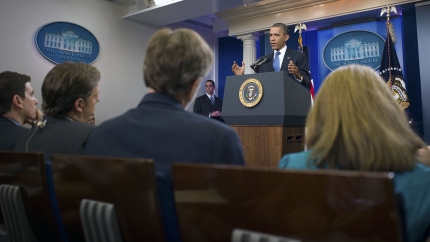
The White House

Office of the Press Secretary

Memorandum--Regulation and Independent Regulatory Agencies

America's free market is the greatest force for prosperity the world has ever known.  It is the key to our global leadership and the success of our people.  But throughout our history, one of the reasons it has worked is that we have sought a proper balance -- a balance that promotes economic growth, innovation, competitiveness, and job creation, while protecting the health, safety, and security of the American people.  Over the past two and a half years, the pursuit of that balance has guided my Administration's approach to rules and regulations.  And in January of this year, I signed an Executive Order requiring executive agencies to reduce regulations that place unnecessary burdens on American businesses and the American people while ensuring that regulations protect our safety, health, and environment.  I initiated a careful, Government-wide review of regulations already on the books in order to reduce outdated, unjustified regulations that stifle job creation and make our economy less competitive.  We are taking immediate steps to eliminate millions of hours in annual paperwork burdens for large and small businesses and save more than $1 billion in annual regulatory costs.  And hundreds of reform proposals from 30 agencies, now available for public scrutiny, promise to deliver billions of dollars in additional savings.

The Executive Order also requires executive agencies to consider costs and benefits and to reduce burdens on the American people; to expand opportunities for public participation; to simplify and harmonize rules; and to promote flexibility and freedom of choice.

With full respect for the independence of your agencies, I am asking you today to join in this review and produce your own plans to reassess and streamline regulations.  For rules going forward, I am also asking you to follow the key cost-saving, burden-reducing principles outlined in the January Executive Order.

I hope you see this as an opportunity to do something big and lasting -- to change the ways of Washington; to focus on what works; and to forge a 21st-century regulatory system that makes our economy stronger and more competitive, while we meet our fundamental responsibilities to one another.

I look forward to working with all of you on this important initiative, and I thank you for your attention and service to our country.

BARACK OBAMA