The White House

Office of the Press Secretary

Background on the President's Fiscal Policy Speech Today

BACKGROUND ON THE PRESIDENT’S FISCAL POLICY SPEECH TODAY
THE GEORGE WASHINGTON UNIVERSITY

Today the President will deliver a fiscal policy speech at The George Washington University.  The audience will be comprised of members of the administration, members of fiscal commission and university students and faculty.

Administration officials expected to attend
Vice President Joe Biden
Secretary Tim Geithner
Jacob Lew, Director, Office of Management and Budget
Bill Daley, Chief of Staff
Gene Sperling, Chair, National Economic Council

Fiscal Commission members expected to attend
Erskine Bowles, Co-Chair
Alan Simpson, Co-Chair
Representative Dave Camp
Representative Jeb Hensarling
Representative Paul Ryan
Representative Jan Schakowsky
David Cote, Chairman and CEO, Honeywell International

The President, the Vice President, First Lady and Dr. Jill Biden Launch Joining Forces

Read the Transcript  |  Download Video: mp4 (483MB) | mp3 (46MB)

Yesterday, the President, Vice President, First Lady and Dr. Biden launched Joining Forces, an unprecedented national initiative to support and honor our military families. “This campaign is about all of us, all of us joining together, as Americans, to give back to the extraordinary military families who serve and sacrifice so much, every day, so that we can live in freedom and security,” said First Lady Michelle Obama.

Joining Forces aims to educate, challenge, and spark action from all sectors of our society – citizens, communities, businesses, non-profits, faith based institutions, philanthropic organizations, and government – to ensure military families have the support they have earned. As part of Joining Forces, businesses and organizations, including some of the best know names and brands, announced major new commitments to support military families in the areas of employment, education and public awareness.

President Barack Obama, First Lady Michelle Obama, and Vice President Joe Biden acknowledge Dr. Jill Biden during the launch of the Joining Forces

President Barack Obama, First Lady Michelle Obama, and Vice President Joe Biden acknowledge Dr. Jill Biden during the launch of the Joining Forces initiative to support and honor America’s service members and their families, in the East Room of the White House. April 12, 2011. (Official White House Photo by Lawrence Jackson)

As the First Lady said, “our motto is simple:  Everyone can do something.” Find out how you can get involved at JoiningForces.gov. Watch a video of the launch event above, read full remarks here or see excerpts below:

The White House

Office of the Press Secretary

Presidential Proclamation--Civil War Sesquicentennial

-------
BY THE PRESIDENT OF THE UNITED STATES OF AMERICA
A PROCLAMATION

On April 12, 1861, artillery guns boomed across Charleston Harbor in an attack on Fort Sumter. These were the first shots of a civil war that would stretch across 4 years of tremendous sacrifice, with over 3 million Americans serving in battles whose names reach across our history. The meaning of freedom and the very soul of our Nation were contested in the hills of Gettysburg and the roads of Antietam, the fields of Manassas and the woods of the Wilderness. When the terrible and costly struggle was over, a new meaning was conferred on our country's name -- the United States of America. We might be tested, but whatever our fate might be, it would be as one Nation.

The Civil War was a conflict characterized by legendary acts of bravery in the face of unprecedented carnage. Those who lived in these times -- from the resolute African American soldier volunteering his life for the liberation of his fellow man to the determined President secure in the rightness of his cause -- brought a new birth of freedom to a country still mending its divisions.

On this milestone in American history, we remember the great cost of the unity and liberty we now enjoy, causes for which so many have laid down their lives. Though America would struggle to extend equal rights to all our citizens and carry out the letter of our laws after the war, the sacrifices of soldiers, sailors, Marines, abolitionists, and countless other Americans would bring a renewed significance to the liberties established by our Founders. When the guns fell silent and the fate of our Nation was secured, blue and gray would unite under one flag and the institution of slavery would be forever abolished from our land.

As a result of the sacrifice of millions, we would extend the promise and freedom enshrined in our Constitution to all Americans. Through the 13th, 14th, and 15th Amendments, we would prohibit slavery and indentured servitude, establish equal protection under the law, and extend the right to vote to former slaves. We would reach for a more perfect Union together as Americans, bound by the collective threads of history and our common hopes for the future.

We are the United States of America -- we have been tested, we have repaired our Union, and we have emerged stronger. As we respond to the critical challenges of our time, let us do so as adherents to the enduring values of our founding and stakeholders in the promise of a shared tomorrow.

NOW, THEREFORE, I, BARACK OBAMA, President of the United States of America, by virtue of the authority vested in me by the Constitution and the laws of the United States, do hereby proclaim April 12, 2011, as the first day of the Civil War Sesquicentennial. I call upon all Americans to observe this Sesquicentennial with appropriate programs, ceremonies, and activities that honor the legacy of freedom and unity that the Civil War bestowed upon our Nation.

IN WITNESS WHEREOF, I have hereunto set my hand this twelfth day of April, in the year of our Lord two thousand eleven, and of the Independence of the United States of America the two hundred and thirty-fifth.

                                 BARACK OBAMA

Press Briefing

April 12, 2011 | 46:48 | Public Domain

White House Press Briefings are conducted most weekdays from the James S. Brady Press Briefing Room in the West Wing.

Download mp4 (447MB) | mp3 (43MB)

Read the Transcript

Press Briefing by Press Secretary Jay Carney, 4/12/2011

1:43 P.M. EDT

MR. CARNEY:  Good afternoon.  How’s everybody today?  Good, glad to hear it.  I will not -- I don’t have an opening announcement or statement to make, so I will head straight to questions.

Associated Press, Mr. Feller.

Q    Thank you, Jay.  Do you plan to answer any of our questions today about the speech?  (Laughter.)

MR. CARNEY:  Of course I do.

Q    You do?

MR. CARNEY:  What I won’t do with any specificity is preview or detail the elements of the President’s speech that he gives tomorrow afternoon at George Washington University, where he will provide the American people his vision for long-term deficit reduction and dealing with our long-term debt.  And I know you guys will cover that with interest.

And I’d actually just explain that we -- that there’s a purpose behind this.  This is his vision, and rather than give a little here, give a little there, we’d like the entirety of his vision to carry the day tomorrow when he gives his speech.

Q    Senator Chambliss said down in Atlanta yesterday that the White House threw the Gang of Six, obviously the bipartisan working group there, a curveball by talking about long-term debt reform on Wednesday.  Do you fear that the President might jeopardize those sensitive negotiations?  Is that a concern of the White House at all?

MR. CARNEY:  Ben, the President has very carefully thought through his engagement in this issue, when he would give this speech, the building blocks to reaching this point.  Along the way he has said very clearly that he supports the efforts of the so-called Gang of Six and others who are addressing these obstacles, these challenges, in a very serious way and in a bipartisan way.  That’s a healthy and good thing.  And it is reflective of the environment that was created by the President’s fiscal commission after it reported last year.

He wants and hopes that the discussion will continue.  He has talked very clearly about the need to get this done through a conversation where everyone sits at the table and discusses a balanced way to address our long-term deficit and debt.  And he will provide his vision tomorrow and looks forward to working with leaders of Congress, going forward from there.

Q    You said “his vision” a couple times.  Is that what we should expect -- that this is the President’s vision as opposed to aligning himself with the bipartisan commission he tasked or the work on the Hill?

MR. CARNEY:  Well, what I would say, again, without previewing the President’s speech in any detail, is that -- and I know it’s frustrating.  I’ve been on your side of this podium and I know it can be frustrating when we’re not previewing or giving a lot of details -- and there were a lot of stories this morning that were contradictory.  Some had the President embracing one plan; another had the President embracing another.  And all were written with great authority.  Some of them can’t be true.

So what the President will do tomorrow -- (laughter) --

Q    If you could clarify.  (Laughter.)

MR. CARNEY:  I will clarify.  The President tomorrow will give his vision of what -- of how we should approach long-term deficit reduction.  And it will be his.  He obviously has engaged in this issue very deeply and is aware of a variety of ideas and approaches that have been put out there from a number of sources.  But the vision that he lays out for the American people tomorrow will be his own.

Q    And one last one.  What’s the relationship between the speech and the debt ceiling vote?

MR. CARNEY:  The speech and the debt ceiling?  We don’t believe there is a relationship between the two, and we don’t believe, going back to questions I had yesterday, that there should be a link between efforts to address our long-term deficit problem and debt problem and the imperative of raising the debt ceiling, which the President and all the leaders of Congress have said has to be done.

It will happen, because everyone recognizes the consequences of not doing it, which would be to throw the global economy into chaos, to halt on a dime the economic recovery that we’ve been experiencing and fought so hard to help foster.  This is not an alternative.  And we are confident that the Congress will vote accordingly.

In the meantime, as the President will amply demonstrate tomorrow, he wants to have this conversation about how we can get our fiscal house in order and how we can take a balanced approach towards reducing our deficit in the long term while protecting the investments which will enable us to grow in the 21st century, which in turn will help us reduce our deficit and debt.

Q    Thanks, Jay.

MR. CARNEY:  Tricia.

Q    Senator Lieberman, and even some Democrats, have said that they won’t vote to raise the debt ceiling unless the President gives them some concrete plans for debt reduction.  Is he going to offer that tomorrow?  And is he going to offer a specific number for the amount of debt he wants to see?

MR. CARNEY:  Tricia, I will wait for the President to lay out the specifics of his vision tomorrow, but I will simply say that we believe Congress needs to vote to raise the debt ceiling to avoid an economic -- a global economic calamity.  The President will tomorrow, once again, demonstrate his sincere commitment to reducing the deficit, to cutting spending, to getting our fiscal house in order; the commitment that he demonstrated through dealing with one of the main drivers of our long-term deficits and debt -- health care costs, which, as you know, through the Affordable Care Act will be reduced by $200 billion in 10 years and over a trillion in 20.  Serious deficit reduction.  Addressing one of the main drivers of the problem, which he also demonstrated again just on Friday in the agreement he reached with Speaker Boehner to finance the rest of the fiscal year with the largest nominal discretionary cut in spending in history.

Q    Will he demonstrate that commitment by giving the kind of concrete numbers that people seem to be hoping to hear?

MR. CARNEY:  He will demonstrate that commitment clearly and vividly.

Q    Is he going to talk about taxes at all?

MR. CARNEY:  I will not preview the President’s speech, but I will say that the President believes there has to be a balanced approach, that there is no practical way --

Q    Does that mean tax -- raising revenues as well as cutting spending?

MR. CARNEY:  I’m not going to say more than that.  I will not say more than that.  But he believes that there has to be a balanced approach, and he demonstrated in his 2012 budget proposal that we need to consider all three legs of the stool when we’re dealing with the deficit.  And that’s entitlements, tax expenditures, and defense spending.  Those are the -- and, well, of course, with interest, which gets reduced if we reduce the other three.

So we need to -- the only way to get there in a balanced way, in a way that spreads the burden, that makes sure that it’s fair and protects the economy so that it can continue to grow and create jobs is to look at all of that as we’re going forward.  And that’s what he did, again, in his 2012 budget.  So this is not news that he believes that these -- that you have to look at it this way.  The details I’ll save for him.

Jake.

Q    What’s the White House’s response to critics who say that because of his role in the cover-up of how Pat Tillman actually died and the pain he caused the family of Pat Tillman, that General McChrystal should not be on any sort of advisory committee having to do with military families?

MR. CARNEY:  Jake, the President feels strongly that General McChrystal is the right person to help lead this advisory committee on this vital issue on -- that this administration, this President, this First Lady, Dr. Biden, all believe, and of course the Vice President, all believe is vitally important, because we have now been in a situation where we have been -- we have had our men and women overseas in wars for a decade.

And it’s important to do everything we can to remind Americans who aren’t directly affected, who don’t have a loved one in theater, that there is a need to support those families who do; that this is an effort that should involve all of us.  And that’s what the initiative is about, and General McChrystal is an excellent choice to help oversee that effort.

Q    Is the President aware of the role that General McChrystal played in the cover-up of Pat Tillman’s death?

MR. CARNEY:  Jake, he is aware of -- very aware, having worked closely with General McChrystal for some time, of the General’s resume.

Q    Can you talk to us a little bit about the relationship between the CIA and the ISI and the U.S. and Pakistan, given --

MR. CARNEY:  You want me to talk about the CIA and -- okay.  Let’s see if I can get fired.

Q    You don’t have –- (laughter) -- are there strains between the United States and Pakistan’s government right now that are inhibiting counterterrorism efforts?

MR. CARNEY:  Jake, what I’ll say is that the relationship between Pakistan and the United States is very important.  The cooperation between our two countries and governments is -- continues, has been important, and continues to this day.  We are engaged in a shared goal of defeating insurgents and terrorist groups.  And that cooperation continues to this day.

You know, obviously, that I can’t discuss specifics about intelligence operations, but I can tell you that the cooperation between our two countries is important and continues.

Q    Jay.

MR. CARNEY:  Yes.

Q    Before, when you were talking about the budget, you said that the White House does not see a link between the debt ceiling and a deficit reduction plan.  How can you say that when one leads to the other?  The deficit leads to the need to raise the debt ceiling.  So how can the two not be linked?

MR. CARNEY:  Well, that’s like saying that every spending bill is linked to the -- I mean, that every bill Congress passes that spends money should somehow be linked to the --

Q    When we’re in deficit, every dollar we spend adds to that, right?

MR. CARNEY:  Right.  But that would be true of every bill that goes through Congress every week.  And my point, as you know, I know, is that the -- raising the ceiling, the debt ceiling, is so important because it involves the faith and credit of the United States government as the most powerful economy in the world -- the economy to which the whole world looks for stability.  And if Congress were not to do that, the impact would be immediate and severe, as our Treasury Secretary has described and as a plethora of outside economists described.  So --

Q    We know that part.  But if it’s not linked to a serious deficit reduction plan, won’t the whole world be looking and saying, they’re just borrowing more money?  It’s like a family taking out another credit card to borrow more money.

MR. CARNEY:  The point, Ed, is that the commitment shown by this Congress and this President to address the deficit was demonstrated just a few days ago.  The President will again demonstrate his commitment to it tomorrow.  And the demonstration just a few days ago wasn’t just words, it’s actions.  It was a signed piece of --

Q    It was $38 billion in cuts and a $14 trillion debt ceiling.

MR. CARNEY:  But you’re talking about a demonstration of commitment and what the world looks at when they see the commitment of this President and this Congress to work together to address this important issue.  That will be amplified by the President’s speech tomorrow.

What is not appropriate, given the consequences and the stakes, is to hold a positive vote on raising the debt ceiling hostage to something else, because the -- a game of chicken with our economy is a hugely risky affair that will not just be a game of who wins and who loses in the political sweepstakes here in Washington, but will have a catastrophic and direct impact on economies around the world and on Americans here, on their savings, on their interest rates, on their jobs, and on their prospects.  So this is simply not something we can mess around with.

Q    The last thing, you mentioned the deficit -- the spending cuts from late last week.  How confident is the White House that this is actually a done deal?  There are some people on the Hill saying, well, it’s not complete yet, don’t celebrate yet.  And the mayor of D.C., as part of your answer, was arrested yesterday, Vincent Gray, and he said, “I’m not sure what the White House did in all this, to tell you the truth.  It looks like the District of Columbia was essentially thrown under the bus in order to get a political deal.”  So can you react to him, and also --

MR. CARNEY:  Well, those are several different questions.  The deal -- the agreement was reached, the deal, as I understand it, is moving through Congress and will be signed by the President.  And it will result in the largest discretionary spending cut in history, nominal terms.

The fact is that the compromise that was reached involved a lot of tough choices, as we’ve discussed and as the President has discussed.  Not everyone got what he or she wanted.  The President did not get everything he wanted.  He would not have supported this, does not support the provision that concerns the mayor.  And he is a firm supporter of D.C. home rule.

But in a negotiation, you have to make tough choices, and he fought hard to -- and succeeded in preventing a strenuous effort by the Republicans to de-fund Planned Parenthood, to de-fund access to women’s health providers around the country, and felt that that was vitally important and made sure that that was preserved.

But tough choices were made, and that was one of them.

Chip.

Q    Thanks, Jay.  On the budget deal, is the President asking or encouraging or expecting Democrats to vote for this thing?  Is he --

MR. CARNEY:  Yes, he is -- he believes that it’s the right thing to do.  He believes that it involves tough choices.  It is not -- as I just described, it is not a deal that appeals in all its aspects to him or that he expects will appeal in all its aspects to other Democrats --

Q    Some Democrats have said that --

MR. CARNEY:   -- just as it does not appeal in all its particulars to Republicans.  That’s the nature of compromise.  What we could not do was allow the government to shut down, and the President made sure that the deal he reached with the Speaker of the House and other leaders protected the vital investments that are his priorities and priorities of a lot of others who believe that investments in education, research and development, innovation, are key to the future, the economic future of this country.

So not an ideal world, but that’s not the world we live in.  So it involved tough choices, and he has made his case and will continue to make his case for why he thinks it was the right thing to do.

Q    And without going into any details, of course, will the President directly or indirectly go after Paul Ryan’s plan, and how will he do that?

MR. CARNEY:  Well, I’m not going to preview the President’s speech.  Let’s leave it at that.

Q    You’re not going to say anything about -- how about Paul Ryan’s plan independently?

MR. CARNEY:  Well, what I have said and others have said is that the House Republican plan demonstrates a shared goal with the President, which is that we need to take serious action to address our long-term deficit and debt issues.  What it doesn’t demonstrate is the kind of balance that this President believes we have to employ as we address those long-term needs.

As I described before, there are three legs to this stool in terms of the drivers of our long-term deficits and debt:  entitlement spending, largely health care spending; tax expenditures; and defense spending.  The fourth leg, if you will, of the stool is interest payments on the debt, which you address by addressing the other three.

So there are three legs, and it is where we believe, where the President believes the House Republican plan fails starkly, is that it is imbalanced; it places all the burden on the middle class, on seniors, on the disabled, on people in nursing homes, through its rather drastic reform of Medicare and Medicaid -- reform which in many ways is an elimination of the established entitlements that they represent.  So that’s not the approach the President believes is the right way to go.

And I would just say that when I -- again, it’s important that -- it was a demonstration -- it was a recognition of the seriousness of the problem and of the fact that there is a shared goal here.  And there are a lot of different proposals out there, not just that one, and the President looks forward to having a conversation at the table with people who are serious about addressing this issue and serious in the way that he believes people demonstrated seriousness last week in addressing the CR for fiscal year 2011, which is you have to accept that you’re not going to get everything you want, that a compromise is by definition a coming together on common ground where there’s a consensus around the approach to take.

So the last word on this, I would say, is that it is -- well, I’ll leave it at that.  But the -- the point is, is that balance is essential; that the burden has to be shared by everyone.  And what is not acceptable, in the President’s view -- and, we believe, in the American people’s view -- is a plan that achieves serious deficit reduction only by asking for sacrifice from the middle class, seniors, the disabled, and the poor, while providing substantial tax cuts to the very well off.  That’s not -- it’s not balanced.  It’s also not particularly efficient and effective, because you cannot get there from here in a way that is stable for most Americans without addressing the three legs of the stool.

Q    If the President is going to make that case tomorrow, could you smile?  (Laughter.)

Q    Jay, I think a lot of people are wondering the level of detail we’ll get from the President tomorrow.  Like the Ryan plan or not, it did have a lot of numbers.  Should we expect a lot of numbers from the President tomorrow?

MR. CARNEY:  I will go back to what I said before, which is the President will lay out a vision, and that vision will be clear and vivid tomorrow, and will make clear his priorities in this important conversation.

Q    Target number for what he’s hoping to cut?

MR. CARNEY: I encourage you to attend or watch the speech.

Q    All right, let me shift gears a little bit.

Q    Don’t give up.  (Laughter.)

Q    An Indonesian by the name --

Q    He’s about to give us everything.  (Laughter.)

Q    He’s close to breaking.

Q    Just one more question.

Q    If you just ask him three times.  Isn’t that the way that --

MR. CARNEY:  Yes, that is the magic.

Q    An Indonesian named Umar Patek was apparently captured in Pakistan.  My understanding, he’s arguably the highest-level detainee or capture since the President took office.  Any guidance on where he is and if the U.S. is questioning him at this point?

MR. CARNEY:  I don’t have anything for you on that, Mike.  Sorry.

Q    But if it’s a high-value target, you would know of the plan, I would assume?

MR. CARNEY:  I don’t have anything to say in response to that from here.  Thanks.

Q    So, Jay, is there any chance you can preview the President’s speech?  (Laughter.)

MR. CARNEY:  For you, Chuck, in a few minutes.

Q    In all fairness, is this a -- you keep saying “vision.”  Is it going to be a plan?

MR. CARNEY:  Tomorrow at 1:30 p.m., the President will be giving a speech.

Q    Do you hate yourself at all when -- (laughter) --

MR. CARNEY:  And when -- no.  When he does, his ideas, his concept, his approach, his vision for how we need to address our long-term deficit and debt issues will be clear to you and to the American people.

Q    Concept, approach, vision.

Q    No “P” word.

Q    No plan.  I mean, why are you avoiding -- what’s wrong with saying “plan”?  Is there something wrong with it?

MR. CARNEY:  Well, I think that you can describe a vision as a plan.  I mean, yes, a plan lays out --

Q    So that’s fair.  We can describe --

MR. CARNEY:  -- but I will not -- I will not then go from there to get into specifics about what that vision/plan/concept will include.

Q    Do you plan on briefing congressional leaders before the speech?

MR. CARNEY:  We have a practice of consulting with members of Congress, and I’m sure they will be kept very up to date on what the President’s vision is for long-term deficit reduction --

Q    Are they being invited down here to get a briefing --

MR. CARNEY:  I don’t have any schedule updates for you.

Q    Okay.

MR. CARNEY:  Carol.

Q    Where does Social Security fit into this vision that we’re talking about?

MR. CARNEY:  This goes back to the variety of stories we saw this morning about what will or will not be in the speech tomorrow.

What the President has said, Carol, and it’s a fair question, is that he shares the opinion that has been expressed by a number of folks that Social Security is not the primary culprit or a culprit in our near- or mid-term deficit creation problems.  He does believe, as he said in his State of the Union and elsewhere, that he believes that it’s a -- it would be a good thing to take measures to strengthen Social Security.  But again, I encourage you to be patient with me and accept that I’m not going to get into what will or will not be in the speech tomorrow.

Q    Can we expect that it will be at least mentioned tomorrow?

MR. CARNEY:  Again, I’m not going to play that.  I can’t.

Q    So let’s look forward then.  Is he going to -- is the President going to get out on the road or -- here or in some shape or form sell this plan or vision to the American people?

MR. CARNEY:  I will say without -- I don’t have scheduling announcements, but he will -- this is the beginning of a process by which he intends to engage this conversation.  It’s an important issue and it goes beyond giving one speech.  He recognizes that it is -- it’s a big deal.  We’re talking about major issues that have gone unconfronted and unsolved for a long time for a reason.  And therefore it requires his engagement and the engagement of other serious leaders here in Washington to address the obstacles, address the challenges, and come to some common ground on how to deliver a product to the American people that achieves the goal of reducing our deficit in a stable way that’s balanced, strengthens our economy, does not harm our recovery or our job creation, and positions us well competitively for the 21st century.

Q    But as of right now there’s nothing on the schedule to sort of --

MR. CARNEY:  I have nothing -- I have no scheduling announcements to make about that.  But I will say that the moment does not end with the speech.

Ann.

Q    2012, will the President say now that he will not sign a CR at the end of September?  He had tried not to sign short CRs during the last couple of months.  Does he want Congress on notice now that for the next five months, he really does expect them to come up with a 2012 budget?

MR. CARNEY:  Well, he certainly does believe, as he proposed his own budget several months ago, does believe that it is a far better way to do business to pass a full fiscal year budget, and he does certainly encourage and insist that Congress do that.  I’m not going to -- to predict where we’ll be in terms of 2012 budget negotiations for just that fiscal year in six, eight months is a risky business.

Q    Any surprises in the $38.5 billion as it’s now been spelled out in the actual legislation?  What does the President think the vote will be?  Does he -- is he confident that this compromise will pass?

MR. CARNEY:  I haven’t heard him project vote tallies, so I couldn’t tell you.

Q    But is he confident it will pass?

MR. CARNEY:  Yes.  Abby and then Jackie.

Q    Going back to the debt ceiling vote, Republicans have made it pretty clear that they are not interested in a clean bill.  So my question is:  What is being done at the moment to prevent the kind of nail-biting that we saw last week with the very last-minute deal being brokered on the debt ceiling, given the magnitude, as you described it, of not raising it?  So what’s being done to kind of make -- to bring that process along before it’s too late?

MR. CARNEY:  Well, as you know, the Secretary of the Treasury has been in consultation with Congress; sent a letter to Congress about the imperative back in January of addressing the debt ceiling.  We are urging this -- that this be taken up and addressed in a timely fashion, because, as you say, it is risky business to play chicken with the economy.  And playing chicken would include going up to the last minute, which creates a lot of uncertainty for the global economy, on a scale that makes last week look like something very small and local.

So in terms of the negotiations we’re having, I don’t have any details for you on that, except that I would, again, point you to the fact that every single leader in Congress of both parties has made clear that this will pass and that not pass it would be sheer folly.  We take them at their word.

Q    So are negotiations ongoing?  Is that what you’re saying?

MR. CARNEY:  I would just say that the conversation with Congress began a number of months ago about the need to do this, and has continued since.

Q    Jay.

MR. CARNEY:  Jackie.

Q    How does the President feel about all this punditry and writing that he doesn’t lead?  And will tomorrow’s speech solve that?

MR. CARNEY:  The -- I thought a little bit about this, and I think that one of the unique privileges of this job is having been where you are and looking for threads and narratives.  And now, standing where I am, what I have seen is an extremely deliberate approach to this question and to leadership, which is you -- the President believes very firmly in results and having an idea, a vision, about where we should go, how we should get there, and then it comes back from there.

You figure out where you want to go -- he does -- what the results should be in terms of policy and outcomes, and then you decide what are the best things I can do -- I, being the -- what the best things the President can do to make that happen.  And what that means is that -- sometimes that means not saying anything at all, publicly.  Sometimes it means having very discreet conversation by phone or discreet meetings in the White House.  Sometimes it means standing here or in the East Room or giving a speech and laying out your principles, but refraining -- despite a chorus of encouragement -- refraining from flaming the opposition, because you don’t believe that that’s helpful to your ultimate goal.  And you may win the day, but you won’t get done what you think is important for the American people.

And I am -- I have seen this in my time in this job, and I see now it helps explain to me, in more vivid terms, the whole process that we’ve seen this President go through from the beginning when he took office, which is decisions that are hard, controversial, even unpopular, that you could -- he could have stood up and engaged in the political back-and-forth on the day and gone after his opponents and his critics.  But he didn’t do that at that time because he believed that it would make it harder for him to get the accomplishment that he hoped to get.  And I think if you look at the management of the TARP program, the bailout -- so-called bailout of the auto industry, the Recovery Act, his approach -- and I will leave out a bunch because I’m looking at you and not at a list -- the approach to the START treaty; the approach to the relationship with Russia; the approach to dealing with Iran; the approach to Egypt and the rest of the Middle East has been very much driven by that principle of leadership.  And we believe, obviously, that that approach has paid dividends for the American people.

Julianna.

Q    Even though the President doesn’t agree with all the elements of the Republican congressional budget plan, does he think that Paul Ryan has provided leadership on the issue?

MR. CARNEY:  Julianna, I think it’s a fair question.  I think that what Congressman Ryan has done is laid out his and the House Republicans’ priorities and how they approach this consequential debate.  He believes that the plan itself fails the test of balance, and that balance is essential.  But he does --

Q    Does Ryan meet the test of leadership?

MR. CARNEY:  Well, I think -- again, I haven’t had this specific discussion with him, so I don’t want to put words in his mouth -- but I will say that leadership, courage -- that there’s been a lot written about that.  And I think that one of the -- one measure of -- I mean, there are different -- there are levels of leadership, levels of political courage.  But one measure, certainly, is your willingness to take on the sacred cows in your own party.

And what strikes me about the House Republican budget proposal is that it puts the burden on seniors, on the middle class, on the disabled.  It does not ask or put the burden on wealthier Americans.  And that, in some ways, fails that other test, too, in terms of your willingness to take on the sacred cows in your own party.  I mean, I think that you need to, in any negotiation, be willing to take some heat.

Q    But isn’t Ryan taking --

MR. CARNEY:  Well, again, I would just note on those principles about the balance you find and what I think -- when we looked at the Simpson -- I mean, if you look at the President’s fiscal commission, and while the President has made clear and others have made clear, not every line in it is something that he could support.  What it did establish in an important way was that all those three things have to be looked at if we’re serious about getting from here to there in terms of long-term deficit and debt.

Q    Jay.

MR. CARNEY:  Stephen.

Q    The French and the British seem to be complaining that they’re being asked to shoulder too much of the burden on Libya.  Does this call into question the idea that NATO could do something like this without the U.S. in the driving seat?

MR. CARNEY:  We have full confidence in NATO’s capacities.  NATO is fully capable of and is achieving the goals set out for it and prescribed by United Nations Security Council Resolution 1973.  And of course I would remind you that the -- that that resolution makes clear what the goals of the military action are and what they are not.  And the President and this administration believes that NATO and the coalition, of which we remain a partner, is capable of fulfilling that mission -- of enforcing the no-fly zone, enforcing the arms embargo, and providing civilian protection.

Q    Would you like to see NATO members other than the British, the French, and the U.S. do more?

MR. CARNEY:  I would refer you to NATO for operational details about how NATO should run this mission.  We are no longer in the lead.  NATO is the lead and is fully capable of executing the mission.

Q    May I follow up on Steve’s question?

MR. CARNEY:  Sure.

Q    Today we learned that Moussa Koussa, former Libyan foreign minister who was alleged to have been involved in the Lockerbie bombing, has left London to attend a meeting in Qatar, in Doha, and this meeting is being chaired by Foreign Secretary William Hague.  What is the administration’s view on the British government allowing Moussa Koussa to travel so freely to attend these meetings?

MR. CARNEY:  I don’t have -- I don’t have anything for you on that.  I would point you to the statements that I made before about the actions that we and our allies took to put pressure on those around Muammar Qaddafi to abandon him, and also to the fact that the United Kingdom has made very clear that he is -- he was not given any kind of immunity in return for leaving the country.

Q    Would this administration be averse --

MR. CARNEY:  Again, I’m not going to “would, could, if.”  I don’t have a comment on that specific development.

Let me move around a little bit.  April.

Q    Thank you.

MR. CARNEY:  Sorry, Scott was blocking me.  (Laughter.)

Q    You picked up a bad habit from the last press secretary.

MR. CARNEY:  What’s that?  (Laughter.)

Q    Anyway, my height has nothing to do with anything around here.  Anyway, following up on Ed, what Ed had to say about -- the question Ed asked about Vince Gray, apparently council members and the mayor of Washington, D.C., wanted to make their feelings known about how they were portrayed in the budget -- in the budget that was -- President Obama allowing the cuts to happen in D.C.  Has President Obama reached out to Vince Gray and some of the council members?  Because they are very concerned.  This is the host city of the White House, of -- 80 percent of the government -- well, Washington -- 80 percent, I believe, of Washington, D.C., is federal land, federal buildings.  So why not talk to Vince Gray if the President hasn’t?

MR. CARNEY:  Well, I don’t know that he hasn’t or that he won’t.  My point still stands that this was a tough decision.  The President is a firm supporter of D.C. home rule and continues to be that.  And the choices that had to be made in this negotiation were not easy ones, and he’s made that clear, I’ve made that clear.  But again, he supports D.C. home rule and understands the importance of it to the residents of the District of Columbia.

Q    But many people are not taking this arrest lightly.  I mean, the mayor of Washington, D.C., and council members were arrested because of what they felt.  Is the White House listening to what they have to say?

MR. CARNEY:  Well, I know that everyone here is aware of it.  I don’t -- I simply don’t know what communications or conversations may have happened or are planned right now, April.  But you can certainly check back with me.

Margaret.

Q    Thanks, Jay.  I have two questions.  The first is, how does the President feel about the idea of instituting statutory budget controls with some kind of automatic enforcement mechanism to control debt?  Maybe that’s something that would kick in after the next election.  Has he taken a firm stance on it?  Do you know where he stands?  Is it something you’re considering?

MR. CARNEY:  Again, I will -- since that’s related to the area of long-term deficit and debt reduction, which is the area the President will be addressing in his speech, I will not preview it from here.

Q    So that might actually be something he’d discuss in tomorrow’s speech, but you wouldn’t you say?  (Laughter.)  And then my other -- I just want to --

Q    Can you count to 10 before we hang up the phone?  (Laughter.)

Q    So my other question is, some of the Republicans that I talked to say that they think that the best chance to get the Medicare reform started is precisely the debate over the debt ceiling.  And I guess I’m wondering, if that could help to reach a bipartisan agreement, what’s wrong with talking about it as part of the debate?  I understand when push comes to shove you don’t want the nation to default.  But if you’re trying to bring together liberals who are mad at President Obama for being too nice to Republicans, and Republicans who are proposing stuff you think is, like, off the deep end, then isn’t any mechanism a good mechanism to get this done?  Or if that’s what it’s going to come down to, would you rather just debate it throughout an election year and then deal with it next year?  

MR. CARNEY:  What we would rather do is have the conversation and have it now.  The President is giving a major speech tomorrow that will outline his vision for long-term deficit reduction.

What is not acceptable, what will not make sense is linking somehow or holding hostage a vote on the debt ceiling by trying to link it to a provision -- you mentioned the Medicare reform I assume that’s in the House Republican budget proposal, which is a non-starter.  It’s not supported by the majority in the Congress; it’s not supported by the American people in any recognizable numbers.  It’s not -- and it’s not something this President could sign.  So -- I mean, that’s --

Q    I didn’t mean --

MR. CARNEY:  But he wants -- the conversation is important to have and he looks forward to having it.

Kara.

Q    Thanks.  Can you explain why, months after signing the repeal of “don’t ask, don’t tell,” the White House didn’t allow representatives of gay military families to attend today’s event?  I mean, isn’t that a missed opportunity for the President to reaffirm his commitment to see through the repeal of the policy?

MR. CARNEY:  I actually don’t have anything for you on that.  I will take that question -- I’m not aware of it at all.

Q    Okay.  Well, I mean, the First Lady’s office put out a statement confirming it.  They said that it’s still the law of the land.  But I’m just wondering why -- how that’s not a missed opportunity for you guys to --

MR. CARNEY:  Well, wait.  If you want, I can take this question, but I think you’re conflating here a couple of things.  But why don’t I take that and get back to you.

Bill.

Q    Jay, as you know, some Democrats on the Hill are not happy with the Friday deal.  And I talked to one of them who said the impression that they get is if the Republicans dig in their heels enough and hold off long enough, the President will fold -- on the tax deal and now on this budget deal.  Why are they wrong?

MR. CARNEY:  Because the President held out and protected his priorities.  He negotiated firmly and made sure that investments in education, investments in research and development, investments in infrastructure, the keys to our economic future, were protected, and prevented the passage of unacceptable so-called riders that would have attempted to de-fund the Affordable Care Act, de-fund family planning and women’s health clinics, and numerous other unacceptable measures.

So the reality is, is that a negotiation involves a compromise, and a compromise -- especially when you have a divided government like we have, and there is no question if the point that either Republicans on this side or Democrats on that side want to make is they didn’t get everything they wanted, we concede the point.

Q    But they got 80 percent of what they wanted.  They got $80 billion.  That’s more than --

MR. CARNEY:  That is a fallacy, Bill.  That’s a fallacy because it assumes that every dollar in spending cuts is a victory for Republicans and a loss for Democrats, and that’s actually wholly inaccurate, as you know -- you’ve been around long enough to know.  Balanced budgets -- as have I.  (Laughter.)  Balanced budgets in this town -- the last time, as I recall since I covered it, that the budget was balanced in this town through a bipartisan compromise, there was a Democrat in the White House, okay?  And this President has demonstrated very clearly that he believes we need to address our spending and our debt and our deficits.  And he would have done this regardless because he believes -- not the deal itself, because in an ideal world I made clear that there were tough choices he would not otherwise want to have to make.

But in terms of addressing the deficit and debt, he intended to do it and intends to it, and that’s not a Democratic priority or a Republican priority; it’s an American priority.  It’s important for our economic health, and it’s important for the future of our children and grandchildren and our continued capacity to lead the world.

But what is also important is that you do it in a way that is balanced, that protects key investments, that protects children in Head Start, that protects Pell Grants, that protects research and development that will lead to the creation or help lead to the creation of industries in this country which will create jobs at home and enable us to lead in the industries that will dominate the 21st century around the globe.

He is very much in favor of reducing our spending in a reasonable way, so I go back to the point -- the 80 percent suggestion is a fallacy.

Q    Thanks, Jay.

MR. CARNEY:  I’ll take one more.  David.

Q    Thanks.  I don’t go -- I haven’t been around as long as Bill.  (Laughter.)  Let me ask -- two quick questions.  Does the President feel that the Ryan plan is fundamentally unfair?

MR. CARNEY:  Yes.

Q    The second question, regarding the budget deal, what is his response to the criticism that it’s bad for job creation, that it will be a net loss of jobs?  That this doesn’t lead to --

MR. CARNEY:  That article I believe has --

Q    Well, a few -- more than one person has suggested this.

MR. CARNEY:  In the conversations I’ve heard about this is simply -- is not based on sound economics because the -- while the level of cuts was high in annual -- in terms of annual -- $38.5 billion is substantial, highest nominal reduction in domestic discretionary spending in history.  However, it does not have a substantial -- it does not have a negative impact on our economy, and I think a lot of economists would disagree with that.

In fact, because it protects the investments that I’ve referred to several times now, we believe that it finds an appropriate balance between reducing our spending and protecting the investments we need to continue to grow.

The highest principle the President took into this negotiation was that we must not do anything that harms our recovery, that harms our capacity to create jobs because we’ve clawed and scratched our way out of the deepest recession since the Great Depression, and we should not do anything that harms our ability to continue to climb out of that hole, grow the economy, and create jobs.

Thanks, guys.

Q    Thank you.

END
2:30 P.M. EDT

Close Transcript

The White House

Office of the Press Secretary

Readout of President Obama's call with President Alassane Ouattara of Cote d'Ivoire

President Obama called President Alassane Ouattara today to congratulate him on assuming his duties as the democratically elected President of Cote d’Ivoire.  President Obama offered support for President Ouattara’s efforts to unite Cote d’Ivoire, restart the economy, restore security, and reform the security forces.  The President reiterated his admiration for the extraordinary potential of the Ivorian people, and the two leaders discussed the importance of reestablishing normal trade and assistance relationships to jumpstart the Ivoirian private sector.  The two leaders also reiterated the importance of ensuring that alleged atrocities are investigated and that perpetrators – regardless of which side they supported – are held accountable for their actions, and committed to support the roles of the United Nations commission of inquiry and the International Criminal Court in investigating abuses.  President Obama welcomed President Ouattara’s commitment to provide security and advance the aspirations of all Ivoirians, and said that the United States will be a strong partner as President Ouattara forms an inclusive government, promotes reunification and reconciliation, and responds to the current humanitarian situation.

Joining Forces to Support Military Families

April 12, 2011 | 50:34 | Public Domain

First Lady Michelle Obama and Dr. Jill Biden are joined by President Obama and Vice President Biden as they launch Joining Forces, a national initiative to support and honor America’s service members and their families.

Download mp4 (483MB) | mp3 (46MB)

Read the Transcript

Remarks by the President, the Vice President, the First Lady, and Dr. Biden at Launch of "Joining Forces" Initiative

East Room

12:16 P.M. EDT

THE VICE PRESIDENT:  Well, welcome to the White House.  Shirley, you’re getting to be an old pro.  (Laughter.)  When Shirley and Jill made their first television appearance a while ago, I think it was up in Philly at -- for a Boots on the Ground event, Mr. Secretary, they were both scared to death.  Now I am scared to follow Jill.  (Laughter.)
    
Ladies and gentlemen, Jill and I just returned from a ceremony that honored Bob Dole and his heroic service -- an unparalleled devotion to supporting veterans in this country.

You know, he always knew and taught me what many of us have come to learn -- that we have many obligations in this country, but we only have one truly -- one truly sacred obligation, and that is to prepare those who we send to war with all that they need, and take care of those who return from war and their families with all they deserve.

Although Bob’s generation was known as “The Greatest Generation,” this generation of warriors, as the Chairman of the Joint Chiefs Admiral Mullen can tell you, this generation of warriors may be among the most devoted because of the long, long, long periods of service that they’ve had to endure.

They’ve seen multiple deployments.  They’ve seen and participated in two wars that -- wars that have extended almost a decade.  And in the process, we have lost over 5,000 -- not over, exactly, as of an hour ago -- 5,957 fallen angels; 43,006 -- 43,006 have been wounded.  And there’s still more of a job to be done.  There are still more warriors deployed.

I don’t think there’s ever been a time in American history when a generation of military families has had to endure for as long and as much as this generation of American families of service people.

As I said, we only have one truly sacred obligation.  You know, the poet John Milton said of Shirley and all the Blue Star moms and dads and husbands and wives and grandparents out there, he said, “They also serve who only stand in wait.”  And this generation of military families has, as I said earlier, stood a long time.  Some have waited multiple times.

I look at the men in uniform here, the men I most admire, and I may be mistaken, but I don’t think there’s been this many times when people have been in battle, wounded, seen bloody, bloody conflict, come home for a brief respite, and sent back again.  It’s one thing to go the first time, not knowing exactly what the horrors of war may be like, but to saddle up and go back again and again and again.

On my multiple flights, Mr. Secretary, into Iraq and Afghanistan over 25 times, I -- last time in I sat up with the pilots in the C-130s that were coming in.  And I said, guys, how many tours?  Of the four in the cockpit, only one had served only two.  Three had served -- two had served four, and this was the fifth deployment for the fourth.

So this generation that Michelle and Jill are embarking on bringing the awareness of the rest of the country to, we owe them a lot.  They’ve known the pain and anxiety that comes from when the external and internal bond of family is stretched across oceans and gulfs of time. 

You know, your child, it’s your child when you’re there; your child, you miss their first step; the first smile that they smile; the missed birthdays; the anniversaries that were celebrated on Skype.  We learned all about Skype when our son was in Iraq for a year.
    
Yet their support here at home has never wavered, and I would say that they, too, the families that Shirley represents and many of you in the audience, they are as brave and heroic as their sons and daughters and their husbands and wives that are there, and they truly deserve our support.

As I said, Jill and I know a little bit like -- what it’s like firsthand.  Our son Beau was in Iraq for a year, deployed once.  We learned at that time how much it means to those who are in a war zone thousands of miles away, knowing that their family is being cared for; that the next-door neighbor has offered to cut their grass while their husband is overseas; or that the next-door neighbor will give a jumpstart on that cold morning when you’re trying to get your daughter or son to elementary school.  I know that those little things are the things that make every day work or not work.  It matters.  It matters because it’s one less thing they have to worry about in theater. 

And all of those of you who’ve served in the military and served overseas, no, I’m not exaggerating when I say that -- every single warrior I meet in place in Afghanistan or Iraq or Bosnia, in those days, in Kosovo -- all they ask about, they ask about what it’s like at home:  Can you give my wife a call?  Can you pick up the phone and call my pop, let him know it’s okay?

All Americans should know that one act of kindness extended to a family of a soldier, a sailor, or a Marine, a Coast Guardsman, reverberates across water, over the mountains, and through the deserts, into the heart of the warrior who is standing there alone, thinking as much about his family as his family is thinking about him or her.

I promise you, I promise you, all those of you who are listening on the television or radio, it matters.  It matters. 

Jill always points out that only 1 percent of our nation is serving -- over a million young women and men -- and not so young.  Last time -- four or five times ago I was in Iraq in one of Saddam’s old palaces, and we were having one of those sort of impromptu meetings you have all the time, Mr. Secretary, where one soldier gathers around you, then five, and then 10.  Next thing you’re standing on a chair talking to a bunch.  And I said, “You’re a great bunch of young guys.”  And a guy from the back, General Shinseki, yells, “Biden” -- and I was senator -- “Senator, John Jones” -- I won’t mention his name -- “John Jones.  Saw you here last time.  Sixty-one years old.”  (Laughter.) 

So they’re not all -- they’re not all young.  But the fact is only 1 percent of the families have served in those wars.  Yet 100 percent of American families have an obligation to commit to that 1 percent and just show one -- one single act of kindness to a deployed veteran’s family.

As Jill has declared many times as Second Lady, helping to muster the strength and to remind the neighbors that everyone in America has a duty to fulfill that sacred obligation I mentioned.  Jill knows how important it is for our troops and for their families.  She knows also that -- how far just a little bit of support can go. 

My wife, whom I’m about to introduce, feels it in her bones.  It’s become part of who she is.  That blue star is sort of indelibly branded on her heart.  And it’s come in our family and among our friends, as Shirley will tell you, to define her in a sense. 

Ladies and gentlemen, I’m honored to present to you the Second Lady of the United States, a Blue Star mom, my wife, Jill Biden.  (Applause.) 

DR. BIDEN:  Good morning.  I’m Jill Biden, and I am a proud military mom.  As my husband said, we are honored to have you all here at the White House today as we express the gratitude of our entire nation to those who serve in our military and to their amazing families.  You are all heroes -- from the moms and dads who keep your families together while your loved ones are serving overseas, to the grandparents who step in with much needed support, to the children who are strong and brave while mom and dad are away.  You go about your business every day, lifting up your communities, volunteering at your schools, lending a hand to your neighbors, and you do it all while carrying a heavier burden than most folks imagine.  You are truly remarkable. 

As Joe said, we have been a National Guard family for the last 10 years.  Two and a half years ago, I stood in Dover, Delaware, watching as our son Beau prepared to deploy to Iraq.  I remember it like it was yesterday.  Like other military families I felt an intense mixture of pride and concern, and I can honestly say that not a day passed during his year away when I didn’t worry about his safety.

During the deployment ceremony a friend slipped a prayer into my hand.  It brought me comfort, and I’ve shared it with many others since then.  The prayer asks for courage and strength for each soldier to do their duty when they risk their lives to protect our freedom, and expresses thanks for the sacrifice of these men and women and their families.  That prayer has been a huge source of comfort to me, especially in the year that Beau was deployed.  I could be anywhere in the course of my day, writing on the chalkboard in my classroom or preparing a meal, and I would just stop, close my eyes, and say that quick prayer for him and all others serving in harm’s way.

Now, when I attend deployment ceremonies I pass on this prayer to the moms and families I meet in the hopes that it comforts them as it did me.  I’ve had the opportunity over the last few years to attend several of the deployment and return ceremonies.  I have seen the pride, the trepidation, the relief, and the pure joy.  I have spent time with spouses and children, grandparents and friends, but somehow it is always the mothers who seek me out.  They know that I understand their experience.  And I because I do, I offer them my thanks, my prayers, and a warm embrace.

Michelle and I have met so many amazing families in the past few years.  Just last month, I attended a deployment ceremony where I met some folks I now call the grandparents.  Both parents of three children under the age of 10 were deploying, and these grandparents decided to circle the wagons and take care of the children together.  The grandmothers Janice (ph) and Ellen are here today.  Grandpa Charles is home babysitting.  (Laughter.)  I want to thank your entire family for their service.

Now, just think about these women.  They aren’t wearing uniforms.  They don’t live on a base.  But they are serving.  They could be your neighbors.  Ryan, Emma and Abby (ph) -- their grandchildren -- could be in your child’s classroom.  They could be members of your church or synagogue or customers at the hardware store you manage.  Think about that.

Now, imagine how a community could rally around this family, helping with carpools, sporting events, or school activities.  I’ve seen through my work with Shirley’s organization that small community groups can make a huge difference.  Imagine for a moment not just what these small gestures mean to a family, but what they mean to a soldier thousands of miles of away who knows that someone is looking out for the ones he loves back home.

There are small and effective groups like this all over the country -- from the barbecue master, who travels all over the state of Ohio to cook for military families; to the accountants providing free tax service; to the soldiers in Minnesota collecting hockey equipment for military kids.  These efforts make a difference in the lives of our families.

When I was in Iraq last year, I heard a story that has stuck with me ever since.  An officer told me about a little girl in his daughter’s class who broke into tears when she heard the “Ave Maria” sung during a holiday program.  As the teacher comforted her, the little girl explained that the song had been played at her father’s funeral.  Her father had been killed in Iraq.

As a teacher, I know that all teachers would want to understand that little girl’s experience.  So I shared that story with a group of educators, and I am so pleased to share the good news today that the American Association of Colleges for Teacher Education has partnered with the Military Child Education Coalition to promote training for future teachers.  Together, they hope to teach 10,000 future educators how to best serve their military-connected students across the country.

In our travels, Michelle and I have seen many teachers who are making a real difference for the military children in their classrooms -- teachers who arrange parent-teacher conferences by Skype so deployed parents can participate; or teachers who encourage students to tape a photo of their deployed parent to their desk so they can look at it whenever they feel the need; or teachers like the one in my granddaughter’s classroom who hung up a photo of my son’s deployed unit so the whole class would know that Natalie’s dad was at war.

Believe me, that photo of her dad on the wall meant the world to Natalie, and it meant the world to me and Joe, too.

These teachers and all the other individuals and groups across the country who are supporting our troops and their families are showing all Americans that there are countless ways to help -- some large, and many small, but all important. 

And I can tell you from personal experience, all appreciate it.  We can all join forces. 

I am thrilled and humbled to be here today with a group of people that represents the best of this nation -- individuals and families who embody the strength, the resilience and the patriotism that has shaped the United States of America. 

We -- Joe, myself, Barack, and Michelle -- we are here today because of you.  We are here to celebrate you.  You are doing your part.  The government is doing its part.  And each American has the ability to make a difference in the life of a military family.

That’s what this initiative is all about.  Every one of us can commit to one small act of kindness. 

And now it’s my honor and privilege to introduce a man who is doing his part as a strong leader and constant advocate for our service members, veterans, and military families.  He’s also the husband of my partner on this effort -- our President and Commander-in-Chief, Barack Obama.  (Applause.)

THE PRESIDENT:  Thank you.  Thank you, everybody.  Please, please have a seat.  Thank you very much.  Thank you very much.  Thank you so much.  Thank you.  Thank you, everyone.  Please, please be seated. 

Thank you very much.  Well, as you can see, the Vice President and I are the warm-up acts here today.  (Laughter.)  Our role is to introduce our better halves.  Actually, Michelle and Jill are like our better three-quarters or four-fifths.  They’re basically just all around better.  (Laughter.)

So, thank you, Jill, for your introduction and sharing your personal experiences and stories and being able to describe how much this means to you personally.  To the Vice President, the entire family, which, like so many others, has known both the pride but also the worries and the fears when a loved one in uniform is serving in harm’s way. 

We are joined today by members of Congress, by members of my Cabinet, Joint Chiefs, by leaders across the administration and just about every sector of American society.  But most of all, we’re joined by our service members and their families, representing the finest military that the world has ever known. 

And while the campaign that brings us all together is truly unique, it does reflect a spirit that’s familiar to all of us -- the spirit that has defined us as a people and as a nation for more than two centuries.

Freedom is not free -- simple words that we know are true.  For 234 years, our freedom has been paid by the service and sacrifice of those who’ve stepped forward, raised their hand and said, “Send me.”  They put on a uniform.  They swear an oath to protect and defend.  And they carry titles that have commanded the respect of generations -- soldiers, airmen, Marine, sailor, Coast Guardsman. 

Our nation endures because these men and women are willing to defend it, with their very lives.  And as a nation, it is our solemn duty and our moral obligation to serve these patriots as well as they serve us.

But we are here today because these Americans in uniform have never served alone -- not at Lexington, not at Concord, not in Iraq, not in Afghanistan.  Behind every American in uniform stands a wife, a husband, a mom, a dad, a son or a daughter, a sister or brother.  These families -— these remarkable families —- are the force behind the force.  They, too, are the reason we’ve got the finest military in the world.

Whenever I’m with our troops overseas, when I ask them what we can do for you, there’s one thing they request more than anything else:  “Take care of my family.”  Take care of my family.  Because when our troops are worried about their families back home, it’s harder for them to focus on the mission overseas.  The strength and the readiness of America’s military depends on the strength and readiness of our military families.  This is a matter of national security.  It’s not just the right thing to do; it also makes this country stronger.  

And that’s why, over the past two years, we’ve made major investments to take care of our military families.  Secretary Gates has been one of the leaders in this process -- new housing and childcare for families; new schools for military kids; better health care for veterans; new educational opportunities for hundreds of thousands of veterans and their family members under the Post-9/11 GI Bill.

And that’s why, as part of a landmark Presidential Study Directive, for the first time ever the well-being of our military families is now a national priority -— not just a Defense Department priority, not just a VA priority —- it is a federal government priority. 

Today, my administration is working to implement nearly 50 specific commitments to improve the lives of military families -—everything from protecting families from financial scams to improving education for military kids and spouses, to stepping up our fight to end homelessness among veterans.  And as Commander-in-Chief, I’m not going to be satisfied until we meet these commitments.  Across this administration, we’re going to keep doing everything in our power to give our military families the support and the respect that they deserve.

But as we’ve said all along, this can’t be the work of government alone.  Something else has been true throughout our history:  Our military —- and our military families —- can’t be the only ones bearing the burden of our security.  The United States of America is strongest -— and as Americans, we are at our best -— when we remember our obligations to each other.  When we remember that the price of freedom cannot simply be paid by a select few.  When we embrace our responsibilities to each other, especially those who serve and sacrifice in our name.

And that’s why the extraordinary work that Michelle and Jill have been engaged in these past two years is so important.  I remember how it began.  It was during our campaign.  Michelle was meeting with women all across the country, listening to their struggles, hearing their stories.  And inevitably there were complaints about husbands and -- (laughter) -- not doing enough around the house and -- (laughter) -- being confused when you’ve got to brush the daughter’s hair and get that ponytail right.  (Laughter.)  So they were sharing notes.  But in all these conversations, there was one group that just kept on capturing Michelle’s heart —- and that was military spouses. 

And she decided right then and there, if I was given an opportunity to serve as President and she was given the opportunity to serve as First Lady, she would be their voice.  And that’s exactly what she and Jill have done.

You all see the events around the country —- on the bases, in the communities, at the hospitals with our wounded warriors -— where Michelle and Jill celebrate our military families -- celebrate your families -— and what we can do to support you better.  But what you don’t see is what happens when the cameras are off; how Michelle and Jill come back, and they are inspired by what they saw, and they use their platform to advocate on your behalf in every single agency.

So I want every military family to know that Michelle hears you —- not just as a First Lady, not just as a fellow American —- but as a wife, and a daughter, and a mom.  She is standing up for you and your families -- not just today, in public events like this one, but every day.  And the voice that she promised to be, that’s what she’s been out there doing, making sure that you’re getting the support and appreciation that you and your families deserve.

And so it is my honor to introduce to you my extraordinary wife, America’s extraordinary First Lady, Michelle Obama.  (Applause.)

MRS. OBAMA:  Thank you.  It is a thrill, and it’s always nice to be introduced by the President of the United States.  (Laughter.)  It’s always kind of cool.  And on behalf of all of us, I want to thank my husband, I want to thank Joe for their leadership.  From the top down, their personal commitment to keeping our military families strong is really what’s allowed us to be here. 

And I’ve told military families that.  This is something that comes from the very top.  This isn’t just about me and Jill.  We have husbands who care about your families, that care about these issues, and we wouldn’t be here today if it weren’t for their leadership.

So here we are.  This is the moment that we’ve been working toward for such a very long time.  And let me say that I am just thrilled that all of you could be here today as we launch this unprecedented national campaign to honor and support our incredible military families.  We’re calling it Joining Forces.  Pretty good.  (Laughter.) 

We call it Joining Forces for a very special reason.  This campaign is about all of us, all of us joining together, as Americans, to give back to the extraordinary military families who serve and sacrifice so much, every day, so that we can live in freedom and security.

Joining Forces is a challenge to every segment of American society to take action, to make a real commitment to supporting and engaging these families.  And I want to thank all of you here because this campaign is the result of everything that so many of you have shared with us and taught us over the past two years.

And I am especially grateful to my phenomenal partner in this effort, a Blue Star mom herself and a tireless champion of Guard and Reserve families, and an inspiration to me throughout this entire process, my dear friend, Dr. Jill Biden.  And we need to give Jill -- (applause.)

Joining Forces is inspired by the amazing military spouses and children who we’ve met all across the country, some of whom, like Shirley, have been able to join us today; families who’ve told us that even with the huge outpouring of support for our troops over the last decade, the truth is that as a country, we don’t always see their families, our heroes on the home front.  These families have appealed to us, like a military mom who wrote to me and said, “Please don’t let Americans forget or ignore what we live with.”  Please don’t let them forget.        

Joining Forces is shaped by the insights of spouses like Becky Gates and Patty Shinseki and Deborah Mullen and spouses of the Joint Chiefs, spouses of our Senior Enlisted Advisors and countless spouses of all ranks, many of whom I see sprinkled around have been terrific advisors to us.  Also, the passionate advocates representing military families who are here, and of course, member of Congress from both parties, they’re all in support of this.  These are all leaders who’ve devoted their lives to serving our troops and their families and who’ve helped us to understand where and how a campaign like this could really make a difference.

Joining Forces builds on the great work of the President and the Vice President and the entire administration, which has made military families a priority across the federal government, even as we recognize, as the President said, that this work cannot be done by government alone.

And I am just excited that as a result of the work that we’ve done with so many people over the past two years, businesses and organizations across America, including some of the best known names and brands, have already responded to this call.  Today, as part of Joining Forces, they are going to be announcing major new commitments to support military families, and you’ll all see those incredible commitments as we go forward, but we are tremendously grateful for so many of them stepping up so early.

Joining Forces is rooted in those American values of service and citizenship that have kept our country strong throughout history.  In World War II, for example, the whole nation went to war.  Just about every family was a military family, or knew someone that was. 

However, today, with an all-volunteer force, fewer Americans serve or know someone who does.  And unlike our troops, military families don’t wear uniforms, so we don’t always see them.  But like our troops, these families are proud to serve and they don’t complain, so as a result, the rest of us don’t always realize how hard it can be or what we can do to help lighten their load.

And I have to admit that I haven’t always realized it myself.  My father served in the Army, but he served before I was born, so I didn’t grow up in a military family.  I always revered our troops, but like many Americans, I didn’t see firsthand just how much our military families sacrifice as well.

And that’s why we’re Joining Forces.  This is about the responsibility that we each have to one another, as Americans.  It’s about the fact that, as Joe said, that 1 percent of Americans may be fighting on our behalf, but 100 percent of Americans need to be supporting our troops and their families.  This campaign is about renewing those bonds and those connections between those who serve and the rest of us who live free because of their service.

So this is a national initiative, and here’s how it’s going to work.  First, as part of a new public awareness campaign, we’re going to highlight the service of these families that Americans don’t always see, because the first step in taking action is awareness.  And the truth is that our military families are all around us.  We may not know it.  We’re going to remind Americans that most military families live off base, in thousands of communities across the country.  They’re our neighbors and our coworkers; the military spouse who puts a full day in at the office, then goes home to do the parenting of two while their husband or wife is deployed.

We’re going to remind them that most military children go to public schools.  They’re our kids’ classmates and teammates -- like the girl in your daughter’s class trying to make new friends and handle all the normal pressures of growing up, even as she worries whether Dad or Mom will come home safe.

Many of our National Guardsmen and Reservists and their families don’t live anywhere near a military base.  They’re in virtually every community in this country.  One day they’re our police officers, our firefighters, our doctors and our teachers. And then the next day they’re called to duty and deploy to a war zone.

Just about every county in America has sent a service member to Iraq or Afghanistan.  And their families, including Gold Star families who’ve made the ultimate sacrifice, they live all over America. 

And there probably isn’t a town in this country without a veteran.  So, in other words, we want Americans to realize that, in a way, every community is a military community.

So these are the stories that we’re going to tell.  These are the stories that we’re going to celebrate.  And to help us, we’re being joined by some outstanding folks who know a little thing about capturing the public’s attention -- folks like NASCAR and Walmart and Major League Baseball.  They’re going to be creating public service announcements.  Other PSAs will feature the likes of Oprah Winfrey and Steven Spielberg and Tom Hanks.  Everyone is stepping up. 

The major guilds in entertainment -- writers, producers, directors, actors -- all have committed to telling more stories of military families in TV shows and movies.  Working together, we’re going to make sure that our military families are never forgotten.

This leads to the second part of Joining Forces -- what we can actually do to support these families.  So we’re going to focus on the specific things our military families have told us they care most about, and things that I think that all of us can make a unique contribution to -- the areas of employment, education, wellness, and that includes mental health.

So in the area of employment, we’re going to be champions for our military spouses and veterans as they look for new jobs and advance their careers.  And we’ll make sure that businesses know just how lucky they’d be to have these talented spouses and veterans on their team.

In the area of education, as Jill said, we’re going to work to help our military children thrive in the classroom, even as they move between schools and deal with parents being deployed.  And we’re going to work to make it easier for military spouses to continue their education and get their degrees.

In the area of wellness, including good mental health, we’re going to remind this nation that just as our troops deserve the best support when dealing with the stresses of war and long deployments, so do military spouses and children.  They need the support as well.

Which brings me to the most important part of Joining Forces -- and that’s how we’re going to get all this done.

And as I said, this is a challenge to every segment of American society.  And our motto is simple:  Everyone can do something.  So we’re Joining Forces across the federal government.  Those nearly 50 commitments that the President mentioned are going to make such a difference for so many military families.

But these commitments also do something even more important.  They’re going to give military families a seat at the table across the federal government.  It means that we’ll all be working together to make sure that we’re forging new federal partnerships to serve military families for years to come.

We’re going to be Joining Forces with states and cities and local governments.  We want the whole country to know about states like Michigan and cities like Pittsburgh and Augusta, Georgia, that encourage folks to volunteer and support our troops and veterans and their families.

And states can make it so easy for these families.  They can make it easier for spouses to get their professional licenses and certification.  They can also help make it easier for military children to transfer between schools.  So every state, every city, and every town in this country can do something.

We’re Joining Forces with businesses, both large and small, including some of America’s biggest employers, which are making new commitments as we speak today.  Companies like Sears, Kmart, and Sam’s Club are telling military spouses who work at their stores that if they move to a new duty station, they’ll do their best to have a job waiting for those spouses.  Siemens is setting aside 10 percent of their open positions for veterans. 

The U.S. Chamber of Commerce is stepping up, encouraging its millions of members to hire military spouses and veterans; to find mentors for military wives and women veterans.  And the Chamber is going to host more than 100 job fairs across the country for these individuals.

Technology leaders like AOL, Indeed.com, Cisco, will help connect military spouses and veterans with employers that are hiring.  Companies like Hewlett-Packard and Microsoft will train military spouses in new technologies so they can start their own businesses.  And believe me, the list goes on and on, because every business can do something.

We’re Joining Forces with nonprofits, with reach -- their reach into communities all across the country.  The USO is going to expand its efforts to help Americans support military families right here on the home front. 

Jill said The Military Child Education Coalition is teaming up with the National PTA, and with more than 100 teaching colleges, to help educators and communities better serve our military kids.  The National Math and Science Initiative will be bringing Advanced Placement courses to tens of thousands of students, including military kids.  The Sierra Club and the YMCA are partnering with the National Military Family Association to get 15,000 military kids and families to camp this year.  The American Heart Association will help 100,000 military spouses and women veterans lead healthier lives.

And again, the list goes on and on.  Every one is stepping up, because every nonprofit can do something.

And finally, this is about all of us Joining Forces as Americans.  And we can do it right where we live and work.

As Jill said, if you’re a parent or a teacher, you could encourage your school to find new ways to support our military kids.  If you’re a lawyer, an accountant, a counselor, you can offer your services to a military family, pro bono.  If you’re a member of a church or a synagogue or a mosque, you could urge your faith community just to reach out to military families who are grieving the lost of a loved one.

It could be something as simple as mowing the lawn, shoveling the snow for that family down the street; telling that mom or dad that you’ll take their shift at the carpool; or lending a hand to that wounded warrior in your neighborhood.

You don’t even have to know a military family, because thanks to great organizations like Blue Star Families and their partnerships with the American Red Cross and ServiceNation, every American can write a letter to a military family and let them know that, in their honor, you’ll be serving or volunteering in their own community.  It’s that easy.

And if you ask any military family, they will tell you sometimes it’s the smallest things -- these simple gestures that say “thank you” that can make the biggest difference in their lives.

And if you need ideas, you don’t have to go far because we are also creating a new website, JoiningForces.gov, where Americans can come together, connect, and find out how they can take action, often right in their own communities, because every single American can do something.

And that includes me and Jill.  We’re not asking anybody to do anything that we won’t do ourselves.  So beginning tomorrow, we’re hitting the road.  Yes, Michelle and Jill on a road trip.  (Laughter.)  I think Jill is going to drive.  (Laughter.)  We’re going to be traveling throughout the country, celebrating the service of military families and the communities, and nonprofits and businesses and folks who support those families every day.  And at each stop, we are going to be encouraging every American to ask a simple question:  “How can I give back to these families who have given me so much?”  That’s the question.

So obviously I’m excited about this campaign.  And I know Jill is, too.  And we know that this cannot be something that we do just for this year, or just for the next year.  This isn’t just a short-term effort, because our military families deserve our respect and support at every stage of their lives, no matter who’s in office.

So it’s our hope that what we’re launching today becomes part of the fabric of our country.  And to make sure that it does, I am proud that one of America’s leading nonpartisan institutions focused on national security, the Center for a New American Security, has stepped forward to help coordinate Joining Forces.  It’s going to be guided by an advisory board of distinguished Americans with a wealth of experience in serving military families and bringing people together around a common cause, and those include General Stan McChrystal and Patty Shinseki.  Both of them are here today, and we are grateful to you both for leading this effort.  (Applause.)  Good stuff.  (Applause.)

So, Jill and I truly believe that if enough people across this great country realize just how much our military families do for us, and if we look in our own lives to see what we can offer, then there is absolutely no limit to what we can do together to keep these families, and our country, strong.  And if we do this, if we come together, I know that we’ll come closer to our vision of a nation that truly recognizes and honors our military families.

It’s an America where every soldier, sailor, airman, Marine and Coast Guardsman -- and woman –- can deploy knowing that their family will be taken care of back at home.

It’s an America where every military spouse has the support that he or she needs to keep their family strong and thriving.

It’s an America where every military child has the support they need to grow and learn and realize their dreams.

It’s an America where our veterans and their families, especially our Gold Star families who have sacrificed so much, are honored throughout the entirety of their lives.

In short, we see a nation where more Americans across every sector of society are Joining Forces on behalf of our military families.

And believe me, this is going to remain one of my defining missions as First Lady.

So I thank you all for joining us to help make this happen.  And Jill and I hope that this campaign will be worthy of the service and sacrifice and strength of every single military family in this country, and that it will make a real difference in their lives for years to come.

So thank you so much.  (Applause.)

END
1:02 P.M. EDT
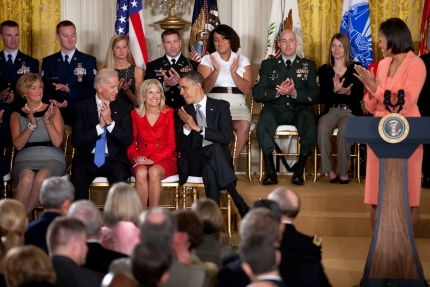
Close Transcript

The White House

Office of the Press Secretary

President Obama to Meet with Bipartisan House and Senate Leadership at the White House

Tomorrow at 10:40AM, the President will host a meeting with bipartisan House and Senate Leadership at the White House to discuss the fiscal policy vision that he will later lay out in a speech at George Washington University. Expected attendees include Speaker Boehner, Leader Pelosi, Representative Cantor, Representative Hoyer, Senator Reid, Senator McConnell, Senator Durbin and Senator Kyl.

The White House

Office of the Press Secretary

Remarks by the President, the Vice President, the First Lady, and Dr. Biden at Launch of "Joining Forces" Initiative

East Room

12:16 P.M. EDT

THE VICE PRESIDENT:  Well, welcome to the White House.  Shirley, you’re getting to be an old pro.  (Laughter.)  When Shirley and Jill made their first television appearance a while ago, I think it was up in Philly at -- for a Boots on the Ground event, Mr. Secretary, they were both scared to death.  Now I am scared to follow Jill.  (Laughter.)
    
Ladies and gentlemen, Jill and I just returned from a ceremony that honored Bob Dole and his heroic service -- an unparalleled devotion to supporting veterans in this country.

You know, he always knew and taught me what many of us have come to learn -- that we have many obligations in this country, but we only have one truly -- one truly sacred obligation, and that is to prepare those who we send to war with all that they need, and take care of those who return from war and their families with all they deserve.

Although Bob’s generation was known as “The Greatest Generation,” this generation of warriors, as the Chairman of the Joint Chiefs Admiral Mullen can tell you, this generation of warriors may be among the most devoted because of the long, long, long periods of service that they’ve had to endure.

They’ve seen multiple deployments.  They’ve seen and participated in two wars that -- wars that have extended almost a decade.  And in the process, we have lost over 5,000 -- not over, exactly, as of an hour ago -- 5,957 fallen angels; 43,006 -- 43,006 have been wounded.  And there’s still more of a job to be done.  There are still more warriors deployed.

I don’t think there’s ever been a time in American history when a generation of military families has had to endure for as long and as much as this generation of American families of service people.

As I said, we only have one truly sacred obligation.  You know, the poet John Milton said of Shirley and all the Blue Star moms and dads and husbands and wives and grandparents out there, he said, “They also serve who only stand in wait.”  And this generation of military families has, as I said earlier, stood a long time.  Some have waited multiple times.

I look at the men in uniform here, the men I most admire, and I may be mistaken, but I don’t think there’s been this many times when people have been in battle, wounded, seen bloody, bloody conflict, come home for a brief respite, and sent back again.  It’s one thing to go the first time, not knowing exactly what the horrors of war may be like, but to saddle up and go back again and again and again.

On my multiple flights, Mr. Secretary, into Iraq and Afghanistan over 25 times, I -- last time in I sat up with the pilots in the C-130s that were coming in.  And I said, guys, how many tours?  Of the four in the cockpit, only one had served only two.  Three had served -- two had served four, and this was the fifth deployment for the fourth.

So this generation that Michelle and Jill are embarking on bringing the awareness of the rest of the country to, we owe them a lot.  They’ve known the pain and anxiety that comes from when the external and internal bond of family is stretched across oceans and gulfs of time. 

You know, your child, it’s your child when you’re there; your child, you miss their first step; the first smile that they smile; the missed birthdays; the anniversaries that were celebrated on Skype.  We learned all about Skype when our son was in Iraq for a year.
    
Yet their support here at home has never wavered, and I would say that they, too, the families that Shirley represents and many of you in the audience, they are as brave and heroic as their sons and daughters and their husbands and wives that are there, and they truly deserve our support.

As I said, Jill and I know a little bit like -- what it’s like firsthand.  Our son Beau was in Iraq for a year, deployed once.  We learned at that time how much it means to those who are in a war zone thousands of miles away, knowing that their family is being cared for; that the next-door neighbor has offered to cut their grass while their husband is overseas; or that the next-door neighbor will give a jumpstart on that cold morning when you’re trying to get your daughter or son to elementary school.  I know that those little things are the things that make every day work or not work.  It matters.  It matters because it’s one less thing they have to worry about in theater. 

And all of those of you who’ve served in the military and served overseas, no, I’m not exaggerating when I say that -- every single warrior I meet in place in Afghanistan or Iraq or Bosnia, in those days, in Kosovo -- all they ask about, they ask about what it’s like at home:  Can you give my wife a call?  Can you pick up the phone and call my pop, let him know it’s okay?

All Americans should know that one act of kindness extended to a family of a soldier, a sailor, or a Marine, a Coast Guardsman, reverberates across water, over the mountains, and through the deserts, into the heart of the warrior who is standing there alone, thinking as much about his family as his family is thinking about him or her.

I promise you, I promise you, all those of you who are listening on the television or radio, it matters.  It matters. 

Jill always points out that only 1 percent of our nation is serving -- over a million young women and men -- and not so young.  Last time -- four or five times ago I was in Iraq in one of Saddam’s old palaces, and we were having one of those sort of impromptu meetings you have all the time, Mr. Secretary, where one soldier gathers around you, then five, and then 10.  Next thing you’re standing on a chair talking to a bunch.  And I said, “You’re a great bunch of young guys.”  And a guy from the back, General Shinseki, yells, “Biden” -- and I was senator -- “Senator, John Jones” -- I won’t mention his name -- “John Jones.  Saw you here last time.  Sixty-one years old.”  (Laughter.) 

So they’re not all -- they’re not all young.  But the fact is only 1 percent of the families have served in those wars.  Yet 100 percent of American families have an obligation to commit to that 1 percent and just show one -- one single act of kindness to a deployed veteran’s family.

As Jill has declared many times as Second Lady, helping to muster the strength and to remind the neighbors that everyone in America has a duty to fulfill that sacred obligation I mentioned.  Jill knows how important it is for our troops and for their families.  She knows also that -- how far just a little bit of support can go. 

My wife, whom I’m about to introduce, feels it in her bones.  It’s become part of who she is.  That blue star is sort of indelibly branded on her heart.  And it’s come in our family and among our friends, as Shirley will tell you, to define her in a sense. 

Ladies and gentlemen, I’m honored to present to you the Second Lady of the United States, a Blue Star mom, my wife, Jill Biden.  (Applause.) 

DR. BIDEN:  Good morning.  I’m Jill Biden, and I am a proud military mom.  As my husband said, we are honored to have you all here at the White House today as we express the gratitude of our entire nation to those who serve in our military and to their amazing families.  You are all heroes -- from the moms and dads who keep your families together while your loved ones are serving overseas, to the grandparents who step in with much needed support, to the children who are strong and brave while mom and dad are away.  You go about your business every day, lifting up your communities, volunteering at your schools, lending a hand to your neighbors, and you do it all while carrying a heavier burden than most folks imagine.  You are truly remarkable. 

As Joe said, we have been a National Guard family for the last 10 years.  Two and a half years ago, I stood in Dover, Delaware, watching as our son Beau prepared to deploy to Iraq.  I remember it like it was yesterday.  Like other military families I felt an intense mixture of pride and concern, and I can honestly say that not a day passed during his year away when I didn’t worry about his safety.

During the deployment ceremony a friend slipped a prayer into my hand.  It brought me comfort, and I’ve shared it with many others since then.  The prayer asks for courage and strength for each soldier to do their duty when they risk their lives to protect our freedom, and expresses thanks for the sacrifice of these men and women and their families.  That prayer has been a huge source of comfort to me, especially in the year that Beau was deployed.  I could be anywhere in the course of my day, writing on the chalkboard in my classroom or preparing a meal, and I would just stop, close my eyes, and say that quick prayer for him and all others serving in harm’s way.

Now, when I attend deployment ceremonies I pass on this prayer to the moms and families I meet in the hopes that it comforts them as it did me.  I’ve had the opportunity over the last few years to attend several of the deployment and return ceremonies.  I have seen the pride, the trepidation, the relief, and the pure joy.  I have spent time with spouses and children, grandparents and friends, but somehow it is always the mothers who seek me out.  They know that I understand their experience.  And I because I do, I offer them my thanks, my prayers, and a warm embrace.

Michelle and I have met so many amazing families in the past few years.  Just last month, I attended a deployment ceremony where I met some folks I now call the grandparents.  Both parents of three children under the age of 10 were deploying, and these grandparents decided to circle the wagons and take care of the children together.  The grandmothers Janice (ph) and Ellen are here today.  Grandpa Charles is home babysitting.  (Laughter.)  I want to thank your entire family for their service.

Now, just think about these women.  They aren’t wearing uniforms.  They don’t live on a base.  But they are serving.  They could be your neighbors.  Ryan, Emma and Abby (ph) -- their grandchildren -- could be in your child’s classroom.  They could be members of your church or synagogue or customers at the hardware store you manage.  Think about that.

Now, imagine how a community could rally around this family, helping with carpools, sporting events, or school activities.  I’ve seen through my work with Shirley’s organization that small community groups can make a huge difference.  Imagine for a moment not just what these small gestures mean to a family, but what they mean to a soldier thousands of miles of away who knows that someone is looking out for the ones he loves back home.

There are small and effective groups like this all over the country -- from the barbecue master, who travels all over the state of Ohio to cook for military families; to the accountants providing free tax service; to the soldiers in Minnesota collecting hockey equipment for military kids.  These efforts make a difference in the lives of our families.

When I was in Iraq last year, I heard a story that has stuck with me ever since.  An officer told me about a little girl in his daughter’s class who broke into tears when she heard the “Ave Maria” sung during a holiday program.  As the teacher comforted her, the little girl explained that the song had been played at her father’s funeral.  Her father had been killed in Iraq.

As a teacher, I know that all teachers would want to understand that little girl’s experience.  So I shared that story with a group of educators, and I am so pleased to share the good news today that the American Association of Colleges for Teacher Education has partnered with the Military Child Education Coalition to promote training for future teachers.  Together, they hope to teach 10,000 future educators how to best serve their military-connected students across the country.

In our travels, Michelle and I have seen many teachers who are making a real difference for the military children in their classrooms -- teachers who arrange parent-teacher conferences by Skype so deployed parents can participate; or teachers who encourage students to tape a photo of their deployed parent to their desk so they can look at it whenever they feel the need; or teachers like the one in my granddaughter’s classroom who hung up a photo of my son’s deployed unit so the whole class would know that Natalie’s dad was at war.

Believe me, that photo of her dad on the wall meant the world to Natalie, and it meant the world to me and Joe, too.

These teachers and all the other individuals and groups across the country who are supporting our troops and their families are showing all Americans that there are countless ways to help -- some large, and many small, but all important. 

And I can tell you from personal experience, all appreciate it.  We can all join forces. 

I am thrilled and humbled to be here today with a group of people that represents the best of this nation -- individuals and families who embody the strength, the resilience and the patriotism that has shaped the United States of America. 

We -- Joe, myself, Barack, and Michelle -- we are here today because of you.  We are here to celebrate you.  You are doing your part.  The government is doing its part.  And each American has the ability to make a difference in the life of a military family.

That’s what this initiative is all about.  Every one of us can commit to one small act of kindness. 

And now it’s my honor and privilege to introduce a man who is doing his part as a strong leader and constant advocate for our service members, veterans, and military families.  He’s also the husband of my partner on this effort -- our President and Commander-in-Chief, Barack Obama.  (Applause.)

THE PRESIDENT:  Thank you.  Thank you, everybody.  Please, please have a seat.  Thank you very much.  Thank you very much.  Thank you so much.  Thank you.  Thank you, everyone.  Please, please be seated. 

Thank you very much.  Well, as you can see, the Vice President and I are the warm-up acts here today.  (Laughter.)  Our role is to introduce our better halves.  Actually, Michelle and Jill are like our better three-quarters or four-fifths.  They’re basically just all around better.  (Laughter.)

So, thank you, Jill, for your introduction and sharing your personal experiences and stories and being able to describe how much this means to you personally.  To the Vice President, the entire family, which, like so many others, has known both the pride but also the worries and the fears when a loved one in uniform is serving in harm’s way. 

We are joined today by members of Congress, by members of my Cabinet, Joint Chiefs, by leaders across the administration and just about every sector of American society.  But most of all, we’re joined by our service members and their families, representing the finest military that the world has ever known. 

And while the campaign that brings us all together is truly unique, it does reflect a spirit that’s familiar to all of us -- the spirit that has defined us as a people and as a nation for more than two centuries.

Freedom is not free -- simple words that we know are true.  For 234 years, our freedom has been paid by the service and sacrifice of those who’ve stepped forward, raised their hand and said, “Send me.”  They put on a uniform.  They swear an oath to protect and defend.  And they carry titles that have commanded the respect of generations -- soldiers, airmen, Marine, sailor, Coast Guardsman. 

Our nation endures because these men and women are willing to defend it, with their very lives.  And as a nation, it is our solemn duty and our moral obligation to serve these patriots as well as they serve us.

But we are here today because these Americans in uniform have never served alone -- not at Lexington, not at Concord, not in Iraq, not in Afghanistan.  Behind every American in uniform stands a wife, a husband, a mom, a dad, a son or a daughter, a sister or brother.  These families -— these remarkable families —- are the force behind the force.  They, too, are the reason we’ve got the finest military in the world.

Whenever I’m with our troops overseas, when I ask them what we can do for you, there’s one thing they request more than anything else:  “Take care of my family.”  Take care of my family.  Because when our troops are worried about their families back home, it’s harder for them to focus on the mission overseas.  The strength and the readiness of America’s military depends on the strength and readiness of our military families.  This is a matter of national security.  It’s not just the right thing to do; it also makes this country stronger.  

And that’s why, over the past two years, we’ve made major investments to take care of our military families.  Secretary Gates has been one of the leaders in this process -- new housing and childcare for families; new schools for military kids; better health care for veterans; new educational opportunities for hundreds of thousands of veterans and their family members under the Post-9/11 GI Bill.

And that’s why, as part of a landmark Presidential Study Directive, for the first time ever the well-being of our military families is now a national priority -— not just a Defense Department priority, not just a VA priority —- it is a federal government priority. 

Today, my administration is working to implement nearly 50 specific commitments to improve the lives of military families -—everything from protecting families from financial scams to improving education for military kids and spouses, to stepping up our fight to end homelessness among veterans.  And as Commander-in-Chief, I’m not going to be satisfied until we meet these commitments.  Across this administration, we’re going to keep doing everything in our power to give our military families the support and the respect that they deserve.

But as we’ve said all along, this can’t be the work of government alone.  Something else has been true throughout our history:  Our military —- and our military families —- can’t be the only ones bearing the burden of our security.  The United States of America is strongest -— and as Americans, we are at our best -— when we remember our obligations to each other.  When we remember that the price of freedom cannot simply be paid by a select few.  When we embrace our responsibilities to each other, especially those who serve and sacrifice in our name.

And that’s why the extraordinary work that Michelle and Jill have been engaged in these past two years is so important.  I remember how it began.  It was during our campaign.  Michelle was meeting with women all across the country, listening to their struggles, hearing their stories.  And inevitably there were complaints about husbands and -- (laughter) -- not doing enough around the house and -- (laughter) -- being confused when you’ve got to brush the daughter’s hair and get that ponytail right.  (Laughter.)  So they were sharing notes.  But in all these conversations, there was one group that just kept on capturing Michelle’s heart —- and that was military spouses. 

And she decided right then and there, if I was given an opportunity to serve as President and she was given the opportunity to serve as First Lady, she would be their voice.  And that’s exactly what she and Jill have done.

You all see the events around the country —- on the bases, in the communities, at the hospitals with our wounded warriors -— where Michelle and Jill celebrate our military families -- celebrate your families -— and what we can do to support you better.  But what you don’t see is what happens when the cameras are off; how Michelle and Jill come back, and they are inspired by what they saw, and they use their platform to advocate on your behalf in every single agency.

So I want every military family to know that Michelle hears you —- not just as a First Lady, not just as a fellow American —- but as a wife, and a daughter, and a mom.  She is standing up for you and your families -- not just today, in public events like this one, but every day.  And the voice that she promised to be, that’s what she’s been out there doing, making sure that you’re getting the support and appreciation that you and your families deserve.

And so it is my honor to introduce to you my extraordinary wife, America’s extraordinary First Lady, Michelle Obama.  (Applause.)

MRS. OBAMA:  Thank you.  It is a thrill, and it’s always nice to be introduced by the President of the United States.  (Laughter.)  It’s always kind of cool.  And on behalf of all of us, I want to thank my husband, I want to thank Joe for their leadership.  From the top down, their personal commitment to keeping our military families strong is really what’s allowed us to be here. 

And I’ve told military families that.  This is something that comes from the very top.  This isn’t just about me and Jill.  We have husbands who care about your families, that care about these issues, and we wouldn’t be here today if it weren’t for their leadership.

So here we are.  This is the moment that we’ve been working toward for such a very long time.  And let me say that I am just thrilled that all of you could be here today as we launch this unprecedented national campaign to honor and support our incredible military families.  We’re calling it Joining Forces.  Pretty good.  (Laughter.) 

We call it Joining Forces for a very special reason.  This campaign is about all of us, all of us joining together, as Americans, to give back to the extraordinary military families who serve and sacrifice so much, every day, so that we can live in freedom and security.

Joining Forces is a challenge to every segment of American society to take action, to make a real commitment to supporting and engaging these families.  And I want to thank all of you here because this campaign is the result of everything that so many of you have shared with us and taught us over the past two years.

And I am especially grateful to my phenomenal partner in this effort, a Blue Star mom herself and a tireless champion of Guard and Reserve families, and an inspiration to me throughout this entire process, my dear friend, Dr. Jill Biden.  And we need to give Jill -- (applause.)

Joining Forces is inspired by the amazing military spouses and children who we’ve met all across the country, some of whom, like Shirley, have been able to join us today; families who’ve told us that even with the huge outpouring of support for our troops over the last decade, the truth is that as a country, we don’t always see their families, our heroes on the home front.  These families have appealed to us, like a military mom who wrote to me and said, “Please don’t let Americans forget or ignore what we live with.”  Please don’t let them forget.        

Joining Forces is shaped by the insights of spouses like Becky Gates and Patty Shinseki and Deborah Mullen and spouses of the Joint Chiefs, spouses of our Senior Enlisted Advisors and countless spouses of all ranks, many of whom I see sprinkled around have been terrific advisors to us.  Also, the passionate advocates representing military families who are here, and of course, member of Congress from both parties, they’re all in support of this.  These are all leaders who’ve devoted their lives to serving our troops and their families and who’ve helped us to understand where and how a campaign like this could really make a difference.

Joining Forces builds on the great work of the President and the Vice President and the entire administration, which has made military families a priority across the federal government, even as we recognize, as the President said, that this work cannot be done by government alone.

And I am just excited that as a result of the work that we’ve done with so many people over the past two years, businesses and organizations across America, including some of the best known names and brands, have already responded to this call.  Today, as part of Joining Forces, they are going to be announcing major new commitments to support military families, and you’ll all see those incredible commitments as we go forward, but we are tremendously grateful for so many of them stepping up so early.

Joining Forces is rooted in those American values of service and citizenship that have kept our country strong throughout history.  In World War II, for example, the whole nation went to war.  Just about every family was a military family, or knew someone that was. 

However, today, with an all-volunteer force, fewer Americans serve or know someone who does.  And unlike our troops, military families don’t wear uniforms, so we don’t always see them.  But like our troops, these families are proud to serve and they don’t complain, so as a result, the rest of us don’t always realize how hard it can be or what we can do to help lighten their load.

And I have to admit that I haven’t always realized it myself.  My father served in the Army, but he served before I was born, so I didn’t grow up in a military family.  I always revered our troops, but like many Americans, I didn’t see firsthand just how much our military families sacrifice as well.

And that’s why we’re Joining Forces.  This is about the responsibility that we each have to one another, as Americans.  It’s about the fact that, as Joe said, that 1 percent of Americans may be fighting on our behalf, but 100 percent of Americans need to be supporting our troops and their families.  This campaign is about renewing those bonds and those connections between those who serve and the rest of us who live free because of their service.

So this is a national initiative, and here’s how it’s going to work.  First, as part of a new public awareness campaign, we’re going to highlight the service of these families that Americans don’t always see, because the first step in taking action is awareness.  And the truth is that our military families are all around us.  We may not know it.  We’re going to remind Americans that most military families live off base, in thousands of communities across the country.  They’re our neighbors and our coworkers; the military spouse who puts a full day in at the office, then goes home to do the parenting of two while their husband or wife is deployed.

We’re going to remind them that most military children go to public schools.  They’re our kids’ classmates and teammates -- like the girl in your daughter’s class trying to make new friends and handle all the normal pressures of growing up, even as she worries whether Dad or Mom will come home safe.

Many of our National Guardsmen and Reservists and their families don’t live anywhere near a military base.  They’re in virtually every community in this country.  One day they’re our police officers, our firefighters, our doctors and our teachers. And then the next day they’re called to duty and deploy to a war zone.

Just about every county in America has sent a service member to Iraq or Afghanistan.  And their families, including Gold Star families who’ve made the ultimate sacrifice, they live all over America. 

And there probably isn’t a town in this country without a veteran.  So, in other words, we want Americans to realize that, in a way, every community is a military community.

So these are the stories that we’re going to tell.  These are the stories that we’re going to celebrate.  And to help us, we’re being joined by some outstanding folks who know a little thing about capturing the public’s attention -- folks like NASCAR and Walmart and Major League Baseball.  They’re going to be creating public service announcements.  Other PSAs will feature the likes of Oprah Winfrey and Steven Spielberg and Tom Hanks.  Everyone is stepping up. 

The major guilds in entertainment -- writers, producers, directors, actors -- all have committed to telling more stories of military families in TV shows and movies.  Working together, we’re going to make sure that our military families are never forgotten.

This leads to the second part of Joining Forces -- what we can actually do to support these families.  So we’re going to focus on the specific things our military families have told us they care most about, and things that I think that all of us can make a unique contribution to -- the areas of employment, education, wellness, and that includes mental health.

So in the area of employment, we’re going to be champions for our military spouses and veterans as they look for new jobs and advance their careers.  And we’ll make sure that businesses know just how lucky they’d be to have these talented spouses and veterans on their team.

In the area of education, as Jill said, we’re going to work to help our military children thrive in the classroom, even as they move between schools and deal with parents being deployed.  And we’re going to work to make it easier for military spouses to continue their education and get their degrees.

In the area of wellness, including good mental health, we’re going to remind this nation that just as our troops deserve the best support when dealing with the stresses of war and long deployments, so do military spouses and children.  They need the support as well.

Which brings me to the most important part of Joining Forces -- and that’s how we’re going to get all this done.

And as I said, this is a challenge to every segment of American society.  And our motto is simple:  Everyone can do something.  So we’re Joining Forces across the federal government.  Those nearly 50 commitments that the President mentioned are going to make such a difference for so many military families.

But these commitments also do something even more important.  They’re going to give military families a seat at the table across the federal government.  It means that we’ll all be working together to make sure that we’re forging new federal partnerships to serve military families for years to come.

We’re going to be Joining Forces with states and cities and local governments.  We want the whole country to know about states like Michigan and cities like Pittsburgh and Augusta, Georgia, that encourage folks to volunteer and support our troops and veterans and their families.

And states can make it so easy for these families.  They can make it easier for spouses to get their professional licenses and certification.  They can also help make it easier for military children to transfer between schools.  So every state, every city, and every town in this country can do something.

We’re Joining Forces with businesses, both large and small, including some of America’s biggest employers, which are making new commitments as we speak today.  Companies like Sears, Kmart, and Sam’s Club are telling military spouses who work at their stores that if they move to a new duty station, they’ll do their best to have a job waiting for those spouses.  Siemens is setting aside 10 percent of their open positions for veterans. 

The U.S. Chamber of Commerce is stepping up, encouraging its millions of members to hire military spouses and veterans; to find mentors for military wives and women veterans.  And the Chamber is going to host more than 100 job fairs across the country for these individuals.

Technology leaders like AOL, Indeed.com, Cisco, will help connect military spouses and veterans with employers that are hiring.  Companies like Hewlett-Packard and Microsoft will train military spouses in new technologies so they can start their own businesses.  And believe me, the list goes on and on, because every business can do something.

We’re Joining Forces with nonprofits, with reach -- their reach into communities all across the country.  The USO is going to expand its efforts to help Americans support military families right here on the home front. 

Jill said The Military Child Education Coalition is teaming up with the National PTA, and with more than 100 teaching colleges, to help educators and communities better serve our military kids.  The National Math and Science Initiative will be bringing Advanced Placement courses to tens of thousands of students, including military kids.  The Sierra Club and the YMCA are partnering with the National Military Family Association to get 15,000 military kids and families to camp this year.  The American Heart Association will help 100,000 military spouses and women veterans lead healthier lives.

And again, the list goes on and on.  Every one is stepping up, because every nonprofit can do something.

And finally, this is about all of us Joining Forces as Americans.  And we can do it right where we live and work.

As Jill said, if you’re a parent or a teacher, you could encourage your school to find new ways to support our military kids.  If you’re a lawyer, an accountant, a counselor, you can offer your services to a military family, pro bono.  If you’re a member of a church or a synagogue or a mosque, you could urge your faith community just to reach out to military families who are grieving the lost of a loved one.

It could be something as simple as mowing the lawn, shoveling the snow for that family down the street; telling that mom or dad that you’ll take their shift at the carpool; or lending a hand to that wounded warrior in your neighborhood.

You don’t even have to know a military family, because thanks to great organizations like Blue Star Families and their partnerships with the American Red Cross and ServiceNation, every American can write a letter to a military family and let them know that, in their honor, you’ll be serving or volunteering in their own community.  It’s that easy.

And if you ask any military family, they will tell you sometimes it’s the smallest things -- these simple gestures that say “thank you” that can make the biggest difference in their lives.

And if you need ideas, you don’t have to go far because we are also creating a new website, JoiningForces.gov, where Americans can come together, connect, and find out how they can take action, often right in their own communities, because every single American can do something.

And that includes me and Jill.  We’re not asking anybody to do anything that we won’t do ourselves.  So beginning tomorrow, we’re hitting the road.  Yes, Michelle and Jill on a road trip.  (Laughter.)  I think Jill is going to drive.  (Laughter.)  We’re going to be traveling throughout the country, celebrating the service of military families and the communities, and nonprofits and businesses and folks who support those families every day.  And at each stop, we are going to be encouraging every American to ask a simple question:  “How can I give back to these families who have given me so much?”  That’s the question.

So obviously I’m excited about this campaign.  And I know Jill is, too.  And we know that this cannot be something that we do just for this year, or just for the next year.  This isn’t just a short-term effort, because our military families deserve our respect and support at every stage of their lives, no matter who’s in office.

So it’s our hope that what we’re launching today becomes part of the fabric of our country.  And to make sure that it does, I am proud that one of America’s leading nonpartisan institutions focused on national security, the Center for a New American Security, has stepped forward to help coordinate Joining Forces.  It’s going to be guided by an advisory board of distinguished Americans with a wealth of experience in serving military families and bringing people together around a common cause, and those include General Stan McChrystal and Patty Shinseki.  Both of them are here today, and we are grateful to you both for leading this effort.  (Applause.)  Good stuff.  (Applause.)

So, Jill and I truly believe that if enough people across this great country realize just how much our military families do for us, and if we look in our own lives to see what we can offer, then there is absolutely no limit to what we can do together to keep these families, and our country, strong.  And if we do this, if we come together, I know that we’ll come closer to our vision of a nation that truly recognizes and honors our military families.

It’s an America where every soldier, sailor, airman, Marine and Coast Guardsman -- and woman –- can deploy knowing that their family will be taken care of back at home.

It’s an America where every military spouse has the support that he or she needs to keep their family strong and thriving.

It’s an America where every military child has the support they need to grow and learn and realize their dreams.

It’s an America where our veterans and their families, especially our Gold Star families who have sacrificed so much, are honored throughout the entirety of their lives.

In short, we see a nation where more Americans across every sector of society are Joining Forces on behalf of our military families.

And believe me, this is going to remain one of my defining missions as First Lady.

So I thank you all for joining us to help make this happen.  And Jill and I hope that this campaign will be worthy of the service and sacrifice and strength of every single military family in this country, and that it will make a real difference in their lives for years to come.

So thank you so much.  (Applause.)

END
1:02 P.M. EDT

The White House

Office of the Press Secretary

President Obama, Vice President Biden, First Lady Michelle Obama and Dr. Jill Biden Launch National "Joining Forces"Initiative to Support America's Military Families

Washington, DC – President Barack Obama, Vice President Joseph Biden, First Lady Michelle Obama and Dr. Jill Biden today launched Joining Forces, a national initiative to support and honor America’s service members and their families.  The initiative aims to educate, challenge, and spark action from all sectors of our society – citizens, communities, businesses, non-profits, faith based institutions, philanthropic organizations, and government – to ensure military families have the support they have earned.

Joining Forces is spearheaded by Mrs. Obama and Dr. Biden, who have been leaders in supporting our nation’s military families and advocating for their priorities.  Joining Forces was created to address the unique challenges and needs of military families that Mrs. Obama and Dr. Biden have heard firsthand during meetings with military spouses, briefings with military leaders, and many visits to military communities at home and abroad, and through their work on military family priorities.  Building on this groundwork, the initiative will focus on key priority areas – employment, education, and wellness, while engaging in a comprehensive effort to raise awareness about the service, sacrifice, and needs of military families.

Joining Forces was created to recognize and serve our nation’s extraordinary military families who, like their loved ones in uniform, serve and sacrifice so much so that we can live in freedom and security,” said Mrs. Obama.  “This is a challenge to every segment of American society not to simply say thank you but to mobilize, take action and make a real commitment to supporting our military families.”

“There are so many ways that every American can lend a hand and make a difference,” said Dr. Biden. “We have met individuals and groups across this country who are supporting our troops and their families and showing all Americans that there are countless ways to help – some large and many small.  But all important.  And I can tell you from personal experience, all appreciated. That is why we are here today – and why Michelle and I are trying to rally American communities to join us.”

Joining Forces also builds upon President Obama’s landmark Presidential Study Directive to establish a coordinated and comprehensive Federal approach to supporting military families.  Released this past January, Strengthening Our Military Families:  Meeting America’s Commitment aims to improve the quality of life of our military families, veterans, and survivors of the fallen.  The report details nearly 50 commitments from Cabinet Agencies to reform, strengthen, and better coordinate the Federal Government’s support for military families.  For example, the Department of the Treasury has established an Office of Service Member Affairs in the Consumer Financial Protection Bureau, to address the financial challenges that confront military families. The Departments of Labor, Commerce, Defense and the Small Business Administration are partnering with the business community to make it easier for veterans and their spouses to build a career.

President Obama said, “We’re here today because these Americans in uniform have never served alone.  Not at Lexington and Concord, not in Iraq and Afghanistan.  Behind every American in uniform stands a wife or husband; a mother, a father; a son or daughter; a sister or brother.  These families – these remarkable families – are the force behind the force.”

“I have always said we have lots of obligations as a nation – but only one truly sacred moral obligation:  to prepare and protect those we send into harm’s way, and to give them every bit of care they, and their families, need when they return,”  said Vice President Biden.

The Administration has made military families a priority across the federal government, but Joining Forces recognizes that this can’t be the work of government alone.  Joining Forces will reach out broadly to include commitments and efforts from outside government across many different sectors.  As an initial step, the White House convened and worked with leading employers, non-profits and media companies to kick off Joining Forces with meaningful commitments to address military families’ unique needs in employment, education, wellness and public awareness.  Some examples are below:

In employment, Sears Holdings, Walmart and Sam’s Club, Siemens Corporation, Goodwill, the Society for Human Resource Management, the U.S. Chamber of Commerce, Cisco, and Indeed.com have all committed to major hiring and training initiatives for veterans and family members, and/or transportable job options for military spouses.

In education, the National Math and Science Initiative, Discovery Education, National PTA, the Military Child Education Coalition, American Association of Colleges for Teacher Education, Reach Out and Read, Best Buy’s Geek Squad, McGraw Hill, the Better Business Bureau’s Military Line, and Intel have all committed to major initiatives to support academic achievement of military children, and to expand education and training opportunities for veterans and military spouses.

In wellness, Joining Forces has engaged associations and organizations representing primary care and mental health specialists across military and civilian health services to promote collaboration, sharing of best practices and expansion of exemplary models of care to reach all military families.  WebMD, the American Heart Association, Campaign for Tobacco-Free Kids, YMCA, National Military Family Association, Sierra Club, and the U.S. Tennis Association have all committed to expand access to wellness programs and resources for military families.

Commitments also include public awareness activities to ensure that Americans know more about the unique challenges and needs of military families and their strength, resilience and service.  Joining Forces will work with Sesame Street, NASCAR, A&E Television Networks, AOL, USO, Viacom’s Nickelodeon and Country Music Channel, Disney ABC, Pixar, Major League Baseball, and the four major entertainment guilds on ongoing public awareness campaigns about military families.  And, Blue Star Families, the Red Cross, and ServiceNation: Mission Serve have developed an initiative enabling people to honor military families by making pledges of service.

As part of the initiative, a new website – JoiningForces.gov – provides ways for all Americans to step up and show their gratitude to our service members and their families. Visitors can send messages of thanks, find opportunities to get involved and share stories of service. The website will highlight Federal Government support and the outstanding American citizens, communities, and businesses that are serving our nation’s military families.

In response to the White House’s call to action, one of the nation’s leading nonpartisan institutions focused on national security, the Center for a New American Security (CNAS), has announced it will be coordinating commitments already made and mobilizing ongoing support for the initiative.  The effort at CNAS will be led by a board of distinguished Americans with a life of experience in the armed forces, military families and the private sector.  The two initial members of board will be General Stanley McChrystal (Ret.), and Patty Shinseki.

A full fact sheet is available HERE.

The White House

Office of the Press Secretary

Statement by President Obama on the Passing of Kam Kuwata

“I was saddened to learn of the passing of my friend Kam Kuwata. Kam’s brilliance as a political strategist was matched by his passion for our country and the process by which we govern ourselves. I’ll never forget the critical contribution Kam made to our efforts in 2008, planning an open, vibrant Convention that really captured the spirit of our campaign. Michelle and I send our deepest condolences to Kam’s extended family of friends and to so many in California who mourn his passing.”