The White House

Office of the Press Secretary

FACT SHEET: Harnessing the Power of Data for a Clean, Secure, and Reliable Energy Future

“We are blessed when it comes to energy, but we’re much more blessed when it comes to the innovation and the dynamism and the creativity of our economy.”
– President Barack Obama, May 9, 2014

President Obama’s all-of-the-above energy strategy recognizes that we need to deploy American assets, innovation, and technology in order to safely and responsibly develop more energy here at home and be a leader in the global energy economy. This means tapping into every ounce of America’s creativity and ingenuity to catalyze innovations that provide consumers with choices to reduce costs, save energy, and protect the environment.

This approach calls for all hands on deck—including private-sector entrepreneurs, technologists, and innovators who are critical to building the tools, services, and infrastructure needed to support a clean energy economy. Both the public and private sectors have an important role to play in continuing our progress to develop and deploy renewable energy sources, strengthen the electric grid, drive more advanced and fuel-efficient vehicles, and cut energy waste in homes and businesses. 

Since its earliest days, the Obama Administration has recognized that freely available data from the U.S. Government is an important national asset, serving as fuel for entrepreneurship, innovation, scientific discovery, and economic growth. That is why the Federal Government has taken unprecedented steps to make open data more available to citizens, companies, and innovators—including by launching both an Energy Data Initiative and a Climate Data Initiative

The Administration has also long recognized the value of providing homes and businesses with secure access to their own energy usage data to spur innovation and enable informed choices. In 2012, the Administration launched a Green Button Initiative in partnership with the electric utility industry to provide families and business with easy and secure access to their own energy usage information. Today, over 100 million Americans have access to their own “Green Button” data — and the opportunity to use new private sector tools and services to manage or upgrade their own household or building energy performance.

To continue this momentum, today the White House, the Department of Energy, and the General Services Administration are hosting an “Energy Datapalooza” to announce new steps forward in support of clean energy innovation, and to highlight private-sector innovators who are harnessing the power of data to advance the clean energy economy.

Key Administration steps include:

  • Anonymized building performance data for energy retrofits, financing, and policy design: The Department of Energy announced today that its Buildings Performance Database has exceeded a milestone of 750,000 building records, making it the world’s largest public database of real buildings’ energy performance information. The Buildings Performance Database lets users mine anonymous statistical data from real buildings that match a specific building characteristic profile, enabling real estate professionals, contractors, policymakers and lenders to incorporate real-world performance data into their decision making.
  • Reducing energy costs in Federal buildings with Green Button: The President’s Climate Action Plan and a subsequent Presidential Memorandum issued in December 2013 call for leveraging the Green Button standard (an industry-developed consensus-driven method for accessing and transmitting energy-consumption information) in Federal buildings to save energy and money.  Responding to the President’s vision, the General Services Administration (GSA), with the support of the National Institute of Standards and Technology (NIST) and the Department of Energy, and working with private-sector partners Schneider Electric, Pepco Holdings and FirstFuel Software, announced today the conclusion of a successful pilot using the Green Button standard, demonstrating the opportunity for building managers to use innovative tools to manage energy usage and reduce greenhouse gas emissions. As directed by the President, the Department of Energy’s Federal Energy Management Program (FEMP) will use the results of this pilot to develop government-wide guidance, and the EPA is working to integrate the Green Button standard into its EnergyStar benchmarking tool.  
  • Making solar energy more affordable with software innovation: To further reduce the “soft costs” of solar deployment, the Energy Department recently launched the SunShot Catalyst prize challenge. Catalyst will solicit “problem statements” from industry that highlight barriers and costs associated with solar deployment. Other teams will then propose solutions to these problems. The Department of Energy will help teams with the best proposal to build a prototype in 90 days. The most promising of these prototypes will be awarded a prize of up to $100,000 to launch the initial version of their solution or product.
  • Open geothermal data for scientists and industry: In response to industry demand, the Energy Department supported in the Recovery Act the creation of a National Geothermal Data System. Today, the Department of Energy is launching this resource that contains enough raw geoscience data to pinpoint elusive sweet spots of geothermal energy deep in the earth, enabling researchers and commercial developers to find the most promising areas for geothermal energy. Access to this data will reduce costs and risks of geothermal electricity production and, in turn, accelerate its deployment.
  • Open data on hydropower potential and other important attributes of rivers and streams across the United States: The Department of Energy recently released a study which identified 65-85 gigawatts of untapped hydropower potential in the United States. Accompanying the release of this report, Oak Ridge National Laboratory has released detailed data resulting from this study. This information can be used by stakeholders to help evaluate appropriate sites for hydropower development and to conduct analyses requiring information about the environmental or social characteristics of U.S. river systems.
  • American Energy Data Challenge spurs innovative uses of energy data: Today, Secretary Moniz will announce the winners of the Department of Energy’s “Apps for Energy” contest, the second part of its year-long American Energy Data Challenge to harness energy data into a more powerful force for a cleaner and more efficient economy. The Department will also announce the details of the third part of the challenge: “Open Data by Design.” Beginning June 4, this contest will invite competitors to use information design and graphic design to inspire, inform, and amplify the value of our public data resources.
  • New EPA tool helps state and local planners analyze impacts of energy policies: The U.S. Environmental Protection Agency (EPA) has developed the AVoided Emissions and geneRation Tool (AVERT), a free software tool designed to help state and local air quality planners evaluate county-level emissions displaced at electric power plants by efficiency and renewable energy policies and programs. Analysts are able to improve their understanding of the emission benefits of statewide or multi-state energy efficiency and renewables policies and programs. Regulatory planners are able to assess emission benefits incorporated into Clean Air Act plan to meet clean air goals. Energy officials are able to estimate and promote the air benefits of their energy efficiency or renewable energy policies.

Private-sector and other commitments include:

  • Continued momentum on the Green Button Initiative:  In December 2013, the Administration announced that 48 utilities and electricity suppliers serving more than 59 million homes and businesses have committed to enable their customers with “Green Button” access to help them save energy and shrink their bills. Of these, over 42 million household and business customers (reaching well over 100 million Americans) already have access to their Green Button energy data. Additional developments include:
    • Today, new utilities and state-wide energy efficiency programs are committing to make energy data available to their customers via the Green Button standard, including: Seattle City Light, Los Angeles Department of Water and Power, Green Mountain Power,  Wake Electric, Hawaiian Electric Company, Maui Electric Company, Hawai'i Electric Light Company, and Hawaii Energy.
    • To ensure interoperability of the broad range of Green Button deployments across the nation, a public-private partnership of UCAIug, Underwriters Laboratory, the National Institute of Standards and Technology (NIST), and the Department of Energy announced today they have initiated Green Button Certification efforts.
    • Technology company Pivotal Labs has collaborated with NIST and EnergyOS to provide OpenESPI, an open source implementation of the Green Button standard.
    • In support of the President's goal to cut energy waste in buildings, the District of Columbia’s Department of General Services and New City Energy have implemented a solution to use the Green Button standard to benchmark the energy usage of over 400 municipal buildings in the District.
    • A new coalition of technology companies, Mission:Data, announced the formation of an effort to advance consumers’ secure and easy access to their own energy data, including via Green Button.
  • New industry-led effort to provide consumers and first-responders with information about power outages:  Today, a number of electric utilities and technology companies agreed to the development and use of a voluntary open standard for the publishing of power outage and restoration information.  The commitment of utilities to publish their already public outage information as a structured data in an easy-to-use and common format, in a consistent location, will make it easier for a wide set of interested parties—including first responders, public health officials, utility operations and mutual assistance efforts, and the public at large—to make use of and act upon this important information, especially during times of natural disaster or crisis.
    • Utilities announcing their intent to develop and use this standard and publish their outage and restoration information include: Duke Energy, BGE, ComEd, PECO, SDG&E, Southern California Edison, and National Grid.
    • Utility vendor iFactor Consulting announced its intent to support the standard in its software.
    • Google announces its intent to use the open outage data in its Crisis Maps and other Crisis response products.
  • Cities publishing open building energy performance data in a standard format to aid benchmarking and promote efficiency: Today, the cities of Philadelphia, San Francisco and Washington D.C. are announcing that they will use the Department of Energy’s open source Standard Energy Efficiency Data (SEED) platform to publish the data collected through their benchmarking disclosure programs. SEED is a free, user-friendly, web-enabled software application that helps organizations easily aggregate, clean, track, and share data on the energy performance of large groups of buildings.

###

The White House

Office of the Press Secretary

Fact Sheet: The Administration’s Fiscal Year 2015 Overseas Contingency Operations Request

The Administration is currently finalizing the Department of Defense portion of the Fiscal Year (FY) 2015 Overseas Contingency Operations (OCO) request consistent with the President’s decision on troop levels in Afghanistan.  This request will include funding for the U.S. military mission in Afghanistan and DOD’s supporting presence in the broader region in FY 2015, and it will reflect a continued downward trajectory of war-related spending.

The request will fully support the Administration’s plan for Afghanistan.  In FY 2015, this includes funding for the U.S. advisory and counterterrorism mission, support for our NATO allies in Afghanistan, and an increasingly consolidated U.S. military presence described by the President in his May 27 remarks in the Rose Garden.  It also includes continued material and financial assistance to the Afghan National Security Forces.

In addition, OCO funding in FY 2015 will continue to support a significant portion of our military presence in the region, from which DOD supports the mission in Afghanistan and other important missions.  As the President will state in his West Point speech today, this year’s OCO request will also include transition funding to support our ability to enable partners to counter terrorism globally.

Counterterrorism Partnerships Fund

In his West Point speech, the President will announce that he would ask Congress to support a new Counterterrorism Partnerships Fund (CTPF), which will provide the flexibility and resources required to respond to emerging needs as terrorist threats around the world continue to evolve. The CTPF will build on existing tools and authorities to allow the Administration to respond to evolving terrorist threats.  It will allow us to pursue a more sustainable and effective approach to combating terrorism that focuses on empowering and enabling our partners around the globe. In support of these counterterrorism capacity-building efforts, the Administration will also request funding for expanded or enhanced DOD activities, such as Intelligence, Surveillance, and Reconnaissance; Special Operations; and other activities.  To achieve these objectives, the Administration will seek up to $5 billion in the FY 2015 OCO request.

In partnership with other government agencies, this fund will allow DOD to:

  • Conduct expanded train and equip activities;
  • More effectively facilitate and enable the counterterrorism efforts of our partners on the front lines; and,
  • Together with the State Department, provide security and stabilization assistance, as well as support efforts to counter violent extremism and terrorist ideology.

President Obama Makes a Statement on Afghanistan

May 27, 2014 | 10:53 | Public Domain

President Obama delivers remarks from the White House Rose Garden, updating the American people on next steps in Afghanistan.

Download mp4 (398MB) | mp3 (11MB)

Read the Transcript

Statement by the President on Afghanistan

Rose Garden

2:46 P.M. EDT

THE PRESIDENT:  Good afternoon, everybody.  As you know, this weekend, I traveled to Afghanistan to thank our men and women in uniform and our deployed civilians, on behalf of a grateful nation, for the extraordinary sacrifices they make on behalf of our security.  I was also able to meet with our commanding General and Ambassador to review the progress that we’ve made.  And today, I’d like to update the American people on the way forward in Afghanistan and how, this year, we will bring America’s longest war to a responsible end.

The United States did not seek this fight.  We went into Afghanistan out of necessity, after our nation was attacked by al Qaeda on September 11th, 2001.  We went to war against al Qaeda and its extremist allies with the strong support of the American people and their representatives in Congress; with the international community and our NATO allies; and with the Afghan people, who welcomed the opportunity of a life free from the dark tyranny of extremism. 

We have now been in Afghanistan longer than many Americans expected.  But make no mistake -- thanks to the skill and sacrifice of our troops, diplomats, and intelligence professionals, we have struck significant blows against   al Qaeda’s leadership, we have eliminated Osama bin Laden, and we have prevented Afghanistan from being used to launch attacks against our homeland.  We have also supported the Afghan people as they continue the hard work of building a democracy.  We’ve extended more opportunities to their people, including women and girls.  And we’ve helped train and equip their own security forces.

Now we’re finishing the job we started.  Over the last several years, we’ve worked to transition security responsibilities to the Afghans.  One year ago, Afghan forces assumed the lead for combat operations.  Since then, they’ve continued to grow in size and in strength, while making huge sacrifices for their country.  This transition has allowed us to steadily draw down our own forces -- from a peak of 100,000 U.S. troops, to roughly 32,000 today.

2014, therefore, is a pivotal year.  Together with our allies and the Afghan government, we have agreed that this is the year we will conclude our combat mission in Afghanistan. This is also a year of political transition in Afghanistan.  Earlier this spring, Afghans turned out in the millions to vote in the first round of their presidential election -- defying threats in order to determine their own destiny.  And in just over two weeks, they will vote for their next President, and Afghanistan will see its first democratic transfer of power in history.

In the context of this progress, having consulted with Congress and my national security team, I’ve determined the nature of the commitment that America is prepared to make beyond 2014.  Our objectives are clear:  Disrupting threats posed by   al Qaeda; supporting Afghan security forces; and giving the Afghan people the opportunity to succeed as they stand on their own.

Here’s how we will pursue those objectives.  First, America’s combat mission will be over by the end of this year. Starting next year, Afghans will be fully responsible for securing their country.  American personnel will be in an advisory role.  We will no longer patrol Afghan cities or towns, mountains or valleys.  That is a task for the Afghan people.

Second, I’ve made it clear that we’re open to cooperating with Afghans on two narrow missions after 2014:  training Afghan forces and supporting counterterrorism operations against the remnants of al Qaeda. 

Today, I want to be clear about how the United States is prepared to advance those missions.  At the beginning of 2015, we will have approximately 98,000 U.S. -- let me start that over, just because I want to make sure we don’t get this written wrong.  At the beginning of 2015, we will have approximately 9,800 U.S. servicemembers in different parts of the country, together with our NATO allies and other partners. By the end of 2015, we will have reduced that presence by roughly half, and we will have consolidated our troops in Kabul and on Bagram Airfield.  One year later, by the end of 2016, our military will draw down to a normal embassy presence in Kabul, with a security assistance component, just as we’ve done in Iraq.

Now, even as our troops come home, the international community will continue to support Afghans as they build their country for years to come.  But our relationship will not be defined by war -- it will be shaped by our financial and development assistance, as well as our diplomatic support.  Our commitment to Afghanistan is rooted in the strategic partnership that we agreed to in 2012.  And this plan remains consistent with discussions we’ve had with our NATO allies.  Just as our allies have been with us every step of the way in Afghanistan, we expect that our allies will be with us going forward.

Third, we will only sustain this military presence after 2014 if the Afghan government signs the Bilateral Security Agreement that our two governments have already negotiated.  This Agreement is essential to give our troops the authorities they need to fulfill their mission, while respecting Afghan sovereignty.  The two final Afghan candidates in the run-off election for President have each indicated that they would sign this agreement promptly after taking office.  So I’m hopeful that we can get this done. 

The bottom line is, it’s time to turn the page on more than a decade in which so much of our foreign policy was focused on the wars in Afghanistan and Iraq.  When I took office, we had nearly 180,000 troops in harm’s way.  By the end of this year, we will have less than 10,000.  In addition to bringing our troops home, this new chapter in American foreign policy will allow us to redirect some of the resources saved by ending these wars to respond more nimbly to the changing threat of terrorism, while addressing a broader set of priorities around the globe.

I think Americans have learned that it’s harder to end wars than it is to begin them.  Yet this is how wars end in the 21st century -- not through signing ceremonies, but through decisive blows against our adversaries, transitions to elected governments, security forces who take the lead and ultimately full responsibility.  We remain committed to a sovereign, secure, stable, and unified Afghanistan.  And toward that end, we will continue to support Afghan-led efforts to promote peace in their country through reconciliation.  We have to recognize that Afghanistan will not be a perfect place, and it is not America’s responsibility to make it one.  The future of Afghanistan must be decided by Afghans.  But what the United States can do -- what we will do -- is secure our interests and help give the Afghans a chance, an opportunity to seek a long, overdue and hard-earned peace. 

America will always keep our commitments to friends and partners who step up, and we will never waver in our determination to deny al Qaeda the safe haven that they had before 9/11.  That commitment is embodied by the men and women in and out of uniform who serve in Afghanistan today and who have served in the past.  In their eyes, I see the character that sustains American security and our leadership abroad.  These are mostly young people who did not hesitate to volunteer in a time of war.  And as many of them begin to transition to civilian life, we will keep the promise we make to them and to all veterans, and make sure they get the care and benefits that they have earned and deserve.

This 9/11 Generation is part of an unbroken line of heroes who give up the comfort of the familiar to serve a half a world away -- to protect their families and communities back home, and to give people they never thought they’d meet the chance to live a better life.  It’s an extraordinary sacrifice for them and for their families.  But we shouldn’t be surprised that they’re willing to make it.  That’s who we are as Americans.  That’s what we do.

Tomorrow, I will travel to West Point and speak to America’s newest class of military officers to discuss how Afghanistan fits into our broader strategy going forward.  And I’m confident that if we carry out this approach, we can not only responsibly end our war in Afghanistan and achieve the objectives that took us to war in the first place, we’ll also be able to begin a new chapter in the story of American leadership around the world.

Thanks very much.

END
2:58 P.M. EDT

Close Transcript

President Obama Speaks at the 2014 White House Science Fair

May 27, 2014 | 17:37 | Public Domain

President Obama delivers remarks and celebrates young innovators at the fourth White House Science Fair.

Download mp4 (649MB) | mp3 (17MB)

President Obama Tours the 2014 White House Science Fair

May 27, 2014 | 28:30 | Public Domain

President Obama talks with students about their projects at the fourth White House Science Fair.

Download mp4 (1075MB) | mp3 (27MB)

The White House

Office of the Press Secretary

Background Briefing by Senior Administration Officials via Conference Call on Afghanistan

Via Conference Call

1:51 P.M. EDT

MS. LUCAS MAGNUSON:  Good afternoon, everyone.  Thank you for joining the call.  This is to describe the President’s announcement at 2:45 p.m. about Afghanistan.  As a reminder, this call is on background and information will be attributed to senior administration officials. 

So with that, we'll get started, and then we'll take your questions.

SENIOR ADMINISTRATION OFFICIAL:  Great.  Thanks, everybody, for joining the call.  We just wanted to give you some background on the announcement that the President will make at 2:45 p.m. about his decision on Afghanistan.

First, let me just give some context.  As you know, we have been undertaking a transition since the Lisbon Summit -- the NATO Lisbon summit -- towards Afghan responsibility for security by the end of this year.  That's a transition that was reaffirmed at the NATO Summit in Chicago.  It also involved the Afghan Security Forces moving into the lead for operations in Afghanistan last spring.

What we've seen over the course of the last year is the Afghan National Security Forces step up, make extraordinary sacrifices for their country, and continue to grow in terms of not just their size but also their capability.  And I think that was on display as they secured the election earlier this spring.

On the political side, we've seen also a year of transition here in 2014, with Afghans voting in the millions in the first round of their presidential election and coming out in defiance of threats to choose their next leader.  In just over a couple of weeks the second round of that election will take place.  And so this year, not only will Afghan Security Forces take responsibility for their security but Afghans will have their first democratic transition of power in their history.

In the context of that progress, the President has been reviewing what we might provide in terms of support for Afghanistan beyond 2014.  As you know, he’s always said that we are open to pursuing two narrow missions after 2014 in terms of our security commitment, and that is training Afghan forces and counterterrorism operations against the remnants of al Qaeda. 

We also, of course, have a broader relationship with Afghanistan in development and diplomatic support, but we're focused here on the security support after 2014.  And I'll just say a few things about what the President is going to announce and how he arrived at the decision.

First, consistent with our transition plan, our combat mission in Afghanistan will conclude by the end of the year so Afghans will be fully responsible for securing their country.  Any U.S. personnel in the country will shift fully to an advisory role in support of those two missions.

In terms of what that commitment would be, the President has decided that he’s prepared to have 9,800 U.S. servicemembers in different parts of Afghanistan at the beginning of 2015, together with other NATO allies and partners.  That presence of 9,800 would allow us to provide regional support for those two missions of training Afghan forces and supporting counterterrorism operations.

By the end of 2015, we will reduce that presence by consolidating our troops in Kabul and at Bagram Airfield.  And consistent with that consolidated approach, we would expect the number of U.S. forces in Afghanistan to be reduced by roughly half, although we will determine that exactly as we meet that milestone.

Then, by the end of 2016, our military will draw down to a normal embassy presence in Kabul, with the security assistance component, as we've done in Iraq, where we can continue, for instance, to work through military sales and advice. 

So to summarize, 9,800 U.S. servicemembers in Afghanistan regionally at the beginning of 2015; drawing down by the end of 2015 to a Kabul/Bagram presence that we would anticipate as roughly half of that 9,800; and then concluding with an embassy presence with the security assistance office at the end of 2016.

Of course, more broadly, we will continue our commitment to Afghanistan in other areas -- diplomacy, financial support, development assistance, as an international effort as agreed to, for instance, in Tokyo.

I would note that we will only sustain this presence after 2014 if a bilateral security agreement is signed.  We've already negotiated that agreement with the Afghan government, but we've yet to sign it.  However, both the leading candidates for president have indicated that they would sign that agreement in the first days of their time in office.  That gave the President the confidence to make this announcement and provide this clarity. 

In terms of how we got to where we are, again, I'd just note that we believe it's important, as we said to you over the last several months, that we can provide clear guidance for not just the United States government and military, but also for our NATO allies and partners, who we'll be consulting with at the NATO defense ministry on June 4th.  The President has spoken to, yesterday, Prime Minister Cameron, Prime Minister Renzi, and Chancellor Merkel, who, of course, have been key nations in contemplating a post-2014 presence.  This morning, he spoke with President Karzai to update him on his decision.

So this provides the clarity of planning.  Secondly, as I said, our calculus evolved with respect to announcing this publicly in part because of the constructive statements from the two leading candidates and from how the elections have proceeded thus far. 

And lastly, I'd say we see a moment here of some momentum in Afghanistan.  That was certainly the tenor of the briefing the President received when he was at Bagram.  We see security forces stepping forward.  We see the Afghan people stepping forward through the election process.  We see credible candidates for president.  And we believe that with this announcement we can encourage that continued positive trajectory.  Even as we know there will be violence in Afghanistan, there will continue to be challenges in Afghanistan, our core principle is this is shifting to an Afghan-led effort to guard that security, to have their sovereignty, and to know, however, that they have the support of the international community.

I'd just say one final thing.  The President also looked at this in a broader context of how we view counterterrorism generally.  He will be speaking to that tomorrow at West Point.  But I think an important point for him in this review process was that we're not looking at Afghanistan in isolation; we are looking at this challenge as it extends from Afghanistan and Pakistan all the way to [the] Sahel, and how do we build a strategy that is matched to the threat of today, which is a threat that is less rooted principally in Afghanistan and Pakistan and is more prevalent in some of the other affiliates and extremist groups who have merged or sought to take advantage of instability in other parts of the region.

So we believe that this gives us the framework to provide that support for Afghanistan, but also, frankly, to assure that we have resources to allocate in terms of counterterrorism across the region.

With that, we're happy to move to questions.

Q    Since U.S. forces remaining in Afghanistan will have this counterterror mission, can you elaborate more on your assessment of the Taliban and al Qaeda remnant threat there?  And are there any concerns about a message that might be sent to them by setting this firm timetable?  One other question -- you touched on this, but to what extent will this overall issue figure in tomorrow’s West Point speech? 

SENIOR ADMINISTRATION OFFICIAL:  On your first question, just to make a couple of comments.  As I’ve said, the threat from al Qaeda’s core leadership in Afghanistan and Pakistan has been significantly addressed through the efforts to dismantle the al Qaeda leadership in that part of the world.  That does not mean that there are no traces of al Qaeda.  Of course, there continues to be threats emanating from Afghanistan and Pakistan.  But we do believe that we have struck significant blows against al Qaeda’s leadership. 

However, we do want to maintain a counterterrorism capability precisely because we don’t want al Qaeda to regenerate.  We don’t want there to be significantly enhanced space for them to operate.  That means we’re going to continue our counterterrorism operations in the region.  And it also means that we’re going to train Afghan National Security Forces to help us in mitigating that threat.  So I think people should know, of course that in working with Afghanistan and working with Pakistan, we are going to continue to be vigilant and we’re going to continue to carry out, as necessary, counterterrorism operations if al Qaeda seeks to reemerge or pose threats to the United States. 

However -- you mentioned the Taliban -- on the broader security environment in Afghanistan, we believe that the long-term solution towards Afghan security is not U.S. forces, it’s Afghan forces; and that we’ve trained and equipped an Afghan National Security Force that needs to be responsible for securing their country; that this has never been a situation where the United States was signing on to provide security in Afghanistan indefinitely.  We have always been very clear that this was a year of transition that our combat mission would come to an end.

And, ultimately, we believe and have confidence that the Afghan National Security Forces can be in the lead and can mitigate that violence and can provide for that security.  It doesn’t mean it will be perfect security, but it does mean that the Afghan National Security Forces, after years of training and assistance, are prepared to step forward.

So we will continue to address that al Qaeda threat through our counterterrorism efforts and through our partnership with the Afghans.  With respect to the Taliban, I think that is a challenge that the Afghan National Security Forces will continue to take on.  And I’d note that they already have done so over the course of the last year when they’ve been in the lead for combat operations. 

On your second question, I’d say that this will factor into the President’s speech.  I think what he will be doing tomorrow is putting this in a broader context.  So, today, he is announcing how we are bringing our war in Afghanistan to a responsible end and continuing to support the Afghan National Security Forces.  Tomorrow, he will speak to the much broader question both of how we’re dealing with the counterterrorism challenge across this entire region, and also how are we using U.S. leadership to advance our interests around the world. 

And, again, we believe that ending the wars in Iraq and Afghanistan both provides for a broader distribution of counterterrorism resources even as it also brings our troops home, but it also allows us to focus on a broader set of priorities around the world. 

SENIOR ADMINISTRATION OFFICIAL:  I would just add, as we alluded to in the opening comments, that we received a number of reports when we were in Bagram this weekend.  And one of the things that was really emphasized is the performance of the Afghan Security Forces against the Taliban during the first round of the elections. 

And while the Taliban remains a resilient and -- a fairly resilient insurgent force, what matters more is the relative balance and military strength between the Taliban and the Afghan Security Forces.  And what those first round of elections demonstrated was that despite a pretty deliberate attempt by the insurgency to come out and threaten the first round of elections, that the Afghan Security Forces were able to mobilize and perform relatively independently in a fairly effective way. 

Q    My question regards the NATO allies.  You mentioned some of the phone calls that the President made to Chancellor Merkel and others.  Could you elaborate a little bit on what the expectations are of the American side as to troop levels?  There used to be sort of the formula of NATO allies adding maybe a 50 percent of whatever the Americans were ready to deploy.  And also, concerning regional distribution all over Afghanistan, is there an anticipation on the American side that NATO allies might maintain bases outside of Kabul and Bagram when the Americans are not doing that at the end of next year?  And also, if I may add, what can be done in those few months in certainly the different regional bases that hasn’t been able to be achieved in the past many years since you will be winding -- is that anything other than allowing commanders enough time to really wind down their presence there for the few months until this will be stepped down?

SENIOR ADMINISTRATION OFFICIAL:  Let me just address some of that, and then my colleague will also address some of your other questions. 

On your last question, I think a key piece of this is helping the Afghan National Security Forces as they become a more sustainable entity.  They developed significant capabilities through training and equipping, and through being in the lead for combat operations.  At the same time, there are a lot of other elements that go into being a self-sustaining military.

Now, they’re going to have enduring support, as we agreed to at Chicago, in terms of resources.  But having an advisory capacity in the country next year we believe will help the Afghan National Security Forces become more sustainable in fulfilling the different elements of the professional military in terms of how they plan, how they equip their forces, how they carry out different functions.  And, again, those will often be advisory and not at all focused, for instance, on a combat operation, but simply on how they are structuring themselves as a security force.

So we believe that there is a benefit to having an advisory capacity like that on bases with Afghans where we can work through those types of issues.  But I’ll turn it over to my colleague on the other subject.

SENIOR ADMINISTRATION OFFICIAL:  In terms of the coalition dimension of this, the President’s decision will enable what NATO had already anticipated and begun to plan for, which was a regional approach and a NATO-trained advise-and-assist mission that would continue to keep coalition advisors embedded down to a corps level within the Afghan army and police forces in kind of the four corners, so to speak, of the country. 

This decision is consistent with that plan.  And what we imagine would come out of this decision would be a formalization within NATO of their basic operational concept for the post-2014 mission, and that could occur next week when Defense Ministers convene in Brussels for their next meeting.  The details will be worked out in that meeting.  And, subsequently, there’s a NATO force generation conference in mid-June that will start to get into those operational details. 

But the short answer is, yes, we believe that this will maintain a coalition and regional framework consistent with those expectations and the planning to date.

Q    So how does this work with -- just quickly, I might have missed precisely what you said in terms of the signing of the security agreement.  You have -- both of the runoff candidates have said they would and do it quickly.  But what happens if there is a problem with the June 14th election?  Is there a contingency plan?  I mean, if something, if some event there prevents either the transition from happening -- as you said, this will be the first one in Afghanistan’s history, so a lot is riding on that.  What’s the contingency if there’s no security agreement signed?

SENIOR ADMINISTRATION OFFICIAL:  Well, it’s a simple answer. If there’s not a bilateral security agreement signed, we will not maintain these forces in Afghanistan after 2014.  And you heard us say earlier in the year that we were planning for different contingencies, including the so-called “zero option,” the drawdown of all of our forces by the end of this year.  So we have contingencies planned across the board.  And without a bilateral security agreement, we would not keep U.S. forces in the country.

I will say, again, that both candidates have said that they would sign this agreement within their first days in office.  The election is scheduled for the middle of June.  The inauguration is scheduled for later in the summer.  So if that goes according to plan, we believe that this will be completed and we will move forward with the decision the President is articulating today.  If for whatever reason there is not a bilateral security agreement, again, we have a contingency plan to not sustain this level of commitment militarily in Afghanistan after 2014.

Q    You mentioned NATO.  What’s the expectation of how many troops NATO is going to keep in there?  Because the 9,800 is just American, right?  And also, again, why do we have to say what the number is or what the deadline would be?  Some people argue that the deadline gives the enemy heart and hope that they can just wait it out.  You’re talking 2016 having no troops there, so conducting a counterterror mission, could you do that with an embassy security group that’s there?

SENIOR ADMINISTRATION OFFICIAL:  On your second question, in terms of why announce both the troop levels at the beginning of 2015 and then the step-down, we believe it’s necessary for planning purposes to be clear to our own government and to our allies and partners about the commitments that the United States is prepared to make in 2015, and then through 2016.  That’s prudent planning that allows for everybody to have predictability.

I would say, for instance, that setting dates has been helpful over the course of the last several years in having predictability.  So we were very clear at NATO how we were going to transition to Afghan National Security Forces being in the lead.  And we did that on a schedule that concluded with the Afghans being fully in the lead by last spring.  And that helped prepare them, and that helped provide certainty as they plan their own operations.  And they performed well, and they have been in the lead.  And you have not seen U.S. and international forces in the lead for combat since that transition took place.

So, again, there’s great utility in people knowing how the plan is going to go and knowing what they’re going to be responsible for and when.  And we’ve already seen that over the course of the last two or three years since Lisbon. 

With respect to 2016, we never signed up to be a permanent security force in Afghanistan to fight against the Taliban.  And in fact, we were very clear after the review in 2009 that we were not going to set as a U.S. objective eradicating Taliban presence or influence in Afghanistan.  The objective, again, is to keep the pressure on al Qaeda, disrupt al Qaeda activity that threatens us, and then, train the Afghan National Security Force that can provide for security.

And again, ultimately, it’s that Afghan National Security Force that has to tip the balance towards stability in Afghanistan.  That is not a space that it makes sense for the United States to fill indefinitely.  So we’re not concerned about setting that clear direction that at the end of this process in 2016, we will be at an embassy presence with the security assistance office.  We believe that it’s necessary to have that clarity for the Afghans.  We believe, again, that they are the long-term solution in securing their own country.  We believe that they want to reclaim their full sovereignty in this area of security, and that we can build a more normal, long-term relationship with them in which we are providing assistance, but they’re in the lead.

And I’d just add that this makes sense from our national security interest precisely because of the way in which the counterterrorism mission and threat has changed.  Again, as we’ve seen al Qaeda core push back and we’ve seen regional affiliates seek to gain a foothold in different parts of the Middle East and North Africa, what makes sense is a strategy that is not designed for the threat as it exists in 2001 or 2004.  We need the strategy for how it exists in 2014 and 2016.  And that is going to involve far more partnership and support across this entire region and less of the type of presence that the United States had in Afghanistan over the last 13 years.

SENIOR ADMINISTRATION OFFICIAL:  On your first question about the troop numbers in NATO, the 9,800 figure represents the total U.S. contribution.  That is essentially assessed as being sufficient for both missions that we’ve committed to, the NATO regional advisory mission and also the counterterrorism mission. So that includes both missions.

The exact and specific breakdown of how many within that 9,800 would be dedicated or committed to the NATO mission, that’s something that will be worked out and determined at the mid-June force generation conference we mentioned earlier.

Q    Can you talk a little bit about the timing of this announcement and how it fits with tomorrow’s speech?  Is the idea to sort of get this out there so that tomorrow’s speech can be more big-picture focused?

SENIOR ADMINISTRATION OFFICIAL:  They are related in the sense that today the President wants to be able to discuss in some level of detail his decision on Afghanistan, and focus on that specifically, given its importance to the United States and given the amount of commitment we’ve made in Afghanistan over the last decade. 

Then, tomorrow, I think he wants to put this in the broader context of our foreign and national security policy, both as it relates to the counterterrorism efforts that extends from South Asia to the Sahel, and then, also how it pertains to our broader foreign policy and leadership in the world.

I think a key point here is that you have heard us say often over the last five years that we are winding down a decade of war, that we’ve ended the war in Iraq, that we are winding down the war in Afghanistan, that we’ve been focused on al Qaeda’s core leadership and Osama bin Laden.  Now, I think what the President wants to do tomorrow is be very clear about what the next chapter of American leadership in the world is as it relates to counterterrorism and as it relates to our broader priorities in leading the international community.  So, again, doing this today allows for him to focus on Afghanistan and then put that in a broader context tomorrow. 

The only other thing I’d say in terms of timing is we also have a NATO defense ministerial coming up on June 4th, so that’s a good opportunity for NATO to finalize its plan in this regard, and so we are mindful of providing this clarity for allies and partners.  And, like I said, we’ve seen positive developments over the last couple of months that made the President comfortable with this decision as it relates to the ANSF and their capacity to secure the elections and as it relates to the emergence of two candidates who are supportive of the BSA.

Q    I guess the last question I have is, to what degree have you guys assessed what Pakistan and India’s interactions with each other are going to be after this, just in the sense that anyone that’s looked at Afghan security has had to look at the kind of broad proxy battles between these two neighboring countries inside Afghanistan?  Is it your assessment that their proxy war is slowing, which will give Afghanistan more of a chance, or do your concerns about India and Pakistan’s meddling in Afghanistan continue?

SENIOR ADMINISTRATION OFFICIAL:  That’s an excellent question.  If you look back at the President’s speech at Bagram in 2012, when we kind of laid out this transition up to now, one of the pillars of our strategy was regional stability.  And we’ve always believed that you cannot have true security in South Asia without the investment not just of Afghanistan, but also Pakistan. 

I think we’ve been very focused in the last several months at improving the U.S.-Pakistan relationship and putting it on a firmer footing as it relates to counterterrorism, but also as it relates to our broader relationship.  And with a new leader in Pakistan, we believe we make good progress in that regard.

You’ve seen the Pakistanis, for instance, go on the offensive in certain areas against the extremist groups within their borders.  So part of this long-term solution, again, is going to be a situation where the United States does not assume the burden of going after all of these terrorist groups, but rather we’re working with partners like both Afghanistan and Pakistan, that they’re working on both sides of that border to root out extremist elements.  And, again, I think we’ve seen a composite of trends from Pakistan in that regard.

With respect to India, I think we’ve seen a constructive tone set from the very beginning by Prime Minister Modi and by Prime Minister Sharif, who was one of the first leaders to speak to Prime Minister Modi after his victory in the elections.  He traveled to India for the inauguration, was able to see Prime Minister Modi there.  We always encourage India and Pakistan to pursue dialogue that can reduce tension.  We believe that that is in the interest of the entire region.  And so we’ll continue to encourage that.

So with that new leadership in India, the new leadership in Pakistan, and the new president coming to office in Afghanistan this year, I think we have an opportunity to have that discussion about how all the countries in the region can provide for a greater stability and security.  And that’s certainly something we’re going to pursue.

SENIOR ADMINISTRATION OFFICIAL:  I would just add that there were a lot of people asking that same question, particularly in the macro sense that the region is going to respond in kind as the international community draws down in Afghanistan, and that those regional dynamics, particularly with regards to their proxies, matters considerably to future stability in Afghanistan. But in recent and operational terms, the attack against the Indian consulate in Herat raised that very question.

But as my colleague points out, we’re hopeful that the initial indication between both Islamabad and New Delhi is a positive one.  And Prime Minister Sharif responded to the invite in attending the inauguration, the first such visit in many years, and as well, reminiscent of the last time there was significant progress between the two countries when the BJP came to power during Prime Minister Sharif’s previous term as Prime Minister in the late ‘90s, and they made progress along lines that looked very much like what we have now.

So we’re cautiously hopeful that that could be a positive indicator, but we’re also mindful that this will be very important to the dynamic going forward.

MS. LUCAS MAGNUSON:  Thanks, everyone, for joining us.  This is just a reminder this call was on background, attributable to senior administration officials.  Have a good day.  Thank you. 

END
2:23 P.M. EDT
The White House

Office of the Press Secretary

President Obama to Host Healthy Kids & Safe Sports Concussion Summit

WASHINGTON, DC – On Thursday, May 29, President Obama will host a Healthy Kids & Safe Sports Concussion Summit at the White House, where he will be joined by young athletes, parents, coaches, academics and experts, athletes, military service members, and other stakeholders.

We know that many parents are focused on how best to protect their child from concussions, identify when their child has a concussion, and how best to respond when their child has a concussion.  Last fall, the Institute of Medicine and the National Research Council published a report that found that there are gaps in our research knowledge and that there is a startling lack of data on concussions, especially in youth sports.  The report also found that there is still a “culture of resistance” among athletes related to the self-reporting of concussions and the adherence to treatment plans once they experience a concussion. 

The President believes we can and must do better and the Administration is committed to helping ensure that children continue to be active and play sports safely. During this summit, the Administration will announce new commitments from both the public and private sectors to raise awareness among young athletes, parents, school administrators, clinicians, coaches, and youth sports programs about how to identify, treat, and prevent concussions, as well as to conduct additional research in the field of sports-related concussions that will help better address concussions among students.


Of Selfless Sacrifice and Shared Burdens

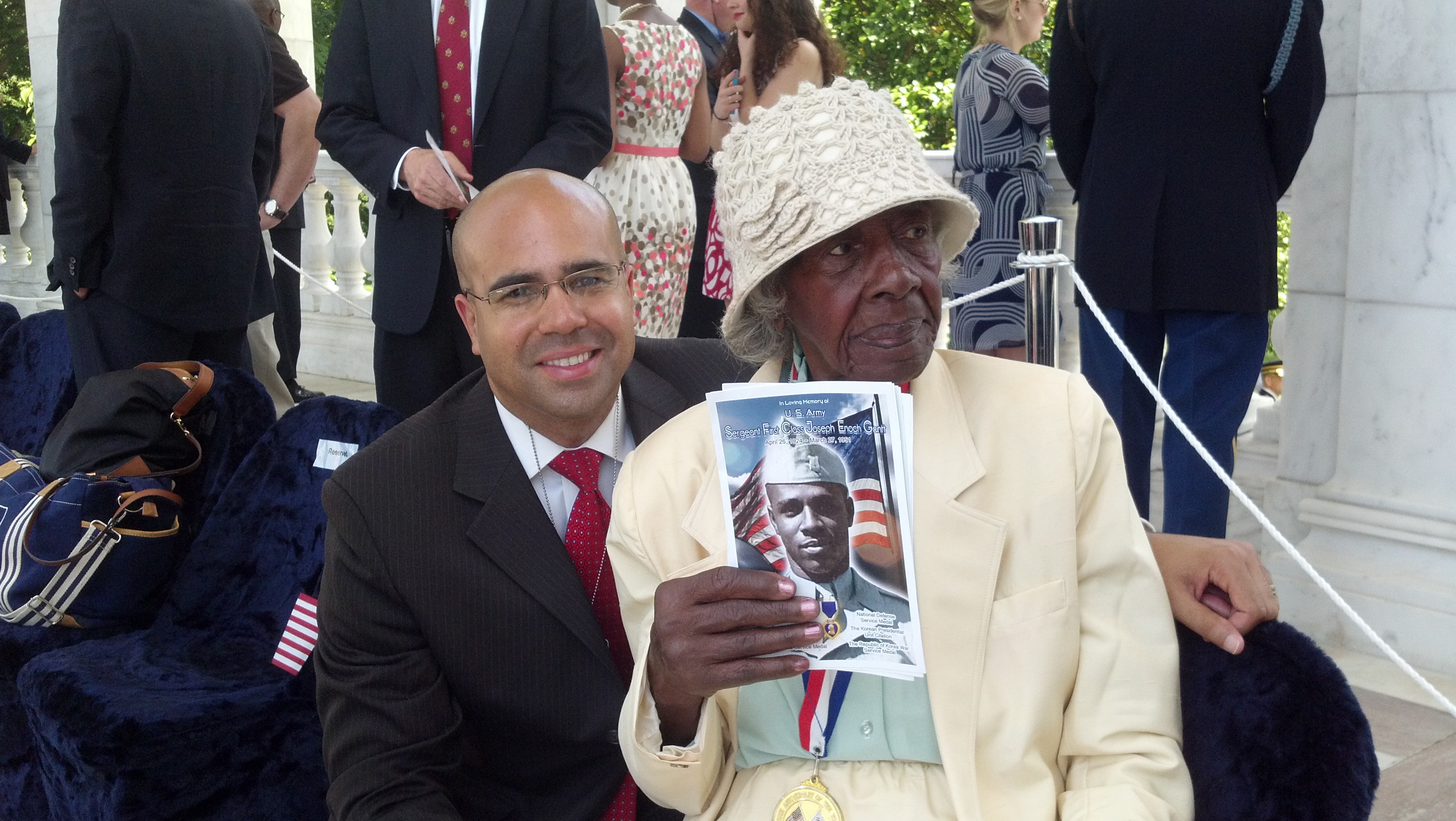
Clara Gantt Reunited with Husband

Clara Gantt waited to be reunited with her husband, a veteran of World War II and the Korean War. She waited, and waited, and waited -- never to remarry. An American story of timeless love and loyalty was shared by the President during the annual Memorial Day remarks at Arlington National Cemetery yesterday.

I was able to sit down with Ms. Gantt and her nephew for a special trip to Washington, D.C. to meet with the President over a Memorial Day breakfast, as well as other gold star families and several Veteran and Military Family Service Organizations.

Ms. Gantt was elated at the chance to meet the Commander-In-Chief, and shared the story of her husband, who was captured in the Korean War, and presumed dead. For more than 60 years, the remains of the war hero, who was posthumously awarded the Bronze Star Medal with Valor, were never identified nor returned to the United States.

The White House

Office of the Press Secretary

Remarks by the President at the White House Science Fair

East Room

12:13 P.M. EDT

THE PRESIDENT:  Welcome to the White House Science Fair!  (Applause.)  I love this event.  (Laughter.)  This is one of my favorite things all year long. 

Before I begin, I want to recognize some people who are here today who really worked hard not only to make our Science Fair happen, but are working hard to connect young people to science every single day.  We’ve got our Secretary of Education -- Arne Duncan is here.  (Applause.)  We have our head of NASA and former astronaut -- Charlie Bolden, is here.  There he is.  (Applause.)  We have our Director of the National Institutes of Health -- Francis Collins, is here.  (Applause.)  My chief Science Advisor -- John Holdren is here.  (Applause.) 

We’ve got Bill Nye, the Science Guy.  You can see his bow-tie.  He’s right here.  (Applause.)  Bill Nye, the Science Guy.  You guys like him, huh?  (Laughter.)  You see, you got a big “whoop.”  (Laughter.)  And we’ve got a woman who gets to build and blow stuff up for a living at MythBusters -- Kari Byron is here.  Where’s Kari?  There she is right there.  (Applause.)

And we want to recognize the people whose love and support helped these amazing young people get here:  the parents, mentors, and tireless teachers.  Let’s give them all a big round of applause.  Yay!  (Applause.)

Now, I have a confession to make.  When I was growing up, my science fair projects were not as successful as the ones here.  (Laughter.)  One year, I accidently killed some plants that were a part of my experiment.  (Laughter.)  Another time, a bunch of mice escaped in my grandmother’s apartment.  (Laughter.)  These experiments did not take me straight to the White House.  (Laughter.)    

And, instead, I have a chance now to see what real young scientists can do.  And they were just amazing.  And, by the way, there were no rodents loose in the White House.  (Laughter.)  I couldn’t even imagine doing some of the work that the young people I had a chance to meet were doing when I was their age, and your generation of young people is learning more than people in some ages ever did.  And our job is to make sure that you’ve got everything you need to continue on this path of discovery and experimentation and innovation that has been the hallmark not only of human progress, but also the hallmark of American progress.  And that’s why we decided to organize these science fairs. 

Last week, we had the Super Bowl champion Seattle Seahawks here.  They came by the White House.  And that was cool -- and there’s a tradition that when the NBA champions or the NFL champions or college football champions -- if they win a championship, they get a chance to come and get highlighted in the White House and take a picture with the President. 

But I believe that what’s being done by these amazing young people who I had a chance to meet is even more important.  And I’m a big sports fan -- everybody knows that.  But what’s happening here is more important.  As a society, we have to celebrate outstanding work by young people in science at least as much as we do Super Bowl winners. 

Because superstar biologists and engineers and rocket scientists and robot-builders, they don’t always get the attention that they deserve, but they’re what’s going to transform our society.  They’re the folks who are going to come up with cures for diseases and new sources of energy, and help us build healthier, more successful societies.  And I want to make sure that every young people across America knows what their peers are doing to inspire even more work in science. 

That’s what this White House Science Fair is all about.  And this year, we’re putting special emphasis and special focus on all the amazing girls and young women who are excelling at science and technology and engineering and math.  And I met some amazing young ladies here today.  (Applause.)  

So a lot of the young people who I met, they started off trying to solve a problem that they saw in their neighborhoods or their school.  But the solutions they’re coming up with have the potential to solve problems all around the world. 

So we have the all-girls app team from Resaca Middle School in Los Fresnos, Texas.  Where are they?  I just saw them.  There they are.  There they are.  (Applause.)  So one of their classmates -- an outstanding young man, Andres Salas -- is visually impaired.  So they designed an app to help him navigate their school and other buildings. 

The app tells Andres where he is, where he may need to go, can give him directions -- which saves Andres a huge amount of time because, they were explaining -- Andres was explaining how if he goes from middle school to high school, he’s got to essentially memorize and track his surroundings and this app is helping him do that.  And so not only do these young ladies have big brains, but they’ve also got big hearts. 

When Maria Hanes thought about entering the science fair her senior year in high school, she wanted to work on a project on something she loves.  She loves football more than anything else.  She’s from Oklahoma, so as you might imagine the Sooners are big in her mind.  And she also recognized, though, that a lot of players are suffering from the concussions that come from collisions -- and she also happened to manage her high school football team.

She dropped her cell phone one day -- like most teenagers, she loves her cell phone more than anything -- (laughter) -- including probably her parents at this stage -- (laughter) -- although I know that she’ll grow out of that.  She noticed her rubber case protected her phone.  She wondered what kinds of stuff are covering football helmets.  And that’s how her “Concussion Cushion” was born.  And that’s the kind of idea that we’re going to be talking about this Thursday, when we actually have parents, kids, and pro athletes come to the White House for a Healthy Kids and Safe Sports Concussion Summit. 

Peyton Robertson is here -- first of all, where is -- I want to make sure I acknowledge Maria.  Where is Maria?  There she is.  Stand up, Maria, so everybody can see you.  (Applause.) 

Now, we’ve got Peyton Robertson, who’s here from Pine Crest School of Fort Lauderdale, Florida.  I would just advise people -- I can’t do this because I’ve got a conflict of interest -- if you can buy stock in Peyton, you should do so now.  (Laughter.)  He actually had two projects here, both patented or patents pending. 

You say you’re 12?

PEYTON:  I am.

THE PRESIDENT:  “I am” -- yes.  (Laughter.)  This guy is something.  (Laughter.)  When Hurricane Wilma hit nearly nine years ago, Peyton took cover in the closet and played Monopoly with his mom, and later said, “It’s a lot easier to win when your parents are distracted by a Category 3 storm.”  (Laughter.)  That is a good point.  You were just buying Boardwalk and -- (laughter) -- they didn’t care, whatever.  (Laughter.)

After the storm, Peyton started thinking about the ways people prepare for floods.  And he noticed that sandbags are heavy and sometimes they leak.  So Peyton designed new, reusable sandbags, using polymers, that, when wet, expand to prevent saltwater from seeping in, and when they dry out, they weigh just four pounds.  Now, this is just one of his projects.  He had another project about retractable training wheels so dad doesn’t have to get out the screwdriver.  (Laughter.)  But it just gives you a sense of the kind of inquisitiveness and ingenuity that a young man like Peyton has.  So give Peyton a big round of applause.  (Applause.)  Way to go, Peyton.  

And then there is Olivia Van Amsterdam and Katelyn Sweeney, representing their team from Natick High School in Massachusetts.  Where are they?  Where did they go?  There they are.  Stand up.  (Applause.)  They learned that diving for a missing person can be dangerous and a time-consuming process, particularly up in Massachusetts where it gets cold and there’s often ice over the water.  So they worked to develop a robot that could help firefighters and ice rescue teams search for objects and bodies in perilous waters.

So they built the robot.  But here’s the other reason that I admire the two of them:  When they’re not busy building lifesaving robots, they are also establishing an all-girls robotics team.  And one is about to graduate.  The other is a junior.  They’re already helping other young women get involved in science and technology, engineering and math.  And we are very, very proud of them.  So give them a big round of applause.  (Applause.) 

Every one of the young people that I met here were amazing.  And it reminds us that there’s so much talent to be tapped if we're working together and lifting it up.  Right now, fewer than one in five bachelor’s degrees in engineering or computer science are earned by women.  Fewer than three in 10 workers in science and engineering are women.  That means we've got half the field -- or half our team we're not even putting on the field.  We've got to change those numbers.  These are the fields of the future.  This is where the good jobs are going to be.  And I want America to be home for those jobs. 

And that’s why, three years ago, I called for a national effort to train 100,000 excellent STEM teachers over the next decade.  We are now making progress on that front.  Today, I’m announcing a new $35 million competition to train some of our best math and science graduates to become teachers, and fill more of our classrooms with the hands-on science that we see here today, even when their school districts can’t afford a lot of fancy equipment.  We’re also going to expand STEM AmeriCorps to provide learning opportunities for 18,000 low-income students this summer.  (Applause.) 

And companies, non-profits, cities -- they’re doing their part.  Today, dozens of them are stepping up with new commitments to inspire and help more students learn.  So seven cities are partnering with more than 200 businesses and non-profits to connect girls and low-income students with mentors in science and technology.  Esri is giving every school in America the chance to use its scientific software for free.  And we're grateful for that.  Khan Academy is partnering with NASA to make lessons about the math and science going on relative to the Mars Project open and accessible to millions of learners worldwide.  And a lot of private sector leaders are involved in these efforts and have come here today -- probably to recruit -- (laughter) -- folks like Peyton, giving him a card and saying, here, in six years come call me.  (Laughter.) 

So we’re blessed to live in a country filled with bright, eager young people who love science, love tinkering, love making things, who have the ability to see old problems and grand challenges with fresh eyes.  And those of us who are grownups have an obligation to help them reach their full potential, just as others helped us. 

It was Franklin Roosevelt who said, “We cannot always build the future for our youth, but we can build our youth for the future.”  And as President, that’s what inspires me.  That’s what gets me up every day.  And that’s why I'm going to keep on -- for every day that I'm in this office, that I have the privilege of being President, I'm going to make sure that my focus is on how we're building up the youth of tomorrow so that they can succeed and, as a consequence, America can succeed.

To all the young people that I met -- I mean, I'm just looking at them.  I want to kind of actually talk about all of them.  You’ve got the young lady here who was diagnosed with cancer at the age of 12, and figured out, with the help of the surgeon, a better understanding of how to isolate the genetic mutations that impact her cancer.  She’s going to be going to Harvard, as you might imagine.  (Laughter.)

You got this guy right here who is designing a new computer system that might allow us to develop flu vaccines faster and more efficiently.  He’s going to Harvard.  (Laughter.)

You got this guy who won like a coding competition for STEM education and he just started high school.  So, I don't know, he'll go to MIT or someplace.  (Laughter.)

And then we've got the Girl Scout troop here from Oklahoma who -- stand up, girls.  (Applause.)  These guys did their own coding to design a Lego system that shows how, if water is rising too fast on a bridge, potentially the bridge would go up right away and save lives and save the bridge.  And they’re in second grade.  (Laughter.)  So I was just learning how to put up a tent.  (Laughter.)  They’re designing bridge stuff to save people.  So we're very proud of them.  Give them a big round of applause.  (Applause.)

Now that I'm at it I'm not going to leave anybody out.  Who else did I miss?  We've got this crew that had a simulated catapult that did outstanding work.  These two folks in the blue shirts are designing a sensor system to save pedestrians, and they are actually doing it jointly with kids in Addis Ababa, Ethiopia, because they want to spread their knowledge, not just restricted to here in the United States.

We've got our team from Chicago doing some outstanding robotic work.  (Applause.)  We've got a young lady from -- was it San Antonio? -- San Antonio, Texas, who’s doing the great work with electronic vehicles, and she actually sat in it.

And I think those are all the folks -- did I miss anybody who I saw, who I had a chance to see?  Because I know that we've got other contestants, including the folks back here. 

Anyway, I wanted to let you know how proud and impressed I was with all of you.  Not only are you great scientists and engineers and tinkerers, but you also gave outstanding presentations to the President of the United States.  And so not only are your parents very proud of you, and your teachers and your mentors, I'm very proud of you as well.   

Thank you, everybody.  This was a great day.  (Applause.)  Good luck.  Great event.  (Applause.)

END
12:30 P.M. EDT

President Obama Marvels at Brilliant Minds, Incredible Inventions at White House Science Fair

Watch on YouTube

Today at the White House, President Obama caught basketballs shot off a hand-built catapult, test drove a remote-controlled search-and-rescue robot, and used his hand to activate an auto-retracting bridge made of Legos – all part of his tour of the 2014 White House Science Fair.

This year’s event brought 100 incredible kids from more than 30 states to participate in a day-long showcase of innovative projects, patent-worthy inventions, and potentially life-saving discoveries made by America’s brightest young minds. The student exhibitors included a young researcher making progress to develop an anti-flu vaccine, an engineer who built an electric car and then raced it in a national competition, a group of girl coders who built an app to help their visually impaired classmate, and multiple teens with patents pending on groundbreaking inventions that could one day save lives.

Becky Fried is Deputy Assistant Director of Strategic Communications at the White House Office of Science and Technology Policy.
Related Topics: Education, Technology, Oklahoma