The White House

Office of the Press Secretary

President Obama Nominates Three to Serve on the U.S. Court of Federal Claims

WASHINGTON, DC - Today, President Obama nominated Judge Nancy B. Firestone, Lydia Kay Griggsby, and Thomas L. Halkowski to serve on the United States Court of Federal Claims.

“These men and women have proven themselves to be not only first-rate legal minds but faithful public servants,” said President Obama.  “It is with full confidence in their ability, integrity, and independence that I nominate them to serve on the Court of Federal Claims.”

Judge Nancy B. Firestone: Nominee for the United States Court of Federal Claims

Judge Nancy B. Firestone has served as a Judge of the United States Court of Federal Claims since 1998.  Previously, she was a Deputy Assistant Attorney General in the Environment and Natural Resources Division at the United States Department of Justice from 1995 to 1998.  From 1989 to 1995, Judge Firestone worked at the United States Environmental Protection Agency, serving as a Judge on the Environmental Appeals Board from 1992 to 1995 and as an Associate Deputy Administrator from 1989 to 1992.  She began her career by working in the Environment and National Resources Division of the Department of Justice in various positions from 1977 to 1989.  Judge Firestone received her J.D. with distinction in 1977 from the University of Missouri-Kansas City School of Law and her B.A. in 1973 from Washington University in St. Louis, Missouri.

Lydia Kay Griggsby: Nominee for the United States Court of Federal Claims

Lydia Kay Griggsby has been the Chief Counsel for Privacy and Information Policy for the United States Senate Committee on the Judiciary since 2008, having previously served as Privacy Counsel for the Committee from 2006 to 2008.  From 2004 to 2005, she worked as Counsel for the Senate Select Committee on Ethics.  Griggsby served as an Assistant United States Attorney in the District of Columbia from 1998 to 2004 and as a trial attorney in the Commercial Litigation Branch of the Civil Division in the United States Department of Justice from 1995 to 1998.  She began her legal career as an associate with DLA Piper LLP from 1993 to 1995.  Griggsby received her J.D. in 1993 from the Georgetown University Law Center and her B.A. in 1990 from the University of Pennsylvania.

Thomas L. Halkowski: Nominee for the United States Court of Federal Claims

Thomas L. Halkowski has been a Principal in the Delaware office of Fish & Richardson, P.C. since 2000, where he primarily handles patent litigation in federal court.  Previously, he served as a trial attorney in the Environment & Natural Resources Division of the United States Department of Justice from 1992 to 2000.  Halkowski began his legal career by clerking for Judge Helen W. Nies of the United States Court of Appeals for the Federal Circuit from 1990 to 1992 and for Judge Roger B. Andewelt of the United States Court of Federal Claims from 1989 to 1990.  Halkowski received his J.D. cum laude in 1989 from the University of Wisconsin Law School, his M.S. in 1986 from the University of Florida, and his B.S. cum laude in 1985 from Marquette University.

The White House

Office of the Press Secretary

Statement by the President

Today, the Minnesota Legislature took action to increase the state minimum wage, giving more hardworking Minnesotans the raise they deserve. With this important step, Minnesota joins a growing coalition of states, cities, counties and businesses that have taken action to do the right thing for their workers and their citizens. I commend the state legislature for raising their minimum wage and we look forward to Governor Dayton signing the bill into law soon.  I urge Congress to follow Minnesota’s lead, raise the federal minimum wage, and lift wages for 28 million Americans.  Congress should listen to the majority of Americans who say it’s time to give America a raise and help ensure that no American who works full time has to raise a family in poverty.

The White House

Office of the Press Secretary

President Obama Announces his Intent to Nominate Dr. William “Bro” Adams as Chairman of the National Endowment for the Humanities

WASHINGTON, DC – Today, President Obama announced his intent to nominate Dr. William “Bro” Adams as Chairman of the National Endowment for the Humanities.

President Obama said, “Bro brings demonstrated leadership and decades of experience as an administrator at major universities and liberal arts institutions.  His clear dedication and lifelong commitment to the humanities make him uniquely qualified to lead the nation’s cultural agency. I’m proud to nominate Bro as Chairman of the National Endowment for the Humanities and look forward to working with him in the months and years to come.”

President Obama announced his intent to nominate Dr. William “Bro” Adams as Chairman of the National Endowment for the Humanities:

Dr. William “Bro” Adams, Nominee for Chairman, National Endowment for the Humanities
Dr. William “Bro” Adams is President of Colby College, a position he has held since 2000.  Previously, he was President of Bucknell University from 1995 to 2000.  Dr. Adams was Vice President and Secretary of Wesleyan University from 1993 to 1995, and was Program Coordinator of the Great Works in Western Culture program at Stanford University from 1986 to 1988.  Earlier in his career, he held various teaching positions at Stanford University, Santa Clara University, and the University of North Carolina.  Dr. Adams served in the Vietnam War as a First Lieutenant in the U.S. Army.  In 1977, he became a Fulbright Scholar and conducted research at the Ecole des Hautes Etudes and the Ecole Normale Superieure in Paris, France.  Dr. Adams is a member of the Board of Directors of the Maine Film Center and the Maine Public Broadcasting Corporation.  Dr. Adams received a B.A. from the Colorado College and a Ph.D. from the University of California, Santa Cruz.

The White House

Office of the Press Secretary

Remarks by the President at LBJ Presidential Library Civil Rights Summit

Lyndon B. Johnson Presidential Library
Austin, Texas

12:16 P.M. CDT

THE PRESIDENT:  Thank you.  Thank you very much.  (Applause.)  Thank you so much.  Please, please, have a seat.  Thank you. 

What a singular honor it is for me to be here today.  I want to thank, first and foremost, the Johnson family for giving us this opportunity and the graciousness with which Michelle and I have been received. 

We came down a little bit late because we were upstairs looking at some of the exhibits and some of the private offices that were used by President Johnson and Mrs. Johnson.  And Michelle was in particular interested to -- of a recording in which Lady Bird is critiquing President Johnson’s performance.  (Laughter.)  And she said, come, come, you need to listen to this.  (Laughter.)  And she pressed the button and nodded her head.  Some things do not change -- (laughter) -- even 50 years later.

To all the members of Congress, the warriors for justice, the elected officials and community leaders who are here today  -- I want to thank you.

Four days into his sudden presidency -- and the night before he would address a joint session of the Congress in which he once served -- Lyndon Johnson sat around a table with his closest advisors, preparing his remarks to a shattered and grieving nation.

He wanted to call on senators and representatives to pass a civil rights bill -- the most sweeping since Reconstruction.  And most of his staff counseled him against it.  They said it was hopeless; that it would anger powerful Southern Democrats and committee chairmen; that it risked derailing the rest of his domestic agenda.  And one particularly bold aide said he did not believe a President should spend his time and power on lost causes, however worthy they might be.  To which, it is said, President Johnson replied, “Well, what the hell’s the presidency for?”  (Laughter and applause.)  What the hell’s the presidency for if not to fight for causes you believe in?

Today, as we commemorate the 50th anniversary of the Civil Rights Act, we honor the men and women who made it possible.  Some of them are here today.  We celebrate giants like John Lewis and Andrew Young and Julian Bond.  We recall the countless unheralded Americans, black and white, students and scholars, preachers and housekeepers -- whose names are etched not on monuments, but in the hearts of their loved ones, and in the fabric of the country they helped to change. 

But we also gather here, deep in the heart of the state that shaped him, to recall one giant man’s remarkable efforts to make real the promise of our founding:  “We hold these truths to be self-evident, that all men are created equal.”

Those of us who have had the singular privilege to hold the office of the Presidency know well that progress in this country can be hard and it can be slow, frustrating and sometimes you’re stymied.  The office humbles you.  You’re reminded daily that in this great democracy, you are but a relay swimmer in the currents of history, bound by decisions made by those who came before, reliant on the efforts of those who will follow to fully vindicate your vision.

But the presidency also affords a unique opportunity to bend those currents -- by shaping our laws and by shaping our debates; by working within the confines of the world as it is, but also by reimagining the world as it should be.

This was President Johnson’s genius.  As a master of politics and the legislative process, he grasped like few others the power of government to bring about change. 

LBJ was nothing if not a realist.  He was well aware that the law alone isn’t enough to change hearts and minds.  A full century after Lincoln’s time, he said, “Until justice is blind to color, until education is unaware of race, until opportunity is unconcerned with the color of men’s skins, emancipation will be a proclamation but not a fact.”

He understood laws couldn’t accomplish everything.  But he also knew that only the law could anchor change, and set hearts and minds on a different course.  And a lot of Americans needed the law’s most basic protections at that time.  As Dr. King said at the time, “It may be true that the law can’t make a man love me but it can keep him from lynching me, and I think that’s pretty important.”  (Applause.)

And passing laws was what LBJ knew how to do.  No one knew politics and no one loved legislating more than President Johnson.  He was charming when he needed to be, ruthless when required.  (Laughter.)  He could wear you down with logic and argument.  He could horse trade, and he could flatter.  “You come with me on this bill,” he would reportedly tell a key Republican leader from my home state during the fight for the Civil Rights Bill, “and 200 years from now, schoolchildren will know only two names:  Abraham Lincoln and Everett Dirksen!”  (Laughter.)  And he knew that senators would believe things like that.  (Laughter and applause.)

President Johnson liked power.  He liked the feel of it, the wielding of it.  But that hunger was harnessed and redeemed by a deeper understanding of the human condition; by a sympathy for the underdog, for the downtrodden, for the outcast.  And it was a sympathy rooted in his own experience.

As a young boy growing up in the Texas Hill Country, Johnson knew what being poor felt like.  “Poverty was so common,” he would later say, “we didn’t even know it had a name.”  (Laughter.)  The family home didn’t have electricity or indoor plumbing.  Everybody worked hard, including the children.  President Johnson had known the metallic taste of hunger; the feel of a mother’s calloused hands, rubbed raw from washing and cleaning and holding a household together.  His cousin Ava remembered sweltering days spent on her hands and knees in the cotton fields, with Lyndon whispering beside her, “Boy, there’s got to be a better way to make a living than this.  There’s got to be a better way.”

It wasn’t until years later when he was teaching at a so-called Mexican school in a tiny town in Texas that he came to understand how much worse the persistent pain of poverty could be for other races in a Jim Crow South.  Oftentimes his students would show up to class hungry.  And when he’d visit their homes, he’d meet fathers who were paid slave wages by the farmers they worked for.  Those children were taught, he would later say, “that the end of life is in a beet row, a spinach field, or a cotton patch.” 

Deprivation and discrimination -- these were not abstractions to Lyndon Baines Johnson.  He knew that poverty and injustice are as inseparable as opportunity and justice are joined.  So that was in him from an early age.

Now, like any of us, he was not a perfect man.  His experiences in rural Texas may have stretched his moral imagination, but he was ambitious, very ambitious, a young man in a hurry to plot his own escape from poverty and to chart his own political career.  And in the Jim Crow South, that meant not challenging convention.  During his first 20 years in Congress, he opposed every civil rights bill that came up for a vote, once calling the push for federal legislation “a farce and a sham.”  He was chosen as a vice presidential nominee in part because of his affinity with, and ability to deliver, that Southern white vote.  And at the beginning of the Kennedy administration, he shared with President Kennedy a caution towards racial controversy. 

But marchers kept marching.  Four little girls were killed in a church.  Bloody Sunday happened.  The winds of change blew.  And when the time came, when LBJ stood in the Oval Office -- I picture him standing there, taking up the entire doorframe, looking out over the South Lawn in a quiet moment -- and asked himself what the true purpose of his office was for, what was the endpoint of his ambitions, he would reach back in his own memory and he’d remember his own experience with want. 

And he knew that he had a unique capacity, as the most powerful white politician from the South, to not merely challenge the convention that had crushed the dreams of so many, but to ultimately dismantle for good the structures of legal segregation.  He’s the only guy who could do it -- and he knew there would be a cost, famously saying the Democratic Party may “have lost the South for a generation.” 

That’s what his presidency was for.  That’s where he meets his moment.  And possessed with an iron will, possessed with those skills that he had honed so many years in Congress, pushed and supported by a movement of those willing to sacrifice everything for their own liberation, President Johnson fought for and argued and horse traded and bullied and persuaded until ultimately he signed the Civil Rights Act into law. 

And he didn’t stop there -- even though his advisors again told him to wait, again told him let the dust settle, let the country absorb this momentous decision.  He shook them off.  “The meat in the coconut,” as President Johnson would put it, was the Voting Rights Act, so he fought for and passed that as well.  Immigration reform came shortly after.  And then, a Fair Housing Act.  And then, a health care law that opponents described as “socialized medicine” that would curtail America’s freedom, but ultimately freed millions of seniors from the fear that illness could rob them of dignity and security in their golden years, which we now know today as Medicare.  (Applause.)

What President Johnson understood was that equality required more than the absence of oppression.  It required the presence of economic opportunity.  He wouldn’t be as eloquent as Dr. King would be in describing that linkage, as Dr. King moved into mobilizing sanitation workers and a poor people’s movement, but he understood that connection because he had lived it.  A decent job, decent wages, health care -- those, too, were civil rights worth fighting for.  An economy where hard work is rewarded and success is shared, that was his goal.  And he knew, as someone who had seen the New Deal transform the landscape of his Texas childhood, who had seen the difference electricity had made because of the Tennessee Valley Authority, the transformation concretely day in and day out in the life of his own family, he understood that government had a role to play in broadening prosperity to all those who would strive for it.

“We want to open the gates to opportunity,” President Johnson said, “But we are also going to give all our people, black and white, the help they need to walk through those gates.” 

Now, if some of this sounds familiar, it’s because today we remain locked in this same great debate about equality and opportunity, and the role of government in ensuring each.  As was true 50 years ago, there are those who dismiss the Great Society as a failed experiment and an encroachment on liberty; who argue that government has become the true source of all that ails us, and that poverty is due to the moral failings of those who suffer from it.  There are also those who argue, John, that nothing has changed; that racism is so embedded in our DNA that there is no use trying politics -- the game is rigged. 

But such theories ignore history.  Yes, it’s true that, despite laws like the Civil Rights Act, and the Voting Rights Act and Medicare, our society is still racked with division and poverty.  Yes, race still colors our political debates, and there have been government programs that have fallen short.  In a time when cynicism is too often passed off as wisdom, it’s perhaps easy to conclude that there are limits to change; that we are trapped by our own history; and politics is a fool’s errand, and we’d be better off if we roll back big chunks of LBJ’s legacy, or at least if we don’t put too much of our hope, invest too much of our hope in our government.

I reject such thinking.  (Applause.)  Not just because Medicare and Medicaid have lifted millions from suffering; not just because the poverty rate in this nation would be far worse without food stamps and Head Start and all the Great Society programs that survive to this day.  I reject such cynicism because I have lived out the promise of LBJ’s efforts.  Because Michelle has lived out the legacy of those efforts.  Because my daughters have lived out the legacy of those efforts.  Because I and millions of my generation were in a position to take the baton that he handed to us.  (Applause.)

Because of the Civil Rights movement, because of the laws President Johnson signed, new doors of opportunity and education swung open for everybody -- not all at once, but they swung open.  Not just blacks and whites, but also women and Latinos; and Asians and Native Americans; and gay Americans and Americans with a disability.  They swung open for you, and they swung open for me.  And that’s why I’m standing here today -- because of those efforts, because of that legacy.  (Applause.)

And that means we’ve got a debt to pay.  That means we can’t afford to be cynical.  Half a century later, the laws LBJ passed are now as fundamental to our conception of ourselves and our democracy as the Constitution and the Bill of Rights.  They are foundational; an essential piece of the American character. 

But we are here today because we know we cannot be complacent.  For history travels not only forwards; history can travel backwards, history can travel sideways.  And securing the gains this country has made requires the vigilance of its citizens.  Our rights, our freedoms -- they are not given.  They must be won.  They must be nurtured through struggle and discipline, and persistence and faith. 

And one concern I have sometimes during these moments, the celebration of the signing of the Civil Rights Act, the March on Washington -- from a distance, sometimes these commemorations seem inevitable, they seem easy.  All the pain and difficulty and struggle and doubt -- all that is rubbed away.  And we look at ourselves and we say, oh, things are just too different now;  we couldn’t possibly do what was done then -- these giants, what they accomplished.  And yet, they were men and women, too.  It wasn’t easy then.  It wasn’t certain then. 

Still, the story of America is a story of progress.  However slow, however incomplete, however harshly challenged at each point on our journey, however flawed our leaders, however many times we have to take a quarter of a loaf or half a loaf -- the story of America is a story of progress.  And that’s true because of men like President Lyndon Baines Johnson.  (Applause.)

In so many ways, he embodied America, with all our gifts and all our flaws, in all our restlessness and all our big dreams.  This man -- born into poverty, weaned in a world full of racial hatred -- somehow found within himself the ability to connect his experience with the brown child in a small Texas town; the white child in Appalachia; the black child in Watts.  As powerful as he became in that Oval Office, he understood them.  He understood what it meant to be on the outside.  And he believed that their plight was his plight too; that his freedom ultimately was wrapped up in theirs; and that making their lives better was what the hell the presidency was for.  (Applause.)

And those children were on his mind when he strode to the podium that night in the House Chamber, when he called for the vote on the Civil Rights law.  “It never occurred to me,” he said, “in my fondest dreams that I might have the chance to help the sons and daughters of those students” that he had taught so many years ago, “and to help people like them all over this country.  But now I do have that chance.  And I’ll let you in on a secret -- I mean to use it.  And I hope that you will use it with me.”  (Applause.)

That was LBJ’s greatness.  That’s why we remember him.  And if there is one thing that he and this year’s anniversary should teach us, if there’s one lesson I hope that Malia and Sasha and young people everywhere learn from this day, it’s that with enough effort, and enough empathy, and enough perseverance, and enough courage, people who love their country can change it.

In his final year, President Johnson stood on this stage, racked with pain, battered by the controversies of Vietnam, looking far older than his 64 years, and he delivered what would be his final public speech. 

“We have proved that great progress is possible,” he said.  “We know how much still remains to be done.  And if our efforts continue, and if our will is strong, and if our hearts are right, and if courage remains our constant companion, then, my fellow Americans, I am confident, we shall overcome.”  (Applause.)

We shall overcome.  We, the citizens of the United States.  Like Dr. King, like Abraham Lincoln, like countless citizens who have driven this country inexorably forward, President Johnson knew that ours in the end is a story of optimism, a story of achievement and constant striving that is unique upon this Earth.  He knew because he had lived that story.  He believed that together we can build an America that is more fair, more equal, and more free than the one we inherited.  He believed we make our own destiny.  And in part because of him, we must believe it as well.

Thank you.  God bless you.  God bless the United States of America.  (Applause.) 

END
12:46 P.M. CDT

The White House

Office of the Press Secretary

Press Gaggle by Press Secretary Jay Carney en route Austin, TX, 4/10/2014

Aboard Air Force One
En Route Austin, Texas

10:14 A.M. CDT

MR. CARNEY:  Good morning, everyone.  Thank you for joining us aboard Air Force One as we make our way from Houston to Austin.  The President is looking forward to participating in celebration today at the LBJ Museum and Library.  He’ll deliver remarks on this very significant anniversary.

With that, I’ll take your questions.

Q    Vladimir Putin has told European leaders the dispute over Ukraine’s gas debt to Russia could affect supplies of Russian gas to Europe.  Is this something you’re aware of, concerned about?

MR. CARNEY:  Well, I haven’t seen that specific report.  Obviously, the issue of energy security in Europe is one that we’re always paying close attention to.  We’ve made clear in the past that it’s wholly inappropriate to use energy exports in order to achieve diplomatic or geopolitical objectives, and we’ve made that view clear.  But we’re in constant conversation with our European partners on matters like this.  But again, that’s just a broad statement.  I haven’t seen that latest report.

Q    Jay, the Congress is poised this afternoon to pass a bill banning the envoy that Iran has chosen for the United Nations.  I know you’ve said that that selection is not viable, but will President Obama sign that piece of legislation?

MR. CARNEY:  Well, as you noted, Josh, the House has not acted as of yet, so I’m going to withhold any statement about --

Q    But you know it’s in the bill, and it’s obviously going to pass.

MR. CARNEY:  What I can tell you is that we’ve made clear and have communicated to the Iranians that the selection they’ve put forward is not viable, and we’re continuing to make that understood.  In terms of legislation, I just don’t have a view on it in terms of the President at this time.

Q    Jay, what kind of impact or consequence does the legislation have in connection with the nuclear talks on Iran?

MR. CARNEY:  None that we have seen.  That’s a kind of fill-in-the-blank question when it comes to Iran with the issues that we have with them, that we continue to have serious disagreements with Iran over.  And this matter is but one.  The talks continue; they continue to be workmanlike and productive.  And we’ve seen no impact on those discussions from some of these other issues.

Q    Eleven Democratic senators are calling on the President to outline an explicit timeline for approving the Keystone pipeline.  Is he going to do that?

MR. CARNEY:  Our position on that process hasn’t changed, which is that it needs to run its appropriate course without interference from the White House or Congress.  It was because of actions taken by Republicans in Congress that one delay was caused in the process already.  So that review continues at the State Department where it’s housed in accordance with past practice of previous administrations of both parties.  And when there’s a decision to be announced, it will be announced.

Q    Jay, voting rights is an issue that’s likely to be on the table tomorrow when the President is in New York and perhaps today as well.  There’s a bipartisan bill from Senators Leahy and Sensenbrenner that would fix some of the issues created by the Supreme Court ruling that undermine parts of the Voting Rights Act.  Is that legislation that the President could support?

MR. CARNEY:  Well, I think that effort is underway and we support the fact that there’s a bipartisan effort to address the need created by the Supreme Court’s decision.  But I haven’t seen legislation, so I don’t have a specific comment on that.  But I think as I’ve said in the past and we have said in the past, it is certainly heartening that not just Democrats but Republicans as well understand the need to fix some of the problems created by the Supreme Court decision.

Q    Has the President seen the intelligence community’s IG report on the Boston bombing?  And does the White House still believe that Russia has been a constructive partner on law enforcement issues?

MR. CARNEY:  I don’t believe the President has seen it, and in terms of the role the FBI had and the information that they received from the Russians, I would refer you to the FBI for specifics. 

The U.S. and Russia have a shared interest in preventing terrorist attacks and a history of close cooperation.  Following the attack in Boston, we received cooperation from the Russian government in the investigation.  As we’ve explained, based on limited information provided by the Russian government, the FBI conducted a thorough investigation of one of the brothers, Tamerlan Tsarnaev, in 2011 and did not find any terrorism activity. 

As part of that investigation, the FBI checked U.S. government databases and other information to look for things as derogatory, such as -- such things as derogatory telephone communication; possible use of online sites associated with the promotion of radical activity; associations with other persons of interest; travel history and plans in education history.  The FBI also interviewed Tamerlan Tsarnaev and family members.  The FBI did not find any terrorism activity, domestic or foreign. 

But for more specifics on that, I would refer you to the FBI.  Obviously, the information that we were provided by the Russians led to that examination that I just described to you, which did not produce any indication of terrorism activity.

Q    Any interaction with any other President today?  And how long is this speech going to take?

MR. CARNEY:  (Laughter.)  You in a rush to get home, Steve? 

Q    Maybe I should have worded that a little differently.  (Laughter.)

MR. CARNEY:  That was Steve Holland, ladies and gentlemen.  I’m not aware of any interaction that the President will have with a former President.  My understanding is that those who are participating in the event are doing so at different times, not when we’re going to be there.  But if that changes I’ll let you know.  On the speech itself, it will be -- the length will be just right. 

Q    Jay, last night the President criticized Republicans and others in terms of the voting rights issue.  But other than criticizing Republicans, is the President satisfied that he’s done enough in his five years in office to expand civil rights?  What does he feel like has been his legacy on civil rights at this point?

MR. CARNEY:  Well, that’s an interesting question.  I think that the President will I think address the broader subject today, and the legacy of Lyndon Baines Johnson and of those people, famous and unknown, who helped make the Civil Rights Act a reality, and helped make some of the other landmark achievements in the Johnson administration on civil rights a reality.

Q    But does he feel like he’s done enough as President?

MR. CARNEY:  I think the President is going to let others judge his record. 

Q    Well, some people say that he’s been more willing to discuss race in the second term, more willing to take on issues that have been of concern to the African American community in his second term.  Do you agree with that? 

MR. CARNEY:  I’m not sure I would agree with that.  I think that the President has obviously addressed issues that affect all Americans, including minorities -- African Americans, Latinos and others.  When he talks about the challenge posed by a lack of mobility economically, obviously that speaks to people who are struggling to get into the middle class, and that can be something identified as an issue that speaks to minorities but it speaks to all Americans.  But that’s something he’s been talking a lot about in his second term.

On sort of other civil rights issues, I think it’s fair to say that there has been enormous progress made under this administration when it comes to LGBT rights -- historic progress.  And that’s something the President wants to continue and wants to see continue.  He also believes that our work is not done when it comes to ensuring that our laws are enforced, when it comes to equality for women. 

And as the President noted last night, it is astounding, as we celebrate the 50th anniversary of the Civil Rights Act, that not a single Republican in the Senate thought it was worth their time or worth their support to vote for a bill that would simply give women more tools to ensure that they’re paid fairly.  And the data is clear on why this is necessary, but for some reason Republicans don’t seem to agree on this issue, which is a little shocking. 

Q    So he’s going to be in Austin celebrating civil rights victories of 50 years ago.  Is there something substantive that he’ll be proposing?  I mean, is that what you’re getting at?  Is he going to emphasize paycheck fairness as the next civil rights movement?

MR. CARNEY:  No, I’m simply noting that as an issue that is in the arena of civil rights, the Paycheck Fairness Act is something that Congress could have joined the President in moving forward, and they chose not to -- Republicans chose not to, which is confounding --

Q    Well, I guess what I’m asking is will he be --

MR. CARNEY:  I’m not going to preview the speech.  I would note that -- beyond saying that he’s going to talk about all those Americans both famous and not who contributed to making the Civil Rights Act a reality.  He’s going to talk about President Johnson’s historic achievement and his legacy.  And he will talk about the need to safeguard that progress to continue to move this country forward, as LBJ did.

Q    Any readout of his -- interaction with President Bush yesterday?

MR. CARNEY:  I think the reporting I saw on it captured the meeting -- the brief meeting very well.  I don’t have anything more to add to that.  I think it’s something the President -- I know the President and First Lady greatly appreciated the fact that President George H.W. Bush greeted them on the tarmac.  And the President has enormous regard and respect for President Bush.

Q    Any lawmakers or other notables that are on this flight with us today?

MR. CARNEY:  Let me get you -- we do have some.  I’ll have to get you a list. 

Q    Will he be meeting with the Johnsons’ daughters?

MR. CARNEY:  I think that he will -- upon arrival, he and the First Lady will spend some time -- just a minute, let me see if I can get this page here -- with members of President Johnson’s family, as well as the director of the LBJ Presidential Library, Mark Updegrove, and Congressman Lewis, John Lewis.

Q    Will he be doing with them -- he’s taking a tour, right?

MR. CARNEY:  I think they’ll have a review of some of the exhibits.

Q    Is the pool going along?

MR. CARNEY:  Is the pool going?  My esteemed colleague says yes.  Hannah Hankins coming to my rescue.

Q    Thanks.

MR. CARNEY:  Anybody else?  All right -- oh, Congresswoman Sheila Jackson Lee.

END
10:28 A.M. CDT

Announcing President Obama’s New Ambassadors for Global Entrepreneurship

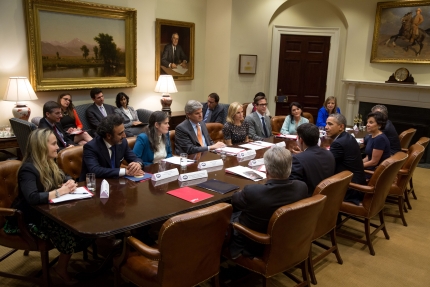
At the Global Entrepreneurship Summit in Kuala Lumpur, Malaysia last October, President Obama announced that we would bring together a group of America’s best and brightest innovators to champion entrepreneurship both here at home and overseas. Together, these individuals would use their networks and platforms to stimulate a start-up culture in the United States and all over the globe. I am honored to chair this new group, the Presidential Ambassadors for Global Entrepreneurship (PAGE).

President Barack Obama drops by the first meeting of the Presidential Ambassadors for Global Entrepreneurship, with Commerce Secretary Penny Pritzker, in the Roosevelt Room of the White House

President Barack Obama drops by the first meeting of the Presidential Ambassadors for Global Entrepreneurship, with Commerce Secretary Penny Pritzker, in the Roosevelt Room of the White House, April 7, 2014. (Official White House Photo by Pete Souza)

Marking the 50th Anniversary of the Civil Rights Act at the LBJ Presidential Library

Ed. note: Tune in to whitehouse.gov/live at 11:50 am ET to watch President Obama's remarks at the LBJ Presidential Library to commemorate the 50th anniversary of the signing of the Civil Rights Act.

In early December 1972, heroes of the Civil Rights Movement of the 1950s and 1960s, braved a rare Austin ice storm to convene at the LBJ Presidential Library for a Civil Rights Symposium. Towering figures like Hubert Humphrey, Barbara Jordan, Clarence Mitchell and Earl Warren rose to the stage in the course of the two-day conference to reflect on the movement they had helped to foster while examining the issues where progress was still needed.

Among them was the host of the gathering, Lyndon Baines Johnson, the thirty-sixth President. It was he who, during the course of his five-year presidency, had sounded a death knell to racial inequality through a triumvirate of laws: The Civil Rights Act of 1964, the Voting Rights Act of 1965, and the Fair Housing Act of 1968.

Lyndon B. Johnson speaks to the nation before signing the Civil Rights Act of 1964.

Lyndon B. Johnson speaks to the nation before signing the Civil Rights Act of 1964. East Room, White House, Washington, DC. 7/2/64.

He considered the second—the Voting Rights Act—his greatest legislative achievement. As with all of them, it had come hard. In March 1965, after a protest march in Selma, Alabama, was brutally thwarted by state troopers, he stood before a joint session of Congress knowing that his plea for the law would fall on the deaf ears of segregationists in his own party. His voice strong, his will determined, he said:

It was more than a hundred years ago that Abraham Lincoln, a great president from another party, signed the Emancipation Proclamation, but emancipation is a proclamation and not a fact. A century has passed since the day of promise. And the promise is unkept.

What happened in Selma is part of a larger movement, which reached into every section and state of America. It is the effort of American Negroes to secure for themselves the full blessings of American life. Their cause must be our cause, too. Because it is not just Negroes, but really, it’s all of us who must overcome the crippling legacy of bigotry and injustice.

And we shall overcome.

Related Topics: Civil Rights, Alabama

President Obama Speaks at Fort Hood Memorial Service

Yesterday, President Obama spoke at Fort Hood Military Base in Killeen, Texas to share his condolences after last week's tragic shooting at the base where Sergeant first Class Daniel Ferguson, Staff Sergeant Carlos Lazaney-Rodriguez, and Sergeant Timothy Owens lost their lives.

"It was love for country that inspired these three Americans to put on the uniform and join the greatest Army that the world has ever known," President Obama said. "They lived those shining values -- loyalty, duty, honor -- that keep us strong and free."

During his remarks at the memorial, the President explained that we must honor their lives "not in word or talk, but in deed and in truth."

We must honor these men with a renewed commitment to keep our troops safe, not just in battle but on the home front, as well. In our open society, and at vast bases like this, we can never eliminate every risk. But as a nation, we can do more to help counsel those with mental health issues, to keep firearms out of the hands of those who are having such deep difficulties. As a military, we must continue to do everything in our power to secure our facilities and spare others this pain.

The White House

Office of the Press Secretary

Remarks by the President at Joint DCCC/DSCC Dinner

Private Residence
Houston, Texas

6:56 P.M. CDT

THE PRESIDENT:  Thank you.  (Applause.)  Thank you, everybody.  Thank you.  (Applause.)   Everybody sit down.  Have a seat.  Have a seat.  Thank you.  Well, first of all, I just want to thank John Eddie and Sheridan for building this house just for our fundraiser here.  (Laughter.)  I think it turned out just fine.  I don't know what your next project is.  (Laughter.)  But it is gorgeous, and we are so grateful to you for everything you’ve done for this community, everything you’ve done for the country, and all the help that you’ve provided to Democrats all across the country.  It really means a lot.  So thank you very much.  (Applause.)  Appreciate you all.

We've got some other luminaries here that I just want to make sure I recognize.  First of all, your outstanding mayor, Annise Parker is here.  (Applause.)   With her beautiful daughter.   Good to see you.  (Applause.)  Somebody who is going to be Speaker of the House once again, has already gone down in history as one of the best Speakers we've ever had -- Nancy Pelosi is in the house.  (Applause.)  Of course, you cannot be a good Speaker unless you’ve got great members in your caucus, and we've got a couple of outstanding ones from the Houston area -- Sheila Jackson Lee -- (applause) -- and Representative Al Green.  (Applause.)  And two outstanding former leaders here in Texas who continue to provide so much outstanding service to the community -- first of all, former mayor, Bill White is in the house.  (Applause.)  He just wrote a book, by the way.  Everybody go out and buy it.  (Laughter.)  If somebody is an author you’ve always got to plug the guy’s book.  (Laughter.)   It was reviewed in The New York Times.  It’s a serious book.    And also, former governor, Mark White.  Where did Mark go?  There he is right there.  (Applause.) 

And of course, all of you are here today, so I want to thank you for that.  And whoever was in charge of the weather in Houston -- usually I come down to Houston and it's not quite this comfortable.  But it’s beautiful.  And thanks to Eden for coming, too, because she’s laughing at all my jokes.  (Laughter.) 

Let me say, first of all, I just came down from Fort Hood, and we were commemorating and celebrating the lives of three incredible patriots who were shot and killed during the event that happened last week there, and met with the families and had a chance to address the entire community.  And I think it's useful just to remember as we wind down this war in Afghanistan how heavy a burden our men and women in uniform and their families have carried over these last 10-plus years of war, and how many scars, seen and unseen, remain, and how important it is for us to support these incredible patriots and incredible veterans.  I know that that's something that folks focus on here in Houston, but I wanted to make sure that I made mention of that.

As a consequence, I was out of Washington, which usually is okay.  It's good getting out of Washington, gives you a little perspective.  While I was gone, the Republicans in the Senate chose to block a bill that seemed like common sense, I think, to most of us, which would provide the ability for us to meaningfully enforce the simple concept of equal pay for equal work; the notion that your mom, your sister, your daughters, your spouse should not be discriminated against at the workplace, and if they’re doing a good job doing something, that they should get paid the same as somebody’s son, husband, father.  

You would think that that at this point would not be a controversial proposition.  And yet, the Republicans in the Senate uniformly decided to say no.  Now, we had done an executive order yesterday facilitating federal contractors to provide basic information -- (applause) -- to make sure that if somebody shares their salary with a fellow employee that they couldn't be retaliated against; that some data is provided -- in aggregate, not in detailed ways -- to make sure that people know whether or not they’re treating women the way they should on the job.  But obviously the action I took through this executive order was restricted to federal contractors; it didn’t reach every employer. 

Now, apparently, a lot of these Republicans during the debate said they just think that this idea there’s a gender pay gap is a fantasy, it's not real, there are all these other reasons why this happens.  And in fact, I think there was a candidate for the Senate, a Republican in Michigan, who voiced the opinion that women make other choices.  And I think that's certainly true; every individual makes other choices.  Very rarely do you meet people who make the choice to be paid less for doing the same job.  (Laughter.) 

But I use this as just one example of the scores of issues that are critical to advancing this country’s future in which not only is the other side blocking progress but aren’t even offering a persuasive alternative vision for how we're going to grow the economy and make sure that anybody who works hard in this country can get ahead.  This has become the least productive Congress in modern history, recent memory.  And that's by objective measures, just basic activity.  At a time when the economy is actually poised to take off, at a time where we finally have recovered from the most crippling economic crisis since the Great Depression, at a time when the private sector has created close to 9 million new jobs and the housing market is recovering and we've got an energy boom going on in this country like we've never seen in a very long time, and the dropout rate is coming down and we've just got a lot of things going for us -- and yet we've still got a lot of competition from countries like China and Germany -- and this can be the American Century just like the 20th century was if we make some good decisions.  If we're investing in early childhood education; if we're investing in rebuilding our roads and our infrastructure -- because I got to tell you, driving here from the airport, it was a little bumpy.  (Laughter.)  And if you think the potholes are bad here, imagine what they’re like where we had one of the worst winters in recent memory.

 If we invest in basic science and research; if we have a smarter tax code that rewards investment and rewards hard work instead of being rife with loopholes that is good business for a lot of accounting firms, but isn't producing any value in our economy -- if we're training our workers for the jobs that are out there right now, if we're making our high schools more effective -- if we take some of these basic steps we are poised to own the next couple of decades.  And when I travel overseas, what’s fascinating is the degree to which other leaders look at us with envy:  You guys have the best cards.  And yet they look at Washington and they say why is it that things are so dysfunctional?  

And that's why I'm here today to talk to you, because we have to have a Congress that works -- not one that is -- march in lockstep, not one that agrees with every proposal I put forward, but a Congress that is serious about governance and is thinking about the next generation and not just the next election.

You take an issue like immigration reform.  Everybody agrees that it's broken.  You’ve got law enforcement, you’ve got the evangelical community, you’ve got the business community, you’ve got the agricultural sector, you’ve got immigration rights advocates -- across the board, everybody says we can fix this thing.  It will be good for families that are being torn apart; it will be something that adds value to our economy; it will actually reduce our deficit because we're bringing people out of the shadows.  We got a bipartisan vote out of the Senate, and yet we cannot even get a vote in the House of Representatives.  And it's not because it doesn’t make sense.  It's not because there’s some serious dispute or technical difference in terms of policy.  It has to do with politics. 

And we've got to stop that.  We don't have time for it.  Too much is at stake.  There are too many families out here who, even though the economy is growing, are still trapped in stagnant wages and stagnant incomes and still struggling to make ends meet at the end of the month.  And if we were taking some basic steps -- minimum wage?  Three-quarters of the country agree we should raise the minimum wage.  Now, usually, when three-quarters of the country agree on something -- and that's not that often -- politicians rush to get that thing done.  (Laughter.)  

AUDIENCE MEMBER:  (Inaudible.)

THE PRESIDENT:  I agree.  Eden agrees with me.  (Laughter.)  

Well, why are we doing it?  The fact of the matter is, is that you’ve got a Congress right now that is solely focused on obstruction because they think it's a good political strategy.   And here’s my challenge to you.  Here’s the disconcerting thing.  Obstruction may actually be a good political strategy if Democrats don't vote in the midterms.   On every issue of importance, Democrats actually have the better argument, and we have majority opinion behind us.  But we have this congenital disease, which is in midterm elections we don't vote at the same rates.  Our voters are younger, more unmarried women, more African American and Latino voters.  They get excited about general elections; they don't get as excited about midterm elections.

And what’s compounding the problem is obviously the massive amounts of money that are coming from super PACs on the other side and active efforts to discourage people from voting -- which is another thing I don't understand but apparently is fairly active here in Texas.  The idea that you’d purposely try to prevent people from voting --

AUDIENCE MEMBER:  Un-American.  

THE PRESIDENT:  Un-American.  How is it that we're putting up with that when we don't have to?  But it requires a level of organization and a level of effort that has to be coordinated and has to be executed.  And that's why your presence here tonight is so important.  We need you to take these midterms as seriously as any presidential election that you’ve ever been involved in.  It may not be as sexy, it may not get as much publicity, but it is as important to the future of our children and our grandchildren as anything else we're going to do.  And you have to feel a sense of urgency about it.

Michelle promised me -- or Michelle made me promise that 2012 was going to be my last campaign.  This is my last campaign; this counts.  And I know you wouldn't be here if you didn’t agree with that.  So the good news is if, in fact, we work hard, if we execute, I'm actually confident that we can do very, very well in this midterm election, and more importantly, by doing well we can do well by the American people.

So thank you very much, everybody.   (Applause.) 

END
7:15 P.M. CDT

President Obama Speaks at a Memorial Service for Victims of the Shooting at Fort Hood

April 09, 2014 | 11:47 | Public Domain

President Obama says that we must honor the lives of those killed in the tragedy at Fort Hood "not in word or talk, but in deed and in truth.”

Download mp4 (433MB) | mp3 (11MB)

Read the Transcript

Remarks by the President at Fort Hood Memorial Service

Fort Hood
Killeen, Texas

2:06 P.M. CDT
 
THE PRESIDENT:  In our lives -- in our joys and in our sorrows -- we’ve learned that there is “a time for every matter under heaven.”  We laugh and we weep.  We celebrate and we mourn.  We serve in war and we pray for peace.  But Scripture also teaches that, alongside the temporal, one thing is eternal. “Love bears all things, believes all things, hopes all things, endures all things.  Love never ends.”
 
Deputy Secretary Fox; General Dempsey; Secretary McHugh; Generals Odierno and Milley; and most of all, the families of the soldiers who have been taken from us; the wounded -- those who have returned to duty and those still recovering; and the entire community of Fort Hood, this “Great Place”:  It is love, tested by tragedy, that brings us together again.
 
It was love for country that inspired these three Americans to put on the uniform and join the greatest Army that the world has ever known.  Sergeant First Class Daniel Ferguson.  Staff Sergeant Carlos Lazaney-Rodriguez.  Sergeant Timothy Owens. 
 
And Danny and Carlos joined two decades ago, in a time of peace, and stayed as the nation went to war.  Timothy joined after 9/11, knowing he could be sent into harm’s way.  Between them, they deployed nine times.  Each served in Iraq.  Danny came home from Afghanistan just last year.  They lived those shining values -- loyalty, duty, honor -- that keep us strong and free.
 
It was love for the Army that made them the soldiers they were.  For Danny, said his fiancée, being in the Army “was his life.”  Carlos, said a friend, was “the epitome of what you would want a leader to be in the Army.”  Timothy helped counsel his fellow soldiers.  Said a friend, “He was always the person you could go talk to.”
 
And it was love for their comrades, for all of you, that defined their last moments.  As we’ve heard, when the gunman tried to push his way into that room, Danny held the door shut, saving the lives of others while sacrificing his own.  And it’s said that Timothy -- the counselor, even then -- gave his life, walking toward the gunman, trying to calm him down. 
 
For you, their families, no words are equal to your loss.  We are here on behalf of the American people to honor your loved ones and to offer whatever comfort we can.  But know this:  We also draw strength from you.  For even in your grief, even as your heart breaks, we see in you that eternal truth: “Love never ends.”
 
To the parents of these men -- as a father, I cannot begin to fathom your anguish.  But I know that you poured your love and your hopes into your sons.  I know that the men and soldiers they became -- their sense of service and their patriotism -- so much of that came from you.  You gave your sons to America, and just as you will honor them always, so, too, will the nation that they served.
 
To the loves of their lives -- Timothy’s wife Billy and Danny’s fiancée Kristen -- these soldiers cherished the Army, but their hearts belonged to you.  And that’s a bond that no earthly power can ever break.  They have slipped from your embrace, but know that you will never be alone.  Because this Army and this nation stands with you for all the days to come.
 
To their children -- we live in a dangerous world, and your fathers served to keep you safe and us safe.  They knew you have so much to give our country; that you’d make them proud.  Timothy’s daughter Lori already has.  Last Wednesday night, she posted this message online: “I just want everyone to think for a moment.”  Love your family, she said, “because you never know when [they’re] gonna be taken from you.  I love you, daddy.”
 
And to the men and women of Fort Hood -- as has already been mentioned, part of what makes this so painful is that we have been here before.  This tragedy tears at wounds still raw from five years ago.  Once more, soldiers who survived foreign warzones were struck down here at home, where they’re supposed to be safe.  We still do not yet know exactly why, but we do know this:  We must honor their lives, not “in word or talk, but in deed and in truth.”
 
We must honor these men with a renewed commitment to keep our troops safe, not just in battle but on the home front, as well.  In our open society, and at vast bases like this, we can never eliminate every risk.  But as a nation, we can do more to help counsel those with mental health issues, to keep firearms out of the hands of those who are having such deep difficulties.  As a military, we must continue to do everything in our power to secure our facilities and spare others this pain.
 
We must honor these men by doing more to care for our fellow Americans living with mental illness, civilian and military.  Today, four American soldiers are gone.  Four Army families are devastated.  As Commander-in-Chief, I’m determined that we will continue to step up our efforts -- to reach our troops and veterans who are hurting, to deliver to them the care that they need, and to make sure we never stigmatize those who have the courage to seek help.
 
And finally, we must honor these men by recognizing that they were members of a generation that has borne the burden of our security in more than a decade of war.  Now our troops are coming home, and by the end of this year our war in Afghanistan will finally be over.
 
In an era when fewer Americans know someone in uniform, every American must see these men and these women -- our 9/11 Generation -- as the extraordinary citizens that they are.  They love their families.  They excel at their jobs.  They serve their communities.  They are leaders.  And when we truly welcome our veterans home, when we show them that we need them -- not just to fight in other countries, but to build up our own -- then our schools and our businesses, our communities and our nation will be more successful, and America will be stronger and more united for decades to come. 
 
Sergeant First Class Daniel Ferguson.  Staff Sergeant Carlos Lazaney-Rodriguez.  Sergeant Timothy Owens.  Like the 576 Fort Hood soldiers who have given their lives in Iraq and Afghanistan, they were taken from us much too soon.  Like the 13 Americans we lost five years ago, their passing shakes our soul.  And in moments such as this, we summon once more what we’ve learned in these hard years of war.  We reach within our wounded hearts.  We lean on each other.  We hold each other up.  We carry on.  And with God’s amazing grace, we somehow bear what seems unbearable. 
 
“Love bears all things, believes all things, hopes all things, endures all things.  Love never ends.”  May God watch over these American soldiers, may He keep strong their families whose love endures, and may God continue to bless the United States of America with patriots such as these.  

END
2:18 P.M. CDT

Close Transcript