The White House

Office of the Press Secretary

U.S.-Russia Joint Statements

On the occasion of the meeting of President Barack Obama with the President of the Russian Federation, Vladimir Putin, in Lough Erne, Northern Ireland, United Kingdom, the White House is pleased to announce the following joint statements between the United States and Russia:

1. Joint Statement on Enhanced Bilateral Engagement

2. Joint Statement on Cooperation in Countering Terrorism

3. Joint Statement on a New Field of Cooperation in Confidence Building

President Obama Speaks to the People of Northern Ireland

June 17, 2013 | 36:15 | Public Domain

Following an introduction by First Lady Michelle Obama, President Obama delivers remarks to the people of Northern Ireland, highlighting the hard work, dialogue, and institutional development they have undertaken together to advance peace and prosperity.

Download mp4 (1464MB) | mp3 (87MB)

Read the Transcript

Remarks by President Obama and Mrs. Obama in Town Hall with Youth of Northern Ireland

Belfast Waterfront
Belfast, Northern Ireland

9:58 A.M. BST

MRS. OBAMA:  Good morning.   (Applause.)  Oh, what an honor. Good morning, everyone.  First of all, let me thank Hannah for that very bold and wonderful introduction.  And of course, I want to thank all of you for being here today. 
 
It is such a pleasure to be here in Belfast.  And as you might imagine, whenever we travel to places like this or anywhere else in the world, we’ve got a pretty packed schedule.  We’re meeting with Presidents and Prime Ministers and First Ladies. We’re visiting historical sites and attending state dinners.  And my husband is spending hours trying to make progress on global issues from trade to international security. 
 
But wherever we go, no matter what’s on our plate, we always do our best to meet with young people just like all of you.  In fact, you all might just very well be some of the most important people that we talk to during our visits, because in just a couple of decades, you will be the ones in charge.  Yes, indeed. You’ll be the ones shaping our shared future with your passion and energy and ideas. 
 
So when I look around this room, I don’t just see a bunch of teenagers.  I see the people who will be moving our world forward in the years ahead.  And that’s why we wanted to be here today. 
 
Let me tell you, when I was your age, I never dreamed that I’d be standing here as First Lady of the United States.  And I know that my husband never thought he’d be President, either.  Neither of us grew up with much money.  Neither of my parents went to university.  Barack’s father left his family when Barack was just two years old.  He was raised by a single mom. 
 
And all along the way, there were plenty of people who doubted that kids like us had what it took to succeed -- people who told us not to hope for too much or set our sights too high.
But Barack and I refused to let other people define us.  Instead, we held tight to those values we were raised with -- things like honesty, hard work, a commitment to our education.
 
We did our best to be open to others; to give everyone we met a fair shake, no matter who they were or where they came from.  And we soon realized that the more we lived by those values, the more we’d see them from other people in return.  We saw that when we reached out and listened to somebody else’s perspective, that person was more likely to listen to us.  If we treated a classmate with respect, they’d treat us well in return.
 
And that’s sort of how we became who we are today.  That’s how we learned what leadership really means.  It’s about stepping outside of your comfort zone to explore new ideas.  It's about rising above old divisions.  It's about treating people the way you want to be treated in return.  
 
And as young people, you all are in a very powerful position to make some of those same choices yourselves.  You have the freedom of an open mind.  You have a fresh perspective that can help you find solutions to age-old problems.  And with today’s technology, you can connect with other young people from all over Northern Ireland and all around the world. 
 
So right now, you’ve got a choice to make.  You’ve got to decide how you’re going to use those advantages and opportunities to build the lives you dream of.  Because that decision will determine not only the kinds of people you’ll become, but also the kinds of communities you’ll live in, the kind of world we’ll all share together. 
 
And standing here with all of you today, I have never felt more optimistic, let me tell you.  Because time and again, I have seen young people like all of you choosing to work together, choosing to lift each other up, choosing to leave behind the conflicts and prejudices of the past and create a bright future for us all.
 
That’s what’s so powerful about your generation.  And again, that’s why we’re here today -- because we want you to know that we believe in each and every one of you.  That is exactly why we're here.  We believe that you all have the ability to make a mark on this world that will last for generations to come.  We are so proud of you.  We expect great things.  
 
So with that, I think it would be a good opportunity for me to introduce someone who accompanied me here today.  (Laughter.) I let him travel with me every now and then.  (Laughter.)   But he is someone who is just as excited and delighted to deliver a message of encouragement and support to all of you -- my husband, the President of the United States, Barack Obama.  (Applause.)
 
PRESIDENT OBAMA:  Thank you!  Thank you so much.  (Applause.)  Thank you very much.  Please be seated. 
 
Well, hello, Belfast!  (Applause.)  Hello, Northern Ireland! (Applause.)  You now know why it’s so difficult to speak after Michelle -- she’s better than me.  (Laughter.)  But on behalf of both of us, thank you so much for this extraordinarily warm welcome.
 
And I want to thank Hannah for introducing my wife.  We had a chance to speak with Hannah backstage and she’s an extraordinary young woman, who I know is going to do even greater things in years to come.
 
I want to thank two men, who I’ve hosted at the White House on many a St. Patrick’s Day, for their warm welcome -- First Minister Peter Robinson -- (applause) -- and Deputy First Minister Martin McGuinness.  (Applause.)  I spend the whole year trying to unite Washington around things, and they come to visit on St. Patrick’s Day and they do it in a single afternoon.  (Laughter.) 
 
I want to thank the Secretary of State for Northern Ireland, Teresa Villiers.  (Applause.)  To all the Ministers in the audience; to Lord Mayor Máirtín Ó Muilleoir.  (Applause.)  And I want to thank all the citizens of Belfast and Northern Ireland for your hospitality.  (Applause.) 
 
As our daughters pointed out as we were driving in, I cause a big fuss wherever I go.  (Laughter.)  So traffic and barricades and police officers, and it’s all a big production, a lot of people are involved -- and I’m very, very grateful for accommodating us.
 
The first time Michelle and I visited this island was about two years ago.  We were honored to join tens of thousands on College Green in Dublin.  We traveled to the little village of Moneygall, where, as it turned out, my great-great-great grandfather was born.  And I actually identified this individual in this place only a few years ago.  When I was first running for office in Chicago, I didn’t know this, but I wish I had.  (Laughter.)  When I was in Chicago, as I was campaigning, they’d look at my last name and they’d say, “Oh, there’s an O’Bama from the homeland running on the South Side, so he must be Irish -- (laughter) -- but I've never heard the Gaelic name, Barack”  (Laughter.)  But it pays to be Irish in Chicago.  (Laughter.) 
 
So while we were in Moneygall, I had a chance to meet my eighth cousin, Henry -- who’s also known as Henry the Eighth.  (Laughter.)  We knew he was my cousin because his ears flapped out just like mine.  (Laughter.)  I leafed through the parish logs where the names of my ancestors are recorded.  I even watched Michelle learn how to pull a proper pint of “black.” 
 
AUDIENCE MEMBER:  Whoop!  (Laughter.) 
 
PRESIDENT OBAMA:  Who’s cheering for that?  (Laughter.)   
 
So it was a magical visit.  But the only problem was it was far too short.  A volcano in Iceland forced us to leave before we could even spend the night.  So we’ve been eager for a chance to return to the Emerald Isle ever since -- and this time, we brought our daughters, too. 
 
In particular, we wanted to come here, to Northern Ireland, a place of remarkable beauty and extraordinary history; part of an island with which tens of millions of Americans share an eternal relationship.  America’s story, in part, began right outside the doors of this gleaming hall.  Three hundred and twenty-five years ago, a ship set sail from the River Lagan for the Chesapeake Bay, filled with men and women who dreamed of building a new life in a new land. 
 
They, followed by hundreds of thousands more, helped America write those early chapters.  They helped us win our independence. They helped us draft our Constitution.  Soon after, America returned to Belfast, opening one of our very first consulates here in 1796, when George Washington was still President.
 
Today, names familiar to many of you are etched on schools and courthouses and solemn memorials of war across the United States -- names like Wilson and Kelly, Campbell and O’Neill.  So many of the qualities that we Americans hold dear we imported from this land -- perseverance, faith, an unbending belief that we make our own destiny, and an unshakable dream that if we work hard and we live responsibly, something better lies just around the bend.
 
So our histories are bound by blood and belief, by culture and by commerce.  And our futures are equally, inextricably linked.  And that’s why I’ve come to Belfast today -- to talk about the future we can build together.
 
Your generation, a young generation, has come of age in a world with fewer walls.  You’ve been educated in an era of instant information.  You’ve been tempered by some very difficult times around the globe.  And as I travel, what I’ve seen of young people like you -- around the world, they show me these currents have conspired to make you a generation possessed by both a clear-eyed realism, but also an optimistic idealism; a generation keenly aware of the world as it is, but eager to forge the world as it should be.  And when it comes to the future we share, that fills me with hope.  Young people fill me with hope.
 
Here, in Northern Ireland, this generation has known even more rapid change than many young people have seen around the world.  And while you have unique challenges of your own, you also have unique reasons to be hopeful.  For you are the first generation in this land to inherit more than just the hardened attitudes and the bitter prejudices of the past.  You’re an inheritor of a just and hard-earned peace.  You now live in a thoroughly modern Northern Ireland. 
 
Of course, the recessions that spread through nearly every country in recent years have inflicted hardship here, too, and there are communities that still endure real pain.  But, day to day, life is changing throughout the North.  There was a time people couldn’t have imagined Northern Ireland hosting a gathering of world leaders, as you are today.  And I want to thank Chief Constable Matt Baggott for working to keep everyone safe this week.  (Applause.) 
 
Northern Ireland is hosting the World Police and Fire Games later this year -- (applause) -- which Dame Mary Peters is helping to organize.  (Applause.)  Golf fans like me had to wait a long six decades for the Irish Open to return to the North last year.  (Applause.)  I am unhappy that I will not get a few rounds in while I'm here.  (Laughter.)  I did meet Rory McIlroy last year -- (applause) -- and Rory offered to get my swing “sorted," -- (laughter) --  which was a polite way of saying, “Mr. President, you need help.” (Laughter.)   
 
None of that would have been imaginable a generation ago.  And Belfast is a different city.  Once-abandoned factories are rebuilt.  Former industrial sites are reborn.  Visitors come from all over to see an exhibit at the MAC, a play at the Lyric, a concert here at Waterfront Hall.  Families crowd into pubs in the Cathedral Quarter to hear “trad.”  Students lounge at cafés, asking each other, “What’s the craic?”  (Laughter and applause.) So to paraphrase Seamus Heaney, it’s the manifestation of sheer, bloody genius.  This island is now chic.
 
And these daily moments of life in a bustling city and a changing country, it may seem ordinary to many of you -- and that’s what makes it so extraordinary.  That’s what your parents and grandparents dreamt for all of you -- to travel without the burden of checkpoints, or roadblocks, or seeing soldiers on patrol.  To enjoy a sunny day free from the ever-present awareness that violence could blacken it at any moment.  To befriend or fall in love with whomever you want.  They hoped for a day when the world would think something different when they heard the word “Belfast.”  Because of their effort, because of their courage that day has come.  Because of their work, those dreams they had for you became the most incredible thing of all -- they became a reality. 
 
It's been 15 years now since the Good Friday Agreement; since clenched fists gave way to outstretched hands.  The people of this island voted in overwhelming numbers to see beyond the scars of violence and mistrust, and to choose to wage peace.  Over the years, other breakthroughs and agreements have followed. That’s extraordinary, because for years, few conflicts in the world seemed more intractable than the one here in Northern Ireland.  And when peace was achieved here, it gave the entire world hope. 
 
The world rejoiced in your achievement -- especially in America.  Pubs from Chicago to Boston were scenes of revelry, folks celebrating the hard work of Hume and Trimble and Adams and Paisley, and so many others.  In America, you helped us transcend our differences -- because if there’s one thing on which Democrats and Republicans in America wholeheartedly agree, it’s that we strongly support a peaceful and prosperous Northern Ireland. 
 
But as all of you know all too well, for all the strides that you’ve made, there’s still much work to do.  There are still people who haven’t reaped the rewards of peace.  There are those who aren’t convinced that the effort is worth it.  There are still wounds that haven’t healed, and communities where tensions and mistrust hangs in the air.  There are walls that still stand; there are still many miles to go.
 
From the start, no one was naïve enough to believe that peace would be anything but a long journey.  Yeats once wrote “Peace comes dropping slow.”  But that doesn’t mean our efforts to forge a real and lasting peace should come dropping slow.  This work is as urgent now as it has ever been, because there’s more to lose now than there has ever been. 
 
In today’s hyper-connected world, what happens here has an impact on lives far from these green shores.  If you continue your courageous path toward a permanent peace, and all the social and economic benefits that have come with it, that won’t just be good for you, it will be good for this entire island.  It will be good for the United Kingdom.  It will be good for Europe.  It will be good for the world.
 
We need you to get this right.  And what’s more, you set an example for those who seek a peace of their own.  Because beyond these shores, right now, in scattered corners of the world, there are people living in the grip of conflict -- ethnic conflict, religious conflict, tribal conflicts -- and they know something better is out there.  And they’re groping to find a way to discover how to move beyond the heavy hand of history, to put aside the violence.  They’re studying what you’re doing.  And they’re wondering, perhaps if Northern Ireland can achieve peace, we can, too.  You’re their blueprint to follow.  You’re their proof of what is possible -- because hope is contagious.  They’re watching to see what you do next. 
 
Now, some of that is up to your leaders.  As someone who knows firsthand how politics can encourage division and discourage cooperation, I admire the Northern Ireland Executive and the Northern Ireland Assembly all the more for making power-sharing work.  That’s not easy to do.  It requires compromise, and it requires absorbing some pain from your own side.  I applaud them for taking responsibility for law enforcement and for justice, and I commend their effort to “Building a United Community” -- important next steps along your transformational journey. 
 
Because issues like segregated schools and housing, lack of jobs and opportunity -- symbols of history that are a source of pride for some and pain for others -- these are not tangential to peace; they’re essential to it.  If towns remain divided -- if Catholics have their schools and buildings, and Protestants have theirs -- if we can’t see ourselves in one another, if fear or resentment are allowed to harden, that encourages division.  It discourages cooperation.   
 
Ultimately, peace is just not about politics.  It’s about attitudes; about a sense of empathy; about breaking down the  divisions that we create for ourselves in our own minds and our own hearts that don’t exist in any objective reality, but that we carry with us generation after generation. 
 
And I know, because America, we, too, have had to work hard over the decades, slowly, gradually, sometimes painfully, in fits and starts, to keep perfecting our union.  A hundred and fifty years ago, we were torn open by a terrible conflict.  Our Civil War was far shorter than The Troubles, but it killed hundreds of thousands of our people.  And, of course, the legacy of slavery endured for generations. 
 
Even a century after we achieved our own peace, we were not fully united.  When I was a boy, many cities still had separate drinking fountains and lunch counters and washrooms for blacks and whites.  My own parents’ marriage would have been illegal in certain states.  And someone who looked like me often had a hard time casting a ballot, much less being on a ballot. 
 
But over time, laws changed, and hearts and minds changed, sometimes driven by courageous lawmakers, but more often driven by committed citizens.  Politicians oftentimes follow rather than lead.  And so, especially young people helped to push and to prod and to protest, and to make common cause with those who did not look like them.  And that transformed America -- so that Malia and Sasha’s generation, they have different attitudes about differences and race than mine and certainly different from the generation before that.  And each successive generation creates a new space for peace and tolerance and justice and fairness.
 
And while we have work to do in many ways, we have surely become more tolerant and more just, more accepting, more willing to see our diversity in America not as something to fear, but as something to welcome because it's a source of our national strength. 
 
So as your leaders step forward to address your challenges through talks by all parties, they’ll need you young people to keep pushing them, to create a space for them, to change attitudes.  Because ultimately, whether your communities deal with the past and face the future united together isn’t something you have to wait for somebody else to do –- that’s a choice you have to make right now. 
 
It's within your power to bring about change.  Whether you are a good neighbor to someone from the other side of past battles -- that’s up to you.  Whether you treat them with the dignity and respect they deserve -- that’s up to you.  Whether you let your kids play with kids who attend a different church -– that’s your decision.  Whether you take a stand against violence and hatred, and tell extremists on both sides that no matter how many times they attack the peace, they will not succeed –- that is in your hands.  And whether you reach your own outstretched hand across dividing lines, across peace walls, to build trust in a spirit of respect –- that’s up to you.  The terms of peace may be negotiated by political leaders, but the fate of peace is up to each of us. 
 
This peace in Northern Ireland has been tested over the past 15 years.  It's been tested over the past year.  It will be tested again.  But remember something that President Clinton said when he spoke here in Belfast just a few weeks after the horrors of Omagh.  That bomb, he said, “was not the last bomb of The Troubles; it was the opening shot of a vicious attack on the peace.”  And whenever your peace is attacked, you will have to choose whether to respond with the same bravery that you’ve summoned so far, or whether you succumb to the worst instincts.  those impulses that kept this great land divided for too long.  You'll have to choose whether to keep going forward, not backwards.
 
And you should know that so long as you are moving forward, America will always stand by you as you do.  We will keep working closely with leaders in Stormont, Dublin and Westminster to support your political progress.  We’ll keep working to strengthen our economies, including through efforts like the broad economic initiative announced on Friday to unlock new opportunities for growth and investment between our two countries’ businesses –- because jobs and opportunity are essential to peace.
 
Our scientists will keep collaborating with yours in fields like nanotechnology and clean energy and health care that make our lives better and fuel economic growth on both sides of the Atlantic –- because progress is essential to peace.  And because knowledge and understanding is essential to peace, we will keep investing in programs that enrich both of us -– programs like the one at Belfast Metropolitan College, which teaches students from West and North Belfast the skills they need for new jobs, and exchange programs that have given thousands in Northern Ireland and the United States the chance to travel to each other’s communities and learn from one another.
 
Now, one of those young people is here today.  Sylvia Gordon is the director of an organization called Groundwork Northern Ireland, which aims to bring about change from the ground up.  (Applause.)  Where’s Sylvia?  Where’s Sylvia?  Is Sylvia here somewhere?  Where is she?  She’s here somewhere.  You’re here, too, yes.  Some guy just waved, he said, “I’m here.”  (Laughter.) Which is good, I appreciate you being here.  (Laughter.)
 
As someone who got my start as a community organizer, I was so impressed with what Sylvia has done, because a few years ago, Sylvia visited the United States to learn more about how Americans organize to improve their communities.  So after she came home, Sylvia rolled up her sleeves here in Belfast and decided to do something about Alexandra Park.  Some of you may know this park.  For years, it was thought to be the only park in Europe still divided by a wall.  Think about that.  In all of Europe, that one park has got a wall in the middle of it. 

Sylvia and her colleagues knew how hard it would be to do anything about a peace wall, but they reached out to the police, they reached out to the Department of Justice.  They brought together people from across the communities.  They knew it was going to be hard, but they tried anyway.  And together, they all decided to build a gate to open that wall.  And now, people can walk freely through the park and enjoy the sun -- when it comes out –- (laughter) -- just like people do every day in parks all around the world.
 
A small bit of progress.  But the fact that so far we’ve only got a gate open and the wall is still up means there’s more work to do.  And that’s the work of your generation.  As long as more walls still stand, we will need more people like Sylvia.  We’ll need more of you, young people, who imagine the world as it should be; who knock down walls; who knock down barriers; who imagine something different and have the courage to make it happen.  The courage to bring communities together, to make even the small impossibilities a shining example of what is possible. And that, more than anything, will shape what Northern Ireland looks like 15 years from now and beyond.
 
All of you -- every single young person here today -- possess something the generation before yours did not, and that is an example to follow.  When those who took a chance on peace got started, they didn’t have a successful model to emulate.  They didn’t know how it would work.  But they took a chance.  And so far, it has succeeded.  And the first steps are the hardest and requires the most courage.  The rest, now, is up to you.
 
“Peace is indeed harder than war,” the Irish author Colum McCann recently wrote.  “And its constant fragility is part of its beauty.  A bullet need happen only once, but for peace to work we need to be reminded of its existence again and again and again.”
 
And that’s what we need from you.  That’s what we need from every young person in Northern Ireland, and that’s what we need from every young person around the world.  You must remind us of the existence of peace -- the possibility of peace.  You have to remind us of hope again and again and again.  Despite resistance, despite setbacks, despite hardship, despite tragedy, you have to remind us of the future again and again and again. 
 
I have confidence you will choose that path; you will embrace that task.  And to those who choose the path of peace, I promise you the United States of America will support you every step of the way.  We will always be a wind at your back.  And as I said when I visited two years ago, I am convinced that this little island that inspires the biggest of things -- this little island, its best days are yet ahead.
 
Good luck.  God bless you.  And God bless all the people of Northern Ireland.  (Applause.)  Thank you.
 
END
10:32 A.M. BST

Close Transcript

President Obama Speaks to the People of Northern Ireland

Watch this video on YouTube

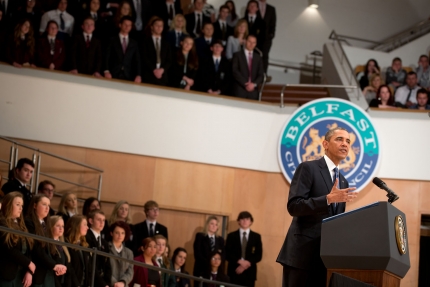
This morning, President Obama spoke to the people of Northern Ireland from the Belfast waterfront.

So many of the qualities that we Americans hold dear we imported from this land -- perseverance, faith, an unbending belief that we make our own destiny, and an unshakable dream that if we work hard and we live responsibly, something better lies just around the bend.

So our histories are bound by blood and belief, by culture and by commerce.  And our futures are equally, inextricably linked.  And that’s why I’ve come to Belfast today -- to talk about the future we can build together.

President Barack Obama delivers remarks at the Belfast Waterfront Convention Center

President Barack Obama delivers remarks at the Belfast Waterfront Convention Center in Belfast, Northern Ireland, June 17, 2013. (Official White House Photo by Pete Souza)

It’s been 15 years since the people of Ireland approved the Good Friday Agreement, and President Obama called the achievement -- and the progress that followed it -- extraordinary. “For years, few conflicts in the world seemed more intractable than the one here in Northern Ireland. And when peace was achieved here, it gave the entire world hope.”

The White House

Office of the Press Secretary

Joint Statement of the Presidents of the United States of America and the Russian Federation on Cooperation in Countering Terrorism

The United States and Russia resolutely condemn terrorism in all its forms and manifestations. The explosions in Boston on April 15, 2013, and the explosion of the terrorist suicide bomber in Makhachkala on May 25, 2013, have demonstrated anew that the global terrorist threat is not weakening and calls for a buildup of our joint efforts in countering it.

Terrorists do not acknowledge borders and seek to impose their extremist ideology of violence everywhere. We note with concern the cases in which terrorist groups have coalesced with transborder organized crime, in particular in the area of the illegal traffic in drugs and arms.

The terrorist threat calls for a concerted, comprehensive response that presupposes law enforcement measures for the protection of our citizens, as well as the implementation of a long-term strategy aimed at denying terrorists any social or material support, and working with societies to prevent the spread of the terrorist ideology. To that end, the United States and Russia intend to strengthen our counterterrorism cooperation on the basis of mutual trust, including the exchange of pertinent operational information between intelligence services and the conduct of coordinated operations.

We intend to continue to contribute to international endeavors to counter terrorism within the framework of the United Nations (UN), Organization for Security and Cooperation in Europe (OSCE), Financial Action Task Force on Money Laundering (FATF), Global Counterterrorism Forum (GCTF), Russia-NATO Council, Asia-Pacific Economic Cooperation (APEC), and Group of Eight (G-8). By way of example, the United States and Russia are engaged in active joint work in the Counter-Terrorism Committee of the UN Security Council, as well as the Al-Qaida Sanctions Committee and the Taliban Sanctions Committee. Together, we work in the G-8 on implementing the initiative for countering improvised explosive devices; in the GCTF, on strengthening the institutions of criminal justice and on the objective of countering violent extremism; and in APEC, on enhancing the security and stability of critical infrastructure. Our countries are cooperating closely as founders and co-chairs of the Global Initiative to Counter Nuclear Terrorism (GICNT), which already counts 85 participant states.

The joint efforts of the United States and Russia, including in the context of the Counterterrorism Working Group of the Bilateral Presidential Commission, are focused on preventing weapons of mass destruction from falling into the hands of terrorists, and halting the funding of terrorist activities, the recruitment and training of those who commit terrorist acts, and the actions of lone terrorists.

Another cause of serious concern is the terrorists’ use of contemporary information and communication technologies for staying in touch, collecting information, spreading their ideology, attracting new adherents and financial resources, planning, organizing, and carrying out terrorist acts. With due respect for the freedom to express opinions, as provided for in international law, we intend to use all legal means to counter the abuse of the Internet for terrorist or other criminal purposes.

The United States and Russia intend to continue to develop their counterterrorism partnership with the business community, including in the field of protecting the tourist sector. Providing security for major sporting and public events, including the Winter Olympic Games in Sochi, is to be an important area of interaction.

We reiterate our firm resolve to join in countering terrorism in accordance with national laws and the fundamental principles of international law, including respect for human rights and fundamental freedoms.

The White House

Office of the Press Secretary

Joint Statement by the Presidents of the United States of America and the Russian Federation on Enhanced Bilateral Engagement

The United States of America and the Russian Federation reaffirm their readiness to intensify bilateral cooperation based on the principles of mutual respect, equality, and genuine respect for each other’s interests.

Guided by this approach, today we reached an understanding on a positive agenda for relations between our countries that encompasses the strategically important issues of arms control, nonproliferation, international security, increasing trade and investment, responding to global threats and challenges, countering terrorism and militant extremism, and enhancing tries between our societies and people. This wide-ranging program of action requires enhanced engagement at all levels.

To strengthen the constructive nature of our relations, we intend to maintain regular contacts at the highest level, and to hold a U.S.-Russia summit in Moscow on September 3-4, 2013, to discuss in greater detail the full range of bilateral and international issues.

We have also decided to expand the dialogue between the U.S. Vice President and the Russian Prime Minister to address our joint agenda, including discussion of the development and diversification of trade and investment links, to promote the strengthening of relations and economic growth in both countries.

An understanding was reached on launching a regular dialogue in the “two plus two” format between foreign and defense ministers to address issues of strategic stability, international security, and shared threats to our countries.

With a view to intensifying cooperation in the security realm, we instructed the Security Councils of the United States and Russia to maintain a regular dialogue to discuss issues of mutual interest.

The Bilateral Presidential Commission will continue to play an important role in developing engagement in various areas. More than sixty U.S. and Russian government agencies currently take part in its activities. To complement the governments’ work on intensifying cooperation, we call on public and business communities in the United States and Russia to establish close links in the interest of bringing our countries closer together.

Expanding direct contracts between Americans and Russians, including through implementation of the bilateral Agreement on Simplifying Visa Formalities, which has been in force since 2012, will serve to strengthen mutual understanding and trust and make it possible to raise U.S.-Russian relations to a qualitatively new level.  

The White House

Office of the Press Secretary

Joint Statement by the Presidents of the United States of America and the Russian Federation on a New Field of Cooperation in Confidence Building

We, the Presidents of the United States of America and the Russian Federation, recognize the unprecedented progress in the use of Information and Communications Technologies (ICTs), the new capacity they create for the economies and societies of our countries, and the increasing interdependence of the modern world.

We recognize that threats to or in the use of ICTs include political-military and criminal threats, as well as threats of a terrorist nature, and are some of the most serious national and international security challenges we face in the 21st Century. We affirm the importance of cooperation between the United States of America and the Russian Federation for the purpose of enhancing bilateral understanding in this area. We view this cooperation as essential to safeguarding the security of our countries, and to achieving security and reliability in the use of ICTs that are essential to innovation and global interoperability.

Demonstrating our commitment to promoting international peace and security, today we affirm the completion of landmark steps designed to strengthen relations, increase transparency, and build confidence between our two nations:

  • To create a mechanism for information sharing in order to better protect critical information systems, we have established a communication channel and information sharing arrangements between our computer emergency response teams;

  • To facilitate the exchange of urgent communications that can reduce the risk of misperception, escalation and conflict, we have authorized the use of the direct communications link between our Nuclear Risk Reduction Centers for this purpose;

  • Finally, we have directed officials in the White House and the Kremlin to establish a direct communication link between high-level officials to manage potentially dangerous situations arising from events that may carry security threats to or in the use of ICTs.

We have decided to create (in the framework of the U.S.-Russia Bilateral Presidential Commission) a bilateral working group on issues of threats to or in the use of ICTs in the context of international security that is to meet on a regular basis to consult on issues of mutual interest and concern. This working group is to assess emerging threats, elaborate, propose and coordinate concrete joint measures to address such threats as well as strengthen confidence. This group should be created within the next month and should immediately start its practical activities.

These steps are necessary in order to meet our national and broader international interests. They are important practical measures which can help to further the advancement of norms of peaceful and just interstate conduct with respect to the use of ICTs. To further deepen our relationship, relevant agencies of our countries plan to continue their regular dialogue and to identify additional areas for mutually-beneficial cooperation in combating threats to or in the use of ICTs.

The White House

Office of the Press Secretary

Notice to Congress -- Continuation of the National Emergency with Respect to the Western Balkans

NOTICE

- - - - - - -

CONTINUATION OF THE NATIONAL EMERGENCY
WITH RESPECT TO THE WESTERN BALKANS

On June 26, 2001, by Executive Order 13219, the President declared a national emergency with respect to the Western Balkans, pursuant to the International Emergency Economic Powers Act (50 U.S.C. 1701-1706), to deal with the unusual and extraordinary threat to the national security and foreign policy of the United States constituted by the actions of persons engaged in, or assisting, sponsoring, or supporting (i) extremist violence in the Republic of Macedonia and elsewhere in the Western Balkans region, or (ii) acts obstructing implementation of the Dayton Accords in Bosnia or United Nations Security Council Resolution 1244 of June 10, 1999, relating to Kosovo. The President subsequently amended that order in Executive Order 13304 of May 28, 2003, to include acts obstructing the implementation of the Ohrid Framework Agreement relating to Macedonia.

The actions of persons threatening the peace and international stabilization efforts in the Western Balkans continue to pose an unusual and extraordinary threat to the national security and foreign policy of the United States. For this reason, the national emergency declared on June 26, 2001, and the measures adopted on that date and thereafter to deal with that emergency, must continue in effect beyond June 26, 2013. Therefore, in accordance with section 202(d) of the National Emergencies Act (50 U.S.C. 1622(d)), I am continuing for 1 year the national emergency with respect to the Western Balkans declared in Executive Order 13219.

This notice shall be published in the Federal Register and transmitted to the Congress.

BARACK OBAMA

THE WHITE HOUSE,
June 17, 2013.

The White House

Office of the Press Secretary

Message to Congress -- Continuation of the National Emergency with Respect to the Western Balkans

TO THE CONGRESS OF THE UNITED STATES:

Section 202(d) of the National Emergencies Act (50 U.S.C. 1622(d)) provides for the automatic termination of a national emergency unless, within 90 days prior to the anniversary date of its declaration, the President publishes in the Federal Register and transmits to the Congress a notice stating that the emergency is to continue in effect beyond the anniversary date. In accordance with this provision, I have sent to the Federal Register for publication the enclosed notice stating that the national emergency with respect to the Western Balkans that was declared in Executive Order 13219 of June 26, 2001, is to remain in effect beyond June 26, 2013.

The crisis constituted by the actions of persons engaged in, or assisting, sponsoring, or supporting (i) extremist violence in the Republic of Macedonia and elsewhere in the Western Balkans region, or (ii) acts obstructing implementation of the Dayton Accords in Bosnia or United Nations Security Council Resolution 1244 of June 10, 1999, related to Kosovo, which led to the declaration of a national emergency on June 26, 2001, in Executive Order 13219 and to the amendment of that order in Executive Order 13304 of May 28, 2003, to include acts obstructing implementation of the Ohrid Framework Agreement of 2001 in Macedonia, has not been resolved. The acts of extremist violence and obstructionist activity outlined in Executive Order 13219, as amended, are hostile to U.S. interests and continue to pose an unusual and extraordinary threat to the national security and foreign policy of the United States. For this reason, I have determined that it is necessary to continue the national emergency declared with respect to the Western Balkans.

BARACK OBAMA

THE WHITE HOUSE,
June 17, 2013.

Watch President Obama Discuss the NSA and Syria Tonight on Charlie Rose

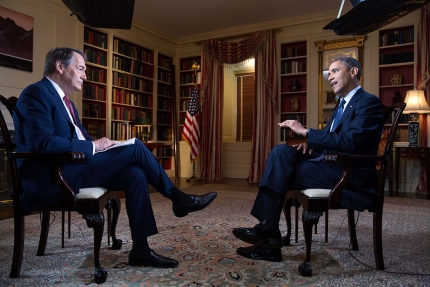
President Barack Obama participates in an interview with Charlie Rose (June 16, 2013)

President Barack Obama participates in an interview with Charlie Rose in the White House Library, Sunday, June 16, 2013. (Official White House Photo by Pete Souza)

Before leaving for this week's G-8 summit in the United Kingdom, President Obama sat down with Charlie Rose in the White House Library for a 45-minute interview on topics ranging from Syria to the National Security Agency.

That discussion will air tonight at 11:00 PM on PBS stations across the country. For more specifics, check your local listings.

Update: Watch a segment of that interview here

The White House

Office of the Press Secretary

Remarks by President Obama, U.K. Prime Minister Cameron, European Commission President Barroso, and European Council President Van Rompuy on the Transatlantic Trade and Investment Partnership

Lough Erne Resort
Lough Erne, Northern Ireland

3:23 P.M. BST

PRIME MINISTER CAMERON:  Well, good afternoon and welcome, everyone.  Welcome to Lough Erne.
 
I always said that the whole point of this meeting in Lough Erne is to fire up our economies and drive growth and prosperity around the world -- to do things that make a real difference to people’s lives.  And there is no more powerful way to achieve that than by boosting trade.  And there’s no better way than by launching these negotiations on a landmark deal between the European Union and the United States of America -- a deal that could add as much as a £100 billion to the EU economy, £80 billion to the U.S. economy, and as much as £85 billion to the rest of the world.
 
And we should be clear about what these numbers could really mean:  2 million extra jobs, more choice and lower prices in our shops.  We’re talking about what could be the biggest bilateral trade deal in history; a deal that will have a greater impact than all the other trade deals on the table put together. 
 
When we last met at Camp David in the G8 and we first suggested we could reach this moment here in Lough Erne, many doubted it would be possible.  Everyone knows these trade deals are difficult.  Some take years to get off the ground, and some never happen at all.  So it’s a testament to the leadership and the political will of everyone here that we’ve reached this point.  We must maintain that political will in the months ahead.  This is a once-in-a-generation prize and we are determined to seize it.
 
President Barroso -- Jose Manuel, over to you.
 
PRESIDENT BARROSO:  Thank you.  Thank you, David.
 
Today is a special day for the relation between European Union and the United States.  Today we announce we will start negotiations of a comprehensive Transatlantic Trade and Investment Partnership agreement.  Very frankly, two years ago, very few would have bet that today we’d be in the position to launch negotiations of an ambitious European Union-United States free trade agreement.
 
And when the teams of the European Commission and United States will meet for the first round on the negotiations next month, it will be the start of a joint undertaking of real strategic importance.  Our joint endeavor is part of our overall agenda for growth and jobs to both sides of the Atlantic by boosting trade and investment.  It is also a powerful demonstration of our determination to shape a open rules-based role.
 
We intend to move forward fast.  We can say that neither of us will give up content for the sake of speed, but we intend to make rapid progress.  I’d rather see the core challenge, moving our regulatory regimes closer, and addressing the harmful effect of behind-the-border trade barriers.  Huge economic benefits are expected from reducing red tape, avoiding divergent regulations for the future. 
 
I’d rather have our companies invest in you, in overseas products and services and job creation, than in double-testing, or multiple inspections, or even separate manufacturing lines.  Our regulators need to build bridges faster and more systematically.  The current economic climate requires us to join forces and to do more with less.  More importantly, in doing so, we will remain strong global players who set the standards for the 21st century. 
 
Therefore, I call on our legislatures, European -- especially European Parliament, our regulators, our civil society to play a constructive and engaged part in these negotiations.
 
The business communities on both sides of the Atlantic, in particular, have been a strong advocate of free trade and investment between Europe and the United States.  And this is also good for the rest of the world.  Given the integrated supply chains in today’s global markets, everyone can benefit from this agreement. 
 
Integrating two of the most developed, most sophisticated, and certainly the largest economies in the world can never be an easy task, but we will find convincing answers to legitimate concerns.  We will find solutions to thorny issues.  We will keep our eyes on the prize, and we’ll succeed.  So even if these negotiations may not always be easy, I’m sure they will be worth it for the sake of the jobs it creates and because of the strategic dimension of what we are doing -- to write the next chapter of what is our common history also forged by the sense that we share the same principles and values, the principles and values of open economies and open societies.
 
PRIME MINISTER CAMERON:  Thank you very much, Jose Manuel.  President Obama -- Barack.
 
PRESIDENT OBAMA:  Thank you very much, David.  And good afternoon.  It is wonderful to be here in Lough Erne.  And thank you so much to the people of Northern Ireland for their warm hospitality.  And, Prime Minister Cameron, thank you for all the outstanding arrangements.
 
Among the things we’ll discuss here are promoting new growth and jobs on both sides of the Atlantic.  And I’m pleased to join these leaders to announce the launch of negotiations on a new trade agreement that will help us do just that -- the Transatlantic Trade and Investment Partnership, also known as T-TIP.
 
I want to thank not only the gentlemen on this stage, but also President Hollande, Chancellor Merkel, Prime Minister Letta, and Taoiseach  Kenny.  We just had an excellent meeting.  And I’m proud to say that America will have the opportunity to host the first round of negotiations next month in Washington.
 
As has already been mentioned, the U.S.-EU relationship is the largest in the world.  It makes up nearly half of global GDP.  We trade about $1 trillion in goods and services each year.  We invest nearly $4 trillion in each other’s economies.  And all that supports around 13 million jobs on both sides of the Atlantic. 
 
And this potentially groundbreaking partnership would deepen those ties.  It would increase exports, decrease barriers to trade and investment.  As part of broader growth strategies in both our economies, it would support hundreds of thousands of jobs on both sides of the ocean.
 
So I’m pleased to hear that this negotiation enjoys the support not only of the countries that are here today, but also the broader EU membership.  I can tell you that it has been warmly received in the United States as well, both in our Congress and in our business community.
 
And that broad support, on both sides of the Atlantic, will help us work through some of the tough issues that have already been mentioned.  There are going to be sensitivities on both sides.  There are going to be politics on both sides.  But if we can look beyond the narrow concerns to stay focused on the big picture -- the economic and strategic importance of this partnership -- I’m hopeful we can achieve the kind of high-standard, comprehensive agreement that the global trading system is looking to us to develop. 
 
America and Europe have done extraordinary things together before.  And I believe we can forge an economic alliance as strong as our diplomatic and security alliances -- which, of course, have been the most powerful in history.  And, by doing that, we can also strengthen the multilateral trading system.
 
So this Transatlantic Trade and Investment Partnership is going to be a priority of mine and my administration.  It is important that we get it right -- and that means resisting the temptation to downsize our ambitions or avoid tough issues just for the sake of getting a deal.  And then make sure also -- it’s important that we also make sure that it’s part of an overall plan to do what it takes to promote growth and jobs.  Trade is critical but it is not alone a silver bullet; it has to be part of a comprehensive strategy that we pursue on both sides of the Atlantic.  That’s what our people deserve. 
 
I very much look forward to working with my fellow leaders to make it happen.  We’re going to give a strong mandate to our negotiators, but occasionally I suspect we’re going to have to intervene and break through some logjams.  Nevertheless, I’m confident that we can get it done.
 
So thank you very much.
 
PRIME MINISTER CAMERON:  Thank you, Barack.  And thank you very much for that.  Now, we’re going to hear from the President of the European Council, Herman Van Rompuy -- Herman.
 
PRESIDENT VAN ROMPUY:  Good afternoon, ladies and gentlemen.  This is a special moment.  At the last EU-U.S. summit with President Obama, we jointly decided to see if launching such historic negotiations would be possible.  It was.  And now we can already start the talks.  A year and a half ago, we were not even sure the place had a door, and now we are entering the negotiating room together.  
 
It's a sign of the strong political will on both sides.  This February, in the European Council, our European heads of state and government reiterated their support for a comprehensive trade and investment deal with the United States.  A political signal formalized last Friday by ministers and the Irish presidency formally gave the EU negotiators the green light to start the talks.
 
It shows the political will to work together -- to work together with our long-standing and most trusted partner on the essential objective for governments on either side of the Atlantic -- growth, jobs, and prosperity.  We both know there are no magic solutions.  Recent economic turbulence underlines this.  But we cannot expect to harvest new jobs today; we can plant the seeds for the jobs of tomorrow.  And that’s exactly what the trade agreement is about.
 
Together, Europe and the United States are the backbone of the world economy.  Opening up that space further for opportunities for business and consumers is simply common sense.  Not just our own economies, but also those of our trading partners will benefit.  The positive ramifications will even go beyond the economy as such.
 
We are making our economies all over the world more interdependent, and this will make the world safer.  What is at stake with the transatlantic free trade area is to enshrine Europe and America's role as the world's standard-setters, beyond product specifications, by setting a positive forces and shaping the way we work and the way we live our daily lives.  This is of key strategic significance.
 
Ladies and gentlemen, the Atlantic is not the past; it is also the future.  And that’s why we are impatient to start, although we know that negotiations won't be a smooth ride.  Obviously, there are and will be sensitive issues on each side.  With flexibility, open-mindedness and some creativity, the greatest asset for negotiators and statesmen, I'm confident we will find solutions.  There is too much at stake. 
 
We will find these solutions not only because we know the great benefit it will bring, not only because we share the same rules-based approach at home and abroad in these matters, but also because trade is one vital part of our overall relationship.  It will link our transatlantic destinies even closer together. 
 
The longer the negotiations, therefore, stand for our continued common commitment to engage with each other in order to engage with the world.  The EU and its member states are ready to engage and look forward to the new trade landscape we will shape together.
 
Thank you.
 
PRIME MINISTER CAMERON:  Thank you very much, Herman.  We'll be now welcoming the other guests to the G8, and we'll be taking questions at the end of the G8 at the end of our discussions.
 
Thank you very much, indeed.
 
END  
3:35 P.M. BST