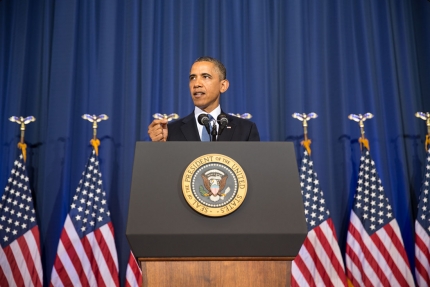
West Wing Week: 05/24/13 or “Justice for Everybody”

This week, the President continued his Jobs & Opportunity tour, this time highlighting bold new efforts in education and manufacturing in Baltimore, gave the commencement address at Morehouse College, invited the President of Myanmar, eight immigration reform advocates and DREAMers themselves, and Gershwin Prize winner Carole King and friends to the White House, and delivered a major counter-terrorism speech at the National Defense University. 

West Wing Week: 05/24/13 or “Justice for Everybody”

May 23, 2013 | 05:38 | Public Domain

This week, the President continued his Jobs & Opportunity tour, this time highlighting bold new efforts in education and manufacturing in Baltimore, gave the commencement address at Morehouse College, invited the President of Myanmar, eight immigration reform advocates and DREAMers themselves, and Gershwin Prize winner Carol King and friends to the White House, and delivered a major counter-terrorism speech at the National Defense University.

Download mp4 (185MB)

President Obama Speaks on the U.S. Counterterrorism Strategy

May 23, 2013 | 59:40 | Public Domain

President Obama lays out the framework for U.S. counterterrorism strategy as we wind down the war in Afghanistan.

Download mp4 (2253MB) | mp3 (144MB)

Read the Transcript

Remarks by the President at the National Defense University

National Defense University
Fort McNair
Washington, D.C. 

2:01 P.M. EDT

THE PRESIDENT:  Good afternoon, everybody.  Please be seated. 

It is a great honor to return to the National Defense University.  Here, at Fort McNair, Americans have served in uniform since 1791 -- standing guard in the earliest days of the Republic, and contemplating the future of warfare here in the 21st century.

For over two centuries, the United States has been bound together by founding documents that defined who we are as Americans, and served as our compass through every type of change.  Matters of war and peace are no different.  Americans are deeply ambivalent about war, but having fought for our independence, we know a price must be paid for freedom.  From the Civil War to our struggle against fascism, on through the long twilight struggle of the Cold War, battlefields have changed and technology has evolved.  But our commitment to constitutional principles has weathered every war, and every war has come to an end.

With the collapse of the Berlin Wall, a new dawn of democracy took hold abroad, and a decade of peace and prosperity arrived here at home.  And for a moment, it seemed the 21st century would be a tranquil time.  And then, on September 11, 2001, we were shaken out of complacency.  Thousands were taken from us, as clouds of fire and metal and ash descended upon a sun-filled morning.  This was a different kind of war.  No armies came to our shores, and our military was not the principal target.  Instead, a group of terrorists came to kill as many civilians as they could.

And so our nation went to war.  We have now been at war for well over a decade.  I won’t review the full history.  What is clear is that we quickly drove al Qaeda out of Afghanistan, but then shifted our focus and began a new war in Iraq.  And this carried significant consequences for our fight against al Qaeda, our standing in the world, and -- to this day -- our interests in a vital region.

Meanwhile, we strengthened our defenses -- hardening targets, tightening transportation security, giving law enforcement new tools to prevent terror.  Most of these changes were sound.  Some caused inconvenience.  But some, like expanded surveillance, raised difficult questions about the balance that we strike between our interests in security and our values of privacy.  And in some cases, I believe we compromised our basic values -- by using torture to interrogate our enemies, and detaining individuals in a way that ran counter to the rule of law.

So after I took office, we stepped up the war against al Qaeda but we also sought to change its course.  We relentlessly targeted al Qaeda’s leadership.  We ended the war in Iraq, and brought nearly 150,000 troops home.  We pursued a new strategy in Afghanistan, and increased our training of Afghan forces.  We unequivocally banned torture, affirmed our commitment to civilian courts, worked to align our policies with the rule of law, and expanded our consultations with Congress.

Today, Osama bin Laden is dead, and so are most of his top lieutenants.  There have been no large-scale attacks on the United States, and our homeland is more secure.  Fewer of our troops are in harm’s way, and over the next 19 months they will continue to come home.  Our alliances are strong, and so is our standing in the world.  In sum, we are safer because of our efforts.

Now, make no mistake, our nation is still threatened by terrorists.  From Benghazi to Boston, we have been tragically reminded of that truth.  But we have to recognize that the threat has shifted and evolved from the one that came to our shores on 9/11.  With a decade of experience now to draw from, this is the moment to ask ourselves hard questions -- about the nature of today’s threats and how we should confront them.

And these questions matter to every American. 

For over the last decade, our nation has spent well over a trillion dollars on war, helping to explode our deficits and constraining our ability to nation-build here at home.  Our servicemembers and their families have sacrificed far more on our behalf.  Nearly 7,000 Americans have made the ultimate sacrifice. Many more have left a part of themselves on the battlefield, or brought the shadows of battle back home.  From our use of drones to the detention of terrorist suspects, the decisions that we are making now will define the type of nation -- and world -- that we leave to our children.  

So America is at a crossroads.  We must define the nature and scope of this struggle, or else it will define us.  We have to be mindful of James Madison’s warning that “No nation could preserve its freedom in the midst of continual warfare.”  Neither I, nor any President, can promise the total defeat of terror.  We will never erase the evil that lies in the hearts of some human beings, nor stamp out every danger to our open society.  But what we can do -- what we must do -- is dismantle networks that pose a direct danger to us, and make it less likely for new groups to gain a foothold, all the while maintaining the freedoms and ideals that we defend.  And to define that strategy, we have to make decisions based not on fear, but on hard-earned wisdom.  That begins with understanding the current threat that we face.

Today, the core of al Qaeda in Afghanistan and Pakistan is on the path to defeat.  Their remaining operatives spend more time thinking about their own safety than plotting against us.  They did not direct the attacks in Benghazi or Boston.  They’ve not carried out a successful attack on our homeland since 9/11.

Instead, what we’ve seen is the emergence of various al Qaeda affiliates.  From Yemen to Iraq, from Somalia to North Africa, the threat today is more diffuse, with Al Qaeda’s affiliates in the Arabian Peninsula -- AQAP -- the most active in plotting against our homeland.  And while none of AQAP’s efforts approach the scale of 9/11, they have continued to plot acts of terror, like the attempt to blow up an airplane on Christmas Day in 2009.

Unrest in the Arab world has also allowed extremists to gain a foothold in countries like Libya and Syria.  But here, too, there are differences from 9/11.  In some cases, we continue to confront state-sponsored networks like Hezbollah that engage in acts of terror to achieve political goals.  Other of these groups are simply collections of local militias or extremists interested in seizing territory.  And while we are vigilant for signs that these groups may pose a transnational threat, most are focused on operating in the countries and regions where they are based.  And that means we'll face more localized threats like what we saw in Benghazi, or the BP oil facility in Algeria, in which local operatives -- perhaps in loose affiliation with regional networks -- launch periodic attacks against Western diplomats, companies, and other soft targets, or resort to kidnapping and other criminal enterprises to fund their operations.

And finally, we face a real threat from radicalized individuals here in the United States.  Whether it’s a shooter at a Sikh Temple in Wisconsin, a plane flying into a building in Texas, or the extremists who killed 168 people at the Federal Building in Oklahoma City, America has confronted many forms of violent extremism in our history.  Deranged or alienated individuals -- often U.S. citizens or legal residents -- can do enormous damage, particularly when inspired by larger notions of violent jihad.  And that pull towards extremism appears to have led to the shooting at Fort Hood and the bombing of the Boston Marathon. 

So that’s the current threat -- lethal yet less capable al Qaeda affiliates; threats to diplomatic facilities and businesses abroad; homegrown extremists.  This is the future of terrorism. We have to take these threats seriously, and do all that we can to confront them.  But as we shape our response, we have to recognize that the scale of this threat closely resembles the types of attacks we faced before 9/11. 

In the 1980s, we lost Americans to terrorism at our Embassy in Beirut; at our Marine Barracks in Lebanon; on a cruise ship at sea; at a disco in Berlin; and on a Pan Am flight -- Flight 103  -- over Lockerbie.  In the 1990s, we lost Americans to terrorism at the World Trade Center; at our military facilities in Saudi Arabia; and at our Embassy in Kenya.  These attacks were all brutal; they were all deadly; and we learned that left unchecked, these threats can grow.  But if dealt with smartly and proportionally, these threats need not rise to the level that we saw on the eve of 9/11.

Moreover, we have to recognize that these threats don’t arise in a vacuum.  Most, though not all, of the terrorism we faced is fueled by a common ideology -- a belief by some extremists that Islam is in conflict with the United States and the West, and that violence against Western targets, including civilians, is justified in pursuit of a larger cause.  Of course, this ideology is based on a lie, for the United States is not at war with Islam.  And this ideology is rejected by the vast majority of Muslims, who are the most frequent victims of terrorist attacks.

Nevertheless, this ideology persists, and in an age when ideas and images can travel the globe in an instant, our response to terrorism can’t depend on military or law enforcement alone. We need all elements of national power to win a battle of wills, a battle of ideas.  So what I want to discuss here today is the components of such a comprehensive counterterrorism strategy. 

First, we must finish the work of defeating al Qaeda and its associated forces.

In Afghanistan, we will complete our transition to Afghan responsibility for that country’s security.  Our troops will come home.  Our combat mission will come to an end.  And we will work with the Afghan government to train security forces, and sustain a counterterrorism force, which ensures that al Qaeda can never again establish a safe haven to launch attacks against us or our allies.

Beyond Afghanistan, we must define our effort not as a boundless “global war on terror,” but rather as a series of persistent, targeted efforts to dismantle specific networks of violent extremists that threaten America.  In many cases, this will involve partnerships with other countries.  Already, thousands of Pakistani soldiers have lost their lives fighting extremists.  In Yemen, we are supporting security forces that have reclaimed territory from AQAP.  In Somalia, we helped a coalition of African nations push al-Shabaab out of its strongholds.  In Mali, we’re providing military aid to French-led intervention to push back al Qaeda in the Maghreb, and help the people of Mali reclaim their future.

Much of our best counterterrorism cooperation results in the gathering and sharing of intelligence, the arrest and prosecution of terrorists.  And that’s how a Somali terrorist apprehended off the coast of Yemen is now in a prison in New York.  That’s how we worked with European allies to disrupt plots from Denmark to Germany to the United Kingdom.  That’s how intelligence collected with Saudi Arabia helped us stop a cargo plane from being blown up over the Atlantic.  These partnerships work.

But despite our strong preference for the detention and prosecution of terrorists, sometimes this approach is foreclosed. Al Qaeda and its affiliates try to gain foothold in some of the most distant and unforgiving places on Earth.  They take refuge in remote tribal regions.  They hide in caves and walled compounds.  They train in empty deserts and rugged mountains.

In some of these places -- such as parts of Somalia and Yemen -- the state only has the most tenuous reach into the territory.  In other cases, the state lacks the capacity or will to take action.  And it’s also not possible for America to simply deploy a team of Special Forces to capture every terrorist.  Even when such an approach may be possible, there are places where it would pose profound risks to our troops and local civilians -- where a terrorist compound cannot be breached without triggering a firefight with surrounding tribal communities, for example, that pose no threat to us; times when putting U.S. boots on the ground may trigger a major international crisis.

To put it another way, our operation in Pakistan against Osama bin Laden cannot be the norm.  The risks in that case were immense.  The likelihood of capture, although that was our preference, was remote given the certainty that our folks would confront resistance.  The fact that we did not find ourselves confronted with civilian casualties, or embroiled in an extended firefight, was a testament to the meticulous planning and professionalism of our Special Forces, but it also depended on some luck.  And it was supported by massive infrastructure in Afghanistan. 

And even then, the cost to our relationship with Pakistan -- and the backlash among the Pakistani public over encroachment on their territory -- was so severe that we are just now beginning to rebuild this important partnership.

So it is in this context that the United States has taken lethal, targeted action against al Qaeda and its associated forces, including with remotely piloted aircraft commonly referred to as drones. 

As was true in previous armed conflicts, this new technology raises profound questions -- about who is targeted, and why; about civilian casualties, and the risk of creating new enemies; about the legality of such strikes under U.S. and international law; about accountability and morality.  So let me address these questions. 

To begin with, our actions are effective.  Don’t take my word for it.  In the intelligence gathered at bin Laden’s compound, we found that he wrote, “We could lose the reserves to enemy’s air strikes.  We cannot fight air strikes with explosives.”  Other communications from al Qaeda operatives confirm this as well.  Dozens of highly skilled al Qaeda commanders, trainers, bomb makers and operatives have been taken off the battlefield.  Plots have been disrupted that would have targeted international aviation, U.S. transit systems, European cities and our troops in Afghanistan.  Simply put, these strikes have saved lives.

Moreover, America’s actions are legal.  We were attacked on 9/11.  Within a week, Congress overwhelmingly authorized the use of force.  Under domestic law, and international law, the United States is at war with al Qaeda, the Taliban, and their associated forces.  We are at war with an organization that right now would kill as many Americans as they could if we did not stop them first.  So this is a just war -- a war waged proportionally, in last resort, and in self-defense.

And yet, as our fight enters a new phase, America’s legitimate claim of self-defense cannot be the end of the discussion.  To say a military tactic is legal, or even effective, is not to say it is wise or moral in every instance.  For the same human progress that gives us the technology to strike half a world away also demands the discipline to constrain that power -- or risk abusing it.  And that’s why, over the last four years, my administration has worked vigorously to establish a framework that governs our use of force against terrorists –- insisting upon clear guidelines, oversight and accountability that is now codified in Presidential Policy Guidance that I signed yesterday.

In the Afghan war theater, we must -- and will -- continue to support our troops until the transition is complete at the end of 2014.  And that means we will continue to take strikes against high value al Qaeda targets, but also against forces that are massing to support attacks on coalition forces.  But by the end of 2014, we will no longer have the same need for force protection, and the progress we’ve made against core al Qaeda will reduce the need for unmanned strikes.

Beyond the Afghan theater, we only target al Qaeda and its associated forces.  And even then, the use of drones is heavily constrained.  America does not take strikes when we have the ability to capture individual terrorists; our preference is always to detain, interrogate, and prosecute.  America cannot take strikes wherever we choose; our actions are bound by consultations with partners, and respect for state sovereignty. 

America does not take strikes to punish individuals; we act against terrorists who pose a continuing and imminent threat to the American people, and when there are no other governments capable of effectively addressing the threat.  And before any strike is taken, there must be near-certainty that no civilians will be killed or injured -- the highest standard we can set.

Now, this last point is critical, because much of the criticism about drone strikes -- both here at home and abroad -- understandably centers on reports of civilian casualties.  There’s a wide gap between U.S. assessments of such casualties and nongovernmental reports.  Nevertheless, it is a hard fact that U.S. strikes have resulted in civilian casualties, a risk that exists in every war.  And for the families of those civilians, no words or legal construct can justify their loss.  For me, and those in my chain of command, those deaths will haunt us as long as we live, just as we are haunted by the civilian casualties that have occurred throughout conventional fighting in Afghanistan and Iraq.

But as Commander-in-Chief, I must weigh these heartbreaking tragedies against the alternatives.  To do nothing in the face of terrorist networks would invite far more civilian casualties -- not just in our cities at home and our facilities abroad, but also in the very places like Sana’a and Kabul and Mogadishu where terrorists seek a foothold.  Remember that the terrorists we are after target civilians, and the death toll from their acts of terrorism against Muslims dwarfs any estimate of civilian casualties from drone strikes.  So doing nothing is not an option.

Where foreign governments cannot or will not effectively stop terrorism in their territory, the primary alternative to targeted lethal action would be the use of conventional military options.  As I’ve already said, even small special operations carry enormous risks.  Conventional airpower or missiles are far less precise than drones, and are likely to cause more civilian casualties and more local outrage.  And invasions of these territories lead us to be viewed as occupying armies, unleash a torrent of unintended consequences, are difficult to contain, result in large numbers of civilian casualties and ultimately empower those who thrive on violent conflict. 

So it is false to assert that putting boots on the ground is less likely to result in civilian deaths or less likely to create enemies in the Muslim world.  The results would be more U.S. deaths, more Black Hawks down, more confrontations with local populations, and an inevitable mission creep in support of such raids that could easily escalate into new wars.

Yes, the conflict with al Qaeda, like all armed conflict, invites tragedy.  But by narrowly targeting our action against those who want to kill us and not the people they hide among, we are choosing the course of action least likely to result in the loss of innocent life.

Our efforts must be measured against the history of putting American troops in distant lands among hostile populations.  In Vietnam, hundreds of thousands of civilians died in a war where the boundaries of battle were blurred.  In Iraq and Afghanistan, despite the extraordinary courage and discipline of our troops, thousands of civilians have been killed.  So neither conventional military action nor waiting for attacks to occur offers moral safe harbor, and neither does a sole reliance on law enforcement in territories that have no functioning police or security services -- and indeed, have no functioning law. 

Now, this is not to say that the risks are not real.  Any U.S. military action in foreign lands risks creating more enemies and impacts public opinion overseas.  Moreover, our laws constrain the power of the President even during wartime, and I have taken an oath to defend the Constitution of the United States.  The very precision of drone strikes and the necessary secrecy often involved in such actions can end up shielding our government from the public scrutiny that a troop deployment invites.  It can also lead a President and his team to view drone strikes as a cure-all for terrorism.

And for this reason, I’ve insisted on strong oversight of all lethal action.  After I took office, my administration began briefing all strikes outside of Iraq and Afghanistan to the appropriate committees of Congress.  Let me repeat that:  Not only did Congress authorize the use of force, it is briefed on every strike that America takes.  Every strike.  That includes the one instance when we targeted an American citizen -- Anwar Awlaki, the chief of external operations for AQAP.

This week, I authorized the declassification of this action, and the deaths of three other Americans in drone strikes, to facilitate transparency and debate on this issue and to dismiss some of the more outlandish claims that have been made.  For the record, I do not believe it would be constitutional for the government to target and kill any U.S. citizen -- with a drone, or with a shotgun -- without due process, nor should any President deploy armed drones over U.S. soil.

But when a U.S. citizen goes abroad to wage war against America and is actively plotting to kill U.S. citizens, and when neither the United States, nor our partners are in a position to capture him before he carries out a plot, his citizenship should no more serve as a shield than a sniper shooting down on an innocent crowd should be protected from a SWAT team.

That’s who Anwar Awlaki was -- he was continuously trying to kill people.  He helped oversee the 2010 plot to detonate explosive devices on two U.S.-bound cargo planes.  He was involved in planning to blow up an airliner in 2009.  When Farouk Abdulmutallab -- the Christmas Day bomber -- went to Yemen in 2009, Awlaki hosted him, approved his suicide operation, helped him tape a martyrdom video to be shown after the attack, and his last instructions were to blow up the airplane when it was over American soil.  I would have detained and prosecuted Awlaki if we captured him before he carried out a plot, but we couldn’t.  And as President, I would have been derelict in my duty had I not authorized the strike that took him out.

Of course, the targeting of any American raises constitutional issues that are not present in other strikes -- which is why my administration submitted information about Awlaki to the Department of Justice months before Awlaki was killed, and briefed the Congress before this strike as well.  But the high threshold that we’ve set for taking lethal action applies to all potential terrorist targets, regardless of whether or not they are American citizens.  This threshold respects the inherent dignity of every human life.  Alongside the decision to put our men and women in uniform in harm’s way, the decision to use force against individuals or groups -- even against a sworn enemy of the United States -- is the hardest thing I do as President.  But these decisions must be made, given my responsibility to protect the American people.

Going forward, I’ve asked my administration to review proposals to extend oversight of lethal actions outside of warzones that go beyond our reporting to Congress.  Each option has virtues in theory, but poses difficulties in practice.  For example, the establishment of a special court to evaluate and authorize lethal action has the benefit of bringing a third branch of government into the process, but raises serious constitutional issues about presidential and judicial authority. Another idea that’s been suggested -- the establishment of an independent oversight board in the executive branch -- avoids those problems, but may introduce a layer of bureaucracy into national security decision-making, without inspiring additional public confidence in the process.  But despite these challenges, I look forward to actively engaging Congress to explore these and other options for increased oversight.

I believe, however, that the use of force must be seen as part of a larger discussion we need to have about a comprehensive counterterrorism strategy -- because for all the focus on the use of force, force alone cannot make us safe.  We cannot use force everywhere that a radical ideology takes root; and in the absence of a strategy that reduces the wellspring of extremism, a perpetual war -- through drones or Special Forces or troop deployments -- will prove self-defeating, and alter our country in troubling ways.

So the next element of our strategy involves addressing the underlying grievances and conflicts that feed extremism -- from North Africa to South Asia.  As we’ve learned this past decade, this is a vast and complex undertaking.  We must be humble in our expectation that we can quickly resolve deep-rooted problems like poverty and sectarian hatred.  Moreover, no two countries are alike, and some will undergo chaotic change before things get better.  But our security and our values demand that we make the effort.

This means patiently supporting transitions to democracy in places like Egypt and Tunisia and Libya -- because the peaceful realization of individual aspirations will serve as a rebuke to violent extremists.  We must strengthen the opposition in Syria, while isolating extremist elements -- because the end of a tyrant must not give way to the tyranny of terrorism.  We are actively working to promote peace between Israelis and Palestinians -- because it is right and because such a peace could help reshape attitudes in the region.  And we must help countries modernize economies, upgrade education, and encourage entrepreneurship -- because American leadership has always been elevated by our ability to connect with people’s hopes, and not simply their fears.

And success on all these fronts requires sustained engagement, but it will also require resources.  I know that foreign aid is one of the least popular expenditures that there is.  That’s true for Democrats and Republicans -- I’ve seen the polling -- even though it amounts to less than one percent of the federal budget.  In fact, a lot of folks think it’s 25 percent, if you ask people on the streets.  Less than one percent -- still wildly unpopular.  But foreign assistance cannot be viewed as charity.  It is fundamental to our national security.  And it’s fundamental to any sensible long-term strategy to battle extremism. 

Moreover, foreign assistance is a tiny fraction of what we spend fighting wars that our assistance might ultimately prevent. For what we spent in a month in Iraq at the height of the war, we could be training security forces in Libya, maintaining peace agreements between Israel and its neighbors, feeding the hungry in Yemen, building schools in Pakistan, and creating reservoirs of goodwill that marginalize extremists.  That has to be part of our strategy.

Moreover, America cannot carry out this work if we don’t have diplomats serving in some very dangerous places.  Over the past decade, we have strengthened security at our embassies, and I am implementing every recommendation of the Accountability Review Board, which found unacceptable failures in Benghazi.  I’ve called on Congress to fully fund these efforts to bolster security and harden facilities, improve intelligence, and facilitate a quicker response time from our military if a crisis emerges.

But even after we take these steps, some irreducible risks to our diplomats will remain.  This is the price of being the world’s most powerful nation, particularly as a wave of change washes over the Arab World.  And in balancing the trade4offs between security and active diplomacy, I firmly believe that any retreat from challenging regions will only increase the dangers that we face in the long run.  And that's why we should be grateful to those diplomats who are willing to serve. 

Targeted action against terrorists, effective partnerships, diplomatic engagement and assistance -- through such a comprehensive strategy we can significantly reduce the chances of large-scale attacks on the homeland and mitigate threats to Americans overseas.  But as we guard against dangers from abroad, we cannot neglect the daunting challenge of terrorism from within our borders.

As I said earlier, this threat is not new.  But technology and the Internet increase its frequency and in some cases its lethality.  Today, a person can consume hateful propaganda, commit themselves to a violent agenda, and learn how to kill without leaving their home.  To address this threat, two years ago my administration did a comprehensive review and engaged with law enforcement. 

And the best way to prevent violent extremism inspired by violent jihadists is to work with the Muslim American community  -- which has consistently rejected terrorism -- to identify signs of radicalization and partner with law enforcement when an individual is drifting towards violence.  And these partnerships can only work when we recognize that Muslims are a fundamental part of the American family.  In fact, the success of American Muslims and our determination to guard against any encroachments on their civil liberties is the ultimate rebuke to those who say that we’re at war with Islam.

Thwarting homegrown plots presents particular challenges in part because of our proud commitment to civil liberties for all who call America home.  That’s why, in the years to come, we will have to keep working hard to strike the appropriate balance between our need for security and preserving those freedoms that make us who we are.  That means reviewing the authorities of law enforcement, so we can intercept new types of communication, but also build in privacy protections to prevent abuse.

That means that -- even after Boston -- we do not deport someone or throw somebody in prison in the absence of evidence.  That means putting careful constraints on the tools the government uses to protect sensitive information, such as the state secrets doctrine.  And that means finally having a strong Privacy and Civil Liberties Board to review those issues where our counterterrorism efforts and our values may come into tension.

The Justice Department’s investigation of national security leaks offers a recent example of the challenges involved in striking the right balance between our security and our open society.  As Commander-in-Chief, I believe we must keep information secret that protects our operations and our people in the field.  To do so, we must enforce consequences for those who break the law and breach their commitment to protect classified information.  But a free press is also essential for our democracy.  That’s who we are.  And I’m troubled by the possibility that leak investigations may chill the investigative journalism that holds government accountable.

Journalists should not be at legal risk for doing their jobs.  Our focus must be on those who break the law.  And that’s why I’ve called on Congress to pass a media shield law to guard against government overreach.  And I’ve raised these issues with the Attorney General, who shares my concerns.  So he has agreed to review existing Department of Justice guidelines governing investigations that involve reporters, and he’ll convene a group of media organizations to hear their concerns as part of that review.  And I’ve directed the Attorney General to report back to me by July 12th.

Now, all these issues remind us that the choices we make about war can impact -- in sometimes unintended ways -- the openness and freedom on which our way of life depends.  And that is why I intend to engage Congress about the existing Authorization to Use Military Force, or AUMF, to determine how we can continue to fight terrorism without keeping America on a perpetual wartime footing.

The AUMF is now nearly 12 years old.  The Afghan war is coming to an end.  Core al Qaeda is a shell of its former self.  Groups like AQAP must be dealt with, but in the years to come, not every collection of thugs that labels themselves al Qaeda will pose a credible threat to the United States.  Unless we discipline our thinking, our definitions, our actions, we may be drawn into more wars we don’t need to fight, or continue to grant Presidents unbound powers more suited for traditional armed conflicts between nation states. 

So I look forward to engaging Congress and the American people in efforts to refine, and ultimately repeal, the AUMF’s mandate.  And I will not sign laws designed to expand this mandate further.  Our systematic effort to dismantle terrorist organizations must continue.  But this war, like all wars, must end.  That’s what history advises.  That’s what our democracy demands.

And that brings me to my final topic:  the detention of terrorist suspects.  I’m going to repeat one more time:  As a matter of policy, the preference of the United States is to capture terrorist suspects.  When we do detain a suspect, we interrogate them.  And if the suspect can be prosecuted, we decide whether to try him in a civilian court or a military commission.  

During the past decade, the vast majority of those detained by our military were captured on the battlefield.  In Iraq, we turned over thousands of prisoners as we ended the war.  In Afghanistan, we have transitioned detention facilities to the Afghans, as part of the process of restoring Afghan sovereignty. So we bring law of war detention to an end, and we are committed to prosecuting terrorists wherever we can.

The glaring exception to this time-tested approach is the detention center at Guantanamo Bay.  The original premise for opening GTMO -- that detainees would not be able to challenge their detention -- was found unconstitutional five years ago.  In the meantime, GTMO has become a symbol around the world for an America that flouts the rule of law.  Our allies won’t cooperate with us if they think a terrorist will end up at GTMO. 

During a time of budget cuts, we spend $150 million each year to imprison 166 people -- almost $1 million per prisoner.  And the Department of Defense estimates that we must spend another $200 million to keep GTMO open at a time when we’re cutting investments in education and research here at home, and when the Pentagon is struggling with sequester and budget cuts.

As President, I have tried to close GTMO.  I transferred 67 detainees to other countries before Congress imposed restrictions to effectively prevent us from either transferring detainees to other countries or imprisoning them here in the United States. 

These restrictions make no sense.  After all, under President Bush, some 530 detainees were transferred from GTMO with Congress’s support.  When I ran for President the first time, John McCain supported closing GTMO -- this was a bipartisan issue.  No person has ever escaped one of our super-max or military prisons here in the United States -- ever.  Our courts have convicted hundreds of people for terrorism or terrorism-related offenses, including some folks who are more dangerous than most GTMO detainees.  They're in our prisons. 

And given my administration’s relentless pursuit of al Qaeda’s leadership, there is no justification beyond politics for Congress to prevent us from closing a facility that should have never have been opened.  (Applause.)

AUDIENCE MEMBER:  Excuse me, President Obama -- 

THE PRESIDENT:  So -- let me finish, ma'am.  So today, once again --

AUDIENCE MEMBER:  There are 102 people on a hunger strike.  These are desperate people. 

THE PRESIDENT:  I'm about to address it, ma'am, but you've got to let me speak.  I'm about to address it.

AUDIENCE MEMBER:  You're our Commander-In-Chief --

THE PRESIDENT:  Let me address it.

AUDIENCE MEMBER:  -- you an close Guantanamo Bay. 

THE PRESIDENT:  Why don’t you let me address it, ma'am.

AUDIENCE MEMBER:  There’s still prisoners --

THE PRESIDENT:  Why don’t you sit down and I will tell you exactly what I'm going to do.

AUDIENCE MEMBER:  That includes 57 Yemenis.

THE PRESIDENT:  Thank you, ma'am.  Thank you.  (Applause.)  Ma'am, thank you.  You should let me finish my sentence. 

Today, I once again call on Congress to lift the restrictions on detainee transfers from GTMO.  (Applause.) 

I have asked the Department of Defense to designate a site in the United States where we can hold military commissions.  I’m appointing a new senior envoy at the State Department and Defense Department whose sole responsibility will be to achieve the transfer of detainees to third countries. 

I am lifting the moratorium on detainee transfers to Yemen so we can review them on a case-by-case basis.  To the greatest extent possible, we will transfer detainees who have been cleared to go to other countries. 

AUDIENCE MEMBER:  -- prisoners already.  Release them today.

THE PRESIDENT:  Where appropriate, we will bring terrorists to justice in our courts and our military justice system.  And we will insist that judicial review be available for every detainee.

AUDIENCE MEMBER:  It needs to be --

THE PRESIDENT:  Now, ma'am, let me finish.  Let me finish, ma'am.  Part of free speech is you being able to speak, but also, you listening and me being able to speak.  (Applause.)

Now, even after we take these steps one issue will remain -- just how to deal with those GTMO detainees who we know have participated in dangerous plots or attacks but who cannot be prosecuted, for example, because the evidence against them has been compromised or is inadmissible in a court of law.  But once we commit to a process of closing GTMO, I am confident that this legacy problem can be resolved, consistent with our commitment to the rule of law. 

I know the politics are hard.  But history will cast a harsh judgment on this aspect of our fight against terrorism and those of us who fail to end it.  Imagine a future -- 10 years from now or 20 years from now -- when the United States of America is still holding people who have been charged with no crime on a piece of land that is not part of our country.  Look at the current situation, where we are force-feeding detainees who are being held on a hunger strike.  I'm willing to cut the young lady who interrupted me some slack because it's worth being passionate about.  Is this who we are?  Is that something our Founders foresaw?  Is that the America we want to leave our children?  Our sense of justice is stronger than that. 

We have prosecuted scores of terrorists in our courts.  That includes Umar Farouk Abdulmutallab, who tried to blow up an airplane over Detroit; and Faisal Shahzad, who put a car bomb in Times Square. It's in a court of law that we will try Dzhokhar Tsarnaev, who is accused of bombing the Boston Marathon.  Richard Reid, the shoe bomber, is, as we speak, serving a life sentence in a maximum security prison here in the United States.  In sentencing Reid, Judge William Young told him, “The way we treat you…is the measure of our own liberties.”

AUDIENCE MEMBER:  How about Abdulmutallab -- locking up a 16-year-old -- is that the way we treat a 16-year old?  (Inaudible) -- can you take the drones out of the hands of the CIA?  Can you stop the signature strikes killing people on the basis of suspicious activities?

THE PRESIDENT:  We’re addressing that, ma’am. 

AUDIENCE MEMBER:  -- thousands of Muslims that got killed -- will you compensate the innocent families -- that will make us safer here at home.  I love my country.  I love (inaudible) --

THE PRESIDENT:  I think that -- and I’m going off script, as you might expect here.  (Laughter and applause.)  The voice of that woman is worth paying attention to.  (Applause.)  Obviously, I do not agree with much of what she said, and obviously she wasn’t listening to me in much of what I said.  But these are tough issues, and the suggestion that we can gloss over them is wrong.

When that judge sentenced Mr. Reid, the shoe bomber, he went on to point to the American flag that flew in the courtroom.  “That flag,” he said, “will fly there long after this is all forgotten.  That flag still stands for freedom.”

So, America, we’ve faced down dangers far greater than al Qaeda.  By staying true to the values of our founding, and by using our constitutional compass, we have overcome slavery and Civil War and fascism and communism.  In just these last few years as President, I’ve watched the American people bounce back from painful recession, mass shootings, natural disasters like the recent tornados that devastated Oklahoma.  These events were heartbreaking; they shook our communities to the core.  But because of the resilience of the American people, these events could not come close to breaking us.

I think of Lauren Manning, the 9/11 survivor who had severe burns over 80 percent of her body, who said, “That’s my reality. I put a Band-Aid on it, literally, and I move on.”

I think of the New Yorkers who filled Times Square the day after an attempted car bomb as if nothing had happened.

I think of the proud Pakistani parents who, after their daughter was invited to the White House, wrote to us, “We have raised an American Muslim daughter to dream big and never give up because it does pay off.”

I think of all the wounded warriors rebuilding their lives, and helping other vets to find jobs.

I think of the runner planning to do the 2014 Boston Marathon, who said, “Next year, you’re going to have more people than ever.  Determination is not something to be messed with.”

That’s who the American people are -- determined, and not to be messed with.  And now we need a strategy and a politics that reflects this resilient spirit. 

Our victory against terrorism won’t be measured in a surrender ceremony at a battleship, or a statue being pulled to the ground.  Victory will be measured in parents taking their kids to school; immigrants coming to our shores; fans taking in a ballgame; a veteran starting a business; a bustling city street; a citizen shouting her concerns at a President.   

The quiet determination; that strength of character and bond of fellowship; that refutation of fear -- that is both our sword and our shield.  And long after the current messengers of hate have faded from the world’s memory, alongside the brutal despots, and deranged madmen, and ruthless demagogues who litter history  -- the flag of the United States will still wave from small-town cemeteries to national monuments, to distant outposts abroad.  And that flag will still stand for freedom.

Thank you very, everybody.  God bless you.  May God bless the United States of America.  (Applause.)

3:00 P.M. EDT


Close Transcript

The White House

Office of the Press Secretary

Presidential Nominations Sent to the Senate

NOMINATIONS SENT TO THE SENATE:

William Ira Althen, of Virginia, to be a Member of the Federal Mine Safety and Health Review Commission for a term of six years expiring August 30, 2018, vice Michael F. Duffy, term expired.

Katherine Archuleta, of Colorado, to be Director of the Office of Personnel Management for a term of four years, vice John Berry, term expired.

Ann Marie Buerkle, of New York, to be a Commissioner of the Consumer Product Safety Commission for a term a of seven years from October 27, 2011, vice Anne M. Northup, term expired.

James F. Entwistle, of Virginia, a Career Member of the Senior Foreign Service, Class of Minister-Counselor, to be Ambassador Extraordinary and Plenipotentiary of the United States of America to the Federal Republic of Nigeria.

Chai Rachel Feldblum, of the District of Columbia, to be a Member of the Equal Employment Opportunity Commission for a term expiring July 1, 2018.  (Reappointment)

Douglas Edward Lute, of Indiana, to be United States Permanent Representative on the Council of the North Atlantic Treaty Organization, with the rank and status of Ambassador Extraordinary and Plenipotentiary.

Victoria Nuland, of Virginia, a Career Member of the Senior Foreign Service, Class of Career Minister, to be an Assistant Secretary of State (European and Eurasian Affairs), vice Philip H. Gordon, resigned.

Michael Sean Piwowar, of Virginia, to be a Member of the Securities and Exchange Commission for a term expiring June 5, 2018, vice Troy A. Paredes, term expiring.

Mark E. Schaefer, of California, to be Assistant Secretary of Commerce for Oceans and Atmosphere, vice Larry Robinson.

Daniel A. Sepulveda, of Florida, for the rank of Ambassador during his tenure of service as Deputy Assistant Secretary of State for International Communications and Information Policy in the Bureau of Economic, Energy, and Business Affairs and U.S. Coordinator for International Communications and Information Policy.

Lafe E. Solomon, of Maryland, to be General Counsel of the National Labor Relations Board for a term of four years, vice Ronald E. Meisburg, resigned.

Kara Marlene Stein, of Maryland, to be a Member of the Securities and Exchange Commission for a term expiring June 5, 2017, vice Elisse Walter, term expired.

Daniel M. Tangherlini, of the District of Columbia, to be Administrator of General Services, vice Martha N. Johnson, resigned.

John H. Thompson, of the District of Columbia, to be Director of the Census for the remainder of the term expiring December 31, 2016, vice Robert M. Groves, resigned.

The White House

Office of the Press Secretary

President Obama Announces More Key Administration Posts

WASHINGTON, DC – Today, President Barack Obama announced his intent to nominate the following individuals to key Administration posts:

  • James F. Entwistle – Ambassador to the Federal Republic of Nigeria, Department of State
  • Chai R. Feldblum – Commissioner, Equal Employment Opportunity Commission
  • Douglas E. Lute– United States Permanent Representative on the Council of the North Atlantic Treaty Organization, Department of State
  • Victoria Nuland – Assistant Secretary for European and Eurasian Affairs, Department of State
  • Daniel Sepulveda – rank of Ambassador during his tenure of service as Deputy Assistant Secretary for International Communications and Information Policy, Department of State
  • Mark Schaefer – Assistant Secretary for Oceans and Atmosphere, Department of Commerce
  • Kara M. Stein – Commissioner, Securities and Exchange Commission
  • John H. Thompson – Director of the Census, Department of Commerce 

The President also announced his intent to appoint the following individuals to key Administration posts:

  • Calvin L. Holmes – Member, Community Development Advisory Board
  • John Charles Padalino – Administrator, Rural Utilities Service, Department of Agriculture
  • Clark W. Stevens – Assistant Secretary for Public Affairs, Department of Homeland Security

President Obama said, “I am pleased to announce that these experienced and committed individuals have agreed to join this Administration, and I look forward to working with them in the months and years ahead.”

President Obama announced his intent to nominate the following individuals to key Administration posts:

Ambassador James F. Entwistle, Nominee for Ambassador to the Federal Republic of Nigeria, Department of State

Ambassador James F. Entwistle, a career member of the Senior Foreign Service, Class of Minister-Counselor, is the U.S. Ambassador to the Democratic Republic of the Congo.  From 2007 to 2010, he was Deputy Chief of Mission at the U.S. Embassy in Bangkok, Thailand.  His previous roles overseas include Deputy Chief of Mission at the U.S. Embassy in Colombo, Sri Lanka from 2003 to 2006, Counselor for Political Affairs at the U.S. Embassy in Kuala Lumpur, Malaysia from 1999 to 2003, and Deputy Chief of Mission at the U.S. Embassy in Bangui, Central African Republic from 1994 to 1995.  His roles in Washington include Management Analyst in the Department of State’s Bureau of Consular Affairs from 1997 to 1999 and Desk Officer for Zimbabwe and Botswana in the Department of State’s Office of Southern African Affairs in 1996.  Ambassador Entwistle received a B.A. from Davidson College in North Carolina.

Chai R. Feldblum, Nominee for Commissioner, Equal Employment Opportunity Commission

Chai R. Feldblum currently serves as a Commissioner on the Equal Employment Opportunity Commission, a position she has held since 2010.  Previously, she was a Professor of Law at Georgetown University Law Center from 1991 to 2011, where she founded the Law Center’s Federal Legislation and Administrative Clinic, a program designed to train students to become legislative lawyers.  Ms. Feldblum served as Legislative Counsel for the American Civil Liberties Union from 1988 to 1991.  She clerked for Justice Harry A. Blackmun and Judge Frank M. Coffin of the Federal Court of Appeals for the First Circuit.  Ms. Feldblum received a B.A. from Barnard College and a J.D. from Harvard Law School. 

Douglas E. Lute, Nominee for United States Permanent Representative on the Council of the North Atlantic Treaty Organization, Department of State

Douglas E. Lute is Deputy Assistant to the President and Coordinator for South Asia on the White House National Security Staff.  He retired from active duty in the United States Army as a Lieutenant General in 2010, after 35 years of service.  From 2007 to 2009, he was Assistant to the President and Deputy National Security Advisor for Iraq and Afghanistan.  From 2006 to 2007, he was Director of Operations (J3) on the Joint Staff.  Previously, from 2004 to 2006, he was Director of Operations for the United States Central Command.  General Lute’s previous positions include Deputy Director of Operations for the United States European Command in Stuttgart, Germany; Assistant Division Commander in the 1st Infantry Division in Schweinfurt, Germany; Commander of U.S. Forces in Kosovo; and Commander of the Second Cavalry Regiment.  He received a B.S. from the United States Military Academy at West Point and an M.P.A. from the John F. Kennedy School of Government at Harvard University.                                                                                                                                                                             

Ambassador Victoria Nuland, Nominee for Assistant Secretary for European and Eurasian Affairs, Department of State

Ambassador Victoria Nuland, a career member of the Senior Foreign Service, Class of Career Minister, has served as the State Department Spokesperson since 2011.  Previously, from 2010 to 2011, she was Special Envoy for Conventional Armed Forces in Europe.  Ambassador Nuland served on the faculty of the National War College from 2008 to 2010, after serving as the U.S. Permanent Representative to the North Atlantic Treaty Organization (NATO) from 2005 to 2008.  From 2003 to 2005, she was Principal Deputy National Security Advisor to the Vice President, and from 2000 to 2003, she served as U.S. Deputy Permanent Representative to NATO.  From 1997 to 1999, Ambassador Nuland was Deputy to the Ambassador-at-Large for the former Soviet States at the Department of State.  Ambassador Nuland served overseas at the U.S. Embassies in Moscow from 1991 to 1993, Mongolia in 1988, and at the U.S. Consulate in Guangzhou, China from 1985 to 1986.  She received a B.A. from Brown University.

Daniel Sepulveda, Nominee for the rank of Ambassador during his tenure of service as Deputy Assistant Secretary of State for International Communications and Information Policy

Daniel Sepulveda is the Deputy Assistant Secretary of State for International Communications and Information Policy, a position he has held since April 2013.  From 2009 to 2013, he was a Senior Advisor in the Office of U.S. Senator John Kerry.  Previously, he was Assistant U.S. Trade Representative for Congressional Affairs in the Office of the United States Trade Representative from January 2009 to November 2009.  Before serving in the Obama Administration, he was a Legislative Assistant for U.S. Senator Barack Obama from 2005 to 2008 and U.S. Senator Barbara Boxer from 2001 to 2005.  He served as Special Assistant to the Assistant Secretary for Public Affairs from 2000 to 2001 and Special Assistant to the Assistant Secretary for Policy from 1999 to 2000 at the U.S. Department of Labor.  From 1997 to 1999, he was a Policy Analyst with the National Council of La Raza.  Mr. Sepulveda received a B.A. from Emory University and an M.P.A. from the University of Texas in Austin where he studied as a Woodrow Wilson Fellow in Public Policy and International Affairs.

Dr. Mark Schaefer, Nominee for Assistant Secretary for Oceans and Atmosphere, Department of Commerce

Dr. Mark Schaefer is currently Deputy Executive Director for Environmental Conflict Resolution at the Morris K. Udall and Stewart L. Udall Foundation, a position he has held since 2008.  From 2007 to 2008, he served as an independent consultant, providing advice on environmental science and technology policy to various organizations, including the Woodrow Wilson International Center for Scholars.  Prior to this, he was Chief Executive Officer of the Global Environment and Technology Foundation.  Dr. Schaefer was Chief Executive Officer of NatureServe from 2000 to 2006.  He served at the U.S. Department of Interior from 1996 to 2000 as Deputy Assistant Secretary for Water and Science.  From 1993 to 1996, Dr. Schaefer served as the Assistant Director for Environment in the Office of Science and Technology Policy within the Executive Office of the President.  From 1989 to 1993, he was a Senior Staff Associate with the Carnegie Commission on Science, Technology, and Government.  He was a Congressional Science Fellow in the Office of Technology Assessment at the U.S. Congress from 1987 to 1989.  Dr. Schaefer has served on the Board of Trustees of the Morris K. Udall Foundation and the National Research Council Board on Earth Sciences and Resources within the National Academy of Sciences.  Dr. Schaefer received a B.A. from the University of Washington and a Ph.D. from Stanford University.

Kara M. Stein, Nominee for Commissioner, Securities and Exchange Commission

Kara M. Stein is currently Legal Counsel and Senior Policy Advisor to Senator Jack Reed.  From 2009 to 2013, she served as Staff Director of the Senate Subcommittee on Securities, Insurance, and Investment with the Committee on Banking, Housing and Urban Affairs.  Ms. Stein has served in multiple roles within Senator Reed’s office, including Legal Counsel and Senior Policy Advisor from 2007 to 2009, Democratic Director on the Banking Subcommittee on Housing and Transportation from 2001 to 2006, and Legal Counsel from 1999 to 2000.  Previously, she was a Legislative Assistant with Senator Chris Dodd from 1997 to 1999.  Before her service on the Hill, Ms. Stein was an associate with Wilmer, Cutler & Pickering from 1996 to 1997 and an assistant professor with the University of Dayton School of Law from 1995 to 1996.  She was an Advocacy Fellow with the Georgetown University Law Center from 1993 to 1995, a Skadden Fellow from 1991 to 1993, and a visiting lecturer with the University of Nigeria Faculty of Law from 1989 to 1990.  Ms. Stein received a B.A. from Yale College and a J.D. from Yale Law School.

John H. Thompson, Nominee for Director of the Census, Department of Commerce

John H. Thompson is the President and CEO of the National Opinion Research Center (NORC) at the University of Chicago, a position he has held since 2008.  He previously served as Executive Vice President of NORC from 2002 to 2008.  Prior to this, Mr. Thompson has held various positions at the United States Census Bureau since 1975, including Associate Director for the Decennial Census and Chief of the Decennial Management Division.  He also worked in the Statistical Support Division from 1987 to 1995 and the Statistical Methods Division from 1975 to 1987.  Mr. Thompson has been member of the American Statistical Association since 1975.  He was elected as a Fellow of the Association in 2000, and has chaired the Social Statistics Section in 2011 and the Committee on Fellows in 2009.  He is currently serving as a member of the Committee on National Statistics with the National Academy of Sciences.  Mr. Thompson received a B.S. and M.S. from the Virginia Polytechnic Institute and State University.

President Obama announced his intent to appoint the following individuals to key Administration posts:

Calvin L. Holmes, Appointee for Member, Community Development Advisory Board

Calvin L. Holmes is the President of the Chicago Community Loan Fund (CCLF), a position he has held since 1998.  He first began working with the CCLF as a Loan Officer in 1995.  Prior to this, Mr. Holmes was a property manager with the St. Ambrose Housing Aid Center in Baltimore from 1993 to 1995.  Previously, he served as a transportation planner for three years for the City of Chicago from 1988 to 1991.  Mr. Holmes has served on a number of boards and committees, including the Bank of America National Community Advisory Board, the Housing Partnership Network, the Community Reinvestment Fund, and the Citibank NMTC Corporation Community Advisory Board.  Mr. Holmes received a B.A. from Northwestern University and an M.R.P. from Cornell University. 

John Charles Padalino, Appointee for Administrator, Rural Utilities Service, Department of Agriculture

John Charles Padalino currently serves as the Acting Administrator of the Rural Utilities Service for the U.S. Department of Agriculture (USDA), a role he has held since 2012.  From 2009 to 2012, Mr. Padalino served in a number of positions at USDA, including Chief of Staff to the Under Secretary for Rural Development.  Prior to this, Mr. Padalino practiced law in El Paso, Texas, at Kemp Smith LLP from 2003 to 2009.  Mr. Padalino also worked as a Field Organizer for Obama for America in Texas in 2008.  From 1997 to 2000, he was a Senior Water and Wastewater Utility Operator at H20 Consulting, Inc., and a Water and Wastewater Utility Operator at Severn Trent Environmental Services, Inc. from 1995 to 1997.  Mr. Padalino received a B.A. from the University of Texas at Austin and a J.D. from Rutgers School of Law - Camden.

Clark W. Stevens, Appointee for Assistant Secretary for Public Affairs, Department of Homeland Security

Clark W. Stevens is an Assistant Press Secretary for the White House, where he handles homeland security, disaster response, and energy and environmental issues.  Previously, he was Press Secretary for the Department of Homeland Security in 2010 and Press Secretary for the Federal Emergency Management Agency from 2009 to 2010.  Before joining the Administration, he was Northeast Regional Spokesperson for the 2009 Presidential Inaugural Committee, Virginia Press Secretary in 2008 for Obama for America, and Press Secretary to several states in the primaries from 2007 to 2008.  Mr. Stevens received a B.A. from Colby College.

The White House

Office of the Press Secretary

President Obama Announces More Key Administration Posts

WASHINGTON, DC – Today, President Barack Obama announced his intent to nominate the following individuals to key Administration posts:

  • William I. Althen – Member, Federal Mine Safety and Health Review Commission
  • Ann Marie Buerkle  – Commissioner, Consumer Product Safety Commission
  • Michael Piwowar  – Commissioner, Securities and Exchange Commission 

President Obama announced his intent to nominate the following individuals to key Administration posts:

William I. Althen, Nominee for Member, Federal Mine Safety and Health Review Commission

William I. Althen is founder of William I. Althen Consulting, which provides counsel on legal issues related to health, safety, labor, and employment matters.  From 2004 to 2010, Mr. Althen served as Of Counsel in the Ogletree Deakins law firm, and from 2003 to 2009, he was an adjunct professor at George Mason University.  From 1981 to 2003, he was Founder and Managing Partner of the Heenan, Althen & Roles law offices in Washington, D.C and Charleston, West Virginia.  Mr. Althen received an A.B. from Georgetown University and a J.D. from Georgetown University Law Center.

Ann Marie Buerkle, Nominee for Commissioner, Consumer Product Safety Commission

Ann Marie Buerkle served as the U.S. Representative of New York’s 25th Congressional District from 2011 to 2013.  During her time in Congress, Ms. Buerkle was selected to serve as a United States Representative to the 66th Session of the General Assembly of the United Nations from 2011 to 2012.  Previously, Ms. Buerkle was an Assistant Attorney General for the state of New York from 1997 to 2009.  Earlier in her career, she practiced law in a private firm from 1994 to 1997.  She began her career as a registered nurse at Columbia Presbyterian Hospital in New York City.  She received a B.S. from Le Moyne College and a J.D. from Syracuse University College of Law.

Dr. Michael Piwowar, Nominee for Commissioner, Securities and Exchange Commission

Dr. Michael Piwowar is the Chief Economist for the U.S. Senate Committee on Banking, Housing, and Urban Affairs, a position he has held since 2009.  From 2008 to 2009, Dr. Piwowar served as a Senior Economist on the Council of Economic Advisers, where he was also a Staff Economist to the Financial Regulatory Reform Working Group of the President’s Economic Recovery Advisory Board.  From 2006 to 2009, he worked as a Principal at the Securities Litigation and Consulting Group, Inc.  Dr. Piwowar was a Senior Financial Economist from 2004 to 2006 and a Visiting Academic Scholar from 2002 to 2004 at the Securities and Exchange Commission.  From 1998 to 2004, Dr. Piwowar served as an assistant professor at Iowa State University.  He received a B.A. from the Pennsylvania State University, an M.B.A. from Georgetown University, and a Ph.D. from the Pennsylvania State University.

The White House

Office of the Press Secretary

Fact Sheet: The President’s May 23 Speech on Counterterrorism

In a broad and comprehensive address at National Defense University, President Obama laid out the framework for U.S. counter-terrorism strategy as we wind down the war in Afghanistan. The President provided the American people with an update on how the threat of terrorism has changed substantially since September 11, 2001, as Al Qaeda’s core in Afghanistan and Pakistan has been decimated, and new threats have emerged from al Qaeda affiliates, localized extremist groups, and homegrown terrorists. The President also discussed our comprehensive strategy to meet these threats, including waging the war against al Qaeda and our counter-terrorism efforts more broadly. The following are some of the policy highlights from the President’s speech:

Responding to the Threat: Targeting Terrorists and Leveraging Effective Partnerships

Our response to terrorism cannot depend on military or law enforcement alone. We need all elements of national power to win a battle of wills and ideas.  First, we must finish the work of defeating al Qaeda and its associated forces. In Afghanistan, we will complete our transition to Afghan responsibility for security and work with the Afghan government to train security forces, and sustain a counter-terrorism force that ensures al Qaeda can never again establish a safe-haven to launch attacks against us or our allies.

Beyond Afghanistan, we must define our effort not as a boundless ‘global war on terror’ – but rather as a series of persistent, targeted efforts to dismantle specific networks of violent extremists that threaten America. In many cases, this will involve partnerships with other countries.  Much of our best counter-terrorism cooperation results in the gathering and sharing of intelligence and the arrest and prosecution of terrorists.

Standards for Taking Lethal Action

Despite our strong preference for the detention and prosecution of terrorists, sometimes this approach is foreclosed. Al Qaeda and its affiliates try to gain a foothold in some of the most distant and unforgiving places on Earth.  In this context, the United States has taken lethal, targeted action against al Qaeda and its associated forces, including with remotely piloted aircraft commonly referred to as drones. As was true in previous armed conflicts, this new technology raises profound questions – about who is targeted, and why; about civilian casualties, and the risk of creating new enemies; about the legality of such strikes under U.S. and international law; about accountability and morality. The President’s speech addressed many of those questions.

Our actions are effective. Dozens of highly skilled core al Qaeda commanders, trainers, bomb makers, and operatives have been taken off the battlefield. Plots have been disrupted that would have targeted international aviation, U.S. transit systems, European cities and our troops in Afghanistan. These strikes have saved lives.

America’s actions are legal. We were attacked on 9/11. Within a week, Congress overwhelmingly authorized the use of force. Under domestic law, and international law, the United States is at war with al Qaeda, the Taliban, and their associated forces. So this is a just war – a war waged proportionally, in last resort, and in self-defense.

Over the last four years, the Administration has worked vigorously to establish a framework that governs our use of force against terrorists – insisting upon clear guidelines, oversight and accountability that is now codified in Presidential Policy Guidance the President signed on May 22, 2013. As a part of that effort, the President has indicated a preference that the U.S. military should carry out the use of force in active warzones, and beyond.

Oversight and Authorities

We insist on strong oversight. Since the President took office, the Administration began briefing all strikes outside of Iraq and Afghanistan to the appropriate committees of Congress. Congress is briefed on every targeted strike we take, including the one instance when we specifically targeted an American citizen: Anwar Awlaki, the chief of external operations for Al Qaeda in the Arabian Peninsula (AQAP). This week, the President authorized the declassification of this action, and the deaths of three other Americans in drone strikes, in part to facilitate transparency and debate on this issue, and to dismiss some of the more outlandish claims. In his speech, the President stated for the record that he does not believe it would be constitutional for the government to target and kill any U.S. citizen without due process. Nor should any President deploy armed drones over U.S. soil.

When a U.S. citizen goes abroad to wage war against America – and is actively plotting to kill U.S. citizens -- and when neither the U.S. nor our partners are in a position to capture him before he carries out a plot – his citizenship should not serve as a shield.

Going forward, the President has asked his Administration to review proposals to extend oversight of lethal actions beyond Congress, including the potential for a special court in the judicial branch, or an independent oversight board within the executive branch.

In his speech, the President also stated his intention to engage Congress about the existing Authorization to Use Military Force (AUMF) to determine how we can continue to fight terrorists without keeping America on a perpetual war-time footing. The President will engage Congress and the American people in efforts to refine, and ultimately repeal, the AUMF’s mandate.

Beyond the Use of Force: Diplomatic Engagement and Assistance

Our strategy involves addressing the underlying grievances and conflicts that feed extremism from North Africa to South Asia. Our security and our values demand that we make this effort.  But, success requires sustained engagement, which will require resources. Foreign aid amounts to less than one percent of our budget and it is fundamental to our national security. For what we spent in a month in Iraq at the height of the war, we could be training security forces in Libya, maintaining peace agreements between Israel and its neighbors, feeding the hungry in Yemen, building schools in Pakistan that offer an alternative to extremism, and creating reservoirs of goodwill that marginalize extremists. Going forward, we will need to support democratic transitions in the Arab World; support the Syrian opposition and isolate extremists; and resolve conflicts in places like the Middle East.

The United States cannot carry out this work if we do not have diplomats serving in dangerous places. Over the past decade, we have strengthened security at our Embassies abroad, and we are implementing every recommendation of the Accountability Review Board that found unacceptable failures in Benghazi. The President has called on Congress to fully fund efforts to bolster security, harden our facilities, improve intelligence, and facilitate a quicker response time from our military if a crisis emerges.

Domestic Radicalization

Even as we guard against dangers from abroad, we cannot neglect the daunting challenge of terrorism from within our borders. This threat is not new, but technology and the Internet have increased its frequency and lethality. To address this threat, the President’s Administration did a comprehensive review in 2011. The best way to prevent violent extremism is to work with the American Muslim community, which has consistently rejected extremism. Our communities must work together to understand the signs of radicalization, and partner with law enforcement when an individual is drifting towards violence. And these partnerships can only work when we respect that Muslims are a fundamental part of the American fabric.

A Balance Between Security and Civil Liberties

Thwarting homegrown plots presents particular challenges in part because of our proud commitment to civil liberties for all who call America home. That’s why we must keep working hard to strike the appropriate balance between our need for security and preserving those freedoms that make us who we are. That means reviewing the authorities of law enforcement so we can intercept new types of communication, and build in privacy protections to prevent abuse. That means that even after Boston we do not deport someone or throw someone in prison in the absence of evidence. That means putting careful constraints on the tools the government uses to protect sensitive information, such as the State Secrets doctrine. And that means finally establishing a strong Privacy and Civil Liberties Board to review those issues where our counter-terrorism efforts and our values come into tension.

As the President said in his speech, we must keep information secret that protects our operations and our people in the field. To do so, we must enforce consequences for those who break the law and breach their commitment to protect classified information. But a free press is also essential for our democracy. That is why the President has called on Congress to pass a media shield law that guards against government over-reach. And the Attorney General will review existing Department of Justice guidelines governing investigations that involve reporters, and will convene a group of media organization to hear their concerns as a part of that review. He will report back to the President by July 12.

Closing Guantanamo

President Obama has tried to close Guantanamo, and transferred 67 detainees to other countries before Congress imposed restrictions to prevent us from either transferring detainees to other countries, or imprisoning them in the United States. In his speech, the President called on Congress to lift the restrictions on detainee transfers from Guantanamo. He has asked the Department of Defense to designate a site in the United States where we can hold military commissions, and he is appointing new, senior envoys at the State Department and the Defense Department whose sole responsibility will be to negotiate the transfer of detainees to third countries. The President announced we will lift the moratorium on detainee transfers to Yemen, so we can review them on a case by case basis. When possible, we will transfer detainees who have been cleared to go to other countries. Where appropriate, we will bring terrorists to justice in our courts and military justice system. And we will insist judicial review be available for every detainee.

The White House

Office of the Press Secretary

Remarks by the President at the National Defense University

National Defense University
Fort McNair
Washington, D.C. 

2:01 P.M. EDT

THE PRESIDENT:  Good afternoon, everybody.  Please be seated. 

It is a great honor to return to the National Defense University.  Here, at Fort McNair, Americans have served in uniform since 1791 -- standing guard in the earliest days of the Republic, and contemplating the future of warfare here in the 21st century.

For over two centuries, the United States has been bound together by founding documents that defined who we are as Americans, and served as our compass through every type of change.  Matters of war and peace are no different.  Americans are deeply ambivalent about war, but having fought for our independence, we know a price must be paid for freedom.  From the Civil War to our struggle against fascism, on through the long twilight struggle of the Cold War, battlefields have changed and technology has evolved.  But our commitment to constitutional principles has weathered every war, and every war has come to an end.

With the collapse of the Berlin Wall, a new dawn of democracy took hold abroad, and a decade of peace and prosperity arrived here at home.  And for a moment, it seemed the 21st century would be a tranquil time.  And then, on September 11, 2001, we were shaken out of complacency.  Thousands were taken from us, as clouds of fire and metal and ash descended upon a sun-filled morning.  This was a different kind of war.  No armies came to our shores, and our military was not the principal target.  Instead, a group of terrorists came to kill as many civilians as they could.

And so our nation went to war.  We have now been at war for well over a decade.  I won’t review the full history.  What is clear is that we quickly drove al Qaeda out of Afghanistan, but then shifted our focus and began a new war in Iraq.  And this carried significant consequences for our fight against al Qaeda, our standing in the world, and -- to this day -- our interests in a vital region.

Meanwhile, we strengthened our defenses -- hardening targets, tightening transportation security, giving law enforcement new tools to prevent terror.  Most of these changes were sound.  Some caused inconvenience.  But some, like expanded surveillance, raised difficult questions about the balance that we strike between our interests in security and our values of privacy.  And in some cases, I believe we compromised our basic values -- by using torture to interrogate our enemies, and detaining individuals in a way that ran counter to the rule of law.

So after I took office, we stepped up the war against al Qaeda but we also sought to change its course.  We relentlessly targeted al Qaeda’s leadership.  We ended the war in Iraq, and brought nearly 150,000 troops home.  We pursued a new strategy in Afghanistan, and increased our training of Afghan forces.  We unequivocally banned torture, affirmed our commitment to civilian courts, worked to align our policies with the rule of law, and expanded our consultations with Congress.

Today, Osama bin Laden is dead, and so are most of his top lieutenants.  There have been no large-scale attacks on the United States, and our homeland is more secure.  Fewer of our troops are in harm’s way, and over the next 19 months they will continue to come home.  Our alliances are strong, and so is our standing in the world.  In sum, we are safer because of our efforts.

Now, make no mistake, our nation is still threatened by terrorists.  From Benghazi to Boston, we have been tragically reminded of that truth.  But we have to recognize that the threat has shifted and evolved from the one that came to our shores on 9/11.  With a decade of experience now to draw from, this is the moment to ask ourselves hard questions -- about the nature of today’s threats and how we should confront them.

And these questions matter to every American. 

For over the last decade, our nation has spent well over a trillion dollars on war, helping to explode our deficits and constraining our ability to nation-build here at home.  Our servicemembers and their families have sacrificed far more on our behalf.  Nearly 7,000 Americans have made the ultimate sacrifice. Many more have left a part of themselves on the battlefield, or brought the shadows of battle back home.  From our use of drones to the detention of terrorist suspects, the decisions that we are making now will define the type of nation -- and world -- that we leave to our children.  

So America is at a crossroads.  We must define the nature and scope of this struggle, or else it will define us.  We have to be mindful of James Madison’s warning that “No nation could preserve its freedom in the midst of continual warfare.”  Neither I, nor any President, can promise the total defeat of terror.  We will never erase the evil that lies in the hearts of some human beings, nor stamp out every danger to our open society.  But what we can do -- what we must do -- is dismantle networks that pose a direct danger to us, and make it less likely for new groups to gain a foothold, all the while maintaining the freedoms and ideals that we defend.  And to define that strategy, we have to make decisions based not on fear, but on hard-earned wisdom.  That begins with understanding the current threat that we face.

Today, the core of al Qaeda in Afghanistan and Pakistan is on the path to defeat.  Their remaining operatives spend more time thinking about their own safety than plotting against us.  They did not direct the attacks in Benghazi or Boston.  They’ve not carried out a successful attack on our homeland since 9/11.

Instead, what we’ve seen is the emergence of various al Qaeda affiliates.  From Yemen to Iraq, from Somalia to North Africa, the threat today is more diffuse, with Al Qaeda’s affiliates in the Arabian Peninsula -- AQAP -- the most active in plotting against our homeland.  And while none of AQAP’s efforts approach the scale of 9/11, they have continued to plot acts of terror, like the attempt to blow up an airplane on Christmas Day in 2009.

Unrest in the Arab world has also allowed extremists to gain a foothold in countries like Libya and Syria.  But here, too, there are differences from 9/11.  In some cases, we continue to confront state-sponsored networks like Hezbollah that engage in acts of terror to achieve political goals.  Other of these groups are simply collections of local militias or extremists interested in seizing territory.  And while we are vigilant for signs that these groups may pose a transnational threat, most are focused on operating in the countries and regions where they are based.  And that means we'll face more localized threats like what we saw in Benghazi, or the BP oil facility in Algeria, in which local operatives -- perhaps in loose affiliation with regional networks -- launch periodic attacks against Western diplomats, companies, and other soft targets, or resort to kidnapping and other criminal enterprises to fund their operations.

And finally, we face a real threat from radicalized individuals here in the United States.  Whether it’s a shooter at a Sikh Temple in Wisconsin, a plane flying into a building in Texas, or the extremists who killed 168 people at the Federal Building in Oklahoma City, America has confronted many forms of violent extremism in our history.  Deranged or alienated individuals -- often U.S. citizens or legal residents -- can do enormous damage, particularly when inspired by larger notions of violent jihad.  And that pull towards extremism appears to have led to the shooting at Fort Hood and the bombing of the Boston Marathon. 

So that’s the current threat -- lethal yet less capable al Qaeda affiliates; threats to diplomatic facilities and businesses abroad; homegrown extremists.  This is the future of terrorism. We have to take these threats seriously, and do all that we can to confront them.  But as we shape our response, we have to recognize that the scale of this threat closely resembles the types of attacks we faced before 9/11. 

In the 1980s, we lost Americans to terrorism at our Embassy in Beirut; at our Marine Barracks in Lebanon; on a cruise ship at sea; at a disco in Berlin; and on a Pan Am flight -- Flight 103  -- over Lockerbie.  In the 1990s, we lost Americans to terrorism at the World Trade Center; at our military facilities in Saudi Arabia; and at our Embassy in Kenya.  These attacks were all brutal; they were all deadly; and we learned that left unchecked, these threats can grow.  But if dealt with smartly and proportionally, these threats need not rise to the level that we saw on the eve of 9/11.

Moreover, we have to recognize that these threats don’t arise in a vacuum.  Most, though not all, of the terrorism we faced is fueled by a common ideology -- a belief by some extremists that Islam is in conflict with the United States and the West, and that violence against Western targets, including civilians, is justified in pursuit of a larger cause.  Of course, this ideology is based on a lie, for the United States is not at war with Islam.  And this ideology is rejected by the vast majority of Muslims, who are the most frequent victims of terrorist attacks.

Nevertheless, this ideology persists, and in an age when ideas and images can travel the globe in an instant, our response to terrorism can’t depend on military or law enforcement alone. We need all elements of national power to win a battle of wills, a battle of ideas.  So what I want to discuss here today is the components of such a comprehensive counterterrorism strategy. 

First, we must finish the work of defeating al Qaeda and its associated forces.

In Afghanistan, we will complete our transition to Afghan responsibility for that country’s security.  Our troops will come home.  Our combat mission will come to an end.  And we will work with the Afghan government to train security forces, and sustain a counterterrorism force, which ensures that al Qaeda can never again establish a safe haven to launch attacks against us or our allies.

Beyond Afghanistan, we must define our effort not as a boundless “global war on terror,” but rather as a series of persistent, targeted efforts to dismantle specific networks of violent extremists that threaten America.  In many cases, this will involve partnerships with other countries.  Already, thousands of Pakistani soldiers have lost their lives fighting extremists.  In Yemen, we are supporting security forces that have reclaimed territory from AQAP.  In Somalia, we helped a coalition of African nations push al-Shabaab out of its strongholds.  In Mali, we’re providing military aid to French-led intervention to push back al Qaeda in the Maghreb, and help the people of Mali reclaim their future.

Much of our best counterterrorism cooperation results in the gathering and sharing of intelligence, the arrest and prosecution of terrorists.  And that’s how a Somali terrorist apprehended off the coast of Yemen is now in a prison in New York.  That’s how we worked with European allies to disrupt plots from Denmark to Germany to the United Kingdom.  That’s how intelligence collected with Saudi Arabia helped us stop a cargo plane from being blown up over the Atlantic.  These partnerships work.

But despite our strong preference for the detention and prosecution of terrorists, sometimes this approach is foreclosed. Al Qaeda and its affiliates try to gain foothold in some of the most distant and unforgiving places on Earth.  They take refuge in remote tribal regions.  They hide in caves and walled compounds.  They train in empty deserts and rugged mountains.

In some of these places -- such as parts of Somalia and Yemen -- the state only has the most tenuous reach into the territory.  In other cases, the state lacks the capacity or will to take action.  And it’s also not possible for America to simply deploy a team of Special Forces to capture every terrorist.  Even when such an approach may be possible, there are places where it would pose profound risks to our troops and local civilians -- where a terrorist compound cannot be breached without triggering a firefight with surrounding tribal communities, for example, that pose no threat to us; times when putting U.S. boots on the ground may trigger a major international crisis.

To put it another way, our operation in Pakistan against Osama bin Laden cannot be the norm.  The risks in that case were immense.  The likelihood of capture, although that was our preference, was remote given the certainty that our folks would confront resistance.  The fact that we did not find ourselves confronted with civilian casualties, or embroiled in an extended firefight, was a testament to the meticulous planning and professionalism of our Special Forces, but it also depended on some luck.  And it was supported by massive infrastructure in Afghanistan. 

And even then, the cost to our relationship with Pakistan -- and the backlash among the Pakistani public over encroachment on their territory -- was so severe that we are just now beginning to rebuild this important partnership.

So it is in this context that the United States has taken lethal, targeted action against al Qaeda and its associated forces, including with remotely piloted aircraft commonly referred to as drones. 

As was true in previous armed conflicts, this new technology raises profound questions -- about who is targeted, and why; about civilian casualties, and the risk of creating new enemies; about the legality of such strikes under U.S. and international law; about accountability and morality.  So let me address these questions. 

To begin with, our actions are effective.  Don’t take my word for it.  In the intelligence gathered at bin Laden’s compound, we found that he wrote, “We could lose the reserves to enemy’s air strikes.  We cannot fight air strikes with explosives.”  Other communications from al Qaeda operatives confirm this as well.  Dozens of highly skilled al Qaeda commanders, trainers, bomb makers and operatives have been taken off the battlefield.  Plots have been disrupted that would have targeted international aviation, U.S. transit systems, European cities and our troops in Afghanistan.  Simply put, these strikes have saved lives.

Moreover, America’s actions are legal.  We were attacked on 9/11.  Within a week, Congress overwhelmingly authorized the use of force.  Under domestic law, and international law, the United States is at war with al Qaeda, the Taliban, and their associated forces.  We are at war with an organization that right now would kill as many Americans as they could if we did not stop them first.  So this is a just war -- a war waged proportionally, in last resort, and in self-defense.

And yet, as our fight enters a new phase, America’s legitimate claim of self-defense cannot be the end of the discussion.  To say a military tactic is legal, or even effective, is not to say it is wise or moral in every instance.  For the same human progress that gives us the technology to strike half a world away also demands the discipline to constrain that power -- or risk abusing it.  And that’s why, over the last four years, my administration has worked vigorously to establish a framework that governs our use of force against terrorists –- insisting upon clear guidelines, oversight and accountability that is now codified in Presidential Policy Guidance that I signed yesterday.

In the Afghan war theater, we must -- and will -- continue to support our troops until the transition is complete at the end of 2014.  And that means we will continue to take strikes against high value al Qaeda targets, but also against forces that are massing to support attacks on coalition forces.  But by the end of 2014, we will no longer have the same need for force protection, and the progress we’ve made against core al Qaeda will reduce the need for unmanned strikes.

Beyond the Afghan theater, we only target al Qaeda and its associated forces.  And even then, the use of drones is heavily constrained.  America does not take strikes when we have the ability to capture individual terrorists; our preference is always to detain, interrogate, and prosecute.  America cannot take strikes wherever we choose; our actions are bound by consultations with partners, and respect for state sovereignty. 

America does not take strikes to punish individuals; we act against terrorists who pose a continuing and imminent threat to the American people, and when there are no other governments capable of effectively addressing the threat.  And before any strike is taken, there must be near-certainty that no civilians will be killed or injured -- the highest standard we can set.

Now, this last point is critical, because much of the criticism about drone strikes -- both here at home and abroad -- understandably centers on reports of civilian casualties.  There’s a wide gap between U.S. assessments of such casualties and nongovernmental reports.  Nevertheless, it is a hard fact that U.S. strikes have resulted in civilian casualties, a risk that exists in every war.  And for the families of those civilians, no words or legal construct can justify their loss.  For me, and those in my chain of command, those deaths will haunt us as long as we live, just as we are haunted by the civilian casualties that have occurred throughout conventional fighting in Afghanistan and Iraq.

But as Commander-in-Chief, I must weigh these heartbreaking tragedies against the alternatives.  To do nothing in the face of terrorist networks would invite far more civilian casualties -- not just in our cities at home and our facilities abroad, but also in the very places like Sana’a and Kabul and Mogadishu where terrorists seek a foothold.  Remember that the terrorists we are after target civilians, and the death toll from their acts of terrorism against Muslims dwarfs any estimate of civilian casualties from drone strikes.  So doing nothing is not an option.

Where foreign governments cannot or will not effectively stop terrorism in their territory, the primary alternative to targeted lethal action would be the use of conventional military options.  As I’ve already said, even small special operations carry enormous risks.  Conventional airpower or missiles are far less precise than drones, and are likely to cause more civilian casualties and more local outrage.  And invasions of these territories lead us to be viewed as occupying armies, unleash a torrent of unintended consequences, are difficult to contain, result in large numbers of civilian casualties and ultimately empower those who thrive on violent conflict. 

So it is false to assert that putting boots on the ground is less likely to result in civilian deaths or less likely to create enemies in the Muslim world.  The results would be more U.S. deaths, more Black Hawks down, more confrontations with local populations, and an inevitable mission creep in support of such raids that could easily escalate into new wars.

Yes, the conflict with al Qaeda, like all armed conflict, invites tragedy.  But by narrowly targeting our action against those who want to kill us and not the people they hide among, we are choosing the course of action least likely to result in the loss of innocent life.

Our efforts must be measured against the history of putting American troops in distant lands among hostile populations.  In Vietnam, hundreds of thousands of civilians died in a war where the boundaries of battle were blurred.  In Iraq and Afghanistan, despite the extraordinary courage and discipline of our troops, thousands of civilians have been killed.  So neither conventional military action nor waiting for attacks to occur offers moral safe harbor, and neither does a sole reliance on law enforcement in territories that have no functioning police or security services -- and indeed, have no functioning law. 

Now, this is not to say that the risks are not real.  Any U.S. military action in foreign lands risks creating more enemies and impacts public opinion overseas.  Moreover, our laws constrain the power of the President even during wartime, and I have taken an oath to defend the Constitution of the United States.  The very precision of drone strikes and the necessary secrecy often involved in such actions can end up shielding our government from the public scrutiny that a troop deployment invites.  It can also lead a President and his team to view drone strikes as a cure-all for terrorism.

And for this reason, I’ve insisted on strong oversight of all lethal action.  After I took office, my administration began briefing all strikes outside of Iraq and Afghanistan to the appropriate committees of Congress.  Let me repeat that:  Not only did Congress authorize the use of force, it is briefed on every strike that America takes.  Every strike.  That includes the one instance when we targeted an American citizen -- Anwar Awlaki, the chief of external operations for AQAP.

This week, I authorized the declassification of this action, and the deaths of three other Americans in drone strikes, to facilitate transparency and debate on this issue and to dismiss some of the more outlandish claims that have been made.  For the record, I do not believe it would be constitutional for the government to target and kill any U.S. citizen -- with a drone, or with a shotgun -- without due process, nor should any President deploy armed drones over U.S. soil.

But when a U.S. citizen goes abroad to wage war against America and is actively plotting to kill U.S. citizens, and when neither the United States, nor our partners are in a position to capture him before he carries out a plot, his citizenship should no more serve as a shield than a sniper shooting down on an innocent crowd should be protected from a SWAT team.

That’s who Anwar Awlaki was -- he was continuously trying to kill people.  He helped oversee the 2010 plot to detonate explosive devices on two U.S.-bound cargo planes.  He was involved in planning to blow up an airliner in 2009.  When Farouk Abdulmutallab -- the Christmas Day bomber -- went to Yemen in 2009, Awlaki hosted him, approved his suicide operation, helped him tape a martyrdom video to be shown after the attack, and his last instructions were to blow up the airplane when it was over American soil.  I would have detained and prosecuted Awlaki if we captured him before he carried out a plot, but we couldn’t.  And as President, I would have been derelict in my duty had I not authorized the strike that took him out.

Of course, the targeting of any American raises constitutional issues that are not present in other strikes -- which is why my administration submitted information about Awlaki to the Department of Justice months before Awlaki was killed, and briefed the Congress before this strike as well.  But the high threshold that we’ve set for taking lethal action applies to all potential terrorist targets, regardless of whether or not they are American citizens.  This threshold respects the inherent dignity of every human life.  Alongside the decision to put our men and women in uniform in harm’s way, the decision to use force against individuals or groups -- even against a sworn enemy of the United States -- is the hardest thing I do as President.  But these decisions must be made, given my responsibility to protect the American people.

Going forward, I’ve asked my administration to review proposals to extend oversight of lethal actions outside of warzones that go beyond our reporting to Congress.  Each option has virtues in theory, but poses difficulties in practice.  For example, the establishment of a special court to evaluate and authorize lethal action has the benefit of bringing a third branch of government into the process, but raises serious constitutional issues about presidential and judicial authority. Another idea that’s been suggested -- the establishment of an independent oversight board in the executive branch -- avoids those problems, but may introduce a layer of bureaucracy into national security decision-making, without inspiring additional public confidence in the process.  But despite these challenges, I look forward to actively engaging Congress to explore these and other options for increased oversight.

I believe, however, that the use of force must be seen as part of a larger discussion we need to have about a comprehensive counterterrorism strategy -- because for all the focus on the use of force, force alone cannot make us safe.  We cannot use force everywhere that a radical ideology takes root; and in the absence of a strategy that reduces the wellspring of extremism, a perpetual war -- through drones or Special Forces or troop deployments -- will prove self-defeating, and alter our country in troubling ways.

So the next element of our strategy involves addressing the underlying grievances and conflicts that feed extremism -- from North Africa to South Asia.  As we’ve learned this past decade, this is a vast and complex undertaking.  We must be humble in our expectation that we can quickly resolve deep-rooted problems like poverty and sectarian hatred.  Moreover, no two countries are alike, and some will undergo chaotic change before things get better.  But our security and our values demand that we make the effort.

This means patiently supporting transitions to democracy in places like Egypt and Tunisia and Libya -- because the peaceful realization of individual aspirations will serve as a rebuke to violent extremists.  We must strengthen the opposition in Syria, while isolating extremist elements -- because the end of a tyrant must not give way to the tyranny of terrorism.  We are actively working to promote peace between Israelis and Palestinians -- because it is right and because such a peace could help reshape attitudes in the region.  And we must help countries modernize economies, upgrade education, and encourage entrepreneurship -- because American leadership has always been elevated by our ability to connect with people’s hopes, and not simply their fears.

And success on all these fronts requires sustained engagement, but it will also require resources.  I know that foreign aid is one of the least popular expenditures that there is.  That’s true for Democrats and Republicans -- I’ve seen the polling -- even though it amounts to less than one percent of the federal budget.  In fact, a lot of folks think it’s 25 percent, if you ask people on the streets.  Less than one percent -- still wildly unpopular.  But foreign assistance cannot be viewed as charity.  It is fundamental to our national security.  And it’s fundamental to any sensible long-term strategy to battle extremism. 

Moreover, foreign assistance is a tiny fraction of what we spend fighting wars that our assistance might ultimately prevent. For what we spent in a month in Iraq at the height of the war, we could be training security forces in Libya, maintaining peace agreements between Israel and its neighbors, feeding the hungry in Yemen, building schools in Pakistan, and creating reservoirs of goodwill that marginalize extremists.  That has to be part of our strategy.

Moreover, America cannot carry out this work if we don’t have diplomats serving in some very dangerous places.  Over the past decade, we have strengthened security at our embassies, and I am implementing every recommendation of the Accountability Review Board, which found unacceptable failures in Benghazi.  I’ve called on Congress to fully fund these efforts to bolster security and harden facilities, improve intelligence, and facilitate a quicker response time from our military if a crisis emerges.

But even after we take these steps, some irreducible risks to our diplomats will remain.  This is the price of being the world’s most powerful nation, particularly as a wave of change washes over the Arab World.  And in balancing the trade4offs between security and active diplomacy, I firmly believe that any retreat from challenging regions will only increase the dangers that we face in the long run.  And that's why we should be grateful to those diplomats who are willing to serve. 

Targeted action against terrorists, effective partnerships, diplomatic engagement and assistance -- through such a comprehensive strategy we can significantly reduce the chances of large-scale attacks on the homeland and mitigate threats to Americans overseas.  But as we guard against dangers from abroad, we cannot neglect the daunting challenge of terrorism from within our borders.

As I said earlier, this threat is not new.  But technology and the Internet increase its frequency and in some cases its lethality.  Today, a person can consume hateful propaganda, commit themselves to a violent agenda, and learn how to kill without leaving their home.  To address this threat, two years ago my administration did a comprehensive review and engaged with law enforcement. 

And the best way to prevent violent extremism inspired by violent jihadists is to work with the Muslim American community  -- which has consistently rejected terrorism -- to identify signs of radicalization and partner with law enforcement when an individual is drifting towards violence.  And these partnerships can only work when we recognize that Muslims are a fundamental part of the American family.  In fact, the success of American Muslims and our determination to guard against any encroachments on their civil liberties is the ultimate rebuke to those who say that we’re at war with Islam.

Thwarting homegrown plots presents particular challenges in part because of our proud commitment to civil liberties for all who call America home.  That’s why, in the years to come, we will have to keep working hard to strike the appropriate balance between our need for security and preserving those freedoms that make us who we are.  That means reviewing the authorities of law enforcement, so we can intercept new types of communication, but also build in privacy protections to prevent abuse.

That means that -- even after Boston -- we do not deport someone or throw somebody in prison in the absence of evidence.  That means putting careful constraints on the tools the government uses to protect sensitive information, such as the state secrets doctrine.  And that means finally having a strong Privacy and Civil Liberties Board to review those issues where our counterterrorism efforts and our values may come into tension.

The Justice Department’s investigation of national security leaks offers a recent example of the challenges involved in striking the right balance between our security and our open society.  As Commander-in-Chief, I believe we must keep information secret that protects our operations and our people in the field.  To do so, we must enforce consequences for those who break the law and breach their commitment to protect classified information.  But a free press is also essential for our democracy.  That’s who we are.  And I’m troubled by the possibility that leak investigations may chill the investigative journalism that holds government accountable.

Journalists should not be at legal risk for doing their jobs.  Our focus must be on those who break the law.  And that’s why I’ve called on Congress to pass a media shield law to guard against government overreach.  And I’ve raised these issues with the Attorney General, who shares my concerns.  So he has agreed to review existing Department of Justice guidelines governing investigations that involve reporters, and he’ll convene a group of media organizations to hear their concerns as part of that review.  And I’ve directed the Attorney General to report back to me by July 12th.

Now, all these issues remind us that the choices we make about war can impact -- in sometimes unintended ways -- the openness and freedom on which our way of life depends.  And that is why I intend to engage Congress about the existing Authorization to Use Military Force, or AUMF, to determine how we can continue to fight terrorism without keeping America on a perpetual wartime footing.

The AUMF is now nearly 12 years old.  The Afghan war is coming to an end.  Core al Qaeda is a shell of its former self.  Groups like AQAP must be dealt with, but in the years to come, not every collection of thugs that labels themselves al Qaeda will pose a credible threat to the United States.  Unless we discipline our thinking, our definitions, our actions, we may be drawn into more wars we don’t need to fight, or continue to grant Presidents unbound powers more suited for traditional armed conflicts between nation states. 

So I look forward to engaging Congress and the American people in efforts to refine, and ultimately repeal, the AUMF’s mandate.  And I will not sign laws designed to expand this mandate further.  Our systematic effort to dismantle terrorist organizations must continue.  But this war, like all wars, must end.  That’s what history advises.  That’s what our democracy demands.

And that brings me to my final topic:  the detention of terrorist suspects.  I’m going to repeat one more time:  As a matter of policy, the preference of the United States is to capture terrorist suspects.  When we do detain a suspect, we interrogate them.  And if the suspect can be prosecuted, we decide whether to try him in a civilian court or a military commission.  

During the past decade, the vast majority of those detained by our military were captured on the battlefield.  In Iraq, we turned over thousands of prisoners as we ended the war.  In Afghanistan, we have transitioned detention facilities to the Afghans, as part of the process of restoring Afghan sovereignty. So we bring law of war detention to an end, and we are committed to prosecuting terrorists wherever we can.

The glaring exception to this time-tested approach is the detention center at Guantanamo Bay.  The original premise for opening GTMO -- that detainees would not be able to challenge their detention -- was found unconstitutional five years ago.  In the meantime, GTMO has become a symbol around the world for an America that flouts the rule of law.  Our allies won’t cooperate with us if they think a terrorist will end up at GTMO. 

During a time of budget cuts, we spend $150 million each year to imprison 166 people -- almost $1 million per prisoner.  And the Department of Defense estimates that we must spend another $200 million to keep GTMO open at a time when we’re cutting investments in education and research here at home, and when the Pentagon is struggling with sequester and budget cuts.

As President, I have tried to close GTMO.  I transferred 67 detainees to other countries before Congress imposed restrictions to effectively prevent us from either transferring detainees to other countries or imprisoning them here in the United States. 

These restrictions make no sense.  After all, under President Bush, some 530 detainees were transferred from GTMO with Congress’s support.  When I ran for President the first time, John McCain supported closing GTMO -- this was a bipartisan issue.  No person has ever escaped one of our super-max or military prisons here in the United States -- ever.  Our courts have convicted hundreds of people for terrorism or terrorism-related offenses, including some folks who are more dangerous than most GTMO detainees.  They're in our prisons. 

And given my administration’s relentless pursuit of al Qaeda’s leadership, there is no justification beyond politics for Congress to prevent us from closing a facility that should have never have been opened.  (Applause.)

AUDIENCE MEMBER:  Excuse me, President Obama -- 

THE PRESIDENT:  So -- let me finish, ma'am.  So today, once again --

AUDIENCE MEMBER:  There are 102 people on a hunger strike.  These are desperate people. 

THE PRESIDENT:  I'm about to address it, ma'am, but you've got to let me speak.  I'm about to address it.

AUDIENCE MEMBER:  You're our Commander-In-Chief --

THE PRESIDENT:  Let me address it.

AUDIENCE MEMBER:  -- you an close Guantanamo Bay. 

THE PRESIDENT:  Why don’t you let me address it, ma'am.

AUDIENCE MEMBER:  There’s still prisoners --

THE PRESIDENT:  Why don’t you sit down and I will tell you exactly what I'm going to do.

AUDIENCE MEMBER:  That includes 57 Yemenis.

THE PRESIDENT:  Thank you, ma'am.  Thank you.  (Applause.)  Ma'am, thank you.  You should let me finish my sentence. 

Today, I once again call on Congress to lift the restrictions on detainee transfers from GTMO.  (Applause.) 

I have asked the Department of Defense to designate a site in the United States where we can hold military commissions.  I’m appointing a new senior envoy at the State Department and Defense Department whose sole responsibility will be to achieve the transfer of detainees to third countries. 

I am lifting the moratorium on detainee transfers to Yemen so we can review them on a case-by-case basis.  To the greatest extent possible, we will transfer detainees who have been cleared to go to other countries. 

AUDIENCE MEMBER:  -- prisoners already.  Release them today.

THE PRESIDENT:  Where appropriate, we will bring terrorists to justice in our courts and our military justice system.  And we will insist that judicial review be available for every detainee.

AUDIENCE MEMBER:  It needs to be --

THE PRESIDENT:  Now, ma'am, let me finish.  Let me finish, ma'am.  Part of free speech is you being able to speak, but also, you listening and me being able to speak.  (Applause.)

Now, even after we take these steps one issue will remain -- just how to deal with those GTMO detainees who we know have participated in dangerous plots or attacks but who cannot be prosecuted, for example, because the evidence against them has been compromised or is inadmissible in a court of law.  But once we commit to a process of closing GTMO, I am confident that this legacy problem can be resolved, consistent with our commitment to the rule of law. 

I know the politics are hard.  But history will cast a harsh judgment on this aspect of our fight against terrorism and those of us who fail to end it.  Imagine a future -- 10 years from now or 20 years from now -- when the United States of America is still holding people who have been charged with no crime on a piece of land that is not part of our country.  Look at the current situation, where we are force-feeding detainees who are being held on a hunger strike.  I'm willing to cut the young lady who interrupted me some slack because it's worth being passionate about.  Is this who we are?  Is that something our Founders foresaw?  Is that the America we want to leave our children?  Our sense of justice is stronger than that. 

We have prosecuted scores of terrorists in our courts.  That includes Umar Farouk Abdulmutallab, who tried to blow up an airplane over Detroit; and Faisal Shahzad, who put a car bomb in Times Square. It's in a court of law that we will try Dzhokhar Tsarnaev, who is accused of bombing the Boston Marathon.  Richard Reid, the shoe bomber, is, as we speak, serving a life sentence in a maximum security prison here in the United States.  In sentencing Reid, Judge William Young told him, “The way we treat you…is the measure of our own liberties.”

AUDIENCE MEMBER:  How about Abdulmutallab -- locking up a 16-year-old -- is that the way we treat a 16-year old?  (Inaudible) -- can you take the drones out of the hands of the CIA?  Can you stop the signature strikes killing people on the basis of suspicious activities?

THE PRESIDENT:  We’re addressing that, ma’am. 

AUDIENCE MEMBER:  -- thousands of Muslims that got killed -- will you compensate the innocent families -- that will make us safer here at home.  I love my country.  I love (inaudible) --

THE PRESIDENT:  I think that -- and I’m going off script, as you might expect here.  (Laughter and applause.)  The voice of that woman is worth paying attention to.  (Applause.)  Obviously, I do not agree with much of what she said, and obviously she wasn’t listening to me in much of what I said.  But these are tough issues, and the suggestion that we can gloss over them is wrong.

When that judge sentenced Mr. Reid, the shoe bomber, he went on to point to the American flag that flew in the courtroom.  “That flag,” he said, “will fly there long after this is all forgotten.  That flag still stands for freedom.”

So, America, we’ve faced down dangers far greater than al Qaeda.  By staying true to the values of our founding, and by using our constitutional compass, we have overcome slavery and Civil War and fascism and communism.  In just these last few years as President, I’ve watched the American people bounce back from painful recession, mass shootings, natural disasters like the recent tornados that devastated Oklahoma.  These events were heartbreaking; they shook our communities to the core.  But because of the resilience of the American people, these events could not come close to breaking us.

I think of Lauren Manning, the 9/11 survivor who had severe burns over 80 percent of her body, who said, “That’s my reality. I put a Band-Aid on it, literally, and I move on.”

I think of the New Yorkers who filled Times Square the day after an attempted car bomb as if nothing had happened.

I think of the proud Pakistani parents who, after their daughter was invited to the White House, wrote to us, “We have raised an American Muslim daughter to dream big and never give up because it does pay off.”

I think of all the wounded warriors rebuilding their lives, and helping other vets to find jobs.

I think of the runner planning to do the 2014 Boston Marathon, who said, “Next year, you’re going to have more people than ever.  Determination is not something to be messed with.”

That’s who the American people are -- determined, and not to be messed with.  And now we need a strategy and a politics that reflects this resilient spirit. 

Our victory against terrorism won’t be measured in a surrender ceremony at a battleship, or a statue being pulled to the ground.  Victory will be measured in parents taking their kids to school; immigrants coming to our shores; fans taking in a ballgame; a veteran starting a business; a bustling city street; a citizen shouting her concerns at a President.   

The quiet determination; that strength of character and bond of fellowship; that refutation of fear -- that is both our sword and our shield.  And long after the current messengers of hate have faded from the world’s memory, alongside the brutal despots, and deranged madmen, and ruthless demagogues who litter history  -- the flag of the United States will still wave from small-town cemeteries to national monuments, to distant outposts abroad.  And that flag will still stand for freedom.

Thank you very, everybody.  God bless you.  May God bless the United States of America.  (Applause.)

3:00 P.M. EDT


The White House

Office of the Press Secretary

Presidential Nominations Sent to the Senate

NOMINATIONS SENT TO THE SENATE:

Zachary Thomas Fardon, of Illinois, to be United States Attorney for the Northern District of Illinois for the term of four years, vice Patrick J. Fitzgerald, term expired.

Landya B. McCafferty, of New Hampshire, to be United States District Judge for the District of New Hampshire, vice Steven J. McAuliffe, retired.

Brian Morris, of Montana, to be United States District Judge for the District of Montana, vice Sam E. Haddon, retired.

Susan P. Watters, of Montana, to be United States District Judge for the District of Montana, vice Richard F. Cebull, retired.

President Obama Discusses U.S. Counterterrorism Strategy

President Barack Obama delivers a speech at the National Defense University

President Barack Obama delivers a speech at the National Defense University at Fort McNair in Washington, D.C., May 23, 2013. (Official White House Photo by Pete Souza)

Today at National Defense University, President Obama laid out the framework for U.S. counterterrorism strategy as we wind down the war in Afghanistan.

President Obama discussed how the threat of terrorism has changed substantially since September 11, 2011, and explained his comprehensive strategy to meet these threats.

Read his full remarks here or read a fact sheet about the President's speech here