The White House

Office of the Press Secretary

Remarks by the President on Immigration

Rose Garden

2:09 P.M. EDT

THE PRESIDENT:  Good afternoon, everybody.  This morning, Secretary Napolitano announced new actions my administration will take to mend our nation’s immigration policy, to make it more fair, more efficient, and more just -- specifically for certain young people sometimes called “Dreamers.”

These are young people who study in our schools, they play in our neighborhoods, they’re friends with our kids, they pledge allegiance to our flag.  They are Americans in their heart, in their minds, in every single way but one:  on paper.  They were brought to this country by their parents -- sometimes even as infants -- and often have no idea that they’re undocumented until they apply for a job or a driver’s license, or a college scholarship. 

Put yourself in their shoes.  Imagine you’ve done everything right your entire life -- studied hard, worked hard, maybe even graduated at the top of your class -- only to suddenly face the threat of deportation to a country that you know nothing about, with a language that you may not even speak.

That’s what gave rise to the DREAM Act.  It says that if your parents brought you here as a child, if you’ve been here for five years, and you’re willing to go to college or serve in our military, you can one day earn your citizenship.  And I have said time and time and time again to Congress that, send me the DREAM Act, put it on my desk, and I will sign it right away. 

Now, both parties wrote this legislation.  And a year and a half ago, Democrats passed the DREAM Act in the House, but Republicans walked away from it.  It got 55 votes in the Senate, but Republicans blocked it.  The bill hasn’t really changed.  The need hasn’t changed.  It’s still the right thing to do.  The only thing that has changed, apparently, was the politics. 
 
As I said in my speech on the economy yesterday, it makes no sense to expel talented young people, who, for all intents and purposes, are Americans -- they’ve been raised as Americans; understand themselves to be part of this country -- to expel these young people who want to staff our labs, or start new businesses, or defend our country simply because of the actions of their parents -- or because of the inaction of politicians. 

In the absence of any immigration action from Congress to fix our broken immigration system, what we’ve tried to do is focus our immigration enforcement resources in the right places.  So we prioritized border security, putting more boots on the southern border than at any time in our history -- today, there are fewer illegal crossings than at any time in the past 40 years.  We focused and used discretion about whom to prosecute, focusing on criminals who endanger our communities rather than students who are earning their education.  And today, deportation of criminals is up 80 percent.  We've improved on that discretion carefully and thoughtfully.  Well, today, we're improving it again. 

Effective immediately, the Department of Homeland Security is taking steps to lift the shadow of deportation from these young people.  Over the next few months, eligible individuals who do not present a risk to national security or public safety will be able to request temporary relief from deportation proceedings and apply for work authorization.

Now, let's be clear -- this is not amnesty, this is not immunity.  This is not a path to citizenship.  It's not a permanent fix.  This is a temporary stopgap measure that lets us focus our resources wisely while giving a degree of relief and hope to talented, driven, patriotic young people.  It is --

Q    (Inaudible.)

THE PRESIDENT:  -- the right thing to do. 

Q    -- foreigners over American workers.

THE PRESIDENT:  Excuse me, sir.  It's not time for questions, sir.

Q    No, you have to take questions.

THE PRESIDENT:  Not while I'm speaking. 

Precisely because this is temporary, Congress needs to act.  There is still time for Congress to pass the DREAM Act this year, because these kids deserve to plan their lives in more than two-year increments.  And we still need to pass comprehensive immigration reform that addresses our 21st century economic and security needs -- reform that gives our farmers and ranchers certainty about the workers that they'll have.  Reform that gives our science and technology sectors certainty that the young people who come here to earn their PhDs won't be forced to leave and start new businesses in other countries.  Reform that continues to improve our border security, and lives up to our heritage as a nation of laws and a nation of immigrants.

Just six years ago, the unlikely trio of John McCain, Ted Kennedy and President Bush came together to champion this kind of reform.  And I was proud to join 23 Republicans in voting for it.  So there’s no reason that we can’t come together and get this done.

And as long as I’m President, I will not give up on this issue, not only because it’s the right thing to do for our economy -- and CEOs agree with me -- not just because it’s the right thing to do for our security, but because it’s the right thing to do, period.  And I believe that, eventually, enough Republicans in Congress will come around to that view as well.

And I believe that it’s the right thing to do because I’ve been with groups of young people who work so hard and speak with so much heart about what’s best in America, even though I knew some of them must have lived under the fear of deportation.  I know some have come forward, at great risks to themselves and their futures, in hopes it would spur the rest of us to live up to our own most cherished values.  And I’ve seen the stories of Americans in schools and churches and communities across the country who stood up for them and rallied behind them, and pushed us to give them a better path and freedom from fear --because we are a better nation than one that expels innocent young kids. 

And the answer to your question, sir -- and the next time I’d prefer you let me finish my statements before you ask that question -- is this is the right thing to do for the American people --

Q    (Inaudible.)

THE PRESIDENT:  I didn’t ask for an argument.  I’m answering your question. 

Q    I'd like to --

THE PRESIDENT:  It is the right thing to do -- 

Q    (Inaudible.)

THE PRESIDENT:  -- for the American people.  And here’s why --

Q    -- unemployment --

THE PRESIDENT:  Here’s the reason:  because these young people are going to make extraordinary contributions, and are already making contributions to our society. 

I’ve got a young person who is serving in our military, protecting us and our freedom.  The notion that in some ways we would treat them as expendable makes no sense.  If there is a young person here who has grown up here and wants to contribute to this society, wants to maybe start a business that will create jobs for other folks who are looking for work, that’s the right thing to do.  Giving certainty to our farmers and our ranchers; making sure that in addition to border security, we’re creating a comprehensive framework for legal immigration -- these are all the right things to do. 

We have always drawn strength from being a nation of immigrants, as well as a nation of laws, and that’s going to continue.  And my hope is that Congress recognizes that and gets behind this effort. 

All right.  Thank you very much.

Q    What about American workers who are unemployed while you import foreigners?

END                                              
2:17 P.M. EDT

The White House

Office of the Press Secretary

Press Briefing by Lael Brainard, Mike Froman, and Ben Rhodes Previewing the G20 Summit

James S. Brady Press Briefing Room

12:10 P.M. EDT
 
MR. CARNEY:  Good afternoon, ladies and gentlemen.  Thank you for being here.  As you know and has been announced, we have three guest briefers today, and I will turn it over to them shortly.  On my near right is Lael Brainard, Under Secretary of the Treasury for International Affairs.  To her right is Michael Froman, Deputy Assistant to the President and Deputy National Security Advisor for International Economic Affairs.  And of course you know Ben Rhodes, Deputy National Security Advisor to the President for Strategic Communications.
 
I think Ben will probably open and then they'll be available for your questions about the upcoming G20 summit.  And I'll turn it over to Ben with that.  Thank you.
 
MR. RHODES:  Thanks, everybody.  I'll make a few opening comments, run through the President's schedule.  Then Mike can speak about the G20 agenda, and Lael can speak a little bit more about our efforts to support progress in the global economy.
 
The President will be going down to Los Cabos on Sunday night.  Monday morning, he'll begin around 9:00 a.m. with a bilateral meeting with President Calderón of Mexico.  Of course, President Calderón is hosting the summit, so this is a chance for the two leaders to check signals about the summit agenda.  They had a phone call recently where they were able to do that.
 
Also, of course, the United States and Mexico are close partners on economic and security issues.  President Calderón is nearing the end of his term in office, so it's a good opportunity for the two leaders to recap the progress that they've made together and to look forward in the U.S.-Mexico relationship.
 
Then later that morning, the President will have a bilateral meeting with President Putin of Russia.  This is his first bilateral meeting with President Putin since President Putin was elected and inaugurated.  Expect that the agenda for the meeting will cover a range of issues.  We continue to have good cooperation with Russia on Afghanistan and the supply of our troops there. 
 
The P5-plus-1 talks with Iran will be taking place at roughly the same time as the G20 in Moscow.  Russia has been united with the rest of the P5-plus-1 through that process in working to get Iran to live up to its international obligations, so Iran will be a subject.
 
Deepening economic cooperation between the United States and Russia in commercial ties will certainly be on the agenda as well, given Russia's accession to the WTO, our continued efforts, again, to get greater access for U.S. businesses to Russian markets.
 
Syria, of course, has been a point of difference between the United States and Russia over the course of the last several months.  However we've been working to see if we can move forward in a common position with the international community in support of a political transition within Syria.  Obviously the United States believes that President Assad would need to step down as a part of that transition.  Syria will certainly be on the agenda of their meeting as well. 
 
Of course, when the United States and Russia get together, there will be a broad range of other security issues that will be on the agenda.
 
Following the Russia bilat, the President, later that afternoon, will move into the G20 sessions.  There's an opening plenary session and a working dinner that night where the leaders will discuss the global economy.
 
The next day there are G20 sessions throughout the day on Tuesday.  Following the conclusion of the G20, at around 3:30 p.m., the President will have a bilateral meeting with President Hu Jintao of China.  This will be I think the 12th meeting between President Obama and President Hu.  They will have a chance the review the progress that was made at the G20 on the global economy -- China being, of course, one of our key partners in coordinating action to sustain global growth that is balanced and sustained. 
 
They'll also discuss, I'm sure, a range of security issues  -- North Korea, Iran in the context of the P5-plus-1 talks, as well. So I'm sure it will be a broad discussion with President Hu.
 
Following that meeting, President Obama will have a press conference, and then we will return home here to Washington late that night.
 
Of course, in any G20 there are additional discussions that take place on the margins of the meeting, so I’m sure he’ll have an opportunity to interact with a range of other leaders over the course of the two days.  But why don’t I turn it over to Mike who can walk you through the G20 agenda in some greater detail, and then Lael, again, to speak in more detail about the global economy.
 
MR. FROMAN:  Thanks, Ben.  This is the sixth G20 that the President will attend.  And since its foundation, the G20 has established a pretty solid track record of contributing to the efforts to avoid a global depression back in ’08, ’09 that would have destroyed tens of millions of jobs and businesses; putting in place a framework for strong, balanced and sustainable growth with the goal of rebalancing demand around the globe; updating the financial regulatory system around the world and reforming the international financial institutions; addressing major challenges to international development, including food security and infrastructure; and maintaining an open trading system despite -- or in the midst of the most serious economic crisis in 80 years.
 
It’s launched a major effort on anticorruption and taken on critical issues around energy security, including the phasing out of inefficient fossil fuel subsidies.  And it’s underscored the importance throughout of growth and policies to support the maintenance and creation of decent jobs. 
 
Under the leadership of the Mexican presidency, the G20 has continued this agenda.  Mexico has put an emphasis on the role that green growth can play as part of the global recovery, both to create jobs and deal with the challenges of energy security and climate change. 
 
It’s taken forward the G20’s development agenda with a particular focus on food security and infrastructure, and on financial inclusion -- that is the expansion of access to savings, credit and insurance to a greater percentage of the world’s population. 
 
There has been strong progress on anticorruption and on inefficient fossil fuel subsidy phase-out.  But these summits really have three main purposes.  First, they are opportunities for leaders to engage directly with their counterparts on a whole range of issues, particularly around the global economy, but the broader agenda as well.  And President Obama, as Ben has said, will certainly do that both in his bilateral meetings and on the margins of the plenary sessions themselves.  In fact, often the most important work is done outside the formal sessions of the G20.
 
Second, there are action-enforcing events which drive member governments to reach agreements on a variety of topics and some that require the direct involvement of their leaders and some that don’t.  And next week there will be announcements on progress in a number of areas, including financial regulatory reform, international financial architecture issues that Under Secretary Brainard will talk about, but also other global issues as well.
 
And third, there are moments when leaders come together to address the critical issues of the day.  And that’s where the G20 -- where having the participation of the largest economies around the world at the G20 makes that the most appropriate forum to do so because you have all the relevant leaders at the same place and at the same time.
 
Obviously, the situation in Europe will be central in leaders’ minds when they arrive in Los Cabos.  It’s the dominant risk to the global economy at the moment.  And Europe is our largest trading partner and a key part of the global financial system, and therefore it's very important to the United States, and the rest of the world as they work through their issues.  
 
As a result, the overwhelming focus of this G20 is likely to be how to promote and maintain global economic growth.  Because the stakes are so high, throughout this crisis, the President, Secretary Geithner, Under Secretary Brainard and some of us here at the White House have been in close contact with our European counterparts to discuss approaches to the crisis, to share our own experience in the United States and to offer our support. 
 
And what the Europeans have made clear is that they believe it's in their collective responsibility to do what it takes to keep the eurozone together.  They've already taken a number of difficult decisions that have made important progress, and they have substantial resources to address their issues.  But they also recognize that there is still work to be done.  Reaching agreement among the 17 -- or 27 countries on difficult economic issues is, as Chancellor Merkel said yesterday in a speech, a herculean task.
 
At Los Cabos, the G20 looks forward to hearing more from the European leaders on the progress of their efforts to stabilize their banking system and promote growth, and to hear what their vision is for taking this effort forward toward fiscal and financial union.  That being said, Los Cabos will not be the final word on the eurozone.  That is a continuing conversation with some important milestones, including a meeting of all EU leaders coming up in Brussels at the end of the month.
 
For our part, the United States will continue to provide leadership -- global leadership in terms of strengthening the global recovery.  President Obama is intensely focused on creating jobs, and that's why he has put forward proposals to cut taxes for small businesses hiring, to help families refinance their homes, to invest in infrastructure and to put teachers, firefighters and police officers back to work.  He has also proposed a framework to put our medium-term public finances on stronger, more sustainable footing as well.  That's why the jobs plan he put forward in September was pared with a $4 trillion long-term deficit reduction plan.
 
The President's approach of spurring job creation and growth in the near term, and meaningful deficit reduction in the medium term represents the best policy to protect the U.S. economy and to do our part as the world's largest and most important economy to maintaining the global recovery. 
 
UNDER SECRETARY BRAINARD:  As you know, G20 leaders are coming to Los Cabos at a challenging time.  Euro area fragility remains the key risk to our recovery and to the global economy.  Europe is our largest export market, so weaker demand in Europe means weaker job growth here at home.  European banks are interconnected with financial markets around the world, so volatility in Europe undermines sentiment here at home.  For that reason, Europe will be at the center of discussions in Mexico. 
 
Los Cabos provides a timely opportunity for European leaders to update on their progress and to serve as a catalyst for future action, looking ahead to their council meeting at the end of June.
 
European leaders have told us they are committed to do whatever it takes to strengthen their monetary union.  They're currently focusing on four important areas to escalate their response.  First, European leaders are working to lay out a path to financial union, which is a necessary complement to monetary union.  A more centralized framework for supervision and resolution will permit greater risk-sharing on bank capital and deposition insurance, which are critical for confidence.  As our experience here, what the FDIC has shown, these elements are critical threads in the financial sector safety net.
 
Spain's commitment to recapitalize its banks is a key step on this path and further clarity will be important in the days ahead.
 
Second, euro area authorities continue to make their financial backstops more effective and more credible in the face of market pressures.  Spain and Italy are undertaking difficult, important long-term reforms, and it will be important that they continue to borrow at affordable rates as they undertake those reforms. 
 
Third, there's a growing recognition among European leaders of the importance of supporting growth in the face of a weaker outlook.  This includes support for investments in infrastructure as well as recalibration of fiscal consolidation paths to take into account cyclical conditions.
 
And finally, European leaders face a challenging situation in Greece.  It's a very complex political situation and the Greek people face difficult decisions.  It's in everyone's interest for Greece to remain in the euro while respecting its commitments, and for European partners to work together to put the Greek economy on a sustainable path.
 
Beyond the events in Europe, growth in many key emerging markets is also flagging.  Many of these countries, such as China, have the fiscal and monetary capacity to take actions to spur domestic demand and to help support global growth.  The G20 will look to maintain momentum on rebalancing demand, which is critical to stronger overall growth.  And key, of course, to achieving this, among other things, is for China and other surplus emerging market economies to take fiscal and other measures to support domestic consumption as well as allowing exchange rates to reflect market forces.
 
Leaders will be able to point to significant progress on global financial reform in Los Cabos.  We, of course, continue to lead on this area with implementation of the Dodd-Frank Act, and we're going to see continued movement from all our G20 partners on implementation in key areas, such as over-the-counter derivatives and cross-border bank resolution.
 
And of course, the President will make clear that his top priority here at home remains boosting growth and getting Americans back to work.
 
In short, the focus of Los Cabos will be supporting growth and ensuring our European partners are escalating their response to reinforce financial stability, recognizing the stakes are high for all of us.
 
MR. RHODES:  With that, we'd be happy to take your questions.
 
Q    Can you just sort of bottom-line this for us?  Since the President doesn’t have the ability to really get Europe to do any of the worthy things you've outlined here, what's a good outcome for the G20 from your perspective?  What can we actually -- what does the United States really actually want to get out of the G20?
 
UNDER SECRETARY BRAINARD:  The President has understood from day one how important the stakes are for the world and for us here at home, and he's been deeply engaged, and as was said earlier, Secretary Geithner has been deeply engaged, and a whole host of officials across the administration have continued to work very closely with European partners.
 
What we expect to see at Los Cabos is European leaders articulating how they're going to move forward on escalating their response to the crisis.  And of course, the catalyst for action, looking forward to their meeting later this month, and the actions that we're looking forward to hearing more about and that he has been talking to European leaders about are areas like moving forward on banking union, working to reinforce their firewalls, working to reinforce and recalibrate the path of fiscal consolidation to support growth, and charting a sustainable path forward on Greece.
 
MR. FROMAN:  Just to add to that, because I think the overwhelming focus of this G20 is going to be reflecting the evolving debate around growth and the critical importance of global growth and global recovery.  And the European piece is the most central piece at the moment in that effort.
 
But as Lael laid out before, there are emerging economies that are also slowing down that can take further action.  We have our role to play in managing a pathway towards medium-term fiscal sustainability.
 
And so coming out of the G20, I think a unified message about the importance of growth, what all of us can do to contribute to that, and most importantly, what European can do in terms of laying out a vision for how it's going to resolve its part of this crisis is our hope for an outcome.
 
Q    What can the G20 and the United States do on Monday to calm markets and the effect of a funding freeze after the Greek elections?
 
UNDER SECRETARY BRAINARD:  First of all, it's important to recognize that we are hearing from both our European partners and from the main candidates in Greece, from the Greek people that they are all looking to find a path forward that will keep Greece in the euro area even as Greece moves forward on reforms.  I think it may take a little time to see the full outcome of the Greek elections, given it's a parliamentary system, but obviously we will be in close discussions with our European partners.
 
And again, there is a commitment on both sides to look for a path forward to help Greece meet its commitments, keeping Greece in the euro area while recognizing that the Greek people are facing very challenging economic circumstances.
 
Q    But are there measures that can be taken, or words that can be said, on Monday to give confidence to markets after that election?
 
UNDER SECRETARY BRAINARD:  So I would anticipate that as the election outcome is clearer and that as the parties in Greece work to form a government, that we'll hear from our European partners on their plans to sit down with the Greeks, and again, to find a path forward that recognizes the adverse economic circumstances in Greece, but of course, it's very important that Greece move forward on its reforms.
 
And European partners have been working very closely together on this, as have we, in conversations with our European friends.  And so I think everyone is well prepared to, in the wake of the elections on Greece, to work together to make sure there's a path forward that's sustainable for Greece and bolsters confidence more broadly.
 
Q    Just one follow-up for Mike, if I could.  The G8 had a fairly robust statement about oil reserves.  Will that issue be discussed at the G20?
 
MR. FROMAN:  I think as part of the discussion of the global economy, obviously energy issues will fit into that, and it tends to be part of the broader discussion.  We don't expect it to be a major focus of the discussion there at the moment, but we do -- I'm sure it will be part of the overall economic discussion.
 
Q    Can I ask you about the President's bilat with Russian President Putin?  There's a report this morning that Moscow has sent a ship that has combat forces to guard their deepwater port -- are we concerned about that?
 
MR. RHODES:  I've seen those reports.  We obviously have to take a closer look at them to understand exactly what's taken place.  Russia has a port that they transited through in the past.  So I can't get into any specific detail on that right now. I have to run down that report and have a fuller understanding of what exactly is taking place.
 
Q    You mentioned that German Chancellor Angela Merkel yesterday said -- called the crisis herculean.  And I'm wondering if you could comment on some of the other things that she said in that speech -- essentially saying that she opposes easy solutions that risk backfiring, and that Germany's power is not infinite and so its responsibility is to deploy our strengthen credibly so we can be of full use to Europe.  How do you interpret the message that she was sending yesterday?
 
UNDER SECRETARY BRAINARD:  I think we've seen a number of statements from European leaders, and again, we expect to hear more of this in Los Cabos, showing that they are fundamentally committed to evolving the euro area in a way that makes the monetary union much stronger by virtue of having a more banking union, more fiscal union, more political union.
 
Obviously these are steps that will take some time, but what we, I think, recognize is that no one country is going to be able to undertake that on their own, and the euro area countries are going to work together to find a path on banking union, for instance, that involves risk-sharing across the euro area and backstops the banking system across the euro area with centralized supervision and regulation.  And you have to put this in the context that Europe has already taken really quite remarkable steps.  I mean, we forget that when they started with this crisis they really had no firewall at all, and they've moved together to put in place very substantial resources to protect the economies in Europe and to ensure that sovereigns continue to have access to financing.  The ECB has taken very important actions to inject liquidity into the banking system. 
 
And so what we're seeing is a continued willingness on the part of European leaders to take those actions.  And again, we're going to look forward to hearing from them, and the President is deeply engaged in encouraging them to lay out the next steps in the escalation of their response.
 
Q    Two questions.  One, can either or both of you comment on the action that the UK took yesterday?  And then, has the U.S. prepared a contingency plan in the event that there is some negative global market reaction on Monday? 
 
And for Ben, on the meeting with Putin and Syria, do you guys consider the standoff with Russia over Syria as marking the death of the reset with Russia?
 
MR. RHODES:  I'll take the second one first.  I'd say a couple things.  First of all, the reset with Russia was based on the belief that we could cooperate with them on areas of common interest, understanding that we'd still have some differences.  And I think we continue to see very positive results from that reset policy.  We supply our troops in Afghanistan significantly through the Northern Distribution Network that passes through Russia, so Russian cooperation in Afghanistan is essential to, again, supplying our troops. 
 
We've worked with Russia on the Iran issue, and they've joined us in U.N. Security Council Resolution 1929, which is the foundation of all the sanctions that we then moved on to put in place on the Iranian government.  Russia has been with us in the P5-plus-1 talks, for instance, in sending a clear message to Iran that they need to live up to their international obligations, and is, in fact, hosting the next round of those talks in Moscow.
 
On nuclear issues -- our efforts to lock down nuclear materials around the world depend in large part on effective cooperation between the United States and Russia, and other countries.  And again, our dialogue with the Russians in the New Start Treaty allows us to have a verifiable mechanism for reducing our deployed nuclear missiles and launchers. 
 
So, in other words, we're able to work with the Russians and cooperate on a set of issues even though we have differences.  And it's our view that just because you have difference on certain issues doesn’t mean that you want to throw aside the very substantial cooperation that we're getting with the Russians, again, on issues from Afghanistan to Iran to nuclear security.
 
However, we have had a very substantial difference with Russia on the issue of Syria.  And essentially, our view for some time now has been that Bashar al-Assad has no legitimacy to lead that country anymore.  He's lost that legitimacy by the actions he's taken, the violence he's committed against his own people, and therefore he needs to step down from power.  That’s been the U.S. view for some time now, as long -- as well as many other countries around the world because we believe that’s what the Syrian people have indicated that they want.  
 
So we've worked through the U.N. Security Council to try to take action to put pressure on the Assad regime, to send a clear message that there needed to be change within Syrian.  The Russian government did not support those efforts and blocked two resolutions at the U.N. Security Council.  However, they have, again, been a part of the Annan plan that puts forward a road map that could allow for an end to the violence in Syria and a political transition. 
 
However, it's our assessment that the Syrian government has not met its commitments -- any of its commitments -- under the Annan plan, and therefore, what we need to do to preserve the credibility of that effort is to lift up the political transition and say this has to be about more than simply getting monitors into the country; this has to be about holding the government to account for its actions, and also showing the Syrian people that there is going to be a political transition that gets underway that involves real change in the country.  And we have held up, for instance, the model of Yemen, where you had a leader step down from power in an orderly fashion and then a road map towards elections. 
 
And we've been working to get the Russians to come in line with, frankly, the broad international community.  This is not just an issue between the United States and Russia; it's really an issue between the international community, on the one hand, that is expressing support for a real transition in Syria, and the Syrian government, which has, of course, resisted those steps.
 
So we'll continue to work through that area of difference with the Russians because we believe that they can play a role, again, in pressing the Assad regime and supporting a political transition.  And that will be on the agenda. 
 
And even as we do that with Russia, we have the "Friends of Syria" group, where we are working with like-minded nations -- European partners, Arab partners, Turkey -- to put pressure on the Assad regime, to impose sanctions, and to support a transition and support the Syrian opposition.  We'll continue to do that.  And if there is not progress made, we have been clear that we can continue to have discussions at the U.N. and the Security Council about what additional steps need to be taken. 
 
So we’ll continue with the progress that’s been made on the reset.  And what we’ve shown is we can have strong differences, we can articulate those differences, but it need not derail cooperation in other areas. 
 
On the other question -- let me just turn it over to Lael.
 
UNDER SECRETARY BRAINARD:  I think it’s important to recognize -- the President recognized very early on that we needed to help insulate our economy, we needed to provide an insurance policy; that our recovery was still quite vulnerable to headwinds from Europe.  And that’s why he worked so hard to put in place an economic plan that would provide support for demand in the short run, at a time when demand is exceptionally weak in Europe and in other parts of the world, while working on a medium-term plan to put our public finances on a sustainable path, a balanced plan.
 
It’s why early on, you’ll recall, he undertook a stress test that ensured that our capital in our banking system was greatly increased so that our banking system today is much better prepared for any kind of shocks that it may encounter.  That’s why he pushed so hard for Dodd-Frank, which both strengthens the supervision and regulation of our financial system, but also ensures that our regulators and supervisors have the tools they need to ensure the resilience of the banking system.
 
So early on, he put out an approach that really does bolster demand, bolster growth, bolster job creation.  And we’re seeing other countries now coming around and also recognizing they need to do more to insure their economies from these risks. 
 
Q    Going back to Russia, you guys have said that the reset wasn’t based on personalities but based on issues.  But at the same time, it’s obvious that Putin doesn’t have the same kind of sunny sort of assessment of U.S.-Russia interests that Medvedev did, so surely that’s going to impact that relationship in some way.  And how do you expect the tone of this meeting to go?
 
MR. RHODES:  Well, look, we’ve always said it’s an interest-based relationship and that, frankly, we weren’t going to have a relationship that depended overly on personalities, because what we wanted to do is build a foundation of common interest that could sustain progress.
 
President Medvedev did have a very good and close personal rapport with President Obama that continues, and that was certainly that case at the G8.  I’d say a couple of things, though.  First of all, we don’t attribute that progress that’s been made over the course of the last several years just to that personal rapport.  It’s a lot of hard, technical work that was done, in many respects, to get the New START Treaty done or to get the Northern Distribution Network set up.
 
Secondly, Prime Minister Putin, as Prime Minister, was certainly an influential figure within Russia during the time of the reset.  So given his influence within Russia and its system, even as President Medvedev was of course the leader of the government, our assessment is that Prime Minister Putin was supportive of the reset as it unfolded over the course of the last several years.
 
Then I'd also say that President Putin has indicated that he is in full agreement with the policies that President Medvedev undertook as it relates to the reset and that, frankly, he wanted to continue the cooperative nature of the relationship in a set of areas.  So in the initial phone calls that President Obama has had with President Putin, the indication that we've given and that the Russians have provided is that we want to continue to build on the common ground that we've had. 
 
That said, President Putin clearly is somebody who can articulate where he has differences with the United States, but we can also articulate where we have differences with Russia.  And I think our assessment is that being candid with one another and clear with one another is in the best interest of the relationship.  So I expect that it will be a candid discussion, it will get down to business, that we'll be able to sustain cooperation in some areas, we'll have differences in other areas. And we'll work to try to bridge those differences, because the relationship between the United States and Russia is in our interest, it's in Russia's interest, but also it's in the interest of the world community, because when we can work together on issues, again, it opens up the door to much better progress, whether you're talking about nonproliferation and nuclear security, whether you're talking about resolving regional tensions as in Syrian, or whether you're talking about the global economy.
 
Q    Just to follow, could the U.S. live with a Syria that is not ruled by Assad, but retains a kind of close, strategic relationship with Russia?
 
MR. RHODES:  We have certainly made clear that our interest in Syria is not the end of any kind of Russian influence.  Our interest in Syria is an end to the violence that's being committed against the Syrian people, and a government that reflects the will of the Syrian people.  We think that it's absolutely necessary, for that to happen, to see Bashar al-Assad leave power.  That’s the one point that we've made -- and that there then must be a process that, again, is responsive to the democratic will of the people. 
 
But, again, if Syria continues to have a relationship with Russia, if Russia continues to have, again, a close relationship with the future government of Syria, that would be in the natural decision-making of two sovereign nations.  And it's not our goal in Syria to eliminate Russian influence.  Our goal in Syria, again, is to stop the violence and to start a transition and have a government that is reflective of the democratic will of the people of that country.
 
Q    Lael, isn't the global and the U.S. economy basically at the hands of Germany at this point?  The U.S. really has no leverage to use at the G20, other than peer pressure?  I mean, does it have any leverage at all, say, use of IMF resources?
 
UNDER SECRETARY BRAINARD:  The President and his economic team have been working very closely with their European partners. We obviously bring a lot to the table, in terms of our own experiences, and the tools and approaches we have used in our own financial crisis, which has put our economy on a much stronger path today than it was on when we first came into office.  And, of course, we've seen European crisis response evolving in directions that reflect that.  But of course, it's going to be important for European leaders to set out their broader path to greater banking union.  Again, it's very important to see risk-sharing, backstopping of the banking system to greater fiscal union.  And so, in the days ahead, that is really where our focus will be.
 
By the same token, the President has been working very hard here at home.  At the end of the day, that is what matters most for jobs and growth here at home.  And we are seeing some progress on that front, although we need to see much stronger action domestically to bolster job growth in the months ahead and, again, in part to make sure that our economy is more resilient to any kind of shock that could emanate from abroad.
 
MR. CARNEY:  Go ahead, Mike, and then we're just going to have time for a couple more. 
 
MR. FROMAN:  Let me just -- to add to that just two points. One is, this is not an issue of U.S. leverage.  It's Europe doing what's in Europe's interests and what's in the interest of the rest of the global economy.  But let me also just underscore this isn't a meeting where we expect Europeans to make decisions about Europe.  You'll have four out of 17 eurozone members there.  You'll have five out of 27 European Union members there, plus of course President Van Rompuy and President Barroso.
 
So this is an opportunity -- and we'll be encouraging them to take this opportunity -- to lay out a vision of where they want to take Europe and the eurozone going forward, and how they want to address these issues.  But this is not a meeting where we expect them to come and make decisions for all of Europe. 
 
MR. CARNEY:  I just want -- you all have a call to the Rose Garden.  So we just -- Ben will call on people, but we've got to wrap it up in the next couple of minutes. 
 
MR. RHODES:  I'll take a couple of more here, yes.
 
Q    Thank you.  I wanted to follow up on the Russian thing. Do you expect any deliverables out of the meeting of the two Presidents?  Frankly, my own feeling about this is that we have a pause in the relationship, and it has nothing to do with external things like Syria or others, but more maybe with the difficult political season in the U.S.  So do you expect real progress in any areas this year?
 
MR. RHODES:  Well, we'd absolutely like to see progress in a set of areas.  Again, on Iran, the Russians are deeply invested in progress in the P5-plus-1 talks, not just as a member of the P5-plus-1, but as the host nation for the next round of those talks.  And so we'll want to be coordinating with the Russians and the rest of our P5-plus-1 partners to see progress in getting Iran to live up to its obligations.
 
On Syria, we would like to see Russia as a part of an international effort to support a political transition within Syria that's entirely consistent with the Annan plan that speaks about a political transition.  So we believe there's space for agreement.  But, again, our view is that political transition has to involve Bashar al-Assad leaving power.
 
On commercial ties, we're actually in agreement in seeking greater access to Russian markets for U.S. businesses, on seeking the repeal of Jackson-Vanik, for instance, to facilitate that effort.  So I think there is areas of agreement and areas where we'd like to make progress, even though we recognize there have been difficulties and tensions in aspects of the relationship in recent weeks.
 
Q    Two questions.  One, this week, a high-level U.S.-India strategic dialogue took place in Washington, and yesterday, the President called the Prime Minister of India, Mr. Singh.  What role the President played in those talks here?  And also, they’re going to meet in Mexico one-on-one.  And second, my question on the corruption -- as far as corruption is concerned, trillions of dollars are sitting in Swiss banks, which are not -- there is no -- it’s from the terrorists and also from corrupt Indian politicians.  And Indians are asking U.S. help now to bring those trillion dollar-plus in the Swiss banks back to India because of the illegal money, which is used by terrorists.
 
MR. RHODES:  I’d just say a couple of things.  First of all, I think we were able to have a consultation here between the United States and India over the course of the last two days.  President Obama spoke to Prime Minister Singh.  They talked about the G20 agenda.  I think they’re in broad agreement about the need for there to be steps to promote global growth, about the need to have European leaders use the G20 as an opportunity to discuss their plans around the eurozone.  So I think that call was very much about coordinating efforts leading into the G20.
 
At the same time, we’ve continued our strategic dialogue with India that runs across a range of different sectors.  We want to see deeper strategic cooperation between our two countries, for instance, as we deal with the future security of South Asia and Afghanistan as the United States draws down there. We’d like to see deeper economic cooperation, including increased exports and commercial ties with India.  And that’s something that was discussed in recent days, and the President is personally very supportive of those efforts. 
 
I think he’ll have a chance to see Prime Minister Singh on the margins of the G20.  In the context of leaders speaking, there is not a formal bilateral meeting planned.
 
On corruption, I’d just say we have been supportive of efforts within India to crack down on corruption.  The G20 also has been a forum that we’ve used to lift up the issue of corruption so that countries can share best practices and join cooperative efforts to combat corruption.
 
Q    Can you just clarify that the U.S. has no emergency contingency plan should the euro crisis devolve -- should we go over the precipice?  I know you said the U.S. has been insulating itself, preparing itself, but can you just confirm that the Treasury and the White House has no special contingency plan for this?
 
UNDER SECRETARY BRAINARD:  Let me just say first, again, it’s important to recognize that we will look forward to learning about the outcomes of the Greek elections, but we already are seeing substantial indications on the part of European partners who we’re very engaged with, on the part of many of the political leaders in Greece, that everyone recognizes that Greece needs to find a path forward within the euro area, and Greece needs to find a path forward that continues to undertake the difficult reforms while receiving support from its European partners in the broader international community.
 
Separately, of course, we are, across the U.S. government, always making sure that we have a toolkit and that we are well prepared for any set of exigencies that may arise.  And so, of course, there is a set of tools that are well understood, and there is always, in any time period, readiness.
 
But I want to go back to the basic point, which is we’re going to hear from European partners in Los Cabos.  They’re very focused on restoring confidence, charting a path forward that contributes to financial stability.  And one of the core elements is to make sure that Greece is on a sustainable path while respecting its commitments within the Euro area.
 
Q    There is a follow-up to that.
 
MR. CARNEY:  This is going to have to be the last one only because the President does have an event and we need to move folks there.  And I’ll read the week ahead.
 
Q    Would the U.S. be supportive of some form of central bank joint intervention if the outcome of the Greek election causes more market turmoil?  And what is the role of the central banks in this?
 
UNDER SECRETARY BRAINARD:  So, of course, we would refer you to the Federal Reserve on that issue.
 
Q    Can I ask on China?
 
MR. CARNEY:  I think we’re going to have to wrap it up just because the President does have an event.  I have a week ahead to read.  I want to thank our participants today and thank you for your questions.  I’ll provide you a week ahead schedule for the President for next week.
 
As you know, on Monday and Tuesday -- and if this is news to you, you weren’t listening -- the President will be at the G20 summit in Los Cabos, Mexico.  The President will return to Washington, D.C. on Tuesday evening.
 
On Wednesday and Thursday, the President will attend meetings here at the White House.
 
On Friday, the President will travel to Orlando, Florida, to deliver remarks at the National Association of Latino Elected and Appointed Officials Annual Conference.  The President will return to the Washington, D.C. that evening.
 
And that’s your week ahead.  Thank you all very much.
 
END
12:52 P.M. EDT
 

The White House

Office of the Press Secretary

Presidential Letter -- 2012 War Powers Resolution 6-Month Report

Dear Mr. Speaker: (Dear Mr. President:)

I am providing this supplemental consolidated report, prepared by my Administration and consistent with the War Powers Resolution (Public Law 93-148), as part of my efforts to keep the Congress informed about deployments of U.S. Armed Forces equipped for combat.

MILITARY OPERATIONS AGAINST AL-QA'IDA, THE TALIBAN, AND ASSOCIATED FORCES AND IN SUPPORT OF RELATED U.S. COUNTERTERRORISM (CT) OBJECTIVES

Since October 7, 2001, the United States has conducted combat operations in Afghanistan against al-Qa'ida terrorists, their Taliban supporters, and associated forces. In support of these and other overseas operations, the United States has deployed combat equipped forces to a number of locations in the U.S. Central, Pacific, European, Southern, and Africa Command areas of operation. Previously such operations and deployments have been reported, consistent with Public Law 107-40 and the War Powers Resolution, and operations and deployments remain ongoing. These operations, which the United States has carried out with the assistance of numerous international partners, have degraded al-Qa'ida's capabilities and brought an end to the Taliban's leadership of Afghanistan.

United States Armed Forces are now actively pursuing and engaging remaining al-Qa'ida and Taliban fighters in Afghanistan. The total number of U.S. forces in Afghanistan is approximately 90,000, of which more than 70,000 are assigned to the North Atlantic Treaty Organization (NATO)-led International Security Assistance Force (ISAF) in Afghanistan. In accordance with June 2011 Presidential guidance, the Department of Defense remains on track to achieve a Force Management Level of 68,000 U.S. forces by the end of this summer. After that, reductions will continue at a steady pace.

The U.N. Security Council most recently reaffirmed its authorization of ISAF for a 12-month period until October 13, 2012, in U.N. Security Council Resolution 2011 (October 12, 2011). The mission of ISAF, under NATO command and in

partnership with the Government of the Islamic Republic of Afghanistan, is to prevent Afghanistan from once again becoming a safe haven for international terrorists. Fifty nations, including the United States and all 28 NATO Allies, contribute forces to ISAF. These forces, including U.S. "surge" forces deployed in late 2009 and 2010, broke Taliban momentum and trained additional Afghan National Security Forces (ANSF). The ANSF are now increasingly assuming responsibility for security on the timeline committed to at the 2010 NATO Summit in Lisbon by the United States, our NATO allies, ISAF partners, and the Government of Afghanistan.

United States Armed Forces are detaining in Afghanistan approximately 2,748 individuals under the Authorization for the Use of Military Force (Public Law 107-40) as informed by the laws of war. On March 9, 2012, the United States signed a Memorandum of Understanding with the Afghan government under which the United States is to transfer Afghan nationals detained by U.S. forces in Afghanistan to the custody and control of the Afghan government within 6 months. Efforts are underway to accomplish such transfers in a safe and humane manner.

The combat-equipped forces, deployed since January 2002 to Naval Base, Guantanamo Bay, Cuba, continue to conduct secure detention operations for the approximately 169 detainees at Guantanamo Bay under Public Law 107-40 and consistent with principles of the law of war.

In furtherance of U.S. efforts against members of al-Qa'ida, the Taliban, and associated forces, the United States continues to work with partners around the globe, with a particular focus on the U.S. Central Command's area of responsibility. In this context, the United States has deployed U.S. combat-equipped forces to assist in enhancing the CT capabilities of our friends and allies, including special operations and other forces for sensitive operations in various locations around the world.

In Somalia, the U.S. military has worked to counter the terrorist threat posed by al-Qa'ida and al-Qa'ida-associated elements of al-Shabaab. In a limited number of cases, the U.S. military has taken direct action in Somalia against members of al-Qa'ida, including those who are also members of al-Shabaab, who are engaged in efforts to carry out terrorist attacks against the United States and our interests.

The U.S. military has also been working closely with the Yemeni government to operationally dismantle and ultimately eliminate the terrorist threat posed by al-Qa'ida in the Arabian Peninsula (AQAP), the most active and dangerous affiliate of al-Qa'ida today. Our joint efforts have resulted in direct action against a limited number of AQAP operatives and senior leaders in that country who posed a terrorist threat to the United States and our interests.

The United States is committed to thwarting the efforts of al-Qa'ida and its associated forces to carry out future acts of international terrorism, and we have continued to work with our CT partners to disrupt and degrade the capabilities of al-Qa'ida and its associated forces. As necessary, in response to the terrorist threat, I will direct additional measures against al-Qa'ida, the Taliban, and associated forces to protect

U.S. citizens and interests. It is not possible to know at this time the precise scope or the duration of the deployments of U.S. Armed Forces necessary to counter this terrorist threat to the United States. A classified annex to this report provides further information.

MILITARY OPERATIONS IN IRAQ

The United States completed its responsible withdrawal of U.S. forces from Iraq in December 2011, in accordance with the 2008 Agreement Between the United States of America and the Republic of Iraq on the Withdrawal of United States Forces from Iraq and the Organization of Their Activities during Their Temporary Presence in Iraq.

MILITARY OPERATIONS IN CENTRAL AFRICA

In October and November 2011, U.S. military personnel with appropriate combat equipment deployed to Uganda to serve as advisors to regional forces that are working to apprehend or remove Joseph Kony and other senior Lord's Resistance Army (LRA) leaders from the battlefield, and to protect local populations. The total number of U.S. military personnel deployed for this mission, including those providing logistical and support functions, is approximately 90. United States forces are working with select partner nation forces to enhance cooperation, information-sharing and synchronization, operational planning, and overall effectiveness. Elements of these U.S. forces have deployed to forward locations in the LRA-affected areas of the Republic of South Sudan, the Democratic Republic of the Congo, and the Central African Republic to enhance regional efforts against the LRA. These forces, however, will not engage LRA forces except in self-defense. It is in the U.S. national security interest to help our regional par

tners in Africa to develop their capability to address threats to regional peace and security, including the threat posed by the LRA. The United States is pursuing a comprehensive strategy to help the governments and people of this region in their efforts to end the threat posed by the LRA and to address the impacts of the LRA's atrocities.

MARITIME INTERCEPTION OPERATIONS

As noted in previous reports, the United States remains prepared to conduct maritime interception operations on the high seas in the areas of responsibility of each of the geographic combatant commands. These maritime operations are aimed at stopping the movement, arming, and financing of certain international terrorist groups, and also include operations aimed at stopping proliferation by sea of weapons of mass destruction and related materials. Additional information is provided in the classified annex.

HOSTAGE RESCUE OPERATIONS

As noted to you in my report of January 26, 2012, at my direction, on January 24, 2012, U.S. Special Operations Forces conducted a successful operation in Somalia to rescue Ms. Jessica Buchanan, a U.S. citizen who had been kidnapped by individuals linked to Somali pirate groups and financiers.

MILITARY OPERATIONS IN EGYPT

Approximately 693 military personnel are assigned to the U.S. contingent of the Multinational Force and Observers, which have been present in Egypt since 1981.

U.S.-NATO OPERATIONS IN KOSOVO

The U.N. Security Council authorized Member States to establish a NATO-led Kosovo Force (KFOR) in Resolution 1244 on June 10, 1999. The original mission of KFOR was to monitor, verify, and, when necessary, enforce compliance with the Military Technical Agreement between NATO and the then-Federal Republic of Yugoslavia (now Serbia), while maintaining a safe and secure environment. Today, KFOR deters renewed hostilities in cooperation with local authorities, bilateral partners, and international institutions. The principal military tasks of KFOR forces are to help maintain a safe and secure environment and to ensure freedom of movement throughout Kosovo.

Currently, 23 NATO Allies contribute to KFOR. Seven non-NATO countries also participate. The United States contribution to KFOR is approximately 817 U.S. military personnel out of the total strength of approximately 6,401 personnel, which includes a temporarily deployed Operational Reserve Force.

I have directed the participation of U.S. Armed Forces in all of these operations pursuant to my constitutional and statutory authority as Commander in Chief (including the authority to carry out Public Law 107-40 and other statutes) and as Chief Executive, as well as my constitutional and statutory authority to conduct the foreign relations of the United States. Officials of my Administration and I communicate regularly with the leadership and other Members of Congress with regard to these deployments, and we will continue to do so.

BARACK OBAMA

Deferred Action Process for Certain Young People: Smart and Sensible Immigration Policy

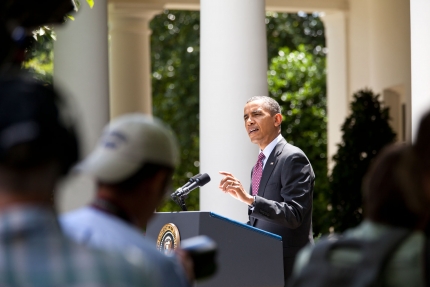
President Barack Obama delivers remarks in the Rose Garden of the White House (June 15, 2012)

President Barack Obama delivers remarks on the Department of Homeland Security’s immigration announcement in the Rose Garden of the White House, June 15, 2012. (Official White House Photo by Sonya N. Hebert)

Secretary Janet Napolitano’s announcement this morning reaffirms President Obama’s commitment to smart and sensible immigration policies that prioritize immigration enforcement toward individuals who pose a threat to public safety. Young deserving people who are Americans in every way but on paper are not this Administration’s priority for removal. These young people came to this country as children. As the President has said many times, it makes no sense to remove productive young people to countries where they may not have lived or even speak the language. They have become productive members in our communities. They have grown up swearing allegiance to our flag. Yet they live in the shadows of America, without the possibility to realize their dreams.

This new policy is the latest in a series of steps the Department of Homeland Security has taken to improve upon the use of prosecutorial discretion. The point of this strategy is to ensure that our immigration enforcement can focus on high-priority individuals instead of clogging the system with low priority cases. The young immigrants who will be eligible under this policy are earnest, productive young people ready to contribute back to America in the fullest possible sense.

Cecilia Muñoz is Director of the White House Domestic Policy Council

President Obama Speaks on Department of Homeland Security Immigration Announcement

June 15, 2012 | 8:56 | Public Domain

President Obama announces a new Department of Homeland Security policy that will allow certain young people who were brought to the United States as young children, do not present a risk to national security or public safety, and meet several key criteria to be considered for relief from removal from the country or from entering into removal proceedings.

Download mp4 (315MB) | mp3 (20MB)

Read the Transcript

Remarks by the President on Immigration

Rose Garden

2:09 P.M. EDT

THE PRESIDENT:  Good afternoon, everybody.  This morning, Secretary Napolitano announced new actions my administration will take to mend our nation’s immigration policy, to make it more fair, more efficient, and more just -- specifically for certain young people sometimes called “Dreamers.”

These are young people who study in our schools, they play in our neighborhoods, they’re friends with our kids, they pledge allegiance to our flag.  They are Americans in their heart, in their minds, in every single way but one:  on paper.  They were brought to this country by their parents -- sometimes even as infants -- and often have no idea that they’re undocumented until they apply for a job or a driver’s license, or a college scholarship. 

Put yourself in their shoes.  Imagine you’ve done everything right your entire life -- studied hard, worked hard, maybe even graduated at the top of your class -- only to suddenly face the threat of deportation to a country that you know nothing about, with a language that you may not even speak.

That’s what gave rise to the DREAM Act.  It says that if your parents brought you here as a child, if you’ve been here for five years, and you’re willing to go to college or serve in our military, you can one day earn your citizenship.  And I have said time and time and time again to Congress that, send me the DREAM Act, put it on my desk, and I will sign it right away. 

Now, both parties wrote this legislation.  And a year and a half ago, Democrats passed the DREAM Act in the House, but Republicans walked away from it.  It got 55 votes in the Senate, but Republicans blocked it.  The bill hasn’t really changed.  The need hasn’t changed.  It’s still the right thing to do.  The only thing that has changed, apparently, was the politics. 
 
As I said in my speech on the economy yesterday, it makes no sense to expel talented young people, who, for all intents and purposes, are Americans -- they’ve been raised as Americans; understand themselves to be part of this country -- to expel these young people who want to staff our labs, or start new businesses, or defend our country simply because of the actions of their parents -- or because of the inaction of politicians. 

In the absence of any immigration action from Congress to fix our broken immigration system, what we’ve tried to do is focus our immigration enforcement resources in the right places.  So we prioritized border security, putting more boots on the southern border than at any time in our history -- today, there are fewer illegal crossings than at any time in the past 40 years.  We focused and used discretion about whom to prosecute, focusing on criminals who endanger our communities rather than students who are earning their education.  And today, deportation of criminals is up 80 percent.  We've improved on that discretion carefully and thoughtfully.  Well, today, we're improving it again. 

Effective immediately, the Department of Homeland Security is taking steps to lift the shadow of deportation from these young people.  Over the next few months, eligible individuals who do not present a risk to national security or public safety will be able to request temporary relief from deportation proceedings and apply for work authorization.

Now, let's be clear -- this is not amnesty, this is not immunity.  This is not a path to citizenship.  It's not a permanent fix.  This is a temporary stopgap measure that lets us focus our resources wisely while giving a degree of relief and hope to talented, driven, patriotic young people.  It is --

Q    (Inaudible.)

THE PRESIDENT:  -- the right thing to do. 

Q    -- foreigners over American workers.

THE PRESIDENT:  Excuse me, sir.  It's not time for questions, sir.

Q    No, you have to take questions.

THE PRESIDENT:  Not while I'm speaking. 

Precisely because this is temporary, Congress needs to act.  There is still time for Congress to pass the DREAM Act this year, because these kids deserve to plan their lives in more than two-year increments.  And we still need to pass comprehensive immigration reform that addresses our 21st century economic and security needs -- reform that gives our farmers and ranchers certainty about the workers that they'll have.  Reform that gives our science and technology sectors certainty that the young people who come here to earn their PhDs won't be forced to leave and start new businesses in other countries.  Reform that continues to improve our border security, and lives up to our heritage as a nation of laws and a nation of immigrants.

Just six years ago, the unlikely trio of John McCain, Ted Kennedy and President Bush came together to champion this kind of reform.  And I was proud to join 23 Republicans in voting for it.  So there’s no reason that we can’t come together and get this done.

And as long as I’m President, I will not give up on this issue, not only because it’s the right thing to do for our economy -- and CEOs agree with me -- not just because it’s the right thing to do for our security, but because it’s the right thing to do, period.  And I believe that, eventually, enough Republicans in Congress will come around to that view as well.

And I believe that it’s the right thing to do because I’ve been with groups of young people who work so hard and speak with so much heart about what’s best in America, even though I knew some of them must have lived under the fear of deportation.  I know some have come forward, at great risks to themselves and their futures, in hopes it would spur the rest of us to live up to our own most cherished values.  And I’ve seen the stories of Americans in schools and churches and communities across the country who stood up for them and rallied behind them, and pushed us to give them a better path and freedom from fear --because we are a better nation than one that expels innocent young kids. 

And the answer to your question, sir -- and the next time I’d prefer you let me finish my statements before you ask that question -- is this is the right thing to do for the American people --

Q    (Inaudible.)

THE PRESIDENT:  I didn’t ask for an argument.  I’m answering your question. 

Q    I'd like to --

THE PRESIDENT:  It is the right thing to do -- 

Q    (Inaudible.)

THE PRESIDENT:  -- for the American people.  And here’s why --

Q    -- unemployment --

THE PRESIDENT:  Here’s the reason:  because these young people are going to make extraordinary contributions, and are already making contributions to our society. 

I’ve got a young person who is serving in our military, protecting us and our freedom.  The notion that in some ways we would treat them as expendable makes no sense.  If there is a young person here who has grown up here and wants to contribute to this society, wants to maybe start a business that will create jobs for other folks who are looking for work, that’s the right thing to do.  Giving certainty to our farmers and our ranchers; making sure that in addition to border security, we’re creating a comprehensive framework for legal immigration -- these are all the right things to do. 

We have always drawn strength from being a nation of immigrants, as well as a nation of laws, and that’s going to continue.  And my hope is that Congress recognizes that and gets behind this effort. 

All right.  Thank you very much.

Q    What about American workers who are unemployed while you import foreigners?

END                                              
2:17 P.M. EDT

Close Transcript

We Come Back Stronger

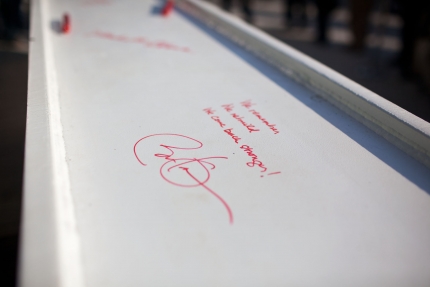
Message signed by President Barack Obama on a beam at One World Trade Center

Message signed by President Barack Obama on one of the final steel beams that will be installed as part of the framework of the Port Authority of New York and New Jersey’s One World Trade Center site in New York, N.Y., June 14, 2012. (Official White House Photo by Chuck Kennedy)


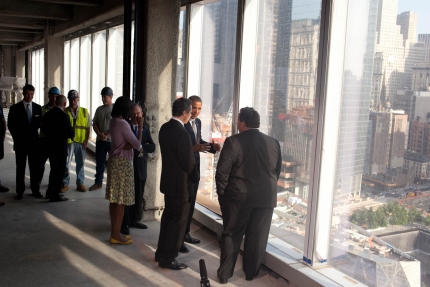
President and Mrs Obama toured the World Trade Center complex in New York yesterday, and got an up close look at the skyscraper that's being built to replace the twin towers that were destroyed in the terrorist attack on September 11, 2001.

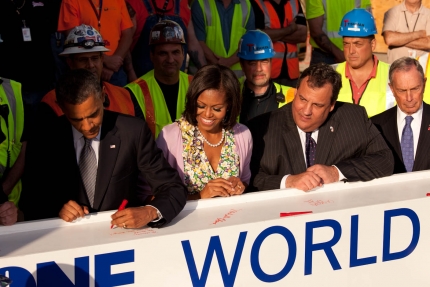
The First Couple reviewed the entire site from the 22nd floor of One World Trade Center, and then made their way back down to the ground level, where they signed one of the final steel beams that will be added to the tower. The President wrote his message in red marker:  "We remember. We rebuild. We come back stronger!"

President Barack Obama signs a steel beam at the One World Trade Center site

President Barack Obama signs one of the final steel beams that will be installed as part of the framework of the Port Authority of New York and New Jersey’s One World Trade Center site in New York, N.Y., June 14, 2012. First Lady Michelle Obama, New York Governor Andrew Cuomo, New Jersey Governor Chris Christie, and New York City Mayor Michael Bloomberg also signed the beam. (Official White House Photo by Chuck Kennedy)

President Barack Obama and First Lady Michelle Obama tour the One World Trade Center site

President Barack Obama and First Lady Michelle Obama tour the Port Authority of New York and New Jersey’s One World Trade Center site in New York, N.Y., June 14, 2012. The President talks with New York Governor Andrew Cuomo and New Jersey Governor Chris Christie, while the First Lady talks with New York City Mayor Michael Bloomberg. (Official White House Photo by Chuck Kennedy)


From the Archives: Presidents as Fathers

  •  Herbert Hoover and son

    Herbert Hoover and son, Herbert Jr., at Cairo Railway Station, 1905.

    1 of 14
  • Franklin D. Roosevelt Father's Day

    Franklin D. Roosevelt (back row, 4th from right) and Eleanor Roosevelt with their 13 grandchildren.

    2 of 14
  • Harry S. Truman Father's Day

    Harry S. Truman with daughter Margaret Truman in the backyard of their home in Independence, Missouri.

    3 of 14
  • Dwight Eisenhower Father's Day

    Dwight Eisenhower's grandson, David, enjoys a birthday party with Roy Rogers (top, far right) at the White House.

    4 of 14
  • John F Kennedy Father's Day

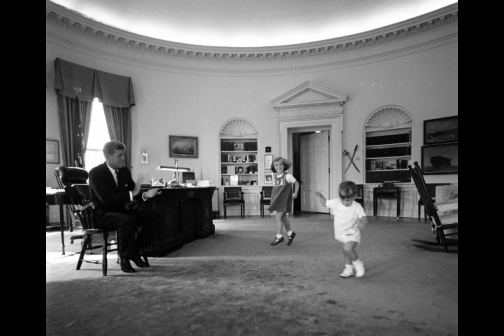
    John F. Kennedy claps while his children, Caroline and John, Jr., dance in the Oval Office of the White House.

    5 of 14
  • Lyndon B. Johnson Father's Day

    Lyndon B. Johnson's grandson, Patrick Lyndon Nugent, gets his first haircut in the White House Barber Shop.

    6 of 14
  • Richard Nixon Father's Day

    Richard Nixon and Pat Nixon with their daughters Tricia and Julie, enjoy the beach with their dog, Checkers, while on a weekend holiday in Mantoloking

    7 of 14
  • Gerald R. Ford Father's Day

    Gerald R. Ford, Betty Ford, and two of their children, Steve and Susan, feed "Flag" the deer at Camp David.

    8 of 14
  • Jimmy Carter Father's Day

    Jimmy Carter with daughter, Amy, and grandson, Jason Carter, by the tree house he designed for Amy on the White House grounds.

    9 of 14
  • Ronald Reagan Father's Day

    Ronald Reagan and son, Michael Reagan, building a snowman with grandchildren, Cameron Reagan and Ashley Reagan, in the White House Rose Garden.

    10 of 14
  • George H.W. Bush Father's Day

    George H.W. Bush plays football with his daughter, Doro, during his campaign for the U.S. Senate. Midland, Texas, 1964.

    11 of 14
  • Bill J. Clinton Father's Day

    William J. Clinton and daughter, Chelsea Clinton, in Chappaqua, New York.

    12 of 14
  • George W. Bush Father's Day

    George W. Bush holds his twin daughters, Barbara and Jenna, born in Dallas, Texas.

    13 of 14
  • Barack Obama Father's Day

    President Barack Obama walks down the Colonnade at the White House with his arms around his daughters, Malia and Sasha.

    14 of 14

As you celebrate Dad this weekend, consider giving a nod to the Presidents who helped give him his own national holiday. On this day in 1966, Lyndon B. Johnson issued the first Presidential Father’s Day Proclamation. It set aside the third Sunday in June in celebration of fathers. Six years later, it became a permanent holiday by order of President Richard Nixon. Each year since then, the Presidents have issued yearly Father’s Day proclamations.

Presidents have enjoyed the day as fathers themselves, and over the years many children have enlivened the White House. Some presidents enter office as grandfathers, such as Franklin D. Roosevelt who had 13 grandchildren. Others, like current President Obama, are fathers to school age children.

In celebration of fathers everywhere, here’s an album of Presidents with the people who know them simply as “Dad” and “Granddad.” These photos are from the holdings of the Presidential Libraries of the U.S. National Archives

View the full size gallery here

Jeannie Chen is the Social Media Coordinator for the Office of Presidential Libraries at the U.S. National Archives.

Tune In: President Obama Delivers Remarks on Immigration

At 1:15 PM ET, President Obama will address the American people from the Rose Garden. He'll discuss an announcement from the Department of Homeland Security.

You can watch live at WhiteHouse.gov/live.

Have questions about the announcement? Ask on Twitter with the hashtag #WHChat. Today at 2:00 PM ET, Felicia Escobar, senior policy director for immigration, will answer live during a special session of White House Office Hours.

Here's how it works:

  • Ask your questions on Twitter with the hashtag #WHChat
  • Follow the Q&A live on Friday, June 15, at 2:00 p.m. ET through the @WHLive Twitter account
  • If you miss the live session, the full session will be posted on WhiteHouse.gov and Storify.com/Whitehouse

The White House

Office of the Press Secretary

Remarks by the President at a Campaign Event

Plaza Hotel
New York, New York

11:00 P.M. EDT

MRS. OBAMA:  (In progress) -- and I know that each of you have somebody in your lives today who doesn’t know what’s at stake.  And those are the kind of uncomfortable conversations that we need to have with those in our lives -- whether it’s our parents or our coworkers, or the people who serve on our boards. We need to let them know what these issues mean and why this President is so important.
 
And that’s where all of you come in.  As I say, you have to multiply yourselves.  For every one of you here, you have to find another 10, 20, 30, 50 people that you are going to be responsible for shaking them up and getting them engaged, convincing them what’s at stake. 

And we know you all can do it.  You have been with us -- so many of you in this room have been with us every step of the way. And for that, Barack and I are grateful -- but, more importantly, our children our grateful.  (Applause.)

I want to thank you all.  So are we ready to work?  (Applause.)  Are we really ready to work?

AUDIENCE:  Yes!

MRS. OBAMA:  -- I'm going to work with as much as possible, with as much passion and as much conviction as this little body can muster up -- (laughter) -- because I completely agree in the man who I’m about to introduce.
 
When he said he would run I was skeptical, but I wasn’t skeptical about what kind of President Barack could be.  I was only skeptical about what we could accomplish.  And even in the midst of all the back-and-forth and all the rancor, so much has happened in these three and a half years.  So much has changed.  And so many children will look at this President and see a different set of possibilities for themselves.  And that we all know we can’t put a price tag on that.
 
So I’m going to work hard for this President.  And with that, I’d like to introduce my husband, your President, Barack Obama.  (Applause.)

THE PRESIDENT:  Thank you.  (Applause.)  Hello, hello, hello!  Hello, New York!  (Applause.)  Thank you.  Thank you so much.  Well, it is wonderful to see all of you. 

Let me begin my thanking a couple of folks who preceded me. First of all, the most important person, the true star of the Obama family, along with Malia, Sasha and Bo -- the First Lady of the United States, Michelle Obama.  (Applause.)  This is what qualifies as date night in the Obama household.  (Laughter.) 

I also want to thank Mariah Carey for performing this evening.  (Applause.)  We are grateful to her.  Appreciate you.  And somebody who can sing pretty good, too, but also just is incredibly passionate about issues and ideas, and I’m so grateful for her friendship -- Alicia Keys.  (Applause.)
 
So I think the way we’re going to do this tonight is I want to actually spend some time in conversation with you, so we’re going to do some Q&A later, and I’m going to just give a few brief remarks at the top.

I was in Cleveland earlier today at Cuyahoga Community College.  This is obviously a region that has been struggling, not just since 2008, but has been struggling for over a decade.  And I described to them what was at stake in this election, and explained that there is one area where I and my opponent completely agree -- and that is that, as important as foreign policy is, as proud as I am to have ended the war in Iraq and made sure that we were providing the resources to go after al Qaeda and take out bin Laden, and the transition that we’re working on in getting our troops home from Afghanistan, as important as social issues are, the crux of this campaign is going to be about the economy.
 
Because when we came together in 2008, part of what compelled me to run and part of what I think brought a lot of people to support me was a belief in a basic bargain that here in America, no matter what you look like, no matter where you come from, no matter who you love, no matter what your faith -- if you are willing to work hard you should be able to make it.  Not everybody will experience extraordinary monetary success, but you should be able to find a good job and make a good home, and educate your kids so that they can achieve more than you ever dreamed of, and retire with some dignity and some respect -- the notion that if you show responsibility for yourself and your life, that you can succeed.
 
And it was that basic bargain that built the greatest middle class in history.  It’s what made us an economic superpower.  It wasn’t the idea that the economy grew from the top down; it was the idea that it grew out from the middle -- all kinds of people contributing, coming together, sharing in prosperity -- and sharing in responsibility not only for this generation but for the next generation.

And the sense was in 2008 that we had lost touch with those values and those ideals.  We had squandered a surplus and turned it into deficits by giving tax cuts to folks who didn’t need them and weren’t even asking for them, two wars paid on a credit card. Manufacturing increasingly left our shores.  A lot of our economic growth was built on debt and speculation.  And we didn’t know at the time when I started to run that we would end up with that entire house of cards collapsing, and the result would be the worst financial crisis and the worst economic crisis in our lifetimes. 

We’ve spent three and a half years working diligently -- and when I say "we" I don’t just mean my administration; I mean the American people all across this country -- working to recover from that crisis.  We’ve created more than 4 million jobs over the last 27 months -- more jobs than were created in the entire 7 years preceding my presidency -- 800,000 jobs just this year alone.  But we lost 9 million jobs. 

We rebuilt and gave the opportunity for workers and businesses to begin to rebuild the auto industry, and have started to see manufacturing grow again for the first time since the 1990s.  But we lost 6 million jobs in the decade before as manufacturing moved offshore.

We were able to stabilize the financial system.  But millions of people all across the country saw their homes suddenly lose 10, 20, 30 percent of their value.  And so as a consequence, we saw actually more wealth lost in that short span of time than was lost during the Depression. 

And so as much as we’ve done over the last three and a half years, we’ve got a lot more work to do -- because the hole that was dug was so deep.  And what this election is going to come down to is where do we go from here?  Because I have a fundamentally different vision about where we need to take this country than my opponent. 

And so all the gridlock in Washington, all the stalemate, all the questions as to why, for example, my jobs bill that I proposed that the economists said would create a million jobs hasn’t passed, or the $4 trillion in deficit reduction that I proposed hasn’t gotten done -- part of it is politics.  Part of it is the party that’s not in the White House wanting to block a President who’s in the White House.  But part of it has to do with just a different conception of how we grow the economy. 

Mr. Romney and his congressional allies believe that if we not only extend the tax cuts that were passed under the previous administration but also an addition $5 trillion -- giving a lot of folks in this room big tax cuts -- that that will somehow grow the economy faster.  That if we strip away regulations on polluters or protections that are offered to consumers or workers, that that will unleash the marketplace.  That’s the essence of their prescription. 

Their analysis is, is that government is the problem, and if we just prune it back to a few basics like national security, and break it up and give it back in the form of tax cuts particularly for the wealthiest Americans that we will grow faster.  And they will deliver on that vision if Mr. Romney is elected and Republicans control the Congress. 

So I don’t necessarily question their sincerity, but I do question their understanding of how we built America.  Because throughout most of our postwar era, the way we grew America was understanding that the market was the most powerful wealth generator in history; that we had a entrepreneurial culture, and we rewarded risk-takers and innovators; but we also understood there were some things we had to do together to make sure everybody had a shot, to make sure that everybody did their fair share, to make sure that everybody was playing by the same rules.

And so we created public schools and public universities because we understood all of us would succeed if every talented kid had a chance to get a great education.  And, yes, that cost money, and we couldn’t do it on our own.  We had to do it together. 

And we understood that businesses are going to thrive if we’ve got great infrastructure -- so we built railroads and highways and ports and airports, telecommunications lines, because we recognized that businesses have to move services and goods and information.  And the faster we can do it, the more efficiently we can do it, the more all of us benefit. 

And we understood that if we invest in science and technology -- (phone rings) -- whose phone is that?  (Laughter.) I’m just impressed because it was a really loud ring.  (Laughter and applause.)  That if we invested in science and technology, that wasn’t necessarily something that we could do on our own and it might not always be profitable for the private sector, but because of those investments, we laid the foundation for the Internet and GPS and medical breakthroughs, which then the private sector was able to take advantage of and commercialize and create jobs and businesses all across America.

We understood that if we set up some rules of the road for our capital markets, small investors and others would be more likely to put their money in because they figured they weren’t getting cheated, which gave us the strongest capital markets in the world.  We understood that if we put in place consumer protections and safety standards, that the American brand, our products people would have confidence in.  And we couldn't do those things on our own; we had to do them together.

The Hoover Dam, the Golden Gate Bridge, the GI Bill -- those things weren’t bad for the marketplace.  Those things facilitated the marketplace.  It helped create our wealth.

And so in this election, we are going to have a choice:  Do we continue with that vision -- which, by the way, used to have adherence not just in the Democratic Party but also in the Republican Party.  This used to be a postwar consensus.  There would be arguments about how big government, how small government, but there was a basic understanding that there were some things we do better together. 

And so the reason I'm running is because I want to continue that tradition.  That will provide us the kind of foundation we need to grow. 

And you've got on the other side a basic argument that says government is the enemy; the market for everything -- that's the solution to our problems.  And I'm not exaggerating here.  As I pointed out in my speech today, if you look at what it would mean to provide an additional $5 trillion tax cut, the only way to pay for it without just exploding the deficit would be to cut out 20 percent of that part of the budget that includes education, includes basic research -- just about everything except Medicare, Social Security, national defense would be cut
-- 20 percent. 

That doesn’t get you $5 trillion, though, so you'd then also have to raise taxes in one way or another on the middle class in order to pay for it.  And that doesn’t deal with the existing deficit; that's just the $5 trillion deficit that would be created if we have these additional tax cuts.

If you roll back the health care bill that we passed, it's estimated that millions of people will not have health insurance, and then millions more if we carry out what's been proposed in terms of cutting Medicaid.  Vulnerable kids, kids with autism or disabilities, or folks in nursing homes. 

Now, I understand the argument the other side is making.  The problem is, is that we tried it just a few years ago.  And it was exactly that theory that led to sluggish economic growth, sluggish job growth, huge deficits, and ultimately resulted in a financial crash.  So the question is why would we think that it would work now?  What evidence do we have that this theory would make sense?

But that's the great thing about democracy -- you can present a plan even if it doesn’t make sense.  (Laughter.)  And you can make your argument for it.  But the point I tried to make today -- and this is what we're going to be doing over the next five months -- is I want absolute clarity on the part of the American people about which way we're going. 

I believe in making sure that we're investing in clean energy -- in solar and wind -- because I think that will create jobs and I think it's good for our national security, and I think it will reduce our dependence on foreign oil, and I think it's good for climate change.  Mr. Romney disagrees.  I want to have that debate.

I believe we have to invest in education at the K through 12 level.  We're going to reform the system, but we also have to hire new teachers, pay them better, hold them accountable but stop teaching to the test.  And, yes, that's going to require some resources.  Mr. Romney wants to cut back on those resources. I want to have that debate.

I believe we have to rebuild America, and we should rebuild America right now.  We've got trillions of dollars in deferred maintenance that we're going to at some point have to replace unless we intend to become a second-rate power.  And we could put thousands of people to work doing it right now here in New York and all across the country.  Mr. Romney disagrees.  I want to have that debate.

I want to reduce the deficit, but I want to do it in a balanced way.  I think everybody should do their fair share and we shouldn’t balance it on the backs of folks who are the most vulnerable when we can afford to do a little bit more.  Mr. Romney has a different theory, and I want to have that debate.

So let me just close by saying this.  Over the next five months you won't be seeing a lot of ads because, frankly, Manhattan is not a battleground state.  (Laughter and applause.) But out in those battleground states, they will be seeing not just millions of dollars of ads, but potentially over a billion dollars of negative ads.  And the message will be very simple:  The economy is not where it needs to be and it's Obama's fault.  That's their message.  There are no new ideas; there's no new proposals.  What they're promising is what Bill Clinton called the same policies as the last time except on steroids.  (Laughter.)  But you know people are anxious and they've gone through a really tough time, and sometimes just making an argument that feeds into that dissatisfaction can be enough. 

So this will be a close election.  The good news is I believe we are right.  I believe the American people understand that what made this country great was not a "fend for yourself" economy, but one in which all of us feel a sense of buy-in, and all of us feel a sense of obligation and commitment, a sense of citizenship.  And what we also learned in 2008 is that when the American people decide something is right and something is true, regardless of all the money and all the cynicism and all the nonsense that passes for political campaigns these days, and that we always have to guard against getting sucked into because we're just in this muddy field -- despite all that, the American people decide what's right and what's true, they can change the country.

That's the bet we made in 2008; that's the bet I'm making now.  And I hope you are ready to work just as hard as you did four years ago, because in many ways this election is even more important.  And if you do, then I think I'll have four more years to finish the job. 

Thank you.  (Applause.) 

END
11:25 P.M. EDT

The White House

Office of the Press Secretary

Remarks by the President at a Campaign Event

Private Residence
New York, New York

8:05 P.M. EDT

THE PRESIDENT:  Well, first of all, to Sarah Jessica and her whole crew -- (laughter) -- Matthew apparently had a show he had to run off to -- but for them to let us crash their house, Secret
Service tromping all over the place, is incredibly generous.  And they've been great friends.  Sarah Jessica is doing all kinds of stuff with our Arts and Humanities Council and she has been a great leader and champion on behalf of the arts.  And we could not thank her more for everything that she's done.  So please give her a big round of applause.  (Applause.) 

To Anna, who has been just a great friend, and I think this is -- she is working really hard here in New York, but she actually was in Chicago as well, making things happen on our behalf.  So, thank you, Anna, for everything that you do.  (Applause.) 

Now, I recognize that most of you are here to see Michelle. (Laughter.)  I understand.  I have been there before.  I always explain I rank fifth in the hierarchy in the White House.  (Laughter.)  There's Michelle, my mother-in-law, the two girls, Bo -- so that actually makes it six -- (laughter) -- in terms of star wattage.  People come to the White House -- first they ask, where's Michelle?  They ask, where are the girls?  And then they say, where's Bo?  (Laughter.)  But that's okay.  See, that's how you're thinking, too, isn’t it?  (Laughter.)  It makes sense to you.

But I do want to say -- I don't get a chance to say this a lot publicly -- some of you know that Michelle had some skepticism about a life in politics.  I think that's well known. And so the grace and the strength and the poise and the warmth that she has brought to an extraordinarily difficult task as First Lady and still being the best mom imaginable couldn't make me prouder.  And so I'm very pleased she's here.  And this is sort of our date night, so -- (applause.)

Now, because this is an intimate setting I usually don't give a long speech -- and I already gave a long speech today.  So what I'd rather do is spend most of my time taking questions and getting comments and advice.  I usually get some advice.  That's one of the things about the President -- (laughter) -- you have advisors everywhere.  But let me just say a few things at the top.

In 2208, when we came together, it was because we had a sense that some of the core values, the basic bargain that had made this country the extraordinary place it is had been betrayed, or at least misplaced.  We had a country in which folks who didn’t need them were getting tax cuts that exploded the deficit.  We had two wars that were placed on a credit card.  We had an economy that was doing very well for a few, but for a huge number of people -- and a growing number of people -- meant harder work for less pay, lower incomes, more stress. 

And Michelle and I, I think, embody the essence of an America in which if you are willing to work hard, if you're willing to take responsibility not just for your own life, but for your community and your family, your neighborhood, that you can make it in this country, regardless of what you look like, where you come from, who you love, what your faith.  And that basic bargain, that dream, felt like it was eroding. 

So that’s why I ran in 2008, and that’s why a lot of you supported me in 2008.

What we didn’t know was that we would end up experiencing the worst financial crisis since the Great Depression -- 9 million people ultimately losing their jobs, millions of homes in foreclosure, people having a harder and harder time just making ends meet. 

And the good news is that because of the incredible resilience of the American people -- and one of the great privileges of being President is you travel all across the country and you meet people from every walk of life -- the good news is because of their resilience, we’ve begun to come back.

So we’ve created more than 4 million jobs over the last 27 months, 800,000 this year alone.  We were able to stabilize the financial system.  Manufacturing started coming back.  Sometimes we had to make some tough choices like bailing out the auto industry.  But because we had faith in those workers and we had faith in American ingenuity, GM is now back on top and -- (applause) -- that’s worth applauding.  Yes, why not?  Why not?  (Applause.)  James has been dying to -- he wanted to fire up the crowd a little bit.

AUDIENCE MEMBER:  He knows how to applause line.

THE PRESIDENT:  Absolutely.  And that was a good one -- right on cue.  (Laughter.)  

But there are still a lot of people hurting out there.  We have not come all the way back.  And with what’s happening in Europe and what’s happening around the globe, the economy is fragile.  And we have to remind ourselves of how much more we have to do not just to get back to where we were before the crisis hit, but how do we get back to that core American ideal in which everybody has a shot -- everybody has a fair shot, everybody is doing their fair share, and everybody is playing by the same set of rules.

And so even as we try to address the crisis -- that was our first order of business -- what we also tried to do was slowly begin a process of reforming our institutions so that we can build a strong middle class and give a ladder of opportunity for people who are trying to get into the middle class. 

That’s why we passed health care reform.  That’s the reason why we made sure that we reformed our financial system so we wouldn’t go through the kind of crisis that we did in 2008.  That’s why we reformed our student loans system so millions of students have a better chance of going to college.  That’s why we invested in science and research, because we understand that’s how we’re going to be able to compete over the long term in this very competitive economy.

And that’s why I’m running for a second term -- because our work is not yet done.  We still have to put more people back to work.  We still have to rebuild America.  We still have to reform our immigration system to make sure that incredibly talented young people who grew up here, who understand themselves as Americans, but may have been brought here with parents who didn’t have papers -- that those kids have a chance to contribute, start businesses, and thrive and do all the things that remind us this is a nation of immigrants as well as a nation of laws.  (Applause.)

We’ve got to make sure that health care gets implemented.  Having ended the war in Iraq, we have to now make sure that we’re dealing with a transition in Afghanistan that’s responsible, but ends the war by 2014.  We have to continue to restore respect for America around the world because we observe rule of law, and we’ve eliminated torture, and we’ve once again reached out to countries on the basis of our ideals and our values, and not just our incredible military.  And we’ve got to take care of our veterans who have fought for us and are now coming home, because they shouldn’t have to fight for a job after they fought for us.

So we’ve got a huge amount of work to do.  And the speech that I gave today focused on the fact that we’ve still got a choice.  We’ve got as fundamental a choice this time out as we've had maybe in 30, 40, 50 years. 

In some ways, this election is more important than 2008 -- because in 2008, as much as I disagreed with Mr. McCain, he believed in climate change.  He believed in campaign finance reform.  He believed in immigration reform.  And now what we have is a Republican nominee and a Republican Party that has moved fundamentally away from what used to be a bipartisan consensus about how you build an economy; that has said our entire agenda is based on cutting taxes even more for people who don’t need them and weren’t asking for them; slashing our commitment to things like education or science or infrastructure or a basic social safety net for seniors and the disabled and the infirm; that wants to gut regulations for polluters or those who are taking advantage of consumers. 

So they’ve got a very specific theory about how you grow the economy.  It’s not very different from the one that actually got us into this mess in the first place.  And what we’re going to have to do is to present very clearly to the American people that choice.  Because ultimately you guys and the American people, you’re the tie-breaker.  You’re the ultimate arbiter of which direction this country goes in.  Do we go in a direction where we’re all in this together and we share in prosperity, or do we believe that everybody is on their own and we’ll see how it plays out? 

And I am absolutely convinced in my gut that we are in this together, and that for all the differences that you hear about in the news and on cable, there is still a lot more that we have in common than what drives us apart.  And I think our ideas are ones that the American people believe in. 

But we’re going to have to fight for it, because the American people are tired.  They’ve gone through a very tough economy.  They’re still having a tough time.  And that’s why this election is going to be close.  Because at a certain point, the other side is going to spend $500 million with a very simple message, which is:  You’re frustrated, you’re disappointed, and it’s the fault of the guy in the White House.  And that’s a -- it’s an elegant message.  It happens to be wrong, but it’s crisp. You can fit it on a bumper sticker.

And so we’re going to have to work hard in this election.  We’re going to have to work harder than we did in 2008.  But the good news is, from those travels around the country, I will tell you people remain hopeful, they remain resilient, and ultimately, they prefer our vision of the future.  So we’ve just got to present it to them, and go out and win an election, and then we’re going to have to spend four more years doing a lot of work.

And I want you to know, despite the fact that my hair is a little grayer than it was -- (laughter) -- when I started on this journey, I’ve never been more determined and more convinced about the importance of our cause.

Thank you, everybody.  Thank you. 

END  
8:19 P.M. EDT