The White House

Office of the Press Secretary

Presidential Trade Proclamation -- To Implement the United States-Colombia Trade Promotion Agreement and for Other Purposes

TO IMPLEMENT THE
UNITED STATES-COLOMBIA TRADE PROMOTION AGREEMENT
AND FOR OTHER PURPOSES
- - - - - - -
BY THE PRESIDENT OF THE UNITED STATES OF AMERICA
A PROCLAMATION

1. On November 22, 2006, the United States entered into the United States-Colombia Trade Promotion Agreement (the "Agreement") and on June 28, 2007, the United States and Colombia amended the Agreement. The Congress approved the Agreement, as amended, in section 101(a) of the United States-Colombia Trade Promotion Agreement Implementation Act (the "Implementation Act") (Public Law 112-42, 125 Stat. 462).

2. Section 105(a) of the Implementation Act authorizes the President to establish or designate within the Department of Commerce an office that shall be responsible for providing administrative assistance to panels established under chapter 21 of the Agreement.

3. Section 201 of the Implementation Act authorizes the President to proclaim such modifications or continuation of any duty, such continuation of duty-free or excise treatment, or such additional duties, as the President determines to be necessary or appropriate to carry out or apply Articles 2.3, 2.5, 2.6, and 3.3.13 and Annex 2.3 of the Agreement.

4. Consistent with section 201(a)(2) of the Implementation Act, Colombia is to be removed from the enumeration of designated beneficiary developing countries eligible for the benefits of the Generalized System of Preferences (GSP).

5. Section 3103 of the Andean Trade Promotion and Drug Eradication Act (title XXXI of the Trade Act of 2002, Public Law 107-210) (ATPDEA) amended section 204(b) of the Andean Trade Preference Act (19 U.S.C. 3203(b)) (ATPA) to provide that certain preferential tariff treatment may be provided to eligible articles that are the product of any country that the President designates as an "ATPDEA beneficiary country" pursuant to section 204(b)(6)(B) of the ATPA, as amended. In Proclamation 7616 of October 31, 2002, Colombia and Peru were designated as beneficiary countries under the ATPDEA.

6. Consistent with section 201(a)(3) of the Implementation Act, Colombia is removed from the enumeration of beneficiary countries under the ATPA (19 U.S.C. 3202(a)(1)). Consequently, Colombia is also removed from the enumeration of beneficiary countries under the ATPDEA.

7. Consistent with section 604 of the Trade Act of 1974, as amended (the "1974 Act") (19 U.S.C. 2483), I have determined that other technical and conforming changes to the Harmonized Tariff Schedule of the United States (HTS) are necessary to reflect that Colombia is no longer eligible to receive the benefits of the GSP, the ATPA, and the ATPDEA.

8. Section 201(d) of the Implementation Act authorizes the President to take such action as may be necessary in implementing the tariff-rate quotas set forth in Appendix I to the General Notes to the Schedule of the United States to Annex 2.3 of the Agreement to ensure that imports of agricultural goods do not disrupt the orderly marketing of commodities in the United States.

9. Section 203 of the Implementation Act sets forth certain rules for determining whether a good is an originating good for the purpose of implementing preferential tariff treatment provided for under the Agreement. I have determined that it is necessary to include these rules of origin, together with particular rules applicable to certain other goods, in the HTS.

10. Section 203(o) of the Implementation Act authorizes the President, after receiving a request from an interested entity, to determine that a fabric, yarn, or fiber is or is not available in commercial quantities in a timely manner in Colombia or the United States; to establish procedures governing the submission of a request for any such determination and ensuring appropriate public participation in any such determination; to add to the list of the United States as set forth in Annex 3-B of the Agreement any fabric, yarn, or fiber determined to be not available in commercial quantities in a timely manner in Colombia and the United States; or to remove from the list in Annex 3-B of the Agreement any fabric, yarn, or fiber that the President has previously added to that list.

11. Section 208 of the Implementation Act authorizes the President to take certain enforcement actions relating to trade with Colombia in textile and apparel goods.

12. Subtitle B of title III of the Implementation Act authorizes the President to take certain actions in response to a request by an interested party for relief from serious damage or actual threat thereof to a domestic industry producing certain textile or apparel articles.

13. Executive Order 11651 of March 3, 1972, as amended, established the Committee for the Implementation of Textile Agreements (CITA), consisting of representatives of the Departments of State, the Treasury, Commerce, and Labor, and the Office of the United States Trade Representative, with the representative of the Department of Commerce as Chairman, to supervise the implementation of textile trade agreements. Consistent with section 301 of title 3, United States Code, when carrying out functions vested in the President by statute and assigned by the President to CITA, the officials collectively exercising those functions are all to be officers required to be appointed by the President with the advice and consent of the Senate.

14. Section 501(a) of the Implementation Act amended section 208(a) of the ATPA (19 U.S.C. 3206(a)) to extend the duration of duty-free treatment under the ATPA until July 31, 2013. I have determined that a modification to the HTS is necessary to reflect this amendment.

15. Section 201 of the Omnibus Trade Act of 2010 (the "Trade Act of 2010") (Public Law 111-344, 124 Stat. 3611), amended section 208(a)(1) of the ATPA (19 U.S.C. 3206(a)(1)) to provide that no duty-free treatment or other preferential treatment extended to beneficiary countries under the ATPA shall remain with respect to Peru after December 31, 2010. I have determined that a modification to the HTS is necessary to reflect this amendment. Consequently, Peru is removed from the enumeration of beneficiary countries under the ATPA and the ATPDEA.

16. Section 1952(a) of the Small Business Job Protection Act of 1996 (Public Law 104-188, 110 Stat. 1755) amended title V of the 1974 Act, to provide, in part, that the President may not designate as an eligible article under the GSP "[t]extile and apparel articles which were not eligible articles for purposes of this title on January 1, 1994, as this title was in effect on such date." I have determined that a modification of general notes 4 and 10 to the HTS is necessary to reflect this amendment.

17. Presidential Proclamation 8332 of December 29, 2008, implemented U.S. tariff commitments under the United States-Oman Free Trade Agreement and incorporated by reference Publication 4050 of the United States International Trade Commission (the "Commission"), entitled "Modifications to the Harmonized Tariff Schedule of the United States Implementing the United States-Oman Free Trade Agreement." Annex II to that publication included certain errors in the quantities specified under certain tariff-rate quotas and references to relevant tariff lines. I have determined that a modification to the HTS is necessary to correct those errors.

18. Presidential Proclamation 8405 of August 31, 2009, modified certain rules of origin under the North American Free Trade Agreement and incorporated by reference Publication 4095 of the Commission, entitled "Modifications to the Harmonized Tariff Schedule of the United States to Adjust Rules of Origin Under the North American Free Trade Agreement." Certain rules of origin were incorrectly deleted from the HTS. I have determined that a modification to general note 12 to the HTS is necessary to restore those rules of origin.

19. Presidential Proclamation 8771 of December 29, 2011, modified the HTS to conform to amendments made to the International Convention on the Harmonized Commodity Description and Coding System and incorporated by reference Publication 4276 of the Commission, entitled "Modifications to the Harmonized Tariff Schedule of the United States Under Section 1206 of the Omnibus Trade and Competitiveness Act of 1988." Annex II to that publication included incorrect rates of duty for certain articles for the years 2016 through 2018. I have determined that a modification of general note 31 to the HTS is necessary to reflect the correct rate of duty for these articles.

20. Presidential Proclamation 8783 of March 6, 2012, implemented U.S. tariff commitments under the United States-Korea Free Trade Agreement and incorporated by reference Publication 4308 of the Commission, entitled "Modifications to the Harmonized Tariff Schedule of the United States to Implement the United States-Korea Free Trade Agreement." Annex II to that publication included an error in the staged duty applied to two tariff subheadings. I have determined that a modification to the HTS is necessary to correct that error.

21. Section 604 of the 1974 Act authorizes the President to embody in the HTS the substance of relevant provisions of chapter V of that Act, and of other Acts affecting import treatment, and of actions taken thereunder, including the removal, modification, continuance, or imposition of any rate of duty or other import restriction.

NOW, THEREFORE, I, BARACK OBAMA, President of the United States of America, by virtue of the authority vested in me by the Constitution and the laws of the United States of America, including but not limited to section 604 of the 1974 Act, section 1952(a) of the Small Business Job Protection Act of 1996, section 201 of the Trade Act of 2010, sections 105(a), 201, 203, 208, 501, and subtitle B of title III of the Implementation Act, and section 301 of title 3, United States Code, and having made the determination under section 101(b) of the Implementation Act necessary for the exchange of notes, do hereby proclaim:

(1) In order to provide generally for the preferential tariff treatment being accorded under the Agreement, to set forth rules for determining whether goods imported into the customs territory of the United States are eligible for preferential tariff treatment under the Agreement, to provide certain other treatment to originating goods of Colombia for the purposes of the Agreement, and to reflect Colombia's removal from the list of beneficiary developing countries under the GSP, and from the list of beneficiary countries under ATPA and ATPDEA, the HTS is modified as set forth in Annex I of Publication 4320 of the Commission, entitled "Modifications to the Harmonized Tariff Schedule of the United States to Implement the United States-Colombia Trade Promotion Agreement," which is incorporated by reference into this proclamation.

(2) The modifications to the HTS made in paragraph (1) of this proclamation shall be effective with respect to goods entered, or withdrawn from warehouse for consumption, on or after the relevant dates indicated in Annex I of Publication 4320.

(3) In order to implement the initial stage of duty elimination provided for in the Agreement and to provide for future staged reductions in duties for originating goods of Colombia for purposes of the Agreement, the HTS is modified as provided in Annex II of Publication 4320, effective on the dates specified in the relevant sections of such Annex and on any subsequent dates set forth for such duty reductions in that Annex.

(4) In order to implement section 501(a) of the Implementation Act, the HTS is modified as set forth in section A of Annex III of Publication 4320.

(5) The modifications to the HTS set forth in section A of Annex III of Publication 4320 shall be effective with respect to goods entered, or withdrawn from warehouse for consumption, on or after November 5, 2011.

(6) The Secretary of Commerce is authorized to exercise the authority of the President under section 105(a) of the Implementation Act to establish or designate an office within the Department of Commerce to carry out the functions set forth in that section.

(7) The CITA is authorized to exercise the authority of the President under section 203(o) of the Implementation Act to determine that a fabric, yarn, or fiber is or is not available in commercial quantities in a timely manner in Colombia and the United States; to establish procedures governing the request for any such determination and ensuring appropriate public participation in any such determination; to add any fabric, yarn, or fiber determined to be not available in commercial quantities in a timely manner in Colombia and the United States to the list in Annex 3-B of the Agreement; or to remove from the list in Annex 3-B of the Agreement any fabric, yarn, or fiber that the President has previously added to that list.

(8) The CITA is authorized to exercise the authority of the President under section 208 of the Implementation Act to direct the exclusion of certain textile and apparel goods from the customs territory of the United States and to direct the denial of preferential tariff treatment to textile and apparel goods.

(9) The CITA is authorized to exercise the functions of the President under subtitle B of title III of the Implementation Act to review requests, and to determine whether to commence consideration of such requests; after an appropriate determination, to cause to be published in the Federal Register a notice of commencement of consideration of a request and notice seeking public comment; to determine whether imports of a Colombian textile or apparel article are causing serious damage, or actual threat thereof, to a domestic industry producing an article that is like, or directly competitive with, the imported article; and to provide relief from imports of an article that is the subject of an affirmative determination as to damage or threat.

(10) The United States Trade Representative (USTR) is authorized to fulfill the obligations of the President under section 104 of the Implementation Act to obtain advice from the appropriate advisory committees and the Commission on the proposed implementation of an action by Presidential proclamation; to submit a report on such proposed action to the appropriate congressional committees; and to consult with those congressional committees regarding the proposed action.

(11) The USTR is authorized to modify U.S. note 33 to subchapter XXII of chapter 98 of the HTS in a notice published in the Federal Register to reflect modifications pursuant to paragraph (7) of this proclamation by the CITA to the list of fabrics, yarns, or fibers in Annex 3-B of the Agreement.

(12) In order to reflect Peru's removal from the list of beneficiary countries under the ATPA and the ATPDEA, the HTS is modified as set forth in section B of Annex III to Publication 4320.

(13) The modifications to the HTS set forth in section B of Annex III to Publication 4320 shall be effective with respect to goods entered, or withdrawn from warehouse for consumption, on or after January 1, 2011.

(14) In order to reflect the amendments to title V of the 1974 Act, general notes 4 and 10 to the HTS are modified as set forth in section A of Annex IV to Publication 4320.

(15) The modifications to the HTS set forth in section A of Annex IV to Publication 4320 shall be effective with respect to goods entered, or withdrawn from warehouse for consumption, on or after January 1, 1996.

(16) In order to provide the intended tariff treatment to certain goods of Oman under the terms of general note 31 to the HTS, subchapter XVI of chapter 99 and general note 31 to the HTS are modified as set forth in section B of Annex IV to Publication 4320.

(17) The modifications to the HTS set forth in section B of Annex IV to Publication 4320 shall be effective with respect to goods entered, or withdrawn from warehouse for consumption, on or after January 1, 2009.

(18) In order to provide the intended tariff treatment to certain goods of Canada or of Mexico under the terms of general note 12 to the HTS, general note 12 is modified as set forth in section C of Annex IV to Publication 4320.

(19) The modifications to the HTS set forth in section C of Annex IV to Publication 4320 are effective with respect to goods entered, or withdrawn from warehouse for consumption, on or after February 3, 2007.

(20) In order to provide the intended tariff treatment to goods of Korea under the terms of general note 33, the HTS is modified as set forth in section D of Annex IV to Publication 4320.

(21) The modifications to the HTS set forth in section D of Annex IV to Publication 4320 are effective with respect to goods entered, or withdrawn from warehouse for consumption, as set forth in section D of Annex IV to Publication 4320.

(22) All provisions of previous proclamations and Executive Orders that are inconsistent with the actions taken in this proclamation are superseded to the extent of such inconsistency.

IN WITNESS WHEREOF, I have hereunto set my hand this fourteenth day of May, in the year of our Lord two thousand twelve, and of the Independence of the United States of America the two hundred and thirty-sixth.

BARACK OBAMA

The White House

Office of the Press Secretary

Presidential Proclamation -- 150th Anniversary of the United States Department of Agriculture

150TH ANNIVERSARY OF THE UNITED STATES DEPARTMENT OF AGRICULTURE

BY THE PRESIDENT OF THE UNITED STATES OF AMERICA

A PROCLAMATION


On May 15, 1862, President Abraham Lincoln signed legislation to establish the United States Department of Agriculture (USDA) and codified a commitment to the health of our people and our land.  One hundred and fifty years later, USDA continues to realize that vision of service by applying sound public policy and science to an evolving food and agriculture system. 

The USDA has stood shoulder-to-shoulder with the American people for generations.  During the Great Depression, the Department helped bring an end to the Dust Bowl by promoting soil conservation.  Through two World Wars, the Victory Garden Program fed troops and families around the world.   The USDA worked to bring electric power to rural communities, establish the Supplemental Nutrition Assistance and School Lunch Programs, implement our Nation's food safety regulations, and protect our forests and private lands.  For one-and-a-half centuries, USDA has empowered communities across our country and helped ensure we leave our children a future rich with promise and possibility.

Today, USDA continues to serve the public interest by providing leadership on agriculture, natural resources, safe and nutritious food, research, and a broad spectrum of related issues.  With partners across the public sector and throughout industry, USDA is working to develop and expand markets for agricultural products, grow our businesses and our economy, and protect the quality of our food supply and our environment.  As part of the White House Rural Council, the Department is striving to expand opportunity for millions of families by promoting job growth and investing in infrastructure that will drive progress in the 21st century.  Through the Feed the Future initiative, USDA is supporting America's commitment to combat hunger and improve food security worldwide.  And with the America's Great Outdoors initiative, USDA is supporting community-based conservation initiatives that will preserve our natural heritage for generations to come.

As we commemorate this historic milestone, we pay tribute to the men and women of USDA, past and present, who have faithfully served our Nation for 150 years.  For their commitment, our fields grow richer, our abundance grows greater, and our country stands stronger.

NOW, THEREFORE, I, BARACK OBAMA, President of the United States of America, by virtue of the authority vested in me by the Constitution and the laws of the United States, do hereby proclaim May 15, 2012, as the 150th Anniversary of the United States Department of Agriculture.  I call upon all Americans to observe this day with appropriate programs, ceremonies, and activities that honor the United States Department of Agriculture for its lasting contributions to the welfare of our Nation.

IN WITNESS WHEREOF, I have hereunto set my hand this fourteenth day of May, in the year of our Lord two thousand twelve, and of the Independence of the United States of America the two hundred and thirty-sixth.


BARACK OBAMA
The White House

Office of the Press Secretary

Presidential Proclamation -- National Women's Health Week

NATIONAL WOMEN'S HEALTH WEEK, 2012
- - - - - - -
BY THE PRESIDENT OF THE UNITED STATES OF AMERICA
A PROCLAMATION

Women have guided our country toward prosperity and progress, and our Nation's success depends on their well-being. While women often play a leading role in making medical decisions for their families, their own health care needs have too often gone unmet. During National Women's Health Week, we recommit to making health care more accessible and affordable for women across our country.

As President, I have made advancing gender equality in health care a top priority. Through the historic Affordable Care Act, we are reversing many of the worst abuses of the health insurance industry. Beginning in 2014, many insurers will no longer be allowed to charge women higher premiums simply because of their gender, and it will be illegal for most insurance companies to deny coverage to women because they have a pre-existing condition, including cancer or pregnancy. Health plans will also be required to cover maternity care. The law already enables women in new insurance plans to see any primary care provider or OB-GYN, or bring their children to any pediatrician in their health plan's network without a referral, and it prevents most insurance companies from denying coverage to children with pre-existing conditions.

My Administration has fought to make preventive care accessible to all. Under the Affordable Care Act, we eliminated out-of-pocket costs for recommended preventive services such as mammograms, cervical cancer screenings, contraception, and well-woman visits under most plans. In 2011 alone, more than 20 million women received expanded access to these services at no additional cost.

National Women's Health Week presents an opportunity for all women to prioritize their well-being by scheduling annual check-ups and screenings. To find more information on women's preventive care, visit www.WomensHealth.gov or www.GirlsHealth.gov.

As we celebrate the progress we have made, we recognize that American families cannot afford a return to the days when women were over-charged and denied access to critical services. During National Women's Health Week, let us move forward in pursuit of a fairer, healthier America.

NOW, THEREFORE, I, BARACK OBAMA, President of the United States of America, by virtue of the authority vested in me by the Constitution and the laws of the United States, do hereby proclaim May 13 through May 19, 2012, as National Women's Health Week. I encourage all Americans to celebrate the progress we have made in protecting women's health and to promote awareness, prevention, and educational activities that improve the health of all women.

IN WITNESS WHEREOF, I have hereunto set my hand this fourteenth day of May, in the year of our Lord two thousand twelve, and of the Independence of the United States of America the two hundred and thirty-sixth.

BARACK OBAMA

The White House

Office of the Press Secretary

Presidential Proclamation -- National Defense Transportation Day and National Transportation Week, 2012

NATIONAL DEFENSE TRANSPORTATION DAY
AND NATIONAL TRANSPORTATION WEEK, 2012
- - - - - - -
BY THE PRESIDENT OF THE UNITED STATES OF AMERICA
A PROCLAMATION

From the railroads that connected our continent in the 19th century to the highways that drove progress during the 20th, American infrastructure has fueled our Nation's growth for generations. Our roads, rails, runways, and shipyards have formed the foundation for a thriving global marketplace, and our transportation networks have enabled our first responders and service members to react with speed and efficiency during crisis. On National Defense Transportation Day and during National Transportation Week, we celebrate that rich legacy and recommit to building robust infrastructure that will accelerate our economy in the years ahead.

The need for strong and sustainable transportation networks has never been greater. While transportation systems across our country continue to connect millions of Americans to new economic opportunities, for too many businesses, the state of our roads and railways creates a competitive disadvantage that discourages investment and slows the pace of progress. Crumbling bridges put our safety at risk, and antiquated infrastructure limits our capacity to respond to threats, emergencies, and hazards at home and abroad. These situations diminish our security, our prosperity, and our resilience, and we must do more to address them.

That is why my Administration has prioritized strategic, long-term investments in transportation infrastructure that will keep America safe and ensure we can compete and succeed in the global economy. Through the American Recovery and Reinvestment Act and the Transportation Investment Generating Economic Recovery (TIGER) Discretionary Grant program, all 50 States have launched new highway and infrastructure projects, and many have funded passenger rail development that will modernize our cities and help put more construction workers back on the job. Moving forward, we remain committed to upgrading our infrastructure; ensuring the safety and security of our transportation systems; bringing diverse, sustainable transit opportunities to communities across our country; and investing in innovative solutions to address the transportation challenges of today and tomorrow.

An economy built to last depends on a world-class infrastructure system. This week, as we come together in pursuit of that critical goal, let us recall that as long as we are joined in common purpose and common resolve, our Nation remains strong, and our journey moves forward.

In recognition of the importance of our Nation's transportation infrastructure, and of the men and women who build, maintain, and utilize it, the Congress has requested, by joint resolution approved May 16, 1957, as amended (36 U.S.C. 120), that the President designate the third Friday in May of each year as "National Defense Transportation Day," and, by joint resolution approved May 14, 1962, as amended (36 U.S.C. 133), that the week during which that Friday falls be designated as "National Transportation Week."

NOW, THEREFORE, I, BARACK OBAMA, President of the United States of America, do hereby proclaim Friday, May 18, 2012, as National Defense Transportation Day and May 13 through May 19, 2012, as National Transportation Week. I call upon all Americans to recognize the importance of our Nation's transportation infrastructure and to acknowledge the contributions of those who build, operate, and maintain it.

IN WITNESS WHEREOF, I have hereunto set my hand this fourteenth day of May, in the year of our Lord two thousand twelve, and of the Independence of the United States of America the two hundred and thirty-sixth.

BARACK OBAMA

The White House

Office of the Press Secretary

Presidential Proclamation -- Peace Officers Memorial Day and Police Week

PEACE OFFICERS MEMORIAL DAY AND POLICE WEEK, 2012

BY THE PRESIDENT OF THE UNITED STATES OF AMERICA

A PROCLAMATION


 Every day, public safety officers work tirelessly to protect our citizens, enforce our laws, and keep our neighborhoods safe.  They report for duty knowing full well the dangers they face and the sacrifices they may be called upon to make.  This week, we pay tribute to the thousands of men and women who serve us with extraordinary bravery, and we remember the heroes who have laid down their lives in pursuit of a safer, more just society.

 While we can never fully repay them for their service, we must work to ensure our law enforcement officers are equipped with the tools and technology they need to do their jobs safely and effectively.  My Administration has devoted significant resources to improving officer safety, providing bulletproof vests that have saved lives, training officers to prevent and survive potentially lethal encounters, and strengthening our ability to share information.  We also continue to pursue our goal of deploying a nationwide wireless network for public safety.  For the first time, this new system will give our Nation's police officers and first responders a dedicated communication network in times of crisis    helping fulfill our promise to provide these brave men and women with tools worthy of the sacrifices they make on our behalf.

 We owe a profound debt to all those who have worn the badge, and to the families whose care enables them to serve with courage and pride.  When the unthinkable happens and officers give their lives or are seriously injured in the line of duty, we have an obligation to give their loved ones the support they deserve.  During Peace Officers Memorial Day and Police Week, we recall the selflessness of our law enforcement officers and their families, and we honor all those who devote their lives to forging a stronger, safer America.  Let us reflect on their invaluable contributions as we enjoy the peace they bring to our communities, and let us vow that their service will never be taken for granted.

 By a joint resolution approved October 1, 1962, as amended (76 Stat. 676), and by Public Law 103 322, as amended (36 U.S.C. 136 137), the President has been authorized and requested to designate May 15 of each year as "Peace Officers Memorial Day" and the week in which it falls as "Police Week."

 NOW, THEREFORE, I, BARACK OBAMA, President of the United States of America, do hereby proclaim May 15, 2012, as Peace Officers Memorial Day and May 13 through May 19, 2012, as Police Week.  I call upon all Americans to observe these events with appropriate ceremonies and activities.  I also call on Governors of the United States and the Commonwealth of Puerto Rico, officials of the other territories subject to the jurisdiction of the United States, and appropriate officials of all units of government, to direct that the flag be flown at half staff on Peace Officers Memorial Day.  I further encourage all Americans to display the flag at half staff from their homes and businesses on that day.

IN WITNESS WHEREOF, I have hereunto set my hand this fourteenth day of May, in the year of our Lord two thousand twelve, and of the Independence of the United States of America the two hundred and thirty-sixth.


BARACK OBAMA

The White House

Office of the Press Secretary

Statement by the President on Afghan Transition

I welcome President Karzai’s announcement today of the third tranche of areas to transition to Afghan security lead, which is an important step forward in our effort to achieve our objectives in Afghanistan. As transition proceeds in these areas, nearly 75 percent of the population of Afghanistan will be living in provinces, districts and villages where Afghan forces are leading. The Afghan National Security Forces are strengthening their capacity as we remain on track to meet our goal of having the Afghan government fully responsible for security across the country by the end of 2014.  A week from now, world leaders will gather at the NATO Summit in Chicago to discuss how we can effectively advance the transition process as our forces move from combat to a support role, and demonstrate our enduring support for the Afghan Government and Afghan National Security Forces. I look forward to meeting with President Karzai and my fellow leaders in Chicago to discuss these critical steps that will strengthen Afghan sovereignty while responsibly winding down the war.

President Obama & Vice President Biden Honor the Nations TOP COPS

President Obama TOP COPS 2012

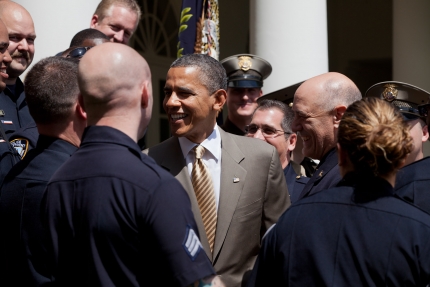
President Barack Obama greets 2012 National Association of Police Organizations Top Cops honorees following his remarks in the Rose Garden of the White House, May 12, 2012. (Official White House Photo by Pete Souza) May 12, 2012. (Official White House Photo)

Today, in a ceremony in the Rose Garden of the White House, President Obama and Vice President Biden honored the winners of the National Association of Police Organizations (NAPO) TOP COPS award for law enforcement who have shown bravery and valor in the line of duty.
 
President Barack Obama, joined by Vice President Joe Biden, National Association of Police Organizations President Tom Nee, and Homeland Security Secretary Janet Napolitano delivered remarks on the imporant role law enforcement officers play, how they put their lives on the live every day to keep America's citizens and neighborhoods safe.  The President  noted:
 You know, I look forward to this event each and every year, because it’s a chance to say thank you.  Every day, hundreds of thousands of law enforcement officers keep our neighborhoods safe, and frankly, they don’t ask for a lot.  They don't ask for a lot of credit.  They don’t go to work planning to be heroes.  They just do their jobs.

But when you put on that badge, you assume a special responsibility.  And every time you put it on, you never know if this day will be the day that you’ve spent your entire career training for -– the day when just doing your job and being a hero are exactly the same thing.  For the men and women standing behind me, America’s Top Cops, that day came.  And when it did, they were ready.  They didn’t flinch.  They didn't back off.  There are people who are alive today only because of their courage.

President Obama also remarked that we must continue to to support our men and women in law enforcement, like the Top Cops and work to make their line of work safer and more effective because, he said:

Our safety will always depend on the quiet heroism of ordinary Americans, like the ones that we recognize today.  We will be forever in debt to those who wear the badge; to men and women with a deep sense of duty, and a willingness to serve and sacrifice on our behalf.  And I think these individuals don't mind me saying that they are representative of the sacrifices and that quiet courage that exists among law enforcement officers all across the country -- and their families, because I know the strains of families in such a difficult job is significant as well.  And those families, those of you who are here today, we want to say thank you to you as well.

So, again, to the 2012 Top Cops, thank you for everything you do.  God bless you and your families.  And God bless the United States of America.  All right. 


Download Video: mp4 (378MB) | mp3 (24MB)
Related Topics: Homeland Security, Service

President Obama Honors the Nations TOP COPS

May 12, 2012 | 10:41 | Public Domain

The President welcomes the winners of the 2012 National Association of Police Organizations TOP COPS award for law enforcement officials who have shown bravery and valor in the line of duty to the White House.

Download mp4 (378MB) | mp3 (24MB)

The White House

Office of the Press Secretary

Remarks by the President and the Vice President Honoring the Winners of the National Association of Police Organizations Top Cops Award

Rose Garden

11:13 A.M. EDT

THE VICE PRESIDENT:  Welcome.  Welcome to the Rose Garden.  Welcome to the White House.  Please be seated, please be seated.  And congratulations.  It’s a great honor to be here with the best of the best, and equally as impressive for us to be here with the families of the best of the best.

Dean, how you doing?

The officers here today have been singled out for extraordinary acts of bravery, and you’re a remarkable group of people.  You’re made of that sterner stuff, and the best we have in this country.

But you’re not only the people who risk your lives to protect all of us, you're also the first ones out there to volunteer to lay down the lines of the Little League field.  You’re the first ones to volunteer at youth camps.  You’re the first one to help your neighbor, whether you've got a badge on or not -- don't have a badge on.  You’re a unique bunch of individuals.

I’ve often tried in all these years of working with you, been trying to figure what is in your DNA, man.  Whatever it is, though, we want to replicate it. 

You deserve not only our thanks and our gratitude, but you deserve our support.  That's why the President has fought so hard to fund the COPS program, the Byrne grants at unprecedented levels -- a billion dollars for COPS in our first year alone.

And earlier this year, finally, because of this man insisting in all the negotiations going on about the budget, finally -- finally -- he was able to sign legislation to secure the D Block, dedicating spectrum to create a national interoperable public safety communications system that you never have to face -- so you never have to face again the dilemmas you saw in New York City on 9/11, in Katrina.  You're actually able to communicate.  And this is the reason why it happened, this man right here.  (Applause.)

Because I want to tell you, they tried to make him have to choose between this and other equally important things he cared about, but this was a showstopper if they weren’t going to go forward with this.  It shouldn’t have taken so long, but it took the leadership of Barack Obama to get it done.

It also takes -- it also takes leadership, the type demonstrated by the President, to stand up for folks who want to take away your collective bargaining rights.  (Applause.)  To say you’ve earned those rights would be the understatement of the day, and they will not be taken away as long as we can do anything about that, or anyone else who cares.  (Applause.)

That's real leadership.  This man has been committed to law enforcement his entire career.  He has never, never wavered from fighting to make sure you guys have the resources you need not only to protect your communities, but to protect one another, to protect your brothers and sisters.  He understands what you know, that having more cops on the street is going to keep you safer; those of you wearing the shield, you are safer when there’s more of you because you have each other’s backs.  And that's why he’s been tireless in fighting to keep as many of you on the job as humanly possible.

I’ve been at this for a long time.  Tommy Nee and his predecessors, all of -- we’ve been good friends for a long, long time.  And I can tell you -- I can say without fear of contradiction, this President feels it in his bones.  He understands.  He understands what you face.  He understands that every day your husband or wife walks out the door -- you family members -- there’s that little shudder because you don't know what’s going to happen.  And we’re both incredibly appreciative for what you do.

The President’s commitment to law enforcement goes to his very core.  Ladies and gentlemen, I’d like to introduce to you my friend, the President of the United States of America, Barack Obama.  (Applause.)

THE PRESIDENT:  Thank you, everybody.  (Applause.)  Please, please, have a seat. 

Well, welcome to the White House.  It is wonderful to be with all of you.  It is especially good to be with somebody who has been fighting on behalf of law enforcement all his life.  Everywhere I go, in every community, people see the track record and the legacy of Joe Biden's work when it comes to looking after law enforcement.  And so I just want to thank my Vice President, who has shown leadership in this administration to make sure -- (applause) -- to make sure you guys have what you need.

My Secretary of Homeland Security, Janet Napolitano, is here.  She does outstanding work.  (Applause.)  The director of the Office of National Drug Control Policy, and a longtime police officer, Gil Kerlikowske, is here.  Give Gil a big round of applause.  (Applause.)  Representative John Conyers is here.  (Applause.)  And of course, I want to welcome the leaders of the National Association of Police Organizations, including your president, Tom Nee.  (Applause.)  Tom told me he just had a new granddaughter.

MR. NEE:  Grandson.

THE PRESIDENT:  Grandson.  What's his name?

MR. NEE:  Nicholas Joseph (ph).

THE PRESIDENT:  Nicholas Joseph (ph).  So give him a round of applause for that.  (Applause.)

You know, I look forward to this event each and every year, because it’s a chance to say thank you.  Every day, hundreds of thousands of law enforcement officers keep our neighborhoods safe, and frankly, they don’t ask for a lot.  They don't ask for a lot of credit.  They don’t go to work planning to be heroes.  They just do their jobs.

But when you put on that badge, you assume a special responsibility.  And every time you put it on, you never know if this day will be the day that you’ve spent your entire career training for -– the day when just doing your job and being a hero are exactly the same thing.  For the men and women standing behind me, America’s Top Cops, that day came.  And when it did, they were ready.  They didn’t flinch.  They didn't back off.  There are people who are alive today only because of their courage.

Now, I had a chance to just shake each one of these individuals' hands and express my appreciation to them personally.  They're a pretty humble group.  Some of them will tell you they don't deserve to be called heroes; they're entitled to their opinion.  (Laughter.)  I disagree with them.  I think they are.  What else do you call a team that takes down a deranged gunman and saves countless lives?  (Applause.)  Or a unit that flies a helicopter into dangerous winds, and pulls off a daring nighttime rescue?  (Applause.)  Or an officer who, after being shot three times, switches her gun from her right hand to her left, so that she can return fire until backup arrives?  (Applause.)

I guarantee you that when the bullets were flying, when lives were on the line, these men and women weren’t thinking about bravery.  They weren’t thinking of themselves.  Instead, they were looking out for their fellow officers, and for the civilians that they swore to protect.  And when they return home, they’ll go back to being just another member of the team.

But they've earned this moment.  Today, we celebrate 34 extraordinary individuals, and we recognize the sacrifices they and their fellow officers make.  Some of our Top Cops are still recovering from gunshot wounds.  I’m sure that many are, even now, thinking of a partner or a teammate who fell in the line of duty.

So we honor their memories today.  We honor all those who have put their lives on the line in order to protect their fellow citizens -– even if they were complete strangers.  I hope that we also pledge to learn something from the example that they set.  Because while most of us will never be asked to run straight into a hail of bullets, or chase down an armed suspect on foot, we also have responsibilities to meet.

For those of us in elected office, that includes helping states and cities to keep first responders on the job.  It includes supporting cutting-edge tools they need, from a high-speed public safety broadband network to a new generation of mobile apps.

Even as we do everything we can to support men and women like our Top Cops, and to make police work safer and more effective, we do have to recognize that one thing will never change.  Our safety will always depend on the quiet heroism of ordinary Americans, like the ones that we recognize today.  We will be forever in debt to those who wear the badge; to men and women with a deep sense of duty, and a willingness to serve and sacrifice on our behalf.  And I think these individuals don't mind me saying that they are representative of the sacrifices and that quiet courage that exists among law enforcement officers all across the country -- and their families, because I know the strains of families in such a difficult job is significant as well.  And those families, those of you who are here today, we want to say thank you to you as well.

So, again, to the 2012 Top Cops, thank you for everything you do.  God bless you and your families.  And God bless the United States of America.  All right.  (Applause.)

END
11:23 A.M. EDT

The White House

Office of the Press Secretary

Weekly Address: Congress Must Act on “To-Do List”

Washington, DC

In this week’s address, President Obama called on Democrats and Republicans to come together and act on his Congressional “to-do list,” which will create jobs and help restore middle class security. In this make-or-break moment for the middle class, these five initiatives have bipartisan support and will help create an economy that is built to last.  While some believe we should return to the same policies that led to the worst recession since the Great Depression, the President believes we must take action to speed up the recovery and ensure that our economy once again rewards hard work and responsibility as we keep our country moving forward.

Remarks of President Barack Obama
Weekly Address
The White House
May 12, 2012

We all know the past few years have been difficult for this country.  After the worst recession of our lifetimes, it will take longer than any of us would like for the economy to fully recover.  But there are plenty of steps we can take to speed up the recovery.  There are things we can do – right now – to help create jobs and restore some of the financial security that so many families have lost. 

Now, the other side isn’t so optimistic.  They think all we can do is cut taxes – especially for the wealthiest Americans – and go back to letting banks and corporations write their own rules again.  That’s their plan. 

But I think they’re wrong.  We tried their ideas for nearly a decade, and it didn’t work out so well.  We can’t go back to the same policies that got us into this mess.  We’ve got to move forward.  We need to build an economy where hard work and responsibility are rewarded – where you can find a good job, own your own home, maybe start a businesses, and give your kids the chance to do even better. 

That’s where we need to go.  And I’ve been pushing Congress to help us get there by passing a few common-sense policies that would make a difference.  Democrats and Republicans have already done some important work together – from passing tax cuts for workers, to opening up new markets for American products, to reforming our patent system.  But now we need to do more. 

That’s why we made Congress a handy “To-Do” list – just like the kind I get from Michelle.  It’s short, but each of the ideas on this list will help create jobs and build a stronger economy right now. 

First, Congress should stop giving tax breaks to companies that ship jobs overseas, and use that money to cover moving expenses for companies that bring jobs back to America. 

Second, Congress should help the millions of Americans who have worked hard and made their mortgage payments on time refinance their mortgages at lower rates and save at least $3,000 a year.  

Third, Congress should help small business owners by giving them a tax break for hiring more workers and paying them higher wages.  Small businesses are the engine of economic growth in this country.  We shouldn’t be holding them back – we should be making it easier for them to succeed.  

Fourth, if Congress fails to act soon, clean energy companies will see their taxes go up and could be forced to lay off employees.  These companies are putting Americans to work and helping break our dependence on foreign oil.  Congress should extend these tax credits.  

And finally, Congress should help our veterans returning from Iraq and Afghanistan by creating a Veterans Job Corps.  Our men and women in uniform have served this country with honor.  Now it’s our turn to serve them.  

So that’s Congress’s “To-Do” List.  But now we need them to start crossing things off.  I need you to call your Members of Congress, write an email, tweet, and let them know we can’t afford to wait any longer to get things done.  Tell them now is the time to take steps we know will grow our economy and create jobs. 

You’re working harder.  You’re meeting your responsibilities.  Your representatives in Washington should do the same.  Let’s push Congress to do the right thing.  Let’s keep moving this country forward together. 

Thanks, and have a great weekend. 

###