President Obama Welcomes the Kentucky Wildcats

May 04, 2012 | 9:02 | Public Domain

The President honors the 2012 NCAA Men's Basketball champion Kentucky Wildcats in a ceremony in the East Room of the White House. May 4, 2012.

Download mp4 (319MB) | mp3 (21MB)

The White House

Office of the Press Secretary

Remarks by the President Honoring the 2012 NCAA Men's Basketball Champion Kentucky Wildcats

East Room


5:03 P.M. EDT


THE PRESIDENT:  Thank you!  (Applause.)  Thank you very much.  Everybody, have a seat.  Have a seat.  Welcome to the White House, and congratulations to the Kentucky Wildcats on your 8th national championship.  (Applause.)  Eighth national champ -- that’s not bad.  (Laughter.)  That’s not bad.  Although, this is the first in 14 years.

Now, this was the fourth year that I filled out my bracket on ESPN.  And what I’ve learned is that if I make the right picks, I look like a genius.  But if things go the other way, then a team like Kentucky gets to come to my house and remind me, in person, that I was wrong.  (Laughter.)  So it is a double-edged sword.

Of course, I knew Kentucky was good.  I had them in the championship game.  But in the end, I thought, they got all these freshmen.  These guys are too young.  (Laughter.)  And keep in mind, at this time last year, three of the Wildcats’ five starters were still in high school.  Michael Kidd-Gilchrist couldn’t even vote yet.  (Laughter.)

But let’s face it, sometimes talent trumps experience.  And sometimes, a bunch of young players, even if they’re used to being big fishes in their ponds, even if they’ve never played together before, they can buy into a system, they understand the concept of team, and they do something special right away.  And that’s exactly what happened in Kentucky.

Of course, a lot of credit for that goes to their outstanding coach, Coach Calipari.  (Applause.)  My understanding is, when he recruited these players, Coach started off by asking them some simple questions:  Do you want to win a national title?  The answer was yes, apparently.  (Laughter.)  Can you do it by yourself?  The answer was no.  He took a roster with six former All-Americans and got them to do something even more impressive, and that was share the ball.  So you had six players average double figures in points this year; nobody averaged more than nine shots a game.  If you didn’t play defense, you didn’t play. 

And as a result, the Wildcats started winning.  At one point, they won 24 straight.  They spent the final eight weeks of the season ranked number one.  They cruised through the tournament, trailed for less than 10 minutes total, before beating Kansas in front of 70,000 fans at the Super Dome.  (Applause.)  So that’s a pretty good run.

Most importantly, though, they did it as a team.  And nobody, I think, was a better example of that than Anthony Davis, who -- everybody kept on remarking on it.  Nobody has ever seen somebody who didn’t have a lot of field goals and yet still controlled the game.  Still ended up being the most valuable player -- racked up sixteen rebounds, six blocks, three steals.  That doesn’t count all the intimidation factor -- (laughter) -- that the other team had to go through.  Of course, that’s what happens when you grow eight inches between your sophomore and senior years of high school.  In fact, he has grown an inch since he got to the White House.  (Laughter.)  His pants are already like this.  (Laughter.)  Just got a new suit.  (Laughter.) 

When Anthony needed help, Doron Lamb stepped up, dropping 22 points in the biggest game of his career.  (Applause.)  First off the bench, Darius Miller, who became -- (applause) -- the first player in Kentucky history to be named Mr. Basketball, win a state championship in high school and win a national title with the Wildcats.  (Applause.)  I’m pretty sure Coach Cal is right that if Darius decides to run for governor he’ll do all right in Kentucky.  (Laughter.)  I also want to congratulate Darius and Eloy Vargas for getting their diplomas on Sunday.  That’s worth a big round of applause.  (Applause.) 

And I want to congratulate them for doing their share of community service in the Lexington community -- from packing backpacks full of food for kids who don’t have enough, to raising money for tornado victims. 

So these guys do it all.  Everybody’s got to take a good look now, because a whole bunch of these guys are going on to the NBA.  Who knows, one of them might end up here in Washington.  We’ll take him.  (Applause.)

Coach Cal is back on the recruiting trail, and if the next group of Wildcats is anything like this one, then I might see them again sometime soon.

So congratulations again to all the fans, to all the faculty, to all the -- everybody who helps to make Kentucky such an outstanding university.  Most of all, congratulations to the team and to coach Calipari.  (Applause.)

COACH CALIPARI:  Thank you very much.  Mr. President, on behalf of the Big Blue Nation, the Commonwealth of Kentucky, we are honored and humbled to be here.  This team, when they won that championship on that court in New Orleans, they were jumping up and down not saying, “We did it!  We won!”  They were saying, “We’re going to the White House!  We’re going to the White House!”  (Laughter.)  Because they wanted to meet you.

As a member of our team, I’d like our seniors, Darius Miller, to give you his #1 jersey that he wore for four years.  Eloy Vargas has a ball that the team has signed, and the young
-- (laughter and applause.)  There’s the #1 jersey.

THE PRESIDENT:  That's a good-looking jersey right there.  (Applause.)

COACH CALIPARI:  And the young guy from your home city of Chicago --

THE PRESIDENT:  Chicago!  (Laughter.) 

COACH CALIPARI:  -- would like to present you with the 2012 National Championship ring, and it might say, it is the first.  (Applause.) 

THE PRESIDENT:  Thank you.  Look at that.  Well, this is some nice gear.  (Laughter.)  I have to say, by the way, after the game, I called the coach and the team, and I mentioned to Anthony that I had actually been to his school, a small charter school in Chicago, when I was still a senator.  And I had spoken to the kids there, and he told me, yes, I was there.  (Laughter.)  But I didn't recognize him.  He looked a little different apparently four years ago, so what a wonderful set of gifts.  I appreciate that. 

END
5:10 P.M. EDT

President Obama Continues Push Against Rate Increases for Student Loans

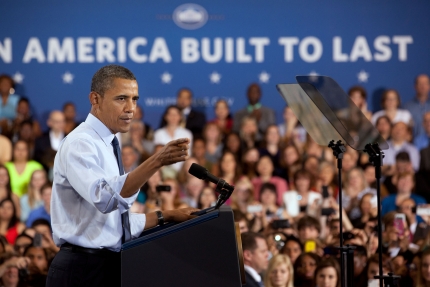
President Barack Obama delivers remarks on interest rates on student loans and affordable higher education (May 4, 2012)

President Barack Obama delivers remarks on interest rates on student loans and affordable higher education, at Washington-Lee High School in Arlington, Va., May 4, 2012. (Official White House Photo by Chuck Kennedy)

Today, President Obama continued his push to prevent interest rates on students loans from doubling on July 1 -- as they're currently scheduled to do.

Unless Congress takes action, more than 7 million students around the country will rack up an average of $1,000 of extra debt each.

In a speech today at Washington Lee High School in Arlington, Virginia, the President told students and parents that education has become more than a luxury.

"[It] is an economic imperative that every American should be able to afford," he said.

The Obama administration has taken a number of steps that to keep higher education within reach of the middle class -- including reforming the student loans system and using the savings to help more people afford college.

But it's going to take Congress to keep interest rates on federal student loans from doubling, and today, the President called on lawmakers to act:

President Obama Speaks on College Affordability

May 04, 2012 | 18:58 | Public Domain

President Obama discusses the importance of a college education and steps his Administration is taking to help keep the cost of college within reach for all families.

Download mp4 (670MB) | mp3 (43MB)

Read the Transcript

Remarks by the President on College Affordability

Washington-Lee High School
Arlington, Virginia

11:53 A.M. EDT

THE PRESIDENT:  Hello, Generals!  (Applause.)  Hello, Virginia!  (Applause.)  Well, let me first of all say, following Amirah is kind of tough.  (Laughter.)  She is really good.  Give her a big round of applause for the great introduction.  (Applause.)  There are a couple of other people I want to introduce who are here today.  First of all, my Secretary of Education, Arne Duncan, is here.  Give him a round of applause.  (Applause.)  Your Congressman, Jim Moran, is here.  (Applause.)

And before we came out, I had a chance to meet with Amirah and her mom, but also a couple other of your classmates.  Brendan Craig is here, and his dad.  (Applause.)  And also Rina Castaneda and her mom.  (Applause.)  Let me just say, they represented you really well.  Those were three impressive seniors.  Thanks for hanging out with me on a Friday.  I know that you’re happy not because I’m here.  There are seniors in the crowd -- (applause) -- and you’re excited about graduating.  I know the juniors are excited to get the seniors -- (applause) -- they’re excited to get the seniors out so they’ll be at the top of the heap.

You’ve got prom coming up.  (Applause.)  I guess you’ve already got your dress all picked out, huh?  (Laughter.)  All right.  You’ve got final exams.

AUDIENCE:  Booo --

THE PRESIDENT:  You’ve got a great summer coming up.  (Applause.)  And then, more than 90 percent of this year’s seniors from this school are going to some sort of post-secondary education, whether it is a 4-year college, community college, vocational.  (Applause.)  That makes us proud.  That is a testament to your principal, who is doing a great job.  So we’re very proud of him.  Thank you.  (Applause.)

Now, I know a lot of you -- certainly a lot of your parents -- are focused on how you’re going to pay for college.  And that’s what I was talking to your classmates and some of your parents about.  That’s why I’m here.  But first, I want to say something about the economy that we’re going to be working to rebuild for you -- because not only do we want you to have a good education, we want to make sure that you’re getting a job after you graduate.  (Applause.)  

Now, this morning, we learned that our economy created 130,000 private sector jobs in April.  And the unemployment rate ticked down again.  So after the worst economic crisis since the Great Depression, our businesses have now created more than 4.2 million new jobs over the last 26 months -- more than 1 million jobs in the last six months alone.  (Applause.)

So that's the good news.  But there are still a lot of folks out of work, which means that we've got to do more.  If we’re going to recover all the jobs that were lost during the recession, and if we're going to build a secure economy that strengthens the middle class, then we're going to have to do more.  And that’s why, next week, I’m going to urge Congress, as they start getting back to work, to take some actions on some common-sense ideas, right now, that can accelerate even more job growth.  That’s what we need, and my message to Congress is going to be, just saying "no" to ideas that will create new jobs is not an option.  There's too much at stake for us not to all be rowing in the same direction.  And that's true for you and that's true for your parents.  (Applause.)

Now, that's in the short term.  But in the long run, the most important thing we can do for our economy is to give all of you and all Americans the best education possible.  That's the most important thing we can do.  (Applause.)  That means helping our schools hire and reward the best teachers -- and you've got some great teachers here.  (Applause.)  That means stepping up our focus on math and science -- something I tell Malia and Sasha every day.  (Applause.)  You're solid on math?  Okay, I like to hear that.  (Laughter.)  That means giving more Americans the chance to learn the skills that businesses are looking for right now.  And in the 21st century, it also means higher education cannot be a luxury -- it is an economic imperative that every American should be able to afford.

Now, my grandfather had the chance to go to college because this country decided that every returning veteran of World War II should be able to afford it.  And on a bipartisan basis, the GI Bill was created that allowed him to go to college.  My mother was able to raise two kids by herself because she was also able to get grants and loans to work her way through school.  Michelle and I are only where we are because scholarships and student loans gave us a shot at a great education.  We didn't come from a wealthy background, but this country gave us a chance at a good education.

This country has always made a commitment to put a good education within the reach of everybody who is willing to work for it.  That’s what makes us special.  That's the kind of investment in our own people that helped us lead the world in business and science and technology and medicine.  That's what made us an economic superpower.

But, unfortunately, since you guys were born -- which doesn’t seem that long ago to me -- (laughter) -- maybe it does to you -- the cost of going to college has more than doubled.  And that means students have to take out more loans.  It’s now to the point where the average student who borrows to pay for college graduates with about $25,000 worth of debt -- $25,000.  And Americans now owe more for their student loans than they do on their credit cards.

Now, I want to give you guys some relief from that debt.  I don’t want you to start off life saddled with debt.  And I don’t want your parents to be taking on so much debt as well.  (Applause.)  Because when you start off already owing a lot of money graduating from school it means making a lot of really tough choices, like maybe waiting longer to buy a house, or to start a family, or to chase that career that you really want.

And like I said, Michelle and I know about this.  We graduated from college and law school with a truckload of student loan debt.  We got married and together we got poorer. (Laughter.)  After we graduated, we were lucky enough to land good jobs, so it was still a great investment for us to go to college and law school.  But we only finished paying off our student loans about eight years ago.  And I know some of your teachers here probably can relate.

AUDIENCE MEMBER:  Woohoo!  (Laughter.)

THE PRESIDENT:  When we should have been starting to save up for Malia’s and Sasha’s college educations, we were still paying off our educations.

So we can’t price the middle class out of a higher education.  We’ve got to make college more affordable.  That’s why we fixed a broken student loan system that was giving tens of billions of dollars to big banks, and we said, let’s use that money to help more people afford college.  That’s why we strengthened aid for low-income students.  (Applause.)  That’s why we fought to set up a new, independent consumer watchdog agency that’s now working with every student and their parents to access a simple factsheet on student loans and financial aid, so you can make your own choices, the best choices, about how to pay for college.  We call it "Know Before You Owe."  Know before you owe.

But making college more affordable isn’t something government can or should do alone.  I was mentioning to your classmates, we’re talking to colleges and universities about doing their part.  And I’ve told Congress to steer federal aid to schools that keep tuition affordable and provide good value and serve their students well.  If colleges and universities can’t stop their costs from going up, then the funding they get from taxpayers, it should go down.  We should steer it to the schools that are really giving students the best deal. 

And states have to do their part by making higher education a higher priority in their budgets.  Last year, over 40 states cut their higher education spending.  And these cuts have been among the largest drivers of public college tuition increases over the past decade.  So we’ve told states, if you can find new ways to bring down the cost of college and make it easier for students to graduate, then we’re going to help you do it -- which is good news.  (Applause.)  

Now, Congress also has to do its part.  (Applause.)  Right now, that means preventing the interest rates on federal student loans from doubling, which would make it harder for you to pay for college next year.  The three classmates of yours that I met, they’re all getting Stafford loans to help pay for college.  And these Stafford loans, right now, have a very low interest rate, because five years ago Congress cut the rate for these student loans in half.  That was a good idea.  It made college more affordable.  But here’s the bad news -- 

AUDIENCE MEMBER:  Uh-oh.

THE PRESIDENT:  Uh-oh.  (Laughter.)  On July 1st -- less than two months from now -- that rate cut expires, and interest rates on those loans will double overnight. 

AUDIENCE:  Booo --

THE PRESIDENT:  That’s not good.  For each year that college [sic] doesn’t act, the average student with these Stafford loans will rack up an additional $1,000 in debt.  That’s like a $1,000 tax hike for more than 7 million students across America.

Now, let me ask, is that something that you can afford if you’re going to college? 

AUDIENCE:  No!

THE PRESIDENT:  You guys shouldn’t have to pay an extra $1,000 just because Congress can’t get its act together.  This should be a no-brainer.  This is something that we need to get done.

So the good news is, the Senate will vote next week on a bill that would keep student loan rates from doubling.  And some Republican senators look like they might support it.  I’m ready to work with them to make it happen.  But unfortunately, rather than find a bipartisan way to fix this problem, the House Republicans are saying they’re only going to prevent these rates from doubling if they can cut things like preventive health care for women instead.  So --

AUDIENCE:  Booo --

THE PRESIDENT:  That’s not good.  We shouldn’t have to choose between women having preventive health care and young people keeping their student loan rates low.  (Applause.)

Some of the Republicans in the House are coming up with all sorts of different reasons why we should just let these rates double.  One of them compared student loans to a "stage three cancer of socialism," whatever that means.  I don’t know.  (Laughter.)  Another warned that this is all about giving you a "free college education," which doesn’t make sense because, of course, loans aren't free; you’ve got to pay them back.  The spokesman for the Speaker of the House said that we were -- meaning me -- we're just talking about student loans to distract folks from the economy.  Now, this makes no sense because this is all about the economy.  (Applause.)  Making sure our young people can earn the best possible education -- that’s one of the best things we can do for the economy.  Making sure college is available to everyone and not just a few at the top -- that’s one of the best things we can do for our economy.

And I don’t think it’s fair when they suggest that students like you should pay more so we can bring down deficits that they helped to run up over the past decade.  They just voted -- (applause) -- we've got to do something about our deficits.  We paid for two wars with a credit card -- debt that you're going to have to pay off.  We gave two tax cuts to folks that don't need it and weren't asking for it.  The Republicans in the House just voted to keep giving billions of taxpayer dollars every year to big oil companies raking in record profits.  They just voted to let millionaires and billionaires keep paying lower tax rates than middle-class workers.  They even voted to give an average tax cut of at least $150,000 to every millionaire in America.  And they want you to pay an extra $1,000 a year for college.

AUDIENCE:  Booo --

THE PRESIDENT:  No, no, that doesn't make sense.  In America, we admire success.  We aspire to it.  I was talking to folks -- Rina wants to study business, and I'm confident she's going to be really wealthy some day and -- (applause) -- we want all of you to work and hustle and study your tails off and achieve your dreams.  But America is not just about protecting a few people who are doing well.  America is about giving everybody a chance to do well.  That’s what makes us strong.  That’s what the American Dream is all about.  (Applause.)  Everybody here, you're only here, you're only succeeding because somebody, somewhere, felt a responsibility not just to themselves, not even just to their own families, but to the country as a whole.  And now it’s our turn to be responsible.  It’s our turn to keep that promise alive for the next generation.

So if you agree with me, then I need all of you -- I see a lot of cell phones here and a lot of -- (laughter) -- all kinds of stuff -- (laughter) -- I want you to send a message to Congress.  Tell them, "don’t double my rate."  You should -- "don't double my rate."  You should call them, you should e-mail them, write on their Facebook page, tweet them.  (Applause.)  Teach your parents how to tweet.  (Laughter.)  And use the hashtag #dontdoublemyrate.  Don't double my rate.  Don't double it.  (Applause.)  I asked some students at the University of North Carolina and the University of Colorado and the University of Iowa to do this last week, and they got it trending worldwide for a while.  There were, of course -- there were more of them than there were of you.  I had Jimmy Fallon’s help.  (Laughter.)

But what I do expect from each of you on this and every other issue that you come to care about -- I want you guys to realize your voice makes a difference.  Your voice matters.  I know sometimes it seems like it doesn’t, but I guarantee you, members of Congress, they pay attention.  And if they start getting a lot of folks telling them they care deeply about something, it changes their mind.  Sometimes, it changes their vote.  Don’t let anybody tell you otherwise.

It doesn’t matter how old you are, what you look like, where you come from, or how much you have -- your voice can make a difference.  (Applause.)  So tell Congress now is not the time to double your interest on your student loans.  Now is the time to double down on our smart investments in building a strong and secure middle class.  Now is the time to double down on building an America that lasts.  And if we work together, I guarantee you we will meet our challenges.

When I met your classmates, when I look out at your faces, it gives me confidence about our future.  (Applause.)  I believe in you.  And I believe you’re going to do great things.  And I believe your generation will remind the world just why it is America is the greatest nation on Earth.
    
Thank you, everybody.  God bless you.  (Applause.)
                       
END
12:12 P.M. EDT

Close Transcript

President Obama and Secretary of Education Arne Duncan Discuss College Affordability

May 04, 2012 | 6:11 | Public Domain

President Obama and Secretary of Education Arne Duncan talk with high school seniors and their parents about the cost of college and steps the Administration is taking to help keep college affordable and within reach for all families.

Download mp4 (218MB) | mp3 (14MB)

Read the Transcript

Remarks by the President and Secretary Duncan in Student/Parent Discussion on College Loans

Washington Lee High School
Arlington, Virginia

11:35 A.M. EDT

THE PRESIDENT:  What I'm going to be talking about today is obviously financing college educations.  And I tell a story about how both Michelle and I, we had to rely on student loans and grants and scholarships to get through college and law school, and we still had a huge amount of debt after we graduated.  It paid off, it's a great investment, but obviously we're pretty sympathetic to the challenges that families go through in terms of financing.

And so I just wanted to get a sense -- all of you are going to be taking out Stafford loans.  And two things I wanted to get a sense of -- number one, I'm assuming that a doubling of the interest rates is not helpful to you, but feel free to talk about that.  I also wanted to get a sense of how it was to apply for one, because one of the things Arne and I and others in the administration have talked about is how do you simplify the process just to make it a little bit easier for people.  Because I know that -- and based on your chuckle, it sounds like that's something that we need to do.

Anybody want to start? 

SECRETARY DUNCAN:  How was the financial aid form itself?  Was that scary?  Was it easy?  Was it hard?

STUDENT:  Pretty easy.  It was kind of like filling out a college application, so that made it really easy -- did it all for you.

THE PRESIDENT:  Oh, good.

SECRETARY DUNCAN:  That's what I like to hear.  What about other folks?

STUDENT:  It was pretty easy. 

SECRETARY DUNCAN:  It used to be really, really tough, and we worked with the IRS to simplify that.  I was scared to partner with the IRS -- (laughter) -- but they did a great, great job.  The form itself used to be a barrier to going on.  So what was your sense on it?

STUDENT:  I did it in my college summit class and my teacher helped me with it. 

SECRETARY DUNCAN:  How was it?

STUDENT:  It was easy.

THE PRESIDENT:  Good.  Parents, how are you feeling about this whole college cost thing?

PARENT:  Well, Brendan is my third one in school now and I have one more that will be coming up --

THE PRESIDENT:  So you're a pro.  (Laughter.) 

PARENT:  Yes.  (Laughter.)  

THE PRESIDENT:  And how about you?  Do you have other kids who are -- you've got to be thinking about?

PARENT:  Yes, I have one -- two that are in community college now, and so they're going to go on to a four-year university.  But for Amirah, she is going straight to a four-year university, and the cost is a lot more than community college.  So we're looking at all our options -- grants, scholarships, definitely the Stafford loans. 

THE PRESIDENT:  Just to be able to afford it.  So it's a big chunk to handle.  

How about you?

PARENT:  Well, Rina is my first one to go to college.  I have two more -- they're small right now.  One is in third grade --

THE PRESIDENT:  Okay, so you've got things spaced out a little bit.  That's good. 

Well, there are two things that we're focused on.  One is obviously keeping loan rates low.  The second thing, though, is to actually try to lower college cost itself.  And we've met with colleges and universities -- the inflation rate on college has actually gone up faster than health care, which is pretty hard to do.

And some of it is not actually the fault of the universities.  If it’s a state school, the state legislatures across the country have been cutting back on the support for public colleges and universities.  And the only way these colleges a lot of times can make it up is by raising tuition.  They’ve got higher health care costs that they have to deal with. But some of it is, I think, a lack of creativity in terms of thinking about how do you keep costs down.  All of you guys when you get to school, you’re going to have to think about making sure that you’re not loading up yourselves with a lot of debt unnecessarily. 

Everybody here is going to be living in dorms?

STUDENTS:  Yes.

THE PRESIDENT:  And eating Ramen noodles?  (Laughter.)  But I think you guys are in a good position because in addition to being able to take out student loans and having parents who are obviously interested and engaged in the process, what we’re trying to do is to, through a variety of channels, provide more information to students so that they can plan ahead about what their debt loads might be when they graduate.  And that’s something that, frankly, when we were going to school we didn’t really have a good idea.  And a lot of kids ended up being surprised by how much things --

SECRETARY DUNCAN:  Knowing four-year costs, knowing the loan repayments.  We're trying to do some things to reduce loan repayments at the back end -- something called income-based repayment, IBR -- you can take a look at.  But helping the front end, know what your costs are, more transparency and help at the back end.  So we're trying to do all those things.  As the President said, push states to invest and push colleges to be reasonable.  These are tough times and don't get carried away, and a lot of colleges are doing it well; some aren’t.  So we're trying to challenge them as well.

THE PRESIDENT:  But overall, it sounds like you guys are all set.  I’m excited for you.  Are you guys getting nervous, too?

(Pool ushered out.)

END
11:41 A.M. EDT

Close Transcript

The White House

Office of the Press Secretary

Remarks by the President and Secretary Duncan in Student/Parent Discussion on College Loans

Washington Lee High School, Arlington, Virginia

11:35 A.M. EDT

        THE PRESIDENT:  What I'm going to be talking about today is obviously financing college educations.  And I tell a story about how both Michelle and I, we had to rely on student loans and grants and scholarships to get through college and law school, and we still had a huge amount of debt after we graduated.  It paid off, it's a great investment, but obviously we're pretty sympathetic to the challenges that families go through in terms of financing.

        And so I just wanted to get a sense -- all of you are going to be taking out Stafford loans.  And two things I wanted to get a sense of -- number one, I'm assuming that a doubling of the interest rates is not helpful to you, but feel free to talk about that.  I also wanted to get a sense of how it was to apply for one, because one of the things Arne and I and others in the administration have talked about is how do you simplify the process just to make it a little bit easier for people.  Because I know that -- and based on your chuckle, it sounds like that's something that we need to do.

        Anybody want to start?  

        SECRETARY DUNCAN:  How was the financial aid form itself?  Was that scary?  Was it easy?  Was it hard?

        STUDENT:  Pretty easy.  It was kind of like filling out a college application, so that made it really easy -- did it all for you.

        THE PRESIDENT:  Oh, good.

        SECRETARY DUNCAN:  That's what I like to hear.  What about other folks?

        STUDENT:  It was pretty easy.  

        SECRETARY DUNCAN:  It used to be really, really tough, and we worked with the IRS to simplify that.  I was scared to partner with the IRS -- (laughter) -- but they did a great, great job.  The form itself used to be a barrier to going on.  So what was your sense on it?

        STUDENT:  I did it in my college summit class and my teacher helped me with it.  

        SECRETARY DUNCAN:  How was it?

        STUDENT:  It was easy.

        THE PRESIDENT:  Good.  Parents, how are you feeling about this whole college cost thing?

        PARENT:  Well, Brendan is my third one in school now and I have one more that will be coming up --

        THE PRESIDENT:  So you're a pro.  (Laughter.)  

        PARENT:  Yes.  (Laughter.)   

        THE PRESIDENT:  And how about you?  Do you have other kids who are -- you've got to be thinking about?

        PARENT:  Yes, I have one -- two that are in community college now, and so they're going to go on to a four-year university.  But for Amirah, she is going straight to a four-year university, and the cost is a lot more than community college.  So we're looking at all our options -- grants, scholarships, definitely the Stafford loans.  

        THE PRESIDENT:  Just to be able to afford it.  So it's a big chunk to handle.   

        How about you?

        PARENT:  Well, Rina is my first one to go to college.  I have two more -- they're small right now.  One is in third grade --

        THE PRESIDENT:  Okay, so you've got things spaced out a little bit.  That's good.  

        Well, there are two things that we're focused on.  One is obviously keeping loan rates low.  The second thing, though, is to actually try to lower college cost itself.  And we've met with colleges and universities -- the inflation rate on college has actually gone up faster than health care, which is pretty hard to do.

        And some of it is not actually the fault of the universities.  If it’s a state school, the state legislatures across the country have been cutting back on the support for public colleges and universities.  And the only way these colleges a lot of times can make it up is by raising tuition.  They’ve got higher health care costs that they have to deal with. But some of it is, I think, a lack of creativity in terms of thinking about how do you keep costs down.  All of you guys when you get to school, you’re going to have to think about making sure that you’re not loading up yourselves with a lot of debt unnecessarily.  

        Everybody here is going to be living in dorms?

        STUDENTS:  Yes.

        THE PRESIDENT:  And eating Ramen noodles?  (Laughter.)  But I think you guys are in a good position because in addition to being able to take out student loans and having parents who are obviously interested and engaged in the process, what we’re trying to do is to, through a variety of channels, provide more information to students so that they can plan ahead about what their debt loads might be when they graduate.  And that’s something that, frankly, when we were going to school we didn’t really have a good idea.  And a lot of kids ended up being surprised by how much things --

        SECRETARY DUNCAN:  Knowing four-year costs, knowing the loan repayments.  We're trying to do some things to reduce loan repayments at the back end -- something called income-based repayment, IBR -- you can take a look at.  But helping the front end, know what your costs are, more transparency and help at the back end.  So we're trying to do all those things.  As the President said, push states to invest and push colleges to be reasonable.  These are tough times and don't get carried away, and a lot of colleges are doing it well; some aren’t.  So we're trying to challenge them as well.

        THE PRESIDENT:  But overall, it sounds like you guys are all set.  I’m excited for you.  Are you guys getting nervous, too?

        (Pool ushered out.)

END 11:41 A.M. EDT

The White House

Office of the Press Secretary

Remarks by the President on College Affordability

Washington-Lee High School
Arlington, Virginia

11:53 A.M. EDT

THE PRESIDENT:  Hello, Generals!  (Applause.)  Hello, Virginia!  (Applause.)  Well, let me first of all say, following Amirah is kind of tough.  (Laughter.)  She is really good.  Give her a big round of applause for the great introduction.  (Applause.)  There are a couple of other people I want to introduce who are here today.  First of all, my Secretary of Education, Arne Duncan, is here.  Give him a round of applause.  (Applause.)  Your Congressman, Jim Moran, is here.  (Applause.)

And before we came out, I had a chance to meet with Amirah and her mom, but also a couple other of your classmates.  Brendan Craig is here, and his dad.  (Applause.)  And also Rina Castaneda and her mom.  (Applause.)  Let me just say, they represented you really well.  Those were three impressive seniors.  Thanks for hanging out with me on a Friday.  I know that you’re happy not because I’m here.  There are seniors in the crowd -- (applause) -- and you’re excited about graduating.  I know the juniors are excited to get the seniors -- (applause) -- they’re excited to get the seniors out so they’ll be at the top of the heap.

You’ve got prom coming up.  (Applause.)  I guess you’ve already got your dress all picked out, huh?  (Laughter.)  All right.  You’ve got final exams.

AUDIENCE:  Booo --

THE PRESIDENT:  You’ve got a great summer coming up.  (Applause.)  And then, more than 90 percent of this year’s seniors from this school are going to some sort of post-secondary education, whether it is a 4-year college, community college, vocational.  (Applause.)  That makes us proud.  That is a testament to your principal, who is doing a great job.  So we’re very proud of him.  Thank you.  (Applause.)

Now, I know a lot of you -- certainly a lot of your parents -- are focused on how you’re going to pay for college.  And that’s what I was talking to your classmates and some of your parents about.  That’s why I’m here.  But first, I want to say something about the economy that we’re going to be working to rebuild for you -- because not only do we want you to have a good education, we want to make sure that you’re getting a job after you graduate.  (Applause.)  

Now, this morning, we learned that our economy created 130,000 private sector jobs in April.  And the unemployment rate ticked down again.  So after the worst economic crisis since the Great Depression, our businesses have now created more than 4.2 million new jobs over the last 26 months -- more than 1 million jobs in the last six months alone.  (Applause.)

So that's the good news.  But there are still a lot of folks out of work, which means that we've got to do more.  If we’re going to recover all the jobs that were lost during the recession, and if we're going to build a secure economy that strengthens the middle class, then we're going to have to do more.  And that’s why, next week, I’m going to urge Congress, as they start getting back to work, to take some actions on some common-sense ideas, right now, that can accelerate even more job growth.  That’s what we need, and my message to Congress is going to be, just saying "no" to ideas that will create new jobs is not an option.  There's too much at stake for us not to all be rowing in the same direction.  And that's true for you and that's true for your parents.  (Applause.)

Now, that's in the short term.  But in the long run, the most important thing we can do for our economy is to give all of you and all Americans the best education possible.  That's the most important thing we can do.  (Applause.)  That means helping our schools hire and reward the best teachers -- and you've got some great teachers here.  (Applause.)  That means stepping up our focus on math and science -- something I tell Malia and Sasha every day.  (Applause.)  You're solid on math?  Okay, I like to hear that.  (Laughter.)  That means giving more Americans the chance to learn the skills that businesses are looking for right now.  And in the 21st century, it also means higher education cannot be a luxury -- it is an economic imperative that every American should be able to afford.

Now, my grandfather had the chance to go to college because this country decided that every returning veteran of World War II should be able to afford it.  And on a bipartisan basis, the GI Bill was created that allowed him to go to college.  My mother was able to raise two kids by herself because she was also able to get grants and loans to work her way through school.  Michelle and I are only where we are because scholarships and student loans gave us a shot at a great education.  We didn't come from a wealthy background, but this country gave us a chance at a good education.

This country has always made a commitment to put a good education within the reach of everybody who is willing to work for it.  That’s what makes us special.  That's the kind of investment in our own people that helped us lead the world in business and science and technology and medicine.  That's what made us an economic superpower.

But, unfortunately, since you guys were born -- which doesn’t seem that long ago to me -- (laughter) -- maybe it does to you -- the cost of going to college has more than doubled.  And that means students have to take out more loans.  It’s now to the point where the average student who borrows to pay for college graduates with about $25,000 worth of debt -- $25,000.  And Americans now owe more for their student loans than they do on their credit cards.

Now, I want to give you guys some relief from that debt.  I don’t want you to start off life saddled with debt.  And I don’t want your parents to be taking on so much debt as well.  (Applause.)  Because when you start off already owing a lot of money graduating from school it means making a lot of really tough choices, like maybe waiting longer to buy a house, or to start a family, or to chase that career that you really want.

And like I said, Michelle and I know about this.  We graduated from college and law school with a truckload of student loan debt.  We got married and together we got poorer. (Laughter.)  After we graduated, we were lucky enough to land good jobs, so it was still a great investment for us to go to college and law school.  But we only finished paying off our student loans about eight years ago.  And I know some of your teachers here probably can relate.

AUDIENCE MEMBER:  Woohoo!  (Laughter.)

THE PRESIDENT:  When we should have been starting to save up for Malia’s and Sasha’s college educations, we were still paying off our educations.

So we can’t price the middle class out of a higher education.  We’ve got to make college more affordable.  That’s why we fixed a broken student loan system that was giving tens of billions of dollars to big banks, and we said, let’s use that money to help more people afford college.  That’s why we strengthened aid for low-income students.  (Applause.)  That’s why we fought to set up a new, independent consumer watchdog agency that’s now working with every student and their parents to access a simple factsheet on student loans and financial aid, so you can make your own choices, the best choices, about how to pay for college.  We call it "Know Before You Owe."  Know before you owe.

But making college more affordable isn’t something government can or should do alone.  I was mentioning to your classmates, we’re talking to colleges and universities about doing their part.  And I’ve told Congress to steer federal aid to schools that keep tuition affordable and provide good value and serve their students well.  If colleges and universities can’t stop their costs from going up, then the funding they get from taxpayers, it should go down.  We should steer it to the schools that are really giving students the best deal. 

And states have to do their part by making higher education a higher priority in their budgets.  Last year, over 40 states cut their higher education spending.  And these cuts have been among the largest drivers of public college tuition increases over the past decade.  So we’ve told states, if you can find new ways to bring down the cost of college and make it easier for students to graduate, then we’re going to help you do it -- which is good news.  (Applause.)  

Now, Congress also has to do its part.  (Applause.)  Right now, that means preventing the interest rates on federal student loans from doubling, which would make it harder for you to pay for college next year.  The three classmates of yours that I met, they’re all getting Stafford loans to help pay for college.  And these Stafford loans, right now, have a very low interest rate, because five years ago Congress cut the rate for these student loans in half.  That was a good idea.  It made college more affordable.  But here’s the bad news -- 

AUDIENCE MEMBER:  Uh-oh.

THE PRESIDENT:  Uh-oh.  (Laughter.)  On July 1st -- less than two months from now -- that rate cut expires, and interest rates on those loans will double overnight. 

AUDIENCE:  Booo --

THE PRESIDENT:  That’s not good.  For each year that college [sic] doesn’t act, the average student with these Stafford loans will rack up an additional $1,000 in debt.  That’s like a $1,000 tax hike for more than 7 million students across America.

Now, let me ask, is that something that you can afford if you’re going to college? 

AUDIENCE:  No!

THE PRESIDENT:  You guys shouldn’t have to pay an extra $1,000 just because Congress can’t get its act together.  This should be a no-brainer.  This is something that we need to get done.

So the good news is, the Senate will vote next week on a bill that would keep student loan rates from doubling.  And some Republican senators look like they might support it.  I’m ready to work with them to make it happen.  But unfortunately, rather than find a bipartisan way to fix this problem, the House Republicans are saying they’re only going to prevent these rates from doubling if they can cut things like preventive health care for women instead.  So --

AUDIENCE:  Booo --

THE PRESIDENT:  That’s not good.  We shouldn’t have to choose between women having preventive health care and young people keeping their student loan rates low.  (Applause.)

Some of the Republicans in the House are coming up with all sorts of different reasons why we should just let these rates double.  One of them compared student loans to a "stage three cancer of socialism," whatever that means.  I don’t know.  (Laughter.)  Another warned that this is all about giving you a "free college education," which doesn’t make sense because, of course, loans aren't free; you’ve got to pay them back.  The spokesman for the Speaker of the House said that we were -- meaning me -- we're just talking about student loans to distract folks from the economy.  Now, this makes no sense because this is all about the economy.  (Applause.)  Making sure our young people can earn the best possible education -- that’s one of the best things we can do for the economy.  Making sure college is available to everyone and not just a few at the top -- that’s one of the best things we can do for our economy.

And I don’t think it’s fair when they suggest that students like you should pay more so we can bring down deficits that they helped to run up over the past decade.  They just voted -- (applause) -- we've got to do something about our deficits.  We paid for two wars with a credit card -- debt that you're going to have to pay off.  We gave two tax cuts to folks that don't need it and weren't asking for it.  The Republicans in the House just voted to keep giving billions of taxpayer dollars every year to big oil companies raking in record profits.  They just voted to let millionaires and billionaires keep paying lower tax rates than middle-class workers.  They even voted to give an average tax cut of at least $150,000 to every millionaire in America.  And they want you to pay an extra $1,000 a year for college.

AUDIENCE:  Booo --

THE PRESIDENT:  No, no, that doesn't make sense.  In America, we admire success.  We aspire to it.  I was talking to folks -- Rina wants to study business, and I'm confident she's going to be really wealthy some day and -- (applause) -- we want all of you to work and hustle and study your tails off and achieve your dreams.  But America is not just about protecting a few people who are doing well.  America is about giving everybody a chance to do well.  That’s what makes us strong.  That’s what the American Dream is all about.  (Applause.)  Everybody here, you're only here, you're only succeeding because somebody, somewhere, felt a responsibility not just to themselves, not even just to their own families, but to the country as a whole.  And now it’s our turn to be responsible.  It’s our turn to keep that promise alive for the next generation.

So if you agree with me, then I need all of you -- I see a lot of cell phones here and a lot of -- (laughter) -- all kinds of stuff -- (laughter) -- I want you to send a message to Congress.  Tell them, "don’t double my rate."  You should -- "don't double my rate."  You should call them, you should e-mail them, write on their Facebook page, tweet them.  (Applause.)  Teach your parents how to tweet.  (Laughter.)  And use the hashtag #dontdoublemyrate.  Don't double my rate.  Don't double it.  (Applause.)  I asked some students at the University of North Carolina and the University of Colorado and the University of Iowa to do this last week, and they got it trending worldwide for a while.  There were, of course -- there were more of them than there were of you.  I had Jimmy Fallon’s help.  (Laughter.)

But what I do expect from each of you on this and every other issue that you come to care about -- I want you guys to realize your voice makes a difference.  Your voice matters.  I know sometimes it seems like it doesn’t, but I guarantee you, members of Congress, they pay attention.  And if they start getting a lot of folks telling them they care deeply about something, it changes their mind.  Sometimes, it changes their vote.  Don’t let anybody tell you otherwise.

It doesn’t matter how old you are, what you look like, where you come from, or how much you have -- your voice can make a difference.  (Applause.)  So tell Congress now is not the time to double your interest on your student loans.  Now is the time to double down on our smart investments in building a strong and secure middle class.  Now is the time to double down on building an America that lasts.  And if we work together, I guarantee you we will meet our challenges.

When I met your classmates, when I look out at your faces, it gives me confidence about our future.  (Applause.)  I believe in you.  And I believe you’re going to do great things.  And I believe your generation will remind the world just why it is America is the greatest nation on Earth.
    
Thank you, everybody.  God bless you.  (Applause.)
                       
END
12:12 P.M. EDT
The White House

Office of the First Lady

President and First Lady to Host Concert Honoring Burt Bacharach and Hal David in the East Room

On Wednesday, May 9th, as part of their “In Performance at the White House” series, the President and First Lady will host a concert in the East Room honoring songwriters Burt Bacharach and Hal David, who will be awarded the 2012 Library of Congress Gershwin Prize for Popular Song.  President Obama will present the award as he did in 2010 and 2009, when the Library of Congress honored Sir Paul McCartney and Stevie Wonder, respectively.   The program will include performances by Sheryl Crow, Michael Feinstein, Diana Krall, Lyle Lovett, Mike Myers, Rumer, Arturo Sandoval, Sheléa and Stevie Wonder.

The President’s remarks will be pooled press and the entire event will be streamed live on www.whitehouse.gov/live starting at 7:00 PM ET on May 9th. 

On Monday, May 21st at 9:00 PM ET, the East Room concert will be broadcast on PBS stations nationwide as “Burt Bacharach & Hal David: The Library of Congress Gershwin Prize for Popular Song In Performance at the White House” (check local listings). The program will also be broadcast at a later date via the American Forces Network to American service men and women and civilians at U.S. Department of Defense locations around the world.

This will be the first time the Gershwin Prize honor has been awarded to a songwriting team; Bacharach and David are a pianist and lyricist respectively.  The Gershwin Prize commemorates George and Ira Gershwin, the legendary American songwriting team whose extensive manuscript collections reside in the Library of Congress. The prize is awarded to musicians whose lifetime contributions in the field of popular song exemplify the standard of excellence associated with the Gershwins. 
 
The White House concert caps off two days of events celebrating the recipients of the Library of Congress Gershwin Prize for Popular Song. On Tuesday, May 8th at 7:00 PM ET, the Library of Congress will host an invitation-only concert at their Coolidge Auditorium in honor of Bacharach and David. The all-star tribute will include performances by Sheryl Crow, Diana Krall, Mike Myers, Lyle Lovett, Rumer and Stevie Wonder.

“Burt Bacharach & Hal David: The Library of Congress Gershwin Prize for Popular Song In Performance at the White House” will be the ninth “In Performance at the White House” program hosted by the President and Mrs. Obama.  Starting in February 2009, these events have honored the musical genius of Stevie Wonder and Sir Paul McCartney; celebrated Hispanic musical heritage during Hispanic Heritage Month; marked Black History Month with events featuring the music from the Civil Rights Movement, Motown and the Blues; spotlighted Broadway and the unique spirit of the American musical; and explored the rich roots of Country Music.

West Wing Week: 5/4/12 or "Out of Many, We are One."

This week, the President traveled to Afghanistan to sign an historic Strategic Partnership Agreement, visit with our troops, and address the American people about responsibly ending the war. The President also traveled to Fort Stewart to sign an Executive Order to protect service members and their families from deceptive marketing practices, spoke at the annual White House Correspondents Dinner, welcomed the Prime Minister of Japan, and spoke at the Building and Construction Trades conference.

West Wing Week: 5/4/12 or "Out of Many, We are One."

May 04, 2012 | 5:11 | Public Domain

This week, the President traveled to Afghanistan to sign an historic Strategic Partnership Agreement, visit with our troops and address the American people about responsibly ending the war. The President also traveled to Fort Stewart to sign an Executive Order to protect service members and their families from deceptive marketing practices, spoke at the annual White House Correspondents Dinner, welcomed the Prime Minister of Japan, and spoke at the Building and Construction Trades conference.

Download mp4 (160.3MB)