The White House

Office of the Vice President

Op-Ed by Vice President Biden on the 20th Anniversary of the Violence Against Women Act

In advance of his remarks on Tuesday to commemorate next Saturday’s 20th Anniversary of the Violence Against Women Act, Vice President Biden penned the following op-ed in Delaware’s The News Journal.

http://www.delawareonline.com/story/opinion/contributors/2014/09/06/hard-fight-end-violence-women/15199597/

The hard fight to end violence against women

Even just 20 years ago, violence against women in America was an epidemic few people wanted to talk about, let alone do something about. No one denied punching a wife in the face or pushing her down the stairs was reprehensible. But most people refused to intervene. They called domestic violence a "family affair." Critics of proposed laws protecting women from this violence claimed they would lead to the "disintegration" of the family.

Today, it's hard for many people to fathom a day in which Americans ignored this violence, or worse, condoned it. But it's true. And it was against that backdrop I introduced the Violence Against Women (VAWA) in 1990, the first federal law that directly held violence against women as a violation of basic civil rights and fundamental human dignity.

It had three simple goals. Make streets safer for women. Make homes safer for women. Protect women's civil rights. It met those goals comprehensively by: increasing violence prevention, investing in shelters, enhancing services, and training police, lawyers, and even judges to better investigate, prosecute, and adjudicate domestic violence cases. But it took four years for the bill to get signed into law in 1994.

It was a struggle with setbacks, but also a journey that has changed America. Sparsely attended Senate hearings at first led to hundreds of pages of testimony by survivors, health professionals, and advocates. I issued "Violence Against Women: A Week in the Life of America," a report detailing the human tragedy of the 21,000 crimes against women that were reported every week in America at the time – a small slice of the 1.1 million assaults, aggravated assaults, murders, and rapes against women committed in the home and reported to police that year. With the help of supporters, we surveyed laws across all 50 states that implied "if you knew her, it wasn't a crime."

And throughout I met true heroes: women, like Carol Post here in Delaware, who ran shelters, coalitions, and rape crisis centers supported by no more than bake sales and good intentions. Survivors who had their arms broken with hammers and their heads hit with pipes by their partners, but who still summoned absolute courage to stand up and share their story.

It is because of them that VAWA is a law that has saved lives – yearly domestic violence rates dropped 64 percent from 1993-2010. It has saved the country money – one study shows the law saved an estimated $12.6 billion in averted social costs in its first six years alone. It has improved justice – higher rates of prosecution for special-victims units, like the Family Division established by Attorney General Beau Biden, and new waves of state law reforms. Services, technology and forensic collection, and education and prevention efforts have all dramatically improved.

Fundamentally, the Violence Against Women Act has changed a prevailing culture from a refusal to intervene to a responsibility to act – where violence against women is no longer accepted as a societal secret and where we all understand that even one case is too many.

This law is my proudest legislative accomplishment, and it was based on something my Dad taught me growing up in Wilmington: that the cardinal sin is an abuse of power, and the ultimate abuse of power is someone physically raising a hand to strike and beat a woman or child.

We know there is still more to do, but years of struggle and progress have spurred a national understanding that you can't talk about human rights and human dignity without talking about the right of every woman on this planet to be free from violence and free from fear.
The White House

Office of the Vice President

Readout of Vice President Biden's Call with Iraqi Kurdistan Regional President Masoud Barzani

This afternoon, Vice President Joe Biden spoke with Iraqi Kurdistan Regional President Masoud Barzani.  The Vice President and President Barzani discussed the ongoing effort to complete the formation of the Iraqi government.  The Vice President emphasized the urgency of work to put in place a new government as quickly as possible.  The Vice President underscored longstanding U.S. support for the Kurdish people and for the security of Iraq. 

Weekly Address: Time to Give the Middle Class a Chance

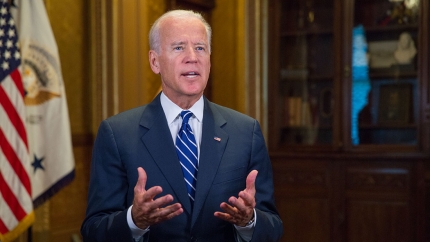
Vice President Biden Delivers the Weekly Address

Vice President Joe Biden tapes the Weekly Address in the Eisenhower Executive Office Building, Sept. 5, 2014. September 5, 2014. (Official White House Photo by Lawrence Jackson)

In this week’s address, the Vice President discusses our continued economic recovery, with 10 million private sector jobs created over 54 straight months of job creation. Yet even with this good news, too many Americans are still not seeing the effects of our recovery.

As the Vice President explains, there’s more that can be done to continue to bolster our economy and ensure that middle class families benefit from the growth they helped create, including closing tax loopholes, expanding education opportunities, and raising the minimum wage.

Transcript | mp4 | mp3

Related Topics: Jobs, Economy

The White House

Office of the Press Secretary

Weekly Address: Time to Give the Middle Class a Chance

WASHINGTON, DC —In this week’s address, the Vice President discusses our continued economic recovery, with 10 million private sector jobs created over the past 54 months. Yet even with this good news, too many Americans are still not seeing the effects of our recovery. As the Vice President explains, there’s more that can be done to continue to bolster our economy and ensure that middle class families benefit from the growth they helped create, including closing tax loopholes, expanding education opportunities, and raising the minimum wage.

The audio of the address and video of the address will be available online at www.whitehouse.gov at 6:00 a.m. ET, September 6, 2014.

Remarks of Vice President Joe Biden
Weekly Address
The White House
September 6, 2014

Ladies and gentlemen, this is Joe Biden, I’m filling in for President Obama, while he addresses the NATO summit in Wales.

When the President and I took office in January of 2009, this nation was in the midst of the greatest economic crisis since the great depression. Our economy had plummeted at a rate of 8% in a single quarter – part of the fastest economic decline any time in the last half century. Millions of families were falling underwater on their homes and threatened with foreclosure. The iconic American automobile industry was under siege.

But yesterday’s jobs report was another reminder of how far we’ve come. We’ve had 54 straight months of job creation. And that’s the longest streak of uninterrupted job growth in the United States’ history.

We’ve gone from losing 9 million jobs during the financial crisis to creating 10 million jobs. We’ve reduced the unemployment rate from 10% in October of 2009 to 6.1% today. And for the first time since the 1990s, American manufacturing is steadily adding jobs – over 700,000 since 2010. And surveys of both American and foreign business leaders confirm that America once again is viewed as the best place in the world to build and invest.

That’s all good news. But an awful lot of middle class Americans are still not feeling the effects of this recovery. Since the year 2000, Gross Domestic Product – our GDP - has risen by 25%. And productivity in America is up by 30%. But middle class wages during that same time period have gone up by only fourteen cents.

Folks, it’s long past time to cut the middle class back into the deal, so they can benefit from the economic growth they helped create. Folks, there used to be a bargain in this country supported by Democrats and Republicans, business and labor. The bargain was simple. If an employee contributed to the growth and profitability of the company, they got to share in the profits and the benefits as well. That’s what built the middle class. It’s time to restore the bargain, to deal the middle class back in. Because, folks, when the middle class does well, everybody does well – the wealthy get wealthier and the poor have a way up.

You know, the middle class is not a number. It’s a value set. It means being able to own your home; raise your children in a safe neighborhood; send them to a good school where if they do well they can qualify to go to college and if they get accepted you’d be able to find a way to be able to send them to college. And in the meantime, if your parents need help, being able to take care of them, and hope to put aside enough money so that your children will not have to take care of you.

That’s the American dream. That’s what this country was built on. And that’s what we’re determined to restore.

In order to do that, it’s time to have a fair tax structure, one that values paychecks as much as unearned income and inherited wealth, to take some of the burden off of the middle class. It’s time to close tax loopholes so we can reduce the deficit, and invest in rebuilding America - our bridges, our ports, our highways, rails, providing good jobs.

With corporate profits at near record highs, we should encourage corporations to invest more in research and development and the salaries of their employees. It’s time for us to invest in educational opportunity to guarantee that we have the most highly skilled workforce in the world, for 6 out of every 10 jobs in the near term is going to require some education beyond high school. Folks, it’s long past due to increase the minimum wage that will lift millions of hardworking families out of poverty and in the process produce a ripple effect that boosts wages for the middle class and spurs economic growth for the United States of America. Economists acknowledge that if we do these and other things, wages will go up and we’ll increase the Gross Domestic Product of the United States.

My fellow Americans, we know how to do this. We’ve done it before. It’s the way we used to do business and we can do it that way again. All the middle class in this country want is a chance. No guarantee, just a chance.

Americans want to work. And when given a fair shot, the American worker has never, ever, ever, let his country down. Folks, it’s never a good bet to bet against the American people.

Thanks for listening.

May God bless you, and may God protect our troops.

Weekly Address: Time to Give the Middle Class a Chance

September 05, 2014 | 5:13 | Public Domain

In this week’s address, the Vice President discusses our continued economic recovery, with 10 million private sector jobs created over the past 54 months, and the work to be done to continue to bolster our economy.

Download mp4 (193MB) | mp3 (5MB)

Read the Transcript

Weekly Address: Time to Give the Middle Class a Chance

[[nid:296536]]

In this week’s address, the Vice President discusses our continued economic recovery, with 10 million private sector jobs created over 54 straight months of job creation. Yet even with this good news, too many Americans are still not seeing the effects of our recovery.

As the Vice President explains, there’s more that can be done to continue to bolster our economy and ensure that middle class families benefit from the growth they helped create, including closing tax loopholes, expanding education opportunities, and raising the minimum wage.

Transcript | mp4 | mp3

Close Transcript

The White House

Office of the Vice President

Readout of the Vice President's Call with Polish Prime Minister Donald Tusk

Vice President Joe Biden spoke today with Polish Prime Minister Donald Tusk about bilateral as well as U.S.-EU relations, the NATO summit, and the crisis in Ukraine. The Vice President congratulated Prime Minister Tusk on his election as the President of the European Council, and discussed our shared agenda for strengthening U.S.-EU ties by completing the Transatlantic Trade and Investment Partnership (T-TIP) and working together to bolster economic growth and energy security in Europe, among other matters. The Vice President and Prime Minister agreed that further consequences needed to be imposed on Russia for its blatant escalation of the conflict in Ukraine. The two leaders also committed to continued close coordination on the crisis in Ukraine and its broader implications for European security, including at the NATO summit in Wales. 

The White House

Office of the Vice President

Readout of the Vice President's Call with Slovak President Andrej Kiska

Vice President Joe Biden spoke with Slovak President Andrej Kiska today about bilateral relations, the NATO summit, and the crisis in Ukraine.  The Vice President noted the strong bilateral relationship between Slovakia and the United States, and congratulated President Kiska on Slovakia’s Constitution Day on September 1.  The Vice President also reaffirmed the United States’ steadfast commitment to NATO’s collective defense under Article 5, and welcomed President Kiska’s support for strengthening the transatlantic relationship and for Slovakia’s contributions to NATO.  President Kiska noted that today the reverse flow of gas had begun between Slovakia and Ukraine, which can help Ukraine meet some of its energy needs.  The two leaders also discussed the need to continue to impose consequences on Russia for its aggressive acts in Ukraine.

The White House

Office of the Vice President

Readout of the Vice President's Call with Iraqi Kurdistan Region President Masoud Barzani

This morning, Vice President Joe Biden spoke with Iraqi Kurdistan Region President Masoud Barzani.  The Vice President and President Barzani discussed the humanitarian assistance and military strikes that the U.S. has provided to support the Iraqi people trapped in the town of Amirli.  Both leaders expressed their support for the ongoing efforts by Iraqi Security Forces and Kurdish Peshmerga, with U.S. and international support, to break the Islamic State of Iraq and the Levant's siege of Amirli.  President Barzani underscored his commitment to forming a new Iraqi government as quickly as possible.

The White House

Office of the Vice President

Readout of the Vice President's Call with President Aquino of the Philippines

Vice President Biden spoke with President Aquino of the Philippines today to express U.S. support for the Filipino peacekeepers currently surrounded by armed non-state groups in the Golan Heights. The two leaders discussed their shared interest in strengthening UN peacekeeping operations. The Vice President praised the commitment of the Philippines over many years to UN peacekeeping missions, including in Liberia, where the support of the international community remains critical to addressing the Ebola outbreak. The two leaders also reaffirmed their commitment to a strong bilateral alliance.


The White House

Office of the Vice President

Readout of the Vice President’s Call with Iraqi Prime Minister-designate Haider al-Abadi

Vice President Joe Biden called Iraqi Prime Minister-designate Haider al-Abadi this afternoon. The Vice President emphasized that continuing progress, under Dr. Abadi’s leadership, toward forming a new government has been critical to rallying international support for Iraq in its fight against the Islamic State of Iraq and the Levant (ISIL). The Prime Minister-designate reviewed with the Vice President his ongoing efforts to form, as rapidly as possible, a government prepared to address the needs of all of Iraq’s communities once it takes office. They also discussed the ongoing cooperation between Iraq and the United States to address the security and humanitarian challenges confronting Iraq.