Vice President Biden Speaks to the Disabled American Veterans

Vice President Biden Speaks to the Disabled American Veterans

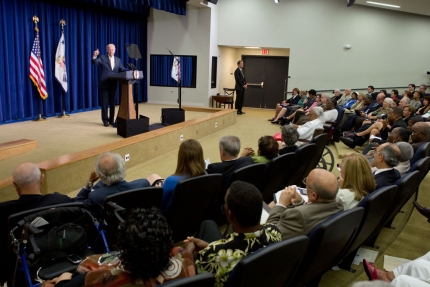
Vice President Joe Biden addresses the Disabled American Veterans convention in Las Vegas, Nevada. August 4, 2012. (Official White House Photo by David Lienemann)

Saturday, Vice President Biden spoke with the Disabled American Veterans (DAV) at their 91st National Convention in Las Vegas.

The 1.2 million-member DAV is made up exclusively of men and women that have been wounded while defending the nation. This group is dedicated to one, single purpose – building better lives for all our nation’s disabled veterans and their families.

The Vice President thanked the men and women for their service and sacrifices and for continuing to serve by supporting their fellow disabled veterans. He also encouraged them to continue fighting for the benefits that they have earned, need and deserve.

During his address to a crowd of almost 4,000 disabled veterans, Vice President Biden stressed, “Let me be crystal, absolutely crystal clear: we’re going to keep our commitment to American veterans, no matter what happens.”

Related Topics: Health Care, Veterans, Nevada

An Issue Beyond Debate: Congress Should Act Now to Protect Women

Ed. Note: This op-ed was first published by the McClatchy Newspapers.

I've spent a lot of years in Washington, and in the past, I had always found that even when partisanship was at its worst, there were still certain issues that rose above the normal course of politics. These days, unfortunately, even that precept is being challenged.

Protecting victims of domestic violence, an issue that has always enjoyed bipartisan support and should be well beyond debate, has become the center of one in Congress. And women across the nation are now at risk.

Let me explain what's happening:

In 1994, I wrote the Violence Against Women Act, which established several critical new protections: first, it provides law enforcement with new tools to prosecute domestic violence crimes and put offenders behind bars. Second, it helps victims find safe places to stay so they don't have to choose between living on the streets or living with someone who is hurting them. And third, it gives women a crisis hotline they can call when they need immediate help.

We've made a lot of progress as a nation since the act first became law. Annual rates of domestic violence have dropped by more than 60 percent. The national hotline has answered more than 2 million crisis calls, directing victims to life-saving assistance.

But make no mistake, this violence still happens every day.

We need to continue these programs and we need to add improvements. For example, we now know that new screening tools can help law enforcement and the courts reduce domestic violence homicide rates, helping them to step in before abuse becomes murder. Such tools might have saved Sarah Rosio, a 24-year-old Wisconsin woman who was strangled to death by her boyfriend after having been abused many times before her death. Two weeks before her death, Sarah was denied a protective order against her abuser. Sarah is gone now, tragically, but we can help others avoid her terrible fate.

To do so, Congress must make the protections in the Violence Against Women Act available to every person in this country who may ever need them. This simply cannot be up for debate in a civilized society like ours.

Every few years, the Violence Against Women Act needs to be reauthorized. And in the past, Congress has worked cooperatively to reauthorize, improve, and expand the reach of the law. Up until now.

Earlier this year, the Senate passed the bill, and they did it with both Democratic and Republican support. Unfortunately, the House did not follow this broadly bipartisan path; Republicans there passed a much weaker version of the bill. While the House bill contains some of the important provisions of the Senate bill, it lacks key improvements - like protecting more victims and requiring dating violence and sexual assault prevention programs on campus - and, in some cases, it actually rolls back current protections for victims of domestic violence.

Support for the Violence Against Women Act runs broad and deep. It includes law enforcement, prosecutors, victims' advocates, faith groups, and Democrats and Republicans alike. So this should be easy - and beyond politics. Instead, the clock is now running out for the more than 23,000 women who call our national domestic abuse hotline every month and for all women who may one day be the victims of violence.

Congress should pass the bipartisan version approved by the U.S. Senate.

I know there are fundamental differences between Democrats and Republicans, and I don't expect those to disappear. But on this issue of basic decency, where there remains so much agreement between us, Republicans and Democrats ought to leave politics at the water's edge. Because women everywhere are counting on us, and they can't wait any longer.


Related Topics: Women, Wisconsin

The White House

Office of the Vice President

Op-ed by Vice President Biden: An Issue Beyond Debate: Congress Should Act Now to Protect Women

The full text of the op-ed by Vice President Joe Biden is printed below. The piece, published online today by McClatchy Newspapers and in hard copies tomorrow, can be read HERE.

An Issue Beyond Debate: Congress Should Act Now to Protect Women
By Vice President Biden

I've spent a lot of years in Washington, and in the past, I had always found that even when partisanship was at its worst, there were still certain issues that rose above the normal course of politics. These days, unfortunately, even that precept is being challenged.

Protecting victims of domestic violence, an issue that has always enjoyed bipartisan support and should be well beyond debate, has become the center of one in Congress. And women across the nation are now at risk.

Let me explain what's happening:

In 1994, I wrote the Violence Against Women Act, which established several critical new protections: first, it provides law enforcement with new tools to prosecute domestic violence crimes and put offenders behind bars. Second, it helps victims find safe places to stay so they don't have to choose between living on the streets or living with someone who is hurting them. And third, it gives women a crisis hotline they can call when they need immediate help.

We've made a lot of progress as a nation since the act first became law. Annual rates of domestic violence have dropped by more than 60 percent. The national hotline has answered more than 2 million crisis calls, directing victims to life-saving assistance.

But make no mistake, this violence still happens every day.

We need to continue these programs and we need to add improvements. For example, we now know that new screening tools can help law enforcement and the courts reduce domestic violence homicide rates, helping them to step in before abuse becomes murder. Such tools might have saved Sarah Rosio, a 24-year-old Wisconsin woman who was strangled to death by her boyfriend after having been abused many times before her death. Two weeks before her death, Sarah was denied a protective order against her abuser. Sarah is gone now, tragically, but we can help others avoid her terrible fate.

To do so, Congress must make the protections in the Violence Against Women Act available to every person in this country who may ever need them. This simply cannot be up for debate in a civilized society like ours.

Every few years, the Violence Against Women Act needs to be reauthorized. And in the past, Congress has worked cooperatively to reauthorize, improve, and expand the reach of the law. Up until now.

Earlier this year, the Senate passed the bill, and they did it with both Democratic and Republican support. Unfortunately, the House did not follow this broadly bipartisan path; Republicans there passed a much weaker version of the bill. While the House bill contains some of the important provisions of the Senate bill, it lacks key improvements - like protecting more victims and requiring dating violence and sexual assault prevention programs on campus - and, in some cases, it actually rolls back current protections for victims of domestic violence.

Support for the Violence Against Women Act runs broad and deep. It includes law enforcement, prosecutors, victims' advocates, faith groups, and Democrats and Republicans alike. So this should be easy - and beyond politics. Instead, the clock is now running out for the more than 23,000 women who call our national domestic abuse hotline every month and for all women who may one day be the victims of violence.

Congress should pass the bipartisan version approved by the U.S. Senate.

I know there are fundamental differences between Democrats and Republicans, and I don't expect those to disappear. But on this issue of basic decency, where there remains so much agreement between us, Republicans and Democrats ought to leave politics at the water's edge. Because women everywhere are counting on us, and they can't wait any longer.

Mr. Biden is Vice President of the United States.

The White House

Office of the Vice President

Readout of Vice President Biden’s Meeting with Arab-American Leaders

Vice President Biden and other Senior Administration Officials met today with a group of Arab-American thinkers and community leaders. In a wide-ranging discussion, members of the group shared their views on developments unfolding across the Middle East and the Vice President outlined the Administration’s approach to this period of profound change. The Vice President expressed his appreciation for the valuable ideas and insights that participants offered on the challenges and opportunities we face.

The White House

Office of the Vice President

Statement by Vice President Joe Biden on the Shooting in Colorado

Jill and I were shocked to learn of the tragedy in Aurora, Colorado this morning. The reason this is so deeply felt by all Americans is that, but for the grace of God, the victims could have been any one of our children, in any one of our towns. It is every parent’s worst nightmare to receive ‘that phone call’ and to sit by their child’s bedside, praying. We know what it’s like to wait and wonder and the helplessness a parent feels at this moment. Our hearts go out to each and every person who is suffering right now as a result of this terrible event. The prayers of an entire nation are with the victims and their families. We stand with the city of Aurora and the state of Colorado in mourning.

Taking in Team USA

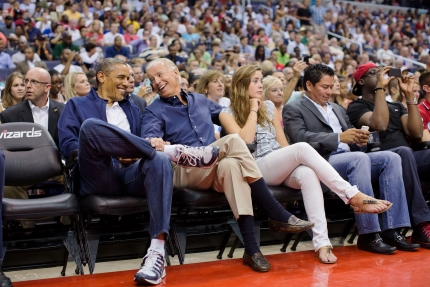
President Obama attends the U.S. Men's Olympic basketball team's game against Brazil (July 17, 2012)

President Barack Obama and Vice President Joe Biden, with granddaughter Naomi Biden, attend the U.S. Men's Olympic basketball team's game against Brazil at the Verizon Center in Washington, D.C., July 16, 2012. (Official White House Photo by Pete Souza)

In the lead up to the 2012 London Olympics, the USA men's basketball team last night played an exhibition game against Brazil at the Verizon Center in Washington, DC.

President Obama was on hand, along with First Lady Michelle Obama and Vice President Biden.

The Obamas and company watched Team USA take on a talented and experienced Brazil squad, also featuring multiple NBA starters. Led by 30 points, six rebounds, and four steals from LeBron James, the Americans forced 23 turnovers to capture an 80-69 win.

Earlier, the USA women's team routed their Brazilian counterparts, 99-67 -- led by 21 points from the three-time WNBA All Star Lindsay Whalen.

President Obama met with both teams to offer some words of encouragement before the players and coaches head to the United Kingdom to defend their gold medals. The Olympics start on July 28, and the First Lady will help to lead the U.S. delegation.

We managed to grab some behind the scenes video from the night. Check it out below.

Earlier, we talked with Alonzo Mourning, a gold medalist in the 2000 Sydney Olympics with Team USA, about the challenges this year's squad will face in London. Watch Alonzo Mourning talk about Team USA basketball.


Related Topics: Inside the White House

Vice President Biden Speaks To Seniors About Retirement Security

Vice President Joe Biden delivers remarks on Seniors Issues July 16, 2012

Vice President Joe Biden delivers remarks at a White House Community Leaders briefing on Seniors Issues, in the South Court Auditorium at the White House, July 16, 2012. (Official White House Photo by David Lienemann)

Today, the Vice President spoke to more than 100 community leaders from across the country representing over 60 seniors groups that are part of the Leadership Council of Aging Organizations. He told the audience that when it comes to Social Security and Medicare, “the question is what are we going to do to strengthen and sustain these programs now and for the future.” In contrast, Congressional Republicans are trying to weaken or dismantle these programs.   

Last year, Congressman Paul Ryan proposed to end traditional Medicare. His plan, which was embraced by his Republican colleagues, would give seniors a voucher to buy private insurance and hold them responsible for any costs that exceed the value of the voucher. As a result, the typical 65-year-old’s out-of-pocket health care costs would double over time. While Congressman Ryan introduced a revised plan this year, it still relies on a voucher system that would increase the financial burden on seniors. 

President Obama and Vice President Biden want to strengthen Medicare and secure the program for the future. Our health care law extends the life of Medicare by eight years by taking smart steps like cutting waste and fraud and creating incentives to cut down on hospital readmissions. These steps will save seniors in traditional Medicare an average of $160 on premiums and copays in 2012 alone. In addition, the law has already saved 5.3 million seniors an average of $600 on prescription drugs by closing the “donut hole,” and has ensured that over 30 million have access to free preventive services like cancer screenings and annual wellness visits. 

Community Leaders Briefing with Seniors

July 16, 2012 | 33:34 | Public Domain

Vice President Biden speaks to community leaders representing seniors organizations from across the country.

Download mp4 (1188MB) | mp3 (77MB)

The Vice President and Dr. Biden Visit U.S. Vets in Las Vegas

On Tuesday, the Vice President and Dr. Jill Biden visited the Las Vegas branch of the non-profit United States Veterans Initiative (U.S. Vets). With a mission to help homeless and at-risk veterans find jobs, U.S. Vets provides comprehensive support that includes housing, counseling, and career development programs. The Las Vegas group alone works with more than 160 veterans every day.   

At the organization’s career center, the Vice President and Dr. Biden joined a life skills workshop, where they met with veterans who are either currently working or searching for work.

The White House

Office of the Vice President

Press Conference Call by the Vice Presdent and Acting Associate Attorney General Tony West

PRESS CONFERENCE CALL BY VICE PRESIDENT JOE BIDEN AND ACTING ASSOCIATE ATTORNEY GENERAL TONY WEST ON A NEW NATIONAL PUBLIC SAFETY FUNDING ANNOUNCEMENT BY ATTORNEY GENERAL ERIC HOLDER

Via Teleconference

1:07 P.M. EDT

MR. LEHRICH: Thank you all for joining us today. Before we get started, I just want to remind you all that the contents of this call are embargoed for 2:30 p.m., when the official announcement is made. You should also have the press release and the full list of COPS program awardees, also embargoed for 2:30 p.m.

We are joined today by the Vice President and by Acting Associate Attorney General Tony West. We’ve also got members of the National Economic Council and the COPS Office at the Department of Justice who will take your questions later and will introduce themselves when they get ready to talk.

But with no further ado, I’ll turn it over to the Vice President.

THE VICE PRESIDENT: Hey, folks, how are you? I apologize -- I have a cold and I apologize for my raspy voice. This is a continuation of our effort to do two things: make the streets safer and make sure that returning veterans from the 9/11 generation, in Afghanistan and Iraq, don’t have to come back and fight as hard for a job as they fought for us.

Since we got into office, the President and I have been absolutely committed to helping our returning veterans -- 9/11 guys and women -- find jobs and transition back into civil life -- civilian life. And it’s a very simple, simple proposition. As I said already, we don’t think if they fought like hell over there they should have to fight that hard when they come home. Because only 1 percent of them are serving, and the idea that they have the highest unemployment rate out there -- it’s about two points -- a little over two points higher than it is for the rest of the population -- it just seems unconscionable to us.

So last August the President issued a challenge to the private sector to hire more veterans. And since then, with the help of Michelle Obama and others, the private sector has already hired 90,000 veterans and their spouses -- their spouses. They’ve already been hired. One thousand six hundred companies signed up, and they committed to hire not just 100,000 -- 170,000 veterans, 9/11 veterans -- 9/11 -- since 9/11, and their spouses by the end of 2013.

Last December, the President also moved on amending the tax code to give tax credits to hire unemployed veterans and veterans with disabilities. And it was enacted into law. Now, the companies can now apply for that -- for a tax credit of $5,600 to hire an unemployed vet, and $9,600 if in fact they hire a veteran -- a $9,600 per-veteran tax credit when they hire a veteran with disabilities. And by the way, they can -- in the middle of this month they’re going to be able to make that formal notification to the government that they did that, and what will happen is we’ll know then how many were actually hired. But we’ll also -- they will then get paid -- they’ll be credited that tax credit within the next couple months.

The third thing we did was we wanted to help veterans transition into the private sector. Many of you reporters have traveled around the country with me, and around -- in and out of Afghanistan and Iraq, and you watch these guys and women -- they’re incredibly talented, qualified people with overwhelming responsibility. And so the Defense Department recently launched, at our request, a task force that’s going to help members obtain credentials and licensing for high-demand jobs. The task force is up and running, and it’s going to help over 100,000 service members obtain certifications that will make them qualify for manufacturing.

For example, if you’re a Navy welder, you may not have to be certified in the civilian sector, but now all these classifications of jobs that qualify you and give you a certificate saying you a qualified welder or mason -- whatever it is -- you’re going to get that categorization; it will be labeled based on your record, based on your job classification in the military, and the private sector says -- the manufacturers association says they will accept that certification as if it came out of a trade school or anything else. And that is a pretty big deal.

Its purpose is that there are still far, far too many veterans out there searching for work. And that’s why we haven’t stopped pushing to help vets get good jobs. In February, the President also announced that this year’s COPS hiring grant -- now, that is the -- not adding -- this is the 2012 budget, the money already appropriated, that from this point on -- from that point on, any cop hired with a COPS hiring grant would be required -- required to give preference to communities recruiting and hiring post-9/11 veterans. It’s not an option; it’s a requirement. And today, the Attorney General is going to announce where these grants are going. There’s 221 cities and counties that are going to be a little bit safer because of these grants.

These COPS grants are going to support 800 police officer positions, 800 positions out there. But there are going to be 629 new shields, new hires out there. And they all are going to be veterans, all 800. All 800 are going to be part of this grant, but 629 will be new hires. And every one of those new hires will be a veteran of the post-9/11 era. And these are -- as I said, these are remarkable women and men.

They’re the finest generation of warriors we have ever, ever seen. But they also -- when they’re overseas, they’re not just warriors, they’re taking on tasks that in the past have been reserved for people of considerably more seniority. They’ve had to master the intricacies of tribal politics -- whether I’m up in a FOB up in the Kunar Valley in Afghanistan, watching these guys negotiate with local tribes as to where the road is going to go. I mean, watching these guys have to inventory Humvees and all of these vehicles that they can run, that are fleets bigger than most trucking companies in the world have. I mean, these are qualified people. They also not only handle that, but they have to deal with issues ranging from electricity to unemployment in Afghanistan and Iraq.

So they’re a remarkable bunch. But a lot of them want to keep serving when they get back. And these COPS grants are going to help them get that chance.

And look, this is just part of our efforts to promote employment for vets. Since the State of the Union, we have called on the Congress to pass our Veterans Job Corps proposal so we could put veterans back to work in communities as park rangers, cops, firefighters, using the skills and expertise they’ve gained in the military. The American public spent a whole hell of a lot of money to train these women and men. They have done a remarkable, remarkable, remarkable job. They are fully qualified. They need the jobs. And it’s bad for the community not to take advantage of it, and it’d be terrible for them.

Last fall we also sent the Congress the American Jobs Act, which would have given local communities the resources to retain and hire as many as 18,000 officers and 1,000 firefighters. Look around the cities you’re from. You’ve laid off firefighters. Most of the places you’ve laid off cops. It’s a problem. It’s a problem for communities. There are shields sitting in drawers that are authorized by the local police department that could be filled now, giving people jobs.

And that also included -- that included preference for hiring. What we’ve done now is a requirement in the 2012 budget. You must hire a veteran with COPS money. That contained preference. Congress should stop sitting on their hands and get on with it. These resources are going to help the communities, as I said, be a heck of a lot safer, and they’re going to provide good, middle-class jobs our cities and our towns need right now. From our perspective, this is just common sense.

Let me conclude by saying we’ve been acting on this common sense initiative since we first came to office. We invested so far $1.6 billion -- billion -- in saving or creating 7,000 police officer positions. It should be more, but that's what we were able to get done -- positions that have been critical in helping police departments make it through a recession that has devastated local budgets. The budgets have been decimated, perfect storms have occurred, foreclosures have occurred, neighborhoods get blighted, crime increases. I mean, this is a vicious cycle, and you can make it a virtuous cycle if the Congress would act.

From 2009 to 2011, roughly 30,000 law enforcement positions went unfilled due to local budget constraints. So while today is a great day for communities and veterans who will benefit from these awards, there is a whole heck of a lot more to do. And that's why we need the Congress to act now.

In the meantime, we are going to act wherever we have the administrative capability of doing that. And that's exactly what we’re doing today when -- Eric will announce it shortly -- what we’re doing today in insisting those 600, I believe, it’s 29 veterans -- or 628 veterans -- I’m not sure the exact number now -- will get -- 29 -- will be hired, brought on. The announcement will be made today.

So it’s -- but there's so much more to do, folks. And I just -- having fought this fight for so long in the United States Senate, and writing the COPS bill, I mean, this is something clearly popular with the public, needed by veterans, and will benefit the community all around.

And I’m going to turn it over to the Associate Attorney General Tony West and for any comments. Thank you all very much. Again, I apologize for my voice.

MR. WEST: Thank you so much, Mr. Vice President. And thank all of you -- thank you all for joining us on this call. As the Vice President stated, we have over 220 cities and counties who will be receiving grant awards totaling over $111 million from the Department of Justice through the 2012 COPS hiring program.

And later today, Attorney General Eric Holder will announce these awards in Philadelphia with COPS Director Melekian, with the Mayor Nutter, the police commissioner there, Police Commissioner Ramsey, and Congressman Fattah. This year, the city of Philadelphia will itself receive $3.1 million to hire 25 military veterans to join the Philadelphia Police Department.

Now, the COPS hiring program really illustrates the department’s dedication to keeping our communities safe through strategic partnerships with the state and local officials who advance the practice of community-oriented policing, which is at the core of the department’s COPS Office.

Now, these funds are critical. They’re absolutely critical to support our law enforcement agencies that are struggling to meet increasing public safety needs with decreasing resources. In fact, when you look at the last three years, from 2009 to 2011, as the Vice President mentioned, approximately 12,000 officers were laid off, and 30,000 positions could not be filled. In all, about 85 percent of all law enforcement agencies reported cuts.

Now, these grant awards, these will save or create jobs for 800 police officers -- 800 police officers -- in cities and counties around the country like Cumberland, Maine to New Orleans, Louisiana; from Takoma, Washington to Toledo, Ohio; from Polk County, Florida to Summersville, West Virginia. Nearly 200 law enforcement officers will no longer be laid off. And as the Vice President mentioned, 629 new officers -- new officers -- will be hired. We’re proud that all 629 of those new hires, they will be military veterans who have served at least 180 days since September 11, 2001.

The Department of Justice’s commitment to supporting law enforcement is unyielding; and we are absolutely proud to support both law enforcement officers and military veterans who have sacrificed so much to keep our country safe. And with that, I’ll turn it over to Danielle Gray.

MR. LEHRICH: Thanks, Mr. West, and thank you to the Vice President. This is Matt Lehrich, again, the press office. I think at this point we are ready to take some of your questions. Let me just introduce our speakers here. Mr. West will stay on. He will also be joined, as he just said, by Danielle Gray, who is deputy director of the National Economic Council here at the White House; Joshua Ederheimer, who is the principal deputy director of the COPS Office at the Department of Justice; and Rebekah Whiteaker, who is the chief of staff at the COPS Office, the Department of Justice.

As a reminder, this is all embargoed for 2:30 p.m., and you should have a list of the awardees, also embargoed for 2:30 p.m., in your inboxes. And with that, Gloria, I think we’re ready for some questions.

Q Yes, these -- police who are being hired in Philadelphia -- most of them may be like military police people who have some law enforcement background in the military?

MR. WEST: This is Tony West. It was a little bit hard to hear the question, but I think the question was are we talking about -- the veterans that we’re talking about, are they military police veterans. And my understanding, and we have folks on from the COPS Office who can also clarify this, but we’re talking about military veterans. It’s not limited to military police, individuals who were trained as military police officers or had some particular training as veterans. It’s open to anyone who served at least 180 days of active duty service since September 11, 2001.

MR. LEHRICH: All right, well, then I want to thank everybody for their time today. I especially want to thank the Vice President, Mr. West and everybody from the COPS Office and the NEC for joining the call and also all of you for taking the time with us today.

As always if you have any questions, please feel free to get in touch with us to follow up, and once again, a reminder that this is all embargoed for 2:30 p.m. today.

Thank you.

END
1:23 P.M. EDT