The White House

Office of the Press Secretary

Letter from the President --War Powers Notification on Chad

Dear Mr. Speaker: (Dear Mr. President:)

Approximately 80 U.S. Armed Forces personnel have deployed to Chad as part of the U.S. efforts to locate and support the safe return of over 200 schoolgirls who are reported to have been kidnapped in Nigeria. These personnel will support the operation of intelligence, surveillance, and reconnaissance aircraft for missions over northern Nigeria and the surrounding area. The force will remain in Chad until its support in resolving the kidnapping situation is no longer required.

This action has been directed in furtherance of U.S. national security and foreign policy interests, pursuant to my constitutional authority to conduct U.S. foreign relations and as Commander in Chief and Chief Executive.

I am providing this report as part of my efforts to keep the Congress fully informed, consistent with the War Powers Resolution (Public Law 93-148). I appreciate the support of the Congress in these actions.

Sincerely,

BARACK OBAMA

The White House

Office of the Press Secretary

Statement by the President on Veterans Health Care

James S. Brady Press Briefing Room

10:58 A.M. EDT

THE PRESIDENT:  Good morning, everybody.  I just met with Secretary Shinseki and Rob Nabors, who I’ve temporarily assigned to work with Secretary Shinseki and the VA.  We focused on two issues:  the allegations of misconduct at Veterans Affairs facilities, and our broader mission of caring for our veterans and their families.

As Commander-in-Chief, I have the honor of standing with our men and women in uniform at every step of their service: from the moment they take their oath, to when our troops prepare to deploy, to Afghanistan -- where they put their lives on the line for our security, to their bedside, as our wounded warriors fight to recover from terrible injuries.  The most searing moments of my presidency have been going to Walter Reed, or Bethesda, or Bagram and meeting troops who have left a part of themselves on the battlefield.  And their spirit and their determination to recover and often to serve again is an inspiration.

So these men and women and their families are the best that our country has to offer.  They’ve done their duty, and they ask nothing more than that this country does ours -- that we uphold our sacred trust to all who have served. 

So when I hear allegations of misconduct -- any misconduct -- whether it’s allegations of VA staff covering up long wait times or cooking the books, I will not stand for it.  Not as Commander-in-Chief, but also not as an American.  None of us should.  So if these allegations prove to be true, it is dishonorable, it is disgraceful, and I will not tolerate it -- period. 

Here’s what I discussed with Secretary Shinseki this morning.  First, anybody found to have manipulated or falsified records at VA facilities has to be held accountable.  The inspector general at the VA has launched investigations into the Phoenix VA and other facilities.  And some individuals have already been put on administrative leave.  I know that people are angry and want a swift reckoning.  I sympathize with that.  But we have to let the investigators do their job and get to the bottom of what happened.  Our veterans deserve to know the facts.  Their families deserve to know the facts.  And once we know the facts, I assure you -- if there is misconduct, it will be punished. 

Second, I want to know the full scope of this problem.  And that’s why I ordered Secretary Shinseki to investigate.  Today, he updated me on his review, which is looking not just at the Phoenix facility, but also VA facilities across the nation.  And I expect preliminary results from that review next week. 

Third, I’ve directed Rob Nabors to conduct a broader review of the Veterans Health Administration -- the part of the VA that delivers health care to our veterans.  And Rob is going to Phoenix today.  Keep in mind, though, even if we had not heard reports out of this Phoenix facility or other facilities, we all know that it often takes too long for veterans to get the care that they need.  That’s not a new development.  It’s been a problem for decades and it’s been compounded by more than a decade of war. 

That’s why, when I came into office, I said we would systematically work to fix these problems, and we have been working really hard to address them.  My attitude is, for folks who have been fighting on the battlefield, they should not have to fight a bureaucracy at home to get the care that they’ve earned.

So the presumption has always been we’ve got to do better.  And Rob’s review will be a comprehensive look at the Veterans Health Administration’s approach currently to access to care.  I want to know what’s working.  I want to know what is not working.  And I want specific recommendations on how VA can up their game.  And I expect that full report from Rob next month.

Number four -- I said that I expect everyone involved to work with Congress, which has an important oversight role to play.  And I welcome Congress as a partner in our efforts not just to address the current controversies, but to make sure we’re doing right by our veterans across the board.  I served on the Veterans Affairs Committee when I was in the Senate, and it was one of the proudest pieces of business that I did in the legislature.  And I know the folks over there care deeply about our veterans. 

It is important that our veterans don’t become another political football, especially when so many of them are receiving care right now.  This is an area where Democrats and Republicans should always be working together.

Which brings me to my final point.  Even as we get to the bottom of what happened at Phoenix and other facilities, all of us, whether here in Washington or all across the country, have to stay focused on the larger mission, which is upholding our sacred trust to all of our veterans, bringing the VA system into the 21st century -- which is not an easy task. 

We have made progress over the last five years.  We’ve made historic investments in our veterans.  We’ve boosted VA funding to record levels.  And we created consistency through advanced appropriations so that veterans organizations knew their money would be there regardless of political wrangling in Washington.

We made VA benefits available to more than 2 million veterans who did not have it before -- delivering disability pay to more Vietnam vets exposed to Agent Orange; making it easier for veterans with post-traumatic stress and mental health issues and traumatic brain injury to get treatment; and improving care for women veterans. 

Because of these steps and the influx of new veterans requiring services added in many cases to wait times, we launched an all-out war on the disability claims backlog.  And in just the past year alone, we’ve slashed that backlog by half.

Of course, we’re not going to let up, because it’s still too high.  We’re going to keep at it until we eliminate the backlog once and for all.  Meanwhile, we’re also reducing homelessness among our veterans.  We’re helping veterans and their families -- more than a million so far -- pursue their education under the Post-9/11 GI Bill.  We’re stepping up our efforts to help our newest veterans get the skills and training to find jobs when they come home.  And along with Michelle and Jill Biden and Joining Forces, we’ve helped hundreds of thousands of veterans find a job.  More veterans are finding work and veterans unemployment, although still way too high, is coming down. 

The point is, caring for our veterans is not an issue that popped up in recent weeks.  Some of the problems with respect to how veterans are able to access the benefits that they’ve earned, that’s not a new issue.  That’s an issue that I was working on when I was running for the United States Senate.  Taking care of our veterans and their families has been one of the causes of my presidency, and it is something that all of us have to be involved with and have to be paying attention to. 

We ended the war in Iraq.  And as our war in Afghanistan ends, and as our newest veterans are coming home, the demands on the VA are going to grow.  So we’re going to have to redouble our efforts to get it right as a nation.  And we have to be honest that there are and will continue to be areas where we’ve got to do a lot better. 

So today, I want every veteran to know we are going to fix whatever is wrong.  And so long as I have the privilege of serving as Commander-in-Chief, I’m going to keep on fighting to deliver the care and the benefits and the opportunities that your families deserve, now and for decades to come.  That is a commitment to which I feel a sacred duty to maintain. 

So with that, I’m going to take two questions.  I’m going to take Jim Kuhnhenn at AP, first of all.

Q    Thank you, Mr. President.  As you said, this is a cause of your presidency.  You ran on this issue -- you mentioned it.  Why was it allowed to get to this stage where you actually had potentially 40 veterans who died while waiting for treatment?  That’s an extreme circumstance.  Why did it get to that?

  THE PRESIDENT:  Well, we have to find out, first of all, what exactly happened.  And I don’t want to get ahead of the IG report or the other investigations that are being done.  And I think it is important to recognize that the wait times generally -- what the IG indicated so far at least -- is the wait times were for folks who may have had chronic conditions, were seeking their next appointment but may have already received service.  It was not necessarily a situation where they were calling for emergency services.  And the IG indicated that he did not see a link between the wait and them actually dying.

That does not excuse the fact that the wait times in general are too long in some facilities.  And so what we have to do is find out what exactly happened.  We have to find out how can we realistically cut some of these wait times.  There has been a large influx of new veterans coming in.  We’ve got a population of veterans that is also aging as part of the baby boom population.  And we’ve got to make sure that the scheduling system, the access to the system, that all those things are in sync.  There are parts of the VA health care system that have performed well. 

And what we’ve seen is, for example, satisfaction rates in many facilities with respect to many providers has been high.  But what we’re seeing is that, in terms of how folks get scheduled, how they get in the system, there are still too many problems.  I’m going to get a complete report from it.  It is not, as a consequence, people not caring about the problem, but there are 85 million appointments scheduled among veterans during the course of a year.  That’s a lot of appointments.  And that means that we’ve got to have a system that is built in order to be able to take those folks in in a smooth fashion, that they know what to expect, that it’s reliable, and it means that the VA has got to set standards that it can meet.  And if it can’t meet them right now, then it’s going to have to set realistic goals about how they improve the system overall.

Q    Does the responsibility ultimately rest with General Shinseki?

THE PRESIDENT:  You know, the responsibility for things always rests ultimately with me, as the President and Commander-in-Chief.  Ric Shinseki has been a great soldier.  He himself is a disabled veteran.  And nobody cares more about our veterans than Ric Shinseki.  So if you ask me how do I think Ric Shinseki has performed overall, I would say that on homelessness, on the 9/11 GI Bill, on working with us to reduce the backlog, across the board he has put his heart and soul into this thing and he has taken it very seriously.

But I have said to Ric -- and I said it to him today -- I want to see what the results of these reports are and there is going to be accountability.  And I’m going to expect even before the reports are done that we are seeing significant improvement in terms of how the admissions process takes place in all of our VA health care facilities.  So I know he cares about it deeply and he has been a great public servant and a great warrior on behalf of the United States of America.  We’re going to work with him to solve the problem, but I am going to make sure that there is accountability throughout the system after I get the full report.

Steve Holland from Reuters.

Q    Thank you, sir.  Has Secretary Shinseki offered to resign?  And if he’s not to blame, then who is?  And were you caught by surprise by these allegations?

THE PRESIDENT:  Ric Shinseki I think serves this country because he cares deeply about veterans and he cares deeply about the mission.  And I know that Ric’s attitude is if he does not think he can do a good job on this and if he thinks he has let our veterans down, then I’m sure that he is not going to be interested in continuing to serve.  At this stage, Ric is committed to solving the problem and working with us to do it.  And I am going to do everything in my power, using the resources of the White House, to help that process of getting to the bottom of what happened and fixing it.

But I’m also going to be waiting to see what the results of all this review process yields.  I don’t yet know how systemic this is.  I don’t yet know are there a lot of other facilities that have been cooking the books, or is this just an episodic problem.  We know that, essentially, the wait times have been a problem for decades in all kinds of circumstances with respect to the VA -- getting benefits, getting health care, et cetera.  Some facilities do better than others.  A couple of years ago, the Veterans Affairs set a goal of 14 days for wait times.  What’s not yet clear to me is whether enough tools were given to make sure that those goals were actually met. 

And I won’t know until the full report is put forward as to whether there was enough management follow-up to ensure that those folks on the front lines who were doing scheduling had the capacity to meet those goals; if they were being evaluated for meeting goals that were unrealistic and they couldn’t meet, because either there weren’t enough doctors or the systems weren’t in place or what have you.  We need to find out who was responsible for setting up those guidelines.  So there are going to be a lot of questions that we have to answer.

In the meantime, what I said to Ric today is let’s not wait for the report retrospectively to reach out immediately to veterans who are currently waiting for appointments, to make sure that they are getting better service.  That’s something that we can initiate right now.  We don’t have to wait to find out if there was misconduct to dig in and make sure that we’re upping our game in all of our various facilities. 

I do think it is important not just with respect to Ric Shinseki, but with respect to the VA generally, to say that every single day there are people working in the VA who do outstanding work and put everything they’ve got into making sure that our veterans get the care, benefits and services that they need.  And so I do want to close by sending a message out there that there are millions of veterans who are getting really good service from the VA, who are getting really good treatment from the VA.  I know because I get letters from veterans sometimes asking me to write letters of commendation or praise to a doctor or a nurse or a facility that couldn’t have given them better treatment. 

And so this is a big system with a lot of really good people in it who care about our veterans deeply.  We have seen the improvements on a whole range of issues like homelessness, like starting to clear the backlog up, like making sure that folks who previously weren’t even eligible for disability because it was a mental health issue or because it was an Agent Orange issue are finally able to get those services.  I don’t want us to lose sight of the fact that there are a lot of folks in the VA who are doing a really good job and working really hard at it.  That does not, on the other hand, excuse the possibility that, number one, we weren’t just -- we were not doing a good enough job in terms of providing access to folks who need an appointment for chronic conditions.  Number two, it never excuses the possibility that somebody was trying to manipulate the data in order to look better or make their facility look better. 

It is critical to make sure that we have good information in order to make good decisions.  I want people on the front lines, if there’s a problem, to tell me or tell Ric Shinseki, or tell whoever is their superior, that this is a problem.  Don’t cover up a problem.  Do not pretend the problem doesn’t exist.  If you can’t get wait times down to 14 days right now, I want you to let folks up the chain know so that we can solve the problem.  Do we need more doctors?  Do we need a new system in order to make sure that the scheduling and coordination is more effective and more smooth?  Is there more follow-up?

And that’s the thing that right now most disturbs me about the report -- the possibility that folks intentionally withheld information that would have helped us fix a problem, because there’s not a problem out there that’s not fixable.  It can’t always be fixed as quickly as everybody would like, but typically we can chip away at these problems.  We’ve seen this with the backlog.  We’ve seen it with veterans homelessness.  We’ve seen it with the Post-9/11 GI Bill.  Initially, there were problems with it.  They got fixed and now it’s operating fairly smoothly.  So problems can be fixed, but folks have to let the people that they’re reporting to know that there is a problem in order for us to fix it.

Q    What about bonuses for those implicated in mismanagement, Mr. President?

THE PRESIDENT:  We’re going to find out.  My attitude is --

Q    Does that upset you?

THE PRESIDENT:  Listen, if somebody has mismanaged or engaged in misconduct, not only do I not want them getting bonuses, I want them punished.  So that’s what we’re going to hopefully find out from the IG report, as well as the audits that are taking place. 

END
11:18 A.M. EDT
The White House

Office of the Vice President

FACT SHEET: Overview of NATO and Bilateral Reassurance Measures in Romania

As a result of Russia’s occupation and attempted annexation of Ukrainian territory, the United States has taken several immediate steps to demonstrate our continued commitment to Article 5 collective defense and reassure our NATO allies, including Romania, who are closest to the crisis.  The United States and NATO are committed to maintaining an augmented, persistent forward presence in Central and Eastern Europe through at least the end of 2014.

New U.S. Measures:

  • Maritime Deployments to the Black Sea: In early April, the United States deployed the USS Donald Cook to the Black Sea where the Cook conducted operations to improve interoperability, increase readiness, and develop professional relationships with Allies.  The Cook conducted presence operations and a port visit in Constanta, Romania, as well as a passing exercise (PASSEX) with the Romanian Navy.
  • In late April, the USS Taylor, a frigate and our contribution to the Standing NATO Maritime Group, was deployed to the Black Sea where Taylor conducted bilateral operations with Romania and Georgia, including port visits to both countries.
  • The USS Vella Gulf will soon enter the Black Sea to conduct port visits and combined maritime training with Allied naval forces.
  • Air-to-Air Refueling Missions: Since mid-March, the United States has been flying refueling missions in support of NATO Airborne Early Warning and Control System (AWACS) flights over Poland and Romania.
  • NATO Response Force (NRF): The Department of Defense is exploring options for increasing the readiness of its U.S.-based, NRF-committed Brigade Combat Team.

Enhancements to Previously Planned U.S. Operations:

  • USS Truxtun: The USS Truxtun entered the Black Sea through the Turkish Straits on March 7 to conduct a port call in Constanta, Romania and a PASSEX with Romanian and Bulgarian naval forces.  Truxtun extended its stay in the Black Sea until March 21 to conduct a port visit in Varna, Bulgaria, hold an onboard maritime planning conference with Bulgarian and Romanian officers, and conduct a second PASSEX.

U.S. Ongoing/Steady State Measures:

  • There are approximately 1,000 U.S. troops in Romania, including Marines, sailors, airmen and soldiers.
    • Black Sea Rotational Forces (BSRF): This force, based out of Mihail Kogalniceanu (MK) Air Base, Romania, includes 250 Marines and sailors tasked with maintaining positive relations with partner nations; enhancing regional stability; and increasing interoperability while providing the capability for rapid crisis response in the Black Sea, Balkan, and Caucasus regions.  In May, BSRF personnel are participating in exercise PLATINUM LYNX; infantry field training with the Romanian military to enhance familiarity and interoperability between U.S. and Romanian forces.
    • Nearly 500 of these U.S. troops are permanently stationed at MK Air Base conducting transit center operations.  
    • 175 U.S. Marines will be temporarily based out of MK Air Base as part of the Special Purpose Marine Air-Ground Task Force (SPMAGTF).  The SPMAGTF is postured to respond to a broad range of military operations in the EUCOM/AFRICOM region, including:  fixed-site security, non-combatant evacuation operations, humanitarian assistance and disaster relief operations, tactical recovery of aircraft and personnel, theater security cooperation, and other missions as directed. 
    • Currently, more than 80 U.S. Airmen are currently participating in Exercise Carpathian Spring in Romania.  The exercise runs from April 12th to 21st and is designed for aircrew to receive upgrade training and build partnership capacity with the Romanians.  
  • European Phased Adaptive Approach (EPAA):  The United States’ contribution to European missile defense includes plans for four Aegis destroyers to be home ported in Rota, Spain (USS Cook recently arrived) and two planned Aegis Ashore sites; one in Romania (2015) and one Poland (2018).  The Romania Aegis Ashore site is critical to NATO missile defense and is the fundamental infrastructure for Phase 2 of the EPAA.  It will consist of a radar with 360-degree coverage, vertical launch tubes with SM-3 Block IB missile defense interceptors, and the associated command and control systems to integrate the radar and the interceptors.  The interceptors could be launched from the site in Romania to defend NATO in the case of a missile attack from the Middle East.   The groundbreaking at the Romania site was completed in 2013, and the site is firmly on budget and on schedule to be operational by the end of 2015. 
  • U.S. Force Presence in Europe:  There are approximately 67,000 service members in Europe.  Approximately 57,000 active duty service members are assigned to U.S. European Command (USEUCOM) and approximately 10,000 support other organizations, such as U.S. Africa Command. 
  • NATO Response Force (NRF) Commitment:  The United States previously pledged several thousand service members to the NATO Response Force including a brigade combat team from the Texas-based 1st Cavalry Division, a hospital ship, air-to-air refueling tankers, and escort ships.
  • Army Rotational Forces:  The United States will send a battalion-sized unit from the United States to Europe twice a year for up to two months per rotation.  In May, the unit will participate in a USEUCOM-hosted multinational exercise, COMBINED RESOLVE II.  The exercise, which includes Romanian participation, will take place in Germany.

The White House

Office of the Press Secretary

Message to the Senate -- Transmitting a Tax Convention with Poland

TO THE SENATE OF THE UNITED STATES:

I transmit herewith, for the advice and consent of the Senate to its ratification, the Convention between the United States of America and the Republic of Poland for the Avoidance of Double Taxation and the Prevention of Fiscal Evasion with Respect to Taxes on Income, signed on February 13, 2013, at Warsaw (the "proposed Convention"). I also transmit for the information of the Senate the report of the Department of State, which includes an overview of the proposed Convention.

The proposed Convention replaces the existing Convention, signed in 1974, and was negotiated to bring United States-Poland tax treaty relations into closer conformity with current U.S. tax treaty policies. For example, the proposed Convention contains provisions designed to address "treaty shopping," which is the inappropriate use of a tax treaty by residents of a third country, that the existing Convention does not. Concluding the proposed Convention with Poland has been a top priority for the tax treaty program at the Department of the Treasury.

I recommend that the Senate give early and favorable consideration to the proposed Convention and give its advice and consent to its ratification.

BARACK OBAMA

The White House

Office of the Press Secretary

Statement by the Press Secretary on H.R. 3627

On Tuesday, May 20, 2014, the President signed into law:

H.R. 3627, the "Kilah Davenport Child Protection Act of 2013," which provides for increased penalties for individuals who commit domestic assault and have at least two previous convictions for assault, sexual abuse, or serious violent felony against their child or a child in their care; and requires the Justice Department to report on the penalties for violations of State laws prohibiting child abuse.

The White House

Office of the Press Secretary

Presidential Nominations Sent to the Senate

NOMINATIONS SENT TO THE SENATE:

Geoffrey W. Crawford, of Vermont, to be United States District Judge for the District of Vermont, vice William K. Sessions, III, retiring.

The White House

Office of the First Lady

Committee On The Arts And Humanities Announces Expansion Of Turnaround Arts Program


Washington, D.C. –The President’s Committee on the Arts and the Humanities (PCAH) will expand its successful Turnaround Arts initiative, a program designed to help turn around low-performing schools, narrow the achievement gap, and increase student engagement through the arts, announced the committee’s co-chairs, George Stevens Jr. and Margo Lion today.

The newly expanded program is funded through a public-private partnership, providing over $5 million over the next three years from the U.S. Department of Education, the National Endowment of the Arts, the Ford Foundation and other private foundations and companies to bring arts education into low-performing schools.  Local program partners will provide an additional $12 million and the money will be used to hire new arts and music teachers, bring teaching artists, art supplies and music instruments into schools and support arts integration into other core subjects such as reading, math and science.

Additionally, the President’s Committee announced a number of new “Turnaround Artists,” who will work to support individual schools’ arts education curriculum: Chad Smith, Clarence Greenwood (aka Citizen Cope), Doc Shaw, Elizabeth Banks, Elton John, Frank Gehry, Jason Mraz, Jesse Tyler Ferguson, Josh Groban, Marc Anthony, Rashida Jones, Russell Simmons, the Silk Road Ensemble, Tim Robbins and Troy Andrews (aka Trombone Shorty). These artists join PCAH members who are currently working with the program, including Alfre Woodard, Chuck Close, Damian Woetzel, Forest Whitaker, John Lloyd Young, Kal Penn, Kerry James Marshall, Kerry Washington, Sarah Jessica Parker and Yo-Yo Ma.

In May 2012, the President’s Committee, in partnership with the U.S. Department of Education and the White House Domestic Policy Council, launched Turnaround Arts as a pilot program in eight “turnaround schools” across the country—public schools in the lowest-achieving five percent of their state that are receiving School Improvement Grants through the U.S. Department of Education. Over the last two years, Turnaround Arts has brought arts education resources into pilot schools. Interim evaluation results show that participating schools are demonstrating improved academic performance, increased student and parent engagement and improved culture and climate.

The expanded program will be working in 35 schools in districts in California, Colorado, Connecticut, Illinois, Iowa, Louisiana, Massachusetts, Minnesota, Montana, Oregon and Washington D.C., with plans to expand to up to 60 schools across the country. Studies show that when students participate in the arts they are four times more likely to be recognized for academic achievement, have higher GPA/SAT scores, are more engaged and cooperative with teachers and peers, and are more self-confident and better able to express their ideas. These benefits are particularly pronounced in high-poverty, low-performing schools.

First Lady Michelle Obama, Honorary Chair of the President’s Committee, said, “The Turnaround Arts program has exceeded not just our expectations, but our wildest hopes and dreams.  With the help of this program and some School Improvement Grants, math and reading scores have gone up in these schools… attendance is up, enrollment is up…parent engagement is up… suspensions have plummeted…and two of the schools in our pilot improved so dramatically that they are no longer in turnaround status.  And today, the students in these schools are engaged in their education like never before.”

“During the two-year Turnaround Arts pilot, we have seen notable progress in school culture, improved academic performance and increased parental engagement at each of our original eight schools,” U.S. Education Secretary Arne Duncan said. “As the Turnaround Arts program expands into 35 schools across the nation, I congratulate the President’s Committee on its success and thank all of our partners for contributing to the U.S. Department of Education’s reform efforts and goal to make sure all children receive a well-rounded, high-quality education.”

“We are proud of the progress Turnaround Arts schools have made so far and thrilled to be able to expand the program into more schools across the country,” said PCAH Vice-Chair Mary Schmidt Campbell, Ph.D. “Thanks to the hard work of our artists, program partners and school educators, we have been able to demonstrate that high quality arts education can positively change young lives and turn around failing schools.”

All schools participating in Turnaround Arts will receive training and resources to address their individual needs. Resources will include a summer leadership program, in-school professional development, partnerships with community arts education and cultural organizations, art supplies and musical instruments.  Participating artists will “adopt” Turnaround Arts schools for the length of the program, working with students, schools and communities to highlight their success. 

“It’s an honor to be part of this program,” said actress and PCAH member Kerry Washington. “Through my work in Turnaround Arts schools over the past two years, I have witnessed the power of integrated arts education to move the needle on some of our toughest educational challenges, and to give all students the chance to excel and to shine.”

National partners in Turnaround Arts include the  U.S. Department of Education, National Endowment for the Arts, the Ford  Foundation,  the  Herb  Alpert  Foundation,  the Rosenthal Family Foundation,  the Keith Haring Foundation, Crayola  LLC,  the  National Association of Music Merchants (NAMM) Foundation and Music Theater International. The program is administered in partnership with Americans for the Arts.  Local program partners include:  Academy of Urban School Leadership, Chicago, IL; Boston Public Schools, Boston, MA; CREATE CA, Los Angeles, CA; Des Moines Public Schools, Des Moines, IA; George Rodrigue Foundation of the Arts, Baton Rouge, LA; and Perpich Center for Arts Education, Minneapolis, MN.

About the President’s Committee on The Arts and The Humanities

Created in 1982 under President Reagan, the President’s Committee on the Arts and the Humanities (PCAH) is an advisory committee to the White House on cultural issues. The PCAH works directly with the three primary cultural agencies—National Endowment for the Arts, the National Endowment for the Humanities and the Institute of Museum and Library Services—as well as other federal partners and the private sector, to address policy questions in the arts and humanities, to initiate and support key programs in those disciplines and to recognize excellence in the field. Its core areas of focus are education, cultural exchange, and creative economy. Under the leadership of the First Lady and Honorary Chairman, and through the efforts of its federal and private members, the President’s Committee has compiled an impressive legacy over its tenure, conducting major research and policy analysis, and catalyzing important federal cultural programs, both domestic and international. For more information, please visit http://www.pcah.gov/

The White House

Office of the Press Secretary

FACT SHEET & REPORT: On White House Roundtable on Investing in America

Attached is a new report by the White House and Department of Commerce: Winning Business Investment in the United States”. The report can also be found HERE.

President Obama announces second-ever SelectUSA Summit to be held in Spring 2015

At a time when our businesses have created 9.2 million new jobs in just over four years, and more companies are considering bringing jobs here, we have a choice to make.  We can make it easier for businesses to invest in America – or we can make it harder.  It has been a top priority for this administration to do all we can to help businesses invest in the U.S. and support good jobs for American workers, and the President wants to work with Congress to continue to create jobs and expand opportunity for more Americans.  But where Congress won’t act, the President will. 

In 2011, the President launched SelectUSA – a global team in embassies abroad and agencies at home focused on encouraging and supporting companies to bring job-creating investment to the United States.  Last October, the President hosted the first-ever SelectUSA Summit, bringing more than 1,300 people - business executives from more than 60 countries, governors, mayors, and economic development officials from 48 states – to see the benefits of doing business and creating jobs in the U.S. and establishing the connections to make that happen. 

The insourcing trend continues to grow, with survey after survey showing companies choosing to invest in the U.S. An AT Kearney survey ranked the U.S. #1 in the world for the first time since 2001.  A 2013 Boston Consulting Group survey of U.S. manufacturers with production abroad found that the majority (54 percent) are looking at re-shoring to the United States from China, up from 37 percent in 2012.  An Organization for International Investment (OFII) / PricewaterhouseCoopers LLP survey showed that executives see the U.S. as the preferred location amongst advanced economies.

Today, the President, with Commerce Secretary Penny Pritzker, Senior Advisor Valerie Jarrett, and National Economic Council Director Jeff Zients will host a roundtable with companies that have recently chosen to invest in the United States.  These companies have recognized the many advantages of locating, growing, and hiring in the United States, and they will discuss the key reasons they chose to invest and hire in the U.S. and what more we can do together to bring even more job-creating investment to the U.S.  Together, the roundtable participants are investing billions of dollars in the U.S. and creating thousands of new jobs.

Second SelectUSA Investment Summit

  • Today, the President is announcing the second SelectUSA Summit to be held in Spring of 2015 in Washington, D.C. With the success of the first summit, this event will be twice the size with more than 2,500 people from around the world to help bring more job-creating investments to the U.S and to share stories about what Made in America really means.

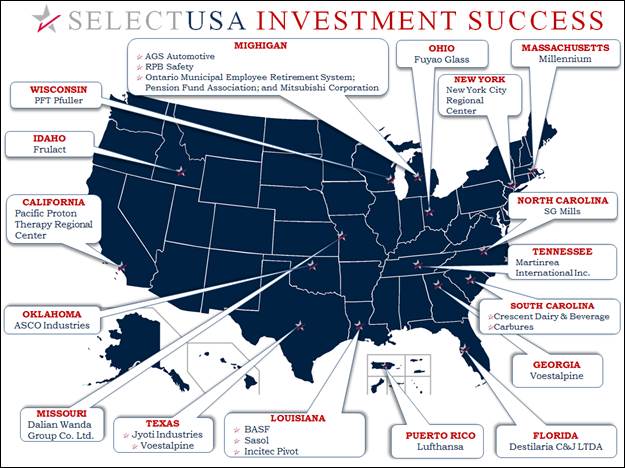
  • SelectUSA has directly assisted in winning more than $18 billion in job-creating business investments for the United States in 17 different states and territories, and since October has assisted nearly 500 businesses, encouraging them to invest in the U.S. and helping them to navigate the Federal government.


SelectUSA Progress Report

The White House and Department of Commerce released a new report Winning Business Investment in the United States that highlights the growing attractiveness of investing in the U.S., the importance of inbound investment, and progress on the President’s SelectUSA initiative.

  • Investment is growing and plays an important role in the U.S. economy:

    • Investment in the U.S. is growing due to one of the most highly-skilled and productive workforces, low-cost and abundant energy resources, global leadership in innovation and invention, access to global markets, and rising costs abroad. 

    • Business fixed investment from companies choosing to grow and invest in the United States accounts for more than 20 percent of the rebound in real GDP since 2009.

    • The U.S. manufacturing sector has added 647,000 new jobs, the fastest pace of manufacturing job growth since the 1990s.

    • Since 2006, the United States has been the world’s largest recipient of foreign direct investment (FDI) and receives the majority of all inflows to the G7.  U.S. affiliates of non-U.S. firms employ 5.6 million Americans.

  • U.S. is an increasingly attractive as a location for investment and job creation:

    • In a 2013 survey of 300 global executives, the U.S. was ranked the top destination for global business cross-border investment, the first time the U.S. has been at the top since 2001. [AT Kearney]

    • The share of U.S. executives actively considering bringing back production from China rose to 54 percent in survey released September 2013, compared with 37 percent only 18 months earlier. [The Boston Consulting Group]

    • In a survey of company financial officers in 2014, more than 80% surveyed believe the U.S. business climate is getting stronger, and 60% surveyed prefer the U.S. to all other advanced economies compared to just 25% making the same claim in 2011. [Organization for International Investment and PricewaterhouseCoopers]

  • The President’s SelectUSA is the first-ever, comprehensive federal effort to actively compete to bring job-creating investment to the United States:

    • In the U.S. and around the world, SelectUSA works to encourage investment from companies, advocating for the U.S., providing companies with the information they need, and connecting them to the resources that will bring them to the U.S., with country-specific strategies in 32 markets representing more than 90% of FDI.

    • SelectUSA serves as a single point of contact for ready investors, assisting companies in navigating the federal government and regulatory system

    • SelectUSA coordinates advocacy by federal officials up to and including the President – working with our mayors and governors to compete and win jobs and investment for the United States.

Companies Participating in President’s SelectUSA Roundtable

Ericsson
Ericsson, a Swedish multinational corporation, is a world-leading provider of communications technology, software, and services for telecommunications operators and other industries.  40 percent of the world's mobile traffic goes through Ericsson networks every day servicing more than 2.5 billion subscribers. In September 2013, Ericsson completed a massive expansion of its Plano, Texas campus, which also serves as its North American headquarters.  Since 2001, Ericsson has more than quadrupled its workforce in Plano, to approximately 4,500 employees.  Ericsson has invested $7 billion in U.S. acquisitions over the past six years and sees opportunities for more growth in the U.S.

Ford
Ford Motor Company, a global automotive industry leader based in Dearborn, Mich., is set to launch 23 new vehicles to customers around the world.  Building on the addition of 14,000 new hires over the past two years, Ford will add more than 5,000 U.S. jobs in 2014 to meet this unprecedented growth.  This past year, Ford also invested $200 million in its Cleveland, Ohio plant to manufacture Ford's 2.0-liter EcoBoost engines, supporting 450 additional jobs in Ohio.  Previously, a Ford plant in Europe supported U.S. demand for these engines.  Ford made the move to assemble these engines in Ohio to help meet rising consumer demand in the U.S. for this award-winning engine.

GLOBALFOUNDRIES
GLOBALFOUNDRIES is the second largest contract chip manufacturer in the world. Launched in 2009 as a partnership between AMD and Mubadala Development Company, GLOBALFOUNDRIES is based in Silicon Valley with manufacturing operations in Germany, Singapore and the United States (Malta, NY), as well as research partnerships around the globe.  GLOBALFOUNDRIES is now operating and expanding their new Fab 8 facility at the Luther Forest Technology Campus in Saratoga County, NY, the most advanced semiconductor foundry manufacturing and technology development center in the United States. In 2013, the company announced an expansion with a $2 billion investment in a Technology Development Center on the same campus, bringing the company’s total investment to more than $8.5 billion at that location. Since breaking ground on Fab 8 in 2009, the company has created more than 2,200 new full-time direct jobs, as well as approximately 650 contractor positions, and expects to create an additional 600 full-time positions by the end of this year. According to company data, the Fab 8 project has required more than 6 million man hours of construction and created more than 10,000 new construction jobs and thousands of construction-related jobs since 2009.

Hankook Tire
Hankook Tire, a South Korean tire manufacturer, is a leading global provider of passenger, SUV, trucks, buses, and competition tires.  Hankook Tire America is the company’s U.S. subsidiary, with headquarters in Wayne, New Jersey and a Research and Development center in Akron, Ohio.  Hankook Tire America is a strategic partner to Ford, and a supplier for Hyundai’s Alabama operations. The company is planning to invest $800 million in a state-of-the-art plant in Clarksville, Tennessee, the company’s first in the United States.  At full capacity, the new plant will support approximately 1,800 full-time jobs.  The company cited growing demand in the United States, a desire to establish a production base in all major markets, and access to an increasingly important customer base as reasons for manufacturing in the United States.  Hankook is expected to break ground on its plant this year and begin tire production by 2016. 

K’NEX
K'NEX Brands is a U.S. manufacturer of construction toys based in Hatfield, Pennsylvania.  Founded in 1992, K'NEX Brands and their wholly owned plastic injection molding subsidiary, The Rodon Group, founded in 1956, manufacturers brands such as K'NEX Building Sets, Lincoln Logs(r), Tinkertoy(r), NASCAR(r), Angry Birds(tm), and more.  Over the past five years, K'NEX, a family-owned company, has been moving its toy production from Asia back to its plant in Pennsylvania.  Approximately 95 percent of the parts and 80 percent of the finished products are now made in the United States.  K'NEX cites speed to market (about three times as fast as the competition) and cost savings (about 30 percent less expensive than the competition) as two reasons for their investment in the United States.  President Obama visited K’NEX in 2012.

Lufthansa
Lufthansa Group, the largest airline group in Europe, is comprised of several businesses that are world market leaders in their segments (Lufthansa Passenger Airlines / Swiss / Austrian / Brussels Airlines, Lufthansa Cargo, Lufthansa Technik, Lufthansa Systems and LSG SkyChefs). Lufthansa companies account for 10,000 employees in the U.S. alone. Lufthansa has multi-billion-dollar investments in the U.S. with its long-standing partnerships with The Boeing Company, General Electric, and Honeywell among others.   In addition, Lufthansa owns 19 percent interest in the U.S. airline JetBlue Airways.  In April 2014, Lufthansa Technik –the largest independent global provider of maintenance, repair, and overhaul services for aircraft, engines, and component parts – announced a significant investment in the Commonwealth of Puerto Rico that is expected to create up to 400 permanent jobs.   Lufthansa Technik chose the United States—among strong international competition—as the site of a new aviation maintenance, repair and overhaul facility to service short-haul and medium-haul aircraft.  With local efforts led by Governor Alejandro García Padilla and the Puerto Rico Industrial Development Company, as well as the support of Vice President Biden and the President’s Task Force on Puerto Rico. The SelectUSA team at the U.S. Department of Commerce worked with the Puerto Rico team to offer Lufthansa information and assistance from across federal agencies and departments that not only assisted in their intense due diligence and assessment for making their decision but also demonstrated why the United States is the top destination for foreign direct investment.

Novozymes
Novozymes, headquartered in Denmark, is a world leader in bioinnovations. The company’s US operations are based in Franklinton, North Carolina, where Novozymes plans to invest $36 million to build a new research and development center in nearby Cary, North Carolina. This new center will create 100 research and development jobs over the next three years. Scientists at this site will research and develop beneficial microorganisms found in the soil and the resulting technology will focus on improved crop yield, fertility and pest control for growers around the world.  The expansion of R&D resources will enable Novozymes’ scientists to pursue more and better biological solutions for the ever-changing challenges facing global agriculture. 

Richelieu
In 2011, Richelieu, an apparel manufacturer, first invested in the United States to rescue the failing sock company International Legwear Group.  With an initial investment of $7 million, Richelieu re-employed ILG’s existing workforce and saved its ongoing accounts.  Richelieu continues to expand, recently deciding to invest up to $24 million in a new, state-of-the-art facility that will ultimately reshore production, creating 205 new jobs.  The company credits Walmart for their assistance and commitment through a multi-year purchase order. SelectUSA, through the U.S. Commercial Service in Canada, has also been instrumental in Richelieu’s investment.  Through comprehensive counselling on the U.S. economic, business and investment climate; support related to federal regulations such as immigration and work permits; and facilitation of federal sources of capital potentially available to them through the Small Business Administration (SBA), SelectUSA helped the company navigate the intricacies of federal regulations.

Safran
Safran is a global high-technology company with concentrations in aerospace, defense, and security.  In the United States, Safran has nearly 7,000 employees in 22 states.  Safran serves federal, state, and local governments as well as top industry partners.  The United States represents over 25% of Safran’s global activities and the U.S. government is Safran’s largest end user.  In March 2014, Safran and Albany International, a New Hampshire-based advanced textiles and materials processing company, inaugurated a new facility in Rochester, New Hampshire.  The 300,000 square-foot facility will produce woven composite parts for aircraft engines and employ over 400 people at full capacity.  To augment local capabilities in advanced manufacturing, Safran and Albany International are also partnering with Great Bay Community College in Portsmouth, New Hampshire to develop a six-month training program.  Graduates will fill key positions including bonding and finishing operators, paint operators, and inspection and coordination of measuring machine operators.

Umicore
Umicore USA, a Belgian global materials technology and recycling group, focuses on application areas in materials science, chemistry, and metallurgy.  In December 2013, Umicore announced an agreement to acquire Palm Commodities International, a leading manufacturer and distributor of materials to the surface treatment industry.  Recently, Umicore has constructed a new facility in Tulsa, OK for the manufacture of precious metals catalysts to cater to its customers in the North American market. The investment will result in a significant expansion of manufacturing capabilities. This facility currently has 126 employees.  Umicore is also investing in a new production line at its plant in Arab, Alabama where there are currently 53 employees in manufacturing and technical positions. This new line will produce catalysts for the petrochemical industry. 

Zurich NA
Zurich North America is a regional subsidiary of Switzerland-based Zurich Insurance Group, and is one of the largest commercial insurers in the U.S.  With almost 9,000 employees in the region and $14 billion in annual revenue, Zurich North America is the largest construction insurer in the U.S. and the largest insurer of the auto industry.  In late 2013, Zurich announced plans to build a sophisticated new North American headquarters in Schaumburg, Illinois.  To be completed in 2016, the project will create up to 700 construction jobs and is one of the largest build to suit projects currently underway in the United States.  Zurich started its U.S. operations in Chicago more than a 100 years ago, and currently employs approximately 3,000 people in the greater Chicago area. Zurich’s decision to remain in Schaumburg reflects their commitment to providing the best possible working environment for their employees.

The White House

Office of the Press Secretary

President Obama Announces Jennifer Yeager Kaplan as Director of the President’s Commission on White House Fellowships

WASHINGTON, DC – Today, President Barack Obama announced Jennifer Yeager Kaplan as the next Director of the President’s Commission on White House Fellowships.

President Obama said, “Jenny’s leadership and experience make her uniquely qualified for this position.  I’m proud to announce Jenny as the next Director of the President’s Commission on White House Fellowships and look forward to welcoming her back to the Administration and working with her in the months and years to come.”

President Obama announced Jennifer Yeager Kaplan as Director of the President’s Commission on White House Fellowships:

Jennifer Yeager Kaplan, Director, President’s Commission on White House Fellowships

Jennifer Yeager Kaplan is Vice President for Corporate Engagement and the Program Officer for the 10,000 Small Businesses Initiative at Goldman Sachs, a position she has held since 2011.  From 2009 to 2011, she served in the White House as Deputy Director of the White House Council on Women and Girls and as Special Assistant to the Director in the Office of Public Engagement.  She also worked in the Personnel Department of the Obama-Biden Transition Project.  Previously, Ms. Kaplan was the Tri-State Finance Director for Obama for America from 2007 to 2008, and Co-National Finance Director of Hopefund from 2005 to 2007.  In 2004, she was Co-National Finance Director of Obama for Illinois.  Ms. Kaplan received a B.S. in Business Administration from The University of North Carolina at Chapel Hill.

The White House

Office of the Press Secretary

President Obama Announces Jennifer Yeager Kaplan as Director of the President’s Commission on White House Fellowships

WASHINGTON, DC – Today, President Barack Obama announced Jennifer Yeager Kaplan as the next Director of the President’s Commission on White House Fellowships.

President Obama said, “Jenny’s leadership and experience make her uniquely qualified for this position.  I’m proud to announce Jenny as the next Director of the President’s Commission on White House Fellowships and look forward to welcoming her back to the Administration and working with her in the months and years to come.”

President Obama announced Jennifer Yeager Kaplan as Director of the President’s Commission on White House Fellowships:

Jennifer Yeager Kaplan, Director, President’s Commission on White House Fellowships

Jennifer Yeager Kaplan is Vice President for Corporate Engagement and the Program Officer for the 10,000 Small Businesses Initiative at Goldman Sachs, a position she has held since 2011.  From 2009 to 2011, she served in the White House as Deputy Director of the White House Council on Women and Girls and as Special Assistant to the Director in the Office of Public Engagement.  She also worked in the Personnel Department of the Obama-Biden Transition Project.  Previously, Ms. Kaplan was the Tri-State Finance Director for Obama for America from 2007 to 2008, and Co-National Finance Director of Hopefund from 2005 to 2007.  In 2004, she was Co-National Finance Director of Obama for Illinois.  Ms. Kaplan received a B.S. in Business Administration from The University of North Carolina at Chapel Hill.