The White House

Office of the Press Secretary

Readout of the President’s Call with Prime Minister Cameron of United Kingdom

The President and Prime Minister Cameron of the United Kingdom spoke today regarding their deep concern about the situation in eastern Ukraine.  The President commended the government of Ukraine’s approach to today’s discussions in Geneva, where it put forward constructive proposals to expand local governance and ensure the rights of all Ukrainians are protected.  The leaders stressed that Russia needs to take immediate, concrete actions to de-escalate the situation in eastern Ukraine, including by using its influence over the irregular forces in eastern Ukraine to get them to lay down their arms and leave the buildings they have seized.  As the President has said, we will look for the Russians to quickly follow through on their commitments in Geneva in this regard.  The President and the Prime Minister agreed that the United States and Europe are prepared to take further measures to impose costs on Russia if this de-escalation does not occur in short order.

The White House

Office of the Press Secretary

Statement by the President on the Passing of Nobel Laureate Gabriel García Marquez

With the passing of Gabriel García Márquez, the world has lost one of its greatest visionary writers – and one of my favorites from the time I was young.  Affectionately known as “Gabo” to millions of his fans, he first won international recognition with his masterpiece One Hundred Years of Solitude.  I once had the privilege to meet him in Mexico, where he presented me with an inscribed copy that I cherish to this day.  As a proud Colombian, a representative and voice for the people of the Americas, and as a master of the “magic realism” genre, he has inspired so many others – sometimes even to pick up the pen themselves.  I offer my thoughts to his family and friends, whom I hope take solace in the fact that Gabo’s work will live on for generations to come.

The White House

Office of the Press Secretary

Readout of the President’s Call with Chancellor Merkel of Germany

The President and Chancellor Merkel of Germany spoke today regarding their deep concern about the situation in eastern Ukraine.  The President commended the government of Ukraine’s approach to today’s discussions in Geneva, where it put forward constructive proposals to expand local governance and ensure the rights of all Ukrainians are protected.  The leaders stressed that Russia needs to take immediate, concrete actions to de-escalate the situation in eastern Ukraine, including by using its influence over the irregular forces in eastern Ukraine to get them to lay down their arms and leave the buildings they have seized.  The President and the Chancellor agreed that the United States and Europe are prepared to take further measures if this de-escalation does not occur in short order.  The leaders also stressed their support for Ukraine’s May 25 presidential elections.

The White House

Office of the Press Secretary

FACT SHEET: Affordable Care Act by the Numbers

The Affordable Care Act is working.  It is giving millions of middle class Americans the health care security they deserve, it is slowing the growth of health care costs and it has brought transparency and competition to the Health Insurance Marketplace.

HEALTH CARE BY THE NUMBERS

  • 8 million people signed up for private insurance in the Health Insurance Marketplace. For states that have Federally-Facilitated Marketplaces, 35 percent of those who signed up are under 35 years old and 28 percent are between 18 and 34 years old, virtually the same youth percentage that signed up in Massachusetts in their first year of health reform.
  • 3 million young adults gained coverage thanks to the Affordable Care Act by being able to stay on their parents plan.
  • 3 million more people were enrolled in Medicaid and CHIP as of February, compared to before the Marketplaces opened. Medicaid and CHIP enrollment continues year-round.
  • 5 million people are enrolled in plans that meet ACA standards outside the Marketplace, according to a CBO estimate. When insurers set premiums for next year, they are required to look at everyone who enrolled in plans that meet ACA standards, both on and off the Marketplace.
  • 5.7 million people will be uninsured in 2016 because 24 States have not expanded Medicaid.

HEALTH CARE COST GROWTH IS LOWEST IN DECADES

  • Health care costs are growing at the slowest level on record: Since the law passed, real per capita health care spending is estimated to have grown at the lowest rate on record for any three-year period and less than one-third the long-term historical average stretching back to 1960. This slower growth in spending is reflected in Medicare, Medicaid, and private insurance. 
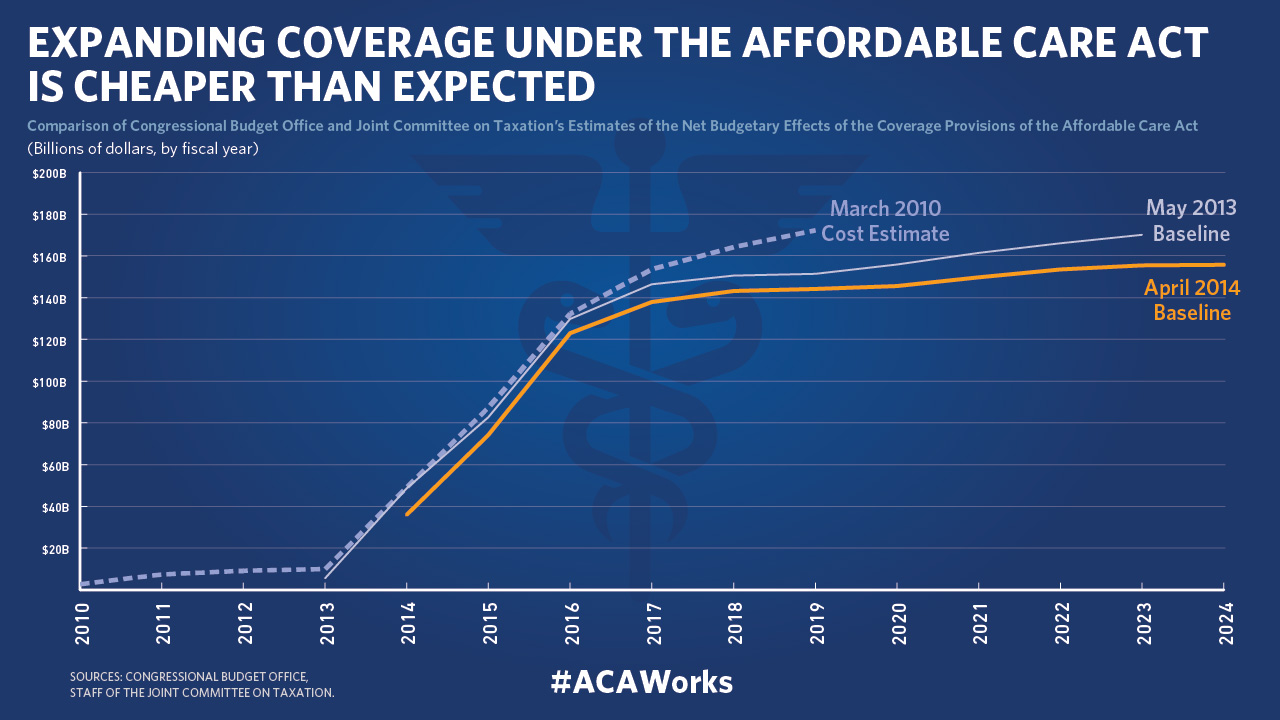
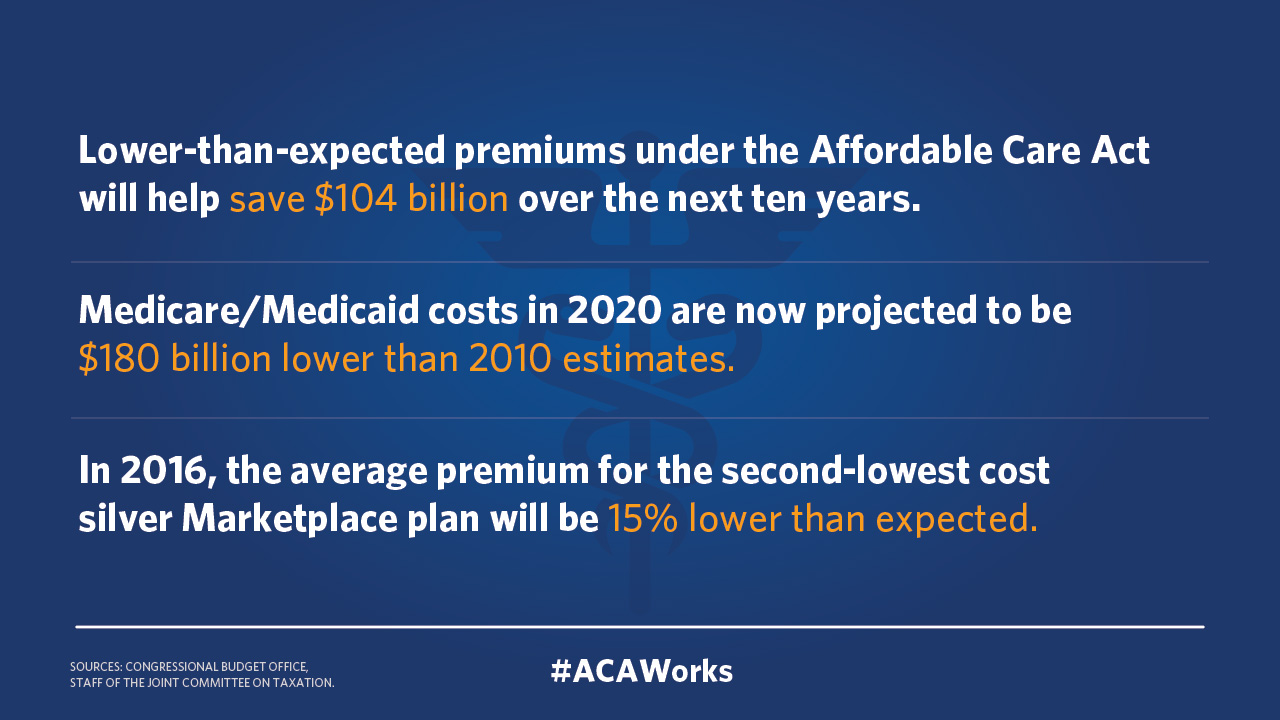
  • CBO projects the deficit will shrink more and premiums will be lower than expected: CBO previously estimated that the ACA will reduce the deficit by $1.7 trillion over two decades, and, just this week, CBO concluded that lower-than-expected Marketplace premiums and other recent developments will cut $104 billion from our deficit over the next ten years. The CBO report also projects that lower-than-expected premiums will help to save $5 billion this year, and that lower premiums will persist in the years ahead, remaining 15 percent below projections by 2016 (the only year in which CBO provides a precise estimate).
  • Medicare spending growth is down: Medicare per capita spending is growing at historically low rates.  This week, for the fifth straight year, the CBO reduced its projections for Medicare spending over the next 10 years – this time by $106 billion.  CBO projects that Medicare and Medicaid costs in 2020 will be $180 billion below its 2010 estimates.  Recent economic research suggests that the ACA’s reforms to Medicare may have “spillover effects” that reduce costs and improve quality across the health care system, not just in Medicare. 

 THE SECURITY OF HEALTH INSURANCE FOR MILLIONS OF MIDDLE CLASS FAMILIES

  • Up to 129 million Americans with pre-existing conditions – including up to 17 million children – no longer have to worry about being denied health coverage or charged higher premiums because of their health status.
  • 71 million Americans with private insurance have gained coverage for at least one free preventive health care service such as mammograms, birth control, or immunizations in 2011 and 2012.
  • In 2013, 37 million people with Medicare received at least one preventive service at no out of pocket cost.
  • Approximately 60 million Americans have gained expanded mental health and substance use disorder benefits and/or federal parity protections.
  • Since the health care law was enacted, almost 8 million seniors have saved nearly $10 billion on prescription drugs as the health care law closes Medicare’s “donut hole.”
  • 105 million Americans no longer have to worry about having their health benefits cut off after they reach a lifetime limit.

The White House

Office of the Press Secretary

President Obama Signs Montana Disaster Declaration

Today, the President declared a major disaster in the State of Montana and ordered federal aid to supplement state and local recovery efforts in the area affected by ice jams and flooding during the period of March 1-16, 2014.

Federal funding is available to state and eligible local governments and certain private nonprofit organizations on a cost-sharing basis for emergency work and the repair or replacement of facilities damaged by the ice jams and flooding in the counties of Broadwater, Dawson, Golden Valley, Jefferson, Lake, Musselshell, Park, Pondera, Prairie, Ravalli, Richland, Rosebud, Sanders, Stillwater, and Wheatland.

Federal funding is also available on a cost-sharing basis for hazard mitigation measures statewide. 

W. Craig Fugate, Administrator, Federal Emergency Management Agency (FEMA), Department of Homeland Security, named Gary R. Stanley as the Federal Coordinating Officer for federal recovery operations in the affected area.

FEMA said additional designations may be made at a later date if requested by the state and warranted by the results of further damage assessments.

FOR FURTHER INFORMATION MEDIA SHOULD CONTACT:  FEMA NEWS DESK AT (202) 646-3272 OR FEMA-NEWS-DESK@DHS.GOV

The White House

Office of the Press Secretary

Statement by the President on the Tragic Ferry Sinking Off the Coast of the Republic of Korea

On behalf of all the American people, Michelle and I send our deepest and heartfelt condolences to the families of the victims of the tragic ferry sinking off the coast of the Republic of Korea.  The bonds of friendship between the American and Korean people are strong and enduring, and our hearts ache to see our Korean friends going through such a terrible loss, especially the loss of so many young students.  South Korea is one of our closest allies, and American Navy personnel and U.S. Marines are already on the scene assisting with the search and rescue efforts.  I’ve directed our military to provide any and all assistance requested by our Korean partners in the days ahead.  As I will underscore on my visit to Seoul next week, America’s commitment to our ally South Korea is unwavering—in good times and in bad.  As the Korean people deal with this heartbreaking tragedy, they will have the unending support and friendship of the United States.   

The White House

Office of the First Lady

First Lady Michelle Obama to Address 2014 Graduating Seniors

This year, First Lady Michelle Obama will deliver commencement addresses at Dillard University, an assembly of high schools in the Topeka, Kansas Public School District, and the District of Columbia College Access Program (DC-CAP). All of these institutions are supporting the First Lady’s higher education initiative and doing their part to answer the President’s call to ensure that by the year 2020, America once again has the highest proportion of college graduates in the world.

The First Lady will deliver remarks at Dillard University because of its legacy as one of America’s top historically black universities; she will address high school students in Topeka, Kansas - home of the landmark U.S. Supreme Court case, Brown vs. Board of Education - which will celebrate its 60th anniversary the same day as the First Lady’s remarks; and she will deliver remarks at the Graduation Celebration of the DC College Access Program (DC-CAP) to highlight the important work that CAP is doing to ensure that first  generation, low income students are graduating from high school ready to pursue a higher degree.

The commencement addresses will be open press, but space is limited. Members of the media who wish to cover the commencements must RSVP directly to the contacts listed below.

Dillard University on Saturday, May 10 at 10:00 AM (Central)
First Lady Michelle Obama will deliver the commencement address to the class of 2014 at Dillard University in New Orleans, LA on Saturday, May 10 at 10:00 AM Central. Dillard is a private four-year liberal arts historically black university with a history dating back to 1869. Academically, Dillard is listed on: Forbes’ 2013 list of Top Colleges and Universities in the U.S., top 60 liberal arts institutions by the Washington Monthly (2013), and is consistently one of U.S News and World Report’s top Historically Black Colleges and Universities.  The University has been fully engaged in the economic development of the Gentilly community in which it is located as well as the city of New Orleans.  Dillard University partners with 12 community organizations, businesses and local schools in implementing such projects as home buyer workshops, community health fairs, edible gardens and water sustainability. Its Minority Health and Health Disparities Research Center also partners with local health institutions to study and address diseases such as diabetes, obesity and colon cancer, which are common to underserved individuals in the New Orleans community.

High Schools in the Topeka, KS Public School District on May 16 at 6:00 PM (Central)
The First Lady will deliver remarks at a “Senior Recognition Day” to celebrate seniors from high schools in the Topeka, KS Public School District on May 16.  This will take place the day before each high school holds their official graduation ceremony.

The remarks will celebrate the achievements of the graduating class of high school seniors in Topeka, home of the landmark U.S. Supreme Court case, Brown v. Board of Education, which is celebrating its 60th anniversary this year. 

DC College Access Program (DC-CAP) Graduation Celebration on June 19 at 6:00 PM (Eastern)
Mrs. Obama will deliver remarks at the Graduation Celebration for the DC College Access Program (DC-CAP) on Thursday, June 19 at 6:00 PM Eastern at The Mayflower Hotel in Washington, DC. DC-CAP is a private, nonprofit organization dedicated to helping DC high school students prepare for, enroll in, and graduate from college. The overwhelming majority of students served by DC-CAP are from low-income, minority, single-parent households and are the first in their families to attend college. DC-CAP provides student and parent college readiness counseling starting in 9th grade helping families navigate the college application and financial aid process throughout the high school years. DC-CAP also provides integral support and financial assistance for students while in college. Since DC-CAP’s inception in 1999, the program has played a critical role in helping to double the number of students enrolling in college and tripling the number who graduate in DC.  The event is an opportunity to applaud their achievement and honor their families who supported them.

Additional information on Commencement Addresses by First Lady Michelle Obama:
In 2009, Mrs. Obama spoke at the graduation of University of California Merced’s first full senior class. She also addressed the Washington Math and Science Tech Public Charter High School Graduation in Washington DC. In 2010, Mrs. Obama addressed graduates of the University of Arkansas at Pine Bluff, the George Washington University, and the Anacostia Senior High School. In 2011, Mrs. Obama delivered commencement addresses at the University of Northern Iowa, Spelman College, and Quantico Middle High School. The First Lady also spoke to graduates and families at West Point. In 2012, Mrs. Obama spoke at the graduation of Virginia Polytechnic Institute and State University (Virginia Tech), North Carolina Agricultural and Technical State University (North Carolina A&T), and Oregon State University (OSU). In 2013, Mrs. Obama addressed graduates of Eastern Kentucky State University, Bowie State University, and Martin Luther King Jr. Academic Magnet High School.

The White House

Office of the Press Secretary

FACT SHEET: Building on Progress – Supporting Solar Deployment and Jobs

White House Celebrates Leadership on Solar and Calls for Commitments to Support Solar Deployment and Jobs

To advance our nation’s energy and climate goals, the United States must be a leader in innovating and deploying clean energy. Solar is a vital component of the Administration’s all-of the above strategy. Supported by historic investments in research, development, and deployment, the price of solar technologies has decreased and the U.S. solar market has experienced rapid growth since President Obama took office. 

But the President is committed to continuing the momentum. That is why, today, the White House is hosting a Solar Summit to honor cross-sector leadership on solar and announce new steps to expand the use of solar in our homes, businesses, and schools.  The White House is also calling, today for new commitments from the private sector and non-profits to support solar deployment and jobs.

Today’s event will be live-streamed on WhiteHouse.gov/live.

Calling for Commitments

President Obama is committed to making 2014 a year of action and has pledged to use the power of his phone and his pen to make progress on behalf of the American people. In that spirit, the White House is calling on leaders across sectors to make tangible commitments to support solar deployment and job creation. The White House will announce those commitments in coming weeks.

Highlighting Leaders in Solar Deployment

  • Celebrating Solar “Champions of Change”: Across the country, individuals are taking the initiative to spur solar deployment – whether they are community leaders helping to reduce permitting times, business owners looking for a cleaner energy source, or homebuilders looking to offer new, renewable options for their customers. 

Today, the White House is celebrating ten Solar Champions of Change who are driving policy changes at the local level to expand energy choices for Americans, grow jobs, and add new clean energy to the grid:

o   Jessica Bailey, Director of Commercial and Industrial Property Assessed Clean Energy (C-PACE), Clean Energy Finance and Investment Authority

o   Donnel Baird, Founder and CEO, BlocPower

o   Kate Bowman, Solar Project Coordinator, Utah Clean Energy

o   Elyse Cherry, CEO, Boston Community Capital

o   Ismael Guerrero, Executive Director, Denver Housing Authority

o   Peter H. Marte, CEO, Hannah Solar LLC

o   Henry Red Cloud, Founder & Sole Proprietor of Lakota Solar Enterprises

o   Anya Schoolman, Executive Director of Community Power Network

o   Tim Sears, Co-Founder, GRID Alternatives

o   Rajendra Singh, D. Houser Banks Professor, Clemson University

Expanding Solar in Homes, Businesses, Schools, and Communities

  • Funding Regional Solar Market Pathways: Today, the Energy Department announced a $15 million Solar Market Pathways funding opportunity to support state, tribal, and local leaders in developing plans that create the economic environment for cost-competitive solar deployment.  The new Solar Market Pathways program will target broader regulatory and policy market barriers with a focus on stakeholder partnerships and commercial-scale solar.  It will fund the development of multi-year plans and innovative programs to help spur significant solar market growth.  Examples include establishing or expanding shared or community solar programs and local financing mechanisms, such as commercial property assessed clean energy (PACE).
  • Providing Technical Assistance and Analysis to Support Solar at Federally-Assisted Housing: The Climate Action Plan calls for a target of 100 megawatts of installed capacity of renewable energy on-site at federally subsidized housing by 2020.  The 100 megawatt target aims to make use of millions of federally-subsidized roofs with on-site generation potential and will more than triple the existing renewable energy capacity onsite.  Today, the Energy Department’s SunShot initiative, which is dedicated to reducing soft-costs of solar power installations, is providing staff and resources to ensure we reach the 100 megawatt target, while the National Renewable Energy Laboratory (NREL) is providing technical expertise and mapping support.
  • Launching an “On-Site Renewables Challenge” as part of EPA’s Green Power Partnership: Since 2001, EPA’s Green Power Partnership has worked with businesses, local and state governments, schools, and Federal agencies to expand the use of clean renewable energy, including solar.  More than 1,500 organizations have been recognized for their leadership as Green Power Partners, together purchasing enough green power annually to avoid the carbon emissions of more than 2.4 million homes.  Today, EPA announced that the Green Power Partnership will aim to double the use of on-site renewable energy, including solar energy, at Partner facilities by the end of the decade.  To support this goal, EPA is announcing a new On-site Renewables Challenge within the Green Power Partnership. The Partnership will track all Partners’ annual combined on-site renewable energy use, which will be updated quarterly. As part of the Challenge, EPA is inviting Partners to commit to increasing the amount of energy they produce and use from on-site renewables by the end of the decade.
  • Sharing Best Practices with a “Solar Deployment Playbook”: To assist businesses looking to install solar, in the next few months the Energy Department will release the Commercial Solar Deployment Playbook.  The playbook will help businesses to identify low-cost financing for solar energy, provide model contracts, and offer case studies of businesses improving their bottom line by deploying solar.
  • Advancing Solar by Partnering with the Rural Utilities Service: Rural America offers excellent resources for renewable energy, and is home to electric co-ops that provide reliable, affordable power for their customers.  To support the growth of renewable energy in rural areas, last year, Agriculture Department’s Rural Utility Service (RUS) Energy Efficiency and Conservation Loan Program finalized rules to facilitate the development of distributed generation and solar in rural communities.  To bolster this new RUS program, the Agriculture and Energy Departments will work with the National Rural Electric Cooperative Association (NRECA), to develop tools, templates, and finance options for co-ops looking to deploy distributed solar in rural communities, including on Federally assisted housing.
  • Leveraging Financing Tools to Deploy Solar: The growth of solar has been fueled in part by access to innovative financing tools. Today, DOE is announcing that in the coming months it will release an updated Guide to Federal Financing for Clean Energy. This guide will highlight financing programs located in various Federal agencies, such as the Treasury, EPA, and USDA, which can be used for energy efficiency and clean energy projects. Earlier this week, the Energy Department’s Loan Programs Office also announced the release of the draft Renewable Energy and Efficient Energy Projects Loan Guarantee Solicitation. This solicitation makes available at least $2.5 billion in loan guarantee authority, which can support innovative solar energy projects and will highlight projects focused on improving the functionality of distributed generation and energy storage.
  • Bolstering Co-Investment in Renewable Energy and Natural Gas: The NREL’s Joint Institute for Strategic Energy Analysis is hosting a series of workshops focused on the unique opportunities for greater synergistic use of natural gas and renewable energy. The workshops will be held in four locations: New York City, focusing on the investment community; Washington, DC, focusing on national policy; and the states of Texas and California, where both natural gas and renewables play a significant role in the economy, and could be used more synergistically. 

Leading By Example

  • Launching a Capital Solar Challenge: Over the last 5 years, the Federal government has worked to lead by example when it comes to reducing carbon emissions, increasing energy efficiency, expanding the use of clean energy. Today, the Administration is launching the Capital Solar Challenge, which will direct Federal agencies, military installations, and Federally-subsidized complexes to identify opportunities to deploy solar renewable energy at Federal locations across the National Capital Region.  The President is charging the Energy Department and GSA to assist agencies in leading the Capital Solar Challenge with the goal of developing solar renewable power on Federal rooftops, covered parking, and appropriate open land.  This program will capitalize on innovative financing and procurement models such as aggregated solar purchases, power purchases agreements, and energy performance contracts, to help lower their cost of electricity. The Capital Solar Challenge will align with efforts in the District to exponentially increase solar on Federally assisted housing as well as municipal buildings.
  • Continuing to Support Solar Deployment at Military Installations: The Department of Defense – the single largest consumer of energy in the United States –committed to deploying 3 gigawatts of renewable energy on military installations, including solar, wind, biomass, and geothermal, by 2025.  To help meet this goal, on April 25, the U.S. Army will break ground on a solar array that will provide nearly 25 percent of the annual installation electricity required for Fort Huachuca.  The project will be the largest Department of Defense solar array on a military installation to date and establishes a new path for innovative partnerships among the U.S. Army, other Federal agencies, private industry, and the utility providers, in addition to advancing the U.S. Army’s energy security objectives.

Building on Progress

Today’s announcements build on significant progress in the American solar industry. Supported by historic investments in research, development, and deployment, the price of solar technologies has decreased and the U.S. solar market has experienced rapid growth since President Obama took office.  Last year was a record-breaking year for new solar installations, and the amount of solar power installed in the United States has increased nearly eleven fold – from 1.2 gigawatts in 2008 to an estimated 13 gigawatts today, which is enough to power more than 2.2 million American homes. 

Last year, solar represented the second-largest source of new electricity added to the grid – growth that underscores significant progress, including:

  • Steep Decline in Solar Technology Costs: Since the beginning of 2010, the average cost of solar panels has dropped more than 60% and the cost of a solar photovoltaic electric system has dropped by about 50%. Solar is now more affordable and more accessible for more American families and companies.
  • Deployment of Solar on Public Lands and Buildings:  Five years ago, there were no renewable energy projects on public lands. Today, the Interior Department is on track to permit enough renewable energy projects on public lands by 2020 to power more than 6 million homes; the Defense Department has set a goal to deploy three gigawatts of renewable energy – including solar, wind, biomass, and geothermal – on Army, Navy, and Air Force installations by 2025; and, as part of the Climate Action Plan, the Federal Government overall committed to sourcing 20% of the energy consumed in Federal buildings from renewable sources by 2020.
  • Creation of Solar Jobs: According to industry analysis, solar now employs nearly 143,000 workers in the United States, a growth of more than 50% since 2010.  Jobs in the solar industry are increasing faster than any other sector in the United States – by more than 20% each year.  Every four minutes, another American home or business goes solar, supporting workers whose jobs can’t be outsourced.

The White House

Office of the Press Secretary

Statement by the President

One year ago, the Senate introduced comprehensive bipartisan legislation to fix our broken immigration system. Both sides worked together to pass that bill with a strong bipartisan vote. The Senate’s commonsense agreement would grow the economy by $1.4 trillion and shrink the deficit by nearly $850 billion over the next two decades, while providing a tough but fair pathway to earned citizenship to bring 11 million undocumented individuals out of the shadows, modernizing our legal immigration system, continuing to strengthen border security, and holding employers accountable.  Simply put, it would boost our economy, strengthen our security, and live up to our most closely-held values as a society.

Unfortunately, Republicans in the House of Representatives have repeatedly failed to take action, seemingly preferring the status quo of a broken immigration system over meaningful reform. Instead of advancing commonsense reform and working to fix our immigration system, House Republicans have voted in favor of extreme measures like a punitive amendment to strip protections from “Dreamers”. The majority of Americans are ahead of House Republicans on this crucial issue and there is broad support for reform, including among Democrats and Republicans, labor and business, and faith and law enforcement leaders. We have a chance to strengthen our country while upholding our traditions as a nation of laws and a nation of immigrants, and I urge House Republicans to listen to the will of the American people and bring immigration reform to the House floor for a vote.

The White House

Office of the Press Secretary

FACT SHEET - American Job Training Investments: Skills and Jobs to Build a Stronger Middle Class

American Job Training Investments:
Skills and Jobs to Build a Stronger Middle Class

To create new opportunities for all hard-working Americans to get ahead, the President has asked the Vice President to lead an initiative to help individuals get trained with skills businesses need now and then placed in good, middle class jobs. Training America’s workers with the skills they need for a good job can help middle class families feel more secure in their jobs and help American businesses grow our economy. But too many businesses can’t find skilled workers for jobs they want to fill, while too many people looking for a job may be ready to learn new skills but may not be certain that there’s a job waiting for them on the other end. Community colleges are one of the best ways to train workers with the skills they need for a job, and hands-on apprenticeships are one of the clearest paths to a good, secure middle class job. In fact, 87 percent of apprentices are employed after completing their programs and the average starting wage for apprenticeship graduates is over $50,000. 

Today, as part of this effort, the President and Vice President are announcing new federal investments using existing funds to support job-driven training, like apprenticeships, that will expand partnerships with industry, businesses, unions, community colleges, and training organizations to train workers in the skills they need. Employers, unions, and foundations are joining these efforts with new commitments to support job-driven training. These steps are part of President Obama’s commitment to make 2014 a year of action, acting with Congress when possible but also using his pen and his phone – calling on businesses, philanthropy, non-profits, states, and local communities to act. 

American Job Training Executive Actions

Partnering Local Businesses with Community Colleges to Put Americans Back to Work Through a Nearly $500 Million Job Training Competition. Today, the Department of Labor is releasing the application for partnerships of community colleges, employers and industry to develop training programs that are job-driven – that is – designed to respond to the demands of employers so people get placed in jobs. As part of a nearly $500 million competition, all grantees will be required to identify sectors with open jobs to fill, partner with the public workforce system and employers in that sector to address the skills needed for these open jobs, and create pathways from entry level positions to more advanced positions to ensure room for growth for employees with even the lowest starting skills levels. This program is a part of the Trade Adjustment Assistance and Community College and Career Training (TAA-CCCT) competitive grant program that has, over the last three years, supported community colleges preparing dislocated workers and other adults for jobs available in their regional economies. For the first time, this year’s funding will prioritize three key goals by providing larger grants to applicants who propose to address them:

  • Scale In-Demand Job Training Across the Country through National Industry Partnerships. Grants will incentivize partnerships to include national entities - such as industry associations - that commit to help design and implement job training programs based on industry-recognized credentials, and replicate these with other education and training institutions across the country where industry also needs to hire workers with those skills.
  • Advance Education & Training to Ensure a Seamless Progression from One Stepping Stone to Another. In order to make it easier for individuals to progress through their careers and build one degree on top of another, this competition prioritizes applicants that are increasing state-wide alignment of the training investments made by employers, educators and the workforce system. For example, communities will work to ensure accelerated degree paths and credentials that incorporate prior learning, provide credit based on demonstrated skills rather than seat time, and other innovative strategies that will pave the way for making college more affordable for adult workers and all kinds of students.
  • Improve Statewide Employment and Education Data Integration and Use. In order to better assess the effectiveness of education and job training programs over time and continue to improve job placement rates, these grants encourage applications that commit States to further integrate their employment and education data systems. 

Deadline for applications is July 7th, and grants will be awarded to community colleges in every state.

Expanding Apprenticeships for Good Middle Class Jobs. The Department of Labor is making $100 million in existing H-1B funds available for American Apprenticeship Grants to reward partnerships that help more workers participate in apprenticeships. This competition will help more Americans access this proven path to employment and the middle class: 87 percent of apprentices are employed after completing their programs and the average starting wage for apprenticeship graduates is over $50,000.

The new American Apprenticeship Grants competition – which will be launched in the fall – will focus on partnerships between employers, labor organizations, training providers, community colleges, local and state governments, the workforce system, non-profits and faith-based organizations that:

  • Launch apprenticeship models in new, high-growth fields: Many fast-growing occupations and industries with open positions, such as in information technology, high-tech services, healthcare, and advanced manufacturing, have an opportunity to adopt and adapt apprenticeship programs, to meet their skilled workforce needs.
  • Align apprenticeships to pathways for further learning and career advancement: Apprenticeships that embed industry-recognized skills certifications or reward workplace learning with college credit provide an affordable educational pathway for those who need to earn while they learn, and apprenticeships linked to pre-apprenticeship programs can help more Americans access this training and get on an early pathway to a good career.
  • Scale apprenticeship models that work: Across the country, there are pockets of excellence in apprenticeship, but all too often these successful models are unknown in other regions or to other employers. These grants will build from strength and invest in innovations and strategies to scale apprenticeships – including to market the value of apprenticeships, make them more attractive to women and other Americans who have been underrepresented, increase the return on investment for workers and, or build national and regional partnerships to expand apprenticeships.

Making Apprenticeships Work for More Americans. The Departments of Labor, Education, and Veteran Affairs are reforming their programs to enable the use of education benefits for apprenticeships:

  • Streamlining GI Bill benefits for apprentices. Through a new partnership between the Departments of Veterans Affairs and Labor, employers now have a fast-track for their veteran employees to access their GI Bill benefits for registered apprenticeships, helping more than 9,000 veteran apprentices receive the benefits they have earned.
  • Connecting apprentices with college credit. The Registered Apprenticeship College Consortium (RACC), a partnership among community colleges, national accreditors, employers, and major apprenticeship sponsors, will make it possible for apprenticeship graduates to earn credits that will transfer to any community college in the consortium they attend. Founding members include large state systems like Ohio and Wisconsin. Since it was launched last week by the Vice President, 33 more colleges and systems have started the process, including the state system of North Carolina, to join the consortium.

Business and Philanthropic Investments in Job-Driven Training 

Business, Union, and Non-Profit Efforts to Expand Apprenticeships: Today, the President and Vice President will recognize efforts by employers, unions, and training institutions to expand apprenticeships, helping more Americans access this proven path to employment and middle class earnings.

  • The President’s Advanced Manufacturing Partnership (AMP) is developing scalable apprenticeship models in high need advanced manufacturing. Spearheaded by AMP members Dow, Alcoa, and Siemens, a coalition of employers is partnering with community colleges in Northern California and in Southern Texas on apprenticeships in advanced manufacturing occupations – like welders who can fabricate equipment using high-performance alloys and technicians to maintain the complex equipment found in today’s factories. Led by South Central College in southern Minnesota, a coalition of 24 community colleges and employers is pioneering a statewide apprenticeship model in mechatronics. And Harper College, in suburban Chicago, is establishing an apprenticeship program linked to college credit for veterans in advanced manufacturing specialties, including logistics and supply chain management.  To scale these models and meet the demand for a projected 40,000 employees with advanced skills in machining, welding, and industrial maintenance over the next decade, coalition members will release a “How To” manual documenting concrete steps other employers, community colleges, training organizations and states can follow to replicate the model.
  • The United Auto Workers, in partnership with employers such as Ford, General Motors, Chrysler, John Deere and many others, plans to add nearly 2,000 apprentices. The apprentices, who will be added in the next year, represent the largest expansion in the apprenticeship program in more than a decade and an example of employers and workers joining together to strengthen our workforce. Together, the Big Three domestic automakers, John Deere, and suppliers such as American Axle, International Automotive Components, Gerdau Special Steel, and Tower Automotive, among others will employ apprentices with starting annual wages between $40,000 and $60,000, presenting a solid path to the middle class.
  • UPS will add 2,000 new apprentices, including drivers and apprentices in new programs like IT, operations, and automotive repair. Over the next five years, UPS is committed to expanding their existing apprenticeship program for drivers and to expand their apprenticeship programs to include apprentices in other growing fields such as information technology, operations, and automotive repair. This expansion builds on UPS’ longstanding commitment to apprenticeships and its historic partnership with the Teamsters.
  • The SEIU Healthcare Northwest Training Partnership (Training Partnership), in partnership with its employers ResCare, Addus, Chesterfield, the State of Washington, and others, is expanding its novel apprenticeship program for home care aides to train 3,000 apprentices a year. The Training Partnership’s innovative online pre-apprenticeship and apprenticeship program for home care aides in Washington state currently trains 300 apprentices a year for jobs as home care aides. The Training Partnership is pleased to announce that it and its employer and labor partners are expanding the program nationwide with a goal of reaching 3,000 apprentices a year within five years for fast-growing jobs in healthcare and, through new online technologies, scaling its other healthcare training programs to reach more than 10x more workers over five years.
  • North America’s Building Trades Unions pledge to add 25,000 new apprentices over the next five years.  In addition to the more than $1 billion the Building Trades Unions invest annually in registered apprenticeship training for their members and employers, over the next five years, through new and emerging industry partnerships, North America’s Building Trades Unions will build on the strengths of their existing programs by adding 25,000 apprentices over the next five years.

Philanthropic and Non-Profit Support to Generate Stronger Community College-Industry Partnerships: Philanthropic and non-profit commitments to provide technical assistance and disseminate best practices for applications for the Job-Driven Training Grants, to support the goal of replicating successful programs across the nation.

  • Philanthropic Support for Potential Applicants and Grantees. Six national foundations will join together to assist grantees to succeed. The Bill & Melinda Gates Foundation, Lumina Foundation, ACT Foundation, Joyce Foundation and Wadhwani Foundation will each make investments to develop strong partnerships among community colleges, employers, and industry associations that lead to the creation and adoption of industry-recognized credentials. The goal of technical assistance will focus on training and supporting awardees and their partners to develop strategies to scale their efforts, improve collection and sharing of data, and share proven practices and early successes to strengthen competency-based training and credentialing. Some of the foundations will also support convenings and other outreach to inform potential applicants about the program.
  • Best Practices Website for Community Colleges and Employers to Develop Job-Driven Training Partnerships. Skills for America's Future (SAF) will launch a new website with strategies for community college applicants to develop strong partnerships needed to apply for and implement successful grants. SAF will work to source information from employers and community colleges who have been involved in previous rounds of TAA-CCCT as well as national resource organizations so that the site will stay updated with relevant information going forward.

Continuing to Call on Congress for Further Action

Expanding Apprenticeships and Investing in Community Colleges. Over 4 years, this fund would create competitive grants to partnerships of community colleges, industry and employers, to reform job training curricula and launch new programs to deliver skills for in-demand jobs and careers. This fund will help to spur the development and adoption of common, industry-recognized credentials and skill assessments to allow employers to more easily identify and hire qualified candidates. $2 billion will be set aside for an Apprenticeship Training Fund that would provide grants for comprehensive expansion strategies that can combine small incentives and guidance to employers with a statewide marketing effort to drive apprenticeship adoption as well as innovative regional consortia to create new apprenticeships and increase participation in existing apprenticeship programs. With support for comprehensive state strategies and regional innovations from Congress, we could double the number of U.S. Registered Apprenticeships within five years.