THE WHITE HOUSE
Office of the Vice President
________________________________________________________________
For Immediate Release                  February 25, 2009
9:42 A.M. EST
THE VICE PRESIDENT:  Thanks for being here.  I know each one of the Cabinet members here has urgent business to attend to, but we're meeting here today because the passage of the recovery act is just really the first step.  We have to actually get this money out the door.  We've got to make sure that we're able to answer this economic crisis.  And in order to do that, we've got to do something that's somewhat unprecedented.
And that is -- and we got to follow the money here in a way that we -- it's working exactly like we intended it to.  How far and fast we travel on this road to recovery is going to depend a lot at the front of this -- this is only one of three pieces the President laid out last night.  The recovery act is not going to solve our problem.  But if we don't -- if we don't get this moving and get it moving well, it's going to impede the ability of the Secretary of Treasury and the Director of OMB to do the two pieces they're putting together, which are major chunks of the overall recovery the President talked about last night.
Already this week we've announced that 95 percent of Americans are going to see their paychecks go up because the withholding taxes are going to fall.  And that will be no later than April 1st.  And we've already announced that the first tranche of recovery money is being given to the states.  Just 10 days after the bill was signed, $15 billion to help health care for children and seniors and the needy is already on the way.
And today, the Department of Housing and Urban Development is taking the first step to awarding $10 billion to state and local governments to fund and create jobs through projects making public housing more energy efficient, making improvements in affordable housing; and also, making sure that we actually begin to fund the lead-based paint removal program -- all of which are going to not only increase the public health but -- and energy efficiency -- but they're going to create jobs.  And next week, we'll have more announcements about the next step in getting our investments out the door and putting them to work creating jobs and beginning to grow this economy.
But the purpose of today's meeting is the day after -- hours after the President made his Joint Session speech -- is to discuss the next steps -- precisely how are we, the Cabinet members, going to be able to implement this legislation.  From my consultation with some of you -- and I've gotten a chance to meet with almost all of you directly and individually already -- is that there's an awful lot of conversations taking place between our staffs in the preparation to making sure this money is spent both quickly but efficiently.
So today's purpose -- you not only want to hear me talking to you -- how you're going to go about this.  And we're going to do this once a week, as we kick this thing off, to make sure we know exactly what we're doing. 
Again, this has never been done before.  We've never been in a position where this much money with this much need with this much urgency is available, and the need for us to follow the money in ways we haven't done before.  And this is the first step.  We've got to go through the same process, as you all know, with the governors and with the mayors and with all the recipients of these funds. 
In the last week, President Obama and I have met with many of our nation's governors and many of the mayors, and we reminded them all what this Economic Recovery Act is about:  It's about making a difference in people's lives.  It's about giving people who are out of work or at the risk of losing their job or risk of losing their health care, to help them get through some tough times.  And it's about breaking ground for projects that have been long neglected or have been long needed -- roads, bridges, dams, levees.
It's about putting money into our schools.  And it's about investing in health care technology.  It's about making a real commitment to renewable energy, energy efficiency, stronger energy infrastructure, in the name of not only creating jobs, but also laying the foundation for a 21st century energy policy that frees us from dependence upon oligarchs of oil out there. 
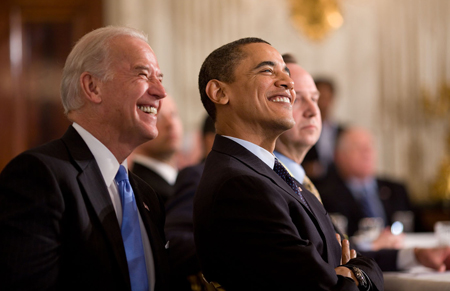
But above all -- above all, it's about creating and saving jobs now.  And so I look forward to working with all of you, and -- both individually and collectively -- and with what's going to be an accountability board.  They said last night, don't mess with Joe.  Well, this is the guy to don't mess with.  (Laughter.)
I want to hear -- and as we go along -- all kidding aside, the purpose of this -- I'm going to be a bit of a pain in the neck.  I know you've got a thousand other things to do in your agencies.  But we're going to have -- we're going to do this weekly.  We're going to make sure that I know -- you've got to let me know what roadblocks you encounter.  You've got to let me know any way that, through the Vice President's office, I can clear the way of some of the bureaucratic structures you're running into; also, if you're running into any headwind when you get out there in the states, you get out there in the cities.  This is just a different deal. 
Governor, I know you've done this as a governor.  Those of you -- Janet Napolitano is a governor, as well -- you're used to doing a lot of this.  We're going to be looking to you to figure out how we actually break the logjam of some of this. 
What I don't want to have -- we're going to have a web site up there -- I don't want to hear that we've sent money out to renovate a school in a particular city, in a particular state -- it will be up there.  All the press will see it on the web site.  The neighbors and the community will see it.  What I don't want to see, Peter -- I don't want to get a phone calling saying, it's been sitting there and nothing has happened for three weeks; now it's five weeks; then it's seven weeks.  Well, I see two trucks there, but I don't see anything happening. 
We have got to make sure that we hold as many people accountable, not in a draconian way, but to actually get this done.  And up to now, you've never had to -- we've never had to sort of follow the dollar -- follow the dollar beyond where we ordinarily -- other than meeting the criteria, does the state, the county, and the city qualify for it; we cut the check.  Well, we're going to be more intrusive than that on cutting the check.
And so every person that any federal dollar flows through has a responsibility to see it's used well.  And so it's the fact that millions of Americans are struggling just to get by, that this should be an incentive to ensure that the money we spend is spent well. 
And I told the governors -- and maybe it's because I'm a little too blunt -- but I told the governors and told the mayors -- who I think have the best intentions in the world; they know how badly it's needed -- Republican governors and Democratic governors -- but we may sometimes not have the legal authority once we cut the check to do much about it.  But I'll tell you what, the moral disapprobation of this office will be used if the money is not being out there spent.  I'm going to go on television and say, we gave so-and-so X amount of dollars and nothing is happening -- why hasn't it happened? 
I mean, this is -- this is -- as I said, we've never done this before.  So the President has appointed one of our toughest Inspector Generals.  I'll not go into Earl's background, but all of you around this table know him.  He's a no-nonsense guy.  And he's going to be helping me and Peter and all of us here follow the money to ensure that it's actually -- it's actually getting out there and working. 
So I'm pleased to be working with two people who are way ahead on this already.  And I don't know how this guy finds any time to do anything.  I tell him, he's got the most wonderful job in the administration, handling the budget.
But what I'm going to do now is turn this over to Peter.  I know that the Secretary of Treasury has to go in to see the President right now.  Peter is going to have to go in, too.  But, Peter, I yield to you for some remarks.  And then I'm going to yield, if I can, to Earl.  And then we'll get down to business.
DIRECTOR ORSZAG:  Well, thank you, Mr. Vice President.  I think I just want to emphasize two aspects of the undertaking that we're facing.  If we are to achieve the President's goal of creating or saving 3.5 million jobs through this legislation, we need to make sure the money gets out quickly, and also wisely.
And the first principle of getting the money out the door quickly -- you've already spoken about the fact that the first tranche of the relief to states for Medicaid expenses will be made available through the Department of HHS today.  Over the next couple weeks, you will also money becoming available in food stamps, unemployment insurance, low-income housing tax credits, law enforcement grants, transportation funding and a variety of other areas.
I saw the governors over the weekend, and I made it clear to them that we will work with them to expedite, provide clear guidance quickly in terms of getting the money out the door, but that, in exchange, we need them to be clear that they're not to park the money in rainy-day funds, which would undermine the purpose of the act and not add to aggregate demand.  And they should not use this funding to pay for projects that are basically already done, unless it's very clear the project had absolutely stopped and would not proceed without this money.
The second part of what we need to do, though, is we need to make sure the money is spent very wisely, and that will speak to the accountability and transparency.  We are asking the taxpayers for their help in getting the economy out of this recession, and in exchange they deserve accountability and transparency.
We've already stood up a web site, recovery.gov, which I'm told is receiving 3,000 hits a second, which I think underscores the interest in the accountability and transparency surrounding this endeavor.
OMB has also published detailed guidance to all of the agencies, including everyone here, about how to implement the recovery act in a transparent -- in a transparent manner.  We have to go beyond normal procedures to a higher level of transparency.
In addition to additional reporting, which all of you have already received guidance on, I would identify the need for sufficient numbers of acquisition and contract officers to oversee the money flowing through the system, to make sure that it is well spent.
So in conclusion, I just would underscore I look forward to working with you and Mr. Devaney and others to make sure we get the money out the door quickly, but also that the money is spent wisely so that we get as much bang for the buck as we can from this historic undertaking.
THE VICE PRESIDENT:  Thanks. 
Earl.
MR. DEVANEY:  Mr. Vice President, thank you very much.  As you know, I've been on the job two days, and I've managed to read the recovery act and all of Peter's OMB guidance, and it's a monument task ahead.
I would say that the two goals, if you will, of the accountability board, as Peter mentioned, a big piece of this is the recovery.gov web site.  OMB has gotten that up and running, and I think I'll be at some point taking that over and trying to build that into what it's intended to be.  It's an historic web site that will allow transparency that we've never seen before.  And the goal -- my goal will be for the average citizen to be able to go on that web site and follow the money.
And in large part I think I'll be hearing a lot from citizens, as you mentioned, if they see things that they don't like, and hopefully we'll get some attention to misuse of any of this money.
The second piece of this is to prevent fraud and waste.  And I carefully use the word "prevent" because I think in -- if we were going to do this business as usual, IGs would be detecting fraud and waste, as opposed to preventing fraud and waste.  I was encouraged last week to attend a meeting of the all of the IGs that have stimulus money in their departments, and was delighted to see that everybody seems to be focusing on trying to prevent waste and fraud, as opposed to just simply detecting it and doing investigations and audits.
So I'm sure those will happen, but on the front end of that pipeline, IG is standing there alongside of the departments.  Preventing that waste is I think the way to go and that's what I'm going to be encouraging all the IGs on the board to do.
There are some challenges.  I'll just name one.  Peter mentioned the lack of resources in procurement work.  Pre-9/11 we had about $200 million -- $220 million worth of contracts per year government-wide, and now we have over $500 billion.  And at the same -- during the same amount of time the procurement staffs have not risen in the departments; they've stayed the same.  So that will be a major challenge for all of the Secretaries to address, to make sure that the staff is available to make this happen quickly and to monitor it once it goes out.
So I'm excited about the opportunity.  I know the IGs that are on this board are looking forward to participating and I'm encouraged by the fact that it's -- everybody is treating this -- and my observation is the departments are, as well -- as not business as usual and something that we're going to bring unique talents to that we haven't perhaps done in the past.
THE VICE PRESIDENT:  Look, let me conclude, because I know you've got to -- I know you have to go, and then we can get into some detail here.
One of the primary roles that I am to play in overseeing this is to be the vehicle for you to let know what you need:  What is it that you need in order to be able to get this job done; if you need to take it the President and me then to go from there to get you what you need to be able to do the job.
For example, procurement officers -- it's going to be a problem; many of you do not have your second-level staff folks, you know, the second tier helping you to move the process up on the Hill.  And so I'm going to be asking once a week for a report.  There's already one -- Peter, I'm going to ask you to get a report to me from each of your departments once a week, what you did last week, what you plan on doing this week, what it's going to look like next week, what help do you need, where's the shortfall -- just literally, literally a week-to-week update on the progress and your needs, as well as the progress you're making.
And, you know, we've encouraged and Peter has gone out there, and we all have, talking about -- and each of the states will essentially appoint their own IG, their own person who is going to be responsible for all this money coming through.  I'm going to be inviting all 50 of those people here to Washington in the next couple weeks, when they're saddled up, and to sit down, and with the help of these two men, sit there and go through with those 50, essentially, counterparts to us in each of the states.  We want to know what they're doing, how it administrates with us and how we can help them.
This is a monumental project, but I think it's doable.  As you said, we got to stay on top of it and we got to stay on top of it on a weekly basis, because this is about getting this out and spent in 18 months to create 3.5 million jobs and to set -- tee this up so the rest of the good work that's being done here literally drop-kicks us out of this recession and we begin to grow again -- begin to grow again.
So let's -- I thank the press for being here.  We're going to get down to some of the nitty-gritty as to how we're going to proceed, and thank you all for coming in.  And you'll be reporting here regularly.
                                                       END                                                9:57 A.M. EST
THE WHITE HOUSE
Office of the Vice President
REMARKS BY THE VICE PRESIDENT
AT THE FIRST RECOVERY PLAN IMPLEMENTATION MEETING

Roosevelt Room
February 25, 2009
9:42 A.M. EST
THE VICE PRESIDENT:  Thanks for being here.  I know each one of the Cabinet members here has urgent business to attend to, but we're meeting here today because the passage of the recovery act is just really the first step.  We have to actually get this money out the door.  We've got to make sure that we're able to answer this economic crisis.  And in order to do that, we've got to do something that's somewhat unprecedented.
And that is -- and we got to follow the money here in a way that we -- it's working exactly like we intended it to.  How far and fast we travel on this road to recovery is going to depend a lot at the front of this -- this is only one of three pieces the President laid out last night.  The recovery act is not going to solve our problem.  But if we don't -- if we don't get this moving and get it moving well, it's going to impede the ability of the Secretary of Treasury and the Director of OMB to do the two pieces they're putting together, which are major chunks of the overall recovery the President talked about last night.
Already this week we've announced that 95 percent of Americans are going to see their paychecks go up because the withholding taxes are going to fall.  And that will be no later than April 1st.  And we've already announced that the first tranche of recovery money is being given to the states.  Just 10 days after the bill was signed, $15 billion to help health care for children and seniors and the needy is already on the way.
And today, the Department of Housing and Urban Development is taking the first step to awarding $10 billion to state and local governments to fund and create jobs through projects making public housing more energy efficient, making improvements in affordable housing; and also, making sure that we actually begin to fund the lead-based paint removal program -- all of which are going to not only increase the public health but -- and energy efficiency -- but they're going to create jobs.  And next week, we'll have more announcements about the next step in getting our investments out the door and putting them to work creating jobs and beginning to grow this economy.
But the purpose of today's meeting is the day after -- hours after the President made his Joint Session speech -- is to discuss the next steps -- precisely how are we, the Cabinet members, going to be able to implement this legislation.  From my consultation with some of you -- and I've gotten a chance to meet with almost all of you directly and individually already -- is that there's an awful lot of conversations taking place between our staffs in the preparation to making sure this money is spent both quickly but efficiently.
So today's purpose -- you not only want to hear me talking to you -- how you're going to go about this.  And we're going to do this once a week, as we kick this thing off, to make sure we know exactly what we're doing. 
Again, this has never been done before.  We've never been in a position where this much money with this much need with this much urgency is available, and the need for us to follow the money in ways we haven't done before.  And this is the first step.  We've got to go through the same process, as you all know, with the governors and with the mayors and with all the recipients of these funds. 
In the last week, President Obama and I have met with many of our nation's governors and many of the mayors, and we reminded them all what this Economic Recovery Act is about:  It's about making a difference in people's lives.  It's about giving people who are out of work or at the risk of losing their job or risk of losing their health care, to help them get through some tough times.  And it's about breaking ground for projects that have been long neglected or have been long needed -- roads, bridges, dams, levees.
It's about putting money into our schools.  And it's about investing in health care technology.  It's about making a real commitment to renewable energy, energy efficiency, stronger energy infrastructure, in the name of not only creating jobs, but also laying the foundation for a 21st century energy policy that frees us from dependence upon oligarchs of oil out there. 
But above all -- above all, it's about creating and saving jobs now.  And so I look forward to working with all of you, and -- both individually and collectively -- and with what's going to be an accountability board.  They said last night, don't mess with Joe.  Well, this is the guy to don't mess with.  (Laughter.)
I want to hear -- and as we go along -- all kidding aside, the purpose of this -- I'm going to be a bit of a pain in the neck.  I know you've got a thousand other things to do in your agencies.  But we're going to have -- we're going to do this weekly.  We're going to make sure that I know -- you've got to let me know what roadblocks you encounter.  You've got to let me know any way that, through the Vice President's office, I can clear the way of some of the bureaucratic structures you're running into; also, if you're running into any headwind when you get out there in the states, you get out there in the cities.  This is just a different deal. 
Governor, I know you've done this as a governor.  Those of you -- Janet Napolitano is a governor, as well -- you're used to doing a lot of this.  We're going to be looking to you to figure out how we actually break the logjam of some of this. 
What I don't want to have -- we're going to have a web site up there -- I don't want to hear that we've sent money out to renovate a school in a particular city, in a particular state -- it will be up there.  All the press will see it on the web site.  The neighbors and the community will see it.  What I don't want to see, Peter -- I don't want to get a phone calling saying, it's been sitting there and nothing has happened for three weeks; now it's five weeks; then it's seven weeks.  Well, I see two trucks there, but I don't see anything happening. 
We have got to make sure that we hold as many people accountable, not in a draconian way, but to actually get this done.  And up to now, you've never had to -- we've never had to sort of follow the dollar -- follow the dollar beyond where we ordinarily -- other than meeting the criteria, does the state, the county, and the city qualify for it; we cut the check.  Well, we're going to be more intrusive than that on cutting the check.
And so every person that any federal dollar flows through has a responsibility to see it's used well.  And so it's the fact that millions of Americans are struggling just to get by, that this should be an incentive to ensure that the money we spend is spent well. 
And I told the governors -- and maybe it's because I'm a little too blunt -- but I told the governors and told the mayors -- who I think have the best intentions in the world; they know how badly it's needed -- Republican governors and Democratic governors -- but we may sometimes not have the legal authority once we cut the check to do much about it.  But I'll tell you what, the moral disapprobation of this office will be used if the money is not being out there spent.  I'm going to go on television and say, we gave so-and-so X amount of dollars and nothing is happening -- why hasn't it happened? 
I mean, this is -- this is -- as I said, we've never done this before.  So the President has appointed one of our toughest Inspector Generals.  I'll not go into Earl's background, but all of you around this table know him.  He's a no-nonsense guy.  And he's going to be helping me and Peter and all of us here follow the money to ensure that it's actually -- it's actually getting out there and working. 
So I'm pleased to be working with two people who are way ahead on this already.  And I don't know how this guy finds any time to do anything.  I tell him, he's got the most wonderful job in the administration, handling the budget.
But what I'm going to do now is turn this over to Peter.  I know that the Secretary of Treasury has to go in to see the President right now.  Peter is going to have to go in, too.  But, Peter, I yield to you for some remarks.  And then I'm going to yield, if I can, to Earl.  And then we'll get down to business.
DIRECTOR ORSZAG:  Well, thank you, Mr. Vice President.  I think I just want to emphasize two aspects of the undertaking that we're facing.  If we are to achieve the President's goal of creating or saving 3.5 million jobs through this legislation, we need to make sure the money gets out quickly, and also wisely.
And the first principle of getting the money out the door quickly -- you've already spoken about the fact that the first tranche of the relief to states for Medicaid expenses will be made available through the Department of HHS today.  Over the next couple weeks, you will also money becoming available in food stamps, unemployment insurance, low-income housing tax credits, law enforcement grants, transportation funding and a variety of other areas.
I saw the governors over the weekend, and I made it clear to them that we will work with them to expedite, provide clear guidance quickly in terms of getting the money out the door, but that, in exchange, we need them to be clear that they're not to park the money in rainy-day funds, which would undermine the purpose of the act and not add to aggregate demand.  And they should not use this funding to pay for projects that are basically already done, unless it's very clear the project had absolutely stopped and would not proceed without this money.
The second part of what we need to do, though, is we need to make sure the money is spent very wisely, and that will speak to the accountability and transparency.  We are asking the taxpayers for their help in getting the economy out of this recession, and in exchange they deserve accountability and transparency.
We've already stood up a web site, recovery.gov, which I'm told is receiving 3,000 hits a second, which I think underscores the interest in the accountability and transparency surrounding this endeavor.
OMB has also published detailed guidance to all of the agencies, including everyone here, about how to implement the recovery act in a transparent -- in a transparent manner.  We have to go beyond normal procedures to a higher level of transparency.
In addition to additional reporting, which all of you have already received guidance on, I would identify the need for sufficient numbers of acquisition and contract officers to oversee the money flowing through the system, to make sure that it is well spent.
So in conclusion, I just would underscore I look forward to working with you and Mr. Devaney and others to make sure we get the money out the door quickly, but also that the money is spent wisely so that we get as much bang for the buck as we can from this historic undertaking.
THE VICE PRESIDENT:  Thanks. 
Earl.
MR. DEVANEY:  Mr. Vice President, thank you very much.  As you know, I've been on the job two days, and I've managed to read the recovery act and all of Peter's OMB guidance, and it's a monument task ahead.
I would say that the two goals, if you will, of the accountability board, as Peter mentioned, a big piece of this is the recovery.gov web site.  OMB has gotten that up and running, and I think I'll be at some point taking that over and trying to build that into what it's intended to be.  It's an historic web site that will allow transparency that we've never seen before.  And the goal -- my goal will be for the average citizen to be able to go on that web site and follow the money.
And in large part I think I'll be hearing a lot from citizens, as you mentioned, if they see things that they don't like, and hopefully we'll get some attention to misuse of any of this money.
The second piece of this is to prevent fraud and waste.  And I carefully use the word "prevent" because I think in -- if we were going to do this business as usual, IGs would be detecting fraud and waste, as opposed to preventing fraud and waste.  I was encouraged last week to attend a meeting of the all of the IGs that have stimulus money in their departments, and was delighted to see that everybody seems to be focusing on trying to prevent waste and fraud, as opposed to just simply detecting it and doing investigations and audits.
So I'm sure those will happen, but on the front end of that pipeline, IG is standing there alongside of the departments.  Preventing that waste is I think the way to go and that's what I'm going to be encouraging all the IGs on the board to do.
There are some challenges.  I'll just name one.  Peter mentioned the lack of resources in procurement work.  Pre-9/11 we had about $200 million -- $220 million worth of contracts per year government-wide, and now we have over $500 billion.  And at the same -- during the same amount of time the procurement staffs have not risen in the departments; they've stayed the same.  So that will be a major challenge for all of the Secretaries to address, to make sure that the staff is available to make this happen quickly and to monitor it once it goes out.
So I'm excited about the opportunity.  I know the IGs that are on this board are looking forward to participating and I'm encouraged by the fact that it's -- everybody is treating this -- and my observation is the departments are, as well -- as not business as usual and something that we're going to bring unique talents to that we haven't perhaps done in the past.
THE VICE PRESIDENT:  Look, let me conclude, because I know you've got to -- I know you have to go, and then we can get into some detail here.
One of the primary roles that I am to play in overseeing this is to be the vehicle for you to let know what you need:  What is it that you need in order to be able to get this job done; if you need to take it the President and me then to go from there to get you what you need to be able to do the job.
For example, procurement officers -- it's going to be a problem; many of you do not have your second-level staff folks, you know, the second tier helping you to move the process up on the Hill.  And so I'm going to be asking once a week for a report.  There's already one -- Peter, I'm going to ask you to get a report to me from each of your departments once a week, what you did last week, what you plan on doing this week, what it's going to look like next week, what help do you need, where's the shortfall -- just literally, literally a week-to-week update on the progress and your needs, as well as the progress you're making.
And, you know, we've encouraged and Peter has gone out there, and we all have, talking about -- and each of the states will essentially appoint their own IG, their own person who is going to be responsible for all this money coming through.  I'm going to be inviting all 50 of those people here to Washington in the next couple weeks, when they're saddled up, and to sit down, and with the help of these two men, sit there and go through with those 50, essentially, counterparts to us in each of the states.  We want to know what they're doing, how it administrates with us and how we can help them.
This is a monumental project, but I think it's doable.  As you said, we got to stay on top of it and we got to stay on top of it on a weekly basis, because this is about getting this out and spent in 18 months to create 3.5 million jobs and to set -- tee this up so the rest of the good work that's being done here literally drop-kicks us out of this recession and we begin to grow again -- begin to grow again.
So let's -- I thank the press for being here.  We're going to get down to some of the nitty-gritty as to how we're going to proceed, and thank you all for coming in.  And you'll be reporting here regularly.
                                                       END                                                9:57 A.M. EST

Recovery in Action: Minneapolis and Oregon

The first dollars from the American Recovery and Reinvestment Act are going out in just two days -- Wednesday, Feb. 25, 2009 -- in the form of federal support for state medicaid payments.

But the impact is already being felt well beyond that. Just today, Minneapolis mayor R.T. Rybak announced that he was prepared to swallow hard and make significant cuts to public works and public safety. Thanks to the ARRA, he won't have to:

"Now let’s turn to Police. If the Governor’s cuts were passed on directly to the Police Department, it would have led to the elimination of 57 sworn police officer positions and 19 non sworn employees. We will not have to do that because of two factors. First, working with Chief Dolan, we are proposing elimination of $1.5 million in non personnel costs, including overtime.

"Second the federal Recovery Act’s one time public safety grants arrived just in time. President Obama said he would help cities keep police officers on the job and he has delivered. Because of this funding I will be proposing no personnel cuts in the Police Department. Next time someone asks you what the Recovery Act will do, start by telling them it will keep 57 police officers working on the streets of Minneapolis."

And in Oregon, the funds dedicated to overhauling our energy grid are already spurring investment in green jobs:

"The Bonneville Power Administration will start building a 79-mile, $246 million electrical transmission line this spring along the Columbia River that the agency says will create 700 construction jobs.

"The regional power agency said it is going forward with the project, which has been on hold since 2002, because the stimulus bill signed by President Barack Obama raises the BPA's borrowing authority by $3.25 billion. Its current borrowing authority is $4.4 billion.

" 'The recovery package allows expansion plans of this magnitude,' said Steve Wright, the BPA administrator."

Owning up to what we owe

Center on Budget and Policy Priorities Executive Director Bob Greenstein, Moody's Economy Chief Economist Mark Zandi, and President Obama
This is big -- the President today promised that by the end of his first term, he will cut in half the massive federal deficit we've inherited. And we'll do it in a new way: honestly and candidly.
"This will not be easy. It will require us to make difficult decisions and face challenges we've long neglected," President Obama said. "But I refuse to leave our children with a debt that they cannot repay -- and that means taking responsibility right now, in this administration, for getting our spending under control."
Before we turn this boat around, we've got to acknoweldge how deep underwater we are:
"For too long, our budget process in Washington has been an exercise in deception -- a series of accounting tricks to hide the extent of our spending and the shortfalls in our revenue and hope that the American people won't notice.... budgeting zero dollars for the Iraq war -- zero -- for future years, even when we knew the war would continue; budgeting no money for natural disasters, as if we would ever go 12 months without a single flood, fire, hurricane or earthquake."
"We do ourselves no favors by hiding the truth about what we spend," the President said. "In order to address our fiscal crisis, we're going to have to be candid about its scope."
As the summit concluded, the President took questions and comments from the assembled members of Congress and the business and non-profit communities. He started with Sen. John McCain (R-AZ), who emphasized the need to cut excess from defense spending -- citing as an example reports that the two-year-old plan to overhaul the fleet of Marine One helicopters had gone significantly over-budget.
"We all know how large the defense budget is," Sen. McCain said. "We all know that the cost overruns -- your helicopter is now going to cost as much as Air Force One. I don't think that there's any more graphic demonstration of how good ideas have cost taxpayers an enormous amount of money...[W]e have to make some tough decisions -- you, Mr. President, have to make some tough decisions about not only what we procure, but how we procure it."
"The helicopter I have now seems perfectly adequate to me. Of course, I've never had a helicopter before -- maybe I've been deprived and I didn't know it," the President joked, before continuing with a more serious response. "But I think it is an example of the procurement process gone amuck. And we're going to have to fix it....One of the promising things is I think Secretary Gates shares our concern and he recognizes that simply adding more and more does not necessarily mean better and better, or safer and more secure." 
President Obama talks with Democratic House Majority Leader Steny Hoyer
White House photos 2/23/09 by Pete Souza
Related Topics: Ethics, Fiscal Responsibility
THE WHITE HOUSE
Office of the Press Secretary
For Immediate Release                           February 23, 2009
 
REMARKS BY THE PRESIDENT
IN QUESTION AND ANSWER SESSION
AT THE CLOSING OF THE FISCAL RESPONSIBILITY SUMMIT
 
Dwight D. Eisenhower Executive Office Building
Room 450
4:04 P.M. EST
THE PRESIDENT:  Thank you, everybody.  Thank you.  Please have a seat.  Well, this says something -- I don't know what -- about all of you, that I hear you really enjoyed this fiscal responsibility summit.  (Laughter.)  I mean, it's a sign of a -- (laughter) -- something.  (Laughter.)  Illness, right.
I understand you guys had great breakout sessions, and my advisors just filled me in on some of the issues that came up.  I want to -- I want to just provide a few opening remarks, and then we'll just open it up for questions and comments.
The idea here was to bring everybody together because it's been a long time since we had this conversation.  And over the last eight years, I think we've seen a continued deterioration in the government's balance sheets.
My sense is that, despite partisan differences, despite regional differences and different priorities, everybody is concerned about the legacy we're leaving to our children.  And the hope was, is that if we had a forum like this to start talking about these issues that it would turn out that there are real opportunities for progress -- there are going to be some areas where we can't make progress -- but that we have more in common that we expect.  And I appreciate that while we may have different opinions, there's a renewed willingness to put some concrete ideas on the table, even on those issues that are politically tough, and that's real progress.
A couple of takeaways that my staff indicated to me.  There was a healthy debate on Social Security, but also a healthy consensus among some participants, including Congressmen Boehner and Hoyer as well as Senator Graham and Senator Durbin, that this was a moment to work in a bipartisan way to make progress on ensuring Americans' retirement security.  And I think one of the things we want to do is to figure out how do we capture that momentum.
Over the longer run, putting America on a sustainable fiscal course will require addressing health care.  That seemed to be an issue that there was a lot of consensus around.  Many of you said what I believe, that the biggest source of our deficits is the rising cost of health care.  It's a challenge that impacts businesses, workers and families alike.  And voices as varied as Senator Alexander, Douglas Holtz-Eakin to Senator Baucus and Senator Dodd and Representative Waxman, all agreed to try to tackle health care this year, which I think that offers extraordinary promise, although peril, as well.
The tax reform discussion underscored clear agreement that the tax process has to be simplified for all Americans.  The task force on the budget process yielded some unanimous agreement that the existing -- existing process wasn't working.  The question is whether we'll have the commitment and discipline to do what we know needs to be done and whether we need to create some new mechanisms to deal with these challenges.
Now, I want to make sure that the conversation doesn't end when we go home today.  We've got a lot of hard choices to make.  We need to build off this afternoon's conversation and work together to forge a consensus. 
So one of the things that I'm hoping to do is that my team, each of whom were taking copious notes during the course of these respective breakout sessions, will issue a report or a summary of the conversation.  It will be distributed to each of the participants in those respective discussions.  We will then ask for concrete ideas, either about substance or process, and we will ask that you get those back so that we can then issue a final report coming out of this conversation in 30 days.
And we're -- I think somebody just dubbed this the "fiscal sustainability project," so that's as good of a name as any.  And the idea then is, is that there will be a constant loop between the White House and all of you about how we should move forward on this, and hopefully this will start breaking down into some concrete takeaways and tasks.  Some of the recommendations that have been made are already reflected in the budget that we're proposing.  Some new ideas may have arisen that we did not think of and that can be incorporated as the budget process moves forward in Congress.
And so we are very much looking forward to hearing from your ideas, both about process and about substance.  And then we will in 30 days' time be able to come out with a series of recommendations.  In some cases there may be some things that we can do by executive order that don't require legislation, but there seems to be some consensus they are smart things to do.  In other cases, it's going to require a legislative -- some legislative decisions, and we're going to collaborate closely with the relevant chairs and committees that have jurisdiction.
So, with that, let me just stop.  And what I want to do is just get some comments.  A lot of you have been working hard on this, but I'm going to use my presidential prerogative and call on a couple of people first, and then if other people have comments that they want to offer, please raise your hands.
And I'm going to start with John McCain because -- you know, he and I had some good debates about these issues -- (laughter) -- and I mean what I say here, I think John has also been extraordinarily consistent and sincere about these issues and I want to see if, John, you've got some thoughts about where we need to go and some priority areas.  I know you were in procurement, for example, which is an area I know we would like to work on together with you.
SENATOR McCAIN:  Well, thank you, Mr. President, and thank you for doing this.  I think it's very important.  This particular breakout session is -- we had our -- the Secretary of Homeland Security was our leader.  And so I think it was a very fruitful discussion.
Just one area that I wanted to mention that I think consumed a lot of our conversation on procurement was the issue of cost overruns in the Defense Department.  We all know how large the defense budget is.  We all know that the cost overruns -- your helicopter is now going to cost as much as Air Force One.  I don't think that there's any more graphic demonstration of how good ideas have cost taxpayers an enormous amount of money.
So we will -- and I know that you've already made plans to try to curb some of the excesses in procurement.  We really have to do that.  We're going to have to pay for Afghanistan, as you well know, and we're not done in Iraq.  But most importantly, we have to make some tough decisions -- you, Mr. President, have to make some tough decisions about not only what we procure, but how we procure it.
And I thank you for the opportunity and sharing your thoughts with a lot of very smart people.
THE PRESIDENT:  Well, John, let me -- this is going to be one of our highest priorities.  By the way, I've already talked to Gates about a thorough review of the helicopter situation.  The helicopter I have now seems perfectly adequate to me.  (Laughter.)  Of course, I've never had a helicopter before -- (laughter) -- maybe I've been deprived and I didn't know it.  (Laughter.)
But I think it is a -- it is a -- an example of the procurement process gone amuck.  And we're going to have to fix it.  Our hope is, is that you, Senator Levin, and others, can really take some leadership on this.
And one of the promising things is I think Secretary Gates shares our concern and he recognizes that simply adding more and more does not necessarily mean better and better, or safer and more secure.  Those two things are not -- they don't always move in parallel tracks, and we've got to think that through.
Steny, you participated in the Social Security panel.
REPRESENTATIVE HOYER:  First off, I think that the Social Security section was a very, very productive section.  I think that there's some honest, as you would think, disagreements, but as was indicated earlier, John Boehner, myself in particular, Lindsey Thomas --
THE PRESIDENT:  Lindsey Graham.  I don't know about Lindsey Thomas, but I know Lindsey Graham.  (Laughter.)
REPRESENTATIVE HOYER:  Lindsey Graham.  (Laughter.)  South Carolina is not Louisiana, right?  I got you.  That'll work.  (Laughter.)  But Lindsey Graham.  Everybody gave some very solid recommendations.  And I think there was in fact a consensus, an understanding of the different perspectives and ways and means to get to an objective was essentially that getting to an objective serves a number of purposes.  Obviously, from a fiscal standpoint it served a purpose, but also in giving both seniors and young people confidence that benefits would be available to them in the short term, and from a young people's standpoint, in the long term.
THE PRESIDENT:  Thank you.
REPRESENTATIVE HOYER:  If I can --
THE PRESIDENT:  Yes.
REPRESENTATIVE HOYER:  I think your comment that follow-through is going to be essential; that if we come together and have a good discussion, (inaudible) -- a lot of bright people who have some very good information from various, different (inaudible) -- interest groups who represent large constituencies.  If it just stops there, then it won't have been as useful as you want it to be and as the country wants it to be.
THE PRESIDENT:  Good.  Speaking of bright people with large constituencies -- Bill Novelli.  Where's Bill?  Is he still here?  There you are.
I know you participated in the health care panel.  Bill, your thoughts on Medicare and the interest of your membership in getting an equitable solution to what is an unsustainable situation.
MR. NOVELLI:  The whole entitlement thing is as you characterized it.  We have a real sustainability problem.  But I think you put the right frame on this, Mr. President, by saying that the path to sustainability is health care reform.  And our group I think had tremendously good ideas.  Most of the policy ideas that we all know and share were on the table today.
There's a lot of hard policy work that's going to have to go on, but I think we have some momentum.  But I think one of the things that also came out of the session was, we need to engage the American people.  Yes, we have to think of them as patients,  we have to think of them as insured or uninsured -- but we also have to think of them as taxpayers and as voters who need to understand what the tradeoffs are, what they might lose, what they might gain.  We can all do that, but nobody could do it as well as you can.  You've got the bully pulpit to really carry your message to the public.
THE PRESIDENT:  I appreciate that.  This is the only area where we had done a little prejudging of what needs to be done.  We have scheduled a health care summit next week.  It's not that I've got summititis here -- (laughter) -- but rather, it's actually exactly the point that you're making, Bill, which is everybody here understands a lot of the tradeoffs involved in health care and that there are no perfect solutions.
But in the sound bite, political culture that we got, it's very hard to communicate that.  And we think that it's very important to have some forums -- and I talked about this during -- way back in the primary campaign, that there is a process that the public can listen to about what these tradeoffs are, because I think that some of us get on our high horse and say we've got the answer to health care.  Well, it turns out that, you know, there are costs involved on the front end even if the benefits accrue in the out years.  There are situations in terms of people, if they've got health insurance, sort of liking what they've got now, they just want it for cheaper.  There are issues in terms of providers and them feeling like they're getting squeezed.
And so making sure that all that stuff is surfaced in public and we're educating the public on some of these issues can be very important if we're going to make progress because -- you know, some of these things will ultimately involve some tough decisions and some tough votes.
So, budget process -- Kent, you participated and I want to get both your views and John Spratt's views on -- I don't know if John is still here; there he is -- on budget process and how you think we're going to need to clean this stuff up.
SENATOR CONRAD:  Well, first of all, thank you for doing this.  I thought it was a terrific start in the White House.  I think Bob Greenstein said it very well when he talked about us being on an unsustainable course -- the debt being the threat, because we've doubled the debt in the last eight years; tripled foreign holdings of the debt -- last year when we went out to finance this debt, 68 percent came from foreign enemies.  So that creates a vulnerability.
How do we address it?  That is the $64,000 question.  And that's what we addressed in our group.  I think it's fair to say there were different views.  Many of us believe it's going to take some special process to bring all of the players together to write a plan so that we see the tradeoffs between what's available for health care reform, which without question is the 800-pound gorilla; Social Security, which also has to be addressed for the long term; and revenue.
Revenue is the thing almost nobody wants to talk about, but I think if we're going to be honest with each other, we better recognize that is part of the solution, as well.  And it's very hard to know what you are going to do with Medicare unless you know what revenue is going to be.  Very hard to know what you're going to do with Social Security without knowing what revenue is going to be.  So somehow we've got to come together around a plan, and of course that depends on presidential leadership, which you certainly provided here today.
THE PRESIDENT:  All right.  Thank you.
John.
REPRESENTATIVE SPRATT:  I got a bum leg, Mr. President -- you'll have to excuse me, sir.  Thank you for holding this.
I participated in the 1997 balanced budget negotiations; that was the last time we were at the White House to discuss -- in common, Democrats and Republicans -- some common ground that we could both take up (inaudible) issues.  Thank you for doing this again -- (inaudible).
I would agree with Kent that we agree we need a special process.  We didn't come to final agreement on exactly what that process would be -- would it be a task force or a steering committee within the Congress, or a commission from without Congress?  That's still an issue to be resolved.  But I don't think it's an issue we can't resolve.  And we moved towards discussion of some sort of hybrid of the two.
Clearly that's important.  I think everyone in that room would agree that if we're to succeed at what we're setting out to do, we need a special process that we can -- by which we can accomplish it.  (Inaudible) -- you need to have some assurance that whatever we agree upon can indeed be brought to the floor of each House and brought to a vote.
Many of us think it's too draconian to compare this to the BRAC process where you get an up or down vote, no amendments.  But there needs to be some sort of fast track and special procedure to ensure that whatever the entities come up with it will be viewed and considered.
THE PRESIDENT:  Thank you, Jack.
Since I see her right -- sitting right next to you, Susan, you were in the procurement task force?
SENATOR COLLINS:  Yes.
THE PRESIDENT:  Did you have any thoughts on --
SENATOR COLLINS:  Yes.  If you look across the federal government, there are problems in IT contracts no matter where you look.  And one recommendation that our group talked about is establishing some kind of (inaudible) law to apply to IT contracts.
In general, we also talked about the need for more competition in contracts, for justification for a cost-plus contract.  My favorite pet peeve is we don't have enough skilled contracting officers.  We've had an enormous increase in the volume of contracts at a time when the acquisition work force has actually declined by 22 percent.  So those were some of the issues that we discussed in addition to what Senator McCain said.
THE PRESIDENT:  Charlie, you're right here in front of -- Kent talked about revenue.  You were participating in the tax reform panel.
REPRESENTATIVE RANGEL:  First let me thank you for bringing us together.  The Secretary of Treasury provided a lot of leadership -- (inaudible) -- certainly recognize what (inaudible) -- that we do something.  (Inaudible) -- thought of the tax structure, people thought it was relatively easy to dramatically reduce the rates that make us internationally competitive.  The problems, of course, was the different views they have in how you handle the individual raise.
I don't think there's any committee in the House that would be more anxious to bring forth a product, whether it's in health care, tax reform or Social Security, to bring forth something in a bipartisan way.  And I think this is a dramatic first step to see where we're going.  As I said, I don't want to seem to be corny, but it would appear as though that if America recognized the crisis, that they're not looking for a Democratic or Republican solution.  And in order for us to be politically successful, they're going have to believe that it was done in a bipartisan way.
So I think this initiative is a strong first step.  I only hope at the end of the day we can come out, maybe not in total agreement, but certainly in a bipartisan way.
THE PRESIDENT:  Just a quick thought on taxes, Charlie.  My instinct is, is that you're absolutely right that the individual tax rate is always the hardest thing.  There's some philosophical differences between the parties on this and I understand that.
On the corporate side, I at least have always maintained that if we try to think in the same ways that we thought about it in 1986, and if you closed loopholes, you could actually lower rates.
REPRESENTATIVE RANGEL:  No question about it.
THE PRESIDENT:  And that's an area where there should be the potential for some bipartisan agreement, because I think, on the books, the rates in the United States are high.  In practice, depending on who it is that you can -- what kind of accountant you can hire, they're not so high.  And that's an area where we can work on.  Simplification, same thing.  I don't think there's anybody out here who thinks that we are making it customer-friendly for the taxpayer.  And that's an area where we can make some great progress.
REPRESENTATIVE RANGEL:  Well, if you're looking for a fight and a partisan fight, any loophole you close is a tax increase.  We have to get over that and make certain that the vast majority of businesses recognize it's in their best interest to do the right thing as relates to those who've taken unfair advantage of the government.
THE PRESIDENT:  Well, you were here in '86 -- it's been done before.  We might be able to get it done this time.
REPRESENTATIVE RANGEL:  Well, under your leadership, I'm looking forward to it.  (Laughter.)
THE PRESIDENT:  Eric, you got some thoughts?
REPRESENTATIVE CANTOR:  Mr. President, I want to thank you very much for having us.  It's a great opportunity I think for us to really come together on some of these very, very big issues.
You said before when we were in discussions on the stimulus debate that we're going to have some very tough choices to make.  And we look forward to your address tomorrow night and working through some of these very big issues, as well as trying to address what's on Secretary Geithner's plate in the immediate, as far as the bank fix, the housing fix and others.  Thank you.
THE PRESIDENT:  Thanks.
Max, you were on the health care panel, but obviously you've got jurisdiction over everything.  (Laughter.)  I know how the Finance Committee works.  (Laughter.)
SENATOR BAUCUS:  Well, Mr. President, first, all of us are enormously grateful for what you're doing here -- not on the specific issues, but also our fiscal problems.  It needs to be done, and we deeply appreciate you taking this on together.
I'd like to just make a little bit of a pitch, if you will, on health care reform.  I think it's very symbolic and very interesting that the first person you called upon was John McCain.  And that's the approach I think we need to take here generally, and specifically with health care reform.  You had a different view during the campaign on health care reform.  John McCain had a different view during the campaign on health care reform.  Here's an opportunity for us to come up with something that's uniquely American, that's public and private.  And I do believe if we just keep that working-together approach and keep at it -- all opinions, et cetera -- and take advantage of this opportunity where the stars are now aligned as to health care, and we'll get it done.
Because I was very pleased that you called on John first because I think it's this tone that we have to take here to make sure we're working together.  Thank you.
THE PRESIDENT:  Thank you, Max.
Jim, you got any thoughts on this?
REPRESENTATIVE CLYBURN:  Well, I just wanted to thank you very much, Mr. President, for doing this.  I was thinking when you called on Senator McCain -- I came to this Congress (inaudible), two Democrats and two Republicans.  It is remarkable the things we were able to do in South Carolina with Jim Edwards, (inaudible); Carroll Campbell, John West, Dick Riley -- simply because he started thinking about what we needed to do for the people of our state.
I think that what we're doing here today provides a framework for us to really get some things done for the people of our great nation.  And we can do this.  And I'm so pleased that you've set this tone here today.  And I -- (inaudible).
THE PRESIDENT:  Mike, were you in the -- were you in the health care panel?  Do you want to just add some thoughts?
SENATOR ENZI:  Mr. President, I, too, appreciate the effort to bring these people together.  We had both a number of associations, as well as the House and Senate.  One of the things I want to emphasize was the (inaudible) that Senator Baucus pointed out to be bipartisan started at the beginning of the process rather than at the end of the process.  And we do have a task force set up in the Senate that's under Baucus's heading up, that has had several meetings already that brought out the issues that -- all of the issues to be put on the table.  And the words not to use, because there are some words that send us right into (inaudible) and debate --
THE PRESIDENT:  Socialized medicine.  (Laughter and applause.)
PARTICIPANT:  Both sides of the aisle.  (Laughter.)
SENATOR ENZI:   -- and get the principals together, and then talk to the stakeholders and then take them through the regular Senate processes as soon as possible, to do that sort of thing.  Senator Kennedy and I, and Senators Baucus and Grassley were in the pensions debate.  And that took an hour of time on the floor plus two amendments to get that result, because it went through that very difficult process.  So I appreciate you including that.
THE PRESIDENT:  Did we have some representatives from the Chamber of Business participating?
MR. CASTELLANI:  Mr. President, I'm John Castellani --
THE PRESIDENT:  We saw each other the other day.
MR. CASTELLANI:  Yes.  I was in the health care discussion.  And the one thing that we all agreed on was that it is absolutely imperative for both fiscal reasons, as well as personal reasons and competitive reasons, to move forward on health care.  We simply cannot afford as a nation, and we certainly cannot afford as businesses to maintain the status quo, because it is unsustainable.
And I think as Bill pointed out, and has certainly been pointed out by the people that were participating in it all -- the Senators and members -- there are a lot of good ideas out there.  The time is now to put those good ideas down on a piece of legislation and move forward so we have something that delivers quality health care to everybody in this country in a way that everybody can afford.
THE PRESIDENT:  Business leadership I think is going to be critical.  Andy Stern is sitting right to next to you.  Andy, you've been working on this front for a long time.  You got some thoughts?
MR. STERN:  I mean, I just want to say that I am sitting next to John, because he and I and Bill Novelli and others really have built a relationship over a long period of time, because we don't see this as a Democratic problem or a Republican problem -- it's just an American problem.  And it's time to solve it.  And (inaudible) and I and business and labor and others can come together outside the Congress, it really is time for the Congress to get this job done, because the American people need it.
THE PRESIDENT:  Nice scarf, by the way.  (Laughter.)
David Walker.  Where's David?
MR. WALKER:  Mr. President, it's an honor to be here.  Thank you for your leadership.
You touched in your remarks on our balance sheet.  As a former comptroller general of the United States I can tell you we're $11 trillion in the hole on the balance sheet.  And the problem is not the balance sheet, it's off the balance sheet -- $45 trillion in unfunded obligations.
You mentioned in January about the need to achieve a grand bargain involving budget process, Social Security, taxes, health care reform.  You are 110 percent right.  We need to do that.  The question is, how do we do it?  Candidly, I think it's going to take some type of an extraordinary process that engages the American people, that provides for fast-track consideration.  And with your leadership, that can happen.  But that's what it's going to take, Mr. President.
THE PRESIDENT:  Well, I appreciate that.  And again, when we distribute the notes coming out of these task forces, I want to make sure that people are responding -- both in terms of substance, but also in terms of process, because we're going to need both in order to make some progress on this one.
Q    Mr. President, it was kind of a surprise in the procurement group that was together, we had almost universal recognition that over the last decade or so, we've overdone, in some cases, outsourcing of critical federal requirements, and that means that in many cases we spend more to hire a contractor or a non-federal worker than we would pay to invest in federal workers.
And so there was universal -- Republican, Democrat, House and Senate, even -- (laughter) -- that during this administration we need to assess where we can re-federalize some parts of the workforce, particularly when it came to people who do get procurement and oversee the procurement.
Also, that we do have a system which is disadvantageous to someone remaining in the federal workforce.  Our retirement system pays you less and less the longer you stay.  Yours is (inaudible), by the way, one day when you get your retirement.  (Laughter.)  But the accrual system in fact causes people to leave the federal workforce to double-dip, rather than being encouraged, either during their working time or if we ask them to stay on past their retirement.
So those areas were areas I think we had good common -- your folks, Janet took a lot of notes, so I think you're going to see that we have areas where our committees could work with you to make those changes.  And they are legislative changes that could save us money.
THE PRESIDENT:  Which I think would be terrific.  I mean, that's the kind of stuff -- it's not sexy, but it ends up, over time, making enormous progress.
Anybody else that just wants to -- go ahead.
Q    Thank you.  Thank you, Mr. President.  I just want to bring up that in the health care, we talked a lot about individuals and the systems of health care that we have, and looking for places that we can cut.  But as a community organizer I know that you know that investing in the community -- we look at the models across the world and the models in our country where health care prevails to be the strongest and where people live the longest, it's because they have a community that has -- of support, and a community (inaudible) of health care.
And I think if we look at access issues for those from Native American communities like mine, or rural America or other places that create that access with community support and have the right mid-level service providers and others that can reach to the smaller communities across America.
THE PRESIDENT:  That's important.  Yes, go ahead.
Q    Mr. President, thank you for having us here at the White House.  I'm going to take a little bit different approach.  Senator Baucus mentioned it and Chairman Rangel mentioned it --the need for bipartisanship, and I think the House Republicans have shown that when we're not included in the decision-making, we're disinclined to sign off on the solution.
And it's very easy in the House -- it's set up to get things done quickly if the majority is united -- to forget about the minority.  But if you really want consensus, I would encourage you to encourage the Speaker to have a true open process.  This is a good first step, but if this is all we do, it's a sterile step.
On the other hand, if you really follow up and include everybody in the process, you're more than likely to get a solution that everybody signs off on.  And I have said or stood behind every President since Reagan in this room at bill signing ceremonies that were the result of consensus.  So I commend you for doing this.
THE PRESIDENT:  Well, I think you're making an important point.  And, you know, my response, first of all is, I'm not in Congress so I don't want to interject myself too much into congressional politics.  But I do want to make this point, and I think it's important -- on the one hand, the majority has to be inclusive.  On the other hand, the minority has to be constructive.
And so to the extent that on many of these issues we are able to break out of sort of the rigid day-to-day politics and think long term, then what you should see, I think, is the majority saying, what are your ideas; the minority has got to then come up with those ideas and not just want to blow the thing up.  And I think that on some of these issues, we're going to have some very real differences and, you know, presumably the majority will prevail unless the minority can block it.  But you're just going to have different philosophical approaches to some of these problems.
But on the issue that was just raised here on procurement, on the issues -- some of the issues surrounding health care, the way it cuts isn't even going to be Democratic/Republican.  It's going to be -- you know, there may be regional differences, there may be a whole host of other differences.  And if that's -- if we can stay focused on solving problems, then I will do what I can, through my good offices, to encourage the kind of cooperation you're encouraging.
Way back there, and then I'll -- we'll go right here to Tom, and then -- and then probably that's going to be it, because I think I'm already over time.
Go ahead.
DR. HARTMANN:  Thank you, Mr. President.  Heidi Hartmann, Institute for Women's Policy Research.  I just wanted to point out that in the Social Security group, I think there was a fair amount of concession that, given the demographic trends, we're actually going to need to do some benefit increases for those at the bottom, where we may see poverty increase because we're going to have more older unmarried women, more older minority people.  And there was even, I think, a fair amount of consensus that therefore we will need to see revenue increases going into the system.  So I thought there was a surprising amount of consensus in the Social Security group.
THE PRESIDENT:  Good.  Tom.
A PARTICIPANT:  (Inaudible) -- thanks very, very much for bringing us together.
A couple of people have said to me, coming into the meeting, that why is the President continuing to reach out to the minority?  And I think the answer lies in part -- a couple weeks ago the minister in our church gave a sermon that was based on the parable of the sower, the sower of the seeds.  As you may recall, some of the seeds were sown in stony ground and rough ground, and some of the seeds were sown in places that had thorns, some of the seeds were sown in the -- in shallow soil, and nothing much came out of it.  But some of the seeds were sown in fertile soil, and multiplied tons in fold.
I urge you to continue to reach out not just to Democrats in the House and Senate, but to continue to reach out to Republicans in both chambers, as well, because some of that will fall in fertile soil.  And when it does, the minority has a responsibility --
THE PRESIDENT:  Well, I will certainly do that, Tom, because I'm just a glutton for punishment.  (Laughter.)  I'm going to keep on talking to Eric Cantor.  Some day, sooner or later, he is going to say, boy, Obama had a good idea.  (Laughter.)  It's going to happen.  You watch, you watch.  (Laughter.)
Well, look, just in closing, again, the sooner everybody can respond to our report coming out of each of these groups, the sooner then we can circulate a summary of everything that happened, and then start speaking with you individually and in groups about moving the process forward.
One last point I want to make, just because I think that from the press perspective, there -- I was reading some of the newspapers today and there was this sense of -- that maybe we were doing a pivot because we had just moved forward on the recovery package, now we're talking about fiscal responsibility; how did those two things match up?
I just want to be very clear about this.  I've said it to the governors this morning and I've said it to my staff in the past:  We chose to move forward on a recovery package because there was a strong sense among the vast majority of economists that if we did not try to fill a $1 trillion-a-year hole in demand, because of the drastic pulling back of businesses and consumers, that the recession would get worse, unemployment would increase, and as a consequence, tax revenues would go down, and the long-term deficit and debt projections would be even higher.  That was the basis for the decision.
It was not ideologically driven.  I have no interest in making government bigger for the sake of it.  I've got more than enough on my plate, as Lindsey knows, between Afghanistan and Iraq and issues of terrorism, that if the private sector was just humming along and we could just make government more efficient and not have to worry about this financial crisis, I would love that.  But that's not the circumstance we find ourselves in.  So I made the best judgment about the need for us to move forward on a recovery package.
There were some differences, significant differences between the parties about this.  I would suggest that if you look at the differences, they amounted to maybe 10, maybe 15 percent of the total package.  There wasn't a lot of argument about countercyclical payments to states to make sure that people had extended unemployment insurance or food stamps.  There wasn't a lot of disagreement about some of the infrastructure that needs to be repaired, and there wasn't a lot of disagreement on the tax cut front -- 15, 20 percent of it, there were some disagreements about.
But the reason I make this point is that if we're going to be successful moving forward, it's important for us to distinguish between legitimate policy differences and our politics.  And the reason that there is no contradiction, from my perspective, in doing the recovery package first but now focusing on the medium and long term, is because our hope is that this economy starts recovering.  We will have taken a hit, in terms of our debt and our deficit.  But as Bob Greenstein said, the recovery package will account for about one-tenth of 1 percent of our long-term debt.  The real problems are the structural deficits and the structural debt that we've been accumulating and all of us are complicit in.
So we've got to get that taken care of.  We would have had to get it taken care of whether or not there was a recession; this just underscores the urgency of it.  And I'm hopeful that we move forward in that spirit in the days and weeks and months to come.
So thank you, everybody.  Appreciate it.  (Applause.)
                             END                    4:43 P.M. EST
THE WHITE HOUSE
Office of the Press Secretary
_____________________________________________
For Immediate Release                           February 23, 2009
Remarks by the President
in Q&A session
at closing of Fiscal Responsibility Summit
Dwight D. Eisenhower Executive Office Building
Room 450
4:04 P.M. EST
THE PRESIDENT:  Thank you, everybody.  Thank you.  Please have a seat.  Well, this says something -- I don't know what -- about all of you, that I hear you really enjoyed this fiscal responsibility summit.  (Laughter.)  I mean, it's a sign of a -- (laughter) -- something.  (Laughter.)  Illness, right.
I understand you guys had great breakout sessions, and my advisors just filled me in on some of the issues that came up.  I want to -- I want to just provide a few opening remarks, and then we'll just open it up for questions and comments.
The idea here was to bring everybody together because it's been a long time since we had this conversation.  And over the last eight years, I think we've seen a continued deterioration in the government's balance sheets.
My sense is that, despite partisan differences, despite regional differences and different priorities, everybody is concerned about the legacy we're leaving to our children.  And the hope was, is that if we had a forum like this to start talking about these issues that it would turn out that there are real opportunities for progress -- there are going to be some areas where we can't make progress -- but that we have more in common that we expect.  And I appreciate that while we may have different opinions, there's a renewed willingness to put some concrete ideas on the table, even on those issues that are politically tough, and that's real progress.
A couple of takeaways that my staff indicated to me.  There was a healthy debate on Social Security, but also a healthy consensus among some participants, including Congressmen Boehner and Hoyer as well as Senator Graham and Senator Durbin, that this was a moment to work in a bipartisan way to make progress on ensuring Americans' retirement security.  And I think one of the things we want to do is to figure out how do we capture that momentum.
Over the longer run, putting America on a sustainable fiscal course will require addressing health care.  That seemed to be an issue that there was a lot of consensus around.  Many of you said what I believe, that the biggest source of our deficits is the rising cost of health care.  It's a challenge that impacts businesses, workers and families alike.  And voices as varied as Senator Alexander, Douglas Holtz-Eakin to Senator Baucus and Senator Dodd and Representative Waxman, all agreed to try to tackle health care this year, which I think that offers extraordinary promise, although peril, as well.
The tax reform discussion underscored clear agreement that the tax process has to be simplified for all Americans.  The task force on the budget process yielded some unanimous agreement that the existing -- existing process wasn't working.  The question is whether we'll have the commitment and discipline to do what we know needs to be done and whether we need to create some new mechanisms to deal with these challenges.
Now, I want to make sure that the conversation doesn't end when we go home today.  We've got a lot of hard choices to make.  We need to build off this afternoon's conversation and work together to forge a consensus. 
So one of the things that I'm hoping to do is that my team, each of whom were taking copious notes during the course of these respective breakout sessions, will issue a report or a summary of the conversation.  It will be distributed to each of the participants in those respective discussions.  We will then ask for concrete ideas, either about substance or process, and we will ask that you get those back so that we can then issue a final report coming out of this conversation in 30 days.
And we're -- I think somebody just dubbed this the "fiscal sustainability project," so that's as good of a name as any.  And the idea then is, is that there will be a constant loop between the White House and all of you about how we should move forward on this, and hopefully this will start breaking down into some concrete takeaways and tasks.  Some of the recommendations that have been made are already reflected in the budget that we're proposing.  Some new ideas may have arisen that we did not think of and that can be incorporated as the budget process moves forward in Congress.
And so we are very much looking forward to hearing from your ideas, both about process and about substance.  And then we will in 30 days' time be able to come out with a series of recommendations.  In some cases there may be some things that we can do by executive order that don't require legislation, but there seems to be some consensus they are smart things to do.  In other cases, it's going to require a legislative -- some legislative decisions, and we're going to collaborate closely with the relevant chairs and committees that have jurisdiction.
So, with that, let me just stop.  And what I want to do is just get some comments.  A lot of you have been working hard on this, but I'm going to use my presidential prerogative and call on a couple of people first, and then if other people have comments that they want to offer, please raise your hands.
And I'm going to start with John McCain because -- you know, he and I had some good debates about these issues -- (laughter) -- and I mean what I say here, I think John has also been extraordinarily consistent and sincere about these issues and I want to see if, John, you've got some thoughts about where we need to go and some priority areas.  I know you were in procurement, for example, which is an area I know we would like to work on together with you.
SENATOR McCAIN:  Well, thank you, Mr. President, and thank you for doing this.  I think it's very important.  This particular breakout session is -- we had our -- the Secretary of Homeland Security was our leader.  And so I think it was a very fruitful discussion.
Just one area that I wanted to mention that I think consumed a lot of our conversation on procurement was the issue of cost overruns in the Defense Department.  We all know how large the defense budget is.  We all know that the cost overruns -- your helicopter is now going to cost as much as Air Force One.  I don't think that there's any more graphic demonstration of how good ideas have cost taxpayers an enormous amount of money.
So we will -- and I know that you've already made plans to try to curb some of the excesses in procurement.  We really have to do that.  We're going to have to pay for Afghanistan, as you well know, and we're not done in Iraq.  But most importantly, we have to make some tough decisions -- you, Mr. President, have to make some tough decisions about not only what we procure, but how we procure it.
And I thank you for the opportunity and sharing your thoughts with a lot of very smart people.
THE PRESIDENT:  Well, John, let me -- this is going to be one of our highest priorities.  By the way, I've already talked to Gates about a thorough review of the helicopter situation.  The helicopter I have now seems perfectly adequate to me.  (Laughter.)  Of course, I've never had a helicopter before -- (laughter) -- maybe I've been deprived and I didn't know it.  (Laughter.)
But I think it is a -- it is a -- an example of the procurement process gone amuck.  And we're going to have to fix it.  Our hope is, is that you, Senator Levin, and others, can really take some leadership on this.
And one of the promising things is I think Secretary Gates shares our concern and he recognizes that simply adding more and more does not necessarily mean better and better, or safer and more secure.  Those two things are not -- they don't always move in parallel tracks, and we've got to think that through.
Steny, you participated in the Social Security panel.
REPRESENTATIVE HOYER:  First off, I think that the Social Security section was a very, very productive section.  I think that there's some honest, as you would think, disagreements, but as was indicated earlier, John Boehner, myself in particular, Lindsey Thomas --
THE PRESIDENT:  Lindsey Graham.  I don't know about Lindsey Thomas, but I know Lindsey Graham.  (Laughter.)
REPRESENTATIVE HOYER:  Lindsey Graham.  (Laughter.)  South Carolina is not Louisiana, right?  I got you.  That'll work.  (Laughter.)  But Lindsey Graham.  Everybody gave some very solid recommendations.  And I think there was in fact a consensus, an understanding of the different perspectives and ways and means to get to an objective was essentially that getting to an objective serves a number of purposes.  Obviously, from a fiscal standpoint it served a purpose, but also in giving both seniors and young people confidence that benefits would be available to them in the short term, and from a young people's standpoint, in the long term.
THE PRESIDENT:  Thank you.
REPRESENTATIVE HOYER:  If I can --
THE PRESIDENT:  Yes.
REPRESENTATIVE HOYER:  I think your comment that follow-through is going to be essential; that if we come together and have a good discussion, (inaudible) -- a lot of bright people who have some very good information from various, different (inaudible) -- interest groups who represent large constituencies.  If it just stops there, then it won't have been as useful as you want it to be and as the country wants it to be.
THE PRESIDENT:  Good.  Speaking of bright people with large constituencies -- Bill Novelli.  Where's Bill?  Is he still here?  There you are.
I know you participated in the health care panel.  Bill, your thoughts on Medicare and the interest of your membership in getting an equitable solution to what is an unsustainable situation.
MR. NOVELLI:  The whole entitlement thing is as you characterized it.  We have a real sustainability problem.  But I think you put the right frame on this, Mr. President, by saying that the path to sustainability is health care reform.  And our group I think had tremendously good ideas.  Most of the policy ideas that we all know and share were on the table today.
There's a lot of hard policy work that's going to have to go on, but I think we have some momentum.  But I think one of the things that also came out of the session was, we need to engage the American people.  Yes, we have to think of them as patients,  we have to think of them as insured or uninsured -- but we also have to think of them as taxpayers and as voters who need to understand what the tradeoffs are, what they might lose, what they might gain.  We can all do that, but nobody could do it as well as you can.  You've got the bully pulpit to really carry your message to the public.
THE PRESIDENT:  I appreciate that.  This is the only area where we had done a little prejudging of what needs to be done.  We have scheduled a health care summit next week.  It's not that I've got summititis here -- (laughter) -- but rather, it's actually exactly the point that you're making, Bill, which is everybody here understands a lot of the tradeoffs involved in health care and that there are no perfect solutions.
But in the sound bite, political culture that we got, it's very hard to communicate that.  And we think that it's very important to have some forums -- and I talked about this during -- way back in the primary campaign, that there is a process that the public can listen to about what these tradeoffs are, because I think that some of us get on our high horse and say we've got the answer to health care.  Well, it turns out that, you know, there are costs involved on the front end even if the benefits accrue in the out years.  There are situations in terms of people, if they've got health insurance, sort of liking what they've got now, they just want it for cheaper.  There are issues in terms of providers and them feeling like they're getting squeezed.
And so making sure that all that stuff is surfaced in public and we're educating the public on some of these issues can be very important if we're going to make progress because -- you know, some of these things will ultimately involve some tough decisions and some tough votes.
So, budget process -- Kent, you participated and I want to get both your views and John Spratt's views on -- I don't know if John is still here; there he is -- on budget process and how you think we're going to need to clean this stuff up.
SENATOR CONRAD:  Well, first of all, thank you for doing this.  I thought it was a terrific start in the White House.  I think Bob Greenstein said it very well when he talked about us being on an unsustainable course -- the debt being the threat, because we've doubled the debt in the last eight years; tripled foreign holdings of the debt -- last year when we went out to finance this debt, 68 percent came from foreign enemies.  So that creates a vulnerability.
How do we address it?  That is the $64,000 question.  And that's what we addressed in our group.  I think it's fair to say there were different views.  Many of us believe it's going to take some special process to bring all of the players together to write a plan so that we see the tradeoffs between what's available for health care reform, which without question is the 800-pound gorilla; Social Security, which also has to be addressed for the long term; and revenue.
Revenue is the thing almost nobody wants to talk about, but I think if we're going to be honest with each other, we better recognize that is part of the solution, as well.  And it's very hard to know what you are going to do with Medicare unless you know what revenue is going to be.  Very hard to know what you're going to do with Social Security without knowing what revenue is going to be.  So somehow we've got to come together around a plan, and of course that depends on presidential leadership, which you certainly provided here today.
THE PRESIDENT:  All right.  Thank you.
John.
REPRESENTATIVE SPRATT:  I got a bum leg, Mr. President -- you'll have to excuse me, sir.  Thank you for holding this.
I participated in the 1997 balanced budget negotiations; that was the last time we were at the White House to discuss -- in common, Democrats and Republicans -- some common ground that we could both take up (inaudible) issues.  Thank you for doing this again -- (inaudible).
I would agree with Kent that we agree we need a special process.  We didn't come to final agreement on exactly what that process would be -- would it be a task force or a steering committee within the Congress, or a commission from without Congress?  That's still an issue to be resolved.  But I don't think it's an issue we can't resolve.  And we moved towards discussion of some sort of hybrid of the two.
Clearly that's important.  I think everyone in that room would agree that if we're to succeed at what we're setting out to do, we need a special process that we can -- by which we can accomplish it.  (Inaudible) -- you need to have some assurance that whatever we agree upon can indeed be brought to the floor of each House and brought to a vote.
Many of us think it's too draconian to compare this to the BRAC process where you get an up or down vote, no amendments.  But there needs to be some sort of fast track and special procedure to ensure that whatever the entities come up with it will be viewed and considered.
THE PRESIDENT:  Thank you, Jack.
Since I see her right -- sitting right next to you, Susan, you were in the procurement task force?
SENATOR COLLINS:  Yes.
THE PRESIDENT:  Did you have any thoughts on --
SENATOR COLLINS:  Yes.  If you look across the federal government, there are problems in IT contracts no matter where you look.  And one recommendation that our group talked about is establishing some kind of (inaudible) law to apply to IT contracts.
In general, we also talked about the need for more competition in contracts, for justification for a cost-plus contract.  My favorite pet peeve is we don't have enough skilled contracting officers.  We've had an enormous increase in the volume of contracts at a time when the acquisition work force has actually declined by 22 percent.  So those were some of the issues that we discussed in addition to what Senator McCain said.
THE PRESIDENT:  Charlie, you're right here in front of -- Kent talked about revenue.  You were participating in the tax reform panel.
REPRESENTATIVE RANGEL:  First let me thank you for bringing us together.  The Secretary of Treasury provided a lot of leadership -- (inaudible) -- certainly recognize what (inaudible) -- that we do something.  (Inaudible) -- thought of the tax structure, people thought it was relatively easy to dramatically reduce the rates that make us internationally competitive.  The problems, of course, was the different views they have in how you handle the individual raise.
I don't think there's any committee in the House that would be more anxious to bring forth a product, whether it's in health care, tax reform or Social Security, to bring forth something in a bipartisan way.  And I think this is a dramatic first step to see where we're going.  As I said, I don't want to seem to be corny, but it would appear as though that if America recognized the crisis, that they're not looking for a Democratic or Republican solution.  And in order for us to be politically successful, they're going have to believe that it was done in a bipartisan way.
So I think this initiative is a strong first step.  I only hope at the end of the day we can come out, maybe not in total agreement, but certainly in a bipartisan way.
THE PRESIDENT:  Just a quick thought on taxes, Charlie.  My instinct is, is that you're absolutely right that the individual tax rate is always the hardest thing.  There's some philosophical differences between the parties on this and I understand that.
On the corporate side, I at least have always maintained that if we try to think in the same ways that we thought about it in 1986, and if you closed loopholes, you could actually lower rates.
REPRESENTATIVE RANGEL:  No question about it.
THE PRESIDENT:  And that's an area where there should be the potential for some bipartisan agreement, because I think, on the books, the rates in the United States are high.  In practice, depending on who it is that you can -- what kind of accountant you can hire, they're not so high.  And that's an area where we can work on.  Simplification, same thing.  I don't think there's anybody out here who thinks that we are making it customer-friendly for the taxpayer.  And that's an area where we can make some great progress.
REPRESENTATIVE RANGEL:  Well, if you're looking for a fight and a partisan fight, any loophole you close is a tax increase.  We have to get over that and make certain that the vast majority of businesses recognize it's in their best interest to do the right thing as relates to those who've taken unfair advantage of the government.
THE PRESIDENT:  Well, you were here in '86 -- it's been done before.  We might be able to get it done this time.
REPRESENTATIVE RANGEL:  Well, under your leadership, I'm looking forward to it.  (Laughter.)
THE PRESIDENT:  Eric, you got some thoughts?
REPRESENTATIVE CANTOR:  Mr. President, I want to thank you very much for having us.  It's a great opportunity I think for us to really come together on some of these very, very big issues.
You said before when we were in discussions on the stimulus debate that we're going to have some very tough choices to make.  And we look forward to your address tomorrow night and working through some of these very big issues, as well as trying to address what's on Secretary Geithner's plate in the immediate, as far as the bank fix, the housing fix and others.  Thank you.
THE PRESIDENT:  Thanks.
Max, you were on the health care panel, but obviously you've got jurisdiction over everything.  (Laughter.)  I know how the Finance Committee works.  (Laughter.)
SENATOR BAUCUS:  Well, Mr. President, first, all of us are enormously grateful for what you're doing here -- not on the specific issues, but also our fiscal problems.  It needs to be done, and we deeply appreciate you taking this on together.
I'd like to just make a little bit of a pitch, if you will, on health care reform.  I think it's very symbolic and very interesting that the first person you called upon was John McCain.  And that's the approach I think we need to take here generally, and specifically with health care reform.  You had a different view during the campaign on health care reform.  John McCain had a different view during the campaign on health care reform.  Here's an opportunity for us to come up with something that's uniquely American, that's public and private.  And I do believe if we just keep that working-together approach and keep at it -- all opinions, et cetera -- and take advantage of this opportunity where the stars are now aligned as to health care, and we'll get it done.
Because I was very pleased that you called on John first because I think it's this tone that we have to take here to make sure we're working together.  Thank you.
THE PRESIDENT:  Thank you, Max.
Jim, you got any thoughts on this?
REPRESENTATIVE CLYBURN:  Well, I just wanted to thank you very much, Mr. President, for doing this.  I was thinking when you called on Senator McCain -- I came to this Congress (inaudible), two Democrats and two Republicans.  It is remarkable the things we were able to do in South Carolina with Jim Edwards, (inaudible); Carroll Campbell, John West, Dick Riley -- simply because he started thinking about what we needed to do for the people of our state.
I think that what we're doing here today provides a framework for us to really get some things done for the people of our great nation.  And we can do this.  And I'm so pleased that you've set this tone here today.  And I -- (inaudible).
THE PRESIDENT:  Mike, were you in the -- were you in the health care panel?  Do you want to just add some thoughts?
SENATOR ENZI:  Mr. President, I, too, appreciate the effort to bring these people together.  We had both a number of associations, as well as the House and Senate.  One of the things I want to emphasize was the (inaudible) that Senator Baucus pointed out to be bipartisan started at the beginning of the process rather than at the end of the process.  And we do have a task force set up in the Senate that's under Baucus's heading up, that has had several meetings already that brought out the issues that -- all of the issues to be put on the table.  And the words not to use, because there are some words that send us right into (inaudible) and debate --
THE PRESIDENT:  Socialized medicine.  (Laughter and applause.)
PARTICIPANT:  Both sides of the aisle.  (Laughter.)
SENATOR ENZI:   -- and get the principals together, and then talk to the stakeholders and then take them through the regular Senate processes as soon as possible, to do that sort of thing.  Senator Kennedy and I, and Senators Baucus and Grassley were in the pensions debate.  And that took an hour of time on the floor plus two amendments to get that result, because it went through that very difficult process.  So I appreciate you including that.
THE PRESIDENT:  Did we have some representatives from the Chamber of Business participating?
MR. CASTELLANI:  Mr. President, I'm John Castellani --
THE PRESIDENT:  We saw each other the other day.
MR. CASTELLANI:  Yes.  I was in the health care discussion.  And the one thing that we all agreed on was that it is absolutely imperative for both fiscal reasons, as well as personal reasons and competitive reasons, to move forward on health care.  We simply cannot afford as a nation, and we certainly cannot afford as businesses to maintain the status quo, because it is unsustainable.
And I think as Bill pointed out, and has certainly been pointed out by the people that were participating in it all -- the Senators and members -- there are a lot of good ideas out there.  The time is now to put those good ideas down on a piece of legislation and move forward so we have something that delivers quality health care to everybody in this country in a way that everybody can afford.
THE PRESIDENT:  Business leadership I think is going to be critical.  Andy Stern is sitting right to next to you.  Andy, you've been working on this front for a long time.  You got some thoughts?
MR. STERN:  I mean, I just want to say that I am sitting next to John, because he and I and Bill Novelli and others really have built a relationship over a long period of time, because we don't see this as a Democratic problem or a Republican problem -- it's just an American problem.  And it's time to solve it.  And (inaudible) and I and business and labor and others can come together outside the Congress, it really is time for the Congress to get this job done, because the American people need it.
THE PRESIDENT:  Nice scarf, by the way.  (Laughter.)
David Walker.  Where's David?
MR. WALKER:  Mr. President, it's an honor to be here.  Thank you for your leadership.
You touched in your remarks on our balance sheet.  As a former comptroller general of the United States I can tell you we're $11 trillion in the hole on the balance sheet.  And the problem is not the balance sheet, it's off the balance sheet -- $45 trillion in unfunded obligations.
You mentioned in January about the need to achieve a grand bargain involving budget process, Social Security, taxes, health care reform.  You are 110 percent right.  We need to do that.  The question is, how do we do it?  Candidly, I think it's going to take some type of an extraordinary process that engages the American people, that provides for fast-track consideration.  And with your leadership, that can happen.  But that's what it's going to take, Mr. President.
THE PRESIDENT:  Well, I appreciate that.  And again, when we distribute the notes coming out of these task forces, I want to make sure that people are responding -- both in terms of substance, but also in terms of process, because we're going to need both in order to make some progress on this one.
Q    Mr. President, it was kind of a surprise in the procurement group that was together, we had almost universal recognition that over the last decade or so, we've overdone, in some cases, outsourcing of critical federal requirements, and that means that in many cases we spend more to hire a contractor or a non-federal worker than we would pay to invest in federal workers.
And so there was universal -- Republican, Democrat, House and Senate, even -- (laughter) -- that during this administration we need to assess where we can re-federalize some parts of the workforce, particularly when it came to people who do get procurement and oversee the procurement.
Also, that we do have a system which is disadvantageous to someone remaining in the federal workforce.  Our retirement system pays you less and less the longer you stay.  Yours is (inaudible), by the way, one day when you get your retirement.  (Laughter.)  But the accrual system in fact causes people to leave the federal workforce to double-dip, rather than being encouraged, either during their working time or if we ask them to stay on past their retirement.
So those areas were areas I think we had good common -- your folks, Janet took a lot of notes, so I think you're going to see that we have areas where our committees could work with you to make those changes.  And they are legislative changes that could save us money.
THE PRESIDENT:  Which I think would be terrific.  I mean, that's the kind of stuff -- it's not sexy, but it ends up, over time, making enormous progress.
Anybody else that just wants to -- go ahead.
Q    Thank you.  Thank you, Mr. President.  I just want to bring up that in the health care, we talked a lot about individuals and the systems of health care that we have, and looking for places that we can cut.  But as a community organizer I know that you know that investing in the community -- we look at the models across the world and the models in our country where health care prevails to be the strongest and where people live the longest, it's because they have a community that has -- of support, and a community (inaudible) of health care.
And I think if we look at access issues for those from Native American communities like mine, or rural America or other places that create that access with community support and have the right mid-level service providers and others that can reach to the smaller communities across America.
THE PRESIDENT:  That's important.  Yes, go ahead.
Q    Mr. President, thank you for having us here at the White House.  I'm going to take a little bit different approach.  Senator Baucus mentioned it and Chairman Rangel mentioned it --the need for bipartisanship, and I think the House Republicans have shown that when we're not included in the decision-making, we're disinclined to sign off on the solution.
And it's very easy in the House -- it's set up to get things done quickly if the majority is united -- to forget about the minority.  But if you really want consensus, I would encourage you to encourage the Speaker to have a true open process.  This is a good first step, but if this is all we do, it's a sterile step.
On the other hand, if you really follow up and include everybody in the process, you're more than likely to get a solution that everybody signs off on.  And I have said or stood behind every President since Reagan in this room at bill signing ceremonies that were the result of consensus.  So I commend you for doing this.
THE PRESIDENT:  Well, I think you're making an important point.  And, you know, my response, first of all is, I'm not in Congress so I don't want to interject myself too much into congressional politics.  But I do want to make this point, and I think it's important -- on the one hand, the majority has to be inclusive.  On the other hand, the minority has to be constructive.
And so to the extent that on many of these issues we are able to break out of sort of the rigid day-to-day politics and think long term, then what you should see, I think, is the majority saying, what are your ideas; the minority has got to then come up with those ideas and not just want to blow the thing up.  And I think that on some of these issues, we're going to have some very real differences and, you know, presumably the majority will prevail unless the minority can block it.  But you're just going to have different philosophical approaches to some of these problems.
But on the issue that was just raised here on procurement, on the issues -- some of the issues surrounding health care, the way it cuts isn't even going to be Democratic/Republican.  It's going to be -- you know, there may be regional differences, there may be a whole host of other differences.  And if that's -- if we can stay focused on solving problems, then I will do what I can, through my good offices, to encourage the kind of cooperation you're encouraging.
Way back there, and then I'll -- we'll go right here to Tom, and then -- and then probably that's going to be it, because I think I'm already over time.
Go ahead.
DR. HARTMANN:  Thank you, Mr. President.  Heidi Hartmann, Institute for Women's Policy Research.  I just wanted to point out that in the Social Security group, I think there was a fair amount of concession that, given the demographic trends, we're actually going to need to do some benefit increases for those at the bottom, where we may see poverty increase because we're going to have more older unmarried women, more older minority people.  And there was even, I think, a fair amount of consensus that therefore we will need to see revenue increases going into the system.  So I thought there was a surprising amount of consensus in the Social Security group.
THE PRESIDENT:  Good.  Tom.
A PARTICIPANT:  (Inaudible) -- thanks very, very much for bringing us together.
A couple of people have said to me, coming into the meeting, that why is the President continuing to reach out to the minority?  And I think the answer lies in part -- a couple weeks ago the minister in our church gave a sermon that was based on the parable of the sower, the sower of the seeds.  As you may recall, some of the seeds were sown in stony ground and rough ground, and some of the seeds were sown in places that had thorns, some of the seeds were sown in the -- in shallow soil, and nothing much came out of it.  But some of the seeds were sown in fertile soil, and multiplied tons in fold.
I urge you to continue to reach out not just to Democrats in the House and Senate, but to continue to reach out to Republicans in both chambers, as well, because some of that will fall in fertile soil.  And when it does, the minority has a responsibility --
THE PRESIDENT:  Well, I will certainly do that, Tom, because I'm just a glutton for punishment.  (Laughter.)  I'm going to keep on talking to Eric Cantor.  Some day, sooner or later, he is going to say, boy, Obama had a good idea.  (Laughter.)  It's going to happen.  You watch, you watch.  (Laughter.)
Well, look, just in closing, again, the sooner everybody can respond to our report coming out of each of these groups, the sooner then we can circulate a summary of everything that happened, and then start speaking with you individually and in groups about moving the process forward.
One last point I want to make, just because I think that from the press perspective, there -- I was reading some of the newspapers today and there was this sense of -- that maybe we were doing a pivot because we had just moved forward on the recovery package, now we're talking about fiscal responsibility; how did those two things match up?
I just want to be very clear about this.  I've said it to the governors this morning and I've said it to my staff in the past:  We chose to move forward on a recovery package because there was a strong sense among the vast majority of economists that if we did not try to fill a $1 trillion-a-year hole in demand, because of the drastic pulling back of businesses and consumers, that the recession would get worse, unemployment would increase, and as a consequence, tax revenues would go down, and the long-term deficit and debt projections would be even higher.  That was the basis for the decision.
It was not ideologically driven.  I have no interest in making government bigger for the sake of it.  I've got more than enough on my plate, as Lindsey knows, between Afghanistan and Iraq and issues of terrorism, that if the private sector was just humming along and we could just make government more efficient and not have to worry about this financial crisis, I would love that.  But that's not the circumstance we find ourselves in.  So I made the best judgment about the need for us to move forward on a recovery package.
There were some differences, significant differences between the parties about this.  I would suggest that if you look at the differences, they amounted to maybe 10, maybe 15 percent of the total package.  There wasn't a lot of argument about countercyclical payments to states to make sure that people had extended unemployment insurance or food stamps.  There wasn't a lot of disagreement about some of the infrastructure that needs to be repaired, and there wasn't a lot of disagreement on the tax cut front -- 15, 20 percent of it, there were some disagreements about.
But the reason I make this point is that if we're going to be successful moving forward, it's important for us to distinguish between legitimate policy differences and our politics.  And the reason that there is no contradiction, from my perspective, in doing the recovery package first but now focusing on the medium and long term, is because our hope is that this economy starts recovering.  We will have taken a hit, in terms of our debt and our deficit.  But as Bob Greenstein said, the recovery package will account for about one-tenth of 1 percent of our long-term debt.  The real problems are the structural deficits and the structural debt that we've been accumulating and all of us are complicit in.
So we've got to get that taken care of.  We would have had to get it taken care of whether or not there was a recession; this just underscores the urgency of it.  And I'm hopeful that we move forward in that spirit in the days and weeks and months to come.
So thank you, everybody.  Appreciate it.  (Applause.)
                             END                    4:43 P.M. EST
THE WHITE HOUSE

 Office of the Press Secretary
__________________________________________________________

For Immediate Release                           February 23, 2009

REMARKS BY THE PRESIDENT
AND THE VICE PRESIDENT
AT OPENING OF FISCAL RESPONSIBILITY SUMMIT
East Room

1:03 P.M. EST
THE VICE PRESIDENT:  Mr. President, I want to begin by thanking all of you for being here today.  Represented in this room -- with notable exception is some of my old friends -- what's represented here in this room are the finest minds in the country, representing a wide range of views across the political, ideological and academic spectrum.  And today we're asking you to help us begin to tackle the challenges of our nation's long-term fiscal situation.
We explore -- we are going to explore how we got where we are and begin to debate where we need to head.  We hope this summit will generate a healthy debate, because we truly believe that the best course is -- to arrive at the best answers is to have that debate.  It won't be easy, to state the obvious.
I think we all know that we have inherited unprecedented budget deficits.  And this has made all the more difficult the nearly unprecedented economic challenges the country is facing today.
So the problem will not be solved overnight -- that's news to no one in this room.  But we want to be clear:  As we take the steps that we must to get through the crisis we're in now, we will not lose sight of the long term.  We will not lose sight of the need to tackle unmet needs for health care reform, to deal with the energy policy that we need, and so many other challenges that are going to determine what the 21st century looks like.  We must be direct with the American people about the budget difficulties and the choices we have to make.  And we should be straightforward with them throughout this whole process.
I have always believed that in the toughest moments we are presented with the greatest opportunities as a nation.  There's no question this is a very tough moment.  But it's also a real opportunity to both put our economy back on track and restore fiscal responsibility -- and that's why we need all of you.
Our first speaker will be Dr. Mark Zandi.  Dr. Zandi is the chief economist and cofounder of Moody's Economic -- excuse me -- Moody's Economy.com, where he directs the company's research and consulting activities.  He's one of the best big picture guys in the business.  His most recent book, "Financial Shock," was widely praised for its lucid explanation of the housing bust.  What's less well known about Mark is that he donated the royalties from that book to a fund to invest in low-wealth neighborhoods.  He was also an economic advisor to John McCain's campaign.  And I'm glad he's here with us today.
Following Mark will be Robert Greenstein, founder and executive director of the invaluable Center on Budget and Policy Priorities.  Bob and the Center are very well known to us, as they have been the go-to resource for consistently reliable analysis on matters of budgets and fiscal policy at every level of government.  Bob was awarded the MacArthur Fellowship in 1996, and last year he received both the John W. Gardner Award for independence -- from Independent Sector and Heinz Award for Public Policy in recognition of his work to improve the economic outlook for many Americans -- of many of America's poorer citizens.
And as I understand it, we're going to -- I'm now turning the program over to Mark, if I'm not mistaken.  Mark, welcome.  (Applause.)
* * * * *
THE PRESIDENT:  Thank you, everybody.  Please, have a seat.  Thank you very much.  Thank you to Mark and Bob and to Peter.  It is wonderful to see the Speaker here.  And we've got our -- I don't see Harry here, but we've got Dick Durbin in his stead.  Mitch, thank you for being here.  John Boehner, to all the congressional leadership, thank you.
My administration came into office one month ago in the depths of an economic crisis unlike any that we've seen in generations.  And we recognized that we needed to act boldly, decisively and quickly -- and that is precisely what we did.
Within our first 30 days in office, we passed the most sweeping economic recovery package in history to create or save 3.5 million new jobs, provide relief to struggling families, and lay the foundation for long-term growth and prosperity.  And I had an opportunity to talk to the nation's governors today -- both Republicans and Democrats have ideas about how they are going to use that money to make sure that people are put back to work and that we can stem some of the job loss that's taking place.
I also laid out my housing plan to break the cycle of falling home values and rising foreclosures that has devastated so many communities.  And we put forth a Financial Stability Plan to start shoring up our banks, so we can free up credit and jumpstart lending and restore confidence in our financial system.
These are all extraordinary -- but necessary -- measures to address this economic emergency, and as has already been noted, they will come at a cost.  This administration has inherited a $1.3 trillion deficit -- the largest in our nation's history -- and our investments to rescue our economy will add to that deficit in the short term.  We also have long-term challenges -- health care, energy, education and others -- that we can no longer afford to ignore.
But I want to be very clear, if the message was not effectively delivered by the three previous speakers:  We cannot, and will not, sustain deficits like these without end.  Contrary to the prevailing wisdom in Washington these past few years, we cannot simply spend as we please and defer the consequences to the next budget, the next administration, or the next generation.
We are paying the price for these deficits right now.  In 2008 alone, we paid $250 billion in interest on our debt -- one in every 10 taxpayer dollars.  That is more than three times what we spent on education that year; more than seven times what we spent on VA health care.
So if we confront this crisis without also confronting the deficits that helped cause it, we risk sinking into another crisis down the road as our interest payments rise, our obligations come due, confidence in our economy erodes, and our children and our grandchildren are unable to pursue their dreams because they're saddled with our debts.
And that's why today I'm pledging to cut the deficit we inherited in half by the end of my first term in office.  This will not be easy.  It will require us to make difficult decisions and face challenges we've long neglected.  But I refuse to leave our children with a debt that they cannot repay -- and that means taking responsibility right now, in this administration, for getting our spending under control.
We'll start by being honest with ourselves about the magnitude of our deficits.  For too long, our budget process in Washington has been an exercise in deception -- a series of accounting tricks to hide the extent of our spending and the shortfalls in our revenue and hope that the American people won't notice:  budgeting certain expenditures for just one year, when we know we'll incur them every year for five or 10; budgeting zero dollars for the Iraq war -- zero -- for future years, even when we knew the war would continue; budgeting no money for natural disasters, as if we would ever go 12 months without a single flood, fire, hurricane or earthquake.
We do ourselves no favors by hiding the truth about what we spend.  In order to address our fiscal crisis, we're going to have to be candid about its scope.  And that's why the budget I will introduce later this week will look ahead 10 years, and will include a full and honest accounting of the money we plan to spend and the deficits we will likely incur. 
To start reducing these deficits, I've committed to going through our budget line by line to root out waste and inefficiency -- a process that Peter and our administration, our team, has already begun.  And I'll soon be instructing each member of my Cabinet to go through every item in their budgets, as well.  And already we've seen how much money we can save, just in the last 30 days.
Take one example -- the Department of Agriculture has moved some of its training programs online, saving an estimated $1.3 million a year.  They're modernizing their financial management system, saving an estimated $17.5 million.  They're saving tens of thousands of dollars by cutting back on conferences and travel and other small expenses that add up over time.
So we will replicate these efforts throughout the federal government, eliminating programs that don't work to make room for ones that do -- and making the ones that we keep work better.  We'll end the payments to agribusiness that don't need them and eliminate the no-bid contracts that have wasted billions in Iraq.  We'll end the tax breaks for companies shipping jobs overseas and we'll stop the fraud and abuse in our Medicare program.
And we will reinstate the pay-as-you-go rule that we followed during the 1990s -- the rule that helped us start this new century with a $236 billion surplus.  In recent years, we've strayed from this rule -- and the results speak for themselves.  The pay-go approach is based on a very simple concept:  You don't spend what you don't have.  So if we want to spend, we'll need to find somewhere else to cut.  This is the rule that families across this country follow every single day -- and there's no reason why their government shouldn't do the same.
Now, I want to be very clear:  While we are making important progress towards fiscal responsibility this year in this budget, this is just the beginning.  In the coming years, we'll be forced to make more tough choices and do much more to address our long-term challenges, from the rising cost of health care that Peter described, which is the single most pressing fiscal challenge we face by far, to the long-term solvency of Social Security.
In the end, however, if we want to rebuild our economy and restore discipline and honesty to our budget, we will need to change the way we do business here in Washington.  We're not going to be able to fall back into the same old habits, and make the same inexcusable mistakes:  the repeated failure to act as our economy spiraled deeper into crisis; the casual dishonesty of hiding irresponsible spending with clever accounting tricks; the costly overruns, the fraud and abuse, the endless excuses.  This is exactly what the American people rejected when they went to the polls.
They sent us here to usher in a new era of responsibility in Washington -- to start living within our means again, and being straight with them about where their tax dollars are going, and empowering them with the information they need to hold all of us, their representatives, accountable.
So that's why I have called this summit today, and why I have invited leaders from both sides of the aisle -- because we all have a role to play in this work.  I believe it is time for a frank conversation about the fiscal challenges we face.  They're challenges that concern every single one of us, no matter where we are on this political spectrum.
So today I want to -- I hope that all of you will start talking with each other and exchanging ideas.  I want you to question each other, challenge each other, question me and my team, challenge us, and work together not just to identify problems but to identify solutions.
And that's the purpose of the breakout sessions that are starting right now.  I know that each of you bring a wealth of experience and expertise on a broad range of topics.  I appreciate your willingness to participate in these sessions.  I expect that this process will be engaging and productive, and I look forward to hearing the results when you report back later this afternoon.
So thank you very much, all of you, for participating.  (Applause.)
                           END                     1:32 P.M. EST

Help is on the way

President Obama addresses the nation's governors
$15 billion of funds from the American Recovery and Reinvestment Act will be available in just two days, the President announced this morning, just a week after the act was signed into law.
"By the time most of you get home; money will be waiting to help 20 million vulnerable Americans in your states keep their health care coverage," he told a gathering of the nation's governors in the State Dining Room of the White House. "Children with asthma will be able to breathe easier, seniors won't need to fear losing their doctors, and pregnant women with limited means won't have to worry about the health of their babies."
But as with all the money in the ARRA, it's "not a blank check," the President said. (Learn more about the grant-making process.) He hammered it home by announcing that he's tasked Vice President Biden to oversee  the American Recovery and Reinvestment Act, and that he's named Earl Devaney to keep an eye on every dollar as head of the Recovery Act Transparency and Accountability Board.
A former Secret Service agent, Devaney has worked since 1999 as the Inspector General of the Interior Department, where he exposed the Abramoff scandals and a deep culture of corruption among Bush officials and appointees.
"For nearly a decade as Inspector General at the Interior Department, Earl has doggedly pursued waste, fraud and mismanagement," the President said, "and Joe and I can't think of a more tenacious and efficient guardian of the hard-earned tax dollars the American people have entrusted us to wisely invest. 
"He looks like an inspector," he added. "He's tough."
The appointment of Devaney follows on a tough memo from OMB director Peter Orszag to the heads of federal departments and agencies, explaining the high standards that are expected of them in reporting use of ARRA funds.
President Obama and Vice President Biden
THE WHITE HOUSE
Office of the Press Secretary
_____________________________________________________________________________
For Immediate Release                  February 23, 2009
Vice President Biden to Oversee the Administration’s Implementation of the Recovery Act’s Provisions
President Obama Appoints Earl Devaney as Chair of the Recovery Act Transparency and Accountability Board
President Barack Obama announced Vice President Joe Biden will oversee the Administration’s implementation of the Recovery Act’s provisions and the appointment of Earl Devaney as Chair of the Recovery Act Transparency and Accountability Board in a meeting with the Nation’s Governors this morning. The Vice President will meet regularly with key members of the Cabinet, Governors and Mayors to make sure their efforts are speedy and effective. He will also make regular, public reports to the President on implementation and those will be posted on Recovery.gov. The Chair of the Transparency and Accountability Board Earl Devaney will report to the Vice President.
"Beginning this week, Vice President Biden will meet regularly with key members of my cabinet to make sure our efforts are not just swift, but efficient and effective. He’ll also work closely with our nation’s Governors, and our Mayors, and everyone else involved in this effort, to keep things on track. The fact that I am asking the Vice President to personally lead this effort shows how important it is for our country and our future to get this right, and I thank him for his willingness to take on this critical task," President Obama told a group of Governors this morning. "I am also proud to announce the appointment of Earl Devaney as Chair of the Recovery Act Transparency and Accountability Board. For nearly a decade as Inspector General at the Interior Department, Earl has doggedly pursued waste, fraud and mismanagement, and Joe and I can’t think of a more tenacious and efficient guardian of the hard-earned tax dollars the American people have entrusted us to wisely invest."
As head of the Office of Inspector General, Earl Devaney is currently responsible for overseeing the administration of a nation wide, independent program of audits, evaluations, and investigations involving the Department of the Interiors programs and operations.
Mr. Devaney began his law enforcement career in 1968 as a police officer in his native state of Massachusetts. After graduating from Franklin and Marshall College in 1970 with a degree in Government, he became a Special Agent with the United States Secret Service. At the time of his retirement from the Secret Service in 1991, Mr. Devaney was serving as the Special Agent-in-Charge of the Fraud Division and had become an internationally recognized white collar crime expert regularly sought by major media outlets. During his tenure with the Secret Service, Mr. Devaney was the recipient of five U.S. Department of Treasury Special Achievement Awards and numerous honors and awards from a wide variety of professional organizations.
Upon leaving the Secret Service, Mr. Devaney became the Director of the Office of Criminal Enforcement, Forensics and Training for the U.S. Environmental Protection Agency. In this position, Mr. Devaney oversaw all of EPA's criminal investigators, EPA's Forensics Service Center, and the National Enforcement Training Institute. Mr. Devaney's years of managerial excellence were recognized in 1998 by the prestigious Meritorious Presidential Rank Award for outstanding government service.
For Immediate Release                           February 23, 2009
REMARKS BY THE PRESIDENT
AND THE VICE PRESIDENT
TO THE NATIONAL GOVERNORS ASSOCIATION
State Dining Room
10:29 A.M. EST
THE PRESIDENT:  Thank you very much.  Everybody, please have a seat.
First of all, thanks for not breaking anything last night.  (Laughter.)  Thank you also for waiting until I had left before you started the Congo line.  I don't know whether Rendell was responsible for that -- (laughter) -- but I hear it was quite a spectacle.  Michelle and I just had a wonderful time last night and I hope all of you enjoyed it.  It was a great kick-off of what we hope will be an atmosphere here in the White House that is welcoming and that reminds everybody that this is the people's house.  We are just temporary occupants.  This is a place that belongs to the American people and we want to make sure that everybody understands it's open.
Almost three months ago, we came together in Philadelphia to listen to one another, to share ideas, and to try to push some of our ideology rigidity aside to formulate a recovery plan that would bring some relief to your states and to the American people.
And I want to thank so many of you who were active throughout this process to get the American Recovery and Reinvestment Act done.  I don't want to single out too many folks, but Governor Rendell, Governor Douglas, worked tirelessly.  We had people like Governor Patrick and Governor Schweitzer, Schwarzenegger, Crist, who were out there consistently promoting the plan.  And as a consequence we got this passed through Congress in record time.
Because of what we did together, this plan will save or create at least 3.5 million jobs in every state across the country.  It will keep your police officers on the beat, your firefighters on the job, your teachers in the classroom.  It will provide expanded unemployment insurance and protect health care for your residents who have been laid off.  And beginning April 1st, it will put more money back into the pockets of 95 percent of your working families.
So this plan will ensure that you don't need to make cuts to essential services that Americans rely on now more than ever.  And to show you we're serious about putting this recovery plan into action swiftly, I'm announcing today that this Wednesday, our administration will begin distributing more than $15 billion in federal assistance under the Recovery Act to help you cover the costs of your Medicaid programs -- I know something that is going to be of great relief to many of you.
That means that by the time most of you get home; money will be waiting to help 20 million vulnerable Americans in your states keep their health care coverage.  (Applause.)  Children with asthma will be able to breathe easier, seniors won't need to fear losing their doctors, and pregnant women with limited means won't have to worry about the health of their babies.  So let me be clear, though:  This is not a blank check.  I know you've heard this repeatedly over the last few days, but I want to reiterate it:  These funds are intended to go directly towards helping struggling Americans keep their health coverage, we want to make sure that's what's happening and we're going to work with you closely to make sure that this money is spent the way it's supposed to.
We will get the rest of this plan moving to put Americans to work doing the work America needs done, making an immediate impact while laying the foundation for our lasting growth and prosperity.
These are the steps we're taking to help you turn this crisis into opportunity and pave the way for future prosperity.  But I know that many of you, rather than wait for Washington, have already made your states.  You are innovators and much of the work that you've done has already made a lasting impact and change in people's lives.  Instead of debating the existence of climate change, governors like the seven of you of you working together in the western climate initiative, and the 10 of you who are working together on the regional greenhouse gas initiative are leading the way in environmental and energy policy.  Instead of waiting around for the jobs of the future, governors like Governor Gregoire and Governor Granholm have sparked the creation of cutting-edge companies and tens of thousands of new green jobs.  And instead of passing the buck on accountability and efficiency, governors like Martin O'Malley and Governor Kaine, have revolutionized performance management systems, showing the American people precisely how their governments are working for them.
The point that I made yesterday, or last night, is something that I want to reiterate, though.  You shouldn't be succeeding despite Washington; you should be succeeding with a hand from Washington, and that's what we intend to give you in this administration.  In return, we'll expect a lot from you as the hard work of making the recovery plan's promise a reality begins.
And that's why I'm announcing today that I'm asking my Vice President, Joe Biden, to oversee our administration's implementation efforts.  Beginning this week, Joe will meet regularly with key members of my Cabinet to make sure our efforts are not just swift, but also efficient and effective.  Joe is also going to work closely with you, our nation's governors, as well as our mayors and everyone else involved in this effort, to keep things on track.  And the fact that I'm asking my Vice President to personally lead this effort shows how important it is for our country and our future to get this right, and I thank him for his willingness to take on this critical task.  (Applause.)
In the coming weeks, we're also going to appoint some of the nation's best managers and public officials to work with the Vice President on this effort.  And I'm pleased to make the first of those announcements today with the appointment of Earl Devaney as the chair of the Recovery Act Transparency and Accountability Board.  Where did Earl go?  There he is.  Stand up, Earl, so everybody can see you.  (Applause.)
For nearly a decade as Inspector General at the Interior Department, Earl has doggedly pursued waste, fraud and mismanagement.  He has the reputation of being one of the best IGs that we have in this town.  And Joe and I can't think of a more tenacious and efficient guardian of the hard-earned tax dollars the American people have entrusted us to wisely invest.  I pointed out just when I saw him -- he looks like an inspector there -- (laughter) -- he's tough, you know, he barely cracks a smile.  Earl is here with us today.  I thank him for his willingness to take on this difficult new assignment.
And I expect each of you to approach implementation of this recovery plan with the same seriousness of purpose and the same sense of accountability -- because the American people are watching.  They need this plan to work.  And they expect to see their money spent in its intended purpose.
And that's why we've created recovery.gov -- a web site so that every American can go online to see how their money is spent, and hold their federal, state, and local officials to the high standards that they expect.  And I want to applaud Governors Kaine, Patrick, and Strickland for already having created their own recovery implementation web sites to allow for the monitoring and accountability at the local level.  I encourage every one of you to follow suit.
Let me be clear:  We cannot tolerate business as usual -- not in Washington, but also not in our state capitals.  With Mr. Devaney's leadership, we will use the new tools that the recovery act gives us to watch the taxpayers' money with more rigor and transparency than ever.
If a federal agency proposes a project that will waste that money, I will put a stop to it.  But I want everybody here to be on notice that if a state government does the same, then I will call them out on it, and use the full power of my office and our administration to stop it.
We are addressing the greatest economic crisis we have seen in decades by investing unprecedented amounts of the American people's hard-earned money.  And with that comes an unprecedented obligation to do so wisely, free from politics and personal agendas.  And on this I will not compromise or tolerate shortcuts.  The American people are looking to us for leadership, and it falls on us now to reward their faith and build a better future for our country.  And I have every confidence that we can all do this.
Let me make one last point and then I'm going to bring Joe up.  There has been some healthy debate over the last few weeks, last few days, about this stimulus package, even among the governors.  And I think that's a healthy debate.  And that keeps me on my toes.  It keeps our administration on our toes.  But I just want us to not lose perspective of the fact that most of the things that have been the topic of argument over the last several days amount to a fraction of the overall stimulus package.  This sometimes gets lost in the cable chatter.
For example, I think there are some very legitimate concerns on the part of some about the sustainability of expanding unemployment insurance.  What hasn't been noted is, is that that is $7 billion of a $787 billion program.  And it's not even the majority of the expansion of unemployment insurance.  So it is possible for those who are concerned about sustaining a change that increases eligibility for part-time workers to still see the benefit of $30 billion-plus that is going even if you don't make the change.
So the reason I make that point is, I just want to make sure that we're having an honest debate and presenting to the American people a fulsome accounting of what is going on in this program.  You know, when I hear people say, well, there's a lot of waste in this program -- well, from my perspective at least, keeping teachers in the classroom is not wasteful.  From my perspective, tax cuts to 95 percent of working families is not wasteful.  From my perspective, providing all of you additional resources to rebuild roads and bridges and levees and dams that will enhance the quality of life of your state but also make it more economically competitive, that's not wasteful.
And so if we agree on 90 percent of the stuff, and we're spending all our time on television arguing about 1, 2, 3 percent of the spending in this thing and somehow it's being characterized in broad brush as wasteful spending, that starts sounding more like politics -- and that's what right now we don't have time to do.
So I will always be open to honest disagreements, and I think there are some legitimate concerns that can be raised on a whole host of these issues.  And you're responsible at the state level, and if the federal government gives you something now, and then two years later it's gone, and people are looking to you and starting to blame you, I don't want to put you in that position.  And so you need to think about how this money is going to be spent wisely.
What I don't want us to do, though, is to just get caught up in the same old stuff that inhibits us from acting effectively and in concert.  There's going to be ample time for campaigns down the road.  Right now we've got to make sure that we're standing up for the American people and putting them back to work.  All right.  (Applause.)
Joe.
THE VICE PRESIDENT:  Thank you, Mr. President.  Thanks for this assignment.  I look forward to working with all of you.  Earl Devaney is probably the best-known Inspector General we have in the whole operation.  And I think you'll find him very helpful.  And the Cabinet is ready to go to work.  We're ready to work with all of you.  And so, I have a simple message:  Let's get to work, let's make this work.  (Applause.)
                           END                    10:44 A.M. EST