

Latest News
Video: Veterans Advancing Clean Energy and Climate Security
Posted by on November 12, 2013 at 5:56 PM EDTEd. Note: This blog is cross-posted from the U.S. Department of Energy.
Last week, Secretary Moniz joined other federal officials in honoring veterans that are working in clean energy and climate security at a "Champions of Change" event at the White House. The event honored 12 veterans that are using the skills they learned while in the service to help secure our clean energy future.
Across the country, these veterans are making a difference in their communities, whether by launching new small businesses, advising large institutions on their energy efficiency strategies or providing education and training in renewable energy and energy efficiency to fellow veterans.
The video above features a few of these veterans:
- Joseph Kopser serves as the Co-Founder and CEO of RideScout, a startup smartphone app created to increase transportation efficiency by getting people out of their cars and into other public, commercial, and private options. A West Point and Harvard Kennedy School graduate, Joseph served in the United States Army for 20 years, retiring in 2013 as a lieutenant colonel.
- Andrea Marr is a commissioning engineer at McKinstry’s Irvine, California, office where she advises large institutions on energy efficiency strategies. She served as a gunnery officer on two deployments in support of Operation Iraqi Freedom and as a nuclear engineering officer during a third deployment.
- Elizabeth “Liz” Perez-Halperin is the President and Founder of GC Green Incorporated, a green building general contracting and consulting firm. Liz also served in the United States Navy for over eight years as an aviation logistics specialist. GC Green is involved in an effort to broaden the outreach and impact of the green economy.
Though these veterans have returned from active duty, their service to our nation continues here at home.
Watch our latest video featuring highlights from the Champions of Change: Veterans Advancing Clean Energy and Climate Security event and learn more about the Champions of Change program.
Ben Dotson is the Project Coordinator for Digital Reform in the Office of Public Affairs at the U.S. Department of Energy.
Learn more about Energy and EnvironmentPresident Obama Meets with Tribal Leaders Ahead of the White House Tribal Nations Conference
Posted by on November 12, 2013 at 5:35 PM EDTAhead of his remarks at tomorrow’s White House Tribal Nations Conference, President Obama met today with a dozen tribal leaders to discuss job creation and economic development in tribal communities. Also participating in the meeting were Secretary of the Interior Sally Jewell, Senior Advisor to the President Valerie Jarrett, White House Domestic Policy Council Director Cecilia Muñoz, Director of the National Economic Council Gene Sperling and Director of the Office of Intergovernmental Affairs David Agnew.
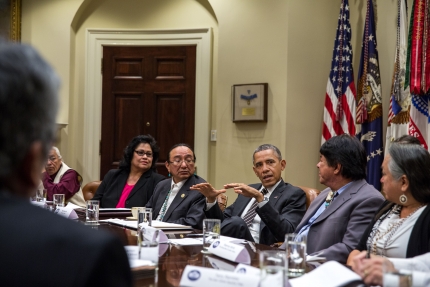
President Barack Obama meets with a group of tribal leaders in the Roosevelt Room of the White House, Nov. 12, 2013. (Official White House Photo by Pete Souza)
This meeting provided tribal leaders an opportunity to directly engage with the President on a leader-to-leader, government-to-government basis and to discuss key issues facing Indian Country at the highest level of Government. During the meeting, tribal leaders in attendance raised a wide range of important issues they are facing related to job creation, including expanding opportunity for renewable energy on tribal lands, increasing access to capital and foreign direct investment opportunities in Indian Country, the successes of tribal self-determination, improving educational outcomes, and jurisdictional challenges.
The twelve tribal leaders that participated in the meeting were:
- Bill Anoatubby, Governor, Chickasaw Nation of Oklahoma
- Melanie Benjamin, Chief Executive, Mille Lacs Band of Ojibwe of Minnesota
- Leonard Forsman, Chairman, Suquamish Tribe of Washington
- Joe Garcia, Governor, Ohkay Owingeh of New Mexico
- Ray Halibritter, Nation Representative and CEO, Oneida Indian Nations of New York
- Carole Lankford, Vice Chairwoman, Confederated Salish and Kootenai Tribes of Montana
- Rex Lee Jim, Vice President, Navajo Nation of Arizona, New Mexico and Utah
- Chris McNeil, CEO, Sealaska of Alaska
- Rosemary Morillo, Chairwoman, Soboba Band of Luiseño Indians of California
- Terri Parton, President, Wichita and Affiliated Tribes of Oklahoma
- Terry Rambler, Chairman, San Carlos Apache Tribe of Arizona
- Robert Shepherd, Chairman, Sisseton-Wahpeton Oyate of South Dakota
Today's meeting kicked off a week of events hosted by the White House Council on Native American Affairs in its continued efforts to strengthen the government-to-government relationship between the United States and Tribal Nations. Tomorrow, the President will host tribal leaders invited from all 566 federally recognized tribes at the fifth consecutive White House Tribal Nations Conference, where tribal leaders will engage with the President, members of his Cabinet and other Senior Administration Officials. The membership of The White House Council on Native American Affairs is also hosting several other meetings and listening sessions to coincide with the Tribal Nations Conference.
Charlie Galbraith is an Associate Director in the Office of Intergovernmental Affairs and Public Engagement. Jodi Gillette is Senior Policy Advisor for Native American Affairs at the White House Domestic Policy Council.
President Obama to Host the 2013 White House Tribal Nations Conference
Posted by on November 12, 2013 at 12:21 PM EDTTomorrow, President Obama will host representatives invited from 566 American Indian and Alaska Native tribes at the 2013 White House Tribal Nations Conference. This year marks the 5th Conference and reinforces our commitment to a strong government-to-government relationship with Tribal Leadership.
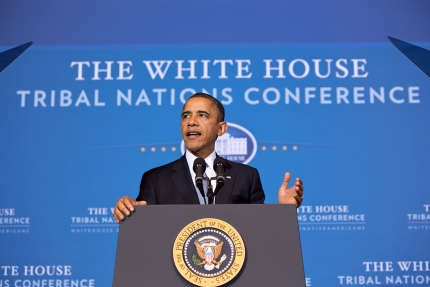
President Barack Obama delivers remarks during the White House Tribal Nations Conference at the Department of the Interior in Washington, D.C., Dec. 5, 2012. (Official White House Photo by Pete Souza)
Earlier this year, the President established the White House Council on Native American Affairs to promote and sustain prosperous and resilient Tribal nations. Chair of this Council, Secretary Jewell of the Department of the Interior, will lead several Cabinet officials in direct discussions with tribal leaders during the Conference.
You can watch the morning and afternoon sessions of the 2013 White House Tribal Nations Conference by tuning in at www.DOI.gov/live.
The agenda is as follows:
Morning Session, 9:00am – 11:30am EST
- Secretary Sally Jewell, Department of the Interior
- Secretary Eric Shinseki, Department of Veterans Affairs
- Secretary Kathleen Sebelius, Department of Health and Human Services
- Secretary Anthony Foxx, Department of Transportation
- Secretary Ernest Moniz, Department of Energy
- Attorney General Eric Holder, Department of Justice
Afternoon Session, 2:00pm – 4:00pm EST
- Administrator Gina McCarthy, Environmental Protection Agency
- Secretary Thomas Perez, Department of Labor
- Secretary Tom Vilsack, Department of Agriculture
Listening Session of the White House Council on Native American Affairs:
- Secretary Sally Jewell, Department of the Interior (Chair and Co-Moderator)
- Cecilia Muñoz, Assistant to the President and Director of the White House Domestic Policy Council (Co-Moderator)
- Secretary Tom Vilsack, Department of Agriculture
- Secretary Thomas Perez, Department of Labor
- Secretary Shaun Donovan, Department of Housing and Urban Development
- Secretary Arne Duncan, Department of Education
- Acting Secretary Rand Beers, Department of Homeland Security
- Administrator Gina McCarthy, Environmental Protection Agency
- Acting Administrator Jeanne Hulit, Small Business Administration
- Chair Nancy Sutley, Council on Environmental Quality
President Barack Obama
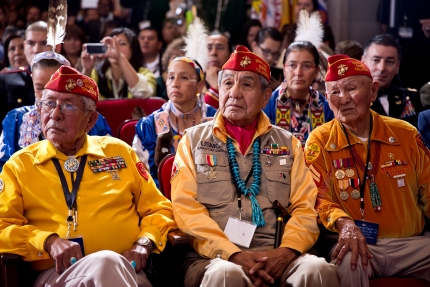
Audience members listen as President Barack Obama delivers remarks during the White House Tribal Nations Conference at the Department of the Interior in Washington, D.C., Dec. 5, 2012. (Official White House Photo by Pete Souza)
We hope you will join us.
Charlie Gailbraith is an Associate Director of Intergovernmental Affairs, and Jodi Gillette is a Senior Policy Advisor for the Domestic Policy Council.
Liberty, Opportunity and Equality for All: The Employment Non-Discrimination Act Vote
Posted by on November 8, 2013 at 1:32 PM EDTEd. Note: This blog is cross-posted from the United States Department of Justice.
The fact remains that, across the country, far too many LGBT Americans suffer discrimination each and every day. That’s why the Department will keep working to promote opportunity and access for every individual. It’s why this will continue to be a priority for this Department as long as I have the privilege to serve as Attorney General. It’s why we will continue to advocate for essential legislative changes and reforms, like the Employment Non-Discrimination Act, to extend workplace protections to all Americans.
-Attorney General Eric Holder, June 2013
Right now, in 29 states, lesbian, gay, transgender and bisexual (LGBT) Americans lack sufficient protections against employment discrimination because of their sexual orientation or gender identity. This week, the Senate passed a bill—the Employment Non-Discrimination Act (ENDA)—that would close this gap in our nation’s civil rights laws.
Since the passage of the Civil Rights Act of 1964, federal law has prohibited employment discrimination on the basis of race, color, religion, sex, or national origin. Yet five decades later, while we wait for ENDA to pass the House of Representatives, no federal law exists that explicitly prohibits employers from discriminating on the basis of an individual’s sexual orientation or gender identity, and the majority of states lack basic workplace protections for LGBT Americans.
As President Obama has stated: “[O]ur journey as a nation is not complete until our gay brothers and sisters are treated like anyone else under the law, for if we are truly created equal, then surely the love we commit to one another must be equal as well.”
If signed into law, a fully inclusive Employment Non-Discrimination Act would explicitly prohibit workplace discrimination based on actual or perceived sexual orientation or gender identity. ENDA’s prohibition of intentional discrimination makes clear that LGBT Americans deserve the same types of protections that are available under Title VII of the Civil Rights Act of 1964.
The ability to earn a living and climb up the economic ladder is at the heart of the American dream. No individual should be denied a job or the opportunity to earn promotions and pay raises because of who they are or who they love. That’s why President Obama, Attorney General Holder, the Civil Rights Division, and the administration as a whole have been committed to the passage of an inclusive ENDA.
In 2009, Tom Perez, then Assistant Attorney General in the Civil Rights Division, testified on behalf of the department before the Senate HELP Committee in support of this legislation, stating: “We have come too far in our struggle for ‘equal justice under the law’ to remain silent or stoic when our LGBT brothers and sisters are still being mistreated and ostracized for reasons that have absolutely nothing to do with their skills or abilities.”
The Civil Rights Division regularly receives letters from LGBT individuals all over the country documenting instances of employment discrimination. This discrimination takes many forms—from cruel instances of harassment, to explicit denials of employment or career-enhancing assignments. It is painfully disappointing to have to tell these men and women that, in the United States of America in 2013, insufficient legal tools exist to address this discrimination. While the Division makes every effort to address these complaints, because there are no federal laws that provide explicit protection against sexual orientation or gender identity discrimination, far too many people are left without clear protections.
Four years ago, Congress passed the Matthew Shepard and James Byrd Jr. Hate Crimes Prevention Act to protect LGBT individuals from hate-fueled violence. Now it’s time for Congress to make certain that these Americans enjoy equal opportunity in the workplace and equal access to the American dream.
Fifty years after the March on Washington, the Civil Rights Division seeks to advance this nation’s long struggle to embrace the principle so eloquently captured by Dr. Martin Luther King Jr.—that persons should be judged based on the content of their character, and not on their race, color, sex, national origin, religion or any other irrelevant factors.
Our existing civil rights laws, enforced by the Civil Rights Division, reflect and uphold this noble principle. So does the Employment Non-Discrimination Act. Its passage would move this great nation one step closer to fulfilling our Constitution’s promise of liberty, opportunity and equality for all.
Jocelyn Samuels is the Acting Assistant Attorney General for the Civil Rights Division of the United States Department of Justice.
Learn more about Civil RightsEnergy Storage Technology is Critical for Developing Secure, Dependable Renewable Power
Posted by on November 5, 2013 at 12:20 PM EDT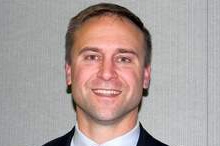
Adam Cote is being honored as a Veteran Advancing Clean Energy and Climate Security Champion of Change.
On December 21, 2004, I was in the mess hall in Mosul, Iraq when a suicide bomber attacked, killing twenty-two and wounding another seventy-two. Lucky to have been behind a large refrigerator, I was uninjured. In the pandemonium that followed I organized the treatment and evacuation of casualties and personally cared for numerous fellow soldiers.
When I returned from Iraq, I applied these skills as a quick thinker and problem solver in complex situations front and center to my work in the energy sector.
My previous deployments to Bosnia and Iraq left me looking for ways to use my civilian career as an energy attorney to strengthen our economic and energy security here at home. Coming from Maine, a state with some of the highest home heating costs in the country – yet some of the most incredible renewable energy resources – I started looking for a way to connect the dots between economic and energy security. How could we start integrating locally generated renewable power to increase our state’s energy security and reduce heating costs for families?
In 2009, my business partners and I founded Thermal Energy Storage of Maine (TESM), a company dedicated to promoting the use of affordable, off-peak electric thermal storage technology as both an economical home heating solution for families and as a way to convert intermittently-generated renewable power into a stable, secure, and local source of power and heat. TESM promotes electric thermal storage (ETS) furnaces and room heaters, which consist of a super-insulated metal box with ceramic bricks and heating elements inside. At night an automatic timer opens a circuit and the heater charges, converting lower-cost, off-peak power into heat energy stored in the bricks for heating homes and businesses.
Today our company works with Central Maine Power Company, Dead River Company, Madison Electric Works, Houlton Water Company and others to offer Mainers affordable, off-peak electric heating solutions that provide home heating at the equivalent cost of $2.25 to 2.90 per gallon of home heating oil.
Integrating renewable power into the U.S. power grid will require widespread development of energy storage technologies. Today, plants using carbon-based resources, such as oil and natural gas, often maintain energy generation and load in a near-perfect equilibrium state. However, many renewable energy resources such as wind, solar, wave and tidal power can be intermittent and difficult to control to match load levels. Energy storage offers a flexible and controllable load that can be available to handle renewable power deliveries whenever they occur.
To use an Army colloquialism, energy storage is “good logistics” – it is a simple solution to a complex problem. If we encourage and incorporate storage technologies in a variety of forms, we will make our entire energy infrastructure more flexible, efficient and secure.
Our company is dedicated to promoting the use of energy storage, and we are proud to add our voice to those calling for storage technologies to be recognized as a key strategic infrastructure goal for our country.
Notification that I had been selected as a White House Champion of Change reached me at the Joint Forces Training Center at Camp Shelby, MS, where I was training with the Maine Army National Guard’s 133rd Engineering Battalion for our deployment to Afghanistan. Although not able to attend the White House event in person, I am humbled and honored to be selected.
Adam Cote is CEO and Co-Founder of Thermal Energy Storage of Maine and currently deployed as a Company Commander in the Maine Army National Guard 133rd Engineering Battalion’s Task Force Black Bear in Afghanistan.
Learn more about Energy and EnvironmentClean Energy and Climate Change Are American Issues
Posted by on November 5, 2013 at 12:18 PM EDT
Robin Eckstein is being honored as a Veteran Advancing Clean Energy and Climate Security Champion of Change.
In 2003 I deployed with the 1st Armored Division, 123rd Main Support Battalion to Baghdad, Iraq as a truck driver. In Iraq, I drove supply missions in and around the Baghdad area. During that time there was no opportunity to reflect on the daily missions to deliver fuel to forward operating bases that left our convoys vulnerable to constant attacks. These forward operating bases were going through so much fuel that the convoys had to leave the safer confines of the main bases and put American lives at risk so that this dirty fossil fuel could be used up almost as fast as it was delivered. I realized there had to be a better way, but during war you don’t have time to worry about the “what ifs.”
After returning home I decided to continue my service to the country by striving to make a difference in clean energy. In 2007 I began working on veterans issues with VoteVets.org. Then in 2009, the Truman National Security Project started a campaign called Operation Free, a coalition of veterans and national security agencies campaigning for comprehensive clean energy reform. This is where I found a true place I could make a difference and ease the pain of losing my chance to serve directly after being medically discharged from my combat disability.
I boarded a bus with a group of fellow veterans from around the nation and we drove across the country speaking at hundreds of different venues, each time discovering that when a group of veterans discussed clean energy and climate change, it was no longer a partisan issue, but one that everyone in America could be concerned about. Whether it was a meeting at the Minot, ND, Chamber of Commerce or a VFW hall in Berkeley, MI, people could see the connections.
Our message was amplified by the Pentagon’s move to take climate change seriously as a threat multiplier. The Department of Defense is taking the lead to help reduce that impact, because every solar generator that replaces a fuel-using one saves lives in a war by not having me or my fellow truck drivers dodging bullets to transport that fuel to forward operating bases.
Bringing a no-nonsense message to the American people from honest war veterans proved that minds and attitudes could be changed. There has been a lot of forward movement on climate change and clean energy in the country, and there is more good work being done today. I know the changes the military is making now will mean fewer convoys being attacked because of the old fuel-guzzling ways of yesteryear. Not only did my fellow veterans and I make a difference by bringing the connection and the truth to Americans across the nation, but I also helped myself by continuing my service to my country and giving myself a reason to not let my disability win. I am honored to be a Champion of Change and thankful to all my fellow veterans that also spread the message on that big blue bus and the many others who helped along the way.
Robin Eckstein is a veteran and a Truman Defense Council member living in Appleton, WI.
Learn more about Energy and EnvironmentA Future for All in Green Energy
Posted by on November 5, 2013 at 12:15 PM EDT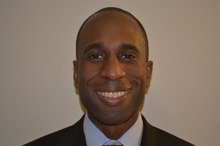
Phillip Green is being honored as a Veteran Advancing Clean Energy and Climate Security Champion of Change.
I am often commended by people for my courage to start Green Powered Technology (GPTech), a green energy business. I then think to myself that starting the business was not nearly as courageous as they imagined, since I initially maintained my day job. However, I think I displayed conviction in graduating from public schools in the Bronx on time, obtaining my college degrees on time as I served in the Army Reserve, researching green energy in Japan and China, and deploying to Afghanistan. All these endeavors were filled with pitfalls I overcame, so I am glad to be honored as a Champion of Change. I am also excited about the chance this recognition has given me to be a role model for others and a messenger for green technology’s many opportunities.
I started GPTech to fully utilize my education, government experience, and global interest in making the world more energy efficient. In 2004, my experience with light-emitting diode, which I researched in Japan, and their adoption challenges prompted me to learn more about technology adoption. After further experience with technology adoption, I felt confident I could form specialized teams to overcome hurdles in adopting green energy and make it easy for anyone to incorporate sustainable energy into their operations and communicate results to interested parties. My time in the U.S. Army and business school greatly assisted me with these team-building skills.
Towards the goal of making the world a more efficient place, GPTech pursued U.S. federal government contracts, since the U.S. government is the single largest energy-consuming entity in the world. Given this scale of consumption, GPTech’s offer to help save money, enhance operations, protect the environment, and provide energy reliability and security could have an especially large effect. I have also positioned my business to do work in Africa and China, because of their rising growth and energy needs.
GPTech provides experts to develop and implement strategies, initiatives, projects, and programs to help federal clients comply with the energy conservation and renewable energy requirements outlined in the Energy Policy Act of 2005, the Energy Independence and Security Act of 2007, Executive Order 13423, and Executive Order 13514.
In emerging markets, GPTech provides support to the U.S. Trade and Development Agency on proposal reviews and feasibility studies for renewable energy projects in the Power Africa Initiative. GPTech is also working on a USAID contract to promote clean energy in emerging markets.
Green energy allows us to improve our communities and our national, economic, and environmental security. The Department of Defense (DoD) risks lives to secure energy by protecting convoys that deliver fossil fuels and securing open sea lanes for oil tankers. Emerging markets require energy for economic growth, but they are not necessarily employing the best energy practices. GPTech envisions better solutions for DoD, emerging markets, and the world by sharing best energy practices, energy efficiency measures, and renewable energy sources.
Green energy presents challenges, which I view as opportunities on both the supply and demand sides. Additionally, green energy requires U.S. students to embrace and find employment in science, technology, engineering, and mathematics fields and eventually find our future energy solutions.
Fortunately, there are researchers working on green energy challenges and companies promoting innovative green energy business models across the globe. The greening of the supply chain presents additional opportunities. In other realms, providing solutions around the nexus of energy, water, and food will continue to present challenges for society and opportunities for entrepreneurs.
Phillip Green is the founder and president of Green Powered Technology, a firm that provides expert advice to our clients on energy and the environment.
Learn more about Energy and EnvironmentSolar Power is a Force Multiplier for Us All
Posted by on November 5, 2013 at 12:13 PM EDT
Nat Kreamer is being honored as a Veteran Advancing Clean Energy and Climate Security Champion of Change.
Tracer rounds from 50-caliber machine guns lit up the sky the night I landed at Baghdad International Airport. Like hundreds of thousands of Americans over three decades, I was in the Middle East, in uniform, carrying a gun to protect our national energy interests. A little over a year later I took off from Bagram Airfield, returned home, and co-founded SunRun to help American homeowners get their energy from clean, affordable, and domestic solar power. There’s nothing like a war with natural resource implications to kick-start passion and faith for renewable energy.
Our lifestyles cannot continue to subsidize foreign energy sources with more blood and more treasure. American soldiers, sailors, airmen, and Marines have and continue to make tremendous personal sacrifices to protect our national energy interests around the world. We have spent at least $7.3 trillion to defend our energy interests in the Persian Gulf alone over the last thirty years, according to research by Princeton University professor Robert J. Stern. To put this in perspective, $7.3 trillion equals approximately $23,000 per U.S. citizen. Imagine the last thirty years without two wars in the Gulf, with a healthier economy, and with a cleaner environment.
We owe our veterans and fellow citizens a way of life powered by clean, affordable, and domestic energy sources like solar. Fortunately, we are making progress. In the first three months of this year 82 percent of all new power generators built in the United States came from renewable energy sources. Every month around 10,000 Americans buy hybrid or electric cars. Every four minutes another solar system powers on in America. In many states a household can buy solar electricity for less than its current utility bill. A car that runs on solar is half as expensive to operate as one running on gasoline. Those simple home economics mean we may not have to spend the next thirty years fighting debt-financed foreign wars.
Our military is leading from the front. The military is putting solar electricity systems on the roofs of base buildings around the country. That solar electricity saves the military money it can invest in our national defense, and installing distributed solar electricity systems on military bases improves their defense by helping make bases self-sustaining and harder to attack.
U.S. military units in the field are starting to use solar panels to generate electricity to run combat systems. Those solar panels make our fighting units more effective by reducing their reliance on vulnerable supply chains and expensive over-land diesel fuel deliveries for generators. According to the U.S. Marine Corps Expeditionary Energy Office, it costs the U.S. military approximately $50 per gallon for every gallon of diesel delivered to combat units in the field. An average solar panel costs approximately $150, creates as much energy as approximately 250 gallons of diesel fuel, and only has to be delivered once. Solar power is a force multiplier for us all.
Nat Kreamer served as a US Navy officer and in the US Special Forces in Afghanistan, where he was awarded the Bronze Star. Today he is the President and CEO of Clean Power Finance, and the Vice Chairman of the Board of Directors of the Solar Energy Industry Association.
Learn more about Energy and Environment
- &lsaquo previous
- …
- 49
- 50
- 51
- 52
- 53
- 54
- 55
- 56
- 57
- …
- next &rsaquo
Twitter