
Office of Science and Technology Policy Blog
President Obama Calls Crews of Atlantis and the International Space Station
Posted by on July 16, 2011 at 8:14 AM EST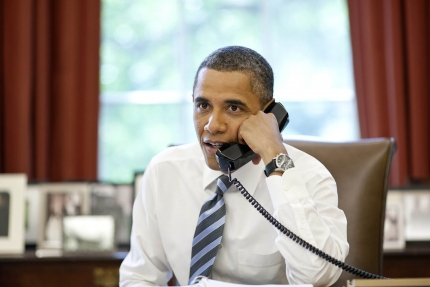
President Barack Obama talks with the crews of the Space Shuttle Atlantis and the International Space Station during a phone call in the Oval Office. July 15, 2011. (Official White House Photo by Pete Souza)
Last Friday, the Space Shuttle Atlantis embarked on the Space Shuttle program’s final mission—a mission to the International Space Station (ISS) to deliver one year of supplies and a new technology demonstration project. President Obama joined millions of Americans and people around the world in taking a moment to watch the incredible liftoff. Yesterday, President Obama gave the ISS a call—you can watch the full video below:
Learn more about Innovations, TechnologyInventing the Future With Student Innovations
Posted by on July 15, 2011 at 1:48 PM ESTLast year, First Lady Michelle Obama kicked-off the 2011 Imagine Cup competition with a video message inviting students to invent the future and compete in the international finals that would be hosted in the United States for the first time.
More than 350,000 students across 183 countries heeded the call and registered to participate. Out of both regional and global competitions, the top 424 students (124 teams) across 70 countries made it to the Worldwide Finals, which took place last night in New York City. They were joined by leading CEOs, entrepreneurs, and Secretary of Education Arne Duncan.
In his State of the Union, the President talked about innovation’s critical role in helping economies across the globe, especially here at home, and the importance of science, technology, engineering, and math (STEM) education to spur that innovation. Now in its ninth year, the Microsoft Imagine Cup has been underway this past week actively demonstrating that innovating with technology can help address unique challenges around the world. Each group of contenders was charged with the task of innovating technologies to address this year’s theme--“Imagine a world where technology can help to solve the toughest problems”--with specific encouragement to focus on the United Nations Millennium Development Goals.
Over the past week--in addition to making it through multiple rounds of competitions--the students have made new friends, advanced ideas and knowledge, and potentially changed the future of the world!
The United States is represented by five teams from across the Nation, including:
- Team Note-Taker in Software Design (Arizona State University)
- Team LifeLens in Windows Phone 7 (UC Davis, UCLA-Anderson School of Business, University of Central Florida, Harvard Business School)
- Team Dragon in Games/mobile (Rice University)
- Team ICSquared (Ithaca College)
- Team Syntax Errors - Embedded development (Santiago Canyon College)
Inspired by the challenge to invent the future, Team Note-Taker entered Imagine Cup 2011, competing against 67 teams, this group found its direction when member David Hayden, an outstanding academic, struggled to achieve excellence in his degree program of mathematics as a result of his being blind. The largest obstacle was learning without being able to see the notes on the whiteboard. Thus David met with his team and began work on the Note-Taker--a device that has a camera with which you can “see the board” on a tablet and take notes correlating to what’s written on the board.
The teams hard work paid off as they placed second in software design. Other creative technologies among U.S. teams were cell phone applications to diagnose malaria with 94 percent accuracy, designed by team LifeLens, and Team Dragons’ gaming device to measure breathing. Team Syntax, the only team to be from a community college in the competition, was comprised of a 21 year old and four gentlemen over the age of 40 who strove to challenge the stigma that a junior college meant junior ideas. This team focused their design on a mobile computer capable of traveling with disaster relief teams to monitor supply levels during times of crisis to ensure faster aid responses to victims.
While all teams have done a great job demonstrating the value of innovation, three U.S. Teams: Note-Taker, LifeLens, and Dragon, represented the United States as contenders in the Worldwide Finals round of the competition. Last night the winning teams were announced during the World Festival with Team Note-taker winning a silver medal followed by Dragon and LifeLens with bronze medals in their individual divisions; rendering them champions among the 350,000 students who entered the competition from around the globe.
Pierre Elias of the U.S. Team Dragon may have summed it up best when he said: “Innovation signifies the American spirit by collaborating through diversity to create something that changes the world.”
Click here to see photos of the U.S. teams, and learn more about the teams and other finalists by checking out the Imagine Cup website.
Natalie DeGraaf is a student volunteer at OSTP
Learn more about Education, TechnologyLet’s “Make in Detroit”
Posted by on July 14, 2011 at 8:26 AM ESTOn Monday, I joined Secretary of Housing & Urban Development Shaun Donovan, Detroit Mayor Dave Bing, Congressman Hansen Clarke and other local leaders in Detroit to launch the “Strong Cities, Strong Communities (SC2)” initiative. Detroit is one of six pilot cities to partner with the Federal government in strengthening its capacity to achieve an economic growth strategy fueled, in part, through new public and private sector partnerships.
In support of this effort, technology and innovation leaders from across the Federal government have volunteered to support technical assistance teams organized for each of the pilot cities. These innovators will work to enhance local efforts already underway or launched on account of this call to action. For Detroit, I’ve asked Dr. Grace Bochenek, TARDEC Director, and Peter Appel, RITA Administrator, to share expertise and best practices from our open innovation framework.
I saw the potential in such a collaboration during a town hall meeting later that afternoon where I joined a non-profit network, Michigan Corps, in announcing the launch of “Make in Detroit”, a comprehensive resource platform specifically designed to spur innovation in the manufacturing sector. “Make in Detroit” launched with an initial roster of 15 organizations including an online intellectual property marketplace, a non-profit robotics innovation center in partnership with the US Army, and a “Tech Shop” designed to transform ideas into crowd-sourced prototypes.
This initiative complements the President’s vision for strengthening the American manufacturing sector through technology and innovation, as described in his recent remarks at Carnegie Mellon University where he unveiled the Advanced Manufacturing Partnership.
To the good people of Detroit and the other pilot communities, we look forward to collaborating in support of your leaders’ economic vision. To others interested in the program, please respond to our request for information on how to design a challenge where you might compete for participation.
Aneesh Chopra is US Chief Technology Officer
Learn more about EconomyNASA Tournament Lab: Open Innovation On-Demand
Posted by on July 13, 2011 at 2:00 PM ESTFrom the NASA Centennial Challenge program to the NASA Innovation Pavilion, the U.S. space agency is at the forefront of the fast-growing movement to use prizes and challenges to tap the best ideas and top talent in the quest to solve difficult problems.
The newest arrow in the agency’s innovation quiver is the NASA Tournament Lab (NTL), an online virtual facility that enables NASA researchers facing complex, computational challenges to “order” high-quality solutions from a community of independent algorithm experts. Designed to leverage the principles of distributed innovation, the Lab eliminates dependence on the skills or schedule of any individual computational scientist, instead tapping the expertise of the most knowledgeable, skilled, and available community members to supply a tailored solution. As a result, the Tournament Lab promises to increase quality while reducing the cost and time of computer code development for NASA systems.
Yesterday, the Lab announced the winners of NASA’s most recent competition--one that challenged the Lab community to build software that automatically detects craters in orbital images. Large-scale, automatic, and robust crater detection algorithms can help solve challenging and important problems in space exploration since craters can provide important information on planet formation and geology; inform the selection of landing sites; provide valuable data for path planning and rover navigation; and help scientists align disparate data sets such as those produced by radar and laser altimetry.
A unique aspect of this challenge was that the dataset used by the developers to create their algorithms was itself generated through Moon Zoo, a citizen science project of Zooniverse. Thousands of individuals, working through the MoonZoo project manually labeled craters from orbital images. These labeled images then served as an important input for both creating and testing the software programs developed by the challenge competitors.
With each competition, NASA learns more about the art and science of using prizes and challenges to crowdsource solutions for NASA operational needs. Jason Crusan, in NASA’s Space Operations Mission Directorate, created the Lab with a NASA contract to Harvard’s Institute of Quantitative Social Science and TopCoder. Professor Karim R. Lakhani (Harvard Business School) is the Director and Principal Investigator and Professor Kevin Boudreau (London Business School) is the Chief Economist of the Lab. Under their direction, the Lab is testing hypotheses and analyzing empirical data from real-world competitions to refine the science of how to successfully design and implement prizes and challenges. The rich lessons learned will be invaluable as prizes and challenges become a routine problem-solving tool for NASA and other public-sector entities.
Kudos to NASA, Harvard, TopCoder, and the entire NASA Tournament Lab community on taking this important step towards the President’s vision of making prizes a standard tool in every agency’s toolbox.
Robynn Sturm is Advisor to the Deputy Director for Policy in the White House Office of Science and Technology Policy
Learn more about TechnologyMedicines Patent Pool Agreement with Gilead a Key Milestone
Posted by on July 12, 2011 at 10:12 PM ESTCongratulations to the Medicines Patent Pool and Gilead Sciences for breaking new ground in using voluntary licensing agreements as a tool to improve access to medicines for people in developing countries.
The Medicines Patent Pool was established by the innovative global health financing initiative UNITAID in 2010 to stimulate innovation and improve access to HIV medicines. The Patent Pool works to achieve these goals by facilitating the sharing of intellectual property by patent holders through the negotiation of voluntary licenses. Last September, the National Institutes of Health (NIH) became the first entity to share patents with the Patent Pool. In May, President Obama joined other leaders of the G8 in affirming support for the Patent Pool and encouraging the voluntary participation of additional patent owners—public and private.
This morning, the Medicines Patent Pool and Gilead announced an agreement allowing the Pool to grant licenses to generic drug manufacturers for several Gilead products relevant to HIV and Hepatitis B treatment. This agreement makes Gilead the first pharmaceutical company to license technology into the Patent Pool. Also notable is the fact that Gilead is licensing intellectual property related to products still in clinical development—which means that manufacturers can plan early for production, potentially accelerating availability in developing countries.
The new agreement covers licenses for critical HIV treatments (tenofovir and emtricitabine), promising HIV treatments in the late-stages of clinical development (cobicistat and elvitegravir), and the combination of these products in a single pill known as the “Quad.” Tenofovir is also licensed to the Patent Pool for use against Hepatitis B – a serious illness in the developing world that the World Health Organization estimates kills 600,000 people a year.
NIH and Gilead are the first licensors to join the Pool. We hope additional public and private patent holders will explore voluntary licenses with the Medicines Patent Pool as one of many innovative ways to help improve the availability of medicines in developing countries.
Hillary Chen is Advisor to the Deputy Director for Policy in the White House Office of Science and Technology Policy
Remembering What Inspires the American Dream
Posted by on July 6, 2011 at 4:48 PM ESTThe celebration of our Nation’s independence is an occasion to remember what has inspired many of the world’s best and brightest to join our way of life—the American Dream.
As far back as 1884, Thomas Edison—America’s most prolific innovator with over 1,000 patents to his name (including the telegraph and light bulb)—took a chance on a bright young electrical engineer from abroad, Nikola Tesla, by employing him at his Edison Machine Works company. Tesla would later become an American citizen and start businesses commercializing his patents in the areas of electrical power systems and AC power.
In the decades that followed, countless immigrant entrepreneurs came to the US and helped grow American jobs. From 1990 to 2005, a study found that 25 percent of venture-backed public companies in the U.S.—including Google, eBay, Yahoo!, Sun Microsystems, and many others included immigrants as founders, creating over 220,000 jobs here in America.
The President believes that we need to reform our immigration system to compete in the 21st century economy. Ensuring that immigrants can start businesses and create jobs here in America is an important pillar of The Administration Blueprint on 21st Century Immigration Reform. For example, the President supports legislation that would create a Startup Visa for job-creating entrepreneurs, so our economy can more directly benefit from their creativity and ingenuity.
It is a message I hear very clearly throughout my travels. Following the President’s call for a national conversation on immigration reform to build a broader consensus on how to fix our broken immigration system, I’ve hosted roundtables in Omaha, Silicon Valley, and most recently, Boston, MA where entrepreneurs, business and civic leaders all expressed concern that our inability to retain top talent is hurting our competitiveness.
In Boston, I heard from MassChallenge, an early partner in Startup America whose 2010 finalists created over 300 new jobs in the US (after only seven months) and raised over $30 million in outside funding. The accelerator invites entrepreneurs from all over the world to enroll in its annual Massachusetts-based startup competition, which in 2010 attracted applicant startups from 26 countries.
While fully addressing comprehensive immigration reform will take legislation, we’ve already taken several administrative steps that can improve our situation in the near-term. In May, the U.S. Citizenship and Immigration Services proposed to streamline the EB-5 visa process, designed for immigrant investors and entrepreneurs who create at least 10 U.S. jobs. Also in May, the U.S. Immigration and Customs Enforcement (ICE) posted an expanded list of Science, Technology, Engineering, and Math (STEM) degrees that enable graduates to qualify for an extra 17 months of Optional Practical Training (OPT).
We understand, however, the limits of these actions. At the Boston Roundtable, I heard from a STEM PhD graduate who is currently on OPT as an entrepreneur. He has hired three people and raised $350,000 in competitive grants for his clean energy startup. Unfortunately, the clock runs out for him next February.
On a personal note, I spent the 4th of July weekend with my immigrant parents who reminded me of their path to achieve the American Dream. My dad enrolled as an engineering graduate student in Villanova and went on to receive three patents in the 1970s for his work on air conditioning products. He grew up in a village that lacked indoor plumbing and electricity, but like millions of others throughout the world, he believed in the story of America.
Let’s work together to rekindle that spirit for the generations that follow.
Aneesh Chopra is US Chief Technology Officer
Learn more about Immigration
- &lsaquo previous
- …
- 111
- 112
- 113
- 114
- 115
- 116
- 117
- 118
- 119
- …
- next &rsaquo


White House Blogs
- The White House Blog
- Middle Class Task Force
- Council of Economic Advisers
- Council on Environmental Quality
- Council on Women and Girls
- Office of Intergovernmental Affairs
- Office of Management and Budget
- Office of Public Engagement
- Office of Science & Tech Policy
- Office of Urban Affairs
- Open Government
- Faith and Neighborhood Partnerships
- Social Innovation and Civic Participation
- US Trade Representative
- Office National Drug Control Policy
categories
- AIDS Policy
- Alaska
- Blueprint for an America Built to Last
- Budget
- Civil Rights
- Defense
- Disabilities
- Economy
- Education
- Energy and Environment
- Equal Pay
- Ethics
- Faith Based
- Fiscal Responsibility
- Foreign Policy
- Grab Bag
- Health Care
- Homeland Security
- Immigration
- Innovation Fellows
- Inside the White House
- Middle Class Security
- Open Government
- Poverty
- Rural
- Seniors and Social Security
- Service
- Social Innovation
- State of the Union
- Taxes
- Technology
- Urban Policy
- Veterans
- Violence Prevention
- White House Internships
- Women
- Working Families
- Additional Issues