
Office of Science and Technology Policy Blog
OSTP Director Holdren Gives Keynote at Kavli Prize Science Forum
Posted by on September 9, 2010 at 8:46 AM EDT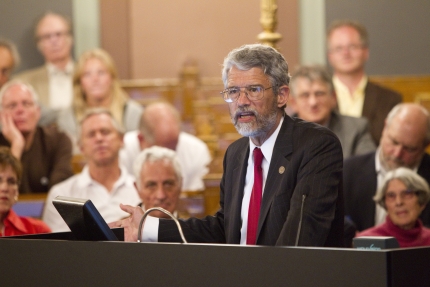
OSTP Director John P. Holdren delivers one of two keynotes at this year's Kavli Prize Science Forum on Monday. (Photo courtesy Kavli Foundation)
OSTP Director John P. Holdren gave one of the two keynote addresses at the Kavli Prize Science Forum in Oslo, Norway on Monday, with the title “Climate-Change Science and Policy: What Do We Know? What Should We Do?” The forum was part of a week of festivities around the second biennial award of the Kavli Prizes in Science, which are administered by the Norwegian Academy of Science and Letters on behalf of the Kavli Foundation and the Norwegian Ministry of Education and Research. Three prizes of $1,000,000 each are awarded in the fields of astrophysics, nanoscience, and neuroscience. Seven of the eight 2010 laureates are Americans. The Science Forum, with the overall theme of “The Role of International Cooperation in Science”, was also addressed by the first Secretary General of the European Research Council; the presidents of the academies of science of the United States, the United Kingdom, China, and Norway; the president of the U.S. National Academy of Engineering; U.S. Undersecretary of Energy Steve Koonin; the president of the Science Council of Japan; the Norwegian Minister of Foreign Affairs; and the Norwegian Minister of Education and Research.
Learn more about TechnologyAdministration Bolstering Efforts on Innovation and Entrepreneurship
Posted by on September 8, 2010 at 4:09 PM EDTFostering innovation and entrepreneurship is one of President Obama’s top priorities. His national innovation strategy identifies three critical roles for government: investing in the building blocks of long-term economic growth, such as research and human capital; creating the right environment to encourage private sector investment; and harnessing innovation to address national priorities such as clean energy and a more efficient healthcare system.
During the past week, the Administration has taken important steps to accomplish these goals.
First, the President today unveiled his proposal to expand, simplify, and permanently extend the Research and Experimentation Tax Credit in order to help companies create good jobs in America today and increase productivity and growth in the future. The President’s proposal would devote about $100 billion to encourage private-sector R&D in the United States, and it would make that policy permanent so that businesses can count on it in the years ahead.
Second, on September 2nd Secretary of Commerce Gary Locke convened the first meeting of the National Advisory Council on Innovation and Entrepreneurship. This council of leading entrepreneurs, investors, and university presidents had a lively discussion on ways in which the public and private sectors could work together to meet some of the Nation’s biggest challenges and reenergize the Nation’s economic momentum. Members of the council proposed ideas for celebrating entrepreneurs and expanding access to capital for high-growth firms. Chief of Staff Rahm Emanuel also addressed the group, a clear indication of how important this issue is to the Administration.
In a blog post, co-chair Steve Case summarized the intent of the group and called for, “ideas on what it will take to spark innovation and entrepreneurship in the nation.” We welcome your input.
Third, the National Science Foundation (NSF) issued a solicitation for a new program called Accelerating Innovation Research (AIR). This program will support researchers that have made an important fundamental advance in science and engineering but who require additional funding to help commercialize their research. For example, a researcher might use the funding to build a prototype or scale-up a new manufacturing process. AIR will also support expanded collaborations between NSF-funded centers and the private sector. These collaborations will help commercialize university research, create jobs, and prepare students to become successful entrepreneurs.
Finally, the National Institute of Standards and Technology (NIST) provided a letter to OSTP on the use of e-commerce to promote the commercialization of federally-funded research. A number of companies, foundations, and non-profit organizations are interested in using online marketplaces and standardized agreements to accelerate the commercialization of research. NIST, the agency responsible for interpreting the “Bayh-Dole” legislation that governs technology transfer of federally-funded research, has concluded that the statute permits using “e-commerce or other creative approaches, especially where such mechanisms can facilitate reduction of transaction costs associated with licensing and promote the translation of federally funded technology.”
Stay tuned—the Administration will have more to say about these issues in the months ahead.
Aneesh Chopra is U.S. Chief Technology Officer
Tom Kalil is Deputy Director for Policy in the White House Office of Science and Technology Policy
Learn more about EconomyArid Arizona Home to NASA’s RATS
Posted by on September 8, 2010 at 11:13 AM EDTFor the past week, hoards of NASA human space exploration study teams have been gallivanting around the Arizona desert as part of NASA’s Desert Research And Technology Studies, or Desert RATS.
The Desert RATS demonstrations—held in the Arizona desert because it is a prime location here on earth for simulating future exploration destinations—offer engineers, astronauts, and scientists a unique opportunity to test new mission concepts and learn how to work with robotic helpers. Among other hardware at the site are two Space Exploration Vehicles (SEVs), which can be adapted for surface or in-space missions. The SEVs have pressurized cabins, allowing the astronauts to live and work inside of them in a shirt-sleeve environment. For the first time at Desert RATS, the two SEVs will dock with a Habitat Demonstration Unit, which helps simulate for the crew what living and working off planet would really be like.
But this year, not wanting to leave anyone’s ideas out of the excitement of exploration, NASA has made great strides in bringing Desert RATS to the public.
Prior to the start of this year’s mission, panoramic images of the Desert RATS test site were taken and displayed online. The public was given the chance to vote and select locations for crews to visit during their stay in Arizona. The location with the most votes was incorporated into the mission plan. During the voting period, the website was visited by people from 88 countries, and more than 2,500 votes were received.
In addition to choosing where crewmembers should visit, the public can engage with the Desert RATS team through Facebook, Twitter, Flickr, and YouTube, and also through crew blog postings and live webcasts.
Head on over to NASA’s Desert RATS homepage for more information on how to get involved and also check out the Desert RATS blog, which includes daily postings, pictures, and videos. This year’s mission is half over (it ends September 15), so become part of NASA’s participatory exploration today!
Phil Larson is a Research Assistant in the White House Office of Science and Technology Policy
Learn more about TechnologyPrize Platform Invites Citizens to Solve Nation’s Challenges
Posted by on September 7, 2010 at 3:26 PM EDTIn search of novel solutions to the tricky problem of how to keep astronauts fit during prolonged periods of weightlessness, NASA found an unlikely ally in Alex Altshuler. Altshuler works for a mechanical engineering firm in Foxboro, MA. He had never before responded to a formal government Request for Proposal (RFP), let alone worked with NASA. Yet, the exercise device he designed in response to a NASA challenge constituted a major breakthrough in mitigating the loss of bone and muscle density in astronauts. NASA dubbed the results “outstanding.”
Citizen solvers like Altshuler are at the heart of the Obama Administration’s commitment (pdf) to increase the use of prizes and challenges to solve tough problems. Prizes allow the government to articulate bold goals – such as building a super-fuel-efficient car, developing a low-cost launch technology for small satellites, or solving the risks to human health that come with space flight – without having to predict which team or approach is most likely to succeed. With a strict focus on results, prizes empower new, untapped talent – like Altshuler – to deliver novel solutions that accelerate innovation.
Learn more about Innovations, TechnologyCase Foundation Releases Follow-Up Report to Innovation Summit
Posted by on August 26, 2010 at 5:31 PM EDTIn April the White House Office of Science and Technology Policy and Domestic Policy Council teamed up with the Case Foundation to host a “Promoting Innovation Summit.” The conference brought together leaders from the public and private sectors to help inspire and inform Federal agency efforts to adopt innovative policymaking techniques such as prizes, challenges, and open grantmaking initiatives.
Conference organizers solicited public comments, which were integrated into the day’s events as a major driver of brainstorming activities. Several “Promoting Innovation Interviews” were held during the day where members of the public could ask questions of various public and private officials over the Internet. You can view these interviews here.
This week, the Case Foundation released a follow-up report and summary of that groundbreaking meeting. The Promoting Innovation report is a recap of the conference and outlines some of the primary takeaways from that day, including five dos and don’ts of using prizes and challenges for leveraging resources and driving change. You can also watch videos of the daylong strategy session here.
President Obama has called for the government to “use innovative tools, methods, and systems” to make Federal governance more efficient and effective. So watch the videos, read the report, and digest the outcomes of a daylong meeting dedicated to exploring cool new ways to create more open and collaborative strategies that engage citizens in developing solutions that work.
Learn more about TechnologyNSTC to Coordinate Certain Arctic Research Policy Committee Activities
Posted by on August 23, 2010 at 12:19 PM EDTOn July 22nd the President signed a Presidential Memorandum directing the National Science and Technology Council (NSTC) to coordinate certain activities assigned to the Interagency Arctic Research Policy Committee (IARPC), created by Congress 25 years ago. Taking that oversight mandate to heart, the NSTC—administered by the Office of Science and Technology Policy—has already begun organizing a number of activities to fulfill these important duties.
The Arctic’s importance to the Nation has grown considerably since IARPC was formed by Arctic Research Policy Act of 1984. Today the Arctic is a focal point for such wide-ranging issues as global climate change, national security, military preparedness, transportation, and energy. As Capt. John E. Lowell, Jr., Director of the National Oceanic and Atmospheric Administration’s Office of Coast Survey, stated earlier this year, the Nation needs to “strengthen arctic science and stewardship to improve our understanding of changing climate and environmental conditions and better inform policy options and management responses to the unique challenges in the Arctic region.”
Adding to the evidence that the Arctic is a growing National priority, the Navy last year established a Task Force on Climate Change with a special focus on Arctic policy, strategy, missions and plans. In November that task force produced an “Arctic Roadmap,” which among other things focuses on U.S. strategic interests in the changing Arctic environment, potential climate-related increases in resource extraction and shipping, and fleet capabilities in the region.
This growth in the Arctic’s importance has resulted in a growing number of agencies working in and focused on the Arctic, requiring much greater interagency collaboration and coordination than in the past. The new Presidential Memorandum supports the growing National focus on the Arctic by enabling this increased collaboration and coordination under the auspices of the NSTC. All told, this change will help increase efficiency and reduce redundancy with regard to Arctic programs while ensuring that agency Arctic programs evolve in alignment with Administration priorities.
To accomplish these goals, the IARPC is now a designated interagency subcommittee under the NSTC’s Committee on Environment and Natural Resources (CENR). Some of the new subcommittee’s duties include:
- Coordinating arctic research, technology, and observation programs;
- Developing interagency plans for expansion of knowledge about the Arctic and its interactions with other components of the Earth system, including ocean, atmosphere, land, and living resources, and about the societal impacts of arctic climate change;
- Developing plans for predicting and forecasting arctic climate change;
- Providing advice relating to ecosystem-based management and stewardship of arctic resources;
Dr. John P. Holdren, Director of the Office of Science and Technology Policy and a co-chair of NSTC, has begun coordinating the selection of participating agencies’ principal representatives to the IARPC and has directed Shere Abbott—OSTP‘s Associate Director for Energy and Environment and co-chair of CENR—to hold the first NSTC IARPC Principals meeting this fall.
As in the past, IARPC will be chaired by the Director of the National Science Foundation. And it will work with the Arctic Research Commission—the Federal agency created by that Act—to, among other things, establish an integrated national arctic research policy; facilitate cooperation between the Federal Government and State and local governments in arctic research; and coordinate and promote cooperative arctic scientific research programs with other nations, subject to the foreign policy guidance of the Secretary of State.
Kate Moran is a Senior Policy Analyst in the White House Office of Science and Technology Policy
Learn more about Technology
- &lsaquo previous
- …
- 133
- 134
- 135
- 136
- 137
- 138
- 139
- 140
- 141
- …
- next &rsaquo


White House Blogs
- The White House Blog
- Middle Class Task Force
- Council of Economic Advisers
- Council on Environmental Quality
- Council on Women and Girls
- Office of Intergovernmental Affairs
- Office of Management and Budget
- Office of Public Engagement
- Office of Science & Tech Policy
- Office of Urban Affairs
- Open Government
- Faith and Neighborhood Partnerships
- Social Innovation and Civic Participation
- US Trade Representative
- Office National Drug Control Policy
categories
- AIDS Policy
- Alaska
- Blueprint for an America Built to Last
- Budget
- Civil Rights
- Defense
- Disabilities
- Economy
- Education
- Energy and Environment
- Equal Pay
- Ethics
- Faith Based
- Fiscal Responsibility
- Foreign Policy
- Grab Bag
- Health Care
- Homeland Security
- Immigration
- Innovation Fellows
- Inside the White House
- Middle Class Security
- Open Government
- Poverty
- Rural
- Seniors and Social Security
- Service
- Social Innovation
- State of the Union
- Taxes
- Technology
- Urban Policy
- Veterans
- Violence Prevention
- White House Internships
- Women
- Working Families
- Additional Issues