
Office of Science and Technology Policy Blog
Students Go For Sun-Day Drive
Posted by on July 30, 2010 at 9:42 AM EDTIn a speech at the National Urban League yesterday, President Obama talked about the importance of getting students enthused about education and the particular importance of science and mathematics education.
Well, there is no better example of how to generate that kind of enthusiasm—all the while helping to make renewable-energy vehicles more practical—than the recently completed American Solar Challenge. Students from 13 universities in the United States, Canada, Germany, and Taiwan competed in the challenge, which requires students to design, construct, and then race a vehicle over 1,100 miles, powered only by the sun.
Learn more about Energy and Environment, TechnologyMore Faces of Women and Girls in STEM
Posted by on July 28, 2010 at 1:47 PM EDTPresident Obama launched the “Educate to Innovate” campaign last November to improve the participation and performance of America’s students in science, technology, engineering, and mathematics (STEM). Last week, representatives from national organizations that are focused on increasing participation and performance of women and girls in STEM fields held a meeting in Washington, DC to develop recommendations to help improve "Educate to Innovate."
The group brainstormed and identified 10 strategies for improving the participation of women and girls in STEM. The original list of strategies under consideration came from a document produced by the National Alliance for Partnerships in Equity Nontraditional Career Preparations: Root Causes and Strategies.
The 10 strategies identified include:
- Training for STEM teachers on new instructional strategies that focus on equitable and “hands-on” methods.
- Training for school counselors to highlight the societal benefits of the STEM professions as well as the high-wage fields of STEM.
- Training for STEM teachers on new interaction strategies that have been shown to motivate students, especially girls, to study STEM subjects.
- Cultivating collaboration and leveraging ongoing work by incentivizing and recognizing public-private partnerships.
- Supporting a National Clearinghouse on research, best practices, materials, organizations, and experts on gender and STEM education.
- Supporting TV programs and media that spark interest in STEM subjects and counter stereotypes about who works in STEM.
- Providing customized STEM programs for underrepresented groups such as African American and Hispanic girls.
- Showcasing role models and mentors to students.
- Educating parents on the fields, courses, and programs available in STEM.
- Training for informal programs on new interactive educational strategies that have been shown to motivate students, especially girls, to choose to study STEM subjects.
The organizers of the meeting invited White House and Federal agency representatives to a listening session to discuss these priorities. In addition to a fact sheet that was distributed at the end of the meeting, organizers will be publishing a longer report with specific recommendations in early August.
Representatives of the following organizations participated in the meeting: American Association of University Women (AAUW), Alliance of Science-Technology Centers (ASTC), Francis Tuttle Technology Center, Girl Scouts of the USA, Girls Inc., Multinational Development of Women in Technology (MDWIT), Milwaukee Public Schools, National Alliance for Partnerships in Equity (NAPE), National Girls Collaborative Project, National Women's Law Center, National Center for Women and IT (NCWIT), National Coalition for Women and Girls in Education (NCWGE), Society of Women Engineers (SWE), Techbridge, and Women in Engineering ProActive Network (WEPAN).
“By creating a unique collaboration among organizations committed to engaging girls in the sciences we improve opportunities by leveraging resources and expertise, sharing effective strategies, and filling gaps without duplicating services. Meeting attendees represented organizations familiar with the issues, solutions, and resources and we are working together to maximize the benefit beyond that which one project or community could accomplish”, stated Karen Peterson of the National Girls Collaborative Project. Peterson is partnering with Mimi Lufkin, NAPE and Claudia Morrell, MDWIT to lead this effort.
To learn more about the group’s future activities, please visit: http://www.stemcollaboration.org.
Irnande Altema is a student volunteer in the White House Office of Science and Technology Policy
Senate Advances Prizes in America COMPETES
Posted by on July 27, 2010 at 3:15 PM EDTLate last week, the Senate Commerce Committee approved the America COMPETES Reauthorization Act of 2010 with a provision that could further empower public sector use of prizes and challenges to spur innovation. The Prize Competitions section of the Committee bill would provide Federal Agencies across the Executive Branch with explicit authority to conduct prize competitions. The prize authority provision draws heavily from S. 3530, the Reward Innovation in America Act of 2010, introduced by Senators Pryor and Warner in June.
Yesterday, the President’s science and technology advisor Dr. John P. Holdren expressed his gratitude for the Senate’s leadership:
The Honorable Mark Pryor The Honorable Mark Warner
United States Senate United States Senate
Washington, DC 20510 Washington, DC 20510Dear Senators Pryor and Warner:
Congratulations on incorporating the goals of your bill, S. 3530, the "Reward Innovation in America Act", into S. 3605, the "America COMPETES Reauthorization Act of 2010", as approved last week by the Committee on Commerce, Science, and Transportation.
The Obama Administration recognizes the promise of prize competitions to spur innovation. In September 2009, the President announced his Strategy for American Innovation. He called on agencies to increase their ability to promote and harness innovation by using tools such as prizes and challenges to solve tough problems. In March 2010, the White House Office of Management and Budget issued a memorandum to all agency heads affirming the Administration’s commitment and providing a policy and legal framework to guide agencies in using prizes to stimulate innovation to advance their core missions. In April 2010, the White House and the Case Foundation convened some of the world’s top experts in prize competitions to share private-sector success stories with nearly 200 policymakers from more than 35 agencies across the Executive Branch.
Section 106 of the Committee bill would empower agencies across the Executive Branch to stimulate innovation by bringing the best ideas and top talent to bear on our nation’s most pressing problems. We look forward to working with you on the details of this proposal and to ensuring that prize authority remains in the final bill.
Thank you for your leadership on this important issue and for your continued commitment to enabling and promoting innovation.
Sincerely,
John P. Holdren
DirectorTom Kalil is Deputy Director for Policy in the White House Office of Science and Technology Policy
Robynn Sturm is Advisor for Open Innovation to the Deputy DirectorPresident Obama and the Atlantis
Posted by on July 26, 2010 at 6:07 PM EDTToday the President took a moment out of his day to greet crew members from the Space Shuttle Atlantis and the International Space Station in the Oval Office -- a glance behind the scenes from Pete Souza:
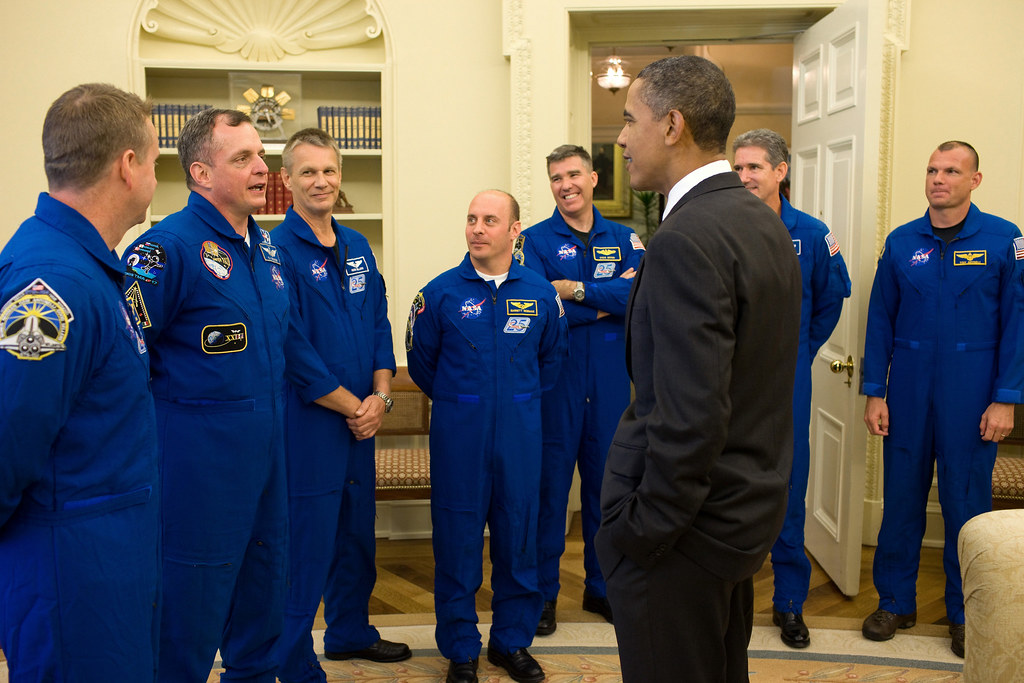
President Barack Obama greets crew members from the Space Shuttle Atlantis and the International Space Station in the Oval Office, July 26, 2010. (Official White House Photo by Pete Souza)
Learn more about TechnologyReflections on the NNI – Coordination & Partnerships
Posted by on July 26, 2010 at 9:25 AM EDT[Ed. Note: This has been cross-posted from strategy.nano.gov]
In the 1990s, I worked for President Clinton’s National Economic Council. Starting in 1998, I worked with a broad range of science agencies to develop the National Nanotechnology Initiative, which President Clinton unveiled in January 2000.
The President’s Council of Advisors on Science & Technology concluded in their recent review of the NNI that the government needs to continue to support fundamental nanoscale science and engineering, but that the federal government also needs to place a greater emphasis on exploitation and commercialization. Below are a few ideas with respect to coordination and partnerships, the topic of this week’s questions being discussed on the NNI Strategy Portal:
First, we need to identify some particular drivers or applications of nanotechnology that are likely to be economically important, and will help meet critical national objectives. The NNI Signature Initiatives are one attempt to identify such areas, whether it’s extending Moore's law beyond the limits of today's silicon-based integrated circuits, or developing solar cells as cheap as paint. The NNI Signature Initiatives are a new way for Federal agencies to work together through greater program-level coordination. Do you have ideas about other ways that Federal agencies can work together, or examples from past efforts that we should consider? What’s the best way to involve industry in these signature initiatives?
A second idea to help the U.S. exploit and commercialize nanotechnologies is a greater emphasis on cost-effective, repeatable, high volume manufacturing. How do we incorporate nanoscale “building blocks” into complex, integrated, functional nanosystems? What partnerships would strengthen the U.S. nanomanufacturing base?
Third, it is worth exploring how the U.S. Government can support more university-industry collaboration as a way of accelerating the transition of ideas from the lab to the marketplace. For example, the semiconductor industry’s Nanoelectronics Research Initiative is a partnership designed to demonstrate novel computing devices capable of replacing the CMOS transistor as a logic switch in the 2020 timeframe. Is this a model that we could try to replicate in other industries? What other sectors would be interested in jointly funding university-based research that is beyond the time horizons of individual firms? Do we have the funding mechanisms to support large-scale, government-industry-university collaborations?
A partnership model to effectively engage the research community in agenda-setting is the Computing Community Consortium (CCC). With support from the National Science Foundation, the CCC allows the computer science community to establish a vision for the field and quickly mobilize the community to pursue “big ideas.” Could this type of consortium work for the nanotechnology research community?
Over the next 10 years, we will continue to see new products with significant improvements in performance and functionality. Please take some time to post your ideas and join the discussion at the NNI Strategy Portal. The Administration needs your insight and expertise as we support research to build “a future in which the ability to understand and control matter at the nanoscale leads to a revolution in technology and industry that benefits society.”
Tom Kalil is Deputy Director for Policy in the White House Office of Science and Technology Policy
Learn more about TechnologyScience and Technology an Indispensible Part of U.S. Development Policy Worldwide
Posted by on July 22, 2010 at 3:20 PM EDTIn January, on the same day I took my oath of office to be Administrator of the U.S. Agency for International Development (USAID), I met with the President’s Council of Advisors on Science and Technology (PCAST). Together we discussed President Obama’s strong support of science, technology, and innovation as an indispensible component of U.S. development policy as we seek to support developing communities worldwide.
Last week marked a major milestone in the Administration’s efforts to advance this goal. Together with the President’s science and technology advisor Dr. John P. Holdren and Secretary of State Hillary Clinton, USAID co-hosted a conference entitled Transforming Development through Science, Technology, and Innovation. We welcomed more than sixty of the top thought leaders in science and development, from within and outside the Federal government, to help us identify a set of “grand challenges” and explore how science and technology can be used to help solve them. These challenges include such acute development needs as installing piped drinking water for households, deploying high-quality irrigation systems with locally-accessible replacement parts, and using the latest mobile technologies for banking, sharing vital health data, paying salaries, and checking commodity prices.
At the conference’s closing event, Secretary Clinton made note of the many development-related “quantum leaps” that science has already enabled, such as the smallpox vaccine that within just a few years turned the tide in global health, mobile banking programs that have helped local economies in Kenya and the Philippines, and updated “green revolution” farming techniques that have boosted productivity in marginal environments. Science, technology, and innovation, she said, can be great equalizers that increase opportunity and prosperity for all.
Last Friday, after the conference had concluded, I again met with PCAST to discuss our findings and how USAID can continue to deliver the transformational promise that science and technology hold for poor communities around the world. We also talked about how these advancements will allow specific key development priorities, such as Feed the Future and the Global Health Initiative, to become more scalable and sustainable.
New technologies alone won’t be a silver bullet for development; we also need to ensure that our implementation, distribution, and communication networks with partner countries are strategically coordinated at all levels. But science, technology, and innovation can help us leapfrog development problems that can otherwise take generations to tackle. They can bridge the divide between the public and private sectors and help us bypass obstacles previously considered insurmountable. And they can help USAID change the way we do business with the more than 80 nations in which we work.
The President’s leadership on this issue has been remarkable and I am tremendously optimistic about our opportunity to increase the impact of USAID’s work with developing communities worldwide in the coming years.
Dr. Rajiv Shah, M.D. is Administrator of the U.S. Agency for International Development
Learn more about Technology
- &lsaquo previous
- …
- 135
- 136
- 137
- 138
- 139
- 140
- 141
- 142
- 143
- …
- next &rsaquo


White House Blogs
- The White House Blog
- Middle Class Task Force
- Council of Economic Advisers
- Council on Environmental Quality
- Council on Women and Girls
- Office of Intergovernmental Affairs
- Office of Management and Budget
- Office of Public Engagement
- Office of Science & Tech Policy
- Office of Urban Affairs
- Open Government
- Faith and Neighborhood Partnerships
- Social Innovation and Civic Participation
- US Trade Representative
- Office National Drug Control Policy
categories
- AIDS Policy
- Alaska
- Blueprint for an America Built to Last
- Budget
- Civil Rights
- Defense
- Disabilities
- Economy
- Education
- Energy and Environment
- Equal Pay
- Ethics
- Faith Based
- Fiscal Responsibility
- Foreign Policy
- Grab Bag
- Health Care
- Homeland Security
- Immigration
- Innovation Fellows
- Inside the White House
- Middle Class Security
- Open Government
- Poverty
- Rural
- Seniors and Social Security
- Service
- Social Innovation
- State of the Union
- Taxes
- Technology
- Urban Policy
- Veterans
- Violence Prevention
- White House Internships
- Women
- Working Families
- Additional Issues