
Office of Science and Technology Policy Blog
Polishing Technology’s Golden Triangle
Posted by on June 15, 2010 at 1:24 PM EDTNew technologies are changing our world fast, as is obvious to anyone using the latest smart phone, wearing the latest nano-fiber fabric, or filling a prescription for the latest biotech-derived medicine. Now the President’s Council of Advisors on Science and Technology (PCAST) wants to hear from you about how the Federal government can best use its resources so three of the newest and most promising technologies provide the greatest economic benefits to society.
This information-gathering process is being coordinated by the President’s Innovation and Technology Advisory Committee (PITAC), part of the PCAST. Through PCAST, PITAC advises the President on matters involving science, technology, and innovation policy. As part of its advisory activities, PITAC is soliciting information and ideas from stakeholders—including the research community, the private sector, universities, national laboratories, State and local governments, foundations, and nonprofit organizations—regarding a technological congruence that we have been calling the “Golden Triangle.”
Each side of the Golden Triangle represents one of three areas of research that together are transforming the technology landscape today: information technology, biotechnology, and nanotechnology. Information technology (IT) encompasses all technologies used to create, exchange, store, mine, analyze, and evaluate data in its multiple forms. Biotechnology uses the basic components of life (such as cells and DNA) to create new products and new manufacturing methods. Nanotechnology is the science of manipulating and characterizing matter at the atomic and molecular levels. Each of these research fields has the potential to enable a wealth of innovative advances in medicine, energy production, national security, agriculture, aerospace, manufacturing, and sustainable environments—advances that can in turn help create jobs, increase the nation’s gross domestic product (GDP), and enhance quality of life. In combination, through what some have called the nano-bio-info convergence, the potential for these fields to transform society is even greater.
PITAC is interested in gaining a better understanding of how the Federal government can enhance this potential, and would like to gather public information and input as to how to best do so. It is posing the following question:
What are the critical infrastructures that only government can help provide that are needed to enable creation of new biotechnology, nanotechnology, and information technology products and innovations that will lead to new jobs and greater GDP?
We’d like to hear your thoughts regarding unique opportunities at the intersections of these fields; where the basic research is taking us and what knowledge gaps remain; impediments to commercialization and broad use of these technologies; infrastructure required to properly test, prototype, scale, and manufacture breakthrough technologies; where the Federal government should invest and focus; and what Federal policies or programs relating to these technologies are in need of review and whether new programs or policies may be needed in light of recent and anticipated advances in these fields.
There are two ways you can share your thoughts on this topic. First, you can go to the OpenPCAST website, where you can contribute your ideas on this and a few related questions. Second, you can be part of a live Webcast discussion scheduled to take place on Tuesday, June 22 from 10 am to 2:30 pm. You can watch the Webcast on the PCAST website and submit your comments via Facebook or Twitter. See the PCAST site for more details.
The information we gather from these activities will guide PCAST/PITAC as we recommend policies and programs relevant to the Golden Triangle of technologies, and as we continue our work to propose ways to implement the President’s “Strategy for American Innovation.” It will also help us identify studies that might be conducted as part of PCAST/PITAC’s “Creating New Jobs through Science, Technology, and Innovation” initiative.
We look forward to hearing from you!
Shirley Ann Jackson and Eric Schmidt are members of PCAST
Learn more about TechnologyNASA Launches Summer of Innovation
Posted by on June 10, 2010 at 1:09 PM EDTSummer is such a wonderful time of year—especially for our young people. School is out, the sun is shining—it’s time for less work, more play. Well you know that saying about too much of a good thing not being such a good thing? That theory applies to summer in some ways. Research shows that during the summer most students become victims of “summer slide”—the loss of academic skills that students gained during the school year. This slide appears to be even more pronounced for underserved and underperforming students and for those, such as girls and minorities, who are underrepresented in science and engineering professions. So how do we combat this problem? I have a plan.
Today at the Jet Propulsion Laboratory, NASA will kick off a new project called the Summer of Innovation, which supports the President’s Educate to Innovate campaign. This is NASA’s first initiative supporting intensive STEM—science, technology, engineering, and math—summer learning opportunities for middle school students and teachers, with a particular focus on students who are underrepresented, underserved and underperforming in STEM. NASA is in a unique position to make this program successful, and at the same time, fun for the students. And when these students and teachers go back to school in the fall, NASA plans to be right there with them! Through direct interaction with our many missions and programs—together with the experts who run them—we’ll continue to convey the excitement of STEM learning and the marvelous opportunities that lie ahead for those who get engaged in it.
This is important to me! Education is a passion of mine, and you might say “I got it honestly”. I was born and raised in Columbia, SC, and my parents were public school teachers. That’s not an easy profession. The hours are long and the wages are modest, yet despite this, they loved each and every day of their work. They made the hard choice to remain in public education because they knew it was their opportunity to inspire thousands of students and to give them the foundation they would need to take their places in national, state, and local leadership. So it was my parents’ dedication that instilled in me this deep and personal passion for education.
But aside from my passion about education, there’s a more practical reason to advocate STEM learning. There is a crisis in this country that comes from the gap between our growing need for scientists, engineers, and other technically skilled workers, and our available supply. This crisis in education, if not resolved, will contribute to future declines in the number of qualified employees to meet demands in critical career fields that affect U.S. global competitiveness and the national economy. As the President has wisely noted, “The country that out-educates us today will out-compete us tomorrow.” Through the Summer of Innovation project, we at NASA want to inspire kids to get involved, to learn and to be part of an exciting and meaningful career path—and we have just the tools to do that. This is an exciting endeavor, and I promise you that these students and teachers will have access to NASA’s best and brightest to help ensure a successful Summer of Innovation experience.
I have said this before—NASA inspires the next generation through our compelling missions, but we must do more. We will continue to move things to the next level by directly engaging students in dynamic STEM activities that form the basis of our work. When students can get involved directly with NASA's missions in all their diversity, they just might take that next step to join us and take part in the nation's future in exploration. But we cannot do this alone. The Summer of Innovation will be a broad, nationwide program that leverages partnerships from many sectors—academia, industry and government. Together we will make a differenceby providing stimulating, relevant learning for our middle schoolers this summer. I look forward to the great things we will accomplish as we embark on this exciting journey.
Charlie Bolden is the Administrator of NASA
Learn more about Education, TechnologyWinning the Presidential Award for Excellence in Math and Science Education
Posted by on June 9, 2010 at 6:58 PM EDTEd. Note: On Monday, President Obama announced the winners of the 2009 Presidential Award for Excellence in Mathematics and Science Teaching. This year the award was given to 103 math and science teachers from across the country teaching 7th through 12th graders. Nate Childers, a science teacher at Hart Middle School in Rochester, Michigan is one of the recipients of the award.
Wow, what a feeling! I never would have guessed 20 years ago that I would be awarded the Presidential Award for Excellence in Mathematics and Science Teaching. At that time, I was working on a marketing degree and working for General Motors. After realizing that the corporate environment wasn’t for me and having a chance interaction with my old high school principal, I decided to pursue a career in education. It’s the best decision I ever made.
I love teaching because I can make science come alive in students' lives. In my classroom, I use real-world scenarios to engage students:
- In “Quakeville,” students are part of an architectural team trying to learn about a city's seismic activity and then designing and constructing a building for the city at the site they proposed.
- In “Handling a Hurricane,” students are community members in a city with an approaching hurricane. They must track the hurricane, make decisions about evacuation and also design and construct a house that can withstand hurricane force winds.
The tragic events around the world this year have brought a new level of relevance to the topics we study. For example, the earthquake in Haiti hit as we were studying plate tectonics. I put together a presentation and brought together students from other science classes to show the students the events that led to the destruction. The Icelandic volcanic eruption occurred after my students learned about volcanoes and during their study of climate. Now, there is the oil spill in the Gulf of Mexico. Even though the full extent of the impact on marine life and the environment will not be known for some time, I have used the opportunity to help students see how interacting earth systems are impacted by human activities.
My classes also do real-world science: since 1994, my students have monitored chemical and biological indicators at a local stream. They compile and analyze trends from the collected data in order to draw conclusions about the health of the stream. This data is sent to our local watershed council and is used by local and state officials to make land use decisions. In fact, after uncovering a problem at our monitoring site in 1999, the state issued a cease and desist order to a construction site until proper erosion control measures were put in place. It was very empowering for students to see that they can make a difference in their community through science.
I find that bringing media and technology into the classroom is another way to grab students’ attention and improve learning. For example, I use an interactive whiteboard daily to present information, show video clips, and compile class data for analysis. I also use electronic student response systems to assess student understanding quickly and then tailor instruction to their needs. Being aware of new tools that are available and not being afraid to try them in the classroom has really improved my students’ experience.
I constantly search for technology that will enhance what the students are learning, and am on an endless quest for new ways to teach challenging concepts and help science come alive for my students. I am never satisfied and always strive to make things better, more relevant, and more engaging.
Many tremendous people have helped me mature into a confident teacher over the years: my middle school and high school principal, Gary Doyle, motivated me to become a teacher years after I graduated; I still hear Dan Hickey’s wise advice 15 years after he hired me; and - most importantly - my wife, also a teacher, constantly offers great ideas, advice, and support. For any new teachers out there, I’d offer two bits of advice that have helped me: surround yourself with positive people and whenever you are making a decision, choose what is best for the student.
I have been blessed to work at a great school with very motivated, hard working people. They inspire me every day to do more for students, for our school, and for our profession. I am honored and humbled by this recognition, and I only hope that all teachers get the recognition and respect they deserve.

Nate Childers and his 7th grade science class at Hart Middle School in Rochester, Michigan.
Nate Childers is a science teacher at Hart Middle School in Rochester, Michigan.
Learn more about EducationConference Marks One-Year of Work Following President Obama's Speech
Posted by on June 9, 2010 at 10:29 AM EDT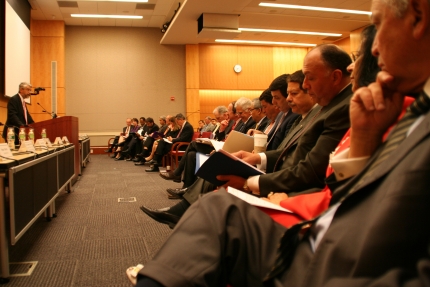
OSTP Director John P. Holdren delivers opening remarks at a conference yesterday marking the one-year anniversary of President Obama's Cairo speech. June 8, 2010. (by Phil Larson)
The Office of Science and Technology Policy yesterday convened a conference celebrating the one-year anniversary of President Obama’s momentous remarks in Cairo that called for increased partnerships with the Muslim world. Science and technology collaborations have played a critical role in developing the new relationships the President called for. And the number of productive exchanges between Federal agencies and their counterparts in Muslim communities around the world has grown considerably in the past year, said OSTP Director John Holdren.
“Almost a year to the day after President Obama made his historic commitment in Cairo to embark on a voyage of renewed engagement with the Muslim world, there is much progress to be proud of and much to celebrate,” said Holdren, speaking to about 150 representatives from embassies, non-governmental organizations, and Federal science agencies at the National Academies’ Keck Center in Washington, DC.
Other speakers at the event—which highlighted accomplishments in the past year and looked ahead to new commitments—included Ralph J. Cicerone, President of the National Academy of Sciences; Rep. Rush Holt (D-N.J.); Maria Otero, Under Secretary of State for Democracy and Global Affairs; Harold Varmus, co-chair of the President’s Council of Advisors on Science and Technology; and General James L. Jones, National Security Advisor to the President.
The event also featured presentations from the Nation’s first three “science envoys,” who were deployed around the globe during the past year to help build connections to scientists and engineers and their institutions in the Muslim world: Elias Zerhouni, former director of the National Institutes of Health; Nobel Prize-winning chemist Ahmed Zewail; and Bruce Alberts, Editor-in-Chief of the journal Science. They were introduced by diplomatic officials from three of the more than ten countries they visited in the past year: Ambassador Sameh Shoukry, the Ambassador of Egypt to the United States; Ambassador Abdallah Baali, Ambassador of Algeria to the United States; and T.H. Salman Al Farisi, Acting Charde d’Affairs of Indonesia.
Among the envoy’s comments:
- “We were welcomed everywhere," said science envoy Ahmed Zewail, who traveled to Turkey, Egypt, Qatar, and Dubai. Zewail spoke of the importance of improving educational opportunities in Muslim-majority countries and emphasized that there is a great hunger for better education in these nations. The heritage and culture of the Muslim world strongly promote education and intellectual development, he said, "despite what you read sometimes in the media."
- "The message of the President in his Cairo speech ... resonated very forcefully" with people in every country we visited, said science envoy Elias Zerhouni. Of course, Zerhouni said, there is still mistrust in some quarters. "We welcome the new beginning," people told him on his travels. "The problem is follow-through." In the past, people told him, Memoranda of Understanding have been signed but not always implemented, leading to what Zerhouni called "MOU fatigue." The good news, Zerhouni said, is that he got a strong sense in his travels that President Obama is seen as taking such commitments seriously. "I think the President has moved the needle," Zerhouni said.
- Science envoy Bruce Alberts reiterated the high regard with which the Muslim world holds the US science and technology enterprise. Indeed, he said, one thing young scientists in Indonesia said they wanted most from the United States is help modeling a merit-based system of science and technology funding like the one in America, which is renowned around the world for how effectively it has rewarded the very best science. "We take that for granted in the United States," Alberts said, "but there is almost no competitive science funding in Indonesia." Now is a great opportunity to provide such guidance, he added, as the Indonesian government has committed to increasing its investment in research and development.
Dr. Holdren noted that efforts like the President’s Cairo initiative cannot change the world immediately, but over a period of years can have a big impact. “The path will have some twists and turns and we cannot expect attitudes to wholly reverse themselves in a year or even two,” Dr. Holdren said. “But they can shift. And they must—both here and abroad. The important thing is to keep going.”
For more information on how we are pursuing the vision articulated by President Obama in Cairo last June, including a list of major accomplishments, visit OSTP's Global Science Diplomacy page.
Learn more about , Foreign PolicyPresident’s “Cairo Initiative” Celebrates a Year of Progress
Posted by on June 4, 2010 at 12:20 PM EDTOn Tuesday, June 8, OSTP Director John Holdren will provide keynote remarks at an event commemorating President Obama’s June 4, 2009, speech at Cairo University, which called for deepening relations between the West and Muslim communities around the world. In that speech, President Obama described how America’s strength in science and technology could be enlisted to forge partnerships with Muslim communities and help solve many of our shared challenges. He spoke of appointing a team of “science envoys” to collaborate on programs to develop new sources of energy, create green jobs, digitize records, purify water, and grow new crops. And he spoke of launching a new fund to support technological development in Muslim communities and help transfer ideas to the marketplace to create more jobs.
Tuesday’s event, at the National Academies’ Keck Center in Washington, DC, will celebrate the one-year anniversary of that “Cairo Initiative.” It will recognize the substantial progress that has been made to date, including the creation of new exchange programs and the deployment of America’s first three science envoys, who have in recent months traveled to more than 10 nations, including Egypt, Algeria, and Indonesia and will recount their experiences at the event. It will also highlight new commitments for further engagement and provide an opportunity for the diplomatic, science and technology, and non-governmental organization communities to comment and ask questions about the path ahead.
Among the many notable achievements to date:
- An Entrepreneurship Summit led to the creation of support networks encompassing business and social entrepreneurs, venture capitalists, development bankers, and other business experts to promote development in a number of countries.
- NASA teamed up with USAID to develop “SERVIR Africa,” a program that monitors and forecasts ecological change and allows participating nations to respond to regional natural disasters. NASA now has 39 agreements with 30 Muslim-majority nations.
- USAID awarded six new Middle East Regional Cooperation projects to fund applied research and science and technology cooperation between Israel and Jordan, West Bank/Gaza, and Tunisia, regarding agriculture, global and regional health, and environmental protection.
- EPA partnered with the City of Jakarta, Indonesia, to create an air quality management program to develop and apply science-based urban air pollution control strategies, programs, and tools, with the goal of improving air quality and human health.
Among the activities planned for the near future:
- The U.S. Department of the Interior will work with the Government of Morocco to promote better management and protection of endangered species by creating a Red List of nationally endangered species. Both agencies will also cooperate to strengthen the implementation of the Convention on International Trade in Endangered Species to promote sustainable tourism development.
- Three new science envoys will be named by the State Department with missions in Central Asia, East and West Africa, and Southeast Asia.
- The National Science Foundation will promote exchange visits by students to conduct research and take courses in areas such as materials science, biology, chemistry, and energy in Muslim communities. This will also allow greater linkage between NSF-funded science/engineering centers and equivalent facilities in Muslim communities.
Clearly much has been accomplished, and more is poised for fruition in the year ahead. A draft agenda for the meeting can be found here. For those who cannot attend, a live audio-cast will be available at www.whitehouse.gov/ostp.
Erin Szulman is a student volunteer at the White House Office of Science and Technology Policy
Learn more about , Foreign Policy"Hacking for Humanity"
Posted by on June 3, 2010 at 5:05 PM EDT“Hacking for Humanity”—never thought you’d hear that phrase, right? Well, Google, Microsoft, NASA, The World Bank, and Yahoo! have joined forces to turn that into a reality and bring us Random Hacks of Kindness, an initiative that brings together the sustainable development, disaster risk management, and software developer communities to solve real-world problems with technology.
After a successful inaugural event last year in California that produced software solutions used during the recent earthquakes in Haiti and Chile, the partners have decided to take the effort global. Random Hacks of Kindness is gearing up for its first worldwide “Hackathon for Humanity” on June 4-6, 2010. The global Hackathon will feature a marathon weekend of hacking and coding competitions geared toward developing software that saves lives, alleviates suffering, and helps communities to recover after natural disasters strike. Hackathon events are set for Washington DC, Sydney, Nairobi, Jakarta, and Sao Paulo.
The event here in DC, held in conjunction with the DC Crisis Camp and the World Bank’s Understanding Risk Conference: Innovation in Disaster Risk Assessment, will begin with a reception hosted by the Global Partnerships Office at the U.S. State Department and will be followed by 48 hours of hacking at Microsoft’s Washington, DC, office. Participation is free and open to everyone, so software engineers, hackers, students, and volunteers, grab your laptops and come out this weekend to put your expertise to work in helping to solve some of the most pressing issues we face around the world! For more info and to register for the DC event, please visit http://rhokdc.eventbrite.com/?src=2m.
Aneesh Chopra is United States Chief Technology Officer
Learn more about Technology
- &lsaquo previous
- …
- 139
- 140
- 141
- 142
- 143
- 144
- 145
- 146
- 147
- …
- next &rsaquo


White House Blogs
- The White House Blog
- Middle Class Task Force
- Council of Economic Advisers
- Council on Environmental Quality
- Council on Women and Girls
- Office of Intergovernmental Affairs
- Office of Management and Budget
- Office of Public Engagement
- Office of Science & Tech Policy
- Office of Urban Affairs
- Open Government
- Faith and Neighborhood Partnerships
- Social Innovation and Civic Participation
- US Trade Representative
- Office National Drug Control Policy
categories
- AIDS Policy
- Alaska
- Blueprint for an America Built to Last
- Budget
- Civil Rights
- Defense
- Disabilities
- Economy
- Education
- Energy and Environment
- Equal Pay
- Ethics
- Faith Based
- Fiscal Responsibility
- Foreign Policy
- Grab Bag
- Health Care
- Homeland Security
- Immigration
- Innovation Fellows
- Inside the White House
- Middle Class Security
- Open Government
- Poverty
- Rural
- Seniors and Social Security
- Service
- Social Innovation
- State of the Union
- Taxes
- Technology
- Urban Policy
- Veterans
- Violence Prevention
- White House Internships
- Women
- Working Families
- Additional Issues