
Office of Science and Technology Policy Blog
National Lab Day: Dinner with a Scientist
Posted by on May 12, 2010 at 3:34 PM EDTAs a former middle school science teacher, I know teachers and students rarely have an opportunity to interact with the scientific community on common ground. Yes, there are great professional development opportunities for teachers at research facilities and college tours for students, but seldom do we put all three groups in the same room and offer an opportunity for conversation. This was the impetus for our National Lab Day event Dinner with a Scientist, an event where we invite local scientists to talk about their work and share activities in a format that is part career day, part prom, and part speed dating.

Chani Sentiwany, Criminalist from the Oakland Police Department Crime Laboratory, shares how forensic biology is used to solve crimes. May 12, 2010. (by Oakland Unified School District)
On May 5th, 250 Oakland secondary students, teachers, and scientists gathered at the Oakland Zoo to see the animals up close and talk about science in a semiformal setting.
Twenty-five scientists attended including researchers from UC Berkeley who shared about particle astrophysics, engineers from Lawrence Berkeley National Lab who discussed materials in computer chips, and chemists from Chevron who talked about the environment. Every thirty minutes, scientists would change tables and meet a different group of teachers and students.
The global importance of science was also highlighted by Oakland Zoo’s Amy Gotliffe who shared about her work as a conservationist and how important it is to change the habits and mindsets of people in the United States and Africa.

Amy Gotliffe, Conservation Manager for the Oakland Zoo, holds up a walrus tusk to talk about the importance of conservation to students from Montera Middle School and United for Success Academy. May 12, 2010. (by Oakland Unified School District)
Abbey Barnard a teacher from United for Success Academy, brought three eight graders who were really interested in science. Among them was a student that recently immigrated to the United States. He was excited learn about conservation around the world and also commented on the fact that eating with silverware was a cross-cultural experience!
Dinner with a Scientist is a unique opportunity for teachers to link their students with working scientists. Discussions ranged from the daily work of scientists to life in college to early childhood experiences, and teachers who influenced their careers. No topic was off limits or too rigorous. The eighth graders discussed multiverses with a physicist from the Space Science Laboratory with ease!
This event was so successful that we’ll host a second Dinner with a Scientist event on June 2nd for upper elementary students and teachers. For more details, checkout the Science in Oakland website.
Whether you’re a teacher or a scientist, getting involved with National Lab Day is easy. To learn more about how to get involved check out these videos on the National Science Foundation website or visit NationalLabDay.org.
Caleb Cheung is the Science Manager for Oakland Unified School District
Learn more about Education, TechnologyHoldren Makes Impact (Craters) on National Lab Day
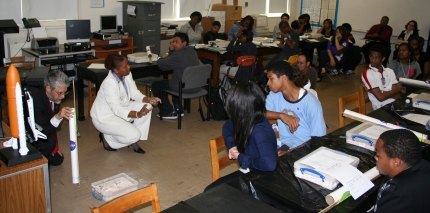
Posted by on May 12, 2010 at 2:56 PM EDTOSTP Director John Holdren visited Room 309 of Banneker High School in Washington, D.C., this morning, part of an infusion of top Administration officials into area schools for National Lab Day. Dr. Holdren met with about 40 high school physics students and participated in a hands-on discovery activity.
After describing what it’s like to be President Obama’s science and technology advisor, Dr. Holdren took several tough questions from the student audience. Students wanted to know about OSTP’s contribution to a wide range of challenges facing the Nation, including climate change, the oil spill in the Gulf of Mexico, and the energy challenge. Students were also very interested in learning how they could get involved in the science and technology domains after high school.

May 12, 2010. (by Phil Larson)
Following the Q&A, Dr. Holdren joined the students in literally getting their hands dirty in an educational activity set up by NASA. Students created a simulated asteroid surface using a mixture of soil, flour, and other ingredients. Then, using golf balls and a protractor, they observed how changes in the angle of a projectile’s impact affected the area and volume of the resulting craters.
May 12, 2010. (by Phil Larson)
As teams of students got into the fun of crater-making and measurement, Dr. Holdren moved from group to group, discussing their results and observations. He also got the students thinking beyond the experiment’s bounds:
"Now that you’ve performed the experiment and seen what happens to the impact crater when you change its angle of impact, think about what would happen if you changed the projectile’s speed—if you dropped it from a higher altitude—or how would a different surface material affect the crater made by a projectile?"
National Lab Day is more than just a day. It is a multi-year initiative that is a nationwide effort to promote hands-on learning through collaborations between K-12 classes and working professionals. The NLD website matches these students for collaboration with scientists, engineers, IT professionals, architects, and other experts working in those fields. Launched in beta this past January, National Lab Day is already working with more than 1,000 schools in all 50 states to promote learning through exploration.
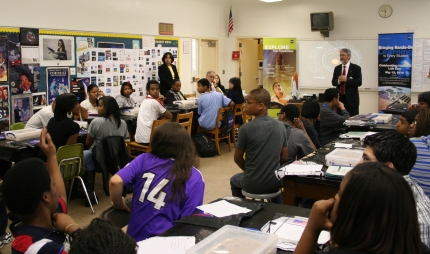
May 12, 2010. (by Phil Larson)
The grassroots effort demonstrated by Dr. Holdren’s visit today responds to President Obama’s call to action less than six months ago for federal scientists to get involved in educational opportunities such as the National Lab Day project. The Department of Energy, National Institutes of Health, NASA, and the National Science Foundation, among others, have all responded to the President's call with direct outreach to their scientific communities and employees.
We are encouraged by the abundant response this initiative has generated, and hope that you will visit NationalLabDay.org and get registered to become a part of this great cause!
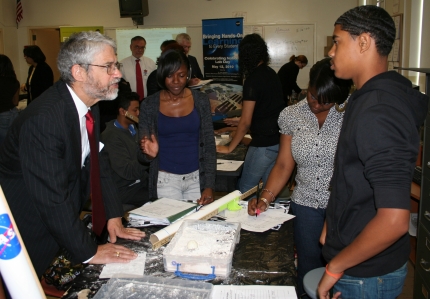
(Photos by Phil Larson) May 12, 2010. (by Phil Larson)
Learn more about Education, TechnologyNational Lab Day Liftoff
Posted by on May 12, 2010 at 9:20 AM EDTIt's no secret that America is going to need many more young people to pursue science and technology professions in the future. As we celebrate National Lab Day on May 12, we have an opportunity for people currently in these careers to work with students and teachers and get them excited about science, technology, engineering and mathematics (STEM) subjects. But National Lab Day is more than just one single day in the year. It's really a collaborative movement to support people who work in our classrooms to inspire tomorrow’s innovators.
I have a particular interest in activities like this. I was born and raised in Columbia, SC – the son of two public school teachers who, despite very long hours and modest wages, loved each and every day of their work. They made the hard choice to remain in public education because they knew it was their opportunity to inspire thousands of students and to give them the foundation they would need to take their places in national, state, and local leadership. My parents’ dedication instilled in me a deep and personal passion for education.
Yesterday, I had the opportunity to follow in my parents’ footsteps for a day and work with Lisa Hedgepeth’s fifth grade students at Langdon Education Campus, a school located in Washington, DC. These students have been studying the solar system, and I had the opportunity to share with them my experience of living and working in space as a NASA astronaut before I became the NASA Administrator. We spent time discussing Newton’s Laws of Motion with me giving them examples of ways in which we are able to demonstrate those laws real-time while in the weightless environment of space. We had an energetic discussion on how these laws are present in everyday life.
Learn more about Education, TechnologyApps for Healthy Kids “Game Jams” Coming to a City Near You
Posted by on May 11, 2010 at 4:36 PM EDTIn unveiling the Childhood Obesity Task Force action plan earlier today, First Lady Michelle Obama underscored the need to “marshal every resource” to solve the problem of childhood obesity within a generation. Two new partnerships announced today as part of the Apps for Healthy Kids competition will give Americans across the country a chance to join the First Lady in her Let’s Move! campaign—and to help give kids the healthy lives they deserve.
Today, the U.S. Department of Agriculture announced it would partner with the International Game Developers Association (IGDA) to host game jams on the weekend of May 21-23 in major U.S. cities, including Boston, New York, San Francisco, and Atlanta. The game jams will draw game developers, graphic artists, and local youth together to brainstorm ideas and produce video game prototypes from scratch in just 48 hours. The prototypes will be displayed at the sixth annual Games for Health Conference, further refined, and ultimately submitted to the Apps for Healthy Kids competition before that competition’s June 30th deadline. You can find out more about jams near you on the Health Games Challenge website.
Launched by the U.S. Department of Agriculture, the White House Office of the First Lady, and the White House Office of Science and Technology Policy on March 10, 2010, the Apps for Healthy Kids competition challenges software developers, game designers, students, and other innovators to develop innovative, fun, and engaging tools and games that help kids and their parents eat better and be more physically active.
The game jams—which will be scheduled in a number of additional cities soon—will be great opportunities for amateur and experienced game developers to collaborate on competition entries and refine their creations before submitting them. But you don’t need to travel to join in creative collaboration! Developers across the country can now get targeted feedback from the toughest of critics—tweens—anytime and anywhere. Recognizing that kids can’t be beat when it comes to judging whether a game will capture the imagination of their peers, the U.S. Department of Agriculture has partnered with Numedeon, Inc. to create a space within the virtual world Whyville.net where hundreds of thousands of tweens will be able to play, rate, and submit feedback to Apps for Healthy Kids contestants. Developers seeking feedback can post their game prototypes in the Whyville Game Arcade.
By creating opportunities for our nation’s most creative and talented innovators to work together and with our nation’s children, the two new partnerships announced today will maximize the number of high-quality submissions throughout the remaining 60 days of the Apps for Healthy Kids contest.
Robynn Sturm is Advisor for Open Innovation to the Deputy Director of the White House Office of Science and Technology Policy
Learn more about , TechnologyFree Text4baby Service for Moms and Moms-to-Be is Growing up Fast
Posted by on May 7, 2010 at 12:59 PM EDTText4baby, a free program that provides pregnant women and new moms with information they need to take care of their health and give their babies the best possible start in life, is growing up fast! A public-private partnership that includes the White House, text4baby provides free SMS text messages timed to a pregnant woman’s due date or baby’s date of birth. Women who sign up for the service by texting BABY (or BEBE for Spanish) to 511411 get health tips, reminders, and information about community resources available to them.
Announced by U.S. Chief Technology Officer Aneesh Chopra on February 4, 2010, text4baby has already delivered more than 1 million free text messages to over 36,000 moms across the country. We are hearing stories about moms making prenatal appointments, using their seatbelts more safely, following safe sleep practices, and making other changes to keep themselves and their babies healthy. In a novel use of the underlying program, Healthy Mothers, Healthy Babies—the non-profit that runs text4baby—issued an extra message this week to alert moms to the recent recall of a number of pediatric medicines.
One of the most important things that text4baby can do is provide information on how moms and moms-to-be can access additional resources. For example, one of the Spanish messages reads:
Aunque te sientas bien, es importante tener cuidado medico todo el embarazo para mantener sanos a ti y a tu bebe. Llama 800-504-7081 para cuidado. (Even if you feel great, it’s important to get medical care through your pregnancy. It helps keep you and your baby healthy. Call 800-504-7081 for care.)
Hotlines, including the National Hispanic Prenatal Helpline (1-800-504-7081) and National Hunger Hotline (1-866-348-6479) are reporting increases in calls linked to text4baby. Top issues that moms ask about are WIC services (which provide Federally supported food assistance), prenatal care services, and free or low-cost cribs.
And communities across the nation are getting into the action! This week, I joined Philadelphia Health Commissioner Dr. Donald Schwarz and other partners to launch an extraordinary text4baby outreach coalition in Philadelphia. The high-energy event at that city’s Please Touch Museum—organized by the Maternity Care Coalition and with support from ClearChannel Radio—featured several moms-to-be who shared their experiences with text4baby. One woman spoke through a translater about her appreciation for having the service in Spanish, and how useful it is to have reminders and tips coming directly to her phone because she is busy with two other small children as well.
Pennsylvania already ranks 9th in the nation in terms of the percentage of pregnant women and new moms using text4baby, and officials say they intend to climb further in the rankings by getting the word out through state and local government offices, non-profit organizations, and the media. (Click here to find out how your state ranks.)
Text4baby is made possible through a broad, public-private partnership that includes government and tribal agencies, corporations, academic institutions, professional associations and non-profit organizations.Founding partners include the National Healthy Mothers, Healthy Babies Coalition, Johnson & Johnson, Voxiva, the CTIA Wireless Foundation, and WPP. U.S. government partners include the White House Office of Science and Technology Policy and the Department of Health and Human Services. Johnson & Johnson is the Founding Sponsor, and Premier Sponsors include WellPoint, Pfizer and CareFirst BlueCross BlueShield. The mobile health platform is provided by Voxiva and free messaging services are generously provided by participating wireless service providers. Implementation partners include BabyCenter, Danya International, Syniverse, Keynote Systems and The George Washington University.
Hillary Chen is a Policy Analyst in the White House Office of Science and Technology Policy

National and Philadelphia text4baby partners pose for a picture with pregnant and new moms (and their children) after the Philadelphia Text4baby Launch at the Please Touch Museum. (Photo by Kevin Melfi) May 6, 2010.
Learn more about Technology, WomenNew York City Students Get Down and Dirty for National Lab Day
Posted by on May 6, 2010 at 9:48 AM EDTWith a major water main break in Boston and the BP oil spill in the Gulf of Mexico in the news these days, it is obvious how much our country needs well-trained chemical engineers with expertise in pollution prevention and treatment. Professor Benjamin Davis of The Cooper Union College is just such an expert. He had been looking for a way to teach young people the field he loves so that they, too, might know about and choose chemical engineering as a college and career option.
Thanks to an article in the newspaper, he came across a link for National Lab Day—a nationwide initiative to foster collaborations among volunteers, students, and educators—and signed up. Yesterday, at the East Side Community High School on the lower east side of Manhattan, Professor Davis taught 10th graders (as well as this U.S. Deputy CTO) how waste water is treated on an industrial scale. In keeping with the basic tenet of National Lab Day, this wasn't just a lecture. It was a hands-on experiment through which we learned how to clean and purify "contaminated" water—namely 100 ml of tap water that the good Professor had mixed with 18 g of dirt, 10 g of flour, 2 ml of salad dressing, and some dish soap that science teacher Joe Vicente had provided for the experiment.
This get-your-hands-dirty experiment can be traced in part back to last November, when the President launched the "Educate to Innovate" campaign to motivate and inspire students to excel in science, technology, engineering, and math. At that White House event, he announced the launch of National Lab Day and challenged Americans to get involved in a historic grassroots effort to bring hands-on learning to students by upgrading science labs, supporting project-based learning, and building communities of support for STEM teachers.
Since its launch the effort has quickly gained momentum, with National Lab Day projects now scheduled in every state, involving over 1,500 schools already and over 200 science and engineering societies and organizations representing millions of potential volunteers. National Lab Day matches volunteers with schools and teachers to coordinate face-to-face learning opportunities. New York City Schools Chancellor Joel Klein, who attended today's event, complimented the innovative approach of National Lab Day, which brings knowledgeable experts into America's middle and high schools to get kids interested science.
"Yo-Yo Ma is in New York today and he can visit five schools," Klein remarked. "But a program like National Lab Day can put a ‘Yo-Yo Ma’ of science and technology in every classroom." And you never know what these match-ups will lead to, he added. "I had a physics teacher in high school who helped me get a science grant that let me go to college."
And although Yo-Yo Ma was not part of today’s water treatment experiment, TV stars Tim Daly and Andrea Bowen turned up to add some chemistry to the chemistry. And of course, there was pizza.
May 12th is the official National Lab Day kick-off, but National Lab Day isn't just a single day. It's an ongoing, year-round, grassroots effort in participatory citizenship designed to encourage young people, as President Obama has said, "to be makers of things, not just consumers of things."

Students at East Side Community High School in New York learn how to clean up dirty water as part of a National Lab Day experience. (Photos by Beth Noveck)

Beth Noveck is U.S. Deputy Chief Technology Officer
- &lsaquo previous
- …
- 142
- 143
- 144
- 145
- 146
- 147
- 148
- 149
- 150
- …
- next &rsaquo

White House Blogs
- The White House Blog
- Middle Class Task Force
- Council of Economic Advisers
- Council on Environmental Quality
- Council on Women and Girls
- Office of Intergovernmental Affairs
- Office of Management and Budget
- Office of Public Engagement
- Office of Science & Tech Policy
- Office of Urban Affairs
- Open Government
- Faith and Neighborhood Partnerships
- Social Innovation and Civic Participation
- US Trade Representative
- Office National Drug Control Policy
categories
- AIDS Policy
- Alaska
- Blueprint for an America Built to Last
- Budget
- Civil Rights
- Defense
- Disabilities
- Economy
- Education
- Energy and Environment
- Equal Pay
- Ethics
- Faith Based
- Fiscal Responsibility
- Foreign Policy
- Grab Bag
- Health Care
- Homeland Security
- Immigration
- Innovation Fellows
- Inside the White House
- Middle Class Security
- Open Government
- Poverty
- Rural
- Seniors and Social Security
- Service
- Social Innovation
- State of the Union
- Taxes
- Technology
- Urban Policy
- Veterans
- Violence Prevention
- White House Internships
- Women
- Working Families
- Additional Issues