
Office of Science and Technology Policy Blog
“Ask the President’s Science Advisor”
Posted by on May 5, 2010 at 2:34 PM EDT
Science and technology today permeate all facets of our lives and have a great bearing on our Nation’s interests across a wide range of issues. It is the job of the President’s Science Advisor, OSTP Director John Holdren, to know a lot about all those issues—and to be able to become an expert fast on subjects outside his expertise. It’s also his job to share as many of those insights as possible, not just with President Obama but with all Americans. In fact, Dr. Holdren is a big advocate of educating the public around issues of science and technology and the policy issues that relate to these topics. That’s why we decided it would be valuable to incorporate a new feature on OSTP’s web presence—one that requires your participation.
Would you like to know more about science and technology issues facing the Nation and the man advising the President on these matters? We’re not just talking about things you could learn in a textbook. This is about making science personal. Do you want Dr. Holdren’s opinion on, say, technological aspects of pop culture or the relevance of sci-fi? Is there a random query lumbering around in your head, the answer to which you absolutely must have directly from the President’s Science Advisor? Well, wait no longer, because this week OSTP is unveiling “Ask the President’s Science Advisor.”
To ask a burning question of Dr. Holdren, send an e-mail to AskDrH@ostp.gov or tweet your short question to @whitehouseostp with hashtag #AskDrH. Dr. Holdren will select a query and answer it via a short blog post to appear on select Fridays, starting May 14.
So now is your chance to ask America’s scientist-in-chief for his personal take on anything with an arguably scientific or technological bent. Like, what subjects in school left him cold? How about whether he prefers academia or government, or which installment of Star Wars or episode of Star Trek says the most about modern scientific society. We want you to have fun with this and, frankly, ask some of the tough questions about Dr. Holdren that the staff here at OSTP would like to know the answers to but, well, hasn't quite gotten around to asking. For basic info on the man, take a look at Dr. Holdren’s bio.
Thank you in advance for your participation. Dr. Holdren is looking forward to answering your fun and thought-provoking questions!
Phil Larson is a Research Assistant in the White House Office of Science and Technology Policy
Learn more about Education, TechnologyUnified House Applauds Administration Efforts in Science, Math Education
Posted by on May 5, 2010 at 12:05 PM EDTWho says Congress disagrees about everything? Yesterday, the House of Representative voted 378-2 to pass a resolution drawing congratulatory attention to President Obama’s efforts to improve science, technology, engineering and math (STEM) education and the Administration’s Educate to Innovate campaign, which has inspired an “all hands on deck” effort by volunteers, industry, philanthropies, and others to help students get excited about STEM subjects and careers.
The House resolution specifically offers kudos to National Lab Day, a nationwide initiative to build local communities of support that will foster ongoing collaborations among volunteers, students and science educators. It’s an effort that the First Lady highlighted this week as she cheered on the final teams at National Science Bowl. As the First Lady put it:
That's why my husband and his administration want to ensure that every single child in this country gets a good education, particularly in math and science.
Next week’s National Lab Day is a great example of what this might look like—this kind of investment. The President has highlighted his grassroots effort, which brings together scientists like Secretary Chu, organizations representing teachers, scientists, mathematicians, engineers, and local volunteers to work with young people in fun hands-on learning.
These students are going to be with us, they’re going to launch rockets, construct miniature windmills, and learn by doing and not just by listening.
We want to bring more hands-on learning like this to students by also modernizing science labs and supporting project-based learning, and expanding advanced courses in schools throughout the country.
We want to create more opportunities for under-represented groups as well, particularly women and girls. We want them to have the confidence; we want all our young women to have the confidence and the support to take on the study and to succeed in the study of science, math, engineering and technology.
And we want to build communities of support for all the teachers who make these subjects come alive for our students. We couldn't do it without you.
The President, First Lady, and 378 members of Congress can’t all be wrong! So get involved with National Lab Day by volunteering, posting a project, or making a video. May 12 is National Lab Day.
Kumar Garg is a Policy Analyst in the White House Office of Science and Technology Policy
Learn more about Education, TechnologyDesign for America – Visualizing Health Data to Inspire Community Action
Posted by on May 3, 2010 at 11:26 AM EDTFor those of you unable to participate in last Friday’s summit on innovation through prizes, challenges, and open grantmaking, I am pleased to report on an opportunity to put your best ideas to work. One of the participants in Friday’s meeting, the Sunlight Foundation, highlighted the “Design for America” competition, which is offering a $5,000 prize for the best visualization of community health data.
A terrific collection of community health information is already available thanks to the Community Health Data Initiative, one of the Department of Health and Human Services’ (HHS) open-government flagship projects. According to Sunlight, “the visualizations should contribute toward the development of community health data dashboards that will enhance usability and understandability of health data for citizens and civic leaders. Entries will be judged based on how effectively, accurately, and creatively they enable users to gain insight about health performance in their communities as compared to others.”
Are you interested in improving the health performance of your community? Curious about how the quality and cost of healthcare services in your area compare with others? Willing to put your technology talents to work to spur change in our nation’s health system? Then spend a few weeks figuring out how to visualize the most compelling data sets available free of charge at HHS.
I am hopeful that when we tap into the creativity and entrepreneurial spirit of the American people, we will strengthen our democracy and help improve the lives of everyday Americans. Thanks for participating.
Aneesh Chopra is U.S. Chief Technology Officer and Associate Director for Technology in the White House Office of Science and Technology Policy
Learn more about Health Care, TechnologyOSTP Director Holdren Speaks Out for Girls in Science, Math, and Engineering
Posted by on April 30, 2010 at 4:46 PM EDTOSTP Director John Holdren today participated in a roundtable discussion about gender equity in math and science education, organized by Sally Ride, the first American woman in space. The event, held at the Willard Hotel and moderated by NBC Capitol Hill Correspondent Kelly O’Donnell, was designed to bring together luminaries from the education, business, and policymaking arenas to discuss the critical need for students, particularly girls, to pursue studies and careers in science, technology, engineering, and mathematics.
Dr. Ride is President and CEO of Sally Ride Science, a science education company that creates programs and products for students and teachers in elementary and middle school. As America’s first woman in space (she flew twice, first in 1983 aboard the Space Shuttle Challenger and again aboard Challenger in 1984) and as the first director of NASA’s Office of Exploration, Dr. Ride has a longstanding interest in encouraging girls to pursue coursework and careers in science and engineering.
Other participants in the discussion included Dr. Laurie Leshin, NASA’s Deputy Director for Science and Technology, and Dr. Cora Marrett, Acting Deputy Director of the National Science Foundation.
In the 4th grade, panelists noted, the number of girls and boys who say they like math and science is about the same. By 8th grade, twice as many boys as girls show an interest in these subjects. Much of the discussion focused on the need for more female role models in science and engineering. Studies suggest that because of the lack of female scientist role models in the media, many girls do not see themselves as "doers" of science.
“We need to step up our efforts in science, technology, engineering, and math education in this country, capturing and holding the interest in these subjects of more girls and boys alike,” said Dr. Holdren, the sole holder of a Y chromosome on the panel. “Getting this done is one of President Obama’s highest priorities.”
Panelists discussed the need for an "all hands on deck effort" and the contributions that everyone can make, such as getting involved in National Lab Day, one part of the President's Educate to Innovate initiative.
The panel capped a week of high-profile meetings for the OSTP Director. On Thursday he co-chaired, with Russian Minister of Education and Science Andrey Fursenko, the first full-committee meeting of the Science and Technology Working Group under the US-Russia Bilateral Presidential Commission. Fursenko brought a delegation that included Ambassador Edward Malayan from the Foreign Ministry. The U.S. delegation included officials from the Departments of Energy, State, Commerce/NOAA, and Interior/USGS, as well as the NSF, NASA, and others.
On Tuesday Dr. Holdren gave the opening keynote address at a strategic planning meeting that engaged leaders from the 13 participating agencies of the U.S. Global Change Research Program, to discuss in part ongoing efforts to strengthen Administration activities in the domains of climate observations and assessment, adaptation research and planning, and climate services.
Flat Stanley Drops in on OSTP
Posted by on April 30, 2010 at 2:07 PM EDTOSTP Director John Holdren took time out from his busy schedule to meet with an unusual visitor this week—Flat Stanley. Stanley is one of many Flat Stanleys traveling the world as part of the Flat Stanley Project, which was launched in 1995 as a means of encouraging third-grade students to correspond with one another by mail. The Project has since blossomed into a viral, global, online phenomenon through which Flat Stanley (or reasonable facsimiles) has visited and been photographed at countless destinations around the world.
Although Stanley got some face time with President Obama a while ago, he has never had an audience with the President’s science advisor. That changed the other day when Stan came to the Nation’s capital during his spring break, with traveling companion Daniel Grossfeld from Miss Groia’s second grade class at Unqua Elementary School in Massapequa, New York.
Here Dr. Holdren, who holds degrees in aerospace engineering and theoretical plasma physics from MIT and Stanford, discusses with Stanley what it is like to exist in a space-time continuum more complex than the one to which this well-traveled but ultimately two-dimensional character is relegated.
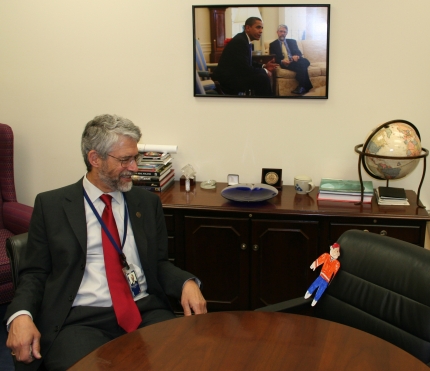
Flat Stanley gets the ear of OSTP Director John Holdren. (Photo by Phil Larson) April 30, 2010. (by Phil Larson)
Learn more about EducationRoom 18, A New Home to the National Medal of Science
Posted by on April 29, 2010 at 10:30 AM EDTPresident Obama's commitment to improving the Nation's education system, especially in science, technology, engineering, and math, can be seen in the wide array of events and initiatives the President has taken part in, including Astronomy Night at the White House, the launch of the Educate to Innovate campaign, and bringing science into this year's White House Easter Egg Roll.
However, the President's commitment can only be the beginning. The real work starts with our Nation's teachers and students at all levels—especially early on. That's why we would like to highlight a unique and innovative lesson plan developed by Caitlin McCabe, a fifth grade teacher at Oak Grove Elementary School in Poughkeepsie, NY. We wanted to share Ms. McCabe's idea with people across America to inspire similar novel concepts.
Ms. McCabe thought of a great way to get her students engaged and interested in science by focusing on the National Medal of Science Awards administered for the White House by the National Science Foundation (NSF). She and her class created their own Medal of Science Award process in which each student researched and learned about a different famous scientist and then drafted a formal nomination as though it was to be submitted to the NSF. In fact, they went the extra mile and actually DID send in their nominations to the NSF, making their best case for why Ralph Baer (widely known as "The Father of Video Games"), Bill Gates, Marie Curie, and other icons should win the coveted Presidential award.
And who says Government is unresponsive? Mayra Montrose, Program Manager for the National Medal of Science at NSF, answered all of the nomination letters with personalized responses, thanking them for their nomination. She also provided NSF patches and rulers to each student. In the end, it was the students themselves who chose the winners: first place, Baer; second place, Walt Disney; and third place, Hippocrates.
Along with the photos (all courtesy of Ms. McCabe), we have included the lesson plan developed by Ms. McCabe, student score sheet, student letters and "biopoems" about their nominees, as well as Montrose's letters back to the students. Additionally, we got in touch with Ms. McCabe and asked her a few questions about how and why she developed such an interesting program:
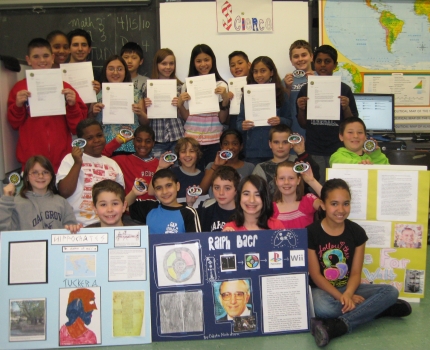
This photo of Ms. Caitlin McCabe's fifth grade class at Oak Grove Elementary School shows some of the posters the students created as well as the letters and patches they received from the National Science Foundation.
Learn more about Education, Technology
- &lsaquo previous
- …
- 143
- 144
- 145
- 146
- 147
- 148
- 149
- 150
- 151
- …
- next &rsaquo


White House Blogs
- The White House Blog
- Middle Class Task Force
- Council of Economic Advisers
- Council on Environmental Quality
- Council on Women and Girls
- Office of Intergovernmental Affairs
- Office of Management and Budget
- Office of Public Engagement
- Office of Science & Tech Policy
- Office of Urban Affairs
- Open Government
- Faith and Neighborhood Partnerships
- Social Innovation and Civic Participation
- US Trade Representative
- Office National Drug Control Policy
categories
- AIDS Policy
- Alaska
- Blueprint for an America Built to Last
- Budget
- Civil Rights
- Defense
- Disabilities
- Economy
- Education
- Energy and Environment
- Equal Pay
- Ethics
- Faith Based
- Fiscal Responsibility
- Foreign Policy
- Grab Bag
- Health Care
- Homeland Security
- Immigration
- Innovation Fellows
- Inside the White House
- Middle Class Security
- Open Government
- Poverty
- Rural
- Seniors and Social Security
- Service
- Social Innovation
- State of the Union
- Taxes
- Technology
- Urban Policy
- Veterans
- Violence Prevention
- White House Internships
- Women
- Working Families
- Additional Issues