
Office of Science and Technology Policy Blog
PCAST Launches Policy Forum on the Future of U.S. Advanced Manufacturing
Posted by on April 7, 2010 at 2:52 PM EDTToday, the President’s Council of Advisors on Science and Technology (PCAST) launched a website to gather public opinion on the future of advanced manufacturing. We hope you will join the conversation at http://pcast.ideascale.com.
PCAST is an advisory group of the nation's leading scientists and engineers, appointed by the President to augment the science and technology advice available to him from inside the White House and from cabinet departments and other federal agencies. One topic it is currently addressing is advanced manufacturing. PCAST has a number of questions regarding advanced manufacturing that could best be answered with the help of public input. PCAST asks that you provide responses to any or all of the following questions by 5:00 p.m. EDT Tuesday, April 20, 2010.
Support for new manufacturing technologies
1. Are public-private partnerships (e.g., consortia), in which government jointly funds projects with industry and often academia, a good mechanism to support new manufacturing technologies that are beyond the reach of individual firms? If not, why not?
2. Some advocate the expansion of the mission of the national laboratories to include R&D challenges relevant to a broad range of manufacturing industries. Is this an appropriate strategy? If not, why not?
3. At some federal agencies, an “innovation budget” is established to promote breakthrough discoveries. Should such a budget be established for advanced manufacturing technology? If not, why not?
Support for new manufacturing firms
4. Given the success of some government-industry-university innovation clusters, should the federal government take the lead in establishing additional clusters to support new manufacturing firms, in particular? If not, why not?
5. Should the federal government assist in the formation and advancement of small firms in the advanced manufacturing sector? If not, why not?
6. Do you believe that potentially valuable research at universities is not being fully utilized by industry? If so, why does this occur, and should federal agencies increase the emphasis on translational research to address this issue? If not, why not?
Support for existing manufacturing firms
7. Should the federal government help form public-private partnerships to perform research on “horizontal,” cross-cutting technology platforms (e.g., modeling, simulation) that are essential, but beyond the reach of individual firms? If not, why not?
8. Should the government generate an international benchmarking effort to compare US manufacturing infrastructures (i.e., technology platforms) with those of competing nations? If not, why not?
9. Should government, in partnership with industry, sponsor programs in manufacturing training and certification at community colleges, technical schools, and colleges to enhance the nation’s workforce? If not, why not?
A national manufacturing strategy
10. Should the President create a national science– and technology–based manufacturing strategy as a pillar of US economic policy? If not, why not? If so, which actions should have highest priority? Which of these are most cost-effective?
We invite your comments and in particular encourage you to be specific in your thoughts and proposals, providing empirical data and specific supporting examples whenever possible so this discussion can generate maximum practical value. You may want to start by reading a collection of papers prepared for PCAST (pdf) on the topic.
Importantly, this is a community-moderated blog. That means we count on you to keep the forum focused and on-topic—something you can do by “voting” on comments. Voting is an expression of how germane to the topic a comment is. Voting up a comment expresses approval of the relevance. If enough people vote down a comment, the comment in question “collapses” into a link so that it doesn’t interrupt the flow of discussion. Please read the complete Terms of Participation, where you can also learn how to “flag” comments such as spam or obscenities that violate the Terms.
We welcome your thoughtful comments in this open and participatory forum.
Deborah Stine is Executive Director of PCAST
Learn more about Economy, TechnologyScience Everywhere, Including 2010 White House Egg Roll
Posted by on April 6, 2010 at 3:31 PM EDTThe President has said that learning science and math “… goes beyond the facts in a biology textbook or the questions on an algebra quiz. It's about the ability to understand our world.” He made these comments last year at the launch of the Administration’s Educate to Innovate campaign to improve science, technology, engineering, and math (STEM) education.
At the 2010 White House Egg Roll yesterday, preschoolers and students had the opportunity to learn some science, with the South Lawn of the White House as their laboratory setting. Some dissected seeds, looked through a microscope, and thought about how plants grow. Some made simple box kites from paper bags, and thought about what makes a kite fly. All had fun exploring the world around them.
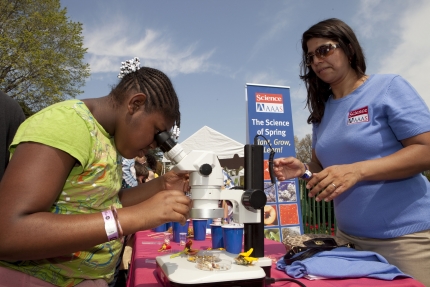
A young girl looks at flower parts under a microscope at the Make-your-own Garden Science exhibit at the Easter Egg Roll on the South Lawn of the White House, April 5, 2010. (Official White House Photo by Chuck Kennedy) April 5, 2010. (Official White House Photo by Chuck Kennedy)
These and other STEM activities were the result of a month of planning by OSTP and key partners in science and media, including:
- The American Association for the Advancement of Science (AAAS), which ran a wonderful “Science of Spring” activity section, allowing parents and children to dissect green been seeds, look at them under a microscope, take beans home to plant, and document their progress online. (You can plant your own seeds and post their progress on that site as well.)
- The Lawrence Hall of Science, which ran a kite-making activity in the Eggspress Yourself section, giving kids a chance to create something themselves and learn about wind energy and flight (while gaining a good excuse to run around). Volunteers helped students experiment with different designs and gave them tips to continue learning at home.
- Discovery Channel’s celebrity scientist-chefs Homaro "Omar" Cantu and Ben Roche, of the new show Future Food, who spent much of their day in the “Play with your Food” section showcasing food science and entertaining ways to make food more healthy. In one, they showed a way to carbonate fresh fruit to create a fun, healthy, eating option. You can check out their recipes yourself.
All in all, an egg-ceptional time was had by all.
Kumar Garg is a Policy Analyst in the White House Office of Science and Technology Policy
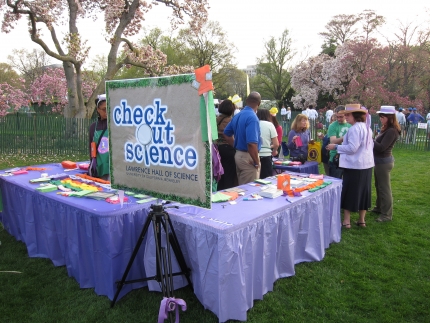
Volunteers from the Lawrence Hall of Science helped children build kites as one of the science activities during the 2010 White House Easter Egg Roll. (Photo by Steve Robinson) April 5, 2010. (by Steve Robinson)
Learn more about Education, TechnologyModernizing Government: Next Steps
Posted by on March 30, 2010 at 9:59 AM EDTLast January, I was privileged to participate in the White House Forum on Modernizing Government. The Forum brought together more than 50 CEOs from the nation’s leading organizations, deputy secretaries from cabinet agencies, labor union leadership, and senior White House Staff to discuss ideas for how government can use technology to save money and improve performance. During the Forum, I was able to participate in a breakout session with David Hayes, Deputy Secretary for the Department of Interior, on transforming government service. The discussion in this breakout session was both engaging and insightful, and focused on ideas for measuring customer satisfaction and improving the ways that the government can deliver services to the American people.
As a follow-up to the Forum, I am pleased to announce that the Office of the Management and Budget has released a follow-up plan entitled “White House Forum on Modernizing Government: Overview and Next Steps” (pdf). The plan outlines guiding principles that emerged from the Forum as well as next steps to continue engaging the private sector in our efforts to improve government productivity. The plan also identifies two areas of immediate focus where private sector best practices have applicability to the Federal Government, and where we know there is a meaningful gap: IT Program Management and Customer Service.
The eagerness of private sector leaders to lend their expertise, and that of their companies, to the common goal of improving Federal Government operations, represents one of the successes of the Forum. In response, we are also developing mechanisms for ongoing interaction and information sharing between government managers and private sector leaders, to build upon our open government efforts.
In collaboration with my colleagues throughout the Federal Government, I look forward to implementing these recommendations and improving the technology our government uses to make government work better for the American people.
Aneesh Chopra is U.S. Chief Technology Officer and Associate Director for Technology in the White House Office of Science and Technology Policy
Learn more about TechnologyHelp Us Find Out a Nobel Answer
Posted by on March 29, 2010 at 2:24 PM EDTAs many of you have probably heard, last week President Obama announced the nomination of Nobel Prize winner Carl Wieman to head up OSTP’s Science Division.
So this got us thinking; has there ever been a sitting Nobel Prize winner in the sciences (that is, chemistry, physics, or medicine) named to a position in the White House? As stated in the White House release, Dr. Wieman received the Nobel Prize in Physics in 2001 for the creation of a new form of matter known as a “Bose-Einstein condensate.” We’ve looked through all of our archives and have been unable to find another OSTP staffer or other government employee in the Executive Office of the President who came to the job with a science Nobel in hand.
Then it occurred to us: What a great opportunity to do some crowdsourcing! If you know of a previous employee in the White House complex who had earned a Nobel Prize in one of the sciences before joining the staff here, please let us know via Twitter @whitehouseostp using #WHNOBEL.
Thanks, and we look forward to your suggestions!
Learn more about Energy and Environment, TechnologyThe Role of Student-Led Innovation in “Killer Apps” for Broadband Networks
Posted by on March 25, 2010 at 10:37 AM EDTStudents have contributed (pdf) some of the most important advances in information and communications technologies—including data compression, interactive computer graphics, Ethernet, Berkeley Unix, the spreadsheet, public key cryptography, speech recognition, Mosaic, and Google.
Today, with the right kind of support, students can play the role of innovators again—by leading the way in the development of broadband applications. In the same way that Mosaic and Google drove demand for today’s Internet, new applications could drive demand for a gigabit/second Internet and 4G wireless. Indeed, a key component of the Federal Communications Commission’s recently released National Broadband Plan is the development of new broadband applications.
Now is the time to launch an initiative that would cultivate, with student involvement, such a wave of innovation. Although it’s impossible to predict what the next generation of applications will be, universities, companies, and students could work together under such an initiative, which would serve as a sort of “Petri dish” where new ideas could incubate and grow. This initiative could be led by the private sector, encourage multi-campus and even global collaboration, build on investments already made in high-speed research networks such as Internet2 and National LambdaRail, and take advantage of a growing number of grants from the Department of Commerce’s Broadband Technology Opportunities Program (BTOP).
The initiative could have a number of elements, including:
- Campus-based incubators for the development of broadband applications, with access to high-speed networks, cutting-edge peripherals, software development kits, and cloud computing services.
- Relevant courses that encourage multidisciplinary teams of students to design and develop broadband applications.
- Competitions that recognize compelling applications developed by students. Some existing competitions that could serve as models include Google’s Android Developer Challenge, Microsoft’s Imagine Cup, and the FCC-Knight Foundation’s “Apps for Inclusion” competition.
Let us know what you think of this idea. You can send us e-mail at broadband@ostp.gov.
Tom Kalil is Deputy Director for Policy in the White House Office of Science and Technology Policy
Aneesh Chopra is U.S. Chief Technology Officer and Associate Director for Technology in the White House Office of Science and Technology Policy
Providing Leadership on Standards to Address National Challenges
Posted by on March 24, 2010 at 9:09 PM EDTIn our technological world, technical standards are playing an increasingly important role as federal agencies tackle a range of pressing problems, such as developing a modern electrical grid and promoting the effective use of medical information to enhance patient care. It has long been government policy that federal agencies should look to voluntary consensus standards to meet these needs. With the rapid pace of technological change and the increasingly complex and interdependent nature of these technologies, the task of developing and adopting standards has become very challenging; therefore, it is more important than ever that federal agencies work effectively with the private sector to ensure that meaningful standards can be in place to meet urgent national needs. The right starting point is to ensure that federal agencies work closely and effectively together to define their standards needs, define their approach to working with industry and standards organizations, and support their meaningful adoption by markets.
To this end, I am joining my colleagues from the Office of Management and Budget—Vivek Kundra, U.S. Chief Information Officer, and Cass Sunstein, Administrator of the Office of Information and Regulatory Affairs—in establishing a Subcommittee on Standards under the National Science and Technology Council’s Committee on Technology. This Subcommittee will be co-chaired by Patrick Gallagher, Director of the National Institute of Standards and Technology (NIST), and Philip Weiser, Deputy Assistant Attorney General for International, Policy and Appellate Matters, Department of Justice. This interagency group will provide high-level leadership so federal agencies are strategically focused and actively engaged on critical standards-related issues. The improved coordination will, in turn, ensure that agencies can work in a responsive and timely fashion with the private sector so that effective standards are developed and put into practice to meet the Nation’s needs.
This Subcommittee will also work closely with the Interagency Committee on Standards Policy (ICSP), which is also chaired by a representative from NIST. The Subcommittee on Standards will provide direction and guidance to the ICSP, and will rely on the ICSP to coordinate interagency implementation of standards policy, assess progress, and develop potential policy options or guidance with the goal of removing barriers to effective standards development or use.
The Obama Administration is committed to working in close partnership with industry, standards organizations, and the public to ensure that the technologies needed to address the urgent challenges facing our country are developed and made in the United States and are appropriately interoperable with related technologies. Whether it is to ensure the security of federal information technology systems, promote the development of a “Smart Grid,” or develop an effective and interoperable health IT system, it is imperative that federal agencies work effectively, openly, and strategically with our private-sector partners to ensure that the innovation being harnessed to tackle a national problem is structured in a way that maximizes technical utility, economic growth, and job creation. Technical standards play a major role in this effort, and this Subcommittee is an important step in ensuring that federal agencies collaborate effectively with the private sector to make it happen.
Aneesh Chopra is U.S. Chief Technology Officer and Associate Director for Technology in the White House Office of Science and Technology Policy
Learn more about Technology
- &lsaquo previous
- …
- 146
- 147
- 148
- 149
- 150
- 151
- 152
- 153
- 154
- next &rsaquo


White House Blogs
- The White House Blog
- Middle Class Task Force
- Council of Economic Advisers
- Council on Environmental Quality
- Council on Women and Girls
- Office of Intergovernmental Affairs
- Office of Management and Budget
- Office of Public Engagement
- Office of Science & Tech Policy
- Office of Urban Affairs
- Open Government
- Faith and Neighborhood Partnerships
- Social Innovation and Civic Participation
- US Trade Representative
- Office National Drug Control Policy
categories
- AIDS Policy
- Alaska
- Blueprint for an America Built to Last
- Budget
- Civil Rights
- Defense
- Disabilities
- Economy
- Education
- Energy and Environment
- Equal Pay
- Ethics
- Faith Based
- Fiscal Responsibility
- Foreign Policy
- Grab Bag
- Health Care
- Homeland Security
- Immigration
- Innovation Fellows
- Inside the White House
- Middle Class Security
- Open Government
- Poverty
- Rural
- Seniors and Social Security
- Service
- Social Innovation
- State of the Union
- Taxes
- Technology
- Urban Policy
- Veterans
- Violence Prevention
- White House Internships
- Women
- Working Families
- Additional Issues