
Office of Science and Technology Policy Blog
U.S., India Hold Joint Commission Meeting on Science and Technology Cooperation
Posted by on June 25, 2010 at 5:01 PM EDT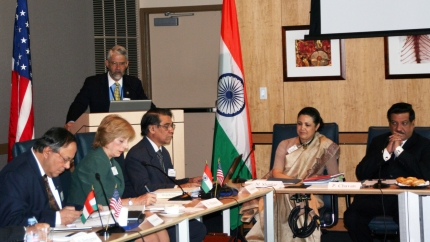
Dr. John P. Holdren, Director of the White House Office of Science and Technology Policy, delivers opening remarks at the U.S.-India Joint Commission Meeting on Science & Technology Cooperation on June 24, 2010. Shri Prithviraj Chavan, India's Minister of Science, Technology, and Earth Sciences, is seated to the right. June 25, 2010. (by Phil Larson)
A flurry of international collaborative work on science and technology reached an apex yesterday as OSTP Director John P. Holdren co-chaired an historic U.S.-India Joint Commission Meeting (JCM) on Science and Technology Cooperation. Dr. Holdren joined Shri Prithviraj Chavan, India's Minister of Science, Technology, and Earth Sciences, along with other dignitaries from the US and Indian governments, in an all-day meeting at the Smithsonian Museum of Natural History in Washington, DC, where a number of cooperative initiatives were discussed. Additional meetings between the two countries continued today.
President Obama has made clear that one of his top priorities is enhancing US cooperation with its global partners, especially on science and technology, and this JCM was just one of several international collaborative meetings Dr. Holdren has taken part in recently.
Just today, France’s Minister of Higher Education and Research Valerie Pécresse and H.E. Pierre Vimont, Ambassador of France, visited OSTP to have discussions with Dr. Holdren. Yesterday, as part of Russian President Medvedev’s visit, Dr. Holdren met with Minister of Education and Science Andrey Fursenko, who, with Dr. Holdren, co-chairs the US-Russia Science and Technology Working Group, which last met in April.
Additionally, following a week-long trip to Japan and South Korea in mid-June to engage in S&T collaborative dialogues there, Dr. Holdren met with a delegation from Egypt here in Washington, to discuss science, technology, engineering and mathematics education, among other topics.
Yesterday’s US-India JCM had many goals, but first and foremost was the establishment of a new S&T dialogue between the two countries. Opening remarks by Dr. Holdren and Minister Chavan set the stage for what was a fruitful day of discussion that had many agencies, disciplines, and viewpoints represented.
The meeting may have concluded with an 8 p.m. dinner, but the opportunities for cooperation have only just begun. As President Obama said at the National Academy of Sciences in April 2009, "[M]y administration is ramping up participation in—and our commitment to—international science and technology cooperation across the many areas where it is clearly in our interest to do so."
Dr. Holdren’s recent string of high-level international meetings attest to the commitment by OSTP and all the science- and technology-based Federal agencies to fulfill the President’s call to action.
Learn more about , Foreign PolicyNew Fast-Track Committee Seeks Feedback on Expediting Manufacturing
Posted by on June 24, 2010 at 2:51 PM EDTQuality, cost, and time to market are three pillars of competitiveness in the world of manufacturing. One innovative way to improve time to market is through the use of computer models and simulation. Using powerful computers and sophisticated software, manufacturers and scientists can map out and test complex systems without having to build expensive, physical prototypes. For instance, computer models of the fluid dynamics of blood flow through the human heart have helped researchers optimize the design of artificial heart valves.
Models allow designers, manufacturers, and policymakers make better decisions faster. However, manufacturers and product and process designers today do not take full advantage of available modeling and simulation tools. There are many reasons behind the limited adoption of these tools, including the relatively high expense of some software and hardware packages; lack of access to technical experts; and a lack of standards, certification, and assurances of reliability for many software tools.
The National Science and Technology Council recently stood up a Fast-Track Action Committee on Computational Modeling and Simulation to identify gaps and challenges in the realm of modeling and simulation and to make recommendations about how to address them. A draft of the committee’s report is available here. NSTC is now seeking comments on this draft report from a wide range of stakeholders including big and small manufacturers, software vendors, researchers, software developers, engineers, and educators. Among the topics NSTC would like stakeholders to consider are:
- Key barriers to adoption of modeling tools
- Competitive advantages offered by such tools
- Limitations of existing tools
- Use and value of cloud computing platforms
- Use and value of of stochastic models
- Software scalability
- Education and training
By inviting widespread public input on this set of questions, NSTC aims to benefit from the distributed expertise of the American people and improve the Nation’s competitiveness in manufacturing while helping to fulfill President Obama’s pledge to have the most open and transparent Administration in history.
To join in the conversation, head over to OpenNSTC, and respond to our questions, post comments, and give feedback on other’s ideas. We look forward to your constructive participation!
Learn more about TechnologyIt's Not Just the Law. It's Law.gov
Posted by on June 22, 2010 at 4:23 PM EDTU.S. Deputy Chief Technology Officer for Open Government Beth Noveck chaired a session at a day-long Washington workshop last week on Law.gov, a national effort to make all primary U.S. legal documents available for free online. The June 18 workshop, sponsored by the Center for American Progress (CAP) and reflecting much of the progress already made through the Obama Administration’s Open Government initiative, emphasized the importance of easing access to legal documents across all three branches of government to increase transparency and accountability and to encourage innovative uses of this trove of information.
Workshop participants noted that there is great demand for primary legal records, including SEC filings and appeals court rulings, but that page charges and other “paywall” barriers limit access to these documents. Moreover, said Stanford Deputy Law Librarian Erika Wayne, efforts to inventory legal information and compile records online are often frustrated because the documents have disclaimers attached, are incomplete, or have not been updated with final text. The value of these documents could be greatly enhanced, added OMB General Counsel Preeta Bansal, if more of them were hyperlinked to one another, to show more clearly the full path of a case.
In her presentation, Noveck highlighted the Administration’s Open Government initiative and, as an example of its potential power, described last year’s successful effort to make the Federal Register available in XML, a “liberating” flexible text format that has facilitated people’s efforts to use Federal legal data in new and innovative ways. Office of the Federal Register director Ray Mosley noted that a new and even easier-to-use version of the XML Federal Register will be released in July. And the founders of several innovative websites—GovPulse.US (which makes Federal Register information more available to the public); FedThread.org (which allows users to annotate the Federal Register); and Oregonlaws.org (which gives users easier access to Oregon legal information) all emphasized how quickly and easily they were able to set up new, innovative frameworks for customers once the relevant data were made public.
Others echoed the idea that, rather than posing a threat to private interests, the free release of data offers new economic opportunities. LexisNexis representative Mike Walsh emphasized, for example, that his company’s main source of profit was the value it added to legal information through editing and linking cases to other cases. Representatives from two other legal information concerns—Justia and Fastcase—concurred that accessible data are best seen as a resource ripe for value-added innovation.
Happily, said Tim O’Reilly, CEO of O’Reilly Media, those who are working to make more data available to the public don’t have to devise highly complicated systems to do so. The best data platforms are fundamentally simple, he said, and encourage innovation through their open—and in many cases open-source—design. More information about Law.gov can be found here, and more information about the CAP workshop, including video from the event, is here.
Learn more about TechnologyAsk Dr. H: "Where Are We on Scientific Integrity?"
Posted by on June 18, 2010 at 8:21 PM EDT[Ed. Note: In this week’s "Ask the President's Science Advisor," OSTP Director Dr. John P. Holdren answers an e-mail question concerning the Obama Administration's efforts to enhance scientific integrity in Federal policymaking. To have your question considered for this feature, e-mail your short query to AskDrH@ostp.gov or tweet @whitehouseostp using the hashtag #AskDrH. The selected question will be posted in the blog with Dr. Holdren's answer.]
Dear Director Holdren,
The President put scientific integrity on the top of his science agenda as a candidate and pledged in his inaugural address to "restore science to its rightful place."
The President asked the Office of Science and Technology Policy 15 months ago to create a plan to restore scientific integrity to federal policymaking. The plan was due by July 9, 2009. Why is there such a delay in restoring scientific integrity to the federal government? What are the sticking points? Can you give me a date when you expect a plan, directive, or Executive Order to be released?
Sincerely,
Jason, San FranciscoPresident Obama’s “Memorandum for the Heads of Executive Departments and Agencies” of March 9, 2009, on the subject of scientific integrity stated clearly and unconditionally the fundamental principles of the Administration’s stance on this subject. These clear and unconditional statements begin, in the document’s second paragraph, with the following:
Political officials should not suppress or alter scientific or technological findings and conclusions. If scientific and technological information is developed and used by the Federal Government, it should ordinarily be made available to the public. To the extent permitted by law, there should be transparency in the preparation, identification, and use of scientific and technological information in policymaking. The selection of scientists and technology professionals for positions in the Executive Branch should be based on their scientific and technological knowledge, credentials, experience, and integrity.
This set of principles is augmented later in the Memorandum, in connection with the President’s request to the Director of the Office of Science and Technology Policy for recommendations for further Presidential action “to guarantee scientific integrity throughout the Executive Branch”. As formulated there, the principles on which these recommendations for further Presidential action are to be based are as follows:
(a) The selection and retention of candidates for science and technology positions in the Executive Branch should be based on the candidate's knowledge, credentials, experience, and integrity;
(b) Each agency should have appropriate rules and procedures to ensure the integrity of the scientific process within the agency;
(c) When scientific or technological information is considered in policy decisions, the information should be subject to well-established scientific processes, including peer review where appropriate, and each agency should appropriately and accurately reflect that information in complying with and applying relevant statutory standards;
(d) Except for information that is properly restricted from disclosure under procedures established in accordance with statute, regulation, Executive Order, or Presidential Memorandum, each agency should make available to the public the scientific or technological findings or conclusions considered or relied on in policy decisions;
(e) Each agency should have in place procedures to identify and address instances in which the scientific process or the integrity of scientific and technological information may be compromised; and
(f) Each agency should adopt such additional procedures, including any appropriate whistleblower protections, as are necessary to ensure the integrity of scientific and technological information and processes on which the agency relies in its decision-making or otherwise uses or prepares.
There should not be any doubt that these principles have been in effect—that is, binding on all Executive departments and agencies—from the date of issue of the Memorandum on March 9, 2009. All that has been awaiting the requested action by the Director of OSTP is recommendations to the President on what further instructions he might issue in augmentation of these principles in order to advance the goal of achieving the highest level of scientific integrity across the Executive Branch.
Pursuant to that request, my staff and I have been engaged since the date of the Memorandum in development of such recommendations, which as specified in the Memorandum has included consultations with “the heads of executive departments and agencies, including the Office of Management and Budget and offices and agencies within the Executive Office of the President”. Indeed, OSTP began the process by creating an interagency panel with representatives from all of the major science offices and agencies. That group launched an unprecedentedly open, Web-based process to accept detailed input from stakeholders inside and outside government. Based on that input and internal discussions, the group developed draft recommendations for consideration by OSTP and OMB. And over the intervening months representatives from those two offices have been honing a final set of recommendations.
I am the first to admit that the process has been more laborious and time-consuming than expected at the outset. Determining how to elaborate on the principles set forth in the Memorandum in enough detail to be of real assistance in their implementation, while at the same time retaining sufficient generality to be applicable across Executive departments and agencies with a wide variety of missions and structures, has been particularly challenging. And other demands on the participants over this time period have also been much greater than expected. But I am pleased to report here that the process, though slower than many (including myself) had hoped, has resulted in what I believe is a high-quality product that I anticipate finalizing and forwarding to the President in the next few weeks.
In addition to the strong scientific integrity principles that, as noted above, have been in effect since the President’s memorandum of March 9, 2009, there has been other important activity on transparency and integrity ongoing in parallel with the process of developing the supplementary recommendations that the memorandum requested. In particular, OSTP and OMB have spearheaded an array of Open Government initiatives that have, together, made a record-breaking amount of government data available to the public and, more generally, have unveiled many previously hidden workings of the Federal government. Indeed, I believe no Administration has pushed as hard as this one to restore integrity in general—and scientific integrity in particular—to the Federal enterprise. I am confident that with the completion of OSTP’s recommendations on scientific integrity these already high standards will be strengthened and assured well into the future.
John P. Holdren is Assistant to the President for Science and Technology and Director of the White House Office of Science and Technology Policy
Learn more about TechnologyFall Student Volunteer Application Deadline Extended
Posted by on June 17, 2010 at 4:21 PM EDTApplications for the fall OSTP Student Volunteer Program will be accepted through Friday, June 25th. The program is seeking highly motivated and dedicated individuals interested in science and technology policy. Applicants must be US citizens and be enrolled, not less than half-time, in an accredited college, university, or other educational institution. Students who wish to participate in this program during the fall semester may work at OSTP on a part-time or full-time basis.
OSTP has responsibility for a variety of important and exciting policy, planning, and communications challenges that student volunteers can have the opportunity to work on. In the Director’s Office, for example, volunteers may help organize interagency policy programs and events that support the Administration’s science and technology agenda. The Science Division offers students the chance to explore policy development relating to the life sciences, physical sciences, and behavioral sciences. The Technology Division focuses in large part on emerging technologies, including information technology and nanotechnology, and their interface with public policy. Opportunities also exist in the fields of energy and environment and national security. Or volunteers may take on duties with the National Science and Technology Council, OSTP’s Open Government Initiative , or the President’s Council of Advisors on Science and Technology.
Students who volunteer at OSTP can expect to gain an up-close perspective on the day-to-day business of policy development for the wide range of science and technology activities being addressed by the Obama Administration. OSTP’s Student Volunteer Program also provides students with a valuable educational and networking experience. The deadline for the fall 2010 application was recently extended to Friday, June 25th, so apply today. Please make sure that you include all of the required documents, as described here, and we look forward to hearing from you soon!
Learn more about TechnologyInnovation for America: Technology for Economic Growth and Empowering Americans
Posted by on June 15, 2010 at 4:49 PM EDTInnovation—the process of developing a new product, service, or process—is critical to ensuring that the next generation of Americans outperforms the last. For this reason, from the day he took office, President Obama has challenged his team to promote innovation using all available tools and to nurture the creative spirit of the American entrepreneur.
Last week I joined my colleagues, Vivek Kundra, the U.S. Chief Information Officer, and Phil Weiser, Senior Advisor for Technology and Innovation to the National Economic Council Director, at the Brookings Institution’s Taubman Forum to discuss an important component in President Obama's Strategy for American Innovation—technology’s role in spurring economic growth and empowering all Americans.
We highlighted three key goals:
1. Accelerate entrepreneurship, innovation and jobs of the future.
Equipping Americans to create and perform the jobs of the future requires investment in the “building blocks” of innovation, such as research and development (R&D), physical infrastructure, and human capital. The Administration has placed particular emphasis on science, technology, engineering, and math (or “STEM”) education. Last November, for example, President Obama launched the “Educate to Innovate” campaign that has already mobilized over $500 million in philanthropic and private sector support and which, through grassroots efforts such as National Lab Day, has created over 1,700 “hands on” learning projects, matched 11,000 teachers and volunteers, and made over 69,000 connections between volunteers and supporting organizations and resources to help bring discovery-based science experiences to students in grades K-12.
Last April, President Obama challenged the combined public and private sector to invest 3% of the nation’s GDP on R&D to ensure that the United States remains the leader in next-generation technologies, just as we have in aerospace, computing, and Internet technology. To accelerate the transition of university and federal lab ideas to the marketplace, the Commerce Department has launched the “i6 Challenge” offering $1 million in prizes for the most effective strategies to spur technology commercialization and entrepreneurship in their regions.
2. Increase access to data and technology to empower consumers.
Last May, CIO Kundra launched data.gov with 47 datasets—an inventory that has mushroomed to over 270,000 in a year and catalyzed a global movement towards open data for innovators to commercialize in ways big and small.
The Department of Energy has embraced this principle in its efforts to seed a clean technology economy, emphasizing the transformative potential of consumer access to data on electric power consumption via a modernized electric grid. To ensure that the Federal government has a comprehensive strategy to achieve a cost-effective “smart grid,” the National Science and Technology Council’s Committee on Technology has convened the key agencies and their experts to develop a framework for our policy in this area as we look beyond the Recovery Act’s $4.5 billion investment.
3. Tap into the creativity and expertise of the American people to spur change.
On the President’s first full day in office, he released a Memorandum on Transparency and Open Government calling for a more transparent, participatory, and collaborative approach to address the nation’s most pressing challenges. Last December, OMB Director Peter Orszag published the follow-on Open Government Directive, which embraced the use of prizes and challenges to encourage public participation in a range of public policy challenges, ranging from encouraging kids to eat healthier to improving the quality of veterans services delivery.
To appreciate the power of government as a convener and catalyst of outside innovation, consider in more detail the origins of the Health 2.0 Developer Challenge. Health & Human Services Secretary Kathleen Sebelius launched the Community Health Data Initiative on June 2nd following a meeting of public health and technology professionals at the Institute of Medicine on March 11th. Over the course of 90 days, fueled by freely available, granular, community-specific health data, Secretary Sebelius celebrated more than 20 new or improved prototype applications designed to spur local and regional efforts to improve health performance -- all without additional cost to the taxpayer. Through the Developer Challenge, we intend to extend this effort through October to allow for a new round of innovations.
In short, engaging the public by using technology more effectively, promoting the conditions for innovation and entrepreneurship, and empowering consumers, are critical goals of the Administration’s technology agenda. The Brookings event was a welcome opportunity to discuss them and we look forward to continuing this discussion over the months ahead.
Aneesh Chopra is United States Chief Technology Officer
Learn more about Technology
- &lsaquo previous
- …
- 138
- 139
- 140
- 141
- 142
- 143
- 144
- 145
- 146
- …
- next &rsaquo


White House Blogs
- The White House Blog
- Middle Class Task Force
- Council of Economic Advisers
- Council on Environmental Quality
- Council on Women and Girls
- Office of Intergovernmental Affairs
- Office of Management and Budget
- Office of Public Engagement
- Office of Science & Tech Policy
- Office of Urban Affairs
- Open Government
- Faith and Neighborhood Partnerships
- Social Innovation and Civic Participation
- US Trade Representative
- Office National Drug Control Policy
categories
- AIDS Policy
- Alaska
- Blueprint for an America Built to Last
- Budget
- Civil Rights
- Defense
- Disabilities
- Economy
- Education
- Energy and Environment
- Equal Pay
- Ethics
- Faith Based
- Fiscal Responsibility
- Foreign Policy
- Grab Bag
- Health Care
- Homeland Security
- Immigration
- Innovation Fellows
- Inside the White House
- Middle Class Security
- Open Government
- Poverty
- Rural
- Seniors and Social Security
- Service
- Social Innovation
- State of the Union
- Taxes
- Technology
- Urban Policy
- Veterans
- Violence Prevention
- White House Internships
- Women
- Working Families
- Additional Issues