
Office of Science and Technology Policy Blog
Nominate a White House Champion of Change for Civic Hacking
Posted by on June 27, 2013 at 8:51 AM ESTPublic service has taken on new forms in the digital age. Today, civic hackers—innovators applying their tech skills for civic good—are empowered by open government data to build tools, apps, and services that meet public needs at the national, state, and local levels.
Just this month, Mayors from Los Angeles, San Diego, Baltimore, Louisville, Palo Alto, and other cities across the country participated in a National Day of Civic Hacking that drew more than 11,000 people participating in 95 open data hacking events. At the White House, we celebrated the day by welcoming more than 30 developers and designers to our second hackathon, setting them loose on the new API for We the People, the White House petitions platform. And just a few weeks ago, in the East Room of the White House, President Obama recognized two extraordinary civic hackers who harnessed their skills and troves of open data to build apps that inform women about the wage gap—important tools to help women as they negotiate starting pay, request promotions, or consider switching career paths.
Learn more about TechnologyThe President's Action Plan to Fight Climate Change
Posted by on June 26, 2013 at 10:29 AM ESTYesterday, in a 45-minute speech at Georgetown University, President Obama laid out a comprehensive plan to reduce greenhouse gas pollution in America, prepare our country for the impacts of climate change, and lead global efforts to fight it. The Plan is a recognition that climate change is unequivocal, its primary cause is greenhouse gas pollution from burning fossil fuels, and it is threatening the health of our communities, families, and economy. In his remarks, President Obama said “the question is not whether we need to act… the question now is whether we will have the courage to act before it’s too late.”
Learn more about Energy and EnvironmentMozilla Ignite Challenge Winners Announced
Posted by on June 25, 2013 at 12:00 PM ESTA year ago this month, OSTP and the National Science Foundation (NSF) launched the US Ignite initiative to jumpstart the development of software applications able to take advantage of the Nation’s growing but underutilized network of very-high-speed, gigabyte/second Internet connections. On Tuesday, at the US Ignite Partnership’s Application Summit in Chicago, IL, NSF and Mozilla announced the winners of the $500,000 Mozilla Ignite Challenge, designed to engage a broad range of developers, startups, students, and communities in creating the next-generation of gigabit applications. We asked the top four winners to tell us a little about their projects.
Engage 3D: Immersive 3D Educational Tools
Engage 3D is a non-profit organization in Chattanooga, TN, and our 3D video conferencing application brings the Microsoft Kinect’s three-dimensional capabilities to the Web, streaming in-browser content in three dimensions.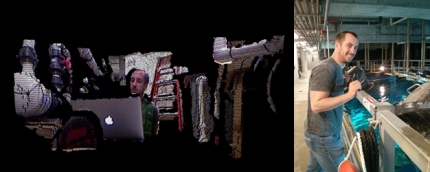
Engage 3D tested its video conferencing application at the Tennessee Aquarium. At left, debugging behind the scenes at the Aquarium. At right, touring the Aquarium to find content for the engage 3D platform. (Photo by Engage 3D)
We showcased an early version of our application at a Chattanooga Downtown Public Library event, where a crowd of more than 1,200 children and teens were mesmerized. Though we had initially targeted healthcare and business for our technology, the fascination we saw at this event made us realize that 3D video conferencing could become a powerful educational tool.
Our in-browser 3D video conferencing platform brings educational content - live, interactive, and in 3D - into classrooms at no additional cost to schools. Unlike a simple video, our application provides students with an opportunity to interact with content in a way that has not been seen before.
Our organization was born entirely out of the Mozilla Ignite App Challenge. Through three rounds of pitches and development, our team has learned much about the exciting possibilities and challenges of gigabit application development. We’ve also gained new expertise in Web tools and we’ve had a tremendous time participating in this program and can’t wait to see what the future holds. For more information visit www.engage3D.org or watch a video demonstration.
Learn more about Innovations, TechnologyWe the Geeks: Innovation for Global Good
Posted by on June 24, 2013 at 6:49 PM ESTEd. note: This event has concluded. Watch the full hangout below.
Geeks have had a lasting positive impact on the lives of millions of people in the developing world—from the innovations and insights that fueled the Green Revolution, to the historic scientific achievements that have marked the “Beginning of the End of AIDS.” Today, geeks are playing a central role in building technologies, making discoveries, building businesses, and engineering solutions that benefit people and communities around the world.
As President Obama and the First Lady travel to Africa this week, the White House will host a “We The Geeks” Google+ Hangout this Thursday, June 27 at 1:00 pm EST to discuss innovation for global good with some of the creative minds making it happen. These individuals are harnessing their science, engineering, and entrepreneurial skills to answer the President’s call to eradicate extreme poverty in the next two decades. The Hangout will be moderated by the Office of Science and Technology Policy’s Deputy Director for Technology and Innovation, Tom Kalil. Speakers include:
- Nikhil Jaisinghani and Brian Shaad, Co-founders, Mera Gao Power (MGP);
- Vineet Bewtra, Director of Investments, Omidyar Network;
- Maura O’Neill, Chief Innovation Officer and Senior Counselor, U.S. Agency for International Development; and
- Alix Zwane, Executive Director, Evidence Action.
Hangout participants will hear from leaders within and outside government, who are working together to spur game-changing innovations in global development. USAID’s Development Innovation Ventures (DIV) program, for example, is seeding, testing, and scaling the next generation of powerful innovations in development from geeks the world over.
Learn more about , InnovationsTwo Years Later, Bold New Steps for the Materials Genome Initiative
Posted by on June 24, 2013 at 8:07 AM ESTTwo years ago today, President Obama launched the Materials Genome Initiative (MGI), a collaborative endeavor of the public and private sectors designed to double the pace of innovation, manufacture, and deployment of high-tech materials in America.
During its first two years, the MGI has come a long way. What started out as a modest investment of roughly $63 million by four Federal agencies has since expanded into a multi-stakeholder endeavor valued in the hundreds of millions of dollars and involving universities, companies, professional societies, and scientists and engineers from across the country—all working together to push the boundaries of what’s possible in the realm of materials science and innovation.
Today, universities, companies, Federal agencies, and other materials science stakeholders announced more than twenty new commitments to kick-start an ambitious third year for the MGI, including:
- The Commerce Department’s National Institute of Standards and Technology (NIST) is committing $25 million over 5 years to form a Center of Excellence on Advanced Materials.
- The University of Wisconsin, Madison, and the Georgia Institute of Technology are creating new Institutes in materials innovation with collective investments totaling roughly $15 million, and will join with the University of Michigan to launch a materials innovation accelerator network
- Lawrence Berkeley National Laboratory (LBNL), Massachusetts Institute of Technology (MIT), and Intermolecular, Inc., are working together to better predict materials behavior with software tools made openly available by LBNL to thousands of users.
- Harvard University and IBM are releasing a freely available and open database describing 2.3 million new materials for potential use in solar cells—the largest open-access effort of its kind; and
- MIT is launching a new massive open online course (MOOC) focusing on innovation and commercialization with new materials, and half-a-dozen other institutions are announcing new educational efforts around the MGI that include curricula development, new graduate degrees, and research opportunities.
The materials community is mobilizing.
Learn more about TechnologyCelebrating “Open Science” Champions of Change at the White House
Posted by on June 21, 2013 at 3:44 PM ESTYesterday at the White House, Obama Administration officials honored 13 extraordinary leaders and organizations selected as “Champions of Change” for their work using and promoting open scientific data and publications to grow our economy and improve our world.
On June 20, 2013, thirteen Champions of Change were honored at the White House for their extraordinary leadership in "open science." From left to right: First row: Jack Andraka, David Altshuler, M.D., Ph.D., Rebecca Moore, Kathy Giusti, Jeremiah P. Ostriker, Eric Kansa, Ph.D., Paul Ginsparg, Ph.D., and David J. Lipman, M.D.; Second row: Drew Endy, Ph.D., Atul Butte, M.D., Ph.D., John Quackenbush, Ph.D., William Noel, Ph.D., and Stephen Friend, M.D., Ph.D.
A call for nominations issued last month resulted in hundreds of extraordinary candidates across a wide range of scientific disciplines—from biomedicine, archeology, astronomy and medieval writings. Of the nominees, 13 were selected based on their outstanding contributions to a growing open science movement that is unleashing scientific data and information for use by innovators, researchers, and entrepreneurs.
At the event, the Champions were invited to highlight projects and initiatives that are helping make “open” the default for scientific research results, and several made additional exciting announcements about how they will continue to promote open science going forward.
In remarks, John P. Holdren, Director of the White House Office of Science and Technology Policy, congratulated the new Champions for their outstanding efforts “to generate, promote, and use open scientific data as fuel for new products, successful businesses, and game-changing scientific insights.” Holdren also emphasized the power and potential benefits of unleashing scientific information for broad use, explaining that “the proposition behind open science is a simple one: more value is derived from scientific results when more people can access and use them.”
Learn more about Technology
- &lsaquo previous
- …
- 57
- 58
- 59
- 60
- 61
- 62
- 63
- 64
- 65
- …
- next &rsaquo


White House Blogs
- The White House Blog
- Middle Class Task Force
- Council of Economic Advisers
- Council on Environmental Quality
- Council on Women and Girls
- Office of Intergovernmental Affairs
- Office of Management and Budget
- Office of Public Engagement
- Office of Science & Tech Policy
- Office of Urban Affairs
- Open Government
- Faith and Neighborhood Partnerships
- Social Innovation and Civic Participation
- US Trade Representative
- Office National Drug Control Policy
categories
- AIDS Policy
- Alaska
- Blueprint for an America Built to Last
- Budget
- Civil Rights
- Defense
- Disabilities
- Economy
- Education
- Energy and Environment
- Equal Pay
- Ethics
- Faith Based
- Fiscal Responsibility
- Foreign Policy
- Grab Bag
- Health Care
- Homeland Security
- Immigration
- Innovation Fellows
- Inside the White House
- Middle Class Security
- Open Government
- Poverty
- Rural
- Seniors and Social Security
- Service
- Social Innovation
- State of the Union
- Taxes
- Technology
- Urban Policy
- Veterans
- Violence Prevention
- White House Internships
- Women
- Working Families
- Additional Issues