
Office of Science and Technology Policy Blog
Recap: A Big Day for Open Data
Posted by on May 10, 2013 at 3:50 PM ESTYesterday, President Obama visited Austin, Texas, to kick off his Middle Class Jobs and Opportunity Tour. At Capital Factory, a local start-up incubator, he met with technology entrepreneurs and innovative companies that are helping grow our economy and create jobs by building new products and services.
One of those companies, Stormpulse, uses freely available government weather data to help businesses protect themselves and their assets from potentially hazardous weather. Stormpulse CEO Matt Wensing has said that “open government data is one of the giants on whose shoulders we stand. Easier access to government data means growing companies like ours can offer significant value to citizens and enterprises.”
Indeed, earlier in the day, in a major step to provide innovative companies like Stormpulse with increased access to government data, the President signed a groundbreaking Executive Order and published a new open data policy requiring that going forward, data generated by the government be made available in open, machine-readable formats, while appropriately safeguarding privacy, confidentiality, and security.
President Barack Obama watches CEO Matt Wensing demonstrate Stormpulse during a tour of Capital Factory in Austin, Texas, May 9, 2013. Capital Factory founder Josh Baer and Todd Park, U.S. Chief Technology Officer, watch at right. (Official White House Photo by Chuck Kennedy)
Learn more about , Innovations, , TechnologyA Strategy for the Arctic, Informed by Sound Science
Posted by on May 10, 2013 at 2:19 PM ESTToday, the Obama Administration released the first-ever National Strategy for the Arctic Region—an approach to protecting national security, promoting environmental stewardship, supporting native cultures, providing for appropriate economic development, and strengthening international cooperation in the Arctic region. The Strategy, which was developed by an interagency team of Administration experts with significant input from the State of Alaska and Alaska Native organizations, articulates several key objectives for Federal activity in the Arctic over the next decade—including increased scientific understanding of the region.
The Strategy is guided by the Nation’s interest in safeguarding peace and stability in the Arctic; ensuring that resource management decisions are based on the best available information; strengthening and forging public-private and international partnerships; and coordinating Arctic-based efforts with Alaska Natives. It also serves to focus our national efforts in the Arctic at a time when the region is undergoing rapid environmental change.
Fast-melting ice on land and at sea has important implications for natural Arctic environments, human well-being, national security, transportation, and economic development. For instance, in addition to contributing to further global warming, diminishing sea-ice changes the distribution of species found in regional ocean waters, which in turn can have profound effects on local economies. Waning sea-ice also changes ocean circulation patterns and navigation pathways, with significant impacts for commercial and military navigation.
Learn more about Energy and EnvironmentGames Win Big in Education Grants Competition
Posted by on May 10, 2013 at 11:56 AM EST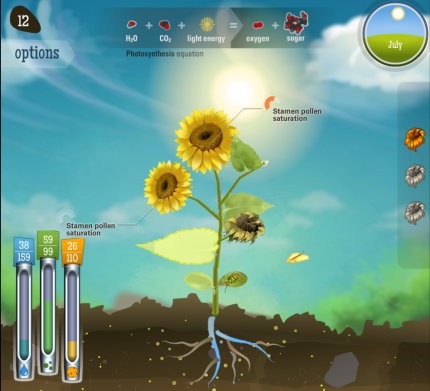
In Filament Games’ "Reach For The Sun," students grow a sunflower from a seed into a full plant by “doing” photosynthesis. (Image by Filament Games)
“I’m calling for investments in educational technology that will help create… educational software that’s as compelling as the best video game. I want you guys to be stuck on a video game that’s teaching you something other than just blowing something up.” - President Obama, March 2011
Today, the U.S. Department of Education announced the final winners of this year’s Small Business Innovation Research (SBIR) contract awards—funds that are reserved for entrepreneurial small businesses using cutting-edge R&D to develop commercially viable technologies to solve tough problems. And there’s something that may surprise you about the winning contracts: More than half—or 12 in all—are for games and game-related projects, more than in any previous year. That says a lot about the increasingly creative field of educational games, and the growing base of evidence indicating that games can be an important and effective component of our strategy to prepare a highly skilled 21st century American workforce.
The SBIR program at the Institute of Education Sciences (IES), the Department of Education’s research division, provides up to $1.05 million to small businesses for the R&D of commercially viable education technology products. The program holds an annual competition and awards funds in several phases: Phase I awards, up to $150,000 for 6 months, allow for the development of a prototype and research to demonstrate its functionality and feasibility; and Phase II awards, up to $900,000 for 2 years, are for full-scale development of the product, iterative research to refine it, and a pilot study to demonstrate its usability, feasibility, and promise. A small number of Fast Track awards are made each year for funds to cover work in both Phase I and Phase II.
Learn more about Education, TechnologyOpen Data for Climate and Health Insights
Posted by on May 9, 2013 at 12:28 PM ESTToday, in conjunction with a series of landmark steps announced by the Obama Administration to unleash troves of useful data from the vaults of government, the interagency US Global Change Research Program (USGCRP) launched a new online tool that promises to accelerate research relating to climate change and human health—the Metadata Access Tool for Climate and Health, or “MATCH.”
The Administration announcements made today include an Executive Order signed by the President declaring that information is a valuable national resource and strategic asset, and a new government-wide Open Data Policy requiring that, going forward, data generated by the government shall be made available in open, machine-readable formats. The move will make troves of previously inaccessible or unmanageable data more readily available to entrepreneurs, researchers, and others who can use open data as fuel for innovation, businesses and new services and tools.
MATCH is one such tool, driven by open data, which could open the door for new scientific insights in the public health and climate science communities. It is a publicly accessible digital platform for searching and integrating metadata—standardized contextual information—extracted from more than 9,000 health, environment, and climate-science datasets held by six Federal agencies.
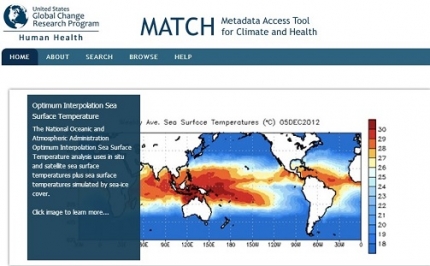
Screenshot of the Metadata Access Tool for Climate and Health (MATCH), the US Global Change Research Program's online tool for researchers that offers centralized access to metadata ‐ standardized contextual information ‐ about thousands of government-held datasets related to health, the environment, and climate-science.
Seeking Outstanding “Open Science” Champions of Change
Posted by on May 7, 2013 at 8:55 AM ESTOn June 20, the White House will host a Champions of Change event to highlight outstanding individuals, organizations, or research projects promoting and using open scientific data and publications to accelerate progress and improve our world. The White House Champions of Change program highlights individuals, businesses, and organizations whose extraordinary stories and accomplishments positively impact our communities.
Access to scientific research can help fuel entrepreneurship, innovation, and scientific breakthroughs. Freely available data generates new ideas, builds new businesses, and generates economic growth that impacts the lives of Americans every day.
That’s why, in February 2013, OSTP Director John P. Holdren issued a memo to the heads of Federal agencies that aims to increase public access to the results of federally-funded research—including scientific data and publications.
Open sharing of research results is a proven strategy for driving positive change. For example, the rapid and open sharing of genomic data from the Human Genome Project revolutionized biomedical research, spurred major growth in the biotechnology industry, and provided $140 in economic returns for every dollar of public investment. And, the Federal Government’s liberation of Global Positioning System (GPS) satellite data led to an explosion of geospatial information systems and the creation of many companies, smartphone apps, and car navigation systems.
Learn more about InnovationsWhite House Champions of Change: Seeking Immigrant Innovators and Entrepreneurs
Posted by on May 7, 2013 at 8:10 AM ESTThis article is cross-posted on the Champions of Change blog
The White House Champions of Change program highlights the stories of people across the country who are strengthening their communities and moving America forward.
In just a few weeks, the White House Office of Public Engagement will host a Champions of Change event focused on immigrant innovators and entrepreneurs – the best and brightest from around the world who are helping create American jobs, grow our economy, and make our Nation more competitive.
The facts are clear: Immigrants make America more prosperous and entrepreneurial. Immigrants are more than twice as likely to start a business in the United States as the native-born, and more than 40 percent of Fortune 500 companies – from GE and Ford to Google and Yahoo! – were founded by immigrants or the children of immigrants.
Moreover, immigrants generate extraordinary innovation as scientists and engineers. Immigrants represent 50 percent of PhDs working in math and computer science and 57 percent of PhDs working in engineering. By some estimates, immigration was responsible for one third of the explosive growth in patenting in past decades, and these innovations contributed to increasing U.S. GDP by 2.4 percent.
Learn more about Immigration
- &lsaquo previous
- …
- 61
- 62
- 63
- 64
- 65
- 66
- 67
- 68
- 69
- …
- next &rsaquo


White House Blogs
- The White House Blog
- Middle Class Task Force
- Council of Economic Advisers
- Council on Environmental Quality
- Council on Women and Girls
- Office of Intergovernmental Affairs
- Office of Management and Budget
- Office of Public Engagement
- Office of Science & Tech Policy
- Office of Urban Affairs
- Open Government
- Faith and Neighborhood Partnerships
- Social Innovation and Civic Participation
- US Trade Representative
- Office National Drug Control Policy
categories
- AIDS Policy
- Alaska
- Blueprint for an America Built to Last
- Budget
- Civil Rights
- Defense
- Disabilities
- Economy
- Education
- Energy and Environment
- Equal Pay
- Ethics
- Faith Based
- Fiscal Responsibility
- Foreign Policy
- Grab Bag
- Health Care
- Homeland Security
- Immigration
- Innovation Fellows
- Inside the White House
- Middle Class Security
- Open Government
- Poverty
- Rural
- Seniors and Social Security
- Service
- Social Innovation
- State of the Union
- Taxes
- Technology
- Urban Policy
- Veterans
- Violence Prevention
- White House Internships
- Women
- Working Families
- Additional Issues