
Office of Science and Technology Policy Blog
Young Scientists and Innovators Amaze President Obama at the White House Science Fair
Posted by on April 22, 2013 at 5:33 PM ESTThis article is cross-posted on the White House blog.
President Obama today celebrated the remarkable achievements of student science fair winners and extraordinary kid innovators from across the nation in the third White House Science Fair. The Fair brought 100 students from more than 40 states to an all-day, hands-on celebration of the power and potential of science, technology, engineering, and math (STEM) education.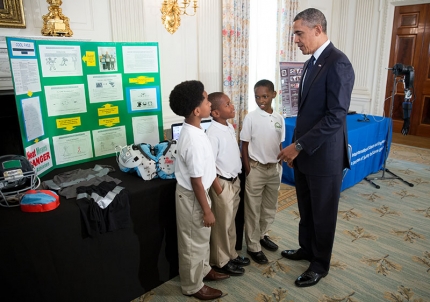
President Barack Obama talks with Evan Jackson, 10, Alec Jackson, 8, and Caleb Robinson, 8, from McDonough, Ga., while looking at exhibits at the White House Science Fair in the State Dining Room, April 22, 2013. The sports-loving grade-schoolers created a new product concept to keep athletes cool and helps players maintain safe body temperatures on the field. (Official White House Photo by Chuck Kennedy)
As the President said in 2009, when he announced the first-ever White House Science Fair, “If you win the NCAA championship, you come to the White House. Well, if you're a young person and you've produced the best experiment or design, the best hardware or software, you ought to be recognized for that achievement, too.”
Learn more aboutStatement on the Launch of Antares
Posted by on April 21, 2013 at 4:28 PM ESTFollowing today's launch of Orbital Sciences' Antares rocket, John P. Holdren, Assistant to the President for Science and Technology, issued the following statement:
"Today's successful test flight of Orbital Sciences' Antares rocket from the spaceport at Wallops Island, Virginia, demonstrates an additional private space-launch capability for the United States and lays the groundwork for the first Antares cargo mission to the International Space Station later this year. The growing potential of America's commercial space industry and NASA's use of public-private partnerships are central to President Obama's strategy to ensure U.S. leadership in space exploration while pushing the bounds of scientific discovery and innovation in the 21st century. With NASA focusing on the challenging and exciting task of sending humans deeper into space than ever before, private companies will be crucial in taking the baton for American cargo and crew launches into low-Earth orbit. I congratulate Orbital Sciences and the NASA teams at Wallops, and look forward to more groundbreaking missions in the months and years ahead."
###
Learn more about TechnologyTaking the Pulse of Our Planet: New Strategy for Earth Observations
Posted by on April 19, 2013 at 2:04 PM ESTEver wonder where the Weather Channel gets its data? Where the satellite images for Google Earth come from? These data and much more come from a complex array of satellites, ocean buoys, stream gauges, human surveys, and other platforms for collecting what the scientific community calls Earth observations. These data are used every day to protect life and property and answer key questions about our planet.
Today, the Obama Administration’s National Science and Technology Council released a National Strategy for Civil Earth Observations—a framework for increasing the efficiency and effectiveness of the Nation’s Earth-observation enterprise. Currently, 11 Federal departments and agencies engage in Earth observation activities, collecting volumes of important data about the Earth on an ongoing basis, using an array of sophisticated tools and systems. The new Strategy outlines a process for evaluating and prioritizing Earth-observation investments according to their value to society in critical areas such as agriculture, global change, disasters, water resources, and weather.
Each year, the U.S. Government invests significant resources in Earth-observations systems to collect data about Earth’s land, oceans, ecosystems, and atmosphere. Together, these systems take the pulse of our planet, providing critical Earth-system data that scientists and analysts can then turn into usable information about climate and weather, disaster events, land-use changes, ecosystem health, natural resources, and more. Ultimately, information and services derived from Earth-observation data—including some as ubiquitous as weather forecasts and GPS-navigation—are used by policy makers, resource managers, business leaders, first-responders, and citizens to make important day-to-day decisions.
Learn more about Energy and EnvironmentUnleashing the Power of Big Data
Posted by on April 18, 2013 at 3:04 PM ESTLast year, the Obama Administration announced the National Big Data Research and Development Initiative—a major step toward addressing the challenge and opportunity of “Big Data.” Big Data are data sets so large, complex, or rapidly-generated that they can’t be processed by traditional information and communication technologies. At its launch, the Big Data Initiative featured more than $200 million in new commitments from six Federal departments and agencies aiming to make the most of the explosion of Big Data and the tools needed to analyze it.
Every day, decision makers, resource manager, engineers, first-responders, scientists, and citizens are faced with a multitude of constantly flowing data streams coming from many sources, in many formats. Making sense of these volumes of Big Data requires cutting-edge tools and technologies that can analyze and extract useful knowledge from vast and diverse streams of information. Wrapping our arms around Big Data could lead to an array of important societal benefits—from empowering consumers with the full landscape of information they need to make optimal energy decisions; to enabling civil engineers to monitor and identify at-risk infrastructure; to informing more accurate predictions of natural disasters; and more.
As we enter the second year of the Big Data Initiative, the Obama Administration is encouraging multiple stakeholders, including federal agencies, private industry, academia, state and local government, non-profits, and foundations to develop and participate in Big Data initiatives across the country. Of particular interest are partnerships designed to advance core Big Data technologies; harness the power of Big Data to advance national goals such as economic growth, education, health, and clean energy; use competitions and challenges; and foster regional innovation.
Learn more about TechnologyInnovative Solutions to Fight Illegal Robocalls
Posted by on April 17, 2013 at 8:48 AM ESTEarlier this month, the Federal Trade Commission (FTC) announced the winners of its Robocall Challenge, the agency’s first public prize competition, which resulted in a tie between two promising solutions that can help block illegal robocalls.
As many Americans know, advances in technology—amidst their numerous benefits to citizens—have had the undesirable side effect of making it cheap and easy to blast out millions of illegal pre-recorded telemarketing calls, or “robocalls.” The FTC has worked to combat this problem using all of the standard tools at its disposal– including strategic targeting, aggressive law enforcement, and coordination with experts to seek a technological solution. However, phones continue to ring with illegal robocalls. In fact, the FTC receives about 200,000 complaints each month regarding these harassing calls.
That’s why, on October 18, the FTC held a Robocall Summit in which it laid out the robocall problem and the full landscape of partial and potential solutions. At the summit, the FTC announced the Robocall Challenge, with a $50,000 prize for the individual or small group that could come up with the best technical proposal to help consumers block illegal robocalls. Organizations with 10 or more employees competed on a separate track for the large-organization non-monetary award (bragging rights only). The challenge criteria were straightforward: does it work? (50%); is it easy to use? (25%); and can it be implemented? (25%).
By the entry deadline this past January, the FTC received almost 800 diverse and creative submissions. On one end of the spectrum of submissions, consumers sent in practical tips about what they’re doing today to reduce robocalls.
Learn more about TechnologyObama Administration Releases Plan to Promote Ocean Economy and Resilience
Posted by on April 16, 2013 at 10:20 AM ESTToday, the Obama Administration released its final plan for translating the National Ocean Policy into on-the-ground actions to benefit the American people. With significant public input from a wide spectrum of individuals and interests, the final Implementation Plan focuses on improving coordination to speed Federal permitting decisions; better manage the ocean, coastal, and Great Lakes resources that drive so much of our economy; develop and disseminate sound scientific information that local communities, industries, and decision-makers can use; and collaborate more effectively with State, Tribal, and local partners, marine industries, and other stakeholders. Without creating any new regulations or authorities, the plan will ensure the many Federal agencies involved in ocean management work together to reduce duplication and red tape and use taxpayer dollars more efficiently.
“Science is the foundation upon which sound management of ocean and coastal resources is based,” said OSTP Director John P. Holdren, who co-chairs the National Ocean Council with Nancy Sutley, Chair of the Council on Environmental Quality. “The President’s National Ocean Policy and the new implementation plan will help advance relevant science and its application to decision-making to strengthen the economies of our coastal regions while increasing their resilience and sustaining their resources."
- Read the Press Release
- Read the Implementation Plan
- Read what others are saying about the Implementation Plan
- Learn more about the National Ocean Council
Learn more about Energy and Environment
- &lsaquo previous
- …
- 64
- 65
- 66
- 67
- 68
- 69
- 70
- 71
- 72
- …
- next &rsaquo


White House Blogs
- The White House Blog
- Middle Class Task Force
- Council of Economic Advisers
- Council on Environmental Quality
- Council on Women and Girls
- Office of Intergovernmental Affairs
- Office of Management and Budget
- Office of Public Engagement
- Office of Science & Tech Policy
- Office of Urban Affairs
- Open Government
- Faith and Neighborhood Partnerships
- Social Innovation and Civic Participation
- US Trade Representative
- Office National Drug Control Policy
categories
- AIDS Policy
- Alaska
- Blueprint for an America Built to Last
- Budget
- Civil Rights
- Defense
- Disabilities
- Economy
- Education
- Energy and Environment
- Equal Pay
- Ethics
- Faith Based
- Fiscal Responsibility
- Foreign Policy
- Grab Bag
- Health Care
- Homeland Security
- Immigration
- Innovation Fellows
- Inside the White House
- Middle Class Security
- Open Government
- Poverty
- Rural
- Seniors and Social Security
- Service
- Social Innovation
- State of the Union
- Taxes
- Technology
- Urban Policy
- Veterans
- Violence Prevention
- White House Internships
- Women
- Working Families
- Additional Issues