
Office of Science and Technology Policy Blog
All-Star STEM Students Meet the President!
Posted by on March 12, 2013 at 5:36 PM ESTToday at the White House, President Obama met with 40 of the Nation's top scientists and engineers, including the inventor of an inexpensive water filter that can reduce toxic E.coli levels in water by as much as 99 percent; the developer of an algorithm that detects oncoming seizures before they happen; a scientist who identified a new drug candidate to treat a common blood cancer; and the creator of an imaging agent that helps surgeons visualize malignant tumors.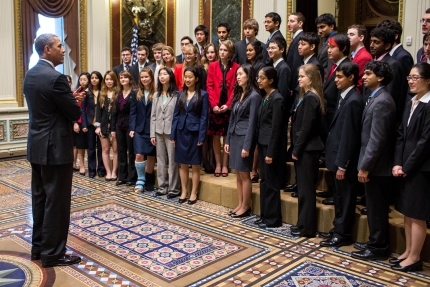
President Barack Obama greets and talks with the 2013 Intel Science Talent Search finalists in the Indian Treaty Room of the Eisenhower Executive Office Building of the White House, March 12, 2013. (Official White House Photo by Pete Souza)
These extraordinary innovators have something in common other than STEM excellence: they're all in high school.
The exceptional students are finalists in the 2013 Intel Science Talent Search (STS) competition. Winners of the competition will be announced tonight at a gala event in Washington, DC.
Learn more about the finalists and the Intel STS competition here.
Learn more about Innovations, EducationSupporting Innovative Approaches to Spectrum Sharing
Posted by on March 11, 2013 at 8:30 AM ESTThis article is cross-posted on the NTIA blog.
The President’s strategy for expanding the capacity of high-speed wireless broadband services across the Nation may get a boost from a new Defense Department Initiative to fund research and development of innovative new approaches to spectrum sharing.
Wireless technology continues to drive innovation and productivity in the United States, fueling economic growth and creating jobs. By most measures, the United States leads the world in the development and deployment of cutting-edge wireless technologies. More subscribers to advanced 4G wireless broadband live in the United States than in the rest of the world combined. U.S. companies dominate the market for smartphone operating systems and online apps. And the wireless industry contributes hundreds of billions of dollars to America’s gross domestic product.
Building on U.S. leadership and promoting even greater economic growth requires that the Nation make ever more efficient use of spectrum, the airwaves on which wireless services ride. Consumers are demanding more spectrum for smartphones and tablets, as are stakeholders from other sectors of the economy and society, including healthcare, transportation, and education. Many critical Government services require spectrum as well, including air traffic control systems, wireless surveillance by law enforcement, weather monitoring, and military combat training. Ensuring adequate spectrum to support the expected growth in all of these commercial and non-commercial uses poses technical challenges and will require trade-offs.
Learn more about TechnologyGlobal Change Research to Benefit the Nation
Posted by on March 7, 2013 at 9:17 AM EST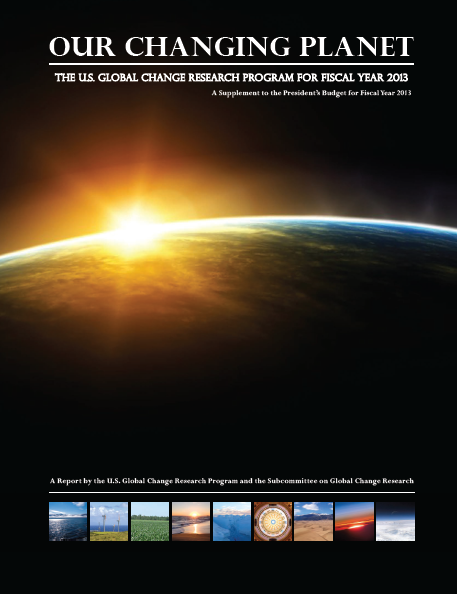 Today, the Administration’s interagency U.S. Global Change Research Program (USGCRP) delivered its annual report to Congress for fiscal year 2013: “Our Changing Planet.” The report highlights recent activities by 13 Federal agencies to strengthen our scientific understanding of global changes—including climate change—the threats and opportunities they present, and how they are likely to evolve over time.
USGCRP’s scientific portfolio spans multiple systems and scales, from organisms to ecosystems to the entire planet—including changes brought about by human behavior as well as by larger natural forces. It incorporates information from nearly all forms of scientific work, including laboratory experiments, field research, computer modeling, scientific assessment, and observations of Earth from land, air, sea, and space. This vast body of work has been carried out by 13 government agencies—all working together to paint a clearer picture of global change so that citizens and decision makers have the information they need to plan, prepare, and respond.
Learn more about Energy and EnvironmentMeet a PIF: Kara DeFrias
Posted by on March 1, 2013 at 5:19 PM EST“I think anyone who wants to make a difference should consider becoming a PIF."
The Presidential Innovation Fellows (PIF) program pairs top innovators from the private sector, non-profits, and academia with top innovators in government to collaborate during focused “tours of duty” on solutions that can deliver game-changing results within just six months. This "Meet a PIF" series features members of the first class of PIFs.
John Paul Farmer: Kara, you were the user experience guru on the Presidential Innovation Fellows (PIF) MyUSA team – tell us about yourself.
Kara Defrias: Originally from New Jersey, but have been living in San Diego for a while now. My undergrad was Theatre and English education. For grad school, I studied instructional design, which is about creating tools that companies use to train their employees. That went well with my career at the time in the insurance industry, and it continues to serve me well today, whether through my work with the TurboTax web team on improving the user experience to make it easier for people to do their taxes, or in creating Design for Delight ideation sessions, which focus on identifying user-experience pain points in business systems and figuring out a way to delight customers with a solution.
John: What drives you in your creative work?
My career has brought me to exciting places – though, interestingly, never into government until becoming a PIF. Memorable moments include watching the cast of Chicago rehearse when I worked on the post production team at the Oscars, and feeling the frenetic energy of the crowd while standing on the field when I was a production coordinator for Super Bowl XXXVII. The most rewarding work, though, is anytime I get to be part of something that helps make a difference—whether it's doing pro-bono work with non-profits like Team Rubicon or inspiring people to make a difference in their world by curating an eclectic collection of speakers when I produce TEDx shows.
Learn more about Innovations, , TechnologyCreating What You Can Imagine, Changing the World
Posted by on March 1, 2013 at 4:26 PM ESTAs we celebrate the historic accomplishments of women during Women’s History Month, there is no better time to engage and empower the next generation of girls to rise up as leaders of our democracy and economy.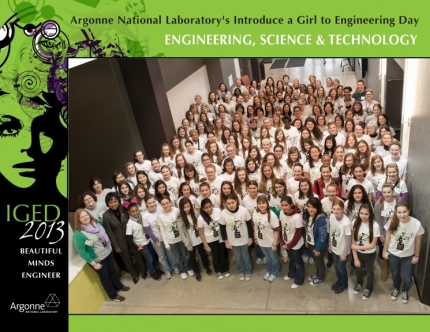
Dot Harris, Director of the Department of Energy’s Office of Economic Impact and Diversity meets with students at Argonne National Laboratory’s Introduce a Girl to Engineering Day (Photo by Argonne National Laboratory)
In that spirit, last week, schools, companies, universities, and National Labs across the country engaged in a range of activities aimed at getting girls excited about classes and careers in the field of engineering—all part of the 13th annual “Introduce a Girl to Engineering Day.”
Women today earn only 18 percent of the America’s undergraduate degrees in engineering—a disparity that suggests the Nation is not taking full advantage of the spectrum of creative energy that could be applied to this important field. To help correct this imbalance, the Administration and a wide range of collaborators in the private sector have been working to spark girls’ interest in the engineering disciplines, which have contributed so much to our economy overall and to such important sectors as medicine, energy, environmental protection, and national security.
Medicines Patent Pool and ViiV Healthcare Collaborate for Children with HIV
Posted by on March 1, 2013 at 2:15 PM ESTOn Wednesday, ViiV Healthcare—a joint venture of GlaxoSmithKline, Pfizer, and Shionogi—announced it would grant a voluntary license to the Medicines Patent Pool to enable low-cost supply of a key pediatric HIV medicine in the 118 countries in which 98.7% of all HIV-positive children reside. It also announced that promising new pediatric medicines in the ViiV Healthcare product pipeline will also be eligible to be licensed to the Medicines Patent Pool for the same 118 countries, once approved by regulatory agencies.
The Medicines Patent Pool is a UN-backed initiative that negotiates voluntary licenses based on a public health perspective and creates a pool of relevant patents to enable the manufacture and sale of generic medicines in developing countries. Voluntary licenses like the one announced this week play an important role in making affordable HIV medicines available in developing countries and stimulating innovation for those markets. That’s why the National Institutes of Health (NIH) became the first entity to share patents with the Medicines Patent Pool in 2010 and why President Obama joined other leaders of the G8 in encouraging other patent owners—public and private—to follow suit.
To learn more about the 3.4 million infants and children currently living with HIV and the full breadth of activities underway to promote public-private partnerships to address their unique needs, please visit the PEPFAR blog.
Robynn Sturm Steffen is Senior Advisor to the Deputy Director for Policy at OSTP
Learn more about
- &lsaquo previous
- …
- 67
- 68
- 69
- 70
- 71
- 72
- 73
- 74
- 75
- …
- next &rsaquo


White House Blogs
- The White House Blog
- Middle Class Task Force
- Council of Economic Advisers
- Council on Environmental Quality
- Council on Women and Girls
- Office of Intergovernmental Affairs
- Office of Management and Budget
- Office of Public Engagement
- Office of Science & Tech Policy
- Office of Urban Affairs
- Open Government
- Faith and Neighborhood Partnerships
- Social Innovation and Civic Participation
- US Trade Representative
- Office National Drug Control Policy
categories
- AIDS Policy
- Alaska
- Blueprint for an America Built to Last
- Budget
- Civil Rights
- Defense
- Disabilities
- Economy
- Education
- Energy and Environment
- Equal Pay
- Ethics
- Faith Based
- Fiscal Responsibility
- Foreign Policy
- Grab Bag
- Health Care
- Homeland Security
- Immigration
- Innovation Fellows
- Inside the White House
- Middle Class Security
- Open Government
- Poverty
- Rural
- Seniors and Social Security
- Service
- Social Innovation
- State of the Union
- Taxes
- Technology
- Urban Policy
- Veterans
- Violence Prevention
- White House Internships
- Women
- Working Families
- Additional Issues